
Quick Answer
Start by setting profit sharing up as a documented operating process, not an informal reward. Use one named profit basis, apply retained-earnings guardrails before any pool is shared, and approve contributions on a per-cycle discretionary basis. Then split execution into separate employee and contractor tracks so payout triggers, agreements, and reporting do not blur. The result is a plan you can recalculate from records, explain to the team, and defend during compliance or payroll review.
Decide objective, eligibility, governance owner, and cadence before formulas#
Run this as a system, not a morale perk. If you want profit sharing to support retention, alignment, and financial health, set it up with a written plan, clear ownership, and rules you can apply the same way every time.
If the setup is loose, the problems are predictable: cashflow strain when payouts are treated as fixed, payout disputes when eligibility is fuzzy, trust erosion after long communication gaps, and retention risk when the plan feels arbitrary.
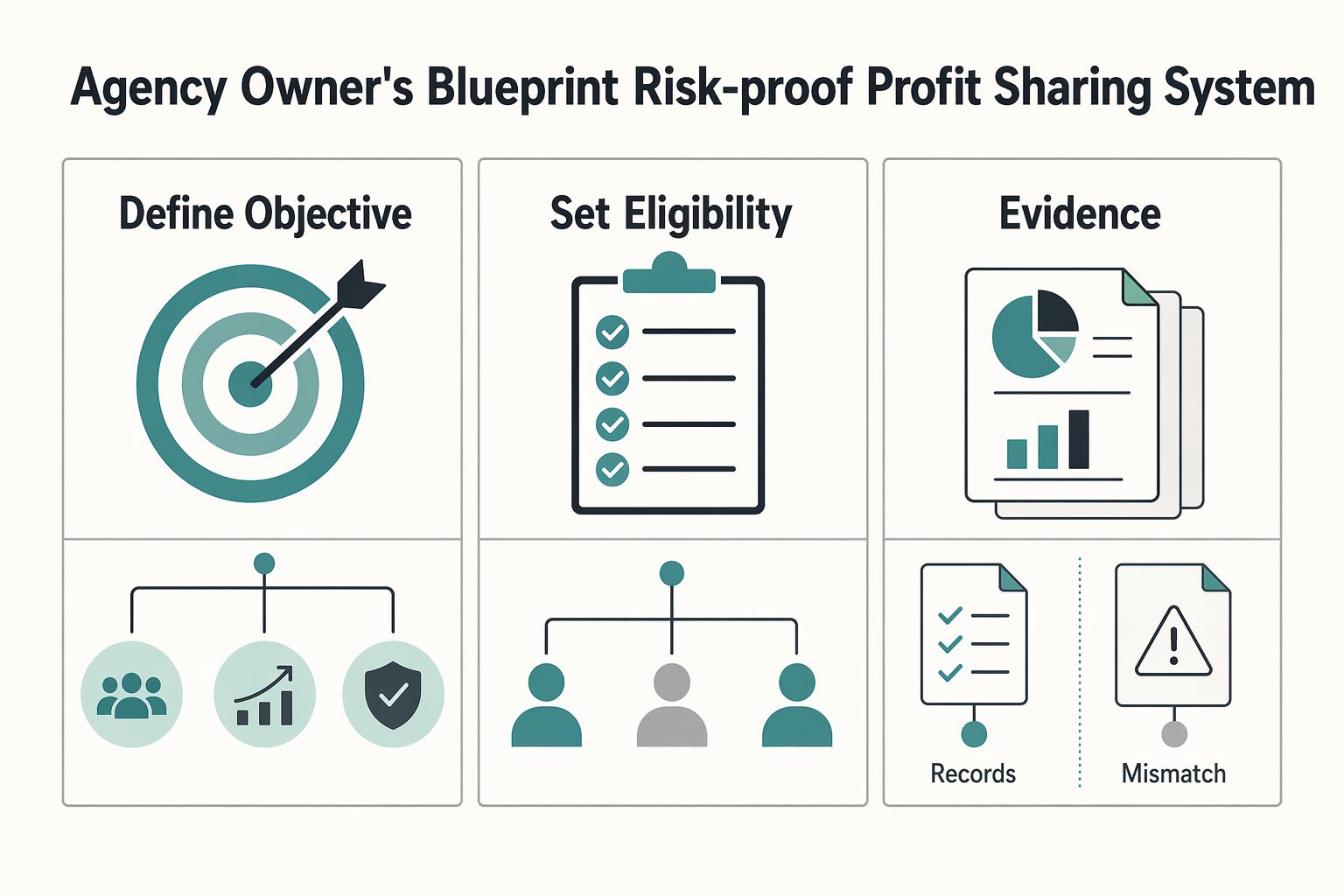
Use this blueprint before you touch formulas.
| Step | Decision you make now | Why it matters |
|---|---|---|
| Define objective | Write one measurable intent for the next 12 months | Keeps the plan tied to outcomes you can actually review |
| Set eligibility | Decide rule-based participation criteria up front | Reduces ad hoc inclusion decisions and payout disputes |
| Assign governance owner | Name who recommends, approves, and records contribution decisions | Matches the sponsor's contribution decision process |
| Set communication cadence | Document launch, update, and payout communications | Treats plan communication as an ongoing duty, not a one-time memo |
Design for flexibility, but document it clearly. Profit-sharing contributions are discretionary, so amounts can vary year to year, including years with no contribution. That works best when expectations and rules are written before rollout.
Start with measurable intent#
Write the objective so your leadership team can verify it internally within a year. Skip vague goals like "boost morale." Define what success should look like in your own retention patterns, profitability behavior, or payout consistency. Frame benefits as possible outcomes, not guarantees.
Set eligibility before discussing money#
Set eligibility in the plan rules, not through manager judgment. The IRS notes that participation follows plan eligibility requirements. One IRS example is employees age 21+ with 1,000 hours over a 12-month period after hire. You do not have to use that exact standard, but you do need a rule your payroll or HR records can verify consistently.
Name the owner and document cadence#
Keep governance explicit. The sponsor decides contribution amounts, so ownership for recommendation, approval, and recordkeeping should be named in advance. The written plan document is the day-to-day foundation, and participant communication should run on a set schedule. If your plan type requires an SPD, treat timing and delivery as part of setup, not an afterthought.
Your pre-formula checklist#
| Control | Requirement |
|---|---|
| Objective | Written in one sentence with an internal success measure |
| Eligibility rule | Written and testable from existing records |
| Governance owner | Named for recommendation, approval, and recordkeeping |
| Communication cadence | Defined for launch, updates, and payout notices |
| Payout gate / reserve rule / profitability cutoff | Current threshold pending finance/source-record verification |
Once those controls are in place, the next decision usually creates the most confusion: what counts as profit. If you need to tighten the operating inputs behind that definition, see How to Manage Project Profitability for Your Agency.
The Financial Foundation: Defining 'Profit' Without Creating Chaos#
After you set eligibility and ownership, the next risk point is your profit definition. If people cannot trace how you moved from financials to the payout pool, disputes are more likely and payout decisions get harder to defend.
For a small agency, pick one definition you can document, verify, and apply the same way each cycle. The goal is not a clever metric name. It is predictable payouts and fewer disputes.
Choose a profit base your team can audit#
If your team uses multiple internal profit views, decide which one controls payouts before results are known.
| Profit base option | Use case | Risk if used for payouts | Recommended for agency profit sharing |
|---|---|---|---|
| A single named payout base | You want payouts tied to one consistent method | Disputes if inclusions and exclusions are not defined in advance | Yes, when definitions are written and applied consistently |
| Multiple internal reporting views | You use different views for internal analysis | Confusion if the payout view is not clearly designated | Yes, only if one view is explicitly designated for payouts |
| Net profit after all items | You want all items included in the pool logic | Payouts may move with non-operating items | Use only if that is the explicit policy |
Build the pool in a fixed order#
Do not improvise the sequence. Use one repeatable process each period.
| Step | Action | Key detail |
|---|---|---|
| 1 | Calculate profit using your named payout base | Apply the same written definition each cycle. |
| 2 | Apply your retained-earnings policy | Document guardrails for tax obligations, operating buffer, debt commitments, and planned reinvestment; current thresholds must be verified from finance and source records before use. |
| 3 | Apply the approved share percentage | This is the portion leadership authorizes for sharing; if the arrangement is discretionary, the contribution can be 0 for a year. |
The order matters: profit first, retained earnings second, share percentage last.
Put the definition under document control#
Use a written plan document as your operating source of truth. For formal profit-sharing plans, the written document is the foundation for day-to-day operations, and the allocation formula is part of that structure. DOL setup guidance also calls out establishing a recordkeeping system early. Even outside that exact plan type, the same discipline helps. Document the definition and formula before the period closes so someone can reproduce the pool from source reports without extra interpretation.
Definition governance checklist#
- Profit base is named exactly, with exclusions and adjustments listed
- Allocation formula is written in one place
- Guardrail categories are documented, with current thresholds pending finance/source-record verification
- Approval owner is named for retained-earnings allocation and final share percentage
- Team communication explains what inputs they can verify and what is excluded from the pool
With the pool defined, the next question is how you divide it.
Distribution Architecture: Choosing Your Allocation Model#
Choose the model you can document, calculate from your current records, and defend consistently each cycle. For small agencies, that usually matters more than choosing the model that sounds most motivating.
| Model | Fairness signal | Behavior it incentivizes | Admin complexity | Common failure mode | Best-fit agency profile |
|---|---|---|---|---|---|
| Pro-rata by compensation (comp-to-comp) | Payouts follow relative compensation | Can focus on sustained contribution across defined roles | Typically lower | Compensation definitions are unclear or inconsistent | Often fits agencies with clear pay structures and dependable compensation records |
| Performance-based tiers (threshold/target/maximum) | Payouts follow measured results for the period | Can focus on agreed outcomes tied to the payout formula | Typically higher | Metrics are vague, changed mid-period, or weakly reported | Often fits agencies with stable scorecards and pre-set performance-period rules |
| Equal share | Eligible participants are treated the same | Can focus on shared accountability and team outcomes | Typically lower | Perceived under-recognition of higher-paid or specialized roles | Often fits small teams with fluid roles and a strong collective-work model |
Start with how the business actually runs. A role-based team can point toward pro-rata. A highly cross-functional team may fit equal share better. If extra reward should track measured results, use tiers only when threshold, target, maximum, and payout-formula rules are defined for the performance period. If your reporting cannot reproduce results cleanly, do not use a high-complexity tier model yet.
Document why the chosen model is defensible in the written plan document. Capture the model, the fairness principle, the verification reports, and the tradeoff you are accepting. Where legal defaults are relevant, confirm whether your governing agreement, entity type, and jurisdiction change that default.
Set governance rules up front to prevent payout disputes:
- Eligibility rules: define participation requirements in the plan document; if this is a qualified plan, verify whether age/service thresholds (commonly age 21 plus 1 year of service) apply.
- Payout timing windows: define the events and timing in the governing agreement (for example, after period close and approval).
- Role changes: state one method explicitly, such as payout-date role, period-average compensation, or explicit proration.
- Exceptions: name the approval owner and process for leave, late-start hires, and disputed records.
- Discretion mechanics: state clearly whether funding for a cycle is discretionary and may be set to
0within applicable limits.
Before moving to compliance, hand off:
- Final allocation formula with one worked example
- Eligibility and payout timing rules
- Role-change and exception policy
- Verification reports finance will use to reproduce payouts
The Compliance Minefield: Avoiding Hidden Legal & Tax Traps#
Treat the payout framework as documented and discretionary from day one. If your language, payout controls, or worker treatment get blurry, you can create legal and tax risk you did not intend.
Design guardrails that keep the plan in bounds#
Keep the program rules explicit in operation, not just in labels.
Use these guardrails in your plan documents and approvals:
- Approve each cycle separately, with a documented funding decision for that cycle.
- Lock metric definitions before the period starts, then keep a close-of-period reconciliation file.
- Preserve period-close numbers and a change log showing who changed what and when.
- If complex regulatory or tax questions appear, pause rollout and verify with specialist counsel before launch.
Performance-heavy models need extra protection against metric-control disputes. If one party can change revenue, margin, or expense inputs after the fact, they can reduce payout. Earn-out disputes follow the same pattern. Freeze rules up front, preserve period-close numbers, and keep an approval trail showing who changed what and when.
What payroll and accounting need from you#
Give finance a complete cycle file, not just a formula. Include approved terms, payout calculations, participant roster, period-close reconciliation, and final approval. Then make payroll and accounting treatment match that file.
Use one reconciliation checkpoint every cycle. If compensation could appear on multiple tax records, reconcile before year-end reporting. Confirm whether the amount is already in W-2 Box 1. Review Box 12 codes (Code V / Code W) where relevant before treating another form as new taxable pay.
Escalate to specialist tax or legal counsel before launch when treatment is unclear, especially if one payment may appear across multiple forms. Compliance mistakes create launch delays and rework, not just penalties.
| Control point | W-2 employee track | 1099 contractor track |
|---|---|---|
| Documentation responsibility | Payroll records aligned to the approved cycle file. | Contract and payment records aligned to the approved cycle file. |
| Reporting review | Confirm whether compensation is already included in W-2 Box 1 before treating another form as new taxable pay. | Run a documented reconciliation checkpoint when compensation could appear across multiple records. |
| Approval controls | Maintain dated approval and change logs for each cycle. | Maintain dated approval and change logs for each cycle. |
| Escalation trigger | Escalate when reporting treatment is unclear or inconsistent across records. | Escalate when reporting treatment is unclear or inconsistent across records. |
| Risk if controls fail | Higher risk of reporting rework and launch delays. | Higher risk of reporting rework and launch delays. |
Before you move into hybrid-team execution, formalize distinct employee and contractor compensation tracks with separate documents, approvals, and reporting records. That separation reduces audit confusion as the program scales.
The Modern Agency Challenge: A Framework for Global & Hybrid Teams#
Do not assume one incentive model will work across employees and contractors. Using one model can increase classification, reporting, and payout risk. A practical framework is a two-pool system. Keep an Employee Profit Sharing Plan for employees and a separate Contractor Performance Bonus Program for contractors, with different triggers, documents, and reporting paths.
This split matters because labels alone do not control status. IRS analysis looks at behavioral control, financial control, and the relationship of the parties, and contract wording by itself is not sufficient. Current U.S. Department of Labor rulemaking materials (still in proposal stage) also emphasize actual working practice over purely contractual framing, so your operations should match your documents.
| Decision point | Employee Profit Sharing Plan | Contractor Performance Bonus Program |
|---|---|---|
| Eligibility | W-2 employees only, tied to employee compensation records and payroll roster | Nonemployee service providers only, tied to the signed services agreement or statement of work |
| Payout trigger | Agency-level performance under approved employee plan rules | Specific project, client, referral, delivery, or acceptance outcomes |
| Contract language | Employee bonus/profit-sharing language aligned to payroll and internal approvals | Fee-for-services language; avoid wording that implies shared company ownership or employee-benefit treatment |
| Documentation trail | Approved plan terms, participant roster, calculation file, payroll coding, final approval; if using a formal employee plan in the retirement sense, DOL describes written plan documentation, a trust, and recordkeeping | Master services agreement, statement of work, measurable performance standard, acceptance record, payout approval, invoice or payment support |
| Tax and reporting owner | Employer handles payroll withholding and reports compensation on Form W-2 | Payer follows nonemployee reporting paths: Form 1099-NEC for reportable U.S. nonemployee compensation; Form 1042-S may apply for nonresident alien payments |
| Main risk if you blur the line | Wage, payroll, and plan-administration confusion | Misclassification arguments, reporting mistakes, and withholding errors |
Build contractor bonuses from the statement of work#
For contractors, define the bonus in the statement of work, use measurable standards, and require objective acceptance evidence before payout. That keeps the bonus tied to deliverables and aligned with performance standards that can be assessed.
Avoid contractor bonus language that sounds like participation in overall company profit. If the logic depends on agency-wide profit concepts, it can increase classification tension between contract language and real working practice.
Before you approve a payout, require a complete file: signed SOW, exact trigger text, acceptance evidence, calculation, and approval record. If the trigger cannot be proven from normal business documents, tighten the clause before paying.
If worker status is uncertain, resolve classification first. Form SS-8 exists for firms and workers to request an IRS status determination.
Set a global payout policy before the first cross-border bonus#
For cross-border payouts, set one primary payout currency for approvals and internal records before you pay the first bonus. If your books are in USD, approve and record the bonus in USD in the cycle file.
| Policy area | Rule | Details |
|---|---|---|
| Primary currency | Set one primary payout currency for approvals and internal records before the first bonus. | If your books are in USD, approve and record the bonus in USD in the cycle file. |
| Exchange-rate responsibility | Assign exchange-rate responsibility between approval and settlement. | Lock this into agreements and the payout process. |
| Transfer methods | Use consistent transfer methods by country or contractor type where practical. | Lock this into agreements and the payout process. |
| Payout records | Keep audit-ready payout records for each event. | Include payee, tax form on file, approval date, gross amount in primary currency, settled amount, exchange rate used, transfer method, transaction confirmation, and fee allocation notes. |
| Foreign-status documentation | Collect foreign-status documentation where relevant, for example Form W-8BEN. | Track validity windows. |
Lock those rules into your agreements and payout process before the first payout.
Reporting and withholding also diverge by worker type, so keep the lanes separate in practice. Employee compensation belongs on Form W-2, not Form 1099-NEC. U.S. nonemployee reporting on Form 1099-NEC starts at $600. Backup withholding can be 24% in specified cases. Some nonresident alien payments may require Form 1042-S and withholding, with 30% as a general rate for many U.S.-source payments unless reduced or exempted.
Apply this now#
- Create two written approval tracks: one for the employee plan and one for contractor bonuses.
- Rewrite contractor SOW bonus clauses to use measurable triggers and objective acceptance criteria.
- Publish a global payout policy covering primary currency, exchange-rate responsibility, transfer-method standards, and required payout records.
- Verify tax form collection before first payout in each lane: W-2 employee files, 1099-NEC path for eligible U.S. contractors, and W-8BEN or other foreign-payee documentation where relevant.
- Current worker-status guidance is pending legal/source-record verification before policy use.
- Retain supporting records long enough to substantiate books and filings, and keep employment-tax records for at least four years after filing the fourth quarter for the year.
Before you lock contractor incentive terms, run a role-by-role classification check with the W-2 vs 1099 calculator and keep the result with each statement of work.
Conclusion: You Are the Architect of Your Agency's Growth#
Treat profit sharing as a system, not a perk. Write rules you can explain, audit, and repeat to reduce cashflow, payroll, and classification risk.
The core decisions are straightforward. Define profit in writing before the period starts, using a method your books can reproduce. Choose an allocation rule your team can recalculate from payroll and eligibility records. Keep employee and contractor incentives structurally separate, since IRS classification still turns on behavioral control, financial control, and the relationship of the parties. Review wage-and-hour exposure before launch, because bonus design can affect regular-rate calculations for non-exempt employees under the FLSA.
If you are using a formal U.S. retirement-plan profit-sharing structure, the written plan document is foundational and should include the allocation formula. If you are using a bonus structure, apply the same discipline with clear policy, eligibility rules, and documented calculations. Each payout should trace cleanly from policy, to eligibility roster, to calculation sheet, to payroll or ledger entry.
This will not guarantee retention or culture change. A well-designed approach can help attraction and retention, and it can strengthen resilience when you pair payouts with disciplined money-in, money-out review.
What to do this week:
- Draft policy language for profit definition, contribution guardrails (including when no contribution is made), eligibility, allocation, approvals, and communication timing.
- Align contracts and worker labels before tying any payment to company results.
- Assign payout workflow ownership: calculation prep, approval review, and payment release.
- Set and document a review cadence for policy, contracts, and records; keep employment tax records for at least four years.
Next step: move from plan design to policy documentation and rollout, with one approved policy, one communication pack, and one repeatable payout file.
When you move from policy design to execution, Gruv Payouts can help you run payout workflows with clear status tracking and audit-ready records where supported.
Frequently Asked Questions
How do you calculate the profit pool for a small agency?
This guide does not provide one required profit-pool formula for every business. For a formal U.S. retirement-plan profit-sharing plan, define the contribution approach and allocation formula in writing before the cycle begins, then make sure the math can be reproduced from your records.
Which allocation model is easiest to manage?
Use the model you can explain clearly and recalculate from source records each cycle. If your team cannot audit it quickly, simplify it before rollout. | Model | Best use case | Main tradeoff | Admin burden | | --- | --- | --- | --- | | Pro rata | Varies by plan design; confirm fit with your advisor | Varies by design | Depends on plan rules | | Performance tier | Varies by plan design; confirm fit with your advisor | Varies by design | Depends on plan rules | | Equal share | Varies by plan design; confirm fit with your advisor | Varies by design | Depends on plan rules |
Do you need a written plan document?
If you are setting up a formal U.S. retirement-plan profit-sharing plan, yes. The DOL describes four initial setup steps, including a written plan document, a trust, recordkeeping, and employee plan information, and the document must include an allocation formula. If you are running a bonus program instead, confirm classification and structure with counsel or your advisor before launch.
Can you skip a contribution in a bad year?
For the formal U.S. retirement-plan version, you can choose the annual contribution amount, including zero for a year. Confirm the final amount against your written plan terms and communicate the decision in writing.
How are employee payouts taxed?
It depends on the structure and jurisdiction. In the formal U.S. plan context, the DOL states that federal and most state governments generally do not tax contributions and earnings until distribution. Confirm the actual treatment with your payroll provider and local tax advisor before you communicate employee gross or net expectations.
Can you include contractors or international freelancers?
There are no universal rules for contractors or international freelancers here. If status, structure, or jurisdiction is unclear, confirm the approach with local counsel or a tax advisor before payment.
What records should you keep for each payout cycle?
Keep records that let you trace eligibility, calculations, approvals, governing policy or formula, and what was paid. This matters because tax administrations increasingly use automated checks, validations, and matching. Before release, verify that approved amounts, payee records, and booked amounts all match.
Can owners and managers get a larger allocation than the rest of the team?
Any larger owner or manager allocation in a formal plan needs careful review. The DOL notes you may need annual testing to ensure rank-and-file contributions remain proportional to owner and manager contributions. Have your advisor review any allocation rule before finalizing contributions.
Can you rely on an IRS bulletin summary, template, or article to settle a close call?
No, not by itself. IRS bulletin synopses are not authoritative interpretations, so use them to spot issues, then confirm the position with your advisor. Update your written documents before the next payout cycle.
Try a related tool
Researched and edited by the Gruv editorial team. Gruv builds cross-border billing, payouts, and finance-operations software for global businesses.
Sources
Educational content only. Not legal, tax, or financial advice.
Related Posts

Hiring a Subcontractor for the First Time Without Costly Surprises
**Start with a risk-control sequence, not an ad hoc handoff.** As the Contractor, your goal is simple: deliver cleanly, control scope, and release payment only when the work and file are complete.
Manage Agency Project Profitability With Cashflow Checkpoints
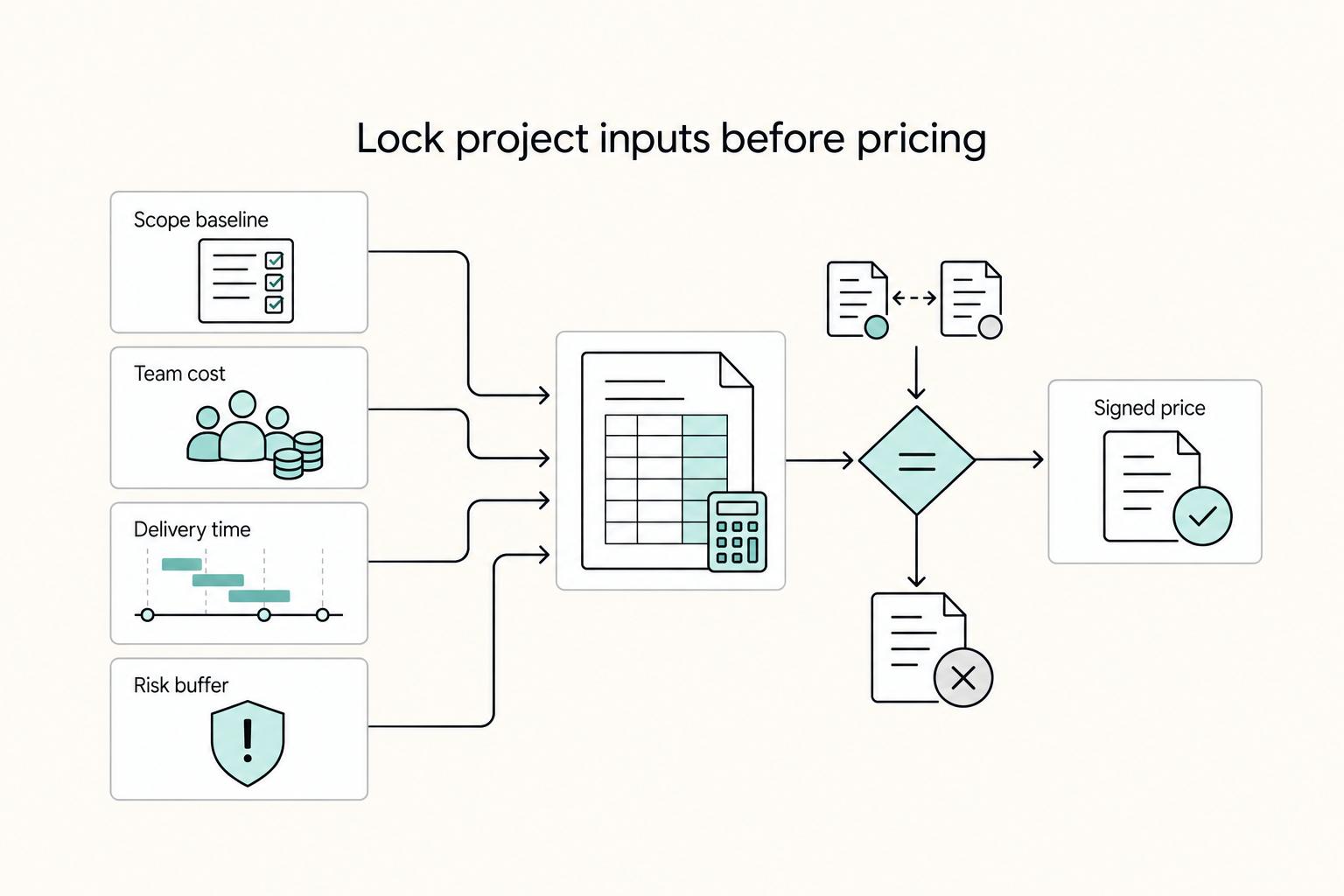
Invoiced revenue can look healthy while cash is still unavailable. That gap is where a project that looks profitable can start to pressure routine operating costs such as payroll, rent, utilities, and equipment.
How to Build a Culture of Innovation in a Remote Agency
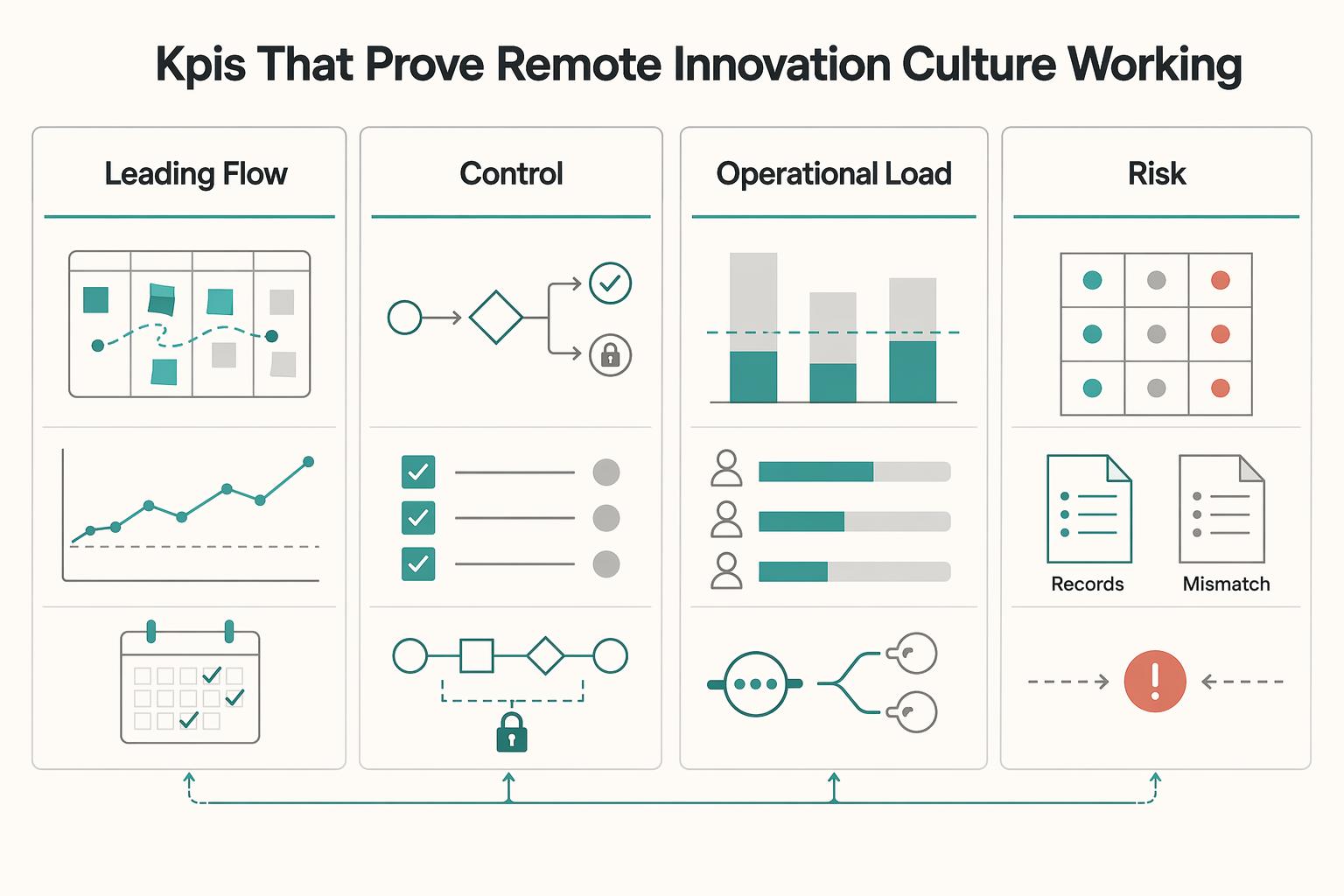
**Run your remote agency innovation culture through a one-week system with named owners, fixed Innovation Hours and Innovation Sprints, and simple controls that protect delivery quality and client trust.** Start here before you tune metrics or tooling. Execution discipline comes first, because remote culture alone does not create better ideas.