
Quick Answer
Start by turning positioning for consultants into an operating rule, not a tagline. State who you serve, what problem slice you own, and what sits outside scope, then carry that wording into the proposal, SOW, kickoff, and invoice. Add governance checkpoints early: one approver, a documented feedback window, and a written process for change requests. This reduces scope drift, billing disputes, and weak-fit work while keeping delivery authority clear.
Why Your Positioning Is Your Greatest Compliance Risk (And How to Fix It)#
Weak positioning is not just a marketing problem. It can also be an operating risk. Broad or fuzzy claims can attract weak-fit buyers, and weak-fit buyers can create ambiguity around scope, approvals, escalation, and what counts as done.
That matters even more in a compliance-heavy market. EY described the 2026 operating environment as nonlinear, accelerated, volatile, and interconnected. It also noted that many organizations are rethinking compliance to keep pace with rapid change and unpredictable risk. If your offer is unclear, buyers may fill in the gaps themselves. You may still win the work, but you can start from mismatched assumptions that are harder to unwind later in proposals and delivery.
| Decision point | If it is unclear | What your message must prove |
|---|---|---|
| Urgency trigger | Buyer delays with "not now" | What changed, why timing matters, and what action unlocks |
| Differentiation proof | Buyer compares you on price alone | Why your method, background, or format fits this case better |
| Delivery-fit boundary | Buyer assumes broader support than you sell | What is included, what is excluded, and who owns approvals |
The practical fix is simple: define one buyer, one pressing problem, one timing trigger, and one delivery boundary. If you cannot state those four things in one short paragraph, your proposal may be carrying hidden cleanup work before the project even starts.
Use a risk lens before you publish the offer#
An attractive niche is not enough. It also has to hold up under pressure. One useful lens here is the NAVI environment itself: nonlinear, accelerated, volatile, interconnected. In practice, that means testing whether your service still works when priorities shift, timelines compress, more stakeholders join, or decision-making gets messy.
This is where you can get caught. Oyster's discussion of compliance challenges points to pain around liability, escalation, and managing the relationship between business and compliance. Those are not abstract issues. They can show up when your positioning promises certainty, speed, or access that your delivery model cannot actually support.
| Positioning choice | Operational risk created | Better choice |
|---|---|---|
| "I help any company with compliance" | Broad inquiries, weak-fit discovery, vague scope | Name the buyer type and the exact problem |
| Feature list as the main pitch | Spec-by-spec comparison and price pressure | Lead with the situation, trigger, and outcome |
| No explicit boundary | Expansion requests and approval confusion | State exclusions and decision rights early |
How to use this in discovery calls#
Use discovery to pressure-test your positioning before the proposal does. Ask one question for each pressure point: what changed, how fast a decision is needed, who else must sign off, and what could shift after kickoff. Then verify that your homepage, proposal title, SOW scope line, and invoice description all use the same buyer, problem, and boundary language before you send anything.
Before you send the proposal, do a quick check. Remove any promise you cannot support with a past example, a repeatable method, or a named deliverable. If your message leans more on personality than proof, tighten it. Use the same discipline you would apply to your personal brand or to a sharper USP.
Once your position is clear, the next job is making sure that clarity survives contact with money in your proposal, SOW, and invoicing language. Related: How to Ask Clients for Testimonials and Reviews.
Keep One Message From Proposal Through Invoice#
Payment friction usually starts when sold scope and billing language stop describing the same job. Keep one message from proposal through invoice so finance is confirming work, not interpreting it.
That is the execution side of your positioning: marketing, sales, and operations stay aligned only if your documents do too.
Set the defaults before you send a proposal#
Set billing and scope defaults before you quote. If your offer line, proposal title, and invoice line items describe different work, fix that first.
| Stage | Owner | Document | Verification step | Failure risk |
|---|---|---|---|---|
| Before proposal | You | Offer summary, proposal template, invoice template | Confirm buyer, problem, delivery format, currency default, and line-item labels use the same language | Client approves one promise, accounts payable receives another |
| At signing | You + client approver | Contract or SOW | Confirm legal names, billing contact, invoice currency, payment trigger, milestone labels, and tax-field requirements that still need official/source-record verification | Billing delay from missing references or disputed trigger |
| At invoicing | You | Invoice + approval evidence | Match invoice lines to signed scope or approved change; store acceptance evidence with the invoice | Payment hold while client asks what the charge covers |
Use a quick message-to-money alignment check each time:
| Positioning element | Must appear in |
|---|---|
| Who you help + problem solved + boundary | Offer summary and proposal intro |
| Named outputs tied to price | Proposal and SOW |
| Scope line, exclusions, milestone labels, approver | SOW and approval trail |
| Invoice line items using the same labels | Invoice |
| Written proof of approval or acceptance | Invoice record |
If your offer still reads like a broad feature list, tighten it first with a clearer USP. Clear positioning makes billing language easier to standardize.
Lock terms at signing so billing cannot drift later#
At signing, use terms that make scope, approvals, and billing checkpoints explicit.
| Term area | Owner | Document | Verification step | Failure risk |
|---|---|---|---|---|
| Start condition | You + client approver | Contract/SOW | Confirm the exact start trigger and whether work starts only after that trigger | Work begins before commercial commitment is clear |
| Milestone logic | You + client approver | Proposal, SOW, invoice template | Confirm milestone names are identical across all three | Deliverable accepted, invoice wording challenged |
| Late-payment handling | You | Contract terms | Confirm clause language matches governing terms you are prepared to enforce | Escalation path is unclear when payment stalls |
For multi-currency work, decide the method before signing and keep it consistent in all documents. Any tax-field requirement must be verified against official tax guidance or source records before it appears in proposal, SOW, or invoice copy.
That caution matters because some regulatory pages are useful but unofficial for legal reliance. If you include legal or tax language in billing documents, verify it against official sources before you standardize it.
Treat scope change as a payment control, not a courtesy#
Treat scope expansion as a formal commercial event. If a request changes deliverables, review rounds, stakeholders, timing, fee, or decision ownership, route it through change control before you continue.
- Capture the request in writing (or summarize it in writing after the call).
- Classify it as in-scope or change using the SOW boundary language.
- If it is a change, issue updated deliverables, fee impact, timeline impact, and approval request.
- Start changed work only after written approval and any required billing update.
This keeps pricing, timeline, and approval evidence synchronized. For a related compliance control when client data is involved, pair this process with a GDPR compliance checklist for freelancers.
The Autonomy Engine: Positioning as Your Ultimate Tool for Control#
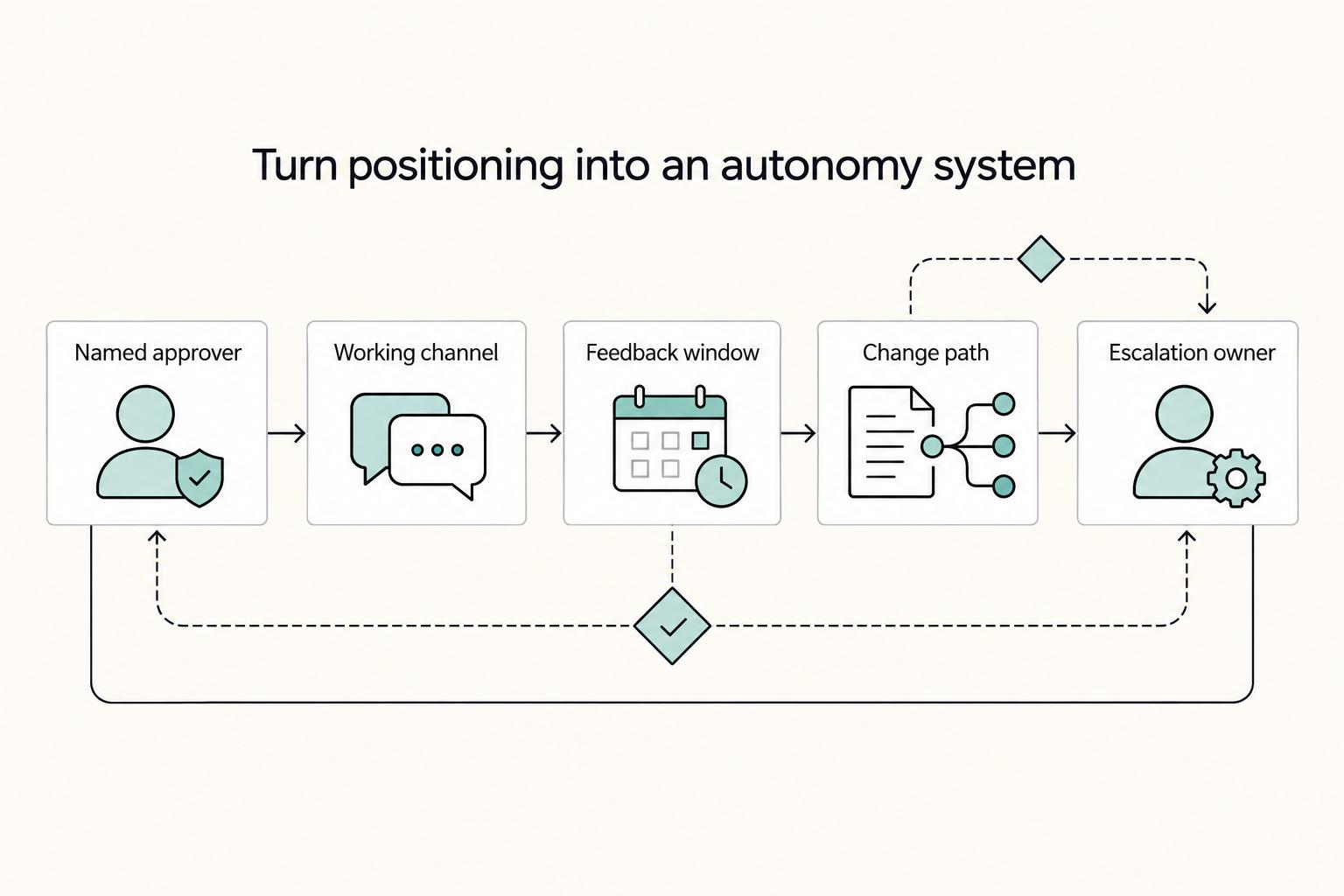
Good positioning gives you more than cleaner messaging. It gives you operational control: clear decision rights, explicit scope boundaries, a defined communication cadence, and one approval owner. That is where your positioning stops being copy and starts working as an execution system.
| Governance item | What to confirm |
|---|---|
| Named approver | One person who consolidates feedback and approves milestones |
| Working channel | Email, client portal, or another channel you confirm in writing |
| Feedback window | Comments due within a stated number of business days after delivery |
| Change path | Out-of-scope requests trigger written review before work continues |
| Escalation owner | The person who resolves stalled approvals or cross-team conflicts |
A sharp promise alone is not enough. Control holds only when governance, planning, execution, and quality control stay aligned after the sale. If your website sounds focused but the client can still rewrite your method, add reviewers, and route requests through multiple channels, the coordination burden is still on you.
| Area | Weak boundaries (broad offer) | Explicit boundaries (focused offer) |
|---|---|---|
| Scope authority | New asks slide into the base fee, so scope drift looks like "helpfulness" until margin erodes | Named outputs, exclusions, and a written change path make extra work visible before it starts |
| Decision rights | Client feedback spills into execution method, pulling you into order-taking | Client sets business priorities; you own method and delivery judgment inside agreed scope |
| Review process | Multiple stakeholders edit timing and content, causing review churn and conflicting notes | One approver consolidates input and signs off within a stated window |
| Communication | Slack, email, calls, and DMs all become default channels, expanding response pressure | One working channel and defined cadence keep requests traceable |
| Procurement signal | Buyers compare vague labor to vague labor, so kickoff starts with procurement ambiguity | Service scope, outcome, and review logic are easier to evaluate before kickoff |
That procurement row matters because clear evaluation logic reduces friction before work starts. You do not need legal complexity here. You need plain scope language the client can repeat internally across procurement, finance, and department ownership.
A compact governance check in your SOW or kickoff note usually does more for autonomy than another discovery call. Include:
- Named approver: one person who consolidates feedback and approves milestones
- Working channel: email, client portal, or another channel you confirm in writing
- Feedback window: comments due within a stated number of business days after delivery
- Change path: out-of-scope requests trigger written review before work continues
- Escalation owner: the person who resolves stalled approvals or cross-team conflicts
Confirm those items in writing before kickoff (reply email, signature, or portal confirmation). If your SOW says "client feedback" but does not name a person or window, expect churn. Things look manageable until priorities blur.
You can still diversify without drifting. An audit, sprint, and recurring review can fit one position when they serve the same buyer, solve the same core problem, and keep the same decision logic. Red flags are consistent: requests for daily team management, open-ended availability, a brand-new method, or committee approvals with no single owner. When those patterns appear, treat it as a different offer and rewrite scope before you say yes.
If your boundaries keep shifting between outreach, proposal, and kickoff, tighten the promise first with a clearer USP. Then make sure it matches how you show up in your personal brand.
If you want a deeper dive, read E&O Insurance for Management Consultants Who Need Contract-Ready Coverage.
Write a Positioning Statement That Survives Proposal and Delivery#
Use this as an implementation worksheet, not branding theory. Your statement should survive proposal, SOW, onboarding, and delivery without turning vague.
One consultancy advisor calls positioning an "exercise in irrelevance." That is the right lens here: decide what to leave out so buyers can quickly understand what you do, how you work, and what is outside scope.
Start with one service focus and pressure-test it#
Start with one service focus based on repeat work patterns, then pressure-test it before you scale outreach.
| Filter | Ask | Pass output you can carry forward | Fail signal |
|---|---|---|---|
| Demand signal | Are buyers already trying to solve this problem? | You can state buyer + problem in one clear line. | You need a long setup to explain urgency. |
| Differentiation | Is your method or body of work recognizably yours? | You can describe how you work in plain terms. | The offer reads like generic freelance support. |
| Delivery feasibility | Can you deliver with clear inputs, outputs, and review points? | Proposal language can name inputs, outputs, and review cadence. | Delivery depends on open-ended access or constant direction. |
| Boundary clarity | Can you name what is not included without hedging? | SOW language can state at least one clear exclusion. | Adjacent requests keep getting absorbed into base scope. |
Carry the pass output forward in a reusable line that names the buyer, problem, service, and boundary.
If this line still feels loose, tighten your USP before pushing more outreach.
Qualify operational fit before you do proposal work#
Qualify operational fit before you do proposal work. Good-fit clients can onboard you, approve work, communicate clearly, and process billing in a way that matches your offer.
| Criteria | Good fit signal | Friction signal |
|---|---|---|
| Onboarding readiness | They name a point of contact, explain intake steps, and know required docs. | No clear owner, unclear setup, changing intake requests. |
| Billing readiness | They can explain invoice routing, PO needs, and the finance or contract term that needs source-record verification before kickoff. | Billing contact is unclear, payment path changes mid-sale, terms stay vague. |
| Communication norms | They accept scheduled reviews, document-based feedback, and a defined response window. | They expect instant replies, constant chat access, or unplanned calls by default. |
| Scope governance | They work from the SOW, name one approver, and treat new requests as separate decisions. | Verbal asks are treated as included, reviewers multiply, no clear change path. |
Turn these into qualification questions and collect concrete answers in notes or writing before you commit.
Turn your positioning into a statement you can reuse#
Turn your positioning into a working statement you can reuse across sales and delivery:
Make the statement concrete: name the buyer, name the problem, describe the service format and cadence, then state what you own and what sits outside scope.
Weak: "I help companies with marketing and communications." Stronger: "I help B2B software leadership teams clarify executive messaging before launch and investor review. I do that through an async messaging audit with scheduled decision calls, document-based feedback, and one named approver. I own the audit, recommendations, and revision rationale. I do not manage daily campaign execution or act as a standing chat-channel resource."
The stronger version is usable because it names the buyer, the problem slice, the delivery method, and the boundary. Reuse the same language in your proposal, SOW, kickoff note, and personal brand.
Review this statement regularly. If poor-fit leads start clustering, update your wording, tighten boundaries, and revise qualification questions before you scale outreach.
Conclusion: Your Position Is Your Policy#
Treat your position like policy, not copy. When it clearly defines who you serve, what you own, and what you will not absorb, it can improve scope discipline and keep your documents consistent. It also gives you something firm to return to when a sale gets rushed or a client tries to widen the brief.
A written positioning statement is a concrete checkpoint. If your core claim changes every time you explain it, the offer is likely still too loose. That looseness is expensive because effort gets pulled toward weak-fit work instead of best-fit clients who are more likely to refer, advocate, and act as references.
| Weak signal | Policy-level signal |
|---|---|
| Channel wording shifts | A written statement keeps the core buyer, problem, and boundary consistent |
| Feedback comes from everyone | Best-fit customer language shapes the statement |
| Competitors blur together | A simple comparison or perceptual map shows your distinct lane |
| No clear owner or review trigger | One owner reviews positioning as customer mix or service mix changes |
Use that as an execution check across the core artifacts that prevent drift:
- Positioning statement: define one buyer, one owned problem, and one clear boundary.
- Best-fit customer inputs: prioritize language from customers who refer, advocate, and act as references.
- Competitive comparison: keep a simple perceptual map or equivalent comparison current.
- Review cadence: revisit positioning when customer segments or service mix changes.
If your wording is still broad, tighten the promise in How to Create a Unique Selling Proposition (USP) for Your Freelance Business. Then make sure your public presence actually matches how you sell and deliver in How to Manage Your Personal Brand as a Freelancer.
Maintenance matters as much as the first draft. Recheck the statement against real buyer language, best-fit customer patterns, and any change in your service mix. Once those shift, your policy should too. We covered related systems work in The Best CRM for Independent Consultants.
Frequently Asked Questions
How do you write a positioning statement for your consulting business?
Start with a concise statement that names your target audience, your offer, and the market need you solve. For positioning for consultants, the statement is most useful when sales and marketing can use the same core message consistently across proposals, SOWs, kickoff conversations, and other channels. Quick check: can someone quickly tell who you help, what problem you solve, how you work, and what is out of scope?
What are examples of a unique value proposition for a consultant?
A credible value proposition is specific enough to rule people out, because you cannot be everything to everyone. "I help B2B SaaS founders tighten launch messaging through an async audit, one weekly decision call, and document-based feedback. I do not manage daily campaign execution." If your version still sounds broad, tighten the owned problem and buyer first with this USP guide. Quick check: if you remove the buyer or delivery method and the sentence still works, it is probably too vague.
How does your positioning affect your tax exposure?
Positioning helps buyers understand your offer, but it is not a substitute for tax or legal guidance. If your public offer, invoice descriptions, and actual delivery do not match, resolve that mismatch and verify current obligations with a qualified advisor in each relevant jurisdiction before you publish or invoice. Quick check: do your website copy, SOW, and invoice line items describe the same service?
How do you position yourself as a premium consultant?
Premium usually reads as lower ambiguity and cleaner decisions, not bigger adjectives. Show the buyer a defined method, named outputs, one approver, a review cadence, and a firm boundary before you talk about fees, then track outcomes to confirm the positioning is working. Quick check: does your offer reduce client coordination drag, or just sound more expensive?
What is the difference between branding and positioning for a consultant?
Positioning is how you differentiate in the buyer's mind and give them a reason to choose you. Branding is how that differentiation is expressed and recognized. It only works if people can actually see and remember your firm consistently across channels. Quick check: can you explain your owned problem clearly without mentioning your visuals, tone, or logo?
Try a related tool
Researched and edited by the Gruv editorial team. Gruv builds cross-border billing, payouts, and finance-operations software for global businesses.
Sources
- acquisition.gov/sites/default/files/page_file_uploads/far-co...trusted
- capmf.cdt.ca.gov/pdf/CA-PMF.pdftrusted
- ecfr.gov/current/title-12/chapter-I/part-5trusted
- eeoc.gov/best-practices-private-sector-employerstrusted
- fac.gov/assets/compliance/2024-Compliance-Supplement...trusted
- federalregister.gov/documents/2025/01/16/2025-00592/securing-the...trusted
- rd.usda.gov/files/UEP_Bulletin_1724E-200.pdftrusted
- whitehouse.gov/wp-content/uploads/2025/08/a11.pdftrusted
Educational content only. Not legal, tax, or financial advice.
Related Posts

GDPR Compliance Checklist for Freelancers Working With EU Clients
Start by separating the decisions you are actually making. For a workable **GDPR setup**, run three distinct tracks and record each one in writing before the first invoice goes out: VAT treatment, GDPR scope and role, and daily privacy operations.

How to Manage Your Personal Brand as a Freelancer
Your brand is not a mood board. Think of it as the experience people have of your work: the promise you make, the proof you can show, and the way you present yourself across client touchpoints. Get that clear first, and your fit is easier to read from profile to proposal.

How to Create a Unique Selling Proposition (USP) for Your Freelance Business
Your USP needs to hold up in real buying conversations, not just look polished on a profile. When positioning is vague, clients often compare on price or choose arbitrarily. Start by naming one concrete benefit you can defend with work you already delivered.