
Quick Answer
Independent contractors should treat remote performance reviews as client business reviews, not employee appraisals. Go in with the decision you need, dated proof of what you delivered, and a clear ask on scope, support, renewal, or rates. Keep the discussion tied to outcomes and agreed standards, push vague feedback toward specific examples, and send a written recap with actions, owners, and dates.
Stop Being Reviewed. Start Leading the Negotiation.#
Go into the call with three things nailed down: the decision you need, the evidence you will show, and the ask you will make. Treat it like a client business review about outcomes, scope, and next-phase terms, not an employee appraisal about approval.
That distinction matters for more than tone. The IRS says worker status turns on the substance of the relationship, not the label. It looks at behavioral control, financial control, and the relationship of the parties. If the meeting drifts into manager-style scoring and open-ended direction, the commercial record gets less clear. If you manage other freelancers too, How to Manage a Global Team of Freelancers is a useful companion.
| Dimension | Employee review dynamic | Contractor commercial review dynamic |
|---|---|---|
| Ownership | Manager runs the evaluation | You set the decision agenda |
| Evidence standard | Discussion can lean on general impressions | Dated artifacts, deliverables, and stakeholder notes |
| Decision rights | Employer sets ratings and expectations | Both sides confirm scope, priorities, and terms |
| Follow-up accountability | Notes are often captured by HR or a manager | Written recap with owners, actions, and dates |
Before the call, filter your proof hard so only the strongest examples make the agenda:
- Artifact quality: use real outputs, not broad praise. A shipped deliverable, handoff note, or client message beats "great job."
- Traceability: each claim should link to a date, project, stakeholder, or decision. If you cannot trace it, do not lead with it.
- Business impact language: describe the problem solved, risk reduced, or decision enabled, not just effort spent.
Bias can show up as vague feedback, especially when visibility is uneven. One NBER working paper found engineers in the same building as teammates received 22 percent more online feedback. That is a useful reminder not to treat feedback volume as pure performance. If you hear "communication felt off" or "ownership was mixed," redirect calmly. Ask for the specific deliverable, date, and missed expectation, then convert that into a documented next action. Keep a written record and share it after the discussion so the outcome is concrete, not interpretive.
If you want a deeper dive, read How to Set Up a Limited Company in Ireland.
Build Your Proof of Performance Dossier#
If you want a clear decision in the review, your dossier should make that decision easy: show what you committed to, what you delivered, how it affected the work, and what ownership you can take next.
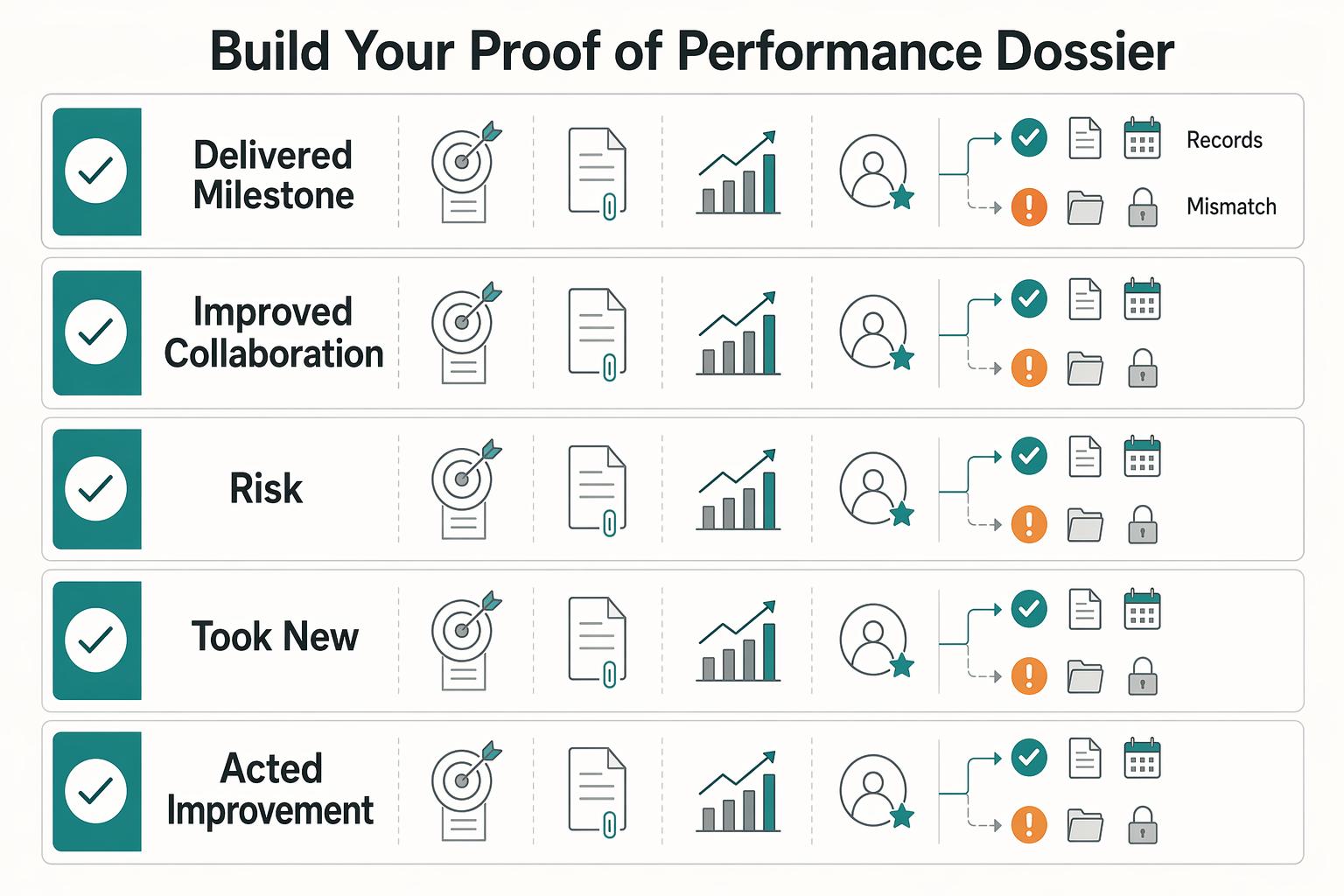
Use one evidence standard for every claim: commitment -> artifact -> effect -> ownership signal. If a point is missing one of those pieces, move it to a backup file instead of leading with it. This keeps the discussion tied to agreed objectives, observable behavior, and measurable standards.
| Common contractor activity | Acceptable proof artifact | Decision this supports |
|---|---|---|
| Delivered a milestone or project phase | Accepted deliverable, dated handoff note, ticket closure with stakeholder sign-off | Renewal or confirmation that scope was fulfilled |
| Improved collaboration across teams | Meeting notes with decisions, async update thread, stakeholder note tied to a specific handoff | Confidence in communication and coordination |
| Resolved a blocker or reduced delivery risk | Decision log, issue summary, before-and-after process note, escalation record with outcome | Readiness for more autonomous ownership |
| Took on a new responsibility | Updated scope note, recurring deliverable history, documented ownership transfer | Expanded scope discussion |
| Acted on improvement feedback | Written check-in feedback, revised output, documented change in approach and result | Credible development, not just intent |
Use this quick filter before sharing:
- Activity vs performance: a screenshot without date or owner usually shows activity, not performance.
- Praise vs proof: "great work" counts more when tied to a specific deliverable, handoff, or decision.
Keep a short proof log behind the dossier so you can show wins and unresolved blockers clearly:
- Commitment source: contract line, scope note, kickoff note, one-to-one note, or agreed objective
- Evidence type: deliverable, stakeholder note, decision record, metric snapshot, handoff document
- Status: complete, in review, blocked, or changed by client input
- Risk flag: none, dependency risk, timeline risk, scope drift, or waiting on approval
Before sending, run a quick Situation-Action-Result quality gate: what was the situation, what observable action did you take, and what result can you show. Then triage: lead with the proof points that support the decision you need now, and keep the rest in reserve.
If feedback turns subjective, do not debate labels. Ask for the specific situation, observable behavior, and impact; if intent is assumed, ask directly rather than guessing motive. Close by converting the point into a written next action with an owner and date, then share the record after the discussion.
You might also find this useful: A Guide to Harassment Training for Remote Teams.
Seize the Agenda: A Framework for Controlling the Conversation#
Your evidence only helps if you control the meeting structure before the call starts. If the conversation opens with impressions, you end up defending your work instead of deciding scope, ownership, and support.
As an independent contractor, keep the discussion on results and agreed standards, not on how you managed every task. Lead with a clear flow and written outputs.
Set the meeting before the meeting#
Prepare 24-48 hours in advance, and make each prep step produce one concrete artifact:
| Prep step | Output | Includes |
|---|---|---|
| Objective statement | One sentence naming the decision you need | "By the end of this call, I want us to confirm renewal scope for Q2 and whether I will own client handoff coordination." |
| Short agenda | Three to four bullets in the invite/email | Delivered outcomes; concerns tied to examples; next-period ownership; actions and dates |
| Selected proof links | Three to five dossier links | Each labeled with commitment, artifact, and business effect |
| Decision list | Explicit decisions to close | Renew current scope; expand ownership; confirm support needed; set next review date |
- Objective statement
Write one sentence naming the decision you need. Example: "By the end of this call, I want us to confirm renewal scope for Q2 and whether I will own client handoff coordination."
- Short agenda
Put three to four bullets in the invite/email, in order: delivered outcomes, concerns tied to examples, next-period ownership, actions and dates.
- Selected proof links
Share three to five dossier links, each labeled with commitment, artifact, and business effect.
- Decision list
Name the decisions you want to close, such as renew current scope, expand ownership, confirm support needed, and set next review date.
Use a quick quality check: if someone cannot tell what decision this meeting should produce, the prep is still too broad.
| Conversation area | Reactive conversation | Led conversation |
|---|---|---|
| Opening move | Starts with general impressions | Starts from the pre-shared objective, agenda, and proof links |
| Evidence handling | Relies on memory and broad statements | Uses dated examples, observable behavior, and documented outcomes |
| Decision quality | Ends with vague alignment | Ends with a named decision, a defined open issue, or a required follow-up |
| Follow-up accountability | No clear owner or date | Actions, owners, and deadlines are documented and sent within 24 hours |
Counter vague feedback without sounding defensive#
When feedback is vague, clarify it live. Use a short situation-behavior-impact sequence to keep the conversation factual:
- Acknowledge: "Thanks for raising that."
- Request the instance: "Which situation or deliverable are you referring to?"
- Clarify behavior and impact: "What did you observe, and what impact did it have?"
- Convert to next step: "Let's define what good looks like next time and who owns the follow-up."
This keeps the discussion anchored to observable facts instead of assumptions about intent.
Turn past proof into future ownership#
Do not stop at "here is what I delivered." Tie each verified result to one proposed next responsibility, plus the support required to execute it.
Use this structure in your notes:
- Proven result: Reduced delivery risk by escalating a blocker early and documenting the decision.
- Next responsibility proposed: Own cross-team dependency tracking for the next phase.
- Support needed: Access to weekly planning call and a named approver for escalations.
- Success criteria: Verify the exact standard from the agreed role scope and approved performance records before use.
Close the meeting with written handoff clarity: decisions, actions, owners, deadlines, and any unresolved standard that still needs examples. If you want the client-side operating view, read Performance Management for Remote Teams: A Guide for IT Agencies.
Turn Proven Value into a Rate Increase#
When you discuss a rate increase, keep the order strict: confirm performance evidence, define next-scope responsibilities, then discuss compensation. In distributed teams, that sequence prevents debates about visibility or hours and keeps the decision tied to outcomes and regularly monitored KPIs.
Use this quick gate before you raise pricing: can you show one documented result, one business effect, and one next responsibility that logically follows? If not, tighten the case first.
Draft a one page proposal the client can say yes to#
Keep it short and decision-ready, and make each field trace back to your dossier.
| Proposal field | What to include | Supporting detail |
|---|---|---|
| Business objective | The client problem or opportunity for the next period | Support it with evidence already on record, such as KPI movement, a recurring bottleneck, or stakeholder feedback |
| Proposed scope change | What you will add, what stays the same, and what is out of scope | Link the added responsibility to a result you already delivered |
| Expected outcome | The business effect using measures the client already uses in reviews | Prefer agreed delivery markers or KPIs over time online, activity theater, or monitoring screenshots |
| Owner responsibilities | Who owns execution, inputs, approvals, and final decisions | If client-side access, signoff, or data is required, write it here before pricing |
- Business objective
State the client problem or opportunity for the next period. Support it with evidence already on record, such as KPI movement, a recurring bottleneck, or stakeholder feedback.
- Proposed scope change
Define what you will add, what stays the same, and what is out of scope. Link the added responsibility to a result you already delivered.
- Expected outcome
Describe the business effect using measures the client already uses in reviews. Prefer agreed delivery markers or KPIs over time online, activity theater, or monitoring screenshots.
- Owner responsibilities
Document who owns execution, inputs, approvals, and final decisions. If client-side access, signoff, or data is required, write it here before pricing.
Name boundaries before fees. If ownership and support are vague, extra work gets absorbed informally and pricing discussions stall.
Benchmark the role, not yourself#
Benchmark after the role is defined. Compare like-for-like inputs: service type, responsibility level, geography, expected outcomes, and market source records verified for the role before use.
This keeps the discussion comparable and avoids personal-cost arguments that do not prove business value.
| Option | Scope | Support expectations | Review rhythm | Pricing structure |
|---|---|---|---|---|
| Continue as is | Current deliverables only | Current client inputs and response pattern | Current checkpoints | No commercial change |
| Expand delivery | Current scope plus one clearly named responsibility | Added access/feedback/approvals during ramp-up | Current checkpoints plus milestone review on added responsibility | Fee updated for added scope |
| Take broader ownership | Responsibility tied to a larger business objective | Ongoing decision access and priority alignment | Delivery review plus strategic checkpoint | Commercial terms reset for wider ownership |
If there is pushback, classify it before you respond: scope, outcome, support, or price. Then document a reopen condition: what must be true, who verifies it, and the next decision checkpoint date so "not now" does not become indefinite delay.
For a step-by-step walkthrough, see Background Checks for Employees and Contractors Without Scope Creep.
You Are a Business, Not an Employee#
Run this as a business decision meeting, not a personal evaluation. Your goal is to leave with a clear decision on scope, support, renewal, or next ownership, using observable work as the main standard.
| Document | What you bring | Decision it enables |
|---|---|---|
| Dossier | One page plus links to dated proof, open items, and what changed | Confirms what was delivered and what still needs a call |
| Agenda | The decision you need, key risks, and questions that require specific examples | Keeps the meeting focused on facts instead of impressions |
| Proposal | Next scope, client support needed, and key dependencies | Lands on yes, no, or revise |
Before the call, bring proof another person can verify without your live explanation. In remote async work, strong evidence is a shipped deliverable, a dated project log, a stakeholder note, a documented handoff, or a short before/after summary of what changed. Weak signals are green-dot time, fast chat replies, message volume, or "always available" behavior. Those signals can add context, but they should not carry the decision when outcomes say something else.
Use your three documents as decision tools:
- Dossier
Bring one page plus links to dated proof, open items, and what changed. This confirms what was delivered and what still needs a call.
- Agenda
Bring the decision you need, key risks, and questions that require specific examples. This keeps the meeting focused on facts instead of impressions.
- Proposal
Bring next scope, client support needed, and key dependencies. This gets you to yes, no, or revise.
| Practical moment | Employee-style posture | Business posture to use |
|---|---|---|
| Opening the call | Wait to be assessed | State the decision needed, then walk through evidence |
| Vague feedback appears | Accept broad language | Ask for the exact date, handoff, or missed expectation |
| Documenting outcomes | Leave with general takeaways | Send a recap with decisions, owners, dependencies, and next checkpoint |
After the call, write down final decisions, owners, dependencies, and the next review checkpoint. If those are not explicit, you had a discussion, not a decision.
If you need adjacent remote-ops policy structure, see How to Create a Travel Policy for a Remote Team. If you need country/program confirmation, Talk to Gruv.
Frequently Asked Questions
How should you prepare for performance reviews for remote employees if you are a contractor, not an employee?
Prepare like you are making a business case, not waiting for a rating. Send a short pre-read with your decision request, a one-page summary, and dated proof. If a claim is not backed by an example, date, or document, do not center the meeting on it.
How do you show your value when your work happens across time zones and async channels?
Replace presence with proof. For each point, show the deliverable, the result it produced, and where the client can verify it. Milestones, resolved blockers, and decisions moved forward are stronger than desk time or fast chat replies.
What should you do if the feedback is vague, subjective, or based on responsiveness?
Ask for a specific example tied to a date, project, handoff, or missed expectation. Do not argue with abstractions. Pin the concern to observable facts, agree on the next expectation, and document it after the meeting.
When is the right time to discuss a rate increase or expanded scope?
Raise pricing or expanded scope only after both sides agree on current delivery and the next responsibility being added. Bring your evidence pack and a one-page scope proposal. If scope, outcome, support, and price get mixed together, separate those items before you negotiate.
How is an employee review different from a contractor client review?
An employee review is usually manager-led and centers on performance expectations, while a contractor review should center on deliverables, scope, support, and commercial decisions. The proof standard should be dated, verifiable examples tied to outcomes. If the conversation drifts into detailed direction over what is done and how it is done, pull it back to deliverables, scope boundaries, and decision rights.
How should you handle remote review logistics so the conversation stays fair and useful?
Send the evidence asynchronously first when possible, then use the live meeting for decisions. In the call, review specific results since the last check-in, test concerns against examples, and confirm what happens next. Keep regular short check-ins and send a short recap with actions and expectations for the next period.
What belongs in the evidence pack you send ahead of time?
Keep it compact and easy to verify. A strong pack includes a one-page summary, relevant facts, dated examples, quantified results where possible, and an 'Open issues / decisions needed' section. If you include benchmarks or market context, keep them as placeholders rather than stale numbers.
Can employee question lists still help if you work independently?
Yes, if you rewrite them around scope, outcomes, and client decisions instead of manager approval or career development. Useful prompts include which result mattered most, what support was missing, and what next responsibility is justified by the evidence.
Try a related tool
Researched and edited by the Gruv editorial team. Gruv builds cross-border billing, payouts, and finance-operations software for global businesses.
Sources
- bpmoportal.berkeley.edu/making-most-your-meetings-agendas-and-action...trusted
- dol.gov/agencies/whd/fact-sheets/13-flsa-employment-...trusted
- dol.gov/agencies/whd/flsa/misclassification/rulemakingtrusted
- eeoc.gov/employers/small-business/5-im-conducting-per...trusted
- federalregister.gov/documents/2024/01/10/2024-00067/employee-or-...trusted
- hr.mit.edu/performance/reviewstrusted
- hr.mit.edu/performance/remotetrusted
- irs.gov/businesses/small-businesses-self-employed/em...trusted
Educational content only. Not legal, tax, or financial advice.
Related Posts
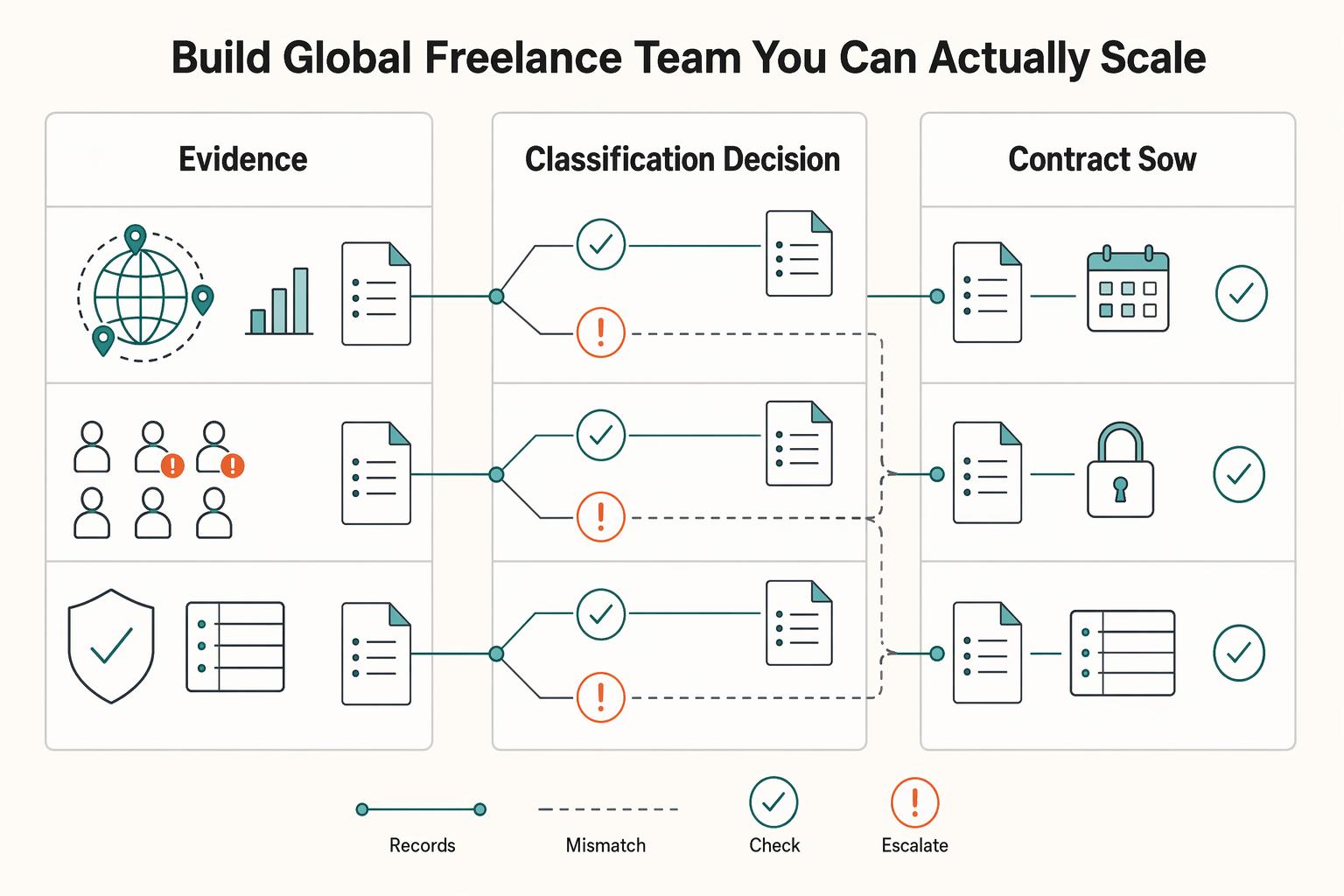
How to Manage a Global Freelance Team Without Compliance Gaps
If you want to manage a global freelance team without constant cleanup, use the same intake-to-payout process for every engagement and save an artifact at each gate. Common failure points are instinct-based classification, vague scope, and payments approved in chat with no audit trail.
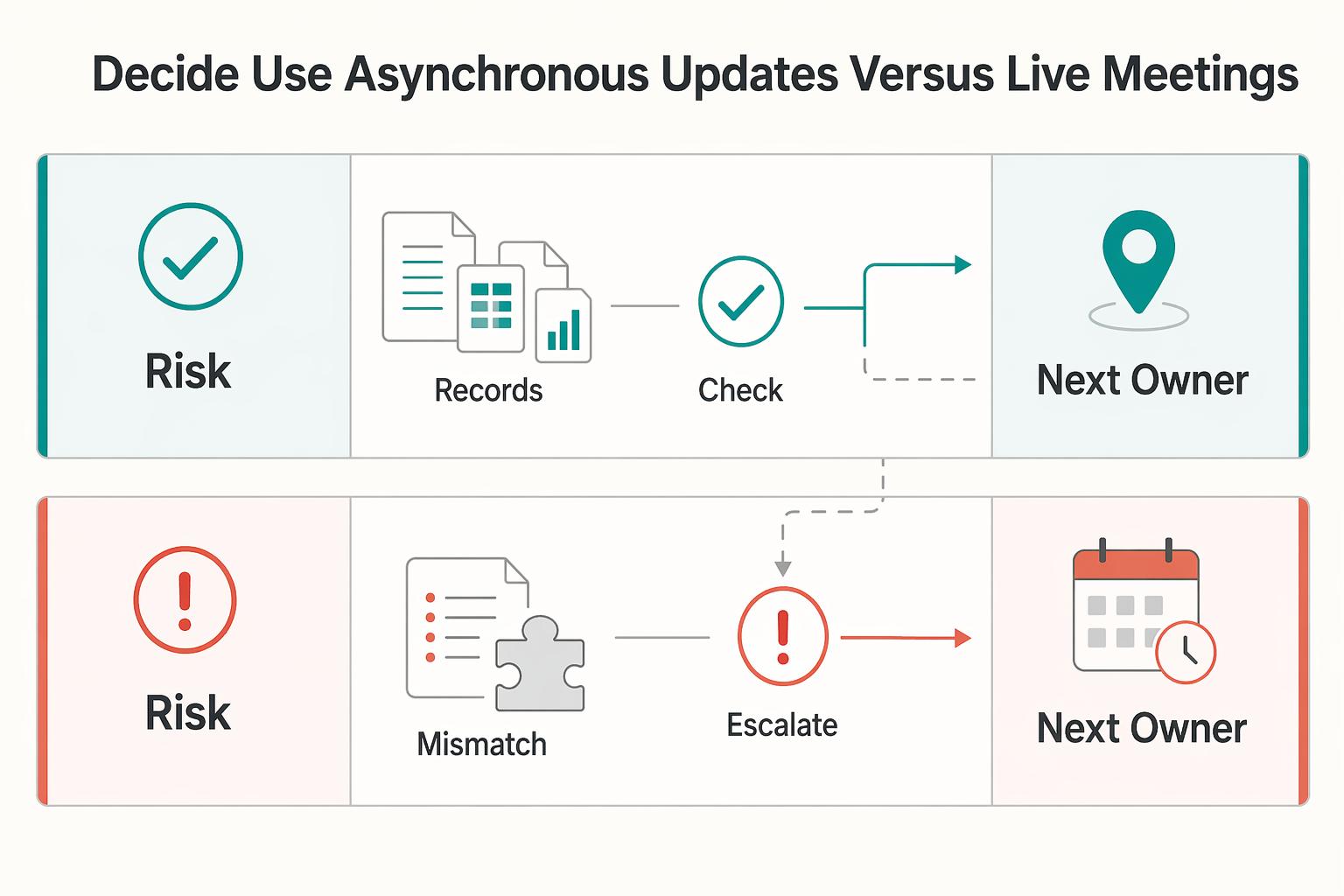
Remote Team Performance Management for IT Agencies
If your remote team performance management feels inconsistent, the problem is often not distance itself. It is ambiguity. Performance breaks down when expectations, feedback, and decisions live in chat history or manager memory instead of a written record you can review. In remote and hybrid teams, documented expectations and [outcome-based measures](https://www.opm.gov/telework/tmo-and-coordinators/performance-management) matter more than office visibility, so your first move is to make the standard visible.
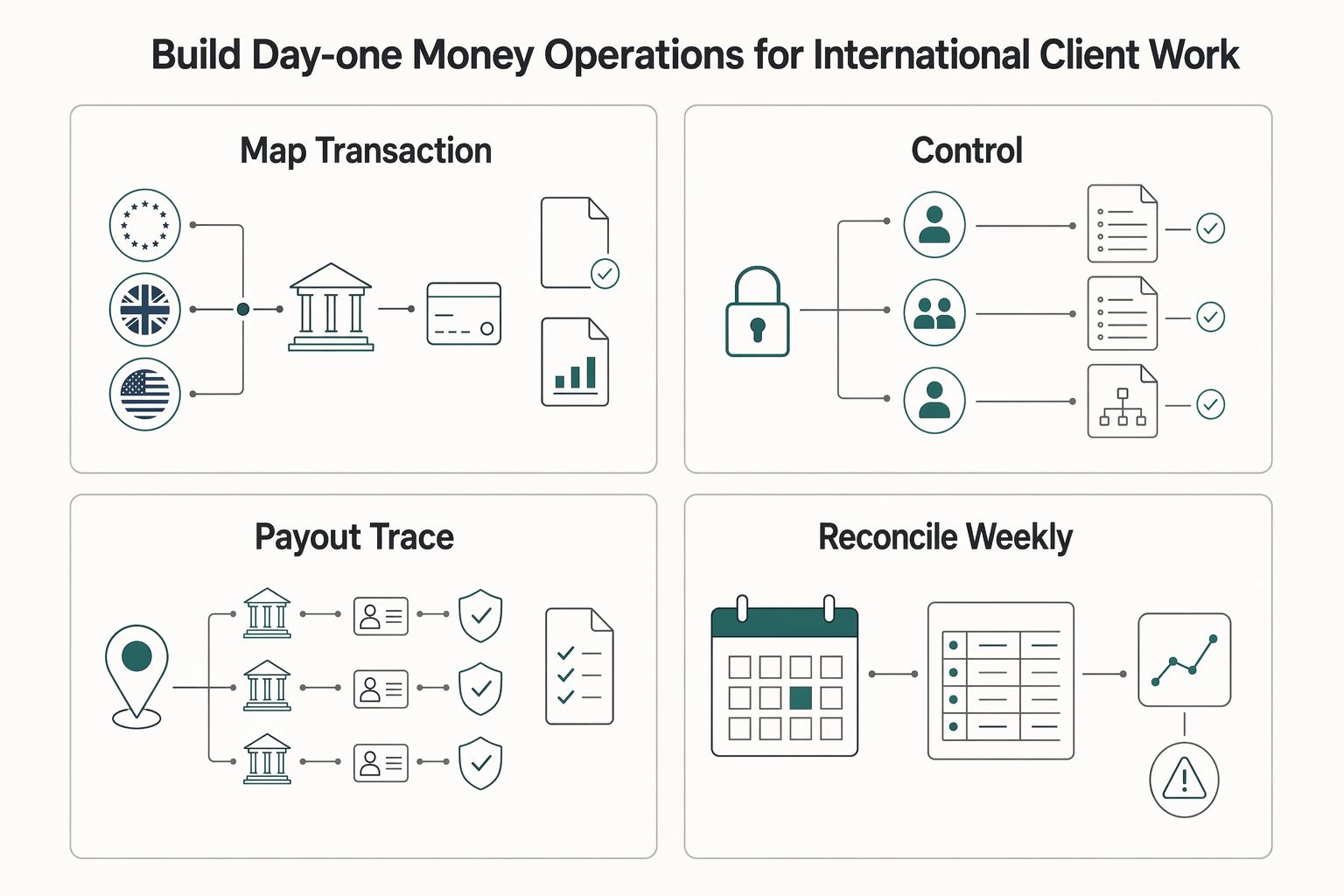
How to Set Up a Limited Company in Ireland
Work in two tracks and keep them separate: complete CRO formation first, then handle post-setup registrations. That order reduces duplicate edits and missed follow-ups.