
Quick Answer
PAYG instalments are regular prepayments toward your income tax, usually made each quarter, that help Australian freelancers spread tax across the year and reduce the risk of a large bill at return time. They can appear on a BAS, IAS B, or instalment notice, are separate from PAYG withholding, and work best when you forecast quarterly income, ring-fence tax cash, and vary only from verified records.
PAYG Isn't a Tax Bill; It's Your Business's Financial Health Score#
Think of PAYG as cash-flow control, not a penalty. You are prepaying expected income tax through recurring ATO reporting cycles, usually once every 3 months, so your annual return is less likely to end with a large balance due.
For a freelancer, this is the reminder that not all cash received is spendable cash. PAYG instalments are credited against your tax when you lodge your return, and the system is designed to spread the hit across the year instead of leaving you with one large payment at year end.
Your PAYG obligation will usually show up in one of these formats:
| Document type | What it can include | What you need to do |
|---|---|---|
| BAS | GST, PAYG withholding, and PAYG income tax instalments | Complete and lodge as required |
| IAS B | PAYG income tax instalment obligation only | Complete and lodge as required |
| Instalment notice | PAYG instalment amount, instead of BAS | Usually pay only; lodge only if you vary |
Keep one distinction clear: PAYG instalments, your own prepayments toward income tax, are separate from PAYG withholding, which covers amounts withheld from employee payments.
Entry can be automatic or voluntary, and the ATO uses information from your latest tax return to assess this. Check your latest return and notice of assessment first, then confirm the current entry criteria with the ATO.
What this changes in your workflow#
- Forecasting cadence: review income at least quarterly, not only at year end.
- Provision discipline: treat part of each client payment as future tax, not free cash.
- Lodging rhythm: confirm whether you received a BAS, IAS B, or instalment notice, then follow the matching action.
The real value is risk control. PAYG helps you avoid a large bill when you lodge your tax return. If your income changes quickly or is hard to forecast, get tax-agent advice early, especially before varying instalments.
For a step-by-step walkthrough, see A Deep Dive into the UAE's Corporate Tax for Freelancers and LLCs.
Step 1: Choose the PAYG Method That Matches Your Cash Reality#
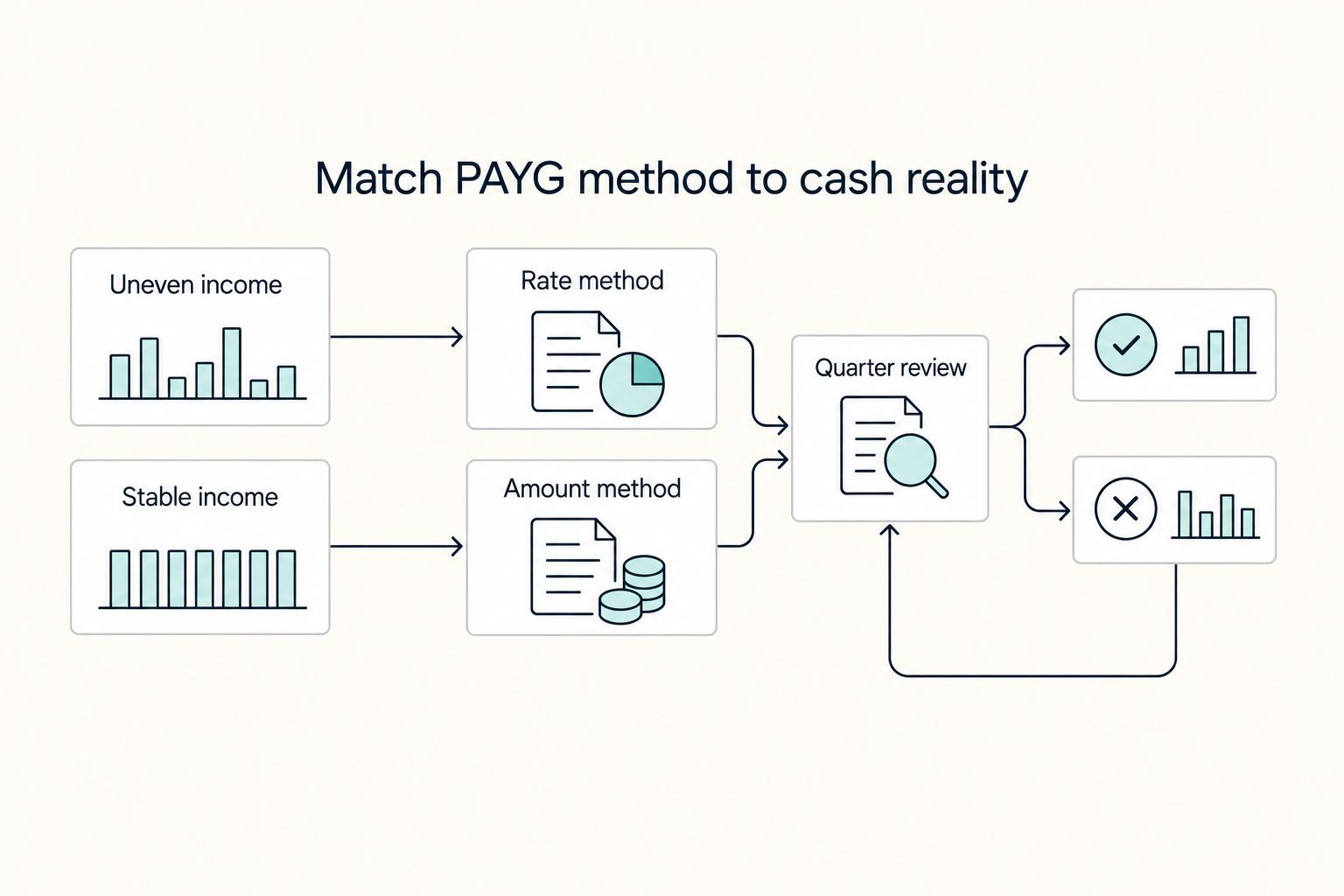
Choose the option that matches your cash reality each quarter, not the one that only looks simpler on paper. If your income is uneven, a more cash-flow-responsive approach can help with timing pressure. If your revenue pattern is consistently stable, a preset amount may be easier to manage.
Check before you choose#
Use records, not memory. Review your recent BAS and instalment notices, plus a simple invoice-and-receipts summary.
| BAS field | What to check |
|---|---|
| G1 | total sales |
| G2 | exports |
| G3 | GST-free sales |
| 1A | GST payable |
| 1B | GST credits |
If your turnover is under $10 million, you may be on a simplified BAS, but these checkpoints still matter. The BAS also includes PAYG sections based on projected income brackets, so check those fields before lodging.
Run this quick checklist before deciding:
- Income volatility: Are quarters similar, or does one project heavily skew annual income?
- Admin capacity: Can you produce clean quarterly numbers before the due date, typically the 28th of the following month for quarterly BAS?
- Recent business changes: Have services, pricing, client mix, or payment timing changed?
- Mixed income types: Do exports, GST-free sales, or uneven payment timing make quarters hard to compare?
If your answers point to inconsistency, be cautious with preset payments because timing mismatches can create cash-flow pressure.
When a preset amount works#
A preset amount often works when your billing pattern is steady across quarters and you want lower ongoing admin.
The tradeoff is timing risk in weaker quarters. Late payments, project gaps, or lumpy revenue can make a fixed payment harder to fund when cash is tight.
When a cash-flow-responsive option works#
This option can fit project-based or seasonal freelance income when you want quarterly decisions to reflect current records. Similar timing logic appears in BAS cash-basis accounting, where GST is deferred until payment is received.
The tradeoff is operational discipline. Your quarterly records need to reconcile cleanly, especially around G1/G2/G3/1A/1B.
A practical choice table#
| Approach | Best for | Main risk | Operating effort | What to verify first |
|---|---|---|---|---|
| Preset quarterly amount | Generally steadier billing patterns | Cash-flow squeeze in weak periods | Low after setup | Recent quarters look consistent and major business settings have not changed |
| Cash-flow-responsive amount | Uneven receipts, project cycles, seasonal swings | Incomplete records can distort quarter-by-quarter decisions | Moderate each quarter | Quarterly records reconcile to BAS checkpoints (G1/G2/G3/1A/1B) before lodgement |
| Unsure or recently changed setup | Revenue or service model changed recently | Choosing convenience over fit | Moderate upfront | BAS history, receipt timing, GST treatment, and record readiness |
If you are unsure, choose conservatively and confirm the setup with your accountant before lodging.
Also watch turnover closely: at $75,000 annual turnover, or $150,000 for non-profits, GST registration can become mandatory, and failing to register when required can create backdated liabilities.
You might also find this useful: A Guide to GST for Australian Freelancers.
Step 2: Fund Your Tax Liability From a Separate Account#
Once your PAYG method fits your income pattern, the next control is simple: separate tax cash from operating cash on the day money lands. This is an operational step, not mindset advice, and it helps prevent spending money that is already committed to liabilities.
You can call it a Tax Vault if that helps, but treat it as a dedicated liability account, not spare cash. If you run a partnership, company, or trust, formal separation is required for tax purposes. If you are a sole trader, it still gives you a clean line between operating spend, personal spend, and amounts that may later be reported on BAS or IAS.
Set the transfer rule before the quarter gets busy#
Use one default rule: move a fixed share of every client payment into the separate account immediately. Start with a conservative allocation based on your lodged results and current forecast, then tune it to your actual margin, GST status, super obligations, and recent notices.
Base that rule on the right input. PAYG instalment income uses gross business and investment income, excluding GST, not net income after deductions. If you are GST-registered, treat GST collected as ring-fenced until BAS lodgement and payment.
Use the same four-step process on every payment#
Use the same process for every receipt:
| Step | What to do | Key detail |
|---|---|---|
| Allocate | Move the transfer to the tax account | As soon as funds clear |
| Label | Record the transfer by date, client, and purpose | PAYG, GST, super, or year-end true-up |
| Track | Monitor the running balance against the statement you will lodge | BAS if GST-registered, IAS if not |
| Reconcile | Check the balance regularly | Monthly and again before due dates |
Before lodgement, compare the account balance to expected PAYG, GST collected, and any super due. If there is a gap, close it before lodgement rather than carrying unpaid tax amounts that can attract general interest charge.
Decide what the buffer actually covers#
Map your buffer to four buckets: PAYG instalments, GST if applicable, super where required, and year-end true-up. PAYG is a prepayment, so final tax can still end in a refund or a catch-up amount after return lodgement.
Keep PAYG and GST funds ring-fenced until BAS or IAS is lodged and paid. Do the same for super when you have eligible employees, or contractors mainly paid for labour who may fall under SG rules. If you are a sole trader, do not assume you owe SG for yourself.
Price work on what is left after provisioning#
Use post-provision cash as your pricing guardrail. Quote and accept work based on what remains after tax set-asides, GST if registered, and direct delivery costs.
If a project only works before provisioning, it is underpriced. That keeps collections and usable income separate in your decisions.
If you want a deeper dive, read our guide to a defensible 2026 filing plan.
Step 3: File with Confidence - A Risk-Mitigation Guide to Varying and Lodging#
Once tax cash is ring-fenced, most execution risk comes down to judgment and record quality. The safest default is still the conservative one: if the facts have not clearly changed, keep your current approach and lodge from verified numbers.
A variation is for documented changed facts, not guesswork.
Should you vary this quarter?#
This guide does not include PAYG-specific variation thresholds, penalty percentages, due dates, or form workflows. Use current ATO PAYG guidance for those details.
Vary only when you can point to evidence that your expected full-year position has materially changed, and keep that evidence with your records.
If your answer is "maybe," stay conservative and reassess next quarter. Underestimating can still create a year-end shortfall. ATO guidance changes, so verify the current rule in official ATO processes before you submit.
Build a short evidence note before lodging#
Before you touch the form, reconcile the income figure you plan to lodge against your invoice register, bank deposits, payment platform reports, and bookkeeping records. If they do not tie out, fix that first.
Then save a brief rationale note with:
- Date of review
- Records checked
- What changed, or did not change
- Why you varied, or chose not to vary
Keep it short and factual so you can explain the decision later.
Use a pre-lodge and post-lodge control loop#
Run the same checklist every quarter:
| Step | What to do | Key detail |
|---|---|---|
| 1 | Reconcile quarter figures | Tie them to invoices, receipts, and accounts |
| 2 | Confirm the current ATO process for your obligation type | For PAYG specifics, verify current ATO instructions directly |
| 3 | Register for GST if required | Register within 21 days; penalties may apply if you fail to register when required |
| 4 | Confirm the non-resident GST path before lodging | Standard registration involves BAS lodgement and GST payment monthly or quarterly; simplified registration is limited and does not allow tax invoices or GST credit claims |
| 5 | Lodge through the current official ATO process, complete payment, and retain proof | Keep lodgement confirmation, payment receipt, and any written ATO registration notice showing the effective date |
Submitted is not done until payment clears and proof is stored.
If your case includes cross-border activity, entity changes, or GST complexity, escalate early to a registered tax professional. ATO processes can differ by registration path and can include operational constraints (for example, offshore electronic lodgement limits in standard non-resident GST), so use current ATO guidance and documented assumptions rather than memory.
Related: A Guide to Tax Residency in Australia for Digital Nomads.
Before you lodge, run a quick deductions check so your annual return and PAYG estimates stay aligned with your records. Use the home office deduction calculator.
Run the Same Quarterly Cycle: Forecast, Fund, File#
To reduce PAYG stress, run the same quarterly cycle every time: Forecast, Fund, File. Repeating that cycle keeps you working from current records instead of assumptions and reduces year-end surprises.
Forecast#
Start each quarter with a short forecast based on current invoices, expected work, and your most recent lodged results. If your income is regular or growing, treat that as a prompt to set up or review PAYG instalments.
Before you make quarter decisions, review deductions and keep expense tracking current. A common failure mode is waiting until lodgement week and finding your year has moved away from your earlier assumptions.
Fund#
As income comes in, keep your expected tax obligation visible in your quarterly plan. PAYG instalments are quarterly prepayments toward expected annual tax, which can reduce the shock of a single end-of-year bill.
If your plan assumes a refund buffer, pressure-test that assumption. Refund outcomes can change, especially when temporary offsets end, so relying on a refund to cover a shortfall can create risk.
File#
Before lodging, reconcile the quarter once, then decide whether your current PAYG approach still matches your numbers. Keep a small support file each cycle: income summary, expense records, and a short note on any changed assumptions.
When to get help#
Get help early if your quarterly numbers no longer match your plan or you are unsure how to proceed.
This quarter, use the checklist from the earlier sections as written, then review what felt clunky and tighten your setup before the next cycle.
Related reading: A Guide to Capital Gains Tax for UK Freelancers.
Planning tool: Track your residency factors.
Frequently Asked Questions
What are PAYG instalments, and how often do you deal with them?
PAYG instalments are regular prepayments toward tax on business and investment income, usually once every 3 months. Each quarter becomes a compliance checkpoint, and your annual return reconciles the year and credits the instalments already paid. Reconcile your numbers before lodging and keep payment and lodgement records.
Is this the same as PAYG withholding?
No. PAYG withholding is a separate employer withholding system. Do not assume one system covers the other across different income streams. Get advice if you move between employee and sole trader work or start paying staff or contractors.
How much should you set aside for tax?
Set your reserve from your own lodged results and current forecasts, not from a generic number. Review it regularly. Get help if your income is volatile, your effective rate is shifting, or the reserve keeps falling short.
Should you use the instalment amount or instalment rate method?
Choose the method only after checking current ATO wording and reconciling your records. A preset amount may fit steadier billing, while quarter-based inputs need fully supportable numbers. Test the cash-flow impact before you choose or change method.
When should you vary an instalment?
Vary only when your expected full-year position has clearly changed and your records support that change. Prepare a short evidence note showing what changed, what records you checked, and why you varied or did not vary. If the position is uncertain, stay conservative and reassess next quarter.
What if you cannot pay on time?
This guide does not verify current late-payment consequences or payment-plan settings. Check current ATO guidance promptly, keep proof of lodgement, and get help early if the shortfall may continue beyond one cycle.
Can you claim business expenses against your quarterly instalments?
PAYG instalments are prepayments that are offset against your tax when you lodge your annual return. Keep deduction records throughout the year so the return is complete and supportable. Get help for judgment-heavy areas such as asset purchases, mixed-use costs, or home office treatment.
Should you voluntarily enter PAYG instalments as a new freelancer?
You may be entered automatically, or you can voluntarily enter, but this guide does not verify a current numeric entry threshold. Check your current ATO status first and then confirm whether voluntary entry is available. Get help if first-year income is rising quickly or includes salary, investment, or overseas income.
Does GST change any of this?
Yes, but GST registration and PAYG instalments are separate checks, so one threshold does not decide the other. If GST registration is required, register within 21 days, and penalties may apply if you fail to register when required. If you are non-resident, standard GST registration may require an Australian registered tax agent because electronic lodgment from outside Australia is not available.
Try a related tool
Researched and edited by the Gruv editorial team. Gruv builds cross-border billing, payouts, and finance-operations software for global businesses.
Sources
- ato.gov.au/businesses-and-organisations/income-deductio...trusted
- ato.gov.au/businesses-and-organisations/income-deductio...trusted
- business.gov.au/finance/tax/pay-as-you-go-payg-instalmentstrusted
- cs.cmu.edu/~ark/dyogatam/wordvecs/vocab.txttrusted
- cs.princeton.edu/courses/archive/spring18/cos226/assignments/...trusted
- govinfo.gov/content/pkg/GAOREPORTS-GAO-06-126/html/GAORE...trusted
- mit.edu/~ecprice/Public/freq/googlelist.countstrusted
- oecd.org/content/dam/oecd/en/publications/reports/201...trusted
Educational content only. Not legal, tax, or financial advice.
Related Posts

Digital Nomad Taxes in 2026 With a Defensible Filing Plan
With digital nomad taxes, the first move is not optimization. It is figuring out where you may be taxable, where filings may be required, and what proof supports that position.
Australia Tax Residency for Digital Nomads With GST and ABN Checkpoints
The goal is a defensible, low-drama position the Australian Taxation Office (ATO) can follow from your records, not a clever workaround. For a digital nomad, that usually means keeping two tracks straight: residency and GST/ABN admin. Consistency is what holds up over time: use real facts, take steps in a clear order, and keep documents that still match months later.
A Guide to GST for Australian Freelancers
**Use a simple decision system, not memory or platform prompts, to manage GST decisions with less stress and fewer mistakes.** You do not need tax trivia to start. You need a repeatable rhythm you can run even when work spans countries, clients, and platforms.