
Quick Answer
Invest only if you can document an eligible gain, meet the 180-Day Investment Period, and prove the exact census tract is a designated Qualified Opportunity Zone through a Qualified Opportunity Fund. Treat Opportunity Zone real estate as a conditional tax incentive, not an automatic green light, and pause when timing, classification, or reporting points are still unresolved.
Start Here if You Want Opportunity Zone Tax Benefits Without Compliance Surprises#
Treat Opportunity Zone real estate as a conditional tax incentive, not an automatic green light. Use this guide to make a go/no-go decision in one sitting based on your risk tolerance, tax profile, and ability to handle the compliance work.
By the end, you should have three outputs: a clear go/no-go call, a short pre-commit checklist of documents to verify, and clear triggers for when to involve a tax professional.
Start from the right expectation#
Economic Opportunity Zones were presented in the Tax Cuts and Jobs Act era as a way to encourage investment in low-income communities. In the October 3, 2018 Senate Small Business and Entrepreneurship hearing (115th Congress, Second Session), the incentive was described as deferral of certain taxes on income when investment goes into low-income communities.
That framing matters. This is not a blanket real estate benefit, not proof a deal is sound, and not a substitute for normal diligence. The same policy discussion also stressed that broad tax cutting alone is not enough without targeted design, which is a useful rule of thumb for investors. Tax treatment can support a strong deal, but it does not rescue a weak one.
Keep the scope narrow if your tax life spans countries#
If your tax life spans countries, keep this section limited to the U.S. incentive framing above. Use this guide as a U.S. decision checkpoint, then separate country-specific residency or reporting questions for dedicated professional review.
Verification is a core step, not an optional step#
Published summaries often mix policy discussion, commentary, and implementation claims, so do not treat them as equal authority. For example, a GAO report released March 1, 2011 can show up in broad searches, but it is a broad duplication-in-government-programs report, not Opportunity Zone implementation guidance.
The October 3, 2018 Senate hearing is useful context, but it is not a compliance manual. If you see OZ 1.0 or OZ 2.0 timeline claims in summaries, treat them as unverified until you confirm them in primary authority.
What a good outcome looks like#
A good outcome is not "there is a tax benefit, so I'm in." It is being able to explain, in plain language, why this fits your risk tolerance, whether the operating burden is realistic, and which points still need professional confirmation.
If you cannot answer those cleanly yet, a no-go or not-yet decision is valid. The safest default is to proceed only when each material claim in your file ties back to primary documentation or written professional advice.
We covered this in detail in A Guide to Cost Segregation Studies for Real Estate.
The Core Terms You Must Get Right Before You Model Returns#
Before you model returns, separate location terms, fund terms, and tax-rule terms. A common source of confusion is blending them into one idea.
Start with the place, not the pitch#
An Opportunity Zone is an economic development tool for investing in distressed U.S. areas. A Qualified Opportunity Zone (QOZ) is the designated area itself, defined by census tract, through state nomination and U.S. Treasury certification.
For decision-making, treat QOZ status as a location test, not a deal-quality signal. Verify the tract with an official census-tract-based lookup before you model tax outcomes.
Then separate the fund from the zone#
A Qualified Opportunity Fund (QOF) is the investment vehicle taxpayers use to invest in Opportunity Zones. The tax path runs through the fund structure, not just the fact that a property sits in a designated tract.
Learn the three rule buckets you will keep seeing#
| Rule bucket | What it covers | Key note |
|---|---|---|
| Deferral of Eligible Gain | Certain gains may be deferred | Requires timely investment in a QOF |
| 180-Day Investment Period | Timing window you need to track | IRS FAQ rule category; detailed mechanics require deeper guidance |
| Inclusion of Deferred Gain | Deferral is temporary | Ends at an inclusion event or on December 31, 2026, whichever is earlier |
For authority, use IRS Opportunity Zone guidance and IRS FAQs to orient yourself, then anchor interpretation in the Income Tax Regulations. The IRS states the FAQs are not legal authority and do not amend regulations. At least one official Opportunity Zone page also notes its guidance reflects original implementation and that newer-law information is still pending.
For a related entity-structure topic, see A Guide to Using a Series LLC for Real Estate Investing.
How the Opportunity Zone Tax Path Works in Real Life#
Treat this as a proof sequence, not a story. If you cannot document timing and classification cleanly from gain through QOF entry, do not proceed.
Follow the sequence in order#
In practice, you need a clear chain from eligible gain to the 180-Day Investment Period, then into a Qualified Opportunity Fund (QOF), and then through holding and exit records, including Inclusion of Deferred Gain checkpoints.
| Checkpoint | What to confirm |
|---|---|
| Eligible gain | The gain event is clearly identified in your records |
| 180-Day Investment Period | The timing window is tracked as a key documentation checkpoint |
| QOF entry | The investment went into a QOF, with dated fund-entry documentation |
| Holding and exit | Ongoing records are maintained so later gain-inclusion analysis is supportable |
If you cannot explain that timeline on one page with supporting documents, pause until you can. The IRS also states its Opportunity Zone FAQs are for basic understanding and are not legal authority. Use them for orientation, then confirm legal interpretation against the Income Tax Regulations with your adviser.
Separate tax qualification from deal quality#
A documented tax path and an attractive investment are two different decisions. Keep "QOF and tax path are documented" separate from "the deal is worth doing," and require support for both before you invest.
Do not blur property tests and business tests#
IRS OZ topics separate property-level and business-level categories, including Qualified Opportunity Zone Business Property and Qualified Opportunity Zone Business. Do not use those labels interchangeably.
A deal being in a designated zone does not, by itself, resolve every qualification question. The IRS also separately flags a QOZ Business 50-percent of gross income test, which is another signal that business-level analysis is distinct from property-level analysis.
Ask for a written statement of which classification bucket the position relies on. If timing or classification is still unclear, treat the deal as a no-go until that is fixed. If you want a deeper dive, read Digital Nomad Taxes in 2026 With a Defensible Filing Plan.
Your 5-Minute Go or No-Go Triage#
Use this as a hard filter: proceed only if gain, timing, and tract proof are all clear. If any gate is uncertain, pause and escalate before committing funds.
| Gate | What to confirm | No-go signal |
|---|---|---|
| Eligible gain | You can name the exact gain and point to the record that supports it | The gain event, recognition date, or related-person status is unclear |
| 180-Day Investment Period | A credible path from gain recognition to QOF investment without a last-week scramble | A dated point depends on unresolved documents or banking and logistics friction |
| Qualified Opportunity Zone tract | The exact tract ID is matched to official designation sources and dated support is saved | Someone is relying on old marketing claims without tract-level support |
The prior section laid out the full sequence. This one answers the narrower question of whether that sequence is usable in your case right now.
Gate 1 asks whether you have a clearly identifiable eligible gain#
Start with the gain event, not the property. For Deferral of Eligible Gain, you should be able to name the exact gain and point to the record that supports it.
The IRS says eligible gains include capital gains and qualified 1231 gains, and exclude gains from related-person transactions. For triage, identify the source document, for example sale records, brokerage gain reporting, K-1 support, or your preparer's gain schedule. If the gain event, recognition date, or related-person status is unclear, treat it as no-go until your adviser confirms it in writing. Because timing matters, keep one date in view: eligible gains are described as gains recognized before January 1, 2027.
Gate 2 asks whether you can meet the 180-day window with real margin#
Treat the 180-Day Investment Period as a deadline checkpoint. You do not need every technical start-date nuance for triage, but you do need a credible path from gain recognition to QOF investment without a last-week scramble.
Pressure-test the timeline with four dated points: gain date, internal decision date, subscription or wire date, and QOF investment date. If any point depends on unresolved documents or banking and logistics friction, you are already tight.
Also keep expectations clear. Deferral is temporary. The IRS notes deferred gain is recognized no later than December 31, 2026, or earlier if an inclusion event reduces or terminates the qualifying investment.
Gate 3 asks whether you can prove the tract is actually designated#
Do not rely on "it's in an OZ area" language. Qualified Opportunity Zone status is tied to population census tracts, so your checkpoint is the exact tract ID used in the deal.
For a fast verification pass, match the tract in the deal memo to official designation sources. CDFI resources can help with nomination and designation context, but your file should still show tract-level designation proof from official sources. Save dated support, whether a screenshot or PDF, in your records. If someone is relying on old marketing claims without tract-level support, treat that as a red flag and pause.
Before you commit funds, your mini evidence pack should include:
- the identified gain record and why it is eligible
- a dated 180-Day Investment Period timeline with operating margin
- tract-level census proof tied to official designation sources
If any one of those is uncertain, the right call is no-go until resolved.
Eligibility Checkpoints You Should Validate Before You Wire Funds#
Before you wire, require a written sign-off table for every material claim. If a claim is still verbal, treat it as unresolved and pause.
In these deals, fund-level, property-level, and investor-level positions are separate. The working rule is simple: each claim needs evidence, a named owner, and a last date when you can still stop.
Use a sign off table before subscription#
Use the table to force claims into documents and clear accountability. For pre-wire diligence, keep sponsor counsel, fund admin, and your tax reviewer explicitly assigned.
| Rule area | Evidence required | Owner | Deadline | Do not proceed if |
|---|---|---|---|---|
| OZ qualification claim (fund, property, or business) | Written legal/tax analysis and dated supporting documents; if the rule criteria are not documented, mark the claim as unknown | Sponsor counsel and your tax reviewer | Before subscription signing | The claim appears only in marketing copy, calls, or undated summaries |
| Investor tax-position claim | Your gain/transaction records plus written confirmation from your tax reviewer of the position you are relying on | Your tax reviewer | Before funding approval | The records, investor identity, or stated position do not line up |
| Rule change or legislative update claims | Official Congress.gov status artifact showing the tracker steps and latest action (including "Presented to President" and "07/04/2025 Became Public Law No: 119-21" for H.R.1) | Sponsor counsel | Before revised docs are signed | The sponsor cites "new law" without an official status record |
| Source-format consistency check | If you rely on extracted text, compare it with the official source page or PDF before relying on wording | Sponsor counsel with fund admin tracking | Before final legal/tax sign-off | Only one format was reviewed for critical language |
| Elevated governance-risk areas | Written rationale for stricter documentation and controls where oversight risk is higher | Sponsor counsel, fund admin, and your tax reviewer | Before wire release | No one is accountable for enhanced controls in higher-risk areas |
Do not confuse renovation language with qualification proof#
"Redevelopment" or similar labels are not proof by themselves. If an OZ eligibility label is part of the investment case, require written analysis tied to specific documents; if that support is missing, treat eligibility as unknown and pause.
If the claimed path changes across calls or documents, stop and resolve it before funding. Mixed or shifting labels are a diligence failure, not a wording issue.
Separate fund, property, and business claims#
Have each claim confirmed by the party who owns it. Sponsor counsel confirms the legal position, fund admin confirms what records will be maintained, and your tax reviewer confirms what assumptions flow to your return.
That split reduces blind spots. A clean memo without a recordkeeping process, or a theory without supporting file evidence, is still a no-go.
Verification details that are worth the extra ten minutes#
For legislative-change claims, keep an official Congress.gov artifact in your file instead of relying on deck screenshots. Congress.gov provides a status tracker with step checkpoints, including "Presented to President." It also shows H.R.1 as "07/04/2025 Became Public Law No: 119-21."
Also check the source format when reviewing extracted text. GAO notes accessible text files may not exactly duplicate printed formatting, so confirm the official source page or PDF before relying on wording.
Where governance risk is elevated, require tighter documentation. GAO describes high-risk areas as having greater vulnerabilities to fraud, waste, abuse, and mismanagement, which is enough to justify stricter evidence standards before cash leaves your account.
If core eligibility or tax-position claims are not documented in writing, do not proceed.
You might also find this useful: Tax Implications for a UK Resident Owning a US LLC.
Picking a Fund Structure That Matches Your Complexity Budget#
If you have limited back-office support, choose the structure with the clearest accountability, even if it gives you less control. In practice, that can mean an administratively mature pooled OZ fund structure instead of a custom setup.
This is an execution choice, not a style preference. The Tax Cuts and Jobs Act created the Opportunity Zone regime. Later IRS final regulations were extensive, with one legal summary describing 544 pages that clarified earlier proposed rules from October 2018 and April 2019. In a dense rule set, every custom feature can add another point of ownership risk.
Pooled funds versus custom structures#
A pooled fund trades control for a more standardized operating setup. A customized structure can still make sense for special ownership, estate, or parallel-investor needs, but only if someone is actively managing the added recordkeeping and legal coordination.
That tradeoff shows up in market behavior. Private equity and private real estate sponsors were described as slow to use OZ tax benefits, with fund structuring presenting both opportunities and challenges. If experienced sponsors found structuring complex, you should not assume a tailored deal will be easy to run as a solo investor.
You may also see "parallel structures" offered for Qualified Opportunity Zone (QOZ) investors. Treat that as a design choice that requires precision. Get an entity chart, governing documents, and a plain-English memo showing how capital is contributed and who monitors qualification at each layer.
The solo-operator rule#
If you are a business of one, use customization only when you have a clear reason and clear operators. A mature pooled fund with consistent documents, working fund administration, and a named tax contact is often a better fit than a structure that depends on you coordinating multiple advisers after the fact.
A common failure mode is false control. Custom terms, side arrangements, trusts, or estate wrappers can feel precise, but family-office OZ planning can involve trust, estate, and GST-related complexity that raises the administrative burden.
Rural labels need harder proof#
If a rural deal uses a label like Qualified Rural Opportunity Fund (QROF), treat that as a documentation trigger, not proof. Do not rely on the label alone to answer structure, eligibility, or tax-treatment questions.
Ask where the term appears, who drafted that document, and what legal authority the sponsor relies on. If the support is only marketing copy, webinar slides, or sales material without matching legal documents, pause and escalate.
Assign owners before you subscribe#
Your structure decision should end with a written accountability map. Before signing, identify:
- who tracks qualification-related tasks across the structure
- who handles investor communications
- who owns year-end tax document readiness and file retention
If no one will take written ownership of each item, the structure is too complex for your support model. In these deals, the safer setup is usually the one you can verify and operate consistently.
This pairs well with our guide on A Guide to Real Estate Investment Trusts (REITs).
Real Estate Deal Fit Matters More Than the Tax Headline#
Treat OZ tax treatment as a bonus, not the investment thesis. If you would not invest in the deal without the OZ angle, the tax headline is not enough.
An Opportunity Zone is a geographic designation, not a quality screen. The program has covered over 8,700 designated census tracts since 2017, so "it is in an OZ" does not tell you whether the project is strong. Start with the exact OZ census tract tied to the property, then test whether that location supports the actual plan.
Start with the tract, then the use case#
Project fit is property-specific. Affordable housing, mixed-use redevelopment, and similar pitches can all sound compelling, but each still depends on local demand and execution in that tract.
Use this operator question: does this specific tract support this specific plan right now? If the sponsor cannot show tract-level demand and a credible operating path, you are underwriting a narrative, not a deal.
Stress test the story against documents#
Misconceptions around OZ investing are documented, so test marketing claims against operating evidence and ask for:
| Ask for | Document detail |
|---|---|
| Property address | Matched to the exact OZ census tract used in legal and subscription documents |
| Base-case underwriting view | Not dependent on full OZ upside |
| Demand and execution support | Project-specific demand support and current execution status |
| Timeline documentation | What is complete, what is still pending, and what assumptions drive the timeline |
If most of the conversation is about tax benefits while core execution steps are unresolved, treat that as a deal-quality warning.
The common investor mistake#
One common mistake is overvaluing tax mechanics and underweighting base deal quality. The tax upside is potential, not certain, so model it that way.
Use a simple decision rule: if the base deal is not investable without OZ incentives, do not use tax treatment to compensate for weak fundamentals. Also treat 2026 designation chatter as speculative unless it changes the current, documentable case for the asset today.
Related: How to Invest in Real Estate as a Digital Nomad.
Handle OZ 1.0 and OZ 2.0 Timeline Conflicts Before You Commit#
Pause the deal if OZ 1.0 and OZ 2.0 timing cannot be reconciled from primary authority. For unresolved timeline points, use one rule: verify with counsel now, not "assume later."
What the public record settles right now#
| Source | What it clearly says now | What it does not settle | What you do |
|---|---|---|---|
| IRS core OZ page and newsroom materials | States nominated communities, and the U.S. Department of the Treasury certified those nominations. Designated tract lists are in IRS Notices 2018-48 and 2019-42. Announcement 2021-10 says QOZ boundaries were unaffected by 2020 decennial census changes. Deferred gain inclusion is tied to an earlier inclusion event or December 31, 2026. | No exact future map-transition dates or later designation-cycle rules are provided here. | Use IRS notices plus Announcement 2021-10 as your baseline, then verify with counsel now before relying on any "automatic carryover" claim. |
| IRS Opportunity Zones FAQs | Useful orientation only. IRS says these Q&As do not constitute legal authority and may not be relied upon as such. | FAQ text alone does not resolve timeline conflicts. | Do not accept FAQ language as a final answer. Verify with counsel now. |
| CDFI Fund OZ page | CDFI says its guidance refers to the original implementation under the Tax Cuts and Jobs Act of 2017. It also says more information on the 2025 permanent framework in the One Big Beautiful Bill Act of 2025 will be provided. | Transition assumptions for the 2025 permanent framework are not complete in these materials. | Treat "new map rules are settled" as unproven until counsel confirms governing text and effective dates. |
| HUD materials | Do not assume any HUD item resolves map timing, designation cycles, or transition mechanics. | A HUD map or summary alone does not reconcile OZ 1.0 and OZ 2.0 timing. | If HUD visuals are in the deal file, pair them with IRS primary materials and counsel review before you commit. |
| Sponsor references to 2025 legislation | More 2025 framework information is pending. | No exact transition date, cycle, or safe-harbor timing is established here. | Do not underwrite from bill-label shorthand. Get counsel's memo on operative text and effective dates. |
Who does what in the designation chain#
Keep the roles separate so your file stays clean. IRS states that states nominated communities and Treasury certified those nominations. CDFI states it supports IRS on nomination and designation under IRC 1400Z-1 only, and that implementation authority for IRC 1400Z-1 and 1400Z-2 is delegated to IRS.
For underwriting, this is a document-control issue. A tract-status claim should trace to the certification and notice trail, not just a map layer, FAQ excerpt, or fund deck. If a sponsor references broader transition authority, require the exact primary documents and counsel interpretation before treating that as settled.
If Puerto Rico tracts are involved, stay literal on dates and records. IRS newsroom materials note a congressional designation effective Dec. 22, 2017, and CDFI notes its spreadsheet update on December 14, 2018 adding two Puerto Rico census tracts.
Verification checklist for your deal file#
- dated screenshot of the sponsor map, with exact census tract ID
- tract match to IRS Notice 2018-48 or IRS Notice 2019-42
- support from Announcement 2021-10 when census-boundary questions are raised
- note on any IRS FAQ language used, plus counsel replacement with primary or binding authority
- written sign-off from sponsor counsel and your tax advisor for each timeline assumption tied to map status, designation continuity, or post-2025 transition claims
If your file lacks dated proof, tract proof, and advisor sign-off, treat timeline status as unresolved risk, not confirmed coverage.
Build an Evidence Pack Before Subscription Documents#
Before you sign subscription documents, consolidate everything into one evidence pack. If a reviewer cannot reconstruct your tract, fund, gain, and filing assumptions from that pack, treat the issue as unresolved risk.
What should sit in one folder#
Use one folder that answers four questions quickly: what tract, what fund, what gain, and what filing consequences. The table below is a practical minimum pack.
| Pack area | Minimum contents | Checkpoint that matters |
|---|---|---|
| Tract and designation proof | dated map screenshot, exact census tract ID, and the primary documents your team relied on | Tract status is supported by documents, not a sponsor summary |
| QOF legal file | subscription documents, offering and organizational documents, and counsel notes on status assumptions | You can confirm the exact entity and document version you reviewed |
| Gain and timing file | advisor memo, dated transaction records, and funding proof used for your gain and timing position | Your position is tied to records, not memory |
| Cross-border reporting file | residency assumptions, return-filing assumptions, Form 8938 review note, FBAR note, foreign-asset reporting tracking, and filing ownership | Form 8938 and FBAR obligations are tracked separately to reduce preventable gaps |
If a point affects your reporting position, store the source document itself, not just a note about it. That keeps later review tied to the actual record.
Add cross-border notes before the deal goes quiet#
For globally mobile investors, add a short tax operations memo before closing. Record your country-residency assumption, whether you expect to file a U.S. annual return, who owns each filing, whether any foreign assets were acquired or sold during the tax year, and any dependency that could delay completion.
Keep the Form 8938 and FBAR tracks separate in that memo. Form 8938 is attached to the annual return and filed by that return's due date, including extensions, and filing Form 8938 does not replace FinCEN Form 114 (FBAR). If you are not required to file an income tax return for the year, Form 8938 is not required for that year.
If a specified domestic entity is in scope, apply that entity's Form 8938 thresholds ($50,000 on the last day of the tax year or $75,000 at any time during the tax year) instead of assuming individual rules.
Keep a dated decision log#
Maintain a dated log showing what was confirmed, by whom, and under which document version. Include the issue decided, the conclusion reached, the reviewer or advisor name, the source document and version date, and the open dependency and next review date.
Do not hardcode old web summaries into your file. IRS and FinCEN pages can change, including event-specific FBAR extension notices, so your log should show exactly which version you relied on when you approved the deal.
Related reading: How to Calculate Cash-on-Cash Return for Real Estate.
If your OZ decision depends on cross-border filing status, use the tax residency tracker to keep day-count evidence in one place.
Cross-Border Tax Interactions That Can Blindside Freelancers#
A Qualified Opportunity Fund (QOF) can provide section 1400Z-2 tax benefits for certain equity interests, but it does not replace baseline filing analysis for residency and self-employment income.
The most common miss is assuming the investment resets the rest of your return. It does not. If you have net earnings from your business, Schedule SE (Form 1040) can still apply because it is used to calculate self-employment tax on those earnings. That tax covers Social Security and Medicare taxes only, not every other tax obligation. In practice, QOF-related tax treatment and a Schedule SE calculation can sit on the same return.
That overlap is where avoidable errors happen. OZ/QOF benefits do not make freelance income disappear, and they do not resolve cross-border status questions. The self-employment tax rate is 15.3% (12.4% Social Security and 2.9% Medicare). The Social Security portion is subject to a wage-base limit (the IRS page cites $168,600 for 2024). If you are globally mobile, review Schedule SE status directly instead of assuming being abroad removes it. The instructions include separate sections for U.S. citizens or resident aliens living outside the United States and for nonresident aliens.
Use a simple control: add the current-year Schedule SE instructions to your file and check for posted corrections before filing. The posted correction to the 2025 instructions on 20-FEB-2026 is a practical reminder that instruction versioning can change your filing process.
The other blindside is home-country treatment. A QOF position may be clear for U.S. tax purposes while still uncertain where you live. If home-country treatment of U.S. funds is uncertain, get bilateral tax advice before investing, while you can still decline the deal or change structure.
Red Flags That Mean You Should Stop and Bring In a Pro#
If any of the items below is still unresolved when subscription documents arrive, pause and bring in a pro before you commit capital.
- It is still unclear whether you are a specified person or a specified domestic entity with a Form 8938 obligation.
- It is still unclear whether you have reportable specified foreign financial assets.
- Threshold and filing-status details that control Form 8938 filing are still "to be determined."
- You are treating Form 8938 as a substitute for FinCEN Form 114 (FBAR).
For the Form 8938 piece specifically, use a simple gate: confirm filer status first, then confirm whether you have reportable specified foreign financial assets. Form 8938 is attached to your annual return and filed by that return's due date, including extensions, and filing Form 8938 does not replace FBAR. If filer status, thresholds, or return-filing requirements for the year are still unresolved, stop and get cross-border tax advice before you commit capital.
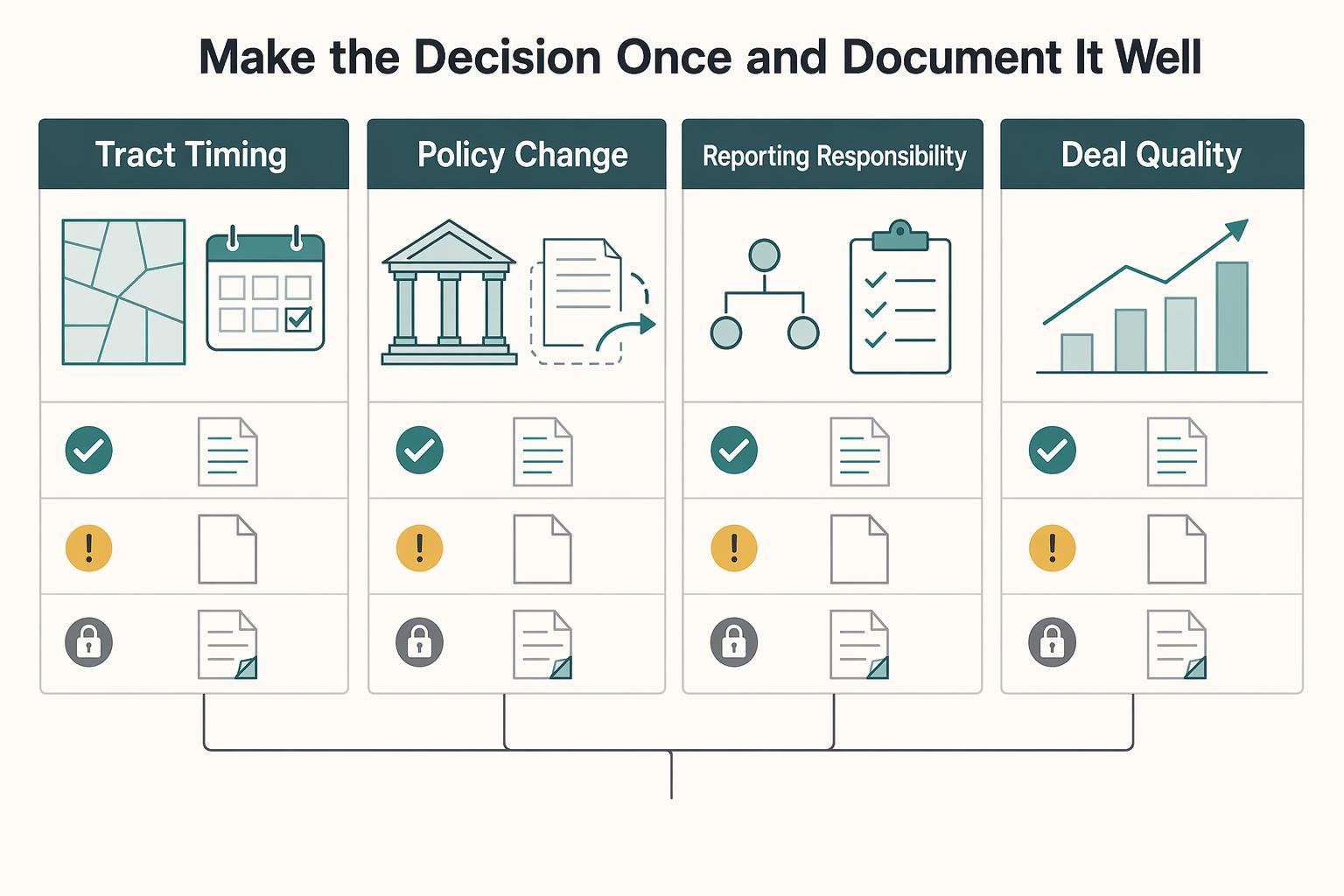
Make the Decision Once and Document It Well#
Proceed only when all three are true at the same time: the tax position is supportable, the documentation is complete, and the underlying deal is still strong on its own. If any one is unresolved, pause before subscription documents or funding.
Use your triage notes, checkpoint table, and evidence pack as a single decision file, then force a yes or no. Could you defend this file to a skeptical reviewer six months from now? At minimum, it should show what you know, who confirmed it, and what is still unverified.
| Checkpoint | Proceed when | Pause when |
|---|---|---|
| Tract and timing status | Current status is documented for the specific deal | You are relying on old deck assumptions |
| Policy-change impact | You have written support for how redesignation timing affects this investment | Timing impact is unclear, including 2027 redesignation effects |
| Reporting responsibility | Required reporting outputs (including Treasury annual and semi-regular reporting inputs) and investor document flow are clear in writing | Reporting or accountability is vague |
| Deal quality vs tax upside | The deal still works without the tax angle | The tax angle is carrying a weak deal |
Keep policy headlines separate from deal proof. In a July 11, 2025 analysis article, OZ policy is described as permanent with decennial redesignation cycles, and the map is described as likely smaller in the next round taking effect in 2027, so tract re-checking is a live task. The same analysis also warns that investor benefits can be front-loaded even when investment viability is weak. Tax treatment does not make a bad deal safe.
If a sponsor claims rural fund treatment or highlights the described enhanced basis step-up terms (30 percent versus the standard 10 percent), ask for written support, fund documents, and clear reporting ownership before you proceed. If your understanding depends mainly on a July 11, 2025 analysis article, treat your file as incomplete until legal and tax points are confirmed in writing.
The next step is mechanical: complete the checklist, collect missing proof, and mark each unresolved item as proceed, pause, or decline. If the decision still depends on assumptions you cannot document, do not fund yet.
Need another tax workflow example? Read A Real Estate Agent's Guide to the Home Office Deduction.
When you are ready to set up compliant money movement and audit-ready records across markets, talk to Gruv.
Frequently Asked Questions
What is an Opportunity Zone in real estate, and what does a Qualified Opportunity Zone actually designate?
An Opportunity Zone is an economic development tool for investing in distressed U.S. areas. A Qualified Opportunity Zone is the designated area itself, defined by census tract through state nomination and U.S. Treasury certification. Treat it as a location test, not a deal-quality signal.
Do I need to invest through a Qualified Opportunity Fund to access Opportunity Zone tax incentives?
Yes. The tax path runs through a Qualified Opportunity Fund, not just the fact that a property sits in a designated tract. Ask for the fund documents and a clear explanation of how your capital reaches qualifying property or business activity.
What are the core eligibility steps I should verify before making an Opportunity Zone real estate investment?
Start with three basics: eligible gain, the 180-Day Investment Period, and Inclusion of Deferred Gain. Then confirm tract-level designation proof and the qualifying path or classification the investment relies on. Because IRS FAQs are for basic understanding only, get your eligibility assumptions reviewed in writing before you commit.
Are Opportunity Zone rules changing under OZ 1.0 and OZ 2.0, and how should I handle conflicting timeline statements?
Yes, public summaries can conflict on OZ 1.0 and OZ 2.0 timing. Use IRS notices and Announcement 2021-10 as your baseline, and do not treat FAQ language or sponsor summaries as a final answer. If post-2026 treatment matters to your economics, get written confirmation from counsel before you invest.
Is Opportunity Zone real estate a good fit for a low-complexity solo operator with limited admin capacity?
It can be, but only if the structure matches your compliance and documentation capacity. A more administratively mature pooled fund may fit better than a custom setup when you have limited back-office support. If reporting ownership and recordkeeping are not clear in writing, pause.
What remains unknown from public summaries, and which points require direct professional verification?
The biggest unresolved issue in the article's public summaries is post-2026 treatment and the legal status of OZ 2.0 timeline claims. Public summaries also do not fully settle reliance-ready thresholds for tests like purchase, original use, or substantial improvement. Verify your gain eligibility, timing, QOF documentation, qualifying path, and any state-tax treatment directly with a qualified advisor.
Researched and edited by the Gruv editorial team. Gruv builds cross-border billing, payouts, and finance-operations software for global businesses.
Sources
- cdfifund.gov/opportunity-zonestrusted
- congress.gov/115/chrg/CHRG-115shrg32694/CHRG-115shrg32694...trusted
- congress.gov/bill/119th-congress/house-bill/1/summary/00trusted
- fincen.gov/report-foreign-bank-and-financial-accountstrusted
- gao.gov/assets/a315948.htmltrusted
- gao.gov/assets/a315740.htmltrusted
- huduser.gov/publications/pdf/ezec_report.pdftrusted
- huduser.gov/portal/periodicals/cityscpe/vol24num1/Citysc...trusted
Educational content only. Not legal, tax, or financial advice.
Related Posts

Digital Nomad Taxes in 2026 With a Defensible Filing Plan
With digital nomad taxes, the first move is not optimization. It is figuring out where you may be taxable, where filings may be required, and what proof supports that position.
How to Invest in Real Estate as a Digital Nomad
**Run anything with money and moving parts like an operations system (cash, docs, delegation, and controls), not a "passive income" vibe.** Real life stress-tests weak spots. You change time zones, a client pays late, and something breaks at the worst moment. As the CEO of a business-of-one, your job is to build a setup that keeps working when you are not available on demand.

Tax Implications for a UK Resident Owning a US LLC
When people search **uk resident owning us llc tax**, they often start with the wrong question. You do not win by chasing a clever position. You win by running a compliant system that can handle the way the US and UK classify LLC income differently, with records you can defend.