
Quick Answer
Start with okrs for company goal setting by setting a small number of Objectives, then attaching Key Results that are specific, time-bound, measurable, and verifiable. Run one Quarterly OKR cycle with weekly check-ins, assign one accountable owner per Objective and KR, and grade at quarter end using evidence from systems you already trust. Keep KPIs for health monitoring and keep task lists for delivery so OKRs stay focused on business outcomes.
Why OKRs fail as activity lists and work as outcome-linked measures with a single owner#
OKRs work when they create clarity, not more paperwork. For an independent professional, that means turning ambition into a short list of measurable outcomes with clear ownership, visible progress, and regular control points. You should be able to tell whether the business is actually moving.
The tension is familiar. You want goals that stretch the business, but you do not want the quarter to collapse into a bloated to-do list or a few upbeat lines nobody can verify. An Objective states what you want to achieve. A Key Result is the proof that progress is happening. If you cannot point to a real measure and a real owner, the KR is not ready.
That discipline matters more than the format. Research cited by Google Re:Work notes that committing to a goal can improve performance, and that challenging, specific goals can improve engagement in achieving them. Atlassian describes OKRs as a way to align people around measurable objectives and outcomes, with transparency and regular progress reviews. A quarterly review cycle is a common choice because it gives you enough time for meaningful movement without letting drift hide for too long.
The usual failure is simple. People mix strategy with task tracking. "Send 20 outreach emails," "redesign the site," or "publish content every week" may all be useful work, but on their own they are still activities. They only become strong Key Results when they connect to a business outcome such as qualified pipeline, conversion rate, retained clients, or booked revenue. If a KR cannot be checked against a source you already trust, like your CRM, invoicing report, analytics dashboard, or proposal tracker, review time turns into opinion.
This guide takes a practical line. You do not need a heavy process or a big-team setup. You do need a few operating rules: one owner per Objective and per Key Result, a quarterly cycle, simple grading, and regular control points. That way, you can catch problems while there is still time to respond. If a result has no baseline, no data source, or no check-in rhythm, treat that as a launch blocker, not something to clean up later.
By the end, you will have a first-quarter setup plan, a quality filter for writing KRs that hold up under grading, and a clear way to handle misses without chaos or blame. The goal is not motivational language. It is a business rhythm that helps you aim high, review honestly, and make better decisions when the quarter stops going to plan.
For a step-by-step walkthrough, see A freelancer's guide to 'Measure What Matters' (OKRs).
Build the right mental model before writing your first OKR#
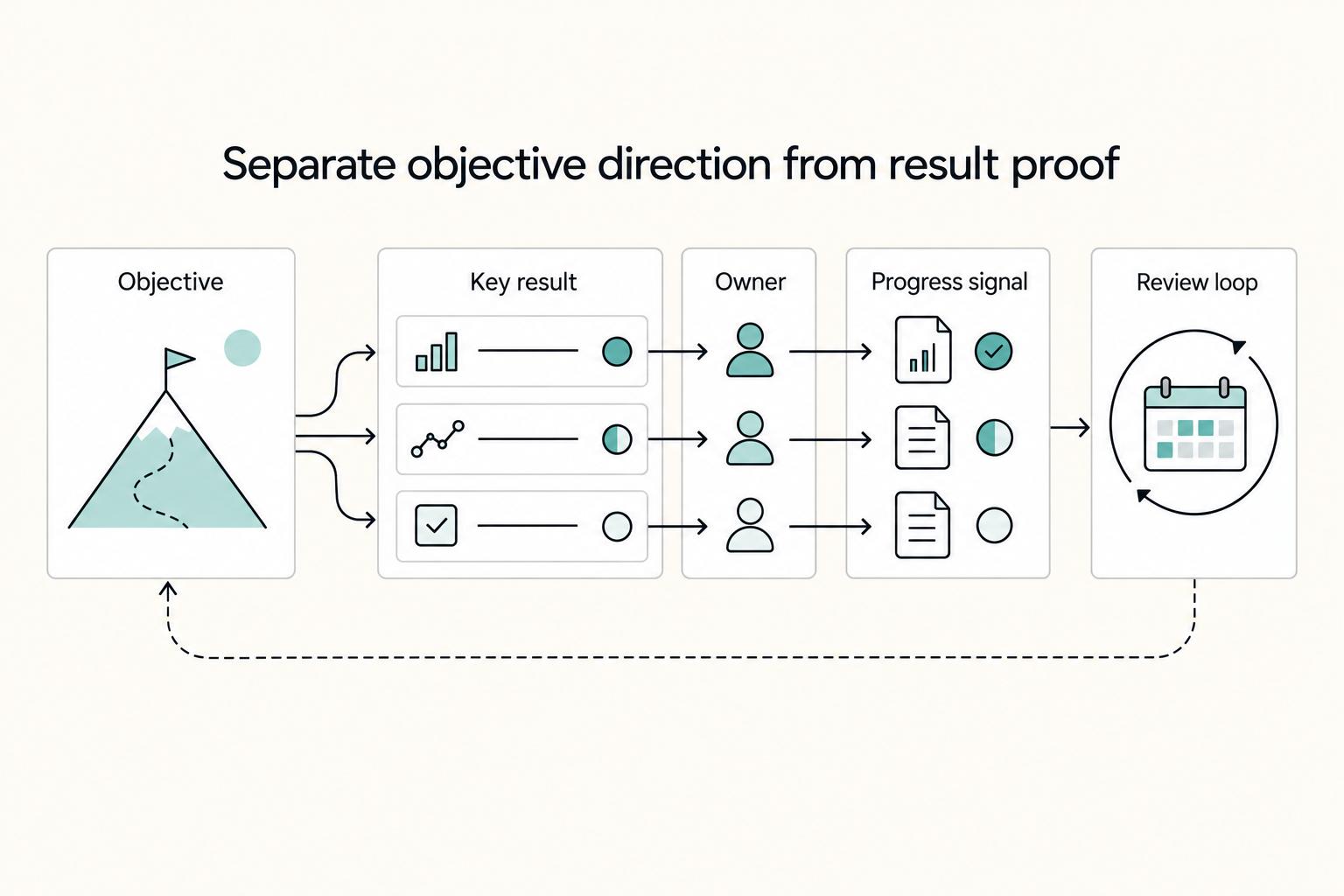
OKRs work when you separate direction from proof. Without that split, goals slip back into task lists. An Objective states where you want the business to go. A Key Result is the measurable evidence that you are moving there. If a statement sounds ambitious but cannot be checked, it is not ready yet.
Before you approve any Key Result, ask:
- What exact measure are we tracking?
- Where will we verify it during review?
If either answer is unclear, rewrite the KR before the cycle starts.
Keep one boundary firm from day one: OKRs are for strategic alignment around measurable outcomes, with quarterly reviews as the anchor. Your project plan, calendar, and task tracker still hold day-to-day execution. When you mix strategy and task tracking, the system drifts into busywork.
Separate OKRs from KPIs and task management#
Keep these four tools separate: KPIs keep the business healthy, OKRs drive measurable change, task lists track execution, and performance evaluations assess people.
| Tool | Best use | Time horizon | What it sounds like | Common mistake |
|---|---|---|---|---|
| Objectives and Key Results (OKRs) | Align teams around measurable outcomes and drive change | Usually quarterly | "Raise proposal-to-close rate this quarter" | Writing activities instead of outcomes |
| Key Performance Indicator (KPI) | Track whether an important metric stays healthy | Continuous | "Keep churn within our acceptable range" | Treating a monitoring metric like a change goal |
| To-do list | Track actions and delivery | Daily to weekly | "Publish the new pricing page" | Confusing completed tasks with business outcomes |
| Performance evaluations | Assess individual performance in role | Your review cycle | "How well did this person perform?" | Mixing stretch targets into people judgment |
Use this decision rule: if a metric must stay healthy continuously, it is a KPI. If it defines a shift you want by quarter end, it is a KR.
Before you approve any KR, ask whether you can map it to one business outcome and one owner. If it sits in a generic bucket like "marketing improvements," rewrite it until the outcome and owner are explicit.
Keep OKRs and performance evaluations separate in practice. When people expect stretch goals to affect personal ratings, teams often choose safer targets and avoid meaningful stretch.
If you are unsure where something belongs, ask: are we keeping this healthy, getting this done, or changing this this quarter? Healthy goes to KPIs, done goes to task management, and quarterly change goes to OKRs.
Set scope and ownership for a lean company#
In a lean company, start narrow: set a small set of company priorities, then map supporting team or individual KRs so execution is clear. The goal is alignment around measurable outcomes, not capturing every important task in one quarter. If a proposed KR does not clearly support a company Objective, keep it in normal delivery work or track it as a KPI.
Keep ownership clear, even with shared delivery#
Use a clear operating rule: one accountable owner per Objective and one accountable owner per KR, with collaborators listed for delivery support. This is a clarity choice, not a universal law. It keeps updates, evidence, and escalation paths unambiguous when progress stalls.
A simple KR line should show:
- Parent Objective
- Metric
- Accountable owner
- Collaborators
Decide tie-breaks before capacity gets tight#
When two KRs compete for the same capacity, use a predefined tie-break: prioritize the KR tied to the quarter's primary Objective, and defer or narrow the other. Treat this as an internal focus rule so strategy and execution stay connected.
Collaborative design vs MBO-style assignment#
Collaborative OKR design sets direction at the top and involves the people doing the work in shaping supporting KRs. MBO-style assignment defines goals top-down and hands them down for execution. A practical blend for lean teams is to set company priorities in leadership, draft supporting KRs with the team or individual owners, then finalize ownership in one review. For more on freelance goal setting, see How to Use OKRs for Freelance Goal Setting and Performance Tracking.
Write Objectives and Key Results that survive real grading#
If a Key Result cannot be graded cleanly at quarter end, it is not ready. An Objective states what you want to accomplish, and Key Results are how you will know you achieved it.
Weak KRs usually fail in predictable ways: they are vague, binary with no outcome context, or activity-only. Keep each Objective tied to measurable outcomes, and keep the set focused on top priorities rather than every task.
Use a KR quality filter before anything goes live#
Before launch, check every KR against the same four tests:
| Test | What a solid KR looks like | Reject if it reads like |
|---|---|---|
| Specific | Names the exact outcome and who or what is affected | "Improve onboarding" |
| Time-bound | Tied to a defined period (typically this quarter) | "Increase retention" with no deadline |
| Measurable | Has a clear baseline-to-target measurement or threshold | "Do better on sales calls" |
| Verifiable | Can be checked in a named system or evidence source | "Launch new messaging" with no proof of effect |
Reject activity-only KRs unless the activity itself is the intended result and you can defend that choice. Treat binary KRs carefully: "launch X" may be a milestone, but it is not outcome evidence on its own.
Before sign-off, each KR should include:
Data source(where the metric is pulled from)Check-in frequency(for example, weekly or biweekly)On-track definition(how progress should look at checkpoints)
If the owner cannot fill those three fields, the KR is still too loose.
Grade for ambition, not easy wins#
Use grading to test ambition and learning, not to reward safe targets. In stretch-oriented OKR practice, about 70% completion can still represent strong progress. So repeated perfect scores can mean targets were too conservative, not that performance was maximized.
Grade against the stated target and evidence, not effort. "We worked hard" and "we shipped it" are inputs; the KR grade comes from whether the promised result moved.
Rewrite weak OKRs into gradable ones#
- Weak Objective: Improve customer onboarding
Weak KR: Launch a new onboarding flow Stronger Objective: Help new customers succeed faster in their first 30 days Stronger KR: Increase 30-day activation rate from baseline to target by quarter end, measured in product analytics and reviewed weekly
- Weak Objective: Grow revenue
Weak KR: Reach out to more leads Stronger Objective: Build a healthier new-business pipeline Stronger KR: Increase qualified pipeline created this quarter from baseline to target, measured in CRM stage reports and reviewed weekly
- Weak Objective: Strengthen brand presence
Weak KR: Publish thought leadership content Stronger Objective: Generate more demand from the right audience Stronger KR: Increase inbound demo requests from organic content from baseline to target by quarter end, measured in attributed form submissions and checked biweekly
Final checkpoint: a new manager should be able to grade every KR from the tracker alone, without extra backstory. If they cannot, rewrite now.
Run the Quarterly OKR cycle without adding bureaucracy#
Run a quarterly OKR cycle with lightweight governance: set direction at kickoff, review evidence weekly, make live decisions only when judgment is required, then grade and carry forward intentionally. That structure keeps OKRs focused on outcomes instead of status chatter.
The practical rule is simple: use quarterly goals, review them weekly, and require pre-meeting updates so live time goes to decisions, not readouts.
Use a fixed quarterly rhythm#
A quarter is a common default because it gives enough time to move real outcomes while still allowing course correction. If you are running 2 to 4 Objectives, this cadence is usually enough to keep priorities clear without adding process weight.
| Stage | Main focus | Key detail |
|---|---|---|
| Quarter kickoff | Confirm each Objective, KR, owner, baseline, target, data source, and review rhythm | Keep initiatives and to-dos in your project tool, not inside the OKR tracker |
| Weekly check-ins | Review evidence weekly | KR owners should update current value, trend, confidence, and blockers before the meeting |
| Mid-quarter correction | Re-check assumptions | Decide what changes: the KR, the execution plan, or both |
| End-quarter grading | Grade against the stated target and evidence | Not effort or activity volume |
| Next-cycle carry-forward | Carry forward only what is still strategic | Rewrite or retire KRs that no longer fit |
Quarterly OKRs are the execution layer; broader strategic OKRs set direction. Weekly evidence is what makes learning visible early enough to act on.
Design meetings so decisions happen live#
Keep weekly reviews small and decision-oriented: accountable Objective owners, KR owners under review, and one decision-maker who can resolve tradeoffs. Pull in dependencies only for the segment that needs them.
Before the meeting, each owner updates:
- current KR value or status against target
- evidence link or named source
- blocker, risk, or decision needed
In the meeting, answer only what matters now: Is the KR on track, at risk, or off track? What changed in the evidence? What decision is required this week?
Know the red flags early#
Most cycles fail from unmanaged warning signs, not bad intent. Watch for:
| Red flag | What it looks like |
|---|---|
| Stale KRs | No updated value, source, or comment |
| Missing owners | Vague shared accountability |
| No evidence updates | Despite weekly reviews |
| Task-level reporting | No movement in the outcome |
If reporting slips into task updates, move that detail back to the project system and return the conversation to KR movement. Start with a simple shared tracker and add more tooling only when team size, dependencies, or reporting complexity genuinely require it. Complexity should earn its place.
Handle misses, changing priorities, and conflicting KRs#
Misses are part of quarterly OKR work, not automatic proof the quarter failed. The useful move is to diagnose what changed, then make a clear decision on the KR, the execution plan, or the priority itself.
Read a miss before you react#
Start with evidence, then decide. Check the stated target, current value, trend, data source, owner note, and blockers from weekly reviews before you change anything.
Use this if-then rule:
- If assumptions changed, revise the KR target and record why.
- If assumptions still hold but execution slipped, keep the target and change plan, sequencing, or ownership closest to the work.
That keeps OKRs focused on mission-critical outcomes and top priorities, rather than turning them into a running list of every task.
Resolve conflicts by choosing, not blending#
When two Objectives compete for the same capacity, pick the one with higher strategic impact this quarter and explicitly pause the other. Keeping both "active" without real support usually weakens both.
As a practical check, make sure each active Objective still has a small, reviewable KR set (often 3 to 4). If not, narrow scope before progress turns into status noise.
Roll forward only what still matters#
Roll an Objective forward only when it is still strategic for the next quarter. If it is, carry it and rewrite or retire KRs that no longer match current constraints.
If the Objective is no longer strategic, close it cleanly and reallocate effort.
Use a 30-day startup checklist to launch your first cycle#
Use the first 30 days to establish a working OKR rhythm, not to perfect wording. This is a practical startup sequence for your first cycle, and you should adapt it to your operating reality.
| Week | Focus | What to do |
|---|---|---|
| Week 1 | Objective candidates and KPI context | Define a small set of Objective candidates and capture KPI context so each Objective has clear business relevance |
| Week 2 | Draft Key Results | Keep only lines that measure outcome movement; cut lines that are really task lists |
| Week 3 | Dry review and ownership | Run a dry review and finalize clear ownership, check-in cadence, and grading notes for each KR |
| Week 4 | Publish the cycle and start reviews | Publish the cycle, start weekly check-ins, and set a mid-cycle decision point for scope correction |
The core principle is cadence: OKRs create more value when you run them as a weekly operating rhythm with mid-cycle course correction, not as a once-a-quarter review artifact. If month one still feels incomplete, that is normal. One OKR guide frames implementation from scratch as a 90-day effort.
Conclusion#
After all the edge cases, the core point is simple: strong Objectives and Key Results are not polished slogans. They are a small set of measurable commitments with a steady review rhythm. The Objective states what you want to accomplish. The Key Results show the measurable outcomes that tell you whether it actually moved.
That is why a practical starting move is not a bigger tool or a longer planning document. It is one disciplined quarterly OKR cycle for the next 90 days. Keep the scope tight enough to reflect only a few top priorities, because OKRs are not meant to capture everything the business is doing. If an Objective is carrying every project, every KPI, and every urgent request, you have already lost the focus the method is supposed to create.
Before you launch, do one hard verification pass on every KR. Check that each one is measurable, has clear evidence for review, and can be graded at the end of the quarter. A practical checkpoint is this: if you cannot answer "what evidence will we use to grade this?" in one sentence, the KR is not ready. In many cases, three to five Key Results per Objective is enough. More than that can signal that the Objective is doing too much.
One failure mode is drift. Teams can start with outcome language, then slowly report task completion instead of outcome movement, or keep stale KRs alive after priorities change. Regular grading helps catch that. A missed KR is not automatically a planning failure, especially if the target was ambitious. It is useful feedback. If the quarter exposed a bad assumption, rewrite the next cycle around what the data taught you. If the assumption was sound but execution was weak, keep the outcome and change the plan, ownership, or capacity behind it.
If you want OKRs to become a durable operating habit, keep them boring in the best sense of the word. Review them quarterly, check progress regularly, and make decisions from evidence rather than mood. Consistency beats complexity here. A simple tracker, a few real priorities, and disciplined review will take you much further than an elaborate setup you cannot maintain.
Frequently Asked Questions
What are OKRs for company goal setting in a small business?
In a small business, OKRs give you a clear way to say what matters this cycle and how you will know if it moved. The Objective states the direction and why it matters. The Key Results provide the measurable proof, so priorities do not dissolve into a pile of urgent tasks.
How are OKRs different from KPIs, task lists, and performance evaluations?
KPIs are periodic measurements that tell you how the business is doing in steady state, like retention, margin, or cash runway. OKRs describe an outcome you want to achieve, while task lists organize the work you plan to do. OKR scoring is narrower: at the end of a cycle, you grade whether each KR was met.
What makes a Key Result strong enough to grade confidently?
A strong KR is measurable and clear enough to verify at the end of the cycle. Before you approve one, make sure the metric and target are explicit so grading is based on evidence, not interpretation.
How often should we review OKRs during a quarter?
There is no single standard cadence that fits every team. What does need to happen is end-of-cycle grading based on whether each KR was met. Some teams also add in-quarter check-ins, but the exact rhythm depends on how they run OKRs.
What is a reasonable completion range for stretch-oriented OKRs?
There is no universal completion percentage you should force onto every team. Judge stretch goals in context, then grade the result honestly at the end of the cycle.
How many Objectives and Key Results should a lean team run at once?
Keep the company set tight enough that everyone can remember it without opening a tracker. A common guideline is about three to five Objectives at a time, and some practitioners aim for up to four to keep focus visible. Use only as many Key Results as needed to measure whether each Objective moved.
What should we do when priorities change mid-quarter?
Because there is no single standard way to deploy OKRs, teams handle this differently. Define your change process clearly, and keep final grading tied to whether each KR was met by the end of the cycle.
Try a related tool
Researched and edited by the Gruv editorial team. Gruv builds cross-border billing, payouts, and finance-operations software for global businesses.
Sources
Includes 7 external sources outside the trusted-domain allowlist.
- scholarworks.waldenu.edu/cgi/viewcontent.cgitrusted
- aihr.com/blog/okr-vs-kpiexternal
- atlassian.com/agile/agile-at-scale/okrexternal
- eisenhower.me/okrexternal
- evalflow.com/blog/okr-examplesexternal
- jeffgothelf.com/blog/okr-faq-top-10-questions-about-objectiv...external
- leandatapoint.com/resources/objective-key-resultsexternal
- medium.productcoalition.com/moving-to-okrs-in-30-days-a-step-by-step-gui...external
Educational content only. Not legal, tax, or financial advice.
Related Posts

Digital Nomad Health Insurance Comparison for Long-Stay Moves
Use focused time now to avoid expensive mistakes later. Start with a practical `digital nomad health insurance comparison`, then map your route in [Gruv's visa planner](/tools/visa-for-digital-nomads) so we anchor policy checks to your real plan before pricing pages pull you off course.

Use OKRs to Run Your Freelance Business Week to Week
You know the pattern: you work all week, stay busy, ship client work, and still end Friday unsure whether the business actually moved forward. That is not a motivation problem. It is a visibility problem. A freelancer-grade system works when you stop judging yourself by effort and start running the business on decisions, evidence, and measurable outcomes.

The Best Travel Insurance with Electronics Coverage for Remote Workers
Electronics coverage problems often start before the trip, not only after damage happens. Many trace back to purchase-stage choices: broad labels read as guarantees, eligibility details entered too quickly, or exclusions ignored until a claim is active. If a denied claim would interrupt your income, choose clarity over price from day one.