
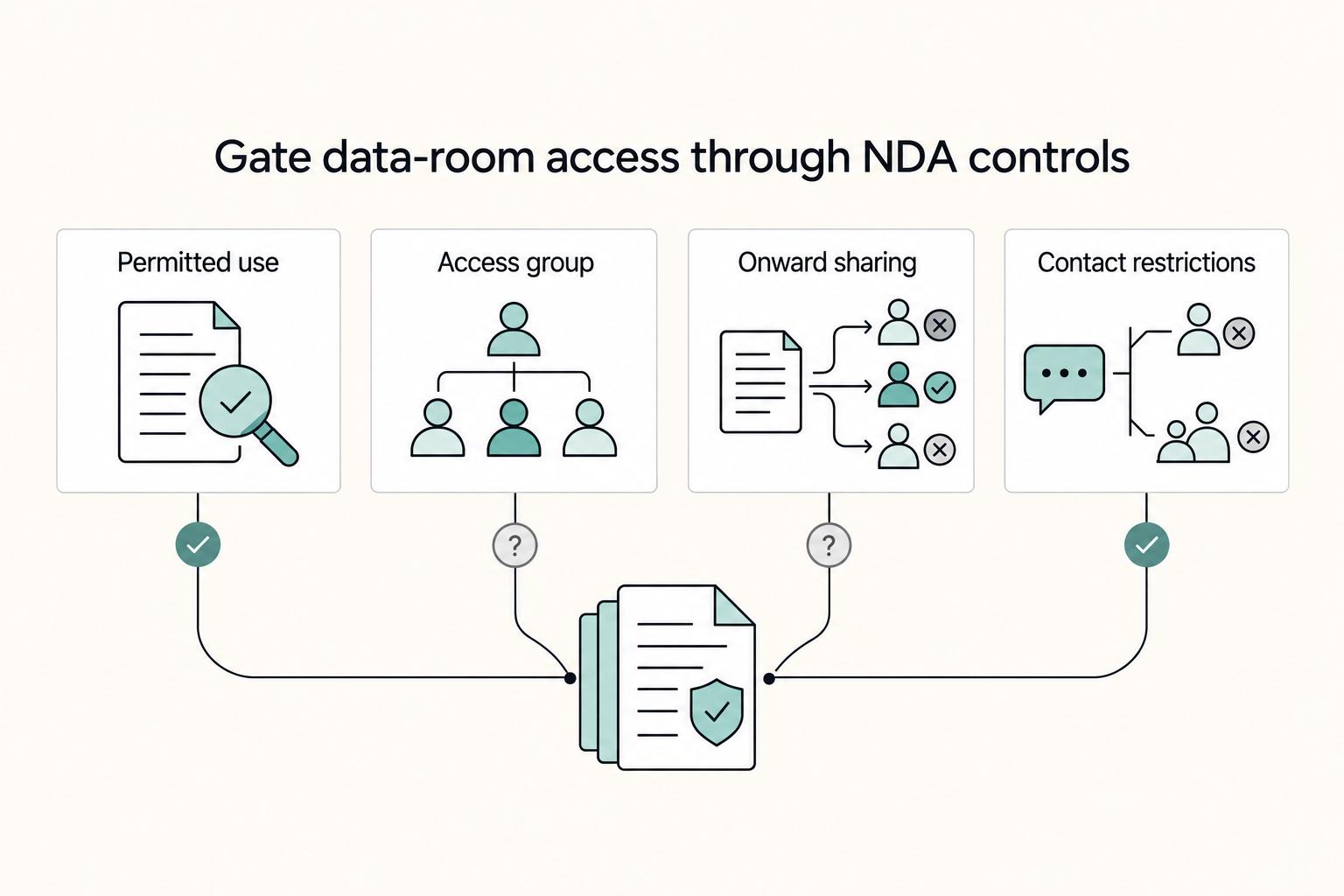
Quick Answer
Start with an NDA for M&A as your disclosure gate, not a late-stage form. Get it signed before sharing CIM files or broader virtual data room content, then narrow purpose to transaction evaluation, define who can receive materials, and set clear onward-sharing limits. Add practical return-or-destroy obligations and tighten compelled-disclosure wording. If remembered-information terms stay open-ended, hold back the most sensitive items until language is clarified.
A Guide to Non-Disclosure Agreements (NDAs) for M&A#
Your NDA in an M&A process is an access-control document. It sets who can see sensitive diligence information, what they can use it for, and how that information can be handled as the deal moves forward.
| Checkpoint | What to confirm |
|---|---|
| Permitted use | Limited to evaluating the transaction |
| Access | Limited to specific buyer personnel and advisers who need it |
| Onward sharing | Expressly defined, not assumed |
| Return or destroy | Applies when discussions end or on request |
| Enforcement | Language is clear, including remedies where damages alone may be inadequate |
In many sell-side processes, buyer interest starts with limited teaser material. Then the NDA is signed, and after that sellers often share fuller materials, including the CIM and broader diligence materials through a virtual data room. For especially sensitive materials, access may move to a more restricted clean room. That is why NDA terms matter early. They are not end-stage paperwork.
Your first structural choice is simple: should confidentiality run one way or both ways?
| NDA format | When it fits | Seller risk to watch |
|---|---|---|
| Unilateral | You are the party primarily disclosing confidential information for evaluation | Cleaner fit for one-way disclosure, but you still need tight purpose and access controls |
| Mutual | Both sides will actually share confidential information | Works when disclosure is genuinely two-way |
| Mutual in a mostly one-way process | Buyer paper is "mutual" even though only you are opening meaningful diligence materials | You may take on unnecessary reciprocal obligations |
Define confidential information in practical diligence categories so the scope is clear. Typical categories include commercial information such as key customers and suppliers, technical and IP information, financial information, employee-related information, and strategic information.
Before you sign, confirm these checkpoints:
- Permitted use is limited to evaluating the transaction.
- Access is limited to specific buyer personnel and advisers who need it.
- Onward sharing is expressly defined, not assumed.
- Return or destroy obligations apply when discussions end or on request.
- Enforcement language is clear, including remedies where damages alone may be inadequate.
You might also find this useful: How to Create a 'Data Room' for a Due Diligence Process.
Why the NDA is the First Battle, Not Just a Formality#
Treat the first NDA round as a pre-diligence screen, not a paperwork exercise. Before you share sensitive financial, customer, technical, or roadmap information, pay attention to how the buyer handles reasonable confidentiality limits in practice.
You are not testing whether they accept every edit. You are testing conduct: timely responses, clear reasons for pushback, and a willingness to narrow terms that are broader than the deal actually requires.
It tests intent while keeping momentum#
The first real test is whether the buyer will limit use of your information to evaluating the potential sale, rather than leaving room for internal business use. In an M&A NDA, that is the core line.
Keep your first redline short and practical. Focus on what has to be set before deeper disclosure:
- Permitted use
- Who can access the information
- Onward sharing limits
- Restrictions on customer contact and recruiting key employees
One disputed clause is not the problem by itself. A pattern of delay, vague answers on broad language, or pressure to share deeper materials before the confidentiality terms are settled can be a warning sign.
It signals your professionalism#
A focused markup can make you look prepared, not difficult. It shows you understand that confidentiality failures can damage both value and momentum.
Prioritize your comments so the buyer can see what is truly non-negotiable. Keep a clean record of drafts, redlines, and written explanations for broad requests. If questions about information use come up later, that record matters.
It controls information before the data room opens#
A secure data room helps, but it does not replace the NDA. The NDA sets the access rules, so start with a tight default: the buyer's deal team and professional advisers only.
Also account for operational risk. In larger organizations, confidentiality breaks can happen when too many people are involved, even if the clause looks strong on paper. If access requests are broad early, stage disclosure. Share less-sensitive material first, and hold back the most sensitive items until access is tighter and the process looks credible.
If this happens, do this#
| Buyer pushback | Your response |
|---|---|
| Broad use rights | Narrow use to evaluating the potential sale; ask for a specific justification before any broader right. |
| Wide affiliate or business-unit access | Limit early access to the deal team and professional advisors; expand later only on a need-to-know basis. |
| Early customer contact or key-employee recruiting | Keep direct contact controlled and outside the NDA default at this stage. |
| Slow or vague responses on core confidentiality edits | Continue discussions, but pause deeper disclosure and stay at teaser/summary level until terms are settled. |
Before you move into a clause-by-clause review, sort issues into two buckets. Resolve permitted use, access, onward sharing, and contact restrictions now. Leave deeper diligence sequencing and other process mechanics for later, once the confidentiality baseline is in place.
Related: A Deep Dive into the 'Limitation of Liability' Clause for Freelance Software Developers.
Redline the core protections before you sign the NDA#
Once a buyer asks for real diligence materials, the NDA often becomes the control document. If only you are disclosing, a unilateral NDA is often the right fit. If both sides will disclose, a mutual form can make sense, but many core protections are the same either way: narrow purpose, tight recipient controls, clear compelled-disclosure handling, and workable return or destroy terms if talks fail.
Redline the highest-risk clauses first#
Start with the clauses that control immediate risk:
| Clause | Article position |
|---|---|
| Permitted use | Use solely to evaluate the proposed transaction |
| Recipients | Defined Representatives who need to know the information |
| Representative breaches | Recipient remains responsible for their breaches |
| Compelled disclosure | Prompt notice and only the portion counsel advises is legally required |
| Return or destroy | Return or destroy on request; keep retention carve-outs narrow |
- Permitted use, transaction-only purpose
- Who can receive information, defined representatives plus need-to-know
- Buyer responsibility for representative breaches
- Compelled disclosure process
- Return or destroy mechanics
For permitted use, keep it explicit: the information may be used solely to evaluate the proposed transaction. If the draft says "evaluate a potential business relationship" or something similar, narrow it. That broader wording can leave room for internal strategy work or competitive use after a failed deal.
For recipients, do not accept a loose "affiliates and advisors" bucket. Define representatives, such as directors, officers, employees, and advisors. Require need-to-know access, require that they are informed of the confidentiality obligations, and keep the buyer responsible for their breaches.
Redline patterns you can paste#
| Overbroad buyer draft | Seller-safe revision | Why this matters in a failed deal |
|---|---|---|
| "Recipient may use the information to evaluate a potential business relationship." | "Recipient may use the Confidential Information solely for evaluating the Proposed Transaction, and for no other purpose." | Limits post-deal-failure competitive or internal reuse. |
| "Recipient may share with affiliates, financing sources, and other persons involved in its review." | "Recipient may disclose only to its Representatives who need to know the information for evaluating the Proposed Transaction, have been informed of the confidentiality obligations, and are bound to comply. Recipient remains responsible for their breaches." | Prevents broad internal spread that is hard to monitor or unwind. |
| "Confidential Information means all information disclosed by Seller." | Add carve-outs for information that becomes public other than through breach, and information independently developed by people without access to protected material. | Preserves standard carve-outs so normal later activity is not mislabeled as misuse. |
| "Recipient may disclose as required by law." | "Recipient must promptly notify Discloser so Discloser may seek to avoid or minimize disclosure, and may disclose only the portion counsel advises is legally required." | Gives you a chance to seek protection and narrows what is disclosed. |
| No clear exit clause, or broad retention rights | "Upon request, Recipient will promptly return or destroy Confidential Information, except copies required to be maintained by law, regulation, or professional standard." | Reduces long-tail risk from stale internal copies after talks end. |
Stress-test the mechanics before you sign#
Headline wording is not enough. Check how the clause will work with the buyer's actual process. Confirm that the defined "Representatives" term matches what the buyer is promising in practice and does not quietly pull in broad affiliate groups you never intended to cover.
For compelled disclosure, "prompt notice" should sit alongside your right to seek to avoid or minimize disclosure, and the clause should limit disclosure to only what counsel advises is legally required.
For return or destroy obligations, test the edge cases: downloaded files, notes, board materials, and adviser work product. Retention carve-outs may be needed for legal, regulatory, or professional requirements, but keep them narrow.
Keep a negotiation record: the first draft, each redline, and written explanations for purpose and recipient limits. If misuse becomes an issue later, that record helps show what was requested and what was accepted.
Escalation triggers and close checklist#
Residuals language, including "unaided memory" concepts, is an escalation issue, not a routine edit. The same is true for standstill, non-solicit, or no-contact terms when someone cites supposed market numbers or durations. Use your own position first, and verify any benchmark before you rely on it.
| Bucket | Item |
|---|---|
| Non-negotiable | Transaction-only use |
| Non-negotiable | Defined representatives only |
| Non-negotiable | Need-to-know access |
| Non-negotiable | Buyer responsibility for representative breaches |
| Non-negotiable | Prompt-notice compelled disclosure with "only legally required portion" |
| Non-negotiable | Return or destroy terms with narrow retention exceptions |
| Negotiable | Unilateral versus mutual structure at this stage |
| Negotiable | Exact representative categories |
| Negotiable | Return versus destroy wording where the legal effect is equivalent |
| Escalate to counsel before signing | Residuals clauses |
| Escalate to counsel before signing | Broad affiliate access |
| Escalate to counsel before signing | Retention tied to vague internal policies |
| Escalate to counsel before signing | Standstill or non-solicit terms based on unverified benchmarks |
| Escalate to counsel before signing | Any mismatch between the draft and verbal assurances |
- Non-negotiable: transaction-only use; defined representatives only; need-to-know access; buyer responsibility for representative breaches; prompt-notice compelled disclosure with "only legally required portion"; return or destroy terms with narrow retention exceptions.
- Negotiable: unilateral versus mutual structure at this stage; exact representative categories; return versus destroy wording where the legal effect is equivalent.
- Escalate to counsel before signing: residuals clauses; broad affiliate access; retention tied to vague internal policies; standstill or non-solicit terms based on unverified benchmarks; any mismatch between the draft and verbal assurances.
For a step-by-step walkthrough, see How to Draft an NDA for a Software Development Project.
Before your next buyer call, turn your redlines into a clean first draft you can review with counsel using the NDA Generator.
The Three Hidden Traps a Buyer Hopes You'll Ignore#
Once purpose and recipient limits are tight, risk usually shifts to a smaller set of clauses that are easy to miss. In an M&A NDA, pay close attention to remembered-information wording, broad definitions, and cleanup obligations before additional disclosure.
If a clause can reasonably be read two ways, assume the broader reading may be used later. In practice, ambiguity and undefined terms are common sources of dispute.
| Trap | Buyer advantage it creates | Preferred redline position |
|---|---|---|
| Remembered-information loophole | Can support arguments that remembered information remains usable after talks fail | Clarify or remove broad remembered-information exceptions before sensitive disclosure |
| Overbroad future-work language | Creates room for later disagreements about what work is restricted | Clarify undefined terms and intended use scope before disclosure |
| Vague return-or-destroy obligations | Leaves uncertainty about what must be cleaned up after talks end | Specify cleanup scope and timing clearly before disclosure |
Trap 1: Scan for remembered-information permission#
Red-flag wording: any exception that permits use of confidential information solely because it remains in memory. Risk: remembered-information disputes are a real issue, and courts have not always distinguished intentional memorization from inadvertent memory. Unclear wording can create competing interpretations about later reuse. Safer fallback: consider removing or narrowly defining remembered-information permission.
Escalation: if wording remains open, pause disclosure of your most sensitive materials until the term is clarified.
Trap 2: Scan for language that can overreach future work#
Red-flag wording: very broad "Confidential Information" and "use" language with undefined terms. Risk: vague terms can create dispute leverage later because each side can claim a different interpretation. Safer fallback: tighten undefined terms and clarify the intended use scope in writing.
Escalation: narrow and clarify. Do not rely on verbal assurances if the defined terms stay broad.
Trap 3: Scan for vague cleanup obligations#
Red-flag wording: soft or undefined cleanup language about what must be returned or destroyed after talks end. Risk: unclear obligations can leave parties in dispute over what was actually cleaned up. Safer fallback: define cleanup scope and timing clearly before sensitive disclosure.
Escalation: resolve unclear cleanup terms early, then align your sharing process so obligations are practical to execute.
Pre-disclosure check for this section#
Before you release more sensitive material, confirm that key NDA terms are organized and clear. Any remembered-information wording should be explicit, core definitions should not be open to multiple interpretations, and cleanup obligations should be specific enough to execute. If those points are still ambiguous, hold back sensitive disclosure until the language is clarified.
We covered this in detail in Confidentiality vs. NDA: What's the Difference for Freelancers?.
Conclusion: The NDA is Your First Step to a Successful Exit#
Treat the NDA as a control point, not a formality. It is often the first document signed, and it sets the tone for the rest of the process. A disciplined redline shows process judgment, not deal hostility.
The risk is practical. Broad use language, loose access, or weak cleanup terms can let deal information be misused, leaked, or repurposed outside the transaction. Keep the sequence tight: sign the NDA before you share deeper materials, for example before the CIM is shared.
Before you disclose more, confirm that the draft clearly says:
- Use is limited to evaluating the proposed transaction, not broader business or competitive purposes.
- Access is limited to a need-to-know group involved in the evaluation.
- Confidentiality terms clearly define what is protected and include clear exceptions, such as public-domain information or legally required disclosure.
- Return or destroy obligations are explicit, so protection does not weaken when the process ends.
Do not treat the buyer's template as "standard" just because it arrives first. Have your attorney review the draft before you sign.
If you want a deeper dive, read Germany Freelance Visa: A Step-by-Step Application Guide.
If you want your NDA terms to stay consistent with the rest of your client paperwork, build a matching baseline with the Freelance Contract Generator.
Frequently Asked Questions
What are the key risks of signing an M&A NDA?
The main risks are broad use rights, vague definitions, and weak return-or-destroy obligations. Before substantive disclosure, tighten permitted use, confidentiality scope, and return-or-destroy language. Keep use tied to evaluating the transaction, limit access to need-to-know representatives, and make sure confidentiality also covers the fact of negotiations. If those points are not accepted, withhold sensitive categories and document in writing what you withheld and why.
How should you negotiate a non-solicit clause?
Start by narrowing who is covered and writing the exceptions into the clause itself. The problem with broad wording is practical: it can create avoidable enforceability and hiring-process friction. Limit who is covered, and include carve-outs for unsolicited applications and general bona fide job ads. Duration should be verified for the deal and the jurisdiction. If broader language remains, reduce scope as far as possible and document which recruiting channels stay permitted.
What is a residuals clause, and why is it a problem?
Ask to delete residuals language entirely. “Unaided memory” wording can create a built-in argument for later use of what you disclosed. The cleaner approach is to remove the memory-use permission instead of trying to soften it. If the buyer will not remove it, document the objection and pause disclosure of your most sensitive information.
Can the NDA stop you from starting a new company later?
The risk is usually tied to confidentiality and use language that is drafted too broadly. Overbroad confidentiality definitions can raise restraint-of-trade enforceability issues. Keep restrictions tied to disclosed transaction information. If the draft stays broad, document the concern and get jurisdiction-specific legal advice before signing.
When should the NDA be signed in the deal process?
Get it signed before substantive transaction discussions begin. Once details are shared, you cannot fully reverse that disclosure. Set evaluation-only use before you open deeper diligence materials, and if the buyer is a competitor, use tighter representative controls or a clean room for highly sensitive items. Keep a dated written record of execution and what was shared after signature.
When is a mutual NDA appropriate instead of a unilateral one?
Use a unilateral NDA if only you are disclosing. Use a mutual NDA only when both sides will disclose, or when that is genuinely uncertain. The risk with a mutual form is taking on confidentiality obligations that do not match the real information flow. If you agree to mutual terms, document what each side is expected to disclose.
Try a related tool
Researched and edited by the Gruv editorial team. Gruv builds cross-border billing, payouts, and finance-operations software for global businesses.
Sources
Includes 4 external sources outside the trusted-domain allowlist.
- ftc.gov/enforcement/competition-matters/2018/03/avoi...trusted
- wlr.law.wisc.edu/wp-content/uploads/sites/1263/2023/12/3.-Tim...trusted
- heritagelawwi.com/drafting-non-disclosure-agreements-ndas-for-m-aexternal
- legaledge.dickinson-wright.com/2026/02/02/just-another-nda-why-ma-confident...external
- news.bloomberglaw.com/us-law-week/non-disclosure-agreements-shield...external
- pipeline.capital/confidentiality-and-non-disclosure-agreement...external
Educational content only. Not legal, tax, or financial advice.
Related Posts

Germany Freelance Visa Application Path for Freiberufler and Gewerbe
Choose your track before you collect documents. That first decision determines what your file needs to prove and which label should appear everywhere: `Freiberufler` for liberal-profession services, or `Selbständiger/Gewerbetreibender` for business and trade activity.

Limitation of Liability Clause for Freelance Software Developers
Start by setting the structure, not just a number. Liability terms allocate risk, so your first move is to define how risk is organized before you negotiate the cap amount. Use these terms consistently from round one:
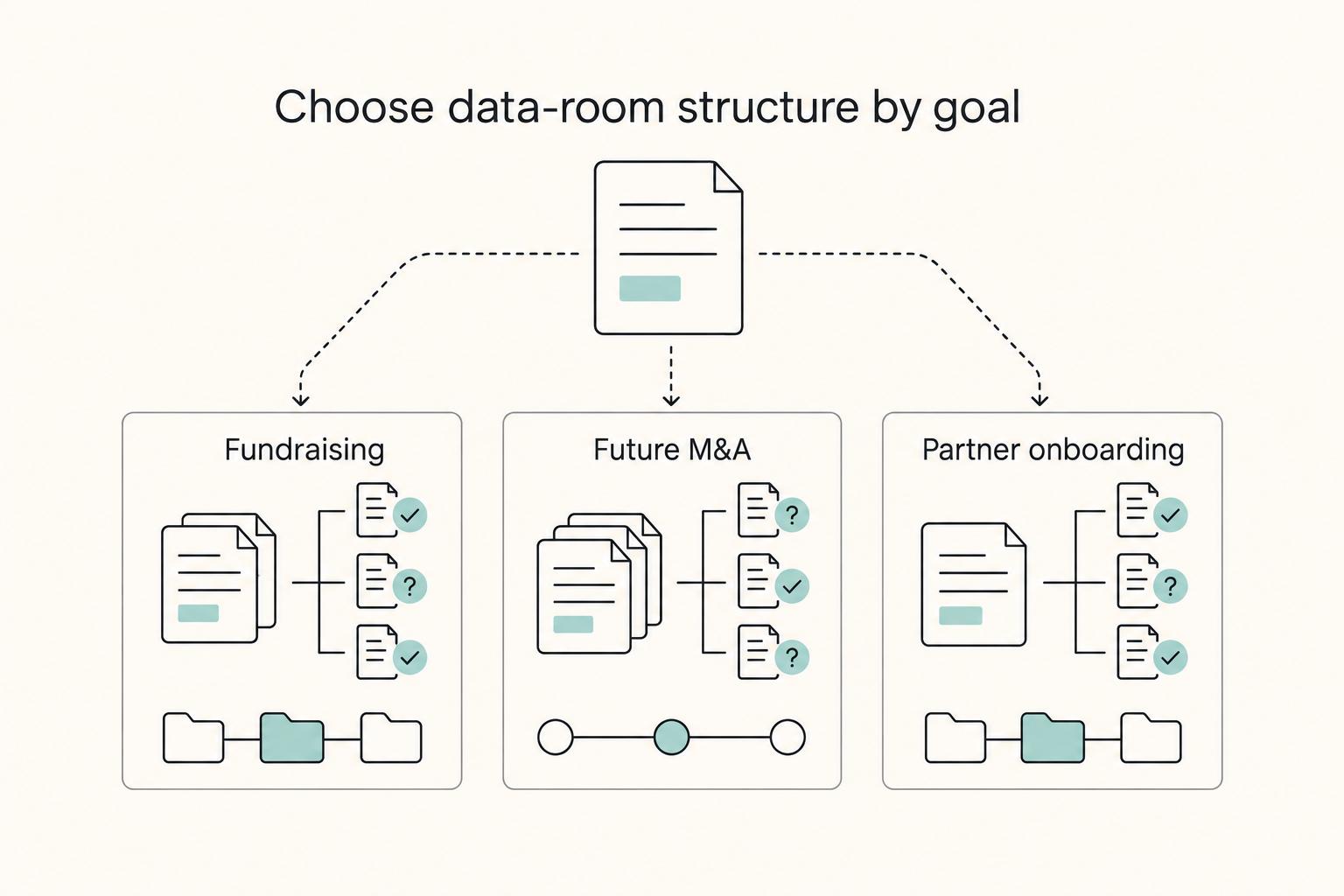
How to Create a Due Diligence Data Room That Holds Up Under Review
Before you build a due diligence data room, decide what success looks like. The goal is not to assemble a giant archive. It is to create a review-ready room that lets another party verify facts quickly, with less back-and-forth and a clear record of what was shared and reviewed.