
Quick Answer
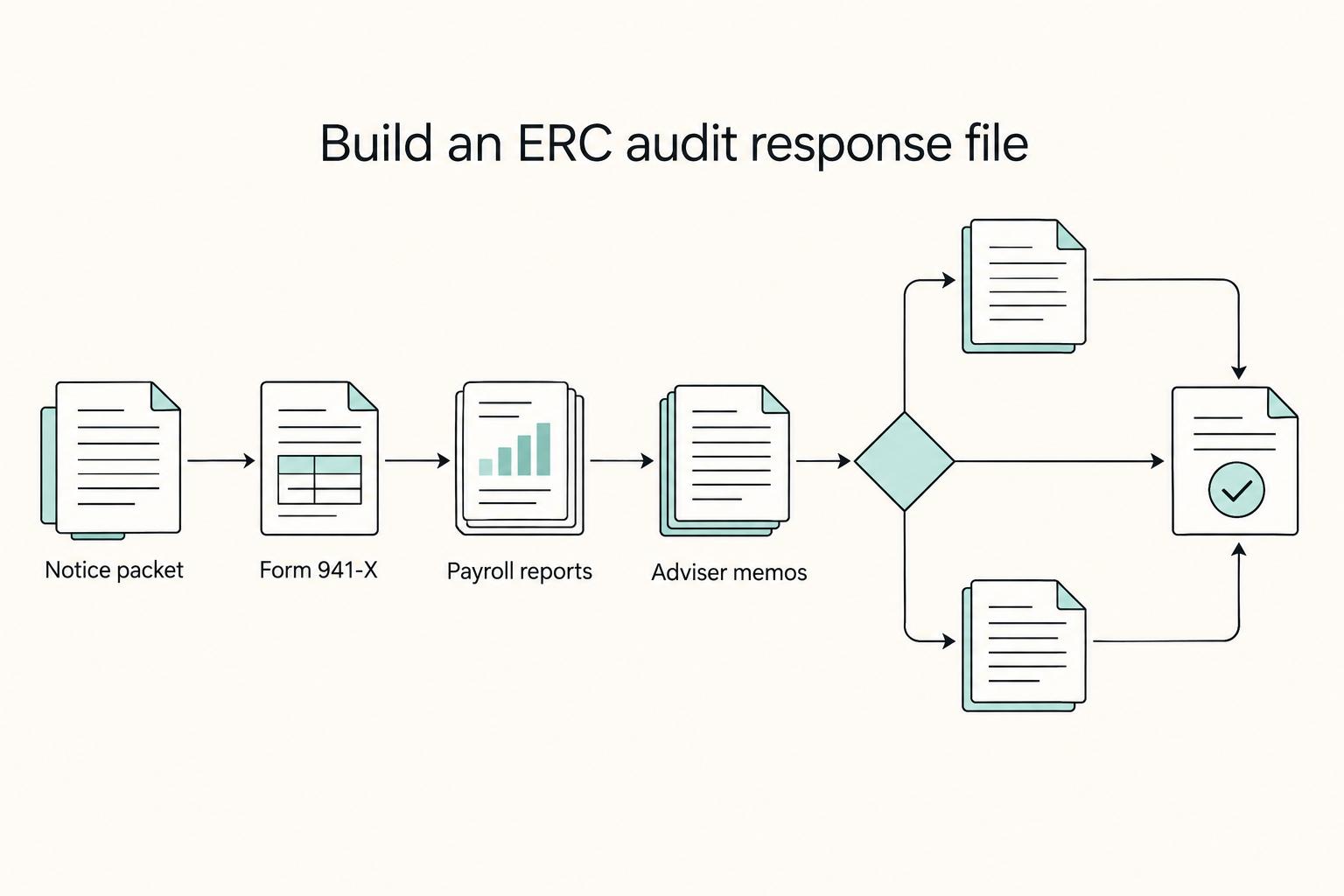
Start by treating an erc audit as a records-verification task: review Letter 6612, confirm the exact periods under review, and freeze the filed Form 941-X, original Form 941, payroll reports, and calculation workpapers. Then tie each claimed amount to source documents before writing any narrative response. If the file does not reconcile or promoter assumptions conflict with payroll data, involve a qualified tax professional and decide whether to defend, reduce, or withdraw based on documented facts.
Start Here If You Just Got an ERC Audit Notice#
Treat an ERC audit notice as a documentation-and-verification process first. Your job is to identify what the IRS is reviewing, lock down the filed records, and respond with copies that support the credit you claimed.
If your notice is Letter 6612, the IRS says it is auditing a return that reported an adjustment or claim for refund. It requests documentation to verify the Employee Retention Credit (ERC) you claimed and states it will hold the ERC while the audit is pending. Read the letter and enclosures carefully before drafting your response.
What the notice is really asking for#
The IRS is asking for documentation to verify the items under audit. Start with the notice itself:
- notice type
- response channel
- due date shown on the notice
- tax periods under review
- exact amended filing tied to the claim
If your ERC claim was filed on Form 941-X, confirm you are working from the correct quarter and filing. Form 941-X is used to correct errors on a previously filed Form 941.
What you should have in hand before you answer#
Before you respond, pull and freeze the records in the versions actually filed or used to file:
- the notice packet and all enclosures
- each relevant Form 941-X and the original Form 941 for the same quarter
- payroll reports supporting the claimed wages and credit calculation
- memos, worksheets, or adviser emails used to compute the claim
Do not rebuild the claim from memory. Your response should tie directly to the filed forms and the supporting payroll records.
When to escalate early#
Bring in a trusted tax professional early if you cannot reconcile Form 941-X numbers to source payroll records, or if support is spread across multiple systems or advisers. IRS ERC FAQs are general information, and IRS guidance points taxpayers back to notices, forms, and instructions for technical detail.
Also consider withdrawal only if it fits your case. The IRS withdrawal process is for taxpayers whose ERC has not been paid yet, or whose refund check was not cashed or deposited. Accepted withdrawals are treated as if the claim was never filed.
Related: A Guide to Employee Retention Credits (ERC) for Small Businesses.
Define the Audit Terms Before You Respond#
Get the audit context straight before you respond. The IRS is asking you to verify a specific ERC claim with records that match what you filed, not to submit a broad business narrative.
What Letter 6612 means#
If your notice is Letter 6612, treat it as an audit request. The IRS states that it is auditing a return that reported an adjustment or claim for refund. It needs documentation to verify the Employee Retention Credit (ERC) you claimed, and it says it is holding the ERC pending audit results.
Read the letter and enclosed forms carefully. Then respond through the channel listed in the notice, whether upload, fax, or mail, if applicable.
What "claim for refund" points to in ERC cases#
In ERC cases, this can point to the amended employment tax return used for the claim, often Form 941-X. IRS says Form 941-X is used to correct errors on a previously filed Form 941.
Before you respond, make sure each figure in your package ties back to the filed amendment, not just internal summaries or slide decks.
Tie each form to its job#
Use a simple mapping so your file stays grounded:
- Form 941-X: the amended return showing what was corrected and claimed
- Form 941: the original quarterly return that was corrected
- Requested documentation: copies the IRS asks for to verify the items under audit
If you determine during document prep that you were not entitled to the credit claimed, call the IRS for withdrawal instructions instead of submitting a weak defense.
Triage in the First 48 Hours#
In the first two days, focus on control, not explanation. Document exactly what the IRS sent, preserve the records tied to your filed claim, and decide whether professional support is needed before drafting a response.
Build a one-page control sheet#
Start with the mailed notice packet. If this is Letter 6612, the IRS says it is auditing a return that reported an adjustment or claim for refund, requesting documentation to verify the credit, and holding the ERC while the audit is open. IRS audit contact starts by mail, so use the letter as your source of truth.
| Control sheet item | Article detail |
|---|---|
| Notice type | Such as Letter 6612 |
| Date received | Date received and scanned |
| IRS contact channel | Listed in the notice |
| Response due date | Shown in the notice |
| Internal owner | For records collection |
| Outside adviser | If any |
| Quarters and forms involved | Such as Form 941-X and the original Form 941 |
Capture only the facts you will need again, and check the instructions against the notice and enclosures each time. Letter 6612 says those documents explain what you must send.
Preserve the evidence file on day one#
Preserve copies of the records that existed when the claim was prepared and filed. Start with filed Form 941-X, original Form 941, and the payroll and supporting records used in the calculation.
This matches IRS guidance that audit requests should generally be answered with records already used to prepare the return, not newly created support. Work from copies, keep a dated folder index, and keep each file tied to the filed quarter.
If a support file does not reconcile to the exact filed quarter, label it supplemental rather than primary evidence.
Escalate early if promoter risk is present#
If a third-party promoter was involved, especially with a fee tied to refund size, consider having a trusted tax professional review the file before you draft a narrative response.
That does not prove the claim is wrong. It can help reduce the risk of repeating unsupported eligibility language instead of relying on filed forms and payroll records.
Start the timeline log now#
Create a short internal chronology right away. Note when Form 941 was filed, when Form 941-X was prepared and filed, who advised on eligibility, what payroll data was used, and when the IRS notice arrived.
If you receive an Information Document Request (IDR), map each response to that timeline so dates, quarters, and documents stay consistent. Keep the log factual and brief. If you determine you were not entitled to the claimed credit, call the IRS for withdrawal instructions instead of building a weak defense.
You might also find this useful: What to Do if Your FEIE Claim is Audited by the IRS.
Map Your Original ERC Position Quarter by Quarter#
Build your response quarter by quarter from the filed record, not from a single after-the-fact summary. For each claimed quarter, anchor your explanation to what you actually filed on Form 941 (or Form 941-SS, if applicable) and corrected on Form 941-X, then flag anything that cannot be traced to source records.
Rebuild each quarter from the filed record#
Treat each quarter as its own memo. The practical question is simple: what changed on the original payroll tax return, and what support existed when that correction was filed?
Keep each quarter memo short and consistent:
- quarter covered
- rationale actually used at filing
- wages included in the calculation
- where the amounts appear on the filed Form 941-X and original Form 941 (or Form 941-SS, if applicable)
If Schedule R (Form 941) was attached, keep it with that quarter's folder and reconcile to that level too. If a quarter only works with hindsight language or a later summary spreadsheet, treat that as a gap until it ties back to filed forms and payroll records.
Reconcile wage support before drafting the narrative#
Do the wage tie-out before you write a single explanation. Map wage support in the quarter file and check it against payroll records, then escalate unresolved gaps before finalizing your response.
Use only the records you froze during initial triage. Mark each wage bucket as included, excluded, or unresolved, then confirm those labels against the filed amendment, not just a later workbook. If a number depends on a manual plug, treat it as unsupported until you can trace it to source payroll data.
Build a quarter table tied to filed forms#
Use one comparison table as your consistency check. It should show:
- the quarter
- the rationale actually used, taken from the contemporaneous memo or workpaper
- the wages included, including the payroll range and employee set used
- where the amounts appear on the filed Form 941-X and original Form 941 (or Form 941-SS), with Schedule R noted if attached
Use line references from the version you filed. Current Form 941-X instructions note that lines 18a, 26a, 30, 31a, 31b, 32, 24, 33a, 33b, and 34 are reserved for future use. Limitation periods can also affect what corrections are still available.
Final checkpoint: every number in your narrative should reconcile to filed forms and payroll records without manual plug adjustments.
Build the IDR Evidence Pack Before the IRS Asks Twice#
Build the evidence pack before you respond so each file answers a specific IRS question. Delays can happen when support is hard to trace across quarters and forms.
The IRS uses an Information Document Request (IDR), paper or electronic Form 4564, to request records, and initial IDRs can be broad books-and-records requests. If your notice is Letter 6612, the IRS is auditing your adjustment or claim for refund. It is holding the ERC while the audit is pending and asking you to provide copies of requested documentation.
Index by question, not by file type#
A practical pack should answer four basic questions:
- Why were you eligible for this quarter?
- Which wages and health-plan amounts were included?
- How was the claimed amount calculated?
- Where do those numbers appear on filed forms?
For each document in your index, include:
- what it proves
- which quarter or quarters it supports
- which IRS question it answers
If one document supports multiple quarters, list it under each quarter so the examiner does not have to infer your logic.
Core categories can include:
- Eligibility memo by claimed quarter
- Payroll records and employee-level wage support
- Quarter calculation workpapers
- Filed return copies and form-bridge documents
IRS ERC audit training materials include items such as Forms W-2, a list of employees paid wages for which ERC was claimed, and support for qualified health-plan expense allocations if applicable. If you used a health-plan allocation workbook, include the source report behind it.
Add the form bridge so the math can be followed#
Your form bridge should help an examiner follow the numbers from payroll support to the filed returns, including Form 941, Form 941-X, and Form 940.
- Form 941: original quarterly payroll tax return anchor
- Form 941-X: correction to a previously filed Form 941
- Form 940: annual FUTA return context, not an ERC claim form
A practical bridge set can include:
- Quarter reconciliation from payroll registers to wages used in the ERC calculation.
- Tie-out from the quarter calculation to filed Form 941-X.
- Annual comparison aligning quarter totals with Form 940 and W-2 records.
If the bridge has unexplained jumps, treat that as a gap before submission.
Use a control table to prevent response-cycle drag#
Use a compact control table to make ownership and risk explicit.
| Document name | Owner | Date range | Source system | Risk if missing |
|---|---|---|---|---|
| Quarter eligibility memo for each ERC claim quarter | Tax lead or adviser | Single quarter | Internal memo folder | Eligibility position looks reconstructed after the fact |
| Payroll register export and employee wage detail | Payroll manager | Claimed quarter payroll dates | Payroll platform | Wage amounts cannot be tied to source payroll records |
| Employee list for wages included in the claim | Payroll or HR | Claimed quarter | Payroll platform or HRIS | Examiner cannot verify which employees were counted |
| Qualified health-plan expense allocation support, if used | Benefits or finance lead | Claimed quarter | Benefits admin system or accounting file | Health-plan amounts appear as unsupported add-ons |
| Filed Form 941 and filed Form 941-X copies | Tax lead | Relevant quarter | E-file archive or return files | No clean tie between original filing and amendment |
| Form 940 copy and W-2 set | Tax lead or payroll lead | Tax year | Return archive and payroll system | Annual payroll picture is incomplete or inconsistent |
Check the pack before you send copies#
Before sending anything, confirm that every indexed file is readable, final, dated, tied to a quarter, and traceable to a source system.
Also separate draft and filed returns clearly. Label filed Form 941, filed Form 941-X, and internal calculation files. Follow the notice packet instructions for what to send and how to send it. Letter 6612 materials indicate fax or mail may apply if listed in your letter.
Keep a sent-items log for the evidence pack: filename, quarter, date sent, and IRS request answered. If the IRS asks again, you can resend the exact prior submission instead of rebuilding it from memory.
We covered this in detail in A Freelancer's Guide to the Statute of Limitations on Tax Audits.
If your ERC evidence is scattered, use a single system with audit trails and exportable records so IDR responses are faster and cleaner. Start with Gruv docs.
Choose Your Path Defend Reduce or Amend#
Choose your lane early, quarter by quarter. Defend only what your records support, and move to correction when eligibility evidence is weak or inconsistent. In a Letter 6612 audit, the IRS is holding the ERC while the audit is in progress, so the goal is a clean, supportable position, not a broad narrative.
| Path | When it fits | What you need in hand | Main caution |
|---|---|---|---|
| Defend as filed | Eligibility and calculation support are consistent across the claimed quarter or quarters | Records showing eligibility and how the ERC was calculated for each claimed quarter | Do not defend a position your own records contradict |
| Withdraw or reduce the ERC claim | Some or all of the claim is not supportable, including cases where you determine you were not eligible | A clear explanation of what is not supportable and the records behind that conclusion | Letter 6612 gives withdrawal instructions for "not entitled" cases. |
| Make adjustments to the amended return | The core claim appears supportable, but amount or filing detail appears wrong | Records and reconciliations needed to explain the correction | IRS FAQs are general information, not a complete open-case procedure |
Defend only when your file is internally consistent#
Use the IRS checkpoint from Letter 6612 before you defend: confirm eligibility and confirm the ERC was calculated correctly while preparing your IDR response.
A defensible file shows a straight line from eligibility to wages to filed amounts, with no gaps you have to explain away after the notice arrived. If you defend, stay narrow. Answer the specific IRS request, attach records that prove that point, and submit through the channels listed in your notice.
Reduce when core support breaks#
Use a hard rule here: if core eligibility evidence is weak or internally inconsistent, correction is the safer path than aggressive defense.
Letter 6612 gives one clear instruction for a specific case. If, during IDR preparation, you determine you are not entitled to the ERC and want to withdraw the claim, call the IRS for instructions.
That instruction helps, but it is limited. It does not fully define every partial-reduction path, so state unknowns plainly instead of assuming one process fits every case.
Adjust an amended return carefully#
Use this path when the underlying claim may still stand, but the amended-return amount or detail appears wrong.
IRS FAQ content confirms a "Correcting an ERC claim" path that can include amending. That same FAQ framework is general and points you back to notices, forms, and instructions for the technical mechanics.
Document open questions in your file before taking procedural steps, such as whether phone instructions are required for your case and how correction should be handled during an active exam. A one-page quarterly decision record helps: chosen lane, reason, supporting records, and unresolved questions.
Handle Promoter Risk and Credit Mill Exposure#
Treat promoter exposure as a documentation risk problem. Isolate what the promoter influenced, test it against your records, and respond with evidence only. Promoter involvement alone does not prove a claim is invalid, but the IRS says it is closely reviewing ERC claims because of a large number of improper claims, so unsupported assumptions are high risk.
Identify where the promoter shaped the claim#
Separate these points before you draft your response: who concluded eligibility, who wrote the support language, and who translated that into amounts on Form 941-X. Then compare each eligibility statement and wage figure to your payroll records and the filed amended return.
If a promoter position cannot be traced to your records, or the Form 941-X logic does not match the underlying file, mark that as a conflict. Do not paper over conflicts with narrative.
Build a separate promoter file#
Keep promoter materials in a separate file, not mixed into your core eligibility evidence. Include:
- Engagement terms or contract
- Fee structure, including any contingency component
- Emails or memos describing eligibility, assumptions, or expected refund outcomes
- Promoter-prepared calculations or draft support
- Filed Form 941-X copies and related filing instructions
This gives you a clean record of what was represented versus what your books support.
Escalate conflicts early and keep your IRS response factual#
Use another hard rule: if promoter analysis conflicts with payroll records or your filed Form 941-X logic, document the conflict and escalate. For complex or material conflicts, consider authorizing qualified representation before the IRS.
Keep the IRS response focused on documents. Letter 6612 emphasizes providing the requested records and following the letter and enclosed forms. If your review shows you are not entitled to the credit, move to correction or withdrawal steps and call for withdrawal instructions during the audit process.
Prepare for the Interview So You Do Not Create New Problems#
If the IRS asks for a call or interview, stay tightly aligned with what you filed and what your records support. One risk is giving a smoother verbal story than your forms and submissions can prove.
Build one timeline and keep it quarter-specific#
Use one timeline that links Letter 6612, each original Form 941, each corrected Form 941-X, and each document submission or IDR response. Letter 6612 says the IRS is auditing your adjustment or refund claim, requesting documentation, and holding the credit during the audit process.
Keep the timeline by quarter. Form 941-X corrects a previously filed Form 941, and the form instructions require a separate Form 941-X for each corrected quarter, so your answers should stay quarter-specific.
Before any conversation, verify that every date, number, and explanation in your notes maps to a filed form, payroll record, or prior submission. If it does not, do not present it as interview-ready.
Rehearse the exact terms already used in your file#
Use the wording already in your support file for these topics:
- Eligibility method
- Data sources for wage calculations
- PPP wage allocation and exclusion from ERC
Be precise on PPP overlap. IRS guidance says employers cannot receive PPP loan forgiveness and ERC for the same wages. Answer from quarter-level records and filed support, not memory.
If you are asked for a figure you cannot immediately tie to Form 941, Form 941-X, or submitted backup, pause and confirm rather than estimate.
Assign roles before the call#
This is an internal control, not an IRS requirement. Set roles in advance so the conversation stays disciplined:
| Role | Responsibility |
|---|---|
| Primary responder | Gives substantive answers within the prepared narrative |
| Records operator | Pulls the exact form, payroll report, or prior submission being discussed |
| Note-taker | Logs each question, answer, and promised follow-up |
This setup reduces live improvisation and keeps the process organized if additional records are requested.
Know when to stop instead of guessing#
A common failure mode is introducing verbal numbers that do not match filed records, especially when quarters get blended or PPP allocations are paraphrased without backup in front of you.
If the discussion moves beyond documented support, ask to verify or consult your authorized representative. Publication 3498-A says that if you ask to consult such a person during an interview, the IRS must stop and reschedule in most cases.
Avoid Cross-Border Filing Confusion During an ERC Audit#
Keep ERC payroll-credit support separate from personal cross-border filings. In an ERC audit, the core question is whether the credit was properly claimed on an original or adjusted employment tax return, including Form 941-X. It is not whether unrelated cross-border filings are bundled into the same explanation.
These are different filing tracks:
| Filing item | What it is for | Where it belongs |
|---|---|---|
| Form 941-X | Corrects a previously filed Form 941 and supports adjusted employment tax claims such as ERC | Business payroll tax file |
| Form 8938 | Reports specified foreign financial assets above applicable thresholds | Attached to your annual tax return |
| FBAR (FinCEN Form 114) | Reports reportable foreign financial accounts when aggregate value exceeds $10,000 at any time during the calendar year | Filed with FinCEN, not with the IRS |
Use a simple checkpoint: if a document does not support eligibility, wages, payroll tax reporting, or quarter-specific calculations, it likely does not belong in your ERC response pack. Form 8938 and FBAR may both matter to your overall compliance, but one does not replace the other, and neither replaces payroll-credit support.
Be careful with Schedule SE. Schedule SE (Form 1040) is for self-employment tax on net self-employment earnings, which is a different filing track from employment tax returns. Do not use Schedule SE logic to explain ERC wage treatment unless your tax adviser confirms it fits your entity setup and reporting.
For globally mobile freelancers, consider keeping two clearly labeled folders: one for payroll-credit audit materials and one for personal cross-border filings. This will not guarantee an outcome, but it can help reduce avoidable mis-submissions, such as attaching Form 8938 workpapers, FBAR confirmations, or Schedule SE calculations to an ERC-focused response.
This pairs well with our guide on A Guide to Filing a 'Quiet Disclosure' for Unreported Foreign Accounts.
Set Up an Audit-Ready Record System for the Next 12 Months#
Your record system should let you reproduce each filed quarter quickly and cleanly if an ERC audit request arrives. Over the next 12 months, organize files so someone can trace exactly how a quarter was prepared, corrected, and supported.
Use a fixed records cadence#
These IRS materials do not require a monthly or quarterly cadence, but using one makes the file easier to reproduce.
| Cadence | What to save | Why it matters |
|---|---|---|
| Monthly | Payroll exports, payout reports, payroll journals, and supporting calculation workbooks used that month | Preserves source data before later edits or reruns change what the system shows |
| Quarterly | Filed Form 941 copy, quarter-end reconciliation file, and any memo explaining unusual treatment or adjustments | Shows that form totals still tie to source records quarter by quarter |
| Event-based | Final Form 941-X package, submission confirmation, adviser emails, and the instruction version used | Preserves support for a corrected claim if the IRS questions it later |
For corrected quarters, keep the final Form 941-X package tied to the originally filed Form 941 and the calculation file that bridges them. If you relied on a specific instruction version, keep that too, for example, Instructions for Form 941-X dated 04/2025.
Make the audit trail easy to follow#
Aim for traceability, not just retention. Another person should be able to follow the path from payroll data to filed totals without guessing which export or workbook was final.
Use one naming convention per quarter folder: source exports, reconciliation workbook, filed forms, and any advisory memo. Keep final filing artifacts separate from editable working files so you can show both the final record and the supporting work.
If a quarter only ties out through manual overrides, treat that as a red flag. Fix the bridge now or escalate before an IRS request forces you to defend numbers you cannot reproduce.
Add a quarterly verification checkpoint#
Run a quarterly check: do filed totals, payroll reports, and advisory memos still reconcile without manual overrides? If not, document the gap immediately while the context is still fresh.
This keeps you ready for the IRS IDR response flow referenced in Letter 6612. The IRS also says to read the letter and enclosed forms carefully and follow the listed response channel, including upload where applicable, so clean quarter files can make response prep faster and clearer.
Choose tools that preserve evidence#
If you use payroll or finance tools, prioritize exportability, traceable logs, and controlled access. Since 17-JULY-2024, electronic filing is available for some amended employment tax returns, so your tools should preserve both the working exports and the exact filed output when available.
If your quarterly review shows you are not entitled to a claimed amount, use that as a correction checkpoint and call the toll-free number on your Letter 6612 for withdrawal instructions. IRS guidance says claim withdrawal can help avoid future issues such as audits, repayment, penalties, and interest.
Related reading: How to Prepare for an IRS Audit.
Know Exactly When to Escalate to a Tax Professional#
Escalate once you move from gathering records to defending numbers or eligibility positions you cannot clearly support. In practice, that often means unreconciled filings, PPP wage overlap risk, or an exam that starts expanding.
| Escalation trigger | What the article says |
|---|---|
| Unreconciled filings | You cannot tie Form 941-X to the original Form 941, source payroll data, and the calculation file without manual adjustments |
| PPP overlap risk | Wages may have been used for both ERC and PPP forgiveness |
| Expanding exam scope | Notices start requesting broader substantiation, more periods, or layered follow-up explanations |
| Aggressive prior advice | Prior guidance relied on broad eligibility conclusions that are hard to defend |
| Promoter-driven position | IRS warnings about high-fee or contingent-fee ERC shops are a practical risk signal |
Escalate on unreconciled filings and PPP overlap#
If you cannot tie Form 941-X to the original Form 941, source payroll data, and your calculation file without manual adjustments, bring in a qualified tax professional. The same applies when wages may have been used for both ERC and PPP forgiveness, because the IRS says PPP-forgiveness wages cannot also support an ERC claim.
Use a simple test: can another person trace each quarter from payroll export to filed 941-X and explain each adjustment line without guessing? If not, escalate before you submit a narrative that the math does not support.
Escalate when the exam starts widening#
Treat widening scope as an escalation trigger. The IRS describes a correspondence audit as relatively limited, and says it can expand into an in-person field audit if issues become more complex.
If notices start requesting broader substantiation, more periods, or layered follow-up explanations, bring in representation early. If you received Letter 6612, that is already a clear signal to respond with complete support, and the IRS explicitly says you may want to review the letter with a trusted tax professional.
Escalate if prior advice looks aggressive or promoter-driven#
If prior guidance relied on broad eligibility conclusions that are hard to defend, have a CPA, EA, or attorney re-evaluate the position before you defend it. Promoter involvement does not prove wrongdoing, but IRS warnings about high-fee or contingent-fee ERC shops are a practical risk signal.
Before engagement, a practical packet can include the IRS notice, filed Form 941-X and Form 941, payroll and calculation support, PPP forgiveness support if relevant, and a short list of unresolved questions. This can help your adviser decide whether to defend the claim, reduce it, or file another adjusted return if needed.
Need the full breakdown? Read How to Handle a Tax Audit When Your Income is Paid Through Deel or Remote.
The Main Takeaway#
Treat an ERC audit as a records problem first. Verify the facts, answer exactly what the IRS asked for, then decide whether to defend or correct.
If you received Letter 6612, treat it as an IRS audit notice. The IRS says it is auditing the ERC adjustment or claim for refund and holding the credit while the audit is underway. Start by reconciling the file before drafting explanations. Tie each relevant Form 941-X amount to source payroll records, the original Form 941, and your quarter-specific eligibility rationale.
Use this sequence:
- Capture the notice deadline and IRS contact details.
- Freeze the exact versions of Form 941-X, Form 941, payroll exports, and adviser communications you will rely on.
- Rebuild the claim quarter by quarter against source records.
- Assemble an IDR response pack so each document maps to a specific IRS request.
- Hold a final defend-versus-correct checkpoint before submitting narrative responses.
At that checkpoint, stay strict. If the records support eligibility and amounts, defend with a document-led response. If the facts are incomplete or unsupported, take the correction path. The IRS says that if you determine you are not entitled to the ERC claimed, call the toll-free number on your letter for withdrawal instructions. If you only need to reduce the claim, withdrawal is not the right path.
Do not let uncertainty turn into story-making from memory. If promoter logic cannot be verified against your payroll records or Form 941-X math, escalate early to a qualified tax professional and keep your response factual.
After the audit, keep the file. IRS employment tax recordkeeping guidance says records related to qualified ERC wages paid after June 30, 2021 should be kept for at least 6 years. If a claim is disallowed, IRS compliance FAQs also note that appeals rights may be available.
If you want a compliance-first setup for cross-border collections and payouts with traceable records, talk to Gruv.
Frequently Asked Questions
Can you withdraw an ERC claim while under audit?
Sometimes, yes. If your review shows the claim is ineligible, the IRS says to call the toll-free number on your letter, including Letter 6612, for withdrawal instructions. IRS guidance says withdrawal generally applies when the ERC has not been paid yet, or when you received a check but have not cashed or deposited it.
What documents are usually requested in an ERC audit?
There is no single checklist that fits every case. The IRS directs you to provide copies of the specific documents it requests to verify the audited items. Start with the notice, then respond to each request in the letter and any follow-up IDR.
How is an ERC audit different from a normal income tax return exam?
An ERC audit is often a claim-for-refund exam tied to ERC support, rather than a full income tax return exam. Even so, documentation requests can still be broad. Keep your response tied to the specific items the IRS asks you to verify.
Does using an ERC promoter increase audit risk?
Using a promoter does not automatically make a claim invalid. What matters is whether your eligibility position and supporting records hold up under review. If promoter-prepared support is unclear or inconsistent, resolve those gaps before you respond.
What should you do first after receiving an IRS ERC audit notice?
Read the letter and enclosed forms carefully before doing anything else. If it is Letter 6612, treat it as a formal audit notice and follow the response instructions exactly. The IRS also states that it can hold the ERC until the audit is resolved.
Are old ERC refunds still auditable?
Potentially. The IRS is auditing ERC adjustment and claim-for-refund returns, and some later-filed claims face additional limits. IRS guidance also says only new 2021 Q3/Q4 claims filed after January 31, 2024 are limited by section 70605(d), with no allowing or refunding after July 4, 2025. IRS also says these ERC compliance FAQs are general, and case outcomes depend on law and facts.
Is every ERC claim audited?
IRS materials do not say every ERC claim is audited. Treat blanket "everyone gets audited" statements as unreliable. The practical approach is to keep a complete, review-ready support file in case your claim is selected.
Try a related tool
Researched and edited by the Gruv editorial team. Gruv builds cross-border billing, payouts, and finance-operations software for global businesses.
Sources
Educational content only. Not legal, tax, or financial advice.
Related Posts

Digital Nomad Taxes in 2026 With a Defensible Filing Plan
With digital nomad taxes, the first move is not optimization. It is figuring out where you may be taxable, where filings may be required, and what proof supports that position.
S-Corp ERC Guide: Eligibility, Owner Wages, Filing Deadlines, and Audit Readiness
If you own an S-Corp, your first decision is not how much you might claim. It is whether you can defend an ERC claim quarter by quarter with records that will hold up under IRS review. This is a compliance exercise, not a windfall play. That posture matters because the IRS says ERC claims are under close review.

The Freelance Payment Penalty: A Modeled Audit of Platform Fees, FX Spreads, and Payout Delays
The money rarely disappears through a single, easy-to-spot fee. The real loss is stacked. A marketplace takes its commission, a processor adds a charge for international cards, a bank or payment company converts the currency at a spread, a platform holds the funds before release, and a wire sheds a little to intermediaries on the way in. Each layer looks defensible on its own, but the worker feels the combined result as a smaller deposit and a later payday.