
Quick Answer
Yes, a practical nanowrimo guide for working professionals is to treat November as a constrained drafting month: lock writing windows in Preptober, choose a finishable story, and use weekly checkpoints. Build around the known challenge target of 50,000 words in 30 days, but protect client obligations as a separate non-negotiable. If progress slips, reduce scope before increasing effort so the draft keeps moving without operational fallout.
Start NaNoWriMo Like an Operator, Not a Gambler#
If you want to finish a draft during NaNoWriMo, treat it like a constrained production month. This guide has one job: help you do that without leaving yourself with a long recovery afterward. The goal is a month you can actually sustain.
The mindset shift matters more than motivation. Treat it as a drafting month, not a publishing month. If you approach it like a launch, you will polish chapter one, second-guess scenes, and burn time on research you do not need. If you approach it like a drafting month, the standard becomes controlled output, steady sessions, and enough structure to keep moving when the day gets messy.
NaNoWriMo, short for National Novel Writing Month, is easier to handle when you treat it as a defined event that needs preparation, not a vague burst of creativity. A practical setup matters even more when your calendar is already full.
Start with the first real checkpoint. Not "Do I feel inspired?" Ask: "Can I point to specific writing windows, backup windows, and the work that stays protected no matter what?" If you cannot name where the draft fits on your calendar before it starts, your scope is probably too big. A common failure mode is taking a broad, research-heavy idea into a month that only has room for forward motion.
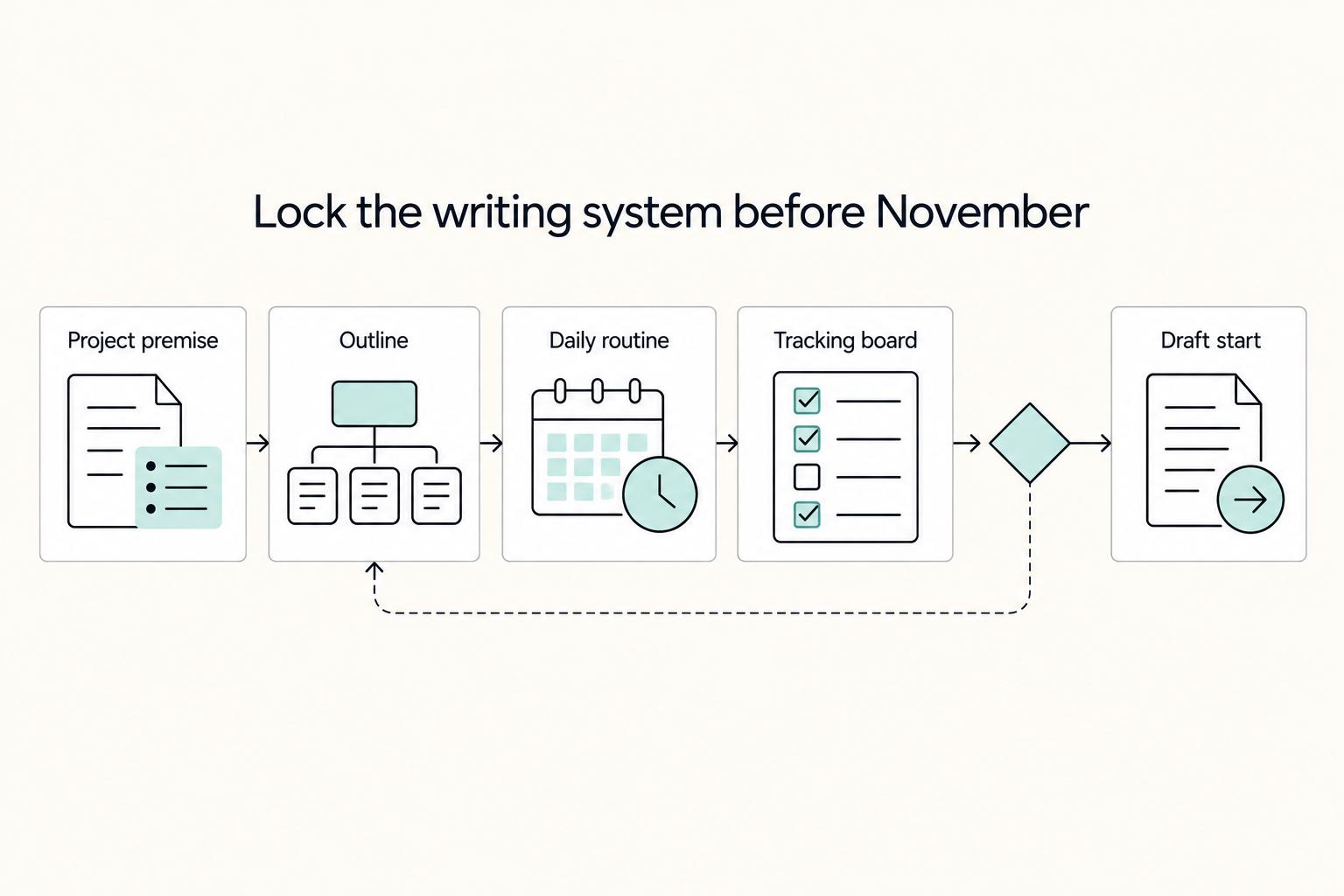
From here, we make the month concrete in the order that reduces risk. First, choose a draft scope you can finish. Then decide whether you need more outline or more discovery on the page. After that comes pre-month setup: calendar blocks, files, scene support, and friction removal before kickoff. Then we move into weekly checkpoints, catch-up rules when you miss time, and a clean handoff afterward so the draft does not turn into another half-finished side project. If your larger goal is business authority as well as creativity, this pairs naturally with How to Write a Book to Establish Your Freelance Expertise.
If attention control is part of your prep, we covered that in A Guide to Creating a 'Digital Detox' Routine.
Know the Game You Are Entering#
NaNoWriMo is a time-boxed drafting challenge, not a general creativity month. The working target is 50,000 words in 30 days from November 1 to November 30, which is roughly 1,667 words per day. Plan for that specific push, or your decisions will drift.
Use two scorecards from day one, and keep them separate. First: draft progress to month-end. Second: whether your client work stayed protected while you drafted. Hitting the word target does not automatically mean the month worked operationally.
Treat first-draft quality expectations the way the challenge does: speed and quantity over polish. Prioritize forward motion. If you keep rewriting early chapters, line-editing, or doing non-blocking research, you are usually trading progress for the feeling of progress.
Before November 1, write one clear constraint statement and pin it in your calendar or project doc. For example: "During NaNoWriMo, client deadlines do not move, deliverables do not ship late, and novel work stays inside pre-scheduled writing blocks." If your writing plan starts to break that rule, reduce the novel scope before you touch client commitments.
Choose a Draft You Can Actually Finish#
Choose the story you can finish cleanly in November, then scope it down until the path is obvious.
| Artifact | Length | Notes |
|---|---|---|
| Logline | 1-2 sentences | If it is fuzzy, reduce scope and test again. |
| Elevator pitch | About 250 words | Show who the protagonist is, what they want, and what makes that hard. |
| Synopsis | 1-3 pages | Name the protagonist goal, core friction, and turning points. |
Start by pressure-testing the premise before you draft:
- Write a logline in 1-2 sentences.
- Expand it into an elevator pitch of about 250 words.
- If either one is fuzzy, reduce scope and test again.
Your pitch should clearly show who the protagonist is, what they want, and what makes that hard. If it keeps drifting into backstory, lore, or side threads, the draft is likely too large for this cycle.
Next, write a synopsis in 1-3 pages. Keep it practical, not polished: name the protagonist goal, core friction, and turning points. This gives you direction and helps you avoid random drafting that can stall before Nov. 30.
Set one if-then rule before day one: if the premise needs heavy worldbuilding just to become understandable, shelve it for this month. Pick the cleaner concept and keep moving.
Use this quick scope-creep checklist:
- Week one red flags: your logline changes daily; your pitch gets longer instead of clearer; you keep adding lore, proper nouns, or side characters not in the synopsis.
- Week two red flags: you are still in setup; new subplots appear before the main conflict advances; you cannot name the next turning point.
If two or more red flags show up, shrink the draft immediately. Keep your logline, pitch, and synopsis in one doc, and check each scene against goal, friction, and turning points.
Pick Plotter or Pantser Based on Risk, Not Identity#
For a 50,000 words in 30 days challenge, treat this as a risk decision, not a personality label: do you want more uncertainty before drafting or during drafting?
A plotter commits to an outline before drafting. On the other side, the source language here uses discovery writer. Use whichever mode helps you keep moving through November.
If your calendar is volatile, start with a light outline so each session has a clear next step. If your calendar is stable and your draft feels overcontrolled, test a short discovery-first stretch and see whether momentum improves.
| Criterion | Question to ask yourself this week | If the answer is "yes," try this |
|---|---|---|
| Schedule predictability | Is your writing time likely to be interrupted or fragmented? | Lean plotter/light-outline |
| Revision burden | Do you want more structure decisions made before pages accumulate? | Lean plotter/light-outline |
| Restart risk | After a missed day, do you need a clear re-entry point? | Lean plotter/light-outline |
| Client-heavy weeks | Are client demands likely to change your writing windows midweek? | Lean plotter/light-outline |
| Creative flow | Is planning making the draft feel rigid and hard to start? | Test discovery-first for a bounded trial |
At the end of week one, check your writing log and decide based on output, not identity. If sessions stall because you are unsure what happens next, add more outline. If sessions stall because the plan is too tight, loosen it and draft forward in discovery mode.
Build Your Preptober Setup Before November Starts#
Use Preptober to lock your writing system before November begins. In the NaNoWriMo community, Preptober is the October prep window for getting your notes and yourself organized so drafting does not depend on daily improvisation.
Lock the calendar before you touch the draft#
For working professionals, logistics are the setup.
- Pick your primary writing windows.
- Pick backup windows for days when client work overruns.
- Set a minimum viable session length you can actually sustain.
Plan for your real calendar, not your ideal one. If 90-minute sessions are rare but 35 to 45 minutes are realistic, build around the smaller block now.
Build a draft kit you can open without thinking#
Keep your setup short and friction-light.
- Project file structure - Keep one obvious home for the draft, synopsis, and notes.
- Scene list from your synopsis - Turn the synopsis into a short next-scenes list so each session starts with a move, not a blank page.
- Distraction controls - Decide in advance what gets closed, muted, or blocked during writing time.
Run one rehearsal before November 1: open the project, find the next scene, and start typing. If setup takes more than a couple of minutes, simplify it.
Set a hard research boundary for November#
Preptober is for preparation; November is for drafting a raw first draft, not polishing for publication by November 30. After kickoff, avoid net-new research unless a real plot blocker stops forward motion.
Use a simple rule:
- If the missing detail only affects elegance, write a placeholder and continue.
- If you cannot write the next scene coherently without it, do a short targeted lookup, capture the answer, and return to drafting.
Related: A guide to 'writing residencies' for authors.
Run November With Weekly Control Points#
Use weekly control points to keep your NaNoWriMo draft moving while protecting paid work. The challenge is commonly framed as drafting 50,000 words in 30 days, so a weekly review is more reliable than relying on daily momentum alone. Treat the sequence below as your private operating cadence, not an official NaNoWriMo rule.
| Week and milestone | Planned sessions | Completed sessions | Draft health | Client workload risk |
|---|---|---|---|---|
| Launch week. NaNo milestone: the draft is moving. Business milestone: next 7 days of client deadlines are confirmed. | Schedule primary blocks and at least 1 backup block. | Count only sessions that produced new draft words. | Healthy if you can name the next 2 to 3 scenes quickly. | High if upcoming deliverables are still unclear by week end. |
| Stabilization week. NaNo milestone: pace is steady toward 50,000 words. Business milestone: key admin and approvals are cleared. | Keep the same rhythm unless week one clearly broke. | Record misses by cause. | Healthy if starts are faster and rereading stays limited. | Medium to high if follow-ups are stacking up. |
| Pressure week. NaNo milestone: middle stretch keeps advancing. Business milestone: send early status updates where delivery could slip. | Reduce ambition, not frequency. | Keep short sessions when long ones fail. | Healthy if you draft forward with placeholders instead of detouring into research. | High if you are delaying risk conversations with clients. |
| Finish week. NaNo milestone: push to your planned ending or monthly target. Business milestone: next-month handoffs are visible. | Protect remaining blocks. | Track whether sessions close scenes or loose ends. | Healthy if you are finishing arcs, not opening new ones. | High if month-end admin is unscheduled. |
Run your checkpoint from evidence, not memory: calendar, draft file, and client deadline list. If they disagree, adjust scope early and protect delivery. Common failure modes and fixes:
- Missed streaks: skip heroic catch-up plans; add one short extra session and resume.
- Bloated scenes: write one line naming the scene's job, then end it when that job is done.
- Perfection loops: leave bracketed notes and keep moving forward; save line edits for later.
- Context-switch fatigue: before stopping, leave a two-line note on what happened and what comes next.
If a week breaks, reset at the next control point. The goal is sustained progress on the draft and stable client delivery through November.
Recover Fast When You Fall Behind#
If you fall behind, recover by changing the plan before adding pressure: cut scope first, simplify scenes second, and add sessions third. That sequence protects momentum when November disrupts your normal routine.
Use triage in the right order#
Start by shrinking the draft to a finishable version. Safe cuts usually include:
- Side arcs that do not change the main decision.
- Extra POV experiments that add setup and transitions.
- Research-heavy details that are interesting but not required for the next scene.
Then simplify scenes so each one does one clear job. Reduce detours, use placeholders, and keep drafting forward. In November, treat "edit later" as an operating rule and leave line-level cleanup for December 1.
Only after those two steps should you increase session count. Add short, repeatable recovery blocks instead of promising marathon catch-up days.
Trigger a rescue sprint after two bad days#
Use this as a personal reset rule, not an official NaNoWriMo protocol: if you miss two days in a row, run a rescue sprint for your next few sessions. Lower polish expectations and focus only on forward words that belong in the draft.
Keep the sprint simple: pick the next scene tied to your main plot, draft through weak spots, and leave bracketed notes instead of stopping to fix every issue. The checkpoint is straightforward: each rescue session should end with new draft progress, not just rereading or polishing.
Falling behind usually means your current version is too large for the week you had, not that the month is over. Adjust scope, keep moving forward, and pace yourself so you can sustain the work.
Use Community Without Letting It Steal Writing Time#
Treat community as a tool, not a hangout. In a 30-day challenge built on daily output, social input only helps if it gets you back to today's draft.
If you use Reddit or other writing forums, enter with one troubleshooting question and leave once you have a usable answer. Before closing the tab, write one concrete next action into your scene notes. If you cannot name that action, you were browsing, not solving, and that is exactly why it helps to shut off internet distractions during your writing block.
One writers' group is usually enough for accountability. Keep your participation narrow: a progress update, your current obstacle, and your next step. NaNoWriMo also includes social features like adding buddies, but apply the same rule: post after drafting, not instead of drafting.
Borrow momentum cues only when they convert into same-day action. Keep the advice that gets you back to the page: "do not line edit in this session," "follow your rough storyline," and "leave a few end-of-day notes so tomorrow starts faster." If a tip pushes you to redesign your process midmonth, park it for December and keep moving forward.
For a step-by-step walkthrough, see A Freelancer's Guide to Dealing with Burnout.
Finish Strong and Hand Off to December#
Finish strong by defining success as controlled scope plus consistent execution, not last-minute heroics. The challenge target remains a 50,000-word win in November across a 30-day first-draft push, but for a working professional, a strong result also means you moved the draft forward without breaking your other commitments.
Use a simple handoff so your November effort stays usable in December:
- Archive the draft as-is with a clear date/version name and at least one backup.
- Capture revision notes in one place while details are still fresh.
- Schedule your first revision block now, even if it is one protected session.
Before you step away, run one quick check: do you know the exact draft version, where your notes live, and when revision starts? If any answer is unclear, the handoff is not finished.
Then connect the draft to your next purpose. If this project supports your authority and business direction, make that explicit and choose the next practical move. Start with How to Write a Book to Establish Your Freelance Expertise, then use community support with intent instead of open-ended postmortems.
If Preptober gave you preparation, November gave you proof: you can set a target, execute steadily, and build a repeatable creative operating habit.
Frequently Asked Questions
What is NaNoWriMo in plain terms, and what counts as "winning" for a busy professional?
NaNoWriMo, or National Novel Writing Month, is a November challenge to draft 50,000 words of a new novel in 30 days. Under the usual rules, "winning" means writing those 50,000 words between November 1 and November 30. If you have client work, the practical win is broader: hit the target if you can, but do not do it by blowing deadlines or creating cleanup work in your business.
How much should I plan before November if I am choosing between plotter and pantser?
Plan enough to avoid staring at the page on day one. A brief synopsis or outline is a useful checkpoint because it gives you a road map without forcing a rigid method. If you are a plotter, sketch the main turns. If you are a pantser, lock the premise, the protagonist's goal, and a few likely scenes.
What is a realistic daily approach when I still have client deadlines?
The standard pace for 50,000 words is about 1,667 words per day. Treat that as a benchmark, not a perfection test. What matters is protecting a minimum writing block and treating clean forward motion as the goal, not polished prose. If your workweek is volatile, use weekdays to keep the streak alive and lower-pressure days to recover word count.
What should I do in the first 48 hours if I already fell behind?
Do not try to make up the whole month in one heroic session. First, check the real gap. Then simplify the next few scenes so you can restart momentum fast. A common trap is spending recovery time on rewrites instead of moving the draft forward.
Is an outline required, or can I still finish with a discovery-drafting approach?
A rigid outline is not required. You can discovery draft, but a short directional note helps you avoid restarting chapters. If you are drafting into the dark, use a simple check at the end of each session: leave yourself the next scene, conflict, or question to answer tomorrow.
How can I use Reddit or a writers' group without losing writing time?
Use Reddit or writers' groups for targeted troubleshooting, not open-ended scrolling. Ask one question, take one usable next action, and leave. With a writers' group, keep updates narrow: what you wrote, what is blocked, and what you will write next. If you want more structure, How to find and join a 'writers' group' can help.
What should I do on December 1 with a raw draft?
Assume you are sitting on a rough draft, not a finished book. Archive the file, back it up, and capture revision notes while the month is still fresh. If you finished early or came in short of 50,000 words, one sensible next step is to flesh out thin scenes or collect notes for revision instead of pretending the manuscript is done.
Try a related tool
Researched and edited by the Gruv editorial team. Gruv builds cross-border billing, payouts, and finance-operations software for global businesses.
Sources
- as.vanderbilt.edu/english/undergraduate-coursestrusted
- digitalarchives.sjc.edu/itemstrusted
- en.wikipedia.org/wiki/National_Novel_Writing_Monthtrusted
- hampton.gov/CivicAlerts.aspxtrusted
- lasell.edu/documents/Registrar/Lasell%202022-2023%20Gra...trusted
- libguides.scc.spokane.edu/nanowrimotrusted
- libguides.scc.spokane.edu/c.phptrusted
- scholarworks.utep.edu/context/open_etd/article/1647/viewcontent/Fo...trusted
Educational content only. Not legal, tax, or financial advice.
Related Posts

Digital Nomad Health Insurance Comparison for Long-Stay Moves
Use focused time now to avoid expensive mistakes later. Start with a practical `digital nomad health insurance comparison`, then map your route in [Gruv's visa planner](/tools/visa-for-digital-nomads) so we anchor policy checks to your real plan before pricing pages pull you off course.

How to Write a Book as a Freelancer Without Scope Drift
The book needs a defined job and a defined boundary before you draft. In this cycle, give it one job: either support your client book services, or strengthen your own authority book so your niche, offer, and sales conversations become clearer.
How to Find and Join a Writers Group That Actually Helps
If you work as a business of one, isolation can quietly erode momentum and quality. The usual advice is to "find a writers' group," but that frame is weak. It casts you as a passive applicant hoping to be let into a social circle.