
Quick Answer
You should move on the Malta Nomad Residence Permit only if your work stays with foreign employers or clients, your year-one budget still works with buffer, and you can manage the tax, travel, and renewal rules. If official eligibility, document requirements, or cash flow are still unclear, the article's answer is not yet.
Run a strict go or no-go test before you commit#
Use a strict go or no-go test. Move forward only if you can verify the current official eligibility rules, carry year-one costs with buffer, and confirm the permit fits how you actually earn. If any one of those is unclear, treat the answer as "not yet."
Verify current permit income thresholds, fees, tax treatment, renewal requirements, Schengen treatment, and the official Malta document checklist directly with Identity Malta before you run your budget math.
Use a verification-first decision lens#
Check these three items before you price anything:
| Check | What to review | What to do |
|---|---|---|
| Eligibility confidence | Current official permit source | Record its update date if shown, and save the page or PDF you relied on |
| Cash-flow resilience | Setup costs, recurring costs, and a normal revenue dip | Test whether your business can absorb them without forcing rushed decisions |
| Strategic fit | Income stability, client geography, delivery model, and travel cadence | Confirm the permit model matches your work pattern |
- Eligibility confidence
Pull the current official permit source, note its update date if shown, and save the page or PDF you relied on.
- Cash-flow resilience
Stress-test setup costs, recurring costs, and a normal revenue dip so you know whether the move still works without rushed decisions.
- Strategic fit
Confirm that the permit model matches how you actually work, including income stability, client geography, delivery model, and travel cadence.
An EU page on the europa.eu domain is official, but it still has to match the question you are answering. One example is VAT e-Commerce OSS guidance, including an Explanatory Notes PDF dated 30 JULY 2021 and listed as 1.83 MB, with 22 other language versions. That is a valid artifact, but it is not Malta permit policy.
Build a first-year budget before committing#
Build the budget before you commit, but treat every amount as a placeholder until you confirm it from current official guidance or live quotes.
| Cost item | One-time or recurring | Budget status | Amount planning note | Your risk buffer assumption |
|---|---|---|---|---|
| Government application fee | One-time | Could be mandatory | Confirm the current official fee before budgeting | Assume potential loss if refused unless official rules confirm otherwise |
| Residence card or issuance fee | One-time | Could be mandatory | Confirm the current official issuance fee before budgeting | Ring-fence separate cash even if paid later |
| Accommodation deposit and setup | One-time | Context-dependent | Use live quotes for deposit and setup costs | Buffer for short-notice booking or larger deposit |
| Monthly housing | Recurring | Context-dependent | Use current rental quotes for your chosen area | Model a realistic upper band, not best-case listings |
| Health insurance | Recurring or annual | Could be mandatory | Use a policy quote that matches the permit standard | Include exclusions, age effects, and upfront payment risk |
| Document prep, translation, notarization, courier | One-time | Case-dependent | Estimate from the current checklist and provider quotes | Assume at least one rework cycle |
| Professional support | One-time | Optional | Quote depends on advisory scope | Useful when your income structure is complex |
| Operating contingency | Recurring reserve | Optional but recommended | Choose a reserve that fits your risk tolerance | Cover delays, rebooking, or temporary revenue wobble |
If verified year-one costs plus normal runway leave you thin on cash, delay the move rather than forcing it.
Prepare income proof by applicant type#
One of the easiest ways to lose time is waiting until the application starts to assemble income proof. Build your evidence file now, then validate it against the current official checklist once you have it.
The accepted checklist by applicant type is not confirmed, so treat these as preparation examples, not official requirements:
- Keep agreements or contracts that define how you earn.
- Keep payment records (invoices or payroll records) and bank statements that show the deposits.
- Keep entity or ownership records when income flows through a company.
Whatever your applicant type, use this checkpoint: a reviewer should be able to follow contract -> invoice/payroll record -> bank deposit without guessing.
Compare alternatives with a neutral matrix#
If you compare countries, use the same four columns for each one: tax treatment clarity, admin complexity, renewal predictability, and lifestyle fit. Fill the values only after country-specific source checks.
That keeps you out of a common trap: comparing one country's old figures against another country's updated rules. For an initial shortlist, Global Digital Nomad Visa Index: 50+ Countries Compared can help. Treat it as a starting filter, not final authority.
If your verified requirements are clear, your evidence file is complete, and your budget still works with buffer, proceed. If not, pause and close the gaps first.
If you want a deeper dive, read Can Digital Nomads Claim the Home Office Deduction?.
Navigating Malta's Tax Landscape: A Compliance Briefing#
Tax is where a workable move gets expensive if you assume too much. Start from this rule: your permit tax result depends on income type, your actual tax residency facts, and how your filings are handled.
Under the Nomad Residence Permits (Income Tax) Rules, S.L. 123.210, tax treatment is tied to authorised work. Permit approval alone does not automatically entitle you to Nomad-rule taxation, and you may still have obligations in both Malta and another country.
What counts as authorised work#
The practical question is whether your income fits the authorised-work definition and all applicable conditions, not simply where you were living when you were paid. For these rules, authorised work is services by the eligible main applicant under a qualifying employment contract or in a self-employed capacity.
| Income type | Likely treatment | What to verify before relying on treatment |
|---|---|---|
| Salary under a qualifying employment contract | Potentially within authorised work | Confirm the arrangement meets authorised-work conditions under S.L. 123.210 |
| Self-employed services under qualifying arrangements | Potentially within authorised work | Confirm the services meet authorised-work conditions under S.L. 123.210 |
| Employment or work that creates Malta-resident employment status | Do not assume Nomad-rule treatment | Confirm treatment and whether Residency Malta Agency notification is required |
| Other non-authorised-work income | Not covered by Nomad 10% rate | Apply general Maltese Income Tax Act rules |
For eligible main applicants, income from authorised work is taxed at 10% under S.L. 123.210. The guidelines also state that no tax is chargeable on authorised-work income before the end of 12 months from the later of the rule's specified starting points. Other income follows ordinary Maltese tax rules, and if Nomad eligibility is lost, standard progressive rates apply.
After you receive the Nomad Residence Card, eligible main applicants are automatically registered for Maltese tax purposes. Treat that as an administrative step, not proof that all of your income qualifies under the Nomad rules.
Keep residency and filing separate#
Do not collapse tax residence and filing into one question. Malta tax residence is fact-based. MTCA also states that presence in Malta for more than 183 days in any particular year means you are considered tax resident for that year, but that is not the only fact pattern to review.
Keep a working checklist of residency facts and filing obligations, and keep records of days present plus work and income documentation.
If you are a US taxpayer#
If you file in the US, plan for cross-border coordination from day one. You still report worldwide income to the IRS.
Treaty relief can matter in some cases, but treaty use by US citizens is often limited and has to be tested article by article, including the saving clause. The Foreign Tax Credit is often the first practical check when the same income is taxed in both places, and it is claimed on Form 1116.
Use this decision flow:
- If the same income is taxed in Malta and the US, test FTC treatment first.
- If a treaty article seems better, test that article and the saving clause before filing. How to Handle the 'Saving Clause' in US Tax Treaties
- If you elect FEIE, do not also claim FTC on the same excluded income.
- If your facts include mixed income streams, entity income, or possible dual residence, use specialist cross-border advice before returns are prepared.
How to vet a tax advisor#
A good advisor relationship here is about execution, not just price. You want clear ownership of classification, filing order, and cross-border coordination.
| Question | What to confirm |
|---|---|
| Do they handle the right case type? | They handle Malta plus home-country Nomad cases |
| What documents do they need to test authorised work? | Contracts, invoices, bank records, and payroll or ownership records as relevant |
| Who decides the treaty versus FTC position? | How that position is documented and shared across advisors |
| How do they handle change events? | Employment-status changes that may require Residency Malta Agency notification |
Ask these questions directly:
- Do they actually handle Malta plus home-country Nomad cases?
- What documents do they need to test authorised work, including contracts, invoices, bank records, and payroll or ownership records as relevant?
- Who decides the treaty versus FTC position, and how is that position documented and shared across advisors?
- How do they handle change events, including employment-status changes that may require Residency Malta Agency notification?
Common compliance mistakes to avoid#
These errors usually come from treating the permit as broader than it is:
- Assuming the 10% rate applies to all income while you live in Malta.
- Treating permit approval as automatic tax-rule eligibility.
- Keeping weak evidence where contract, billing, and payment records do not align.
- Filing without verifying current forms, deadlines, and sequence.
- Missing status-change notifications that can affect your Nomad-rule position.
For more, see Malta Tax Residency Decisions for Digital Nomads.
Managing Your Presence: How Maltese Residency Interacts with Schengen Travel#
Once tax and permit scope are clear, travel is the next operational risk. Treat this as two separate compliance clocks: your Malta renewal-presence clock and your Schengen short-stay clock. If you blend them together, you can create either a renewal gap or a short-stay overstay.
The core rule is simple. Time in Malta under a valid residence permit is excluded from Schengen short-stay day counting. Travel in other Schengen countries is limited to 90 days in any rolling 180-day period. Separately, renewal requires proof that you resided in Malta for at least five (5) cumulative months over the previous twelve (12) months.
How the two clocks run#
Your Malta renewal clock is a 12-month lookback tied to renewal evidence. It tracks cumulative physical presence in Malta and supports your renewal file.
Your Schengen short-stay clock applies when you are outside Malta in other Schengen states as a short-stay visitor. Entry day counts as day 1, and exit day also counts. When you are back in Malta under your permit, those Malta days are not added to Schengen short-stay use.
A long period in Malta does not create a fixed-calendar Schengen reset. The Schengen limit is rolling, so prior short-stay days stay in the 180-day window until they age out.
Reusable trip-planning scenario#
Use this pattern for every trip:
- You live in Malta under your permit: you build renewal presence, and you do not consume Schengen short-stay days for Malta time.
- You leave Malta and enter another Schengen country: that entry day is counted toward short-stay use.
- You move within other Schengen countries: those days keep accumulating in the same rolling 90/180 calculation.
- You return to Malta: Malta time is not counted toward short-stay use, but previously used short-stay days stay in the rolling window until they age out.
What to track#
| Clock or filing item | Purpose | What to log | Supporting evidence to keep | Current rule to verify in your file |
|---|---|---|---|---|
| Malta presence for renewal | Prove cumulative physical presence in Malta | Arrival and departure dates, nights in Malta, periods abroad | Bank statement showing payment transactions carried out in Malta, plus dated presence log | At least five (5) months over the previous twelve (12) months |
| Schengen short stay outside Malta | Avoid short-stay overstay in other Schengen states | Each entry and exit outside Malta, with counted days | Trip log and routine travel records | 90 days in any rolling 180-day period |
| Renewal filing timing | Avoid late renewal risk | Permit expiry date and target filing date | Permit card copy and compiled renewal evidence | Submit 2 to 3 months prior to expiry |
Decision checkpoints#
Use these checkpoints before travel becomes the problem:
- Before travel: test the itinerary against both clocks so you do not weaken either Schengen compliance or renewal presence.
- During travel: update logs on each border crossing. Do not reconstruct from memory later.
- Before renewal filing: reconcile Malta presence over the last 12 months, compile Malta transaction evidence, and file 2 to 3 months before expiry. If you use the European Commission short-stay calculator, treat it as a check tool only, not a legal guarantee.
Common mistakes#
- Treating Schengen as a fixed half-year block instead of a rolling 180-day window.
- Forgetting that entry and exit days count for short-stay math.
- Assuming Malta residence gives unlimited travel in other Schengen countries.
- Reaching renewal with incomplete travel logs or weak Malta transaction evidence.
For a step-by-step walkthrough, see How to Get a Residence Permit in Germany as a Freelancer.
Executing Your Malta Application: Prepare, Verify, and Submit#
Once the move clears the viability, tax, and travel tests, the application becomes an execution problem. What protects you here is document quality, not speed.
The material gathered for this topic does not confirm a usable, itemized Malta Nomad Permit checklist, so treat this as an execution framework until you verify the latest official requirements directly.
Treat a document as compliant only when it matches the latest official checklist you verified, matches your legal identity details exactly, and is current at submission time. If any requirement is still unclear, pause and verify before you submit.
Use this sequence: prepare evidence, secure third-party documents, run quality control, submit, then handle follow-ups consistently.
1) Prepare your evidence pack first#
Start with the documents you can organize immediately from the latest checklist you verified, plus records you already hold. Build a master index with legal name, issue and expiry dates, issuing authority, and intended upload filename for each file.
Before you collect anything else, reconcile names, dates, addresses, and entity names across the whole pack so you do not submit contradictions.
| Evidence check | What it needs to show | What to verify before you rely on it | Current requirement status |
|---|---|---|---|
| Identity consistency | The file belongs to the applicant and matches the application profile | Legal-name match, document details, current validity, legibility | Confirm against the latest official checklist before relying on it |
| Coverage period | The evidence covers the period the checklist asks for | Date coverage and consistency across related files | Confirm against the latest official checklist before relying on it |
| Issuer and source | The source of the record is acceptable for the application | Issuer details and alignment with the rest of your pack | Confirm against the latest official checklist before relying on it |
| Signed or dated records | Any parties, dates, and signatures match the requirement | Correct parties, signatures, and dates where applicable | Confirm against the latest official checklist before relying on it |
| Format and support | The file format and supporting evidence match the checklist | Format rules and any required supporting evidence | Confirm against the latest official checklist before relying on it |
| Submission freshness | The evidence is still current when you submit | Current status at submission time and no internal conflicts | Confirm against the latest official checklist before relying on it |
2) Secure paid third-party documents only after due diligence#
These are often the first documents that create avoidable cost. If you sign too early or on unclear terms, you can lock in expense before you know the paperwork is usable.
Request full draft documents before payment, confirm exact legal-name matching, and get written confirmation that the issued document is meant for permit-application use.
Before you sign, check the following:
- Verify the counterparty through an independent channel.
- Review the full document you will submit, not a summary.
- Confirm start dates, cancellation terms, and refund terms.
- Confirm the signed final version matches names, dates, and key terms before funds are sent.
If a provider will not share complete documentation or cannot clearly explain the terms, pause and use another provider.
3) Run a quality-control pass before submission#
Handle it yourself if your case is straightforward and the checklist is clear. Use an advisor if your document set or requirement interpretation is more complex.
| QC check | What to confirm | Example or note |
|---|---|---|
| Filenames | Use consistent filenames | 01_Passport_FullName_YYYYMMDD |
| Scans | Scans are complete, legible, upright, and uncropped | Do not hide edges, signatures, or stamps |
| Format steps | Formatting, translation, or legalization steps match the latest verified requirements | Confirm against the latest verified requirements |
| Completeness audit | Required categories are present, dates are current, and there are no conflicts across forms and evidence | Pause if any requirement is still unclear |
Run this quality-control checklist before you submit:
- Use consistent filenames, for example
01_Passport_FullName_YYYYMMDD. - Make sure scans are complete, legible, upright, and uncropped.
- Confirm any formatting, translation, or legalization steps against the latest verified requirements.
- Run a final completeness audit: required categories present, dates current, and no conflicts across forms and evidence.
4) Submit, then respond consistently#
Submission is not the end of the process. Keep an exact copy of the submitted file set and a dated index. If follow-up requests arrive, answer directly and consistently. If you correct an error, state exactly what changed.
Focus on these common delay points:
- Inconsistent names, dates, or addresses across documents.
- Documents that are no longer current by review time.
- Missing or unclear evidence for a verified checklist line item.
- Scans that hide edges, signatures, or stamps.
- Submitting before unresolved requirement checks are closed.
This pairs well with our guide on How to Choose Between Japan's Digital Nomad and Business Manager Visas.
Before you submit, run your documents against this practical checklist in the Digital Nomad Visa Cheatsheet.
Your First Year in Malta: A Roadmap for Activation & Optimization#
Approval is only the start. Your first year is an operations year: do the key setup early, collect proof as you go, and get ahead of the renewal window.
Here, Activation means the practical setup steps after approval so the permit works in real life. Tax registration means automatic registration after your Nomad Residence Card is issued. It does not, by itself, confirm tax treatment under the Nomad rules. Residency evidence means records that show you actually lived in Malta, including bank statements with Malta payment transactions for renewal. Renewal readiness means your evidence is organized 2 to 3 months before expiry.
| Task | Why it matters | Required proof | When to do it | Who handles it |
|---|---|---|---|---|
| Record your Nomad Residence Card details | Permit validity runs for 1 year from card issuance, so this date drives your timeline | Card copy, issue date, expiry date | Immediately after receipt | You |
| Verify tax registration status | Registration starts automatically after card issuance, but tax treatment is not automatic | Verified registration confirmation | First weeks | You; advisor if unclear |
| Build Malta presence evidence from month 1 | Renewal requires evidence of at least 5 months in the previous 12 months and asks for bank statements with Malta transactions | Maltese bank statements showing Malta payment transactions | Monthly | You |
| Keep work inside permit scope | This permit does not allow services to Malta-based employers or companies | Contracts, invoices, client list showing foreign counterparties | Ongoing | You; advisor if your client mix changes |
| Open renewal prep early | Overstay risk is hard: overstayers' applications are refused | Renewal checklist, dated reminders | Start 2 to 3 months before expiry | You; advisor for complex cases |
| Track Schengen travel separately | Schengen travel is capped at 90 days in a rolling 180-day period | Passport stamps, boarding passes, travel tracker | Ongoing | You |
Use these decision rules during year one:
- Act immediately: if you start work with a Malta-based company, in which case you must renounce this permit and apply for a residence permit on the basis of employment, or your stay permission is near expiry (a pending application does not automatically extend visa status).
- Do not defer: monthly evidence capture, including bank transactions in Malta, plus renewal file setup in the 2 to 3 month window.
- Use professional support: if your income structure, entity setup, or cross-border tax position changes, because permit issuance alone does not settle your tax position and independent tax advice is recommended.
For risk control, keep one live folder with four subfolders: card or ID, tax, bank statements, and travel. Update it monthly and track the actual card expiry date, renewal filing target, five-month presence check, and 90/180 travel check once you have verified the dates against your records. That routine makes renewal more predictable and less last-minute.
You might also find this useful: Uruguay Digital Nomad Visa: Stay Length, Tax Residency, and Income Treatment.
The Final Verdict: Is Malta the Right Strategic Move for You?#
This permit works best if you want a temporary Malta base for foreign remote work and can run a disciplined compliance process. It is a poor fit if your main goal is permanent settlement, local Maltese client work, or a low-admin residency path.
Use this good-fit vs poor-fit checklist.
| If this is true for you | Signal |
|---|---|
| You are a third-country national, and your work stays with foreign employers or clients, not Malta-based entities. | Good fit |
| You can prove the published minimum gross yearly income (€42,000, or €32,400 if your application was submitted before 1 April 2024). | Good fit |
| You can handle tax admin that separates authorised work from other income, including automatic tax registration for eligible main applicants. | Good fit |
| You can meet renewal presence evidence, including at least five cumulative months in Malta over the previous twelve months. | Good fit |
| You are comfortable with a time-limited route, with an initial 1-year permit and renewal limits that must be checked against the current version you rely on. | Good fit |
| You want permanent residence or citizenship from this route, need Malta-based client work, or want minimal ongoing documentation. | Poor fit |
| Decision criterion | Malta is stronger when... | Another jurisdiction is stronger when... |
|---|---|---|
| Short-term operational base | You want a temporary base for foreign remote work | You need local-market work flexibility |
| Long-term settlement path | You do not need a permanent route from this permit | Settlement path is a primary objective |
| Compliance burden | You can maintain evidence, timing, and renewal discipline | You want lighter ongoing proof or admin requirements |
| Schengen mobility limits | Your travel plan fits the published 90 days in a rolling 180-day period | You need a different mobility profile |
Current sources are not fully aligned on total stay language: current FAQ copy says renewals can reach a maximum of four years total, while older official guide copy says up to three years.
Use these as no-go triggers:
- You cannot meet the published minimum gross yearly income requirement (€42,000, or €32,400 for applications submitted before 1 April 2024).
- You cannot meet the renewal physical-presence evidence (at least five cumulative months in Malta over the previous twelve months).
- You plan to work for Malta-based clients or employers under Nomad status.
- You need to hold another Malta permit at the same time.
- Your lawful stay may expire before approval and you are relying on the application to extend it.
- You are not comfortable with a discretionary decision where published guidance says refusals are final and non-appealable.
Next step: proceed now if your evidence pack and travel pattern are already aligned. Delay if you still need to close documentation or planning gaps. Choose another jurisdiction if your main objective is settlement, local market access, or lower compliance overhead.
We covered this in detail in A Guide to Greece's Digital Nomad Visa and Its 50% Tax Break.
If you are still deciding whether Malta fits your travel and tax pattern, map your year in the Tax Residency Tracker.
Frequently Asked Questions
How is income taxed under the permit, and what do “authorised work,” “remittance,” and treaty relief actually mean?
Authorised work generally means services for foreign employers or foreign clients, not Maltese ones. Under the remittance basis described in the article, Malta-source income is taxable, while foreign income is taxed when received in Malta. MTCA Nomad guidelines state that income derived from authorised work is subject to a 10% rate, and the guideline text also states that no tax is chargeable on authorised-work income before the end of 12 months. If you are a U.S. taxpayer, treaty relief depends on your facts, and the Foreign Tax Credit generally runs through Form 1116, with Form 8833 when a treaty-based return position must be disclosed.
How do travel days and renewal days work together?
You need a dual tracker because renewal presence and Schengen short-stay days are separate clocks. Renewal requires evidence of at least five months in Malta over the previous 12 months, including a bank statement showing payment transactions carried out in Malta, while travel in other Schengen states remains limited to 90 days in any rolling 180-day period. A pending application does not extend lawful stay, so if your allowed stay expires before approval you must leave in line with visa rules.
How do I prove freelancer income if my revenue is uneven?
Uneven revenue is acceptable only if your evidence shows continuity rather than one unusually strong month. The standard described here is a guaranteed source of income, so use signed contracts, invoice history, business bank statements, and a short explanation of how variable months still support stable annual income. As of the FAQ version dated 16 February 2026, the general gross yearly benchmark is EUR42,000. EUR32,400 is retained only for applications submitted before 1 April 2024.
What counts as “comprehensive” health insurance?
Travel insurance is not accepted for this permit. The required standard is comprehensive health insurance with full-year prepaid cover. Because published minimum-benefit tables have differed by version and date, verify the current numeric coverage criteria before relying on a policy.
Malta or Portugal for a solo remote professional?
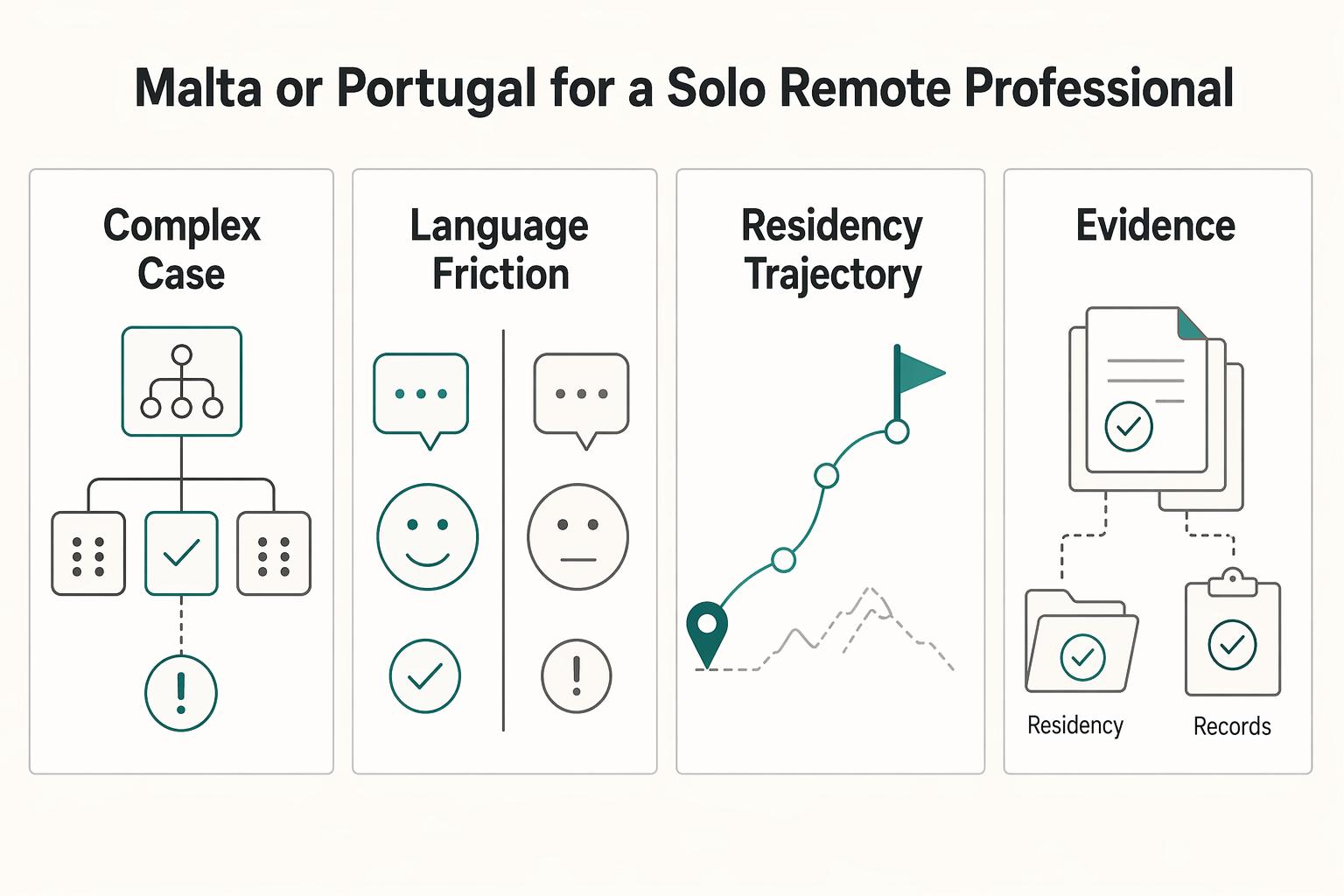
The article treats Malta versus Portugal as a priority decision, not a universal winner. Malta is stronger when your income clearly fits authorised-work rules, your remittance facts are clean, and you can manage the documentation and compliance routine. Portugal should be assessed by verifying domestic classification, filing burden, language friction, and the route that matches your long-term trajectory. Choose based on your top priority, whether that is tax handling, language comfort, residency horizon, or admin load.
Try a related tool
Researched and edited by the Gruv editorial team. Gruv builds cross-border billing, payouts, and finance-operations software for global businesses.
Sources
- eeas.europa.eu/sites/default/files/frequently_asked_questio...trusted
- home-affairs.ec.europa.eu/policies/schengen/border-crossing/short-stay...trusted
- irs.gov/individuals/international-taxpayers/foreign-...trusted
- irs.gov/businesses/international-businesses/malta-ta...trusted
- mtca.gov.mt/docs/default-source/documents/personal-tax/l...trusted
- nomad.residencymalta.gov.mt/topic/permit-renewalstrusted
- nomad.residencymalta.gov.mt/topic/visas-and-residence-permitstrusted
- state.gov/wp-content/uploads/2019/02/10-1123-Malta-Tax...trusted
Educational content only. Not legal, tax, or financial advice.
Related Posts

The 2026 Global Digital Nomad Visa Index for 50+ Countries
Start with legal fit, not lifestyle filters. The practical order is simple: choose a route you can actually document, then decide where you want to live. That single change cuts a lot of wasted comparison work and stops you from falling in love with places that were never a real filing option.

Can Digital Nomads Claim the Home Office Deduction?
Claim the deduction only when your facts and records can carry it. With the home office deduction for digital nomads, the real decision is usually a three-way call: claim it, do not claim it, or pause and get help because your file is not ready.
Handle the Saving Clause in US Tax Treaties Without Guesswork
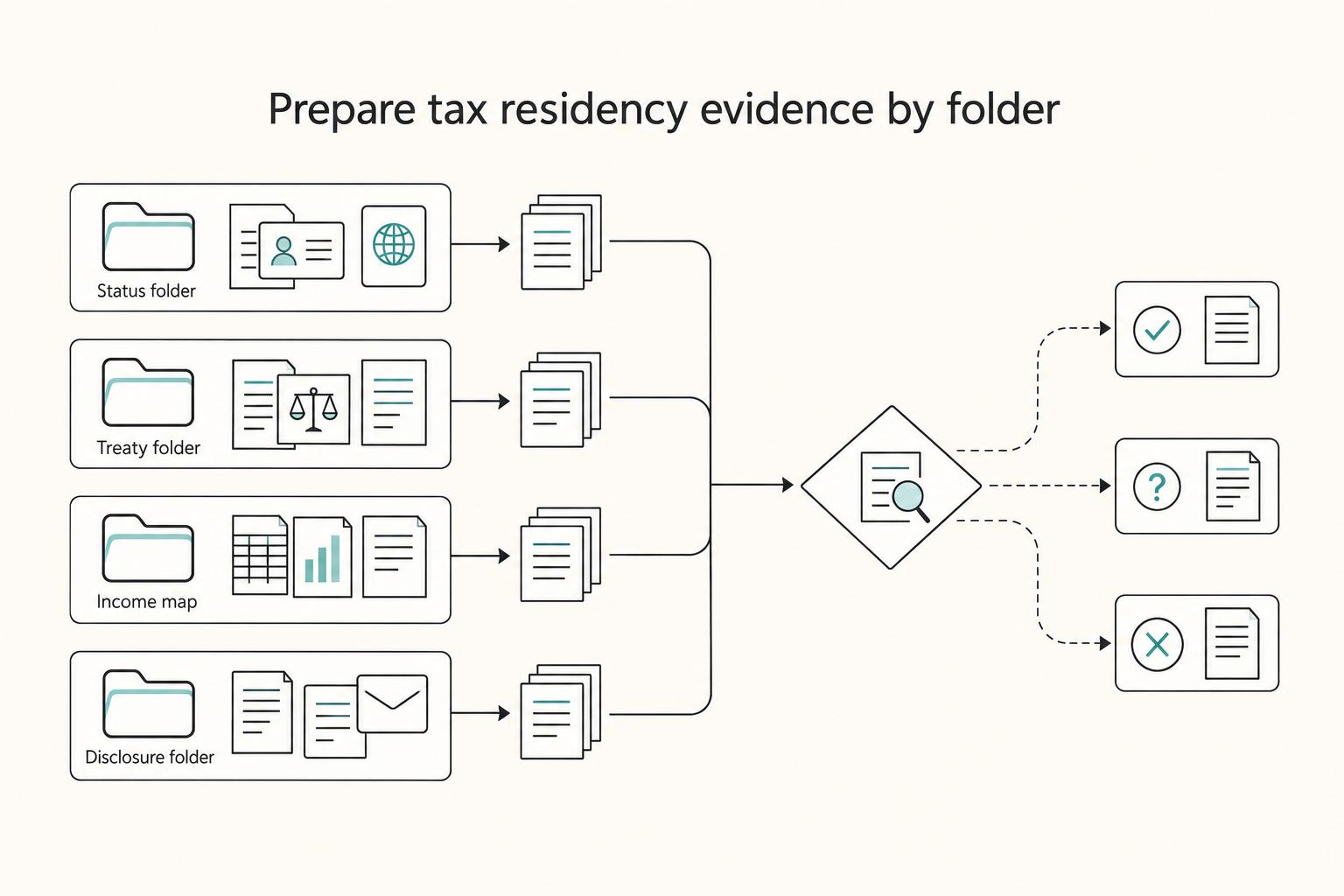
Start with documents, not conclusions. Before you take any `saving clause us tax treaties` position, write down your residency facts, period-by-period status, and filing logic in plain language so someone else can follow your reasoning.