
Quick Answer
Start by treating how to get a literary agent as a partner-selection workflow, not a one-shot pitch. Prepare a consistent package, verify each agent’s live submission guidelines, and send in controlled batches you can measure. Use tools like Publishers Marketplace as pointers, then confirm details on official agency pages. When interest appears, run offer-stage checks on references, contract language, and day-to-day collaboration before you decide.
Decide Your Criteria and Process Before You Query#
To get a literary agent, start by changing the job you think you are doing. You are not asking for permission. You are choosing a business partner for a process that is exciting, subjective, slow, and often emotionally hard, with rejection, long response times, and silence as part of the reality. That shift can lead to better fit and clearer decisions under uncertainty.
| Passive applicant | Strategic partner-seeker |
|---|---|
| Hopes any yes is good news | Decides what kind of yes is worth taking |
| Treats rejection or silence as a verdict on the work | Treats response patterns as information to review |
| Queries sporadically when confidence is high | Commits to a documented process even when confidence dips |
| Focuses on getting signed | Focuses on finding the right fit, knowing representation does not guarantee a publishing deal |
Step 1. Define success before you query. Write down the few criteria that will matter when interest appears. That can include the kind of career support you want, the communication style you can work with, and what would make you walk away. Verification point: if you cannot explain your decision rules in a short note to yourself, you may not be ready to judge offers consistently.
Step 2. Name the four terms you will use throughout this process. For this guide, keep four terms explicit: your query process, the reality of traditional publishing (subjective, slow, and unpredictable), the lack of a publishing guarantee, and your submission history. You do not need perfect definitions yet. You do need a place to capture each one clearly enough that you can act without guessing.
Step 3. Commit to a structured query process. Uncertainty can trigger self-doubt, overthinking, and stop-and-start outreach. Counter that by keeping a simple submission log from day one: who you queried, when, what they asked for, and what happened next. That record matters later too.
If your representation situation changes, a prospective new agent may ask about submission history, including which editors have already seen the manuscript. Poor handoff transparency can raise concerns for some prospective agents. Related: Digital Nomad Health Insurance: A Comparison of Top Providers.
Before You Launch: Is Your Core Asset Investment-Ready?#
Do not start querying until your manuscript, positioning, and submission package clearly describe the same book. If those three parts are out of sync, targeted outreach is harder and your materials are less trustworthy.
| Readiness signal | Not ready yet | Ready to query |
|---|---|---|
| Manuscript quality | Draft is finished, but major feedback still repeats or the opening and later pages feel uneven | The opening and core chapters hold up on reread, and feedback is no longer surfacing major recurring issues |
| Market positioning | Genre/category is vague, comps are picked by taste, and audience fit is unclear | Category is clear, comps are relevant, and you can explain who this book is for |
| Submission professionalism | Query, synopsis, and pages describe different versions of the book | Query, synopsis, and sample pages are consistent and easy to tailor to each agent's requirements |
Step 1. Audit the manuscript, not just the concept. Confirm the pages support the genre/category you plan to pitch. If you are querying work like poetry, short stories, articles, or essays, pause and reassess the route, because SFWA warns reputable agents generally do not handle those categories.
Step 2. Build comps that do real work. Use a small set of recent, relevant titles and keep your logic concrete:
- Identify category fit: where your book sits in the market.
- State audience overlap: who is likely to read yours for similar reasons.
- Name your point of difference: what your book does differently without overclaiming.
If you cannot explain those three points clearly, keep refining before outreach.
Step 3. Finalize your go-to-market package. Treat each document as a separate test:
- Query letter: opens interest.
- Synopsis: shows control of the full story.
- Sample pages: prove execution on the page.
Pre-query self-check:
- Manuscript is polished enough that major recurring revisions are not still open.
- Genre/category is clear and supported by the pages.
- Synopsis matches the actual story.
- Sample pages are strong and representative.
- Query, synopsis, and pages present the same book.
Keep one clean master package, then customize to each agent's current guidelines after you verify they are open to queries and check their preferred contact method (email or online form).
You might also find this useful: How to Write a Book to Establish Your Freelance Expertise.
Prospecting Partners: Building a High-Value Agent List#
Build a defensible list, not a big one. Your goal is to keep only candidates you can verify from live, relevant sources, so your query results are usable.
| Item | What to confirm | Status |
|---|---|---|
| Genre fit | Clear match to your category on the agency or agent pages | confirmed / hinted / unknown |
| Editorial style | Any explicit statement about how hands-on they are | confirmed / hinted / unknown |
| Communication cadence | Any stated response or update expectations | confirmed / hinted / unknown |
| Submission strategy | Any public guidance on what they want and how to submit | confirmed / hinted / unknown |
| Rights handling | Any stated support for rights beyond the core deal | confirmed / hinted / unknown |
Step 1. Use a practical screening rubric before you collect names. Treat your ideal partner profile as a simple screening sheet for each candidate. Mark each item as confirmed, hinted, or unknown based only on what you can see in public profile materials.
- Genre fit: clear match to your category on the agency or agent pages
- Editorial style: any explicit statement about how hands-on they are
- Communication cadence: any stated response or update expectations
- Submission strategy: any public guidance on what they want and how to submit
- Rights handling: any stated support for rights beyond the core deal
Move a candidate to your active list only when category fit is confirmed and a current submission path is visible. Keep everything else as open questions until verified.
Step 2. Validate source quality before you shortlist. Shortlist only from sources you can verify quickly. Confirm the agency has an Agents page before shortlisting, and confirm a Submit page before moving anyone into your active query list.
Reject weak matches early. The research set included clearly off-topic noise (for example, a 2016 California administrative hearing record), which is exactly the kind of result to discard immediately. If a source is blocked by a verification gate like reCAPTCHA, mark it unverified and continue. If you find older material (for example, a post dated Aug 10, 2020), treat it as a lead and re-check live pages for current details.
If you use third-party tools or directories, use them as pointers, not proof. Extract what is explicitly visible, then confirm details on official agency pages before adding a name to your active list.
Step 3. Tier your list by purpose. Use tiers to control risk and learn before you spend your strongest opportunities.
| Tier | Purpose | Readiness criteria | When to query |
|---|---|---|---|
| A | Highest-priority matches | Confirmed category fit, visible current submission path, enough detail for a tailored pitch | After your package has been tested in a smaller wave |
| B | Strong working matches for early signal | Confirmed fit and submission path, with some unknowns in working style details | Early waves |
| C | Plausible but lower-confidence matches | Basic fit appears possible, but multiple fields remain unknown | Later waves or when your category pool is narrow |
Step 4. Run a feedback loop between waves. Track each submission by tier, date sent, source, fit signals used, and outcome. Review results by tier so you can separate targeting problems from package problems before the next wave.
If outcomes are weak across tiers, re-check source quality and submission-path accuracy first, then reassess your materials. If one tier underperforms while another holds up, tighten your screening rules for that tier before sending more queries.
For a step-by-step walkthrough, see How to Write a Book Proposal for a Nonfiction Book.
Executing the Campaign: Managing Outreach as a Sales Pipeline#
Run your outreach like a controlled pipeline, not a one-time blast. Small waves, clean tracking, and deliberate revisions give you usable signal and reduce avoidable mistakes.
Step 1. Build one clean query package, then verify format before each send. Start from one baseline package and keep it stable inside a wave:
- Opening hook (what the project is, fast)
- Market positioning
- Comparable titles
- Brief author context
- Clean close
Before you submit, verify the agent's live Submit page and log the current requirements in your tracker. Use that check to confirm the agent is open, your category is invited, and your materials match the listed instructions.
Step 2. Track decisions, not just activity. Use a tracker that helps you diagnose outcomes, not just record dates.
| Field | Why it matters |
|---|---|
| Agent and agency | Prevents duplicates; lets you review by firm or tier |
| Submit page checked date | Confirms you used current instructions |
| Materials sent | Records exactly what version went out |
| Personalization used | Shows whether a specific angle improves engagement |
| Revision version | Lets you compare package versions cleanly |
| Response type | Separates silence, pass, and request patterns |
| Next action | Forces a clear follow-up decision |
Step 3. Batch your sends and freeze variables inside each batch. Do not change hook, comps, pages, and synopsis all at once. Keep one package version per wave so you can interpret results. This is how you avoid spray-and-pray outreach and get signal you can use.
Step 4. Treat response patterns as instructions for what to revise next.
| Response pattern | Check first | Revise next |
|---|---|---|
| Broad silence across verified targets | Submission accuracy and fit | Targeting list, then query copy |
| Passes after requests for more material | Package alignment | Sample pages or synopsis |
| Better replies from one personalization angle | Fit clarity | Keep that angle and tighten targeting |
| Replies cluster in one segment only | Segment fit | Narrow list toward that segment |
Keep execution quality high in every send. Generic, robotic outreach can undermine trust, so aim for clear, specific, human copy.
We covered this in detail in How to Get a Registered Agent for Your US LLC.
From Offer to Partnership: The Due Diligence Framework#
An offer is your signal to verify, not to rush. Move forward only when three things align: reference feedback, written terms, and day-to-day working fit.
| Area | What to verify |
|---|---|
| Termination path | Who can end the relationship, how notice works, and when it takes effect |
| Scope of representation | Whether the agreement covers one manuscript, a series, or broader current/future work |
| Commission and expenses | What revenue is covered, what costs can be charged to you, and what requires approval |
| Rights splits | Which rights are included, retained, or delegated (for example, audio, translation, film/TV) |
| Post-termination handling | What happens to active submissions, unsold work, signed deals, and future payments |
Step 1. Run reference checks like evidence collection, not reassurance. Ask to speak with current clients and use the same question set each time so you can compare answers. You are testing how this agent communicates, how they handle setbacks, and what representation feels like after the initial excitement.
| Area | Green flags | Red flags |
|---|---|---|
| Communication | Clear update rhythm, direct about response times, specific examples | Vague promises, delayed follow-up during offer stage, avoids specifics |
| Deal strategy | Explains submission approach and fallback path if first round stalls | General talk with no concrete process or fallback |
| Contract terms | Written clarity on scope, termination, expenses, and post-termination handling | Broad or fuzzy language, unclear exit path, verbal assurances instead of clear terms |
| Rights handling | Clear explanation of who handles rights and how decisions are communicated | Rights bundled without explanation, unclear process, rights treated as an afterthought |
Step 2. Review the agency agreement clause by clause, with counsel if needed. Use one repeatable checklist for every offer and keep questions in writing. A short contract can still create long-term risk if key clauses are vague.
Check these five areas:
- Termination path: who can end the relationship, how notice works, and when it takes effect. Confirm the exact notice and effective-date rules from the agency agreement, counsel or adviser notes, and governing contract records before relying on them.
- Scope of representation: whether the agreement covers one manuscript, a series, or broader current/future work.
- Commission and expenses: what revenue is covered, what costs can be charged to you, and what requires approval. Confirm the exact commission language, reimbursable-expense rules, approval requirements, and any limits from the agency agreement, counsel or adviser notes, and governing contract records before relying on them.
- Rights splits: which rights are included, retained, or delegated (for example, audio, translation, film/TV).
- Post-termination handling: what happens to active submissions, unsold work, signed deals, and future payments.
If the deal is framed as traditional publishing, keep the core check in view: the publisher pays the author, not the other way around. If you are being asked to pay while it is presented as traditional, pause and separate representation from fee-for-service publishing.
Step 3. Treat the offer call as a role-based interview. Use focused questions to test collaboration quality before you sign.
- Day-to-day collaboration: How often will you update me during submission, and what triggers updates?
- Escalation process: If we disagree on notes, timing, or submission direction, what is the decision process?
- Deal execution: What is your first submission plan, and what is the fallback if round one does not move?
- Rights management: Who runs subrights conversations, and how will approvals be handled?
- Long-term alignment: Are you positioning this as one project, or as part of a multi-book career plan?
Use a clear decision rule: Go only when references are consistent, terms are understandable in writing, and the working style fits. Choose No-go or Not yet when any one of those is weak. Excitement is not evidence.
Conclusion: Assess Fit, Track Outreach, and Judge by Evidence#
Shift from hopeful applicant to decision-maker#
Shift your role from hopeful applicant to decision-maker. You are not trying to win approval from a literary agent at any cost. You are assessing fit, running outreach, and judging responses against the career you want.
That mindset matters most at offer stage, because warm language often shows up before anything is formal. An email asking to chat is promising, but it is not the same as an offer of representation. Read the wording carefully and do not automatically stop querying or notify pending agents until the offer is explicit.
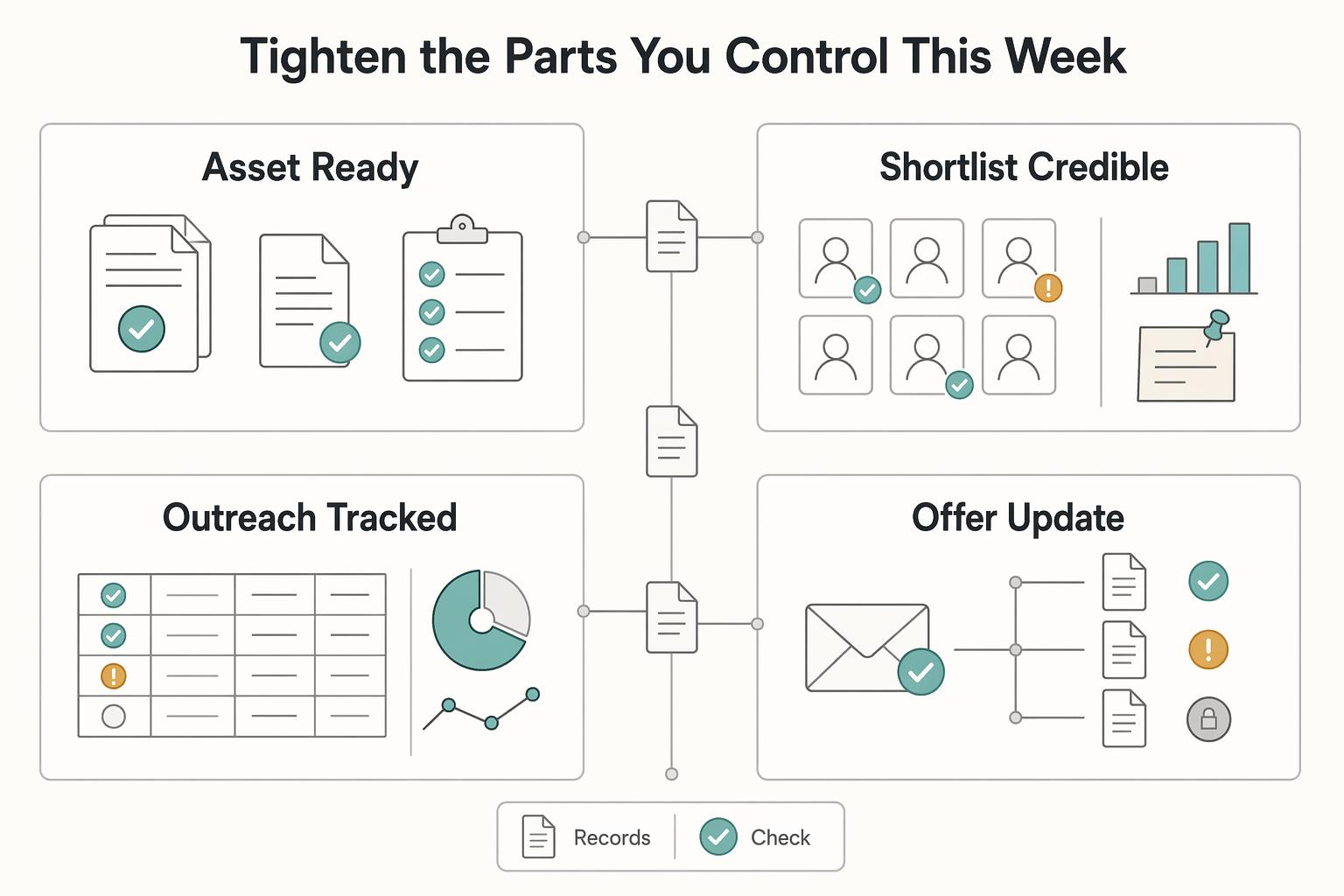
Tighten the parts you control this week#
Use this week to tighten the parts you control. Your query tracker is not just admin. It is the record that tells you what has been sent, what is still pending, and who needs an update if an offer arrives. If you queried through Query Manager, that can be part of your alert process when you need to notify agents.
| Checkpoint | What to confirm |
|---|---|
| Asset ready | Your pages, pitch, and any requested sample materials match the submission guidelines |
| Shortlist credible | Agents represent books like yours and are open to submissions |
| Outreach tracked | Sent date, materials, status, and follow-up notes are in one place |
| Offer update ready | You have clear language prepared to notify pending agents and set a response-by date |
Run this quick checklist before the next batch or the next call:
- Asset ready: your pages, pitch, and any requested sample materials match the submission guidelines
- Shortlist credible: agents represent books like yours and are open to submissions
- Outreach tracked: sent date, materials, status, and follow-up notes are in one place
- Offer update ready: you have clear language prepared to notify pending agents and set a response-by date
If you get real interest, send clean updates and set a clear deadline. One source describes two weeks as standard, while another real decision took about three weeks, so treat timing as a checkpoint, not a rigid rule.
Measure progress by evidence, not mood#
Evaluate progress by evidence, not mood. Good signs are a cleaner shortlist, sharper materials, and better-quality responses. A key red flag is confusing praise with market conviction: a manuscript can be well written and still be seen as hard to sell.
If you want representation that actually helps your career, choose based on fit, process clarity, and professional alignment, not just excitement.
Frequently Asked Questions
How do you vet a literary agent?
Verify fit before you send anything. You want an agent who represents books like yours, is currently signing new clients, and is actually open to the kind of query you plan to send. Check the agent's Submission Guidelines on their site and confirm what they want, because requirements vary widely and some ask for concrete materials such as the first 3 chapters.
What are the biggest contract red flags?
Treat unclear terms as a pause signal. If you cannot explain the key points in plain English, ask follow-up questions in writing before deciding. Use your author-career priorities to judge fit, and consider qualified legal review if you still feel unsure.
How should you track your queries?
Track them in batches, not from memory. One practical strategy recommends batching queries and following up, and one source describes a shotgun approach as rarely effective. Keep one sheet with agent name, agency, date sent, materials requested, status, follow-up date, and any notes from the Submission Guidelines.
What should you ask on The Call?
Ask the questions that matter to your author career, not generic ones. The Call is a phone or Zoom conversation where an agent may discuss your book and offer representation, so you should prepare instead of winging it and treat it like an interview. Write down your priorities first, then ask about communication, editorial fit, submission approach, and what happens if you disagree on strategy.
Does an agent do the same job as an attorney?
Treat them as different kinds of support. One source frames agent value around contract negotiation and rights strategy. If legal language leaves you unsure, consider qualified legal review before you sign.
How do you handle fee requests or paid services?
Slow down and get the details in writing before you decide. Ask what the payment covers and whether it is part of representation or a separate service. If anything is unclear, pause and ask follow-up questions.
Try a related tool
Researched and edited by the Gruv editorial team. Gruv builds cross-border billing, payouts, and finance-operations software for global businesses.
Sources
Includes 1 external source outside the trusted-domain allowlist.
- acquisition.gov/far/part-49trusted
- acquisition.gov/far/part-9trusted
- augustana.edu/files/2025-06/Clinic_Manual_2025_Revision.pdftrusted
- dgs.ca.gov/-/media/Divisions/OAH/General-Jurisdiction/D...trusted
- dpi.wi.gov/sites/default/files/imce/sped/pdf/sl-slp-eva...trusted
- law.cuny.edu/academics/academic-resources-support/legal-w...trusted
- pmc.ncbi.nlm.nih.gov/articles/PMC12302441trusted
- arxiv.org/html/2509.04472v2external
Educational content only. Not legal, tax, or financial advice.
Related Posts

What to Do If You've Been Misclassified as an Independent Contractor
Treat this as a protection problem first, not a label debate. If your work was treated as an independent contractor arrangement even though the relationship functioned differently, your first goal is to protect pay, rights, and records while you choose the least risky escalation path. You can do that without making accusations on day one, which often keeps communication open while you document what happened.

Digital Nomad Health Insurance Comparison for Long-Stay Moves
Use focused time now to avoid expensive mistakes later. Start with a practical `digital nomad health insurance comparison`, then map your route in [Gruv's visa planner](/tools/visa-for-digital-nomads) so we anchor policy checks to your real plan before pricing pages pull you off course.

How to Write a Book as a Freelancer Without Scope Drift
The book needs a defined job and a defined boundary before you draft. In this cycle, give it one job: either support your client book services, or strengthen your own authority book so your niche, offer, and sales conversations become clearer.