
Quick Answer
The best SaaS link building approach is to treat backlinks as a governed business asset, not a monthly outreach tactic. Start by fixing crawlability, indexation, listings, integration pages, and unlinked mentions, then build repeatable link-attracting assets like data reports, podcast appearances, and expert responses, and protect strong placements with clear ownership, review cadences, and risk controls.
Your SaaS Link Building Is a Tactic. Here's How to Make It a Defensible Brand Asset.#
If your SaaS link building still feels like a string of disconnected asks, treat that as an operating problem, not just a marketing gap. You can usually see the pattern in practice. Outreach happens in bursts. Links land on whatever page is easiest to pitch. Anchor text is vague. Nobody owns link quality after placement. Reporting stops at referring domains instead of asking whether those links support authority, credibility, discoverability, and the pages buyers actually visit. That is why the work often fails to compound.
| tactic-led behavior | asset-led behavior |
|---|---|
| Chasing any placement you can get | Prioritizing relevant, editorial links that fit your market and brand |
| Sending outreach to homepages or random blog posts | Targeting deep product pages, use-case pages, comparison pages, and linkable assets |
| Measuring activity volume | Checking crawlability, descriptive anchors, page relevance, and business fit |
| Treating links as a standalone SEO task | Tying effort to SEO, product marketing, content strategy, and partnerships |
The shift is simple. Stop asking, "How do we get more links this month?" and start asking, "What are we building that reputable sites would want to reference over time?" That changes what you publish and how you review it. A basic checkpoint is whether links are crawlable, use descriptive anchors, and point to pages with real buying or educational value, not just top-level pages.
This four-part operating model applies throughout: define the goal, name your constraints, build the system, and assign governance. Your goal is durable authority and discoverability. Your constraints are relevance, brand risk, and team capacity. Your system is repeatable publishing plus partnerships. Your governance is who approves targets, tracks link decay, and rejects low-trust placements. The next three sections follow that structure in order: foundation, scalable link-attraction engines, and relationship assets.
If you want a deeper dive, read How to Use SEO to Attract High-Quality Freelance Clients.
Why Your Backlink Profile Is a Financial Asset, Not a Marketing Metric#
If you want this work to compound, manage backlinks like an asset you govern, not a monthly activity count. Ask, "Did portfolio quality, resilience, and business fit improve?" before you ask, "How many links did we get?"
Link metrics are inputs and signals, not the business outcome itself. Use leading indicators to check acquisition quality, and lagging indicators to check whether that authority is showing up in places that matter, like qualified traffic, demo intent, conversion efficiency, and retention-supporting education pages. Measure contribution, not guaranteed causality.
| area | marketing metric mindset | asset management mindset |
|---|---|---|
| success definition | Count links, domains, or DR movement | Improve portfolio relevance, quality, and durability |
| source selection | Take any placement that looks strong on paper | Prioritize contextual relevance and editorial fit in your niche |
| page targeting | Send links to the homepage or easiest post | Route links to pages tied to buying intent or product understanding |
| anchor strategy | Push exact-match anchors | Keep anchors descriptive and natural |
| risk view | React only after rankings drop | Monitor concentration risk, sudden velocity spikes, obvious paid placements, and weak sources |
| reporting | Show activity totals | Connect inputs to qualified traffic, demo assists, conversion signals, and lost-link risk |
A practical input-to-outcome chain for reporting: acquisition standards -> better source/placement quality -> stronger visibility on relevant pages -> more qualified organic visits -> better demo/conversion signals on those pages
Leading and lagging signals#
Leading signals are the controls you set before outcomes appear: contextual relevance, placement quality, destination-page fit, anchor diversity, crawlability, and whether your profile still looks natural. In practice, a relevant mid-authority link can outperform an irrelevant high-authority one.
Lagging signals sit closer to revenue: qualified organic visits to linked pages, demo activity on those pages, and conversion efficiency trends after authority improves. For education pages, you can also track support for adoption or self-serve retention, but frame this as contribution, not proof of direct cause.
Govern the portfolio, not just the campaign#
Before you scale or outsource, define link standards and non-negotiables in writing. Include unacceptable sources and practices (such as PBNs, spam, and link farms), anchor rules, destination priorities, relevance criteria, and clear KPIs.
| Cadence | Details |
|---|---|
| Review monthly | New referring domains, relevance notes, anchor mix, target-page mix, lost links, qualified organic traffic to linked pages, and assisted demo signals |
| Escalate immediately | Abrupt link velocity changes, rising exact-match anchor share, clusters of irrelevant placements, or over-concentration on one URL or source type |
| Set team thresholds | Use documented internal thresholds for exact-match anchor share, lost high-value links, and target-page concentration; keep values pending until verified |
Use a monthly operating cadence:
- Review monthly: new referring domains, relevance notes, anchor mix, target-page mix, lost links, qualified organic traffic to linked pages, and assisted demo signals.
- Escalate immediately: abrupt link velocity changes, rising exact-match anchor share, clusters of irrelevant placements, or over-concentration on one URL or source type.
- Set team thresholds: use documented internal thresholds for exact-match anchor share, lost high-value links, and target-page concentration; keep values pending until verified.
Keep a placement log with source URL, target URL, anchor text, relevance note, owner, and last verification date. That record makes audits, vendor management, and recovery work faster when performance shifts.
Related: How to Get High-Quality Backlinks to Your Freelance Website.
Tier 1: Building The Foundation (Risk Mitigation & Foundational Authority)#
Complete this tier before you spend on outreach, because Tier 1 is where you reduce waste and prove your target pages can actually receive link value.
Start with crawlability and indexation. Before you request, buy, or earn links, review Google Search Console for crawl errors on the URLs you want to strengthen. If those pages are not being crawled and indexed reliably, link ROI drops. A phased 90-day sequence works better than random activity because execution order is part of risk control.
Complete the listings that establish baseline trust#
Your first foundation layer is coverage across software marketplaces, corporate directories, and niche directories. For this stage, "complete" means each listing is live, accurate, consistent with your site, mapped to the right destination URL, and filled with enough core information for both readers and crawlers to understand your company and product category.
| foundational source type | trust signal created | common implementation gap | owner |
|---|---|---|---|
| software marketplaces | product legitimacy and category fit | incomplete profile, wrong URL, thin description, stale visuals or plan details | product marketing or growth |
| corporate directories | company legitimacy and operating transparency | inconsistent company naming, outdated company details, missing clear site link | ops, founder, or marketing |
| niche directories | topical relevance in your market | low-quality submissions, weak category mapping, duplicate or sparse entries | SEO or content lead |
Prioritize quality and relevance over volume. One strong, relevant listing usually does more than many weak directory placements.
Qualify integration pages before you chase them#
Treat integration links as qualified placements, not automatic wins. Use this four-part check before outreach:
| Check | What to confirm |
|---|---|
| Fit | The integration is real, current, and useful to shared users |
| Relevance | The partner is close to your buyers' workflow or category |
| Editorial context | The link sits inside useful integration content, not a thin logo page |
| Maintenance responsibility | A clear owner keeps links, product details, and page content current |
If a potential placement is weak on multiple checks, skip it. Contextual relevance generally beats higher authority from an irrelevant source.
Reclaim unlinked mentions with a lightweight SOP#
Unlinked mention reclamation is a low-friction way to strengthen your base. Monitor mentions of your brand, product, key people, and distinctive feature names, then triage by relevance, indexation status, and whether adding a link would help the reader.
Use a simple workflow:
- Verify the mention is live and unlinked.
- Select the most useful destination page (not always the homepage).
- Send a short, practical request with the suggested URL.
- Track source URL, mention date, contact, target URL, status, last follow-up date, and benchmark fields like response rate, link win rate, and median time-to-link, with benchmark targets marked pending until verified.
Finish this foundation before you move into scalable link-attraction engines. This order protects budget and lowers avoidable risk, including the downside from outdated tactics.
Tier 2: Constructing The Structure (Building Scalable Link-Attraction Engines)#
Once Tier 1 is stable, shift from one-off outreach to a repeatable system that earns links through useful assets. Pick assets that match buyer research behavior, strengthen topical authority, and fit your real team capacity.
Build your Tier 2 plan around four parts:
- Asset selection criteria: buyer intent fit, topical fit, and whether the asset is useful without a sales pitch.
- Production workflow: brief, draft, SME validation, and publish-ready packaging.
- Distribution plan: who pitches, where it gets promoted, and how follow-up is tracked.
- Clear ownership: content leads drafting, PR leads distribution, and subject-matter experts validate claims before publish.
| asset type | best-fit intent | linkability mechanism | operational effort | common failure mode |
|---|---|---|---|---|
| original data report | early-stage research and category education | publishers cite original findings, summaries, or visuals | data access, analysis, writing, design, outreach | weak methodology or insights that read like product promotion |
| podcast appearances | trust-building with problem-aware audiences | third-party attribution from interview coverage and episode resources | target show qualification, pitch tailoring, speaker prep, follow-through | weak audience fit or no clear post-recording follow-up |
| expert-source responses | timely commentary and credibility building | journalist/source attribution when your input is selected | daily monitoring, fast drafting, approval routing, response tracking | off-topic responses, thin support, or missed follow-up on published mentions |
Research/Data Asset Workflow#
Qualify first: proceed only if the data is anonymized, defensible, and useful on its own. Run the workflow in order: define the question, extract data, validate internally, draft findings, and package charts plus a summary page. Follow through: prepare an outreach pack with your most quotable stats, distribute through PR, and track which claims earn pickups.
Podcast Appearance Workflow#
Qualify first: prioritize shows with clear audience overlap and evidence they publish useful episode resources. Run the workflow in order: map target shows, send tailored pitches, prepare one teachable angle, and align one destination URL before recording. Follow through: send bio/headshot/link details immediately after recording, then verify the live episode page and update your tracking log.
Expert-Response Workflow#
Treat this as a channel set, not a single platform dependency: journalist request networks, source platforms, and direct media requests. Qualify first: route only requests that match your expertise; when a qualification threshold has not been verified yet, mark it as pending rather than inventing a cutoff. Run the workflow in order: monitor daily, draft quickly, approve with SMEs when needed, and submit on deadline. Follow through: log wins and misses, reclaim unlinked mentions when relevant, and refine routing rules.
If Tier 1 foundations are still incomplete, pause here and close those gaps first: indexed target pages, accurate core listings, and an active unlinked-mention process. If those are in place, you are ready for Tier 3, where repeatable assets become harder-to-copy relationship assets.
Need the full breakdown? Read A Guide to SOC 2 Compliance for SaaS Companies.
Tier 3: Placing The Capstone (Forging Irreplicable Relationship Assets)#
Tier 3 is where you turn repeatable content output into relationship assets that are harder to replicate. At this stage, more volume is not the goal. Strategic fit is, because buyers move across channels and stronger outcomes usually come from trusted partnerships rather than generic outreach.
Before you commit, qualify each partner on four points: audience overlap, editorial credibility, brand-safety alignment, and execution reliability. If one fails, treat the opportunity as optional, not foundational.
| capstone channel | primary strategic value | resource intensity | key risk to manage |
|---|---|---|---|
| early digital PR | third-party validation tied to timely, evidence-backed narratives | high | weak evidence or slow approvals that miss timing |
| authority-led guest bylines | trust transfer from credible publications plus direct reach to the right readers | medium | generic perspective that does not match publication standards |
| co-marketing collaborations | combined authority and reach through a shared asset neither side could produce alone | high | unclear ownership, uneven execution, or message drift after launch |
Build digital PR pitches from recurring sales-call questions#
Entry criteria: You have a timely angle and can support it clearly. Workflow: Start from recurring sales-call questions (use the top 10 as your pipeline), select one question with strong evidence, build a short claim-and-proof brief, and assign a named approver before pitching. Expected outcome: Higher-trust visibility that supports your authority narrative, not just a one-off mention.
Pitch guest bylines where the audience matches your buyers#
Entry criteria: The publication audience matches your buyers, and your expert can teach something specific. Workflow: Confirm fit, pitch one clear argument, draft to the publication's editorial style, and link to one page that genuinely helps readers go deeper. Expected outcome: Durable credibility with a relevant audience and stronger association with trusted editorial environments.
Define the shared co-marketing asset before production starts#
Entry criteria: Both partners contribute meaningful inputs (for example, audience access, expertise, or usable data). Workflow: Define the shared asset, set delivery responsibilities, align on message boundaries, and agree on launch and update responsibilities before production starts. Expected outcome: A differentiated asset with broader distribution and stronger trust than either partner could build alone.
| Playbook | Entry criteria | Workflow | Expected outcome |
|---|---|---|---|
| Early digital PR | You have a timely angle and can support it clearly | Start from recurring sales-call questions (use the top 10 as your pipeline), select one question with strong evidence, build a short claim-and-proof brief, and assign a named approver before pitching | Higher-trust visibility that supports your authority narrative, not just a one-off mention |
| Authority-led guest bylines | The publication audience matches your buyers, and your expert can teach something specific | Confirm fit, pitch one clear argument, draft to the publication's editorial style, and link to one page that genuinely helps readers go deeper | Durable credibility with a relevant audience and stronger association with trusted editorial environments |
| Co-marketing collaboration | Both partners contribute meaningful inputs (for example, audience access, expertise, or usable data) | Define the shared asset, set delivery responsibilities, align on message boundaries, and agree on launch and update responsibilities before production starts | A differentiated asset with broader distribution and stronger trust than either partner could build alone |
Governance before launch#
For every shared asset, set one owner, one final approver, and one post-launch maintainer up front. Lock the core message, approved claims, link targets, update cadence, and change-review trigger in the working brief. Where internal standards apply, reference the approved standard or mark the value pending until verified so the team does not improvise.
This handoff is important for the next section: high-authority placements can create lasting value, but only if you monitor them and enforce policy discipline after launch.
For a step-by-step walkthrough, see A guide to the 'Mere-Exposure Effect' for building your personal brand.
Governing Backlink Risk: Owner, Review, and Escalation Path#
Once stronger placements start coming in, your next job is governance: assign a risk owner, run a recurring review, and define an escalation path before issues appear.
Use a simple control model you can run every month:
- One named owner for backlink risk.
- One scheduled quality review.
- One escalation path for brand or search-risk patterns.
That owner should be able to balance marketing goals with compliance exposure, pause campaigns, challenge vendor decisions, and require evidence before risky placements go live or stay live.
Since the March 2024 core update, outdated tactics are not just ineffective; they can hurt performance. Keep your reviews focused on four risk categories you can act on:
- Source quality risk: weak editorial standards, low-trust domains, or obvious placement footprints.
- Relevance mismatch risk: links from sites with authority but no real topical or audience fit.
- Paid-link disclosure risk: compensation or incentives handled without clear internal documentation.
- Agency process risk: output volume you cannot audit, justify, or unwind.
A practical cadence is a monthly review plus alert-based checks when velocity changes sharply. Check whether links are live, indexed, and producing referral signals. For directories and partner pages, use UTM-tagged links so attribution is measurable. Treat exact-match anchor clusters, abrupt link spikes, and unrelated-site batches as escalation triggers, not reporting noise.
Vet agencies like risk-bearing vendors#
Treat procurement as risk control, not just channel sourcing. Due diligence can be proportional, but it still needs documented evidence.
| Low-risk partner signals | High-risk warning signs | What you ask for in procurement |
|---|---|---|
| They qualify prospects by audience overlap, traffic value, and topical fit, not just DR. | They sell domain metrics, guaranteed link counts, or ranking promises. | Ask for a recent prospect-screening sample with inclusion and rejection reasons. |
| They track live status, indexation, and referral signals after publication. | They cannot show whether links remained live or indexed. | Ask for a sample reporting view with post-placement monitoring. |
| They document outreach methods, content ownership, and approval flow. | They are vague about outreach execution or publisher relationships. | Ask for their outreach SOP, review workflow, and approval chain in writing. |
| They prioritize contextual relevance before volume. | They push broad packages across unrelated sites. | Ask for three category-relevant placements and the rationale for each. |
| They explain in-house vs. outsourced tradeoffs realistically. | They position outsourcing as automatically safer or faster. | Ask how they manage compliance review, outreach fatigue, and response rates under 5% without shortcuts. |
A useful stress test: ask how they reject prospects. If they cannot explain why a mid-authority niche placement can beat a high-authority irrelevant one, they are likely optimizing for count, not quality.
Keep a short compliance checklist#
Use one checklist across your team and vendors so standards stay consistent:
- Outreach transparency: document who contacts publishers, under which brand, and with what offer.
- Attribution and disclosure: record paid, sponsored, or incentive-based placements for internal review before outreach.
- Editorial standards: require audience fit, original value, and destination pages that actually support the placement.
- Documentation retention: keep outreach logs, approvals, target lists, live URLs, and change history in one system.
If placements feel forced, the risk may start upstream with weak content inputs. Tighten your upstream process with stronger content marketing for B2B SaaS.
Respond to negative SEO like an incident#
Handle suspicious backlink patterns with an incident-response flow, not guesswork. Detect unusual patterns (irrelevant domains, anchor manipulation, abrupt velocity shifts), then validate impact by checking whether links are real and whether indexation or referral behavior changed.
If a pattern looks harmful, attempt removals and document each action. Use disavow after documented review. That keeps decisions evidence-based and avoids panic-driven cleanup.
You might also find this useful: A Guide to Writing Case Studies for a B2B SaaS Audience.
Conclusion: Your Backlink Profile Is Your Legacy#
Your backlink profile is not a campaign output you admire at the end of a project. It is an owned business asset you maintain over time. That means keeping three jobs running at once: maintain the foundation, refresh the scalable structure, and protect the capstone relationships competitors cannot easily copy.
Keep the foundation clean and credible. Preserve your trust links, check that key listings and partner pages still point to the right destination, and favor relevance over raw authority. One highly relevant link can outperform many weak placements. Your basic verification step is simple: confirm the link is still live and still appears in Google Search Console data before you count it as part of your asset.
Keep the structure productive by refreshing the assets that actually attract links. If a report, comparison page, or integration page earned attention once, update it before it goes stale. If you use Ahrefs for prospecting, tools like Link Intersect and Best by Links can surface new gaps and opportunities, but the tradeoff is manual analysis. That extra review matters because natural link profiles are scrutinized, and manipulative patterns like exact-match anchors, sudden link spikes, or obvious paid placements can create avoidable risk.
Keep the capstone protected. Strategic partnerships, co-marketing placements, and high-trust mentions need the same care you would give any important commercial relationship, including approval history and a record of what was promised.
What to do next:
- Maintain foundational trust links and validate them with live-link checks and Search Console data.
- Refresh linkable assets that have already shown they can attract relevant attention.
- Review strategic partner placements and document URLs, anchor text, approvals, and any paid or sponsored terms.
If your next challenge is creating stronger assets to earn those links, start with the related content marketing guide for B2B SaaS and then continue through the SEO guides in this series.
This pairs well with our guide on A Guide to Revenue Operations (RevOps) for Scaling SaaS Companies.
Frequently Asked Questions
How should you judge ROI from link building for saas?
Judge ROI by measurable SEO outcomes, not by raw link count or vague authority claims. Focus on whether links improve qualified visibility for pages tied to buying decisions. Set written KPIs before work starts, such as DR growth, traffic increase, and rankings, and review them monthly against the pages that matter.
What makes a backlink high quality for your SaaS?
For SaaS, a high-quality backlink is topically relevant, editorially appropriate, and trustworthy. The mention should make sense in context and appear naturally inside useful editorial content. Approve links only when the site is aligned to your audience and the placement is transparent.
What are the safest tactics if your SaaS is new?
Start with tactics that match your current content depth and brand presence. For a new SaaS, that usually means documenting foundational profiles and partner pages before chasing bigger campaigns. Keep a simple sheet of live URLs and owners so the base stays accurate.
Can you scale without taking on avoidable risk?
Yes, but only if process and asset quality scale together. Document non-negotiables such as no PBNs, no spam, and no link farms before you increase outreach or use outside help. Volume without relevance, transparency, and documented review creates governance problems fast.
Is guest posting still worth doing as of today?
Yes, if you treat guest posting as a selective editorial channel instead of a volume tactic. Approve a short target-publication list first and prioritize fit over volume. Reject any offer that cannot clearly explain the site, audience, or editorial process.
How long should you wait before judging results?
Do not judge it too early. Some outsourced teams may secure placements in 2 to 4 weeks, but the more useful benchmark is whether you can commit for at least 6 months before making a final decision. Use a 6-month review window with monthly QA checks for live links, anchor text, target pages, and method quality.
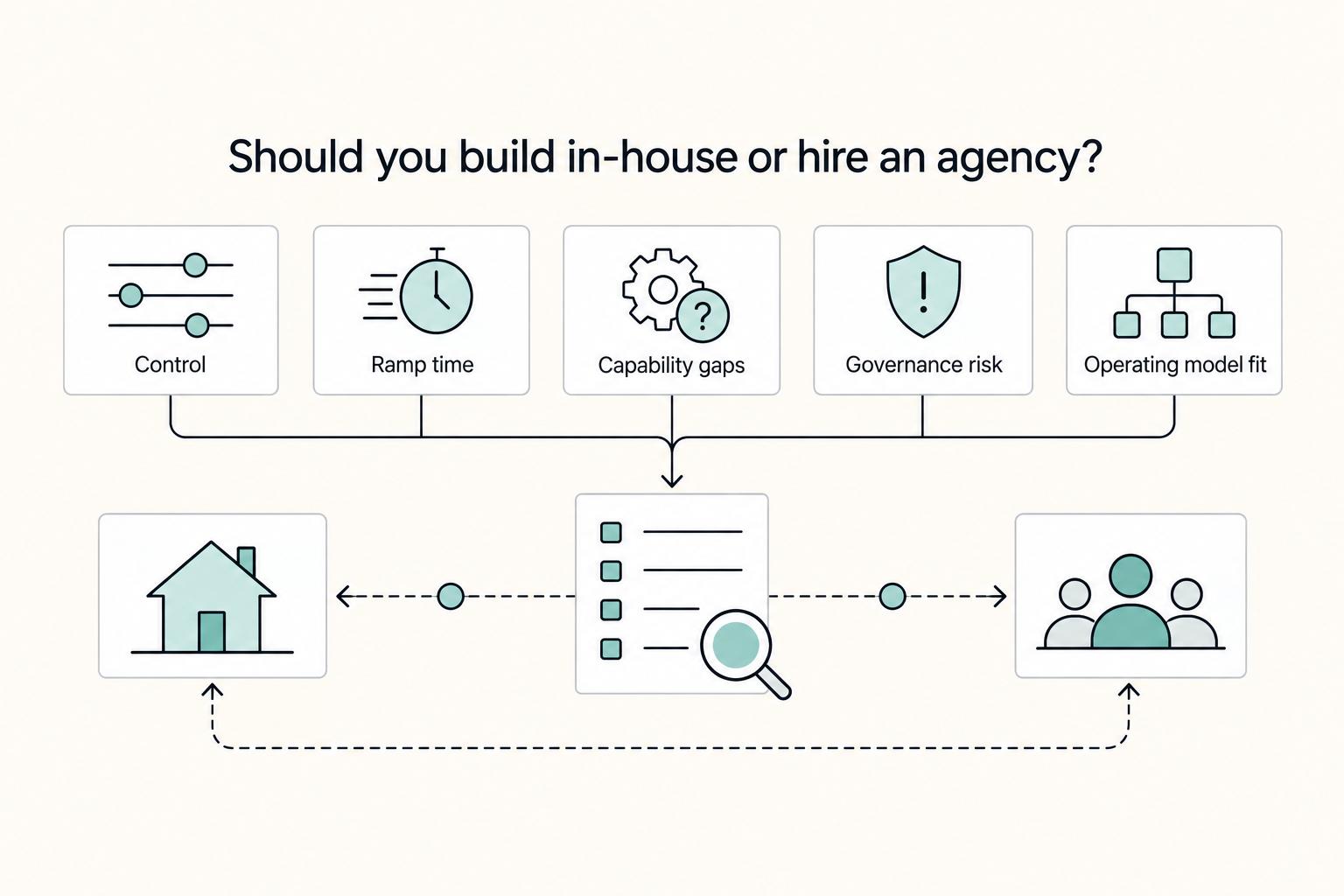
Should you build in-house or hire an agency?
Choose in-house when control and product depth matter more than speed. Choose an agency when ramp time and execution capacity are the bottleneck, but keep stronger review gates. Compare control, ramp time, capability gaps, governance risk, and operating-model fit rather than cost alone.
How do you vet an agency without getting burned?
Treat agency review as a method check, not a sales check. Guaranteed DR promises and unclear outreach methods are red flags when you need editorial fit and documented process. Ask for KPIs, SOPs, prohibited tactics, sample reporting, and a written explanation of how links are sourced before you sign anything.
What should you do next if you want to act this week?
Start with the tier that matches your bottleneck. If your trust layer is thin, begin with Tier 1 foundations; if you already have strong assets, move into Tier 2; if the basics are steady, invest in Tier 3 relationships. Make sure you have something worth promoting before you scale outreach.
Try a related tool
Researched and edited by the Gruv editorial team. Gruv builds cross-border billing, payouts, and finance-operations software for global businesses.
Sources
Includes 4 external sources outside the trusted-domain allowlist.
- brandeis.edu/registrar/bulletin/provisional/rabb.htmltrusted
- bulletin.miami.edu/courses-az/btetrusted
- kent.edu/cae/engineering-full-time-jobstrusted
- snap.berkeley.edu/project/11166188trusted
- almcorp.com/blog/definitive-guide-link-building-2026external
- bluetree.digital/saas-link-buildingexternal
- linkbuildinghq.com/industries/backlinking-for-saas-industryexternal
- marketbetter.ai/blog/lead-generation-for-saasexternal
Educational content only. Not legal, tax, or financial advice.
Related Posts

How to Use SEO to Attract High-Quality Freelance Clients
**Build your *seo for freelancers* around qualified leads, not raw traffic: tighten who you target, what you prove, and how you gate inquiries.** You're the CEO of a business-of-one. Your marketing job isn't "get more attention." It's "get the right work, predictably, without turning your calendar into a sorting machine."

How to Get High-Quality Backlinks to Your Freelance Website
For experienced professionals, the usual client acquisition model stops paying off. It becomes a loop of constant outreach, proposal writing, and networking, all driven by the pressure to keep the pipeline full. That churn eats your best time and leaves less room for the deep work that actually shows your value.
Content Marketing for B2B SaaS That Holds Up Under Real Work
If your publishing is inconsistent, nobody clearly owns decisions, and each post dies after one channel, you do not have an ideas problem. You have an operating problem. For a solo operator or lean team, your content gets more reliable when you document a few non-negotiable rules and review points.