
Quick Answer
Use leave no trace principles as a repeatable workflow, not a one-time reminder: verify current local requirements, make low-impact choices while conditions change, and finish with a full departure sweep. Start with planning and route durability, then apply strict waste and wildlife habits on site. When rules are unclear for your exact location, default to the lower-impact option until you can confirm what is allowed.
Introduction: How to make lower-impact decisions with current local rules#
If you are here, you probably do not want vague outdoor advice. You want clear, current information you can verify before you head out, so you do not accidentally damage a place, break a local rule, or spend the whole trip second-guessing basic choices.
That instinct is right. The Leave No Trace principles are not a universal rulebook for every trail, park, or public land unit. They are a seven-principle ethics framework for minimum-impact travel. They work best when you pair them with the exact rules, alerts, and special concerns issued by the land manager for the area you plan to visit.
In practice, check the specific park, forest, or BLM site before you leave, then confirm current alerts on the destination page itself rather than relying on old blog posts, trail apps, or forum comments. Treat permit, closure, fire, camping, waste, and wildlife details as pending until an official unit or agency source confirms them.
This guide helps you make those calls without turning trip prep into a research spiral. It follows a practical three-phase path: first, how to plan for conditions, regulations, and gear choices before the trip. Second, how to make lower-impact decisions in the field when weather, terrain, or crowding changes. Third, how to handle shared spaces well, including wildlife, noise, campsites, and other people.
The goal is not perfection. It is reducing avoidable impact with better decisions, especially when the original plan stops matching real conditions.
Phase 1: Pre-Mission Strategy & Risk Mitigation#
Your lowest-impact outcome is mostly decided before departure. In this phase, focus on three Leave No Trace principles: Plan Ahead and Prepare, Travel and Camp on Durable Surfaces, and Dispose of Waste Properly. If you cannot confirm current rules, choose a durable-surface route, and clearly define your waste plan, you do not have a true Go decision yet.
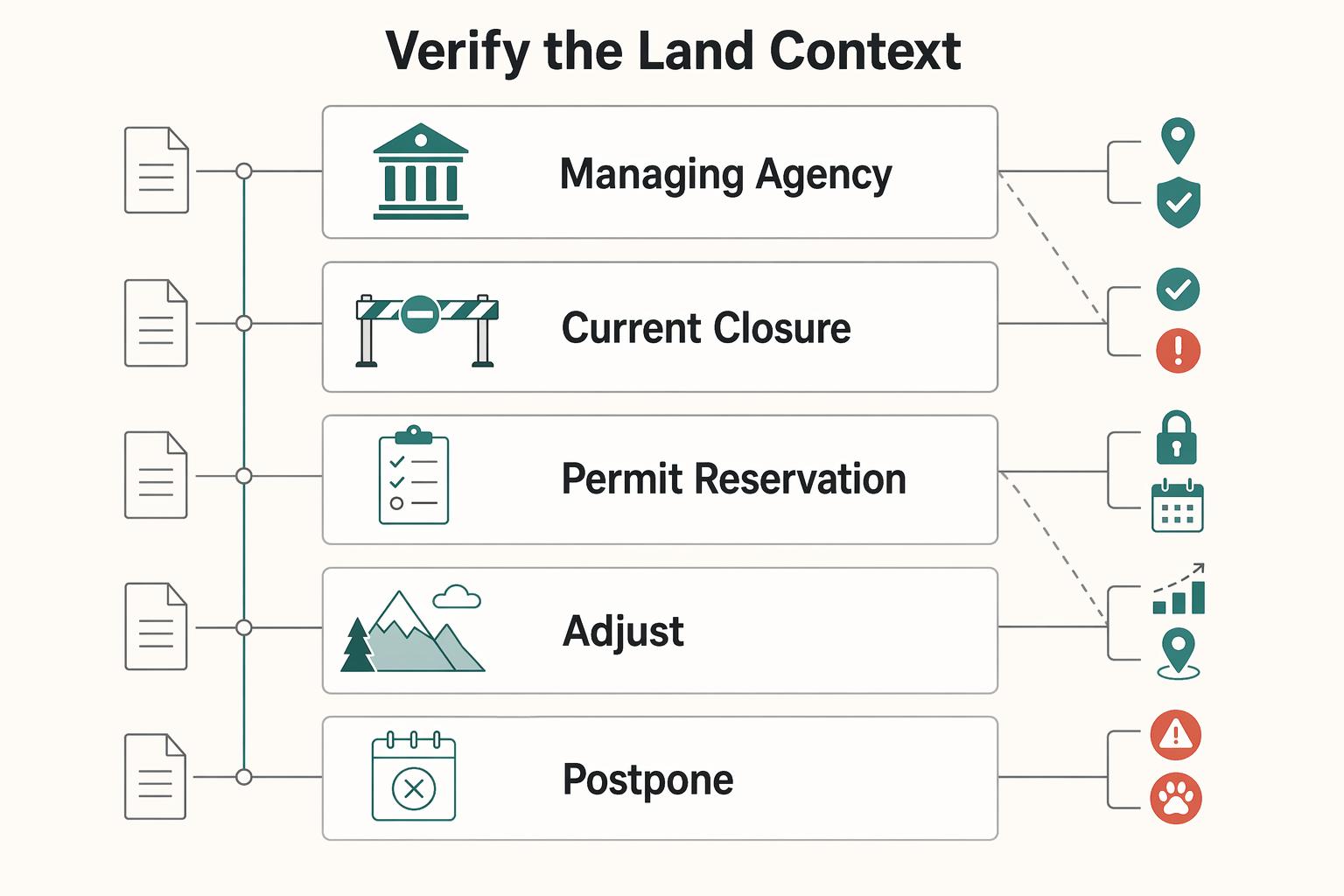
Verify the land context#
Identify the exact governing land manager for your entry point, not just the broader region. Check that official unit page first, then review current notices and alerts that may affect access, conditions, fire risk, wildlife risk, roads, or trails.
Before you leave, record these three items in your trip notes:
| Trip note | What to record |
|---|---|
| Managing agency and unit | Confirm the managing agency and unit from the official land manager |
| Current closure or alert affecting route | Confirm current closures or alerts with the managing unit |
| Permit or reservation dependency | Confirm permit or reservation requirements with the managing unit |
Write them down before you lose signal or start relying on memory.
If your plan is more than a standard personal visit, confirm whether a Special Recreation Permit applies for that use case. Do not assume it does, and do not assume the process is the same across destinations.
Then make an honest go / adjust / postpone call:
| Decision | Route sensitivity | Rule clarity | Team readiness |
|---|---|---|---|
| Go | Route stays mostly on maintained trails, designated campsites, rock, gravel, sand, dry grasses, or snow | Current notices are checked and clear | Everyone understands route, waste handling, and turnaround points |
| Adjust | Some segments or campsites increase impact risk | Rules are partly clear but require route, timing, or permit adjustments | Team can change plan, gear, or pace without forcing shortcuts |
| Postpone | Plan likely depends on fragile terrain, improvised camps, or unclear access | Key closure, permit, or hazard details are unresolved | Skills, gear, fitness, or communication plan are not ready for conditions |
Pack for the impact you want#
Your packing list should prove the plan is workable. Before you leave, verify each item:
| Item | Verification detail |
|---|---|
| Route plan | Map and compass or GPS, plus a shared itinerary and expected return time |
| Weather contingency | Hazards, extreme weather, and emergencies |
| Campsite approach | Prioritizes maintained trails and designated sites; where local rules allow, keep the 200-foot buffer from lakes and streams in mind |
| Waste carry-out plan | Trash, food scraps, and toilet paper; where catholes are allowed, use the 6 to 8 inch depth and keep at least 200 feet from water, camp, and trails |
| Food storage method | Aligned with local wildlife and site rules |
| Emergency communication plan | Who has your route and when they should escalate if you are overdue |
| Required permit or reservation confirmation | Carried when applicable |
A lower-impact plan that falls apart because of missing gear is still a high-impact plan. If any item is still unclear, reduce scope or postpone. For your immediate next planning step, run your route and gear against How to Plan a Multi-Day Hiking Trip, then pressure-test destination fit with Best Nomad Cities for Hiking Without Relocation Surprises.
Phase 2: In-Field Standard Operating Procedures (SOPs)#
In the field, keep decisions rule-first and repeatable. Before you move, stop, cook, or leave, verify the current direction for the exact park, forest, grassland, ranger district, or BLM unit, then act on what still matches conditions on the ground.
Treat last week's screenshot, cached app data, or advice from another area as secondary. If the official unit page now shows a closure, a fire restriction, or an NPS "Danger" alert (imminent hazard), that current notice controls. If you have signal, re-check. If you do not, choose the lower-impact option and avoid actions that depend on unverified rules.
Run the same field loop every time#
Use the same trigger-action loop all day so you do not skip critical checks.
| Trigger | Verify | Action |
|---|---|---|
| Before moving | Route status and closure or alert changes for this unit | Stay on durable surfaces where possible |
| Before stopping or camping | Site-use rules for this unit | Prefer established sites, designated campsites, or other durable surfaces (rock, gravel, sand, dry grasses, snow) |
| Before cooking or using heat | Fire restrictions or closures for this unit | If unclear, use a no-fire alternative |
| Before leaving | Departure and cleanup expectations for this unit | Scan for trash, food scraps, gear traces, and new surface impact |
The point is not ceremony. It is keeping the same checks attached to the same moments, especially when conditions change faster than your assumptions do.
Most field problems come from stacked assumptions, not one dramatic error.
Move and camp with surface and site judgment#
When you choose where to move or camp, use this order: surface first, then site, then proximity risk. Surface choice usually matters more than whether a spot looks convenient.
In popular areas, keep your travel and camp use on existing trails and campsites. On wet or muddy trails, stay in the middle and move single file. In pristine areas where dispersed use is allowed, avoid places where impact is just beginning. A faint social path or lightly worn patch is a warning sign, not a green light.
As you choose your site, protect sensitive zones. Camp at least 200 feet from lakes and streams to protect riparian areas unless the local unit publishes a different site-specific rule. Treat cultural and historic resources as no-touch: examine or photograph, but do not touch or move structures or artifacts. If a site includes cultural features or marked protection zones, relocate.
| Field signal | Decision | Immediate action |
|---|---|---|
| Rules verified, durable route, low-impact established site | Proceed | Continue on trail/site plan and re-check at next trigger |
| Guidance partial or conditions degrading (fragile surface, unclear site suitability) | Adjust | Shorten route, shift to more durable ground, or use established facilities |
| Closure, "Danger" alert, unverified fire rule, or cultural/sensitive-site conflict | Relocate | Leave area and select another site or stop until rules are verified |
Waste and heat without guesswork#
For waste, keep a fixed fallback path. Pack out all trash, leftover food, and litter. Use toilets when available. If toilets are unavailable and local rules allow catholes, use 6 to 8 inches depth and place them at least 200 feet from water, camp, and trails. If you cannot verify cathole permission, do not improvise; use the option that removes impact until you can confirm.
Use the same checkpoint for washing. Carry dishwashing or personal wash water 200 feet from streams or lakes before using soap. Guesswork is what turns a routine stop into a site problem.
For heat, verify before use every time. Check the exact forest, grassland, ranger district, park, or BLM unit for fire restrictions or closures. Even without formal restrictions, use alternatives to campfires during high fire danger. If fires are clearly permitted, use established fire rings, fire pans, or mound fires.
If you want to sharpen field decisions when route issues become safety issues, pair this with A Guide to Wilderness First Aid. For tighter route and campsite planning before your next trip, use How to Plan a Multi-Day Hiking Trip.
Phase 3: Stakeholder & Environment Management#
Your goal in Phase 3 is simple: reduce disturbance to wildlife and other visitors, and verify current unit guidance before each decision. If you cannot verify a rule in the moment, choose the lower-disturbance option and create more space.
Before any wildlife, campsite, or shared-trail choice, check current guidance for that exact park, forest, grassland, ranger district, or BLM unit. Use the live official page, act only on that version, and record what applies now.
- Wildlife: confirm current guidance with the official unit or agency.
- Campsite behavior: confirm current requirements with the official unit or agency.
- Shared-trail behavior: confirm current requirements with the official unit or agency.
Wildlife behavior that does not condition animals to people#
Use this decision sequence in real time, then map each step to current local guidance.
- Prevent attractants first: secure food, trash, cookware, toiletries, and scented items.
- Observe without pressure: do not use actions intended to pull animals closer or hold them in place.
- If behavior appears to change, disengage: stop advancing, create space, and leave if needed.
- Keep your standard strict: avoid any action that could teach animals to associate people with food or access.
When uncertain, default to distance, quiet movement, and shorter exposure.
Shared use without creating friction#
Use a quick behavior matrix, and keep unit-specific requirements marked as pending until an official source confirms them. Small friction points compound fast in crowded areas.
| Situation | Preferred low-impact action |
|---|---|
| Passing | Be predictable and brief; avoid forcing others into fragile areas |
| Breaks | Keep travel corridors clear |
| Noise | Keep your group impact contained to your immediate area |
| Group spacing | Leave room for other visitors to move normally |
| Camp setup | Keep your footprint contained to your site |
Finish each trip with a short debrief you can reuse: note one wildlife moment, one shared-use friction point, one rule you had to re-check, and one SOP update for next time. Apply that update to your next route, timing, camp layout, or group brief so your system improves each outing. For your next planning cycle, use How to Plan a Multi-Day Hiking Trip and How to Pack a Backpack for a Multi-Day Hike.
From Principles to Professional Practice: Your Zero-Impact Mandate#
Use the Leave No Trace principles as your execution standard: verify local rules first, make low-impact choices in the field, and close out with a departure sweep before you leave. If you cannot confirm what is allowed for that exact site, choose the lower-impact option.
| Professional habit | What you do in the field | Common failure mode | What good looks like |
|---|---|---|---|
| Plan ahead and prepare | Check the official land manager page for current regulations, conditions, fire restrictions, and required food-storage method before departure | Running on old trip assumptions | Fewer on-site decisions that create avoidable impact |
| Travel and camp on durable surfaces | Stay on maintained trails and durable surfaces (designated sites, rock, gravel, sand, dry grass, or snow); walk in the middle of muddy trail | Stepping around mud and widening the corridor | Route and camp footprint stay contained |
| Dispose of waste properly | Pack out all trash and leftover food; inspect camp, food-prep, and rest areas; carry water 200 feet from streams/lakes before washing | Leaving micro-trash, spilled food, or washing at shore | No visible waste or food residue after you leave |
| Leave what you find | Use existing campsites and avoid altering natural features | Building new pads, trenches, or furniture | Site condition stays unchanged for the next visitor |
| Minimize campfire impacts | Use established fire rings, fire pans, or mound fires only where fires are permitted | Treating "no posted sign" as permission | No new scars and lower avoidable fire risk |
| Respect wildlife | Never feed animals; store food and trash exactly as local rules require | Unsecured food, snack sharing, or approaching for photos | Wildlife remains unconditioned to people and camps |
| Be considerate of other visitors | Yield as locally directed, keep noise low, and keep gear out of travel paths | Blocking trails or turning breaks into choke points | Others can pass without rerouting or disruption |
On trip day, focus on the highest-impact decisions first: planning, surface choice, waste, wildlife, and shared-space conduct. Camp at least 200 feet from lakes and streams where appropriate. For human waste, use a cathole 6 to 8 inches deep and at least 200 feet from water, camp, and trails when that method is allowed. If fire rules are unclear, skip the fire.
Professional practice is mostly disciplined repetition. Use this final decision filter in real time:
- Can I verify this is allowed here, right now?
- Does this choice keep use on durable ground and prevent site spread?
- If every visitor did this today, would this place still function tomorrow?
For practical trail prep that supports cleaner in-field decisions, see How to Prevent and Treat Blisters While Hiking.
Frequently Asked Questions
What is the most important Leave No Trace principle?
If you need one place to start, start with planning. That is not an official universal ranking, but it is a practical priority because poor preparation often leads to preventable damage and other avoidable problems. Before you go, check the official land manager page for permits, group size rules, conditions, hazards, and current alerts for that exact park, forest, district, or BLM unit.
How do you apply this as a digital nomad or global professional?
Use the same decision habit anywhere you recreate: verify first, then act small. Whether you are hiking on a work break, camping between stays, or using a local green space, go to the official source for that location. Check current notices, then confirm the rule applies to your exact trail, campground, shoreline, or picnic area. If you cannot confirm it, choose the lower-impact option and create more space than feels necessary.
Is Leave No Trace a law?
No. It is an outdoor-ethics philosophy that helps you make lower-impact choices, while the enforceable part is the local regulation set for the place you are visiting. National Park Service regulations, for example, have the force of law, and local restrictions can change with current conditions such as closures or fire restrictions. So do not ask, "What does the ethic allow?" until you first ask, "What does this land manager currently require here?"
What are the leave no trace principles?
They are seven connected habits, not a license to cherry-pick the easy ones. The principles are: Plan Ahead & Prepare; Travel & Camp on Durable Surfaces; Dispose of Waste Properly; Leave What You Find; Minimize Campfire Impacts; Respect Wildlife; Be Considerate of Others. Use them as a quick field check: plan well, stay on durable ground, manage waste, leave features alone, keep fire impacts low, do not pressure wildlife, and avoid making other visitors route around you. If you are publishing a checklist or briefing a group, verify the current wording on the official Leave No Trace page because the framework is well established but not static.
How can you practice this in urban or front-country environments?
Treat parks, campgrounds, and shared recreation spaces as training grounds, not exceptions. Stay on maintained trails and designated campsites or other durable surfaces. Keep breaks and gear out of the main path, pack out trash, keep voices and speakers down, and camp or pause away from trails so others are not forced through your space. Your verification step is the same here too: check the official local park or land manager page, read current notices, and confirm whether any site-specific rule changes apply.
Try a related tool
Researched and edited by the Gruv editorial team. Gruv builds cross-border billing, payouts, and finance-operations software for global businesses.
Sources
- blm.gov/sites/default/files/docs/2025-07/steen-Leave...trusted
- blm.gov/outdoorethicstrusted
- chandlerazpd.gov/wp-content/uploads/2024/12/A00-GO-Public-Web...trusted
- ecfr.gov/current/title-43/subtitle-B/chapter-II/subch...trusted
- ecfr.gov/current/title-36/chapter-I/part-7trusted
- fs.usda.gov/visit/know-before-you-go/safetytrusted
- fs.usda.gov/visit/know-before-you-go/firetrusted
- home.nps.gov/articles/000/idkt_lnt7.htmtrusted
Educational content only. Not legal, tax, or financial advice.
Related Posts

The Best Travel Backpacks for Digital Nomads
Start by ruling out bad fits, not by chasing a universal winner. If a bag does not match how you move, how you work, or what you can comfortably carry, drop it early. That matters far more than one extra pocket or a slick product page.
Wilderness First Aid for Remote Professionals
Your business is built on freedom: the freedom to work from anywhere, serve clients globally, and set your own terms. That freedom also removes the layers that usually absorb disruption before it turns into a business crisis. Your office might be a villa in rural Spain, a research site in Costa Rica, or a temporary base in a developing nation. In any of those places, you are also the security lead, risk manager, and first responder.
How to Plan a Multi-Day Hiking Trip
If you want to plan a multi-day hiking trip with fewer avoidable mistakes, treat it like something you build on purpose, not something you improvise the night before. By the end, you should have a practical phase-by-phase plan and a checklist mindset you can use right away.