
Quick Answer
Start by treating job interviews for teenagers as a fit conversation, not a confidence test. The fastest way to improve outcomes is to match posting duties to real proof, then practice concise answers with STAR and Present-Past-Future structures. During the interview, ask what success looks like in the first few weeks and which shifts are busiest. Afterward, send a tailored thank-you within 24 hours and keep references ready so next steps move quickly.
Your Teen Isn't Asking for a Job; They're Proposing a Business Deal#
A strong interview is not a request for a favor. It is a short business conversation about fit: what the employer needs, what your teen can reliably do, and whether those two things match. Confidence helps, but proof is what makes the case. That framing gets clearer when you break it into four parts:
| Part | What it covers | Grounded examples |
|---|---|---|
| Product | What your teen can actually deliver on shift | showing up on time; learning a register; handling customers politely; finishing closing tasks; staying organized during a rush |
| Client problem | The pressure the employer is trying to reduce | long lines; missed side work; phones going unanswered; messy shelves; slow food prep; needing someone dependable on weekends |
| Pitch | Two or three examples that prove they can help | school clubs; sports; volunteering; family responsibilities; coursework |
| Compensation | Pay as part of the agreement, not the center of the opening conversation | follow the employer's pace; discuss value; avoid "I really need the money" framing |
That frame changes how your teen prepares and answers questions:
| Interview mindset | Asking for a job | Solving a problem |
|---|---|---|
| Preparation | Reads the posting once | Reviews the posting, company history, values, mission, and recent news |
| Answers | Says "I'm hardworking" | Says "I managed checkout at a fundraiser and kept the line moving" |
| End questions | Says "No questions" | Asks what the busiest shift looks like and what success looks like in the first few weeks |
| Pay | Leads with personal need | Follows the employer's pace and talks about contribution professionally |
Before you run any mock interview, use this checkpoint. If your teen cannot answer all three in under a minute, pause practice and go back to prep:
- What problem is this employer probably hiring to solve?
- Which of my skills fit that problem?
- What example proves it?
Start with the posting, then verify with company research. A practical check is simple: can they name one detail from the employer's site, values page, or recent news and connect it to why they want the role? That research is not just there to impress the interviewer. It also helps your teen decide if they actually want the job. If they still need options before doing that prep, A Guide to Summer Jobs for High School Students is a useful next step.
One warning for parents: support the prep, but do not become the candidate. A January 2026 Zety survey of 1,001 employed Gen Z workers ages 18 to 27 found that 20% had a parent contact an employer or recruiter on their behalf. That is not a teen-only sample, but it is still a red flag because some employers may pass on a candidate when a parent steps in directly. Help your teen rehearse, review examples, and calm nerves. Do not email, call, or join the interview unless the employer explicitly asks.
The same professional tone applies to pay. Follow the employer's pace, discuss value, and avoid need-based framing like "I really need the money." That keeps the conversation adult without making your teen sound overrehearsed or combative.
Step 1: The Pre-Interview Due Diligence That Wins the Meeting#
Once your teen can name the employer problem, stop improvising and build a prep file. The goal is simple: tie each answer to the posting, the employer context, and one real example that proves fit.
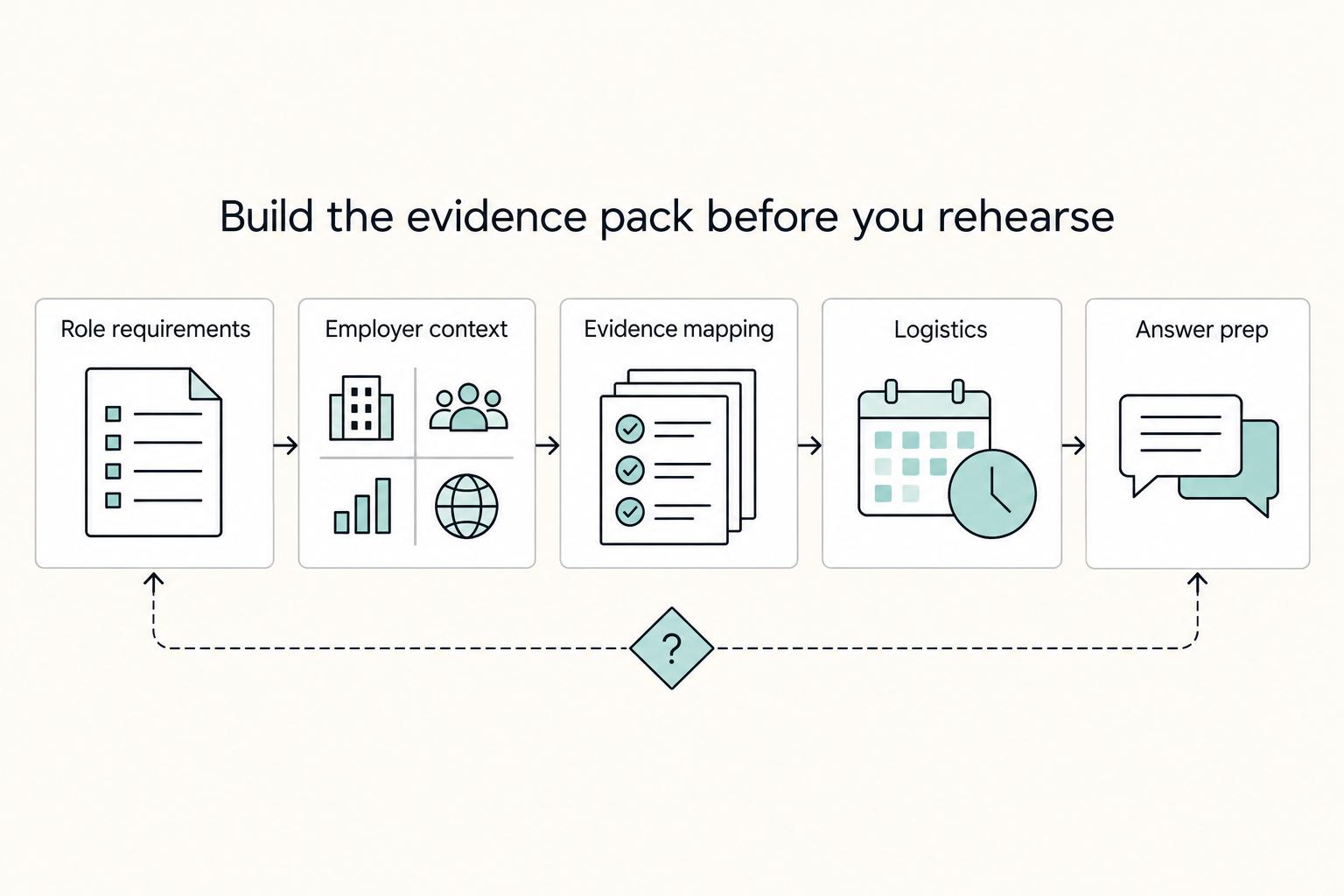
Build the evidence pack before you rehearse#
Start with the job description, then do a short employer research pass. Pull role requirements, then confirm the employer's industry, customer base, size, and history so your teen has concrete material for motivation, teamwork, and availability questions.
| Prep area | Execution step | What to capture |
|---|---|---|
| Role requirements | Re-read the posting and mark action words | greet customers, stock shelves, clean, answer phones, handle cash, work evenings or weekends |
| Employer context | Review the company site and basic search results | what the business does, who it serves, its size, and any history or values language worth noting |
| Evidence mapping | Match each requirement to one proof example | school projects, sports, volunteering, family responsibilities, coursework, prior work |
| Logistics | Confirm interview format and practical details | time, location or link, who they are meeting, what to bring, what to wear |
| Answer prep | Practice likely questions out loud and tighten weak spots | why you want the job, strengths, teamwork, handling pressure, schedule, learning quickly |
Use a simple readiness gate before more rehearsal. If your teen cannot answer all three clearly in under a minute, pause mock interviews and return to research and evidence mapping:
- What problem is this employer likely hiring to solve?
- Which of my skills fit that problem?
- What example proves it?
This prevents the most common miss: sounding confident without saying anything concrete. If job history is limited, use characteristics and academic achievements, but always anchor them to action and follow-through. If your teen still needs role options first, A Guide to Summer Jobs for High School Students is a practical next step.
Keep the public impression clean, not polished#
Keep this practical and low drama. You are not creating a fake persona; you are removing obvious friction from first impressions.
If a public username, bio, profile photo, or recent post could distract from reliability, clean it up. Aim for clear and normal, not corporate. A readable profile and no obviously careless public content is enough. Over-polishing can make answers sound stiff; basic consistency usually works better.
Lock setup and final questions#
Preparation here is execution, not extra credit. For virtual interviews, confirm access and keep notes ready. For in-person interviews, confirm location and route, and set out what your teen needs beforehand.
| Question to ask | What it reveals | How to use it |
|---|---|---|
| What does strong performance in the first few weeks look like? | early priorities | match your examples to speed, accuracy, attendance, or attitude |
| Which part of the shift is usually busiest or most challenging? | pressure points in the role | share an example of staying calm and organized under pressure |
| What do new hires usually need to learn fastest here? | training expectations | show coachability and willingness to ask questions |
| What do reliable team members do here that managers notice? | rewarded behaviors | mirror that language when discussing punctuality and follow-through |
Day-of readiness micro-checklist:
- confirm time, format, and contact details
- open or bring the posting plus example notes
- review your end-of-interview questions once
- arrive or log in early enough to settle before the conversation starts
Step 2: How to Turn 'No Experience' into a Compelling Value Proposition#
"No experience" usually means "no paid role yet," not "no evidence." Your goal is to show clear proof from school, activities, volunteering, or home responsibilities that matches what the employer asked for.
Start with the posting from Step 1, then map each priority skill to one real example your teen can explain clearly. This matters because interviewers may be comparing many candidates for one opening, so vague traits are easy to forget.
| Experience | Proof they can say in the interview | Job relevance in common teen roles |
|---|---|---|
| Group project at school | "I divided tasks, tracked deadlines, and merged the final slides before class." | Teamwork, reliability, follow-through |
| Sports team or club role | "When plans changed, I updated teammates and confirmed everyone's role." | Communication, teamwork, staying composed |
| Babysitting or home responsibilities | "I managed meals, timing, and cleanup, and handled issues without reminders." | Reliability, problem-solving, trust |
| Volunteering | "I greeted visitors, answered basic questions, and kept the area organized during busy periods." | Customer service, initiative, first impression |
For behavioral questions, a structure like STAR can help keep answers specific. Keep each answer to one event, then run this quality check:
- Specific context: Is this one concrete situation, not a general habit?
- Clear ownership: Did your teen explain what they did using "I," not only "we"?
- Concrete outcome: Is there a visible result, like a deadline met, fewer issues, or positive feedback?
- Change explained: Can they state what improved because of their action?
- Follow-up ready: Could they answer "What exactly did you do?" without getting vague?
| Weak claim | Strong claim |
|---|---|
| "I'm responsible." | "I babysit two children and keep meals, homework, and bedtime on schedule without check-ins." |
| "I'm good with people." | "During volunteer shifts, I greeted visitors, answered questions, and stayed calm when lines got busy." |
| "I'm a leader." | "In a class project, I assigned tasks, tracked progress, and made sure we submitted on time." |
For "Tell me about yourself," a simple Present-Past-Future flow can keep the answer focused:
- Present: "I'm a [student/year/activity], and I'm applying for this [job title] role because I can help with [skill from posting]."
- Past: "In [specific event], I had to [task], and I learned to [skill the employer asks for]."
- Future: "In this job, I'd use that by [exact duty from posting], especially during [busy periods/team coordination/new-task learning]."
Once these examples are ready, move to delivery: pick one or two stories, practice them out loud, and prepare for follow-up questions.
Step 3: Executing the Pitch Meeting with Confidence and Control#
On interview day, the goal is clear execution, not a perfect performance. Help your teen show up prepared, communicate in a structured way, and finish with a clear next step.
Pick an outfit with a safe baseline#
Dress standards vary by employer, so use what you observed in Step 1 and stay slightly more polished than the day-to-day look.
| Role setting | Safe outfit baseline | What to avoid |
|---|---|---|
| Fast-paced service | Match the workplace style you observed, but cleaner and more deliberate | Dirty, ripped, distracting, or overly casual pieces |
| Retail or front-facing roles | Keep it tidy, simple, and aligned with the store environment | Anything that clashes with the setting or looks like partywear |
| Office-style or admin settings | Choose plain, conservative, meeting-appropriate clothing | Loungewear, heavily graphic items, or anything clearly underdressed |
Stay budget-aware: clean clothes, basic grooming, and a quick final check are enough.
Show reliability in person or online#
Reliability is visible before the first full answer. Keep behavior steady with a short checklist:
- Start with a clear greeting, then thank the interviewer for their time.
- Listen fully, pause briefly, then answer.
- Keep posture steady and speaking pace controlled.
- Keep your phone away during the interview.
- If the interview is online, confirm the mode in advance (audio, video, chat, email, or survey) and test your setup for that format.
Practice helps most when it is live. Do at least one spoken rehearsal and get feedback before the interview.
Use a reusable answer structure#
Keep answers short, specific, and role-linked with one real example.
| Answer part | What to cover |
|---|---|
| Brief context | Set up the situation |
| Action you took | Explain what you did |
| Result | State what happened |
| Why that result matters for this job | Connect the example back to the role |
For self-introductions, keep it to about 30 seconds: who you are, one strength that fits the role, and why you are interested. Then end by confirming your interest in the next step.
When the interview ends, write down names, questions, promises, and concerns while details are fresh. You will use those notes in Step 4 to make your follow-up specific.
Step 4: Closing the Deal with Strategic Follow-Up#
Send a short, specific follow-up based on your interview notes. In a competitive process, clear role-linked communication helps the interviewer remember your fit.
| Follow-up action | What to do |
|---|---|
| Appreciation | Thank the interviewer for their time and conversation. |
| Role-specific proof | Mention one responsibility or pressure point discussed. |
| Interest signal | Confirm you are still interested in the role. |
| Next-step posture | Close with readiness and openness, without pressure. |
Use a flexible structure instead of a script: thank them, reference one discussion detail, connect it to one truthful example of what you did, then close with interest and openness to next steps. Keep it concrete and honest. Interviewers are assessing examples against real job responsibilities, so vague praise or inflated claims can hurt clarity.
Quick quality check: does your note show one clear action, not just a trait? "I'm a hard worker" is generic. "When our volunteer event got busy, I reorganized check-in so people moved through faster" is specific and easier to trust. Use "I" statements when accurate so your contribution is clear.
| Generic follow-up | Strategic follow-up |
|---|---|
| "Thanks for interviewing me." | References one real detail from the conversation. |
| Repeats personality traits. | Connects one strength to one role responsibility. |
| Ends vaguely. | Shows interest and calm next-step readiness. |
Before sharing references, run this readiness check:
- Permission confirmed: Ask first and confirm they are willing to speak for you.
- Context shared: Send the job posting or explain the role.
- Strengths aligned: Remind them of strengths they have directly seen.
If the employer says no, treat your response as a professional follow-up and a chance to learn. Thank them, keep your tone professional, and ask for brief feedback if appropriate. Then compare that feedback with your interview notes and improve weaker examples before the next interview. If you want short wording for a status check or reply, use the FAQ section as a starting point so it still sounds natural.
Your Teen's First Job Is More Than a Paycheck - It's Their First Business Venture#
The biggest win is building a repeatable professional habit, not just getting one yes. The strongest candidates are usually the ones who show clear value with specific examples and handle the process professionally from preparation through follow-up.
Prepare around the role, not vague confidence advice. Read the posting, choose the 2 to 3 duties that matter most, and match each one to a real example from school, sports, volunteering, or home. If they claim reliability or teamwork, they should show one action and one result an employer can picture.
A useful pressure drill is simple reasoning, not perfect math: start with a few practical assumptions, do a quick estimate, and explain your logic clearly. Keep it simple, avoid overcomplicating, and treat the result as a starting point to verify, not a fact to defend.
What this changes this week#
- Write one 20-second intro, one STAR story, and one "why this job" answer, then practice each out loud until it sounds natural.
- Build a small evidence pack: 3 to 5 non-family references, interview clothes ready the night before, route or video link confirmed, and a thank-you note sent within 24 hours.
- If examples still feel weak, pull stronger proof from real responsibilities using this guide to summer jobs for high school students.
- Keep practicing professional habits in everyday settings, including how you present yourself and your workspace.
- If you want guidance tailored to your situation, Talk to Gruv.
That is the real outcome here: a professional system they can reuse for every next opportunity.
Frequently Asked Questions
How do you answer “Tell me about yourself” if you do not have much experience?
Use a simple structure: who you are now, one example of responsibility, and why that connects to the role. Before the interview, write a brief version and practice saying it aloud a few times so it sounds natural.
How do you turn school, sports, or volunteering into a strong answer?
Pick one situation and keep it concrete: what happened, what you did, and what that shows about you. Reliability, teamwork, and organization are easier to believe when you name one action, not just a trait. If you want more examples to pull from, this guide to summer jobs for high school students can help you spot experience you may be overlooking.
What should you say if they ask why you want the job?
Do not stop at “I need money.” Before the interview, check the employer’s industry, customer base, size, and history. Then mention one detail and connect it to why the role fits you. That quick research shows you care where you are applying.
What can you do if you feel nervous right before the interview?
Nerves are normal, especially when listening and focus get harder under pressure. Practice first with a trusted adult, then with an adult you are less close to, because that can feel more like the real thing. Also confirm your route and timing ahead of time so you do not get flustered by being late or lost.
What should you ask at the end of the interview?
Ask one question that helps you picture the work, such as what a busy shift looks like or what they want a new hire to do well early on. Write your question down before you go so you are not blanking when they ask.
What if they ask whether the pay is acceptable?
Stay calm and answer the question directly. If the rate works for you, say so clearly. If you need a moment, it is fine to ask them to repeat the details so you understand exactly what is being offered.
Try a related tool
Researched and edited by the Gruv editorial team. Gruv builds cross-border billing, payouts, and finance-operations software for global businesses.
Sources
- capd.mit.edu/resources/the-star-method-for-behavioral-int...trusted
- cdse.edu/Portals/124/Documents/jobaids/insider/SPJ-Re...trusted
- doh.wa.gov/sites/default/files/2022-02/EvalCN21-56.pdftrusted
- globalyouth.wharton.upenn.edu/articles/world-economy/value-summer-jobtrusted
- medicine.tufts.edu/academics/medicine/curriculumtrusted
- niehs.nih.gov/health/topics/agents/endocrinetrusted
- pmc.ncbi.nlm.nih.gov/articles/PMC6004510trusted
- pmc.ncbi.nlm.nih.gov/articles/PMC8863281trusted
Educational content only. Not legal, tax, or financial advice.
Related Posts

Thailand's Long-Term Resident (LTR) Visa for Professionals
For a long stay in Thailand, the biggest avoidable risk is doing the right steps in the wrong order. Pick the LTR track first, build the evidence pack that matches it second, and verify live official checkpoints right before every submission or payment. That extra day of discipline usually saves far more time than it costs.
Summer Jobs for High School Students That Build Career Capital
If you are choosing among **summer jobs for high school students**, pay should be one filter, not the whole decision. The better lens is career capital: the proof, people, and skills you can carry forward after the summer ends.

The Freelance Payment Penalty: A Modeled Audit of Platform Fees, FX Spreads, and Payout Delays
The money rarely disappears through a single, easy-to-spot fee. The real loss is stacked. A marketplace takes its commission, a processor adds a charge for international cards, a bank or payment company converts the currency at a spread, a platform holds the funds before release, and a wire sheds a little to intermediaries on the way in. Each layer looks defensible on its own, but the worker feels the combined result as a smaller deposit and a later payday.