
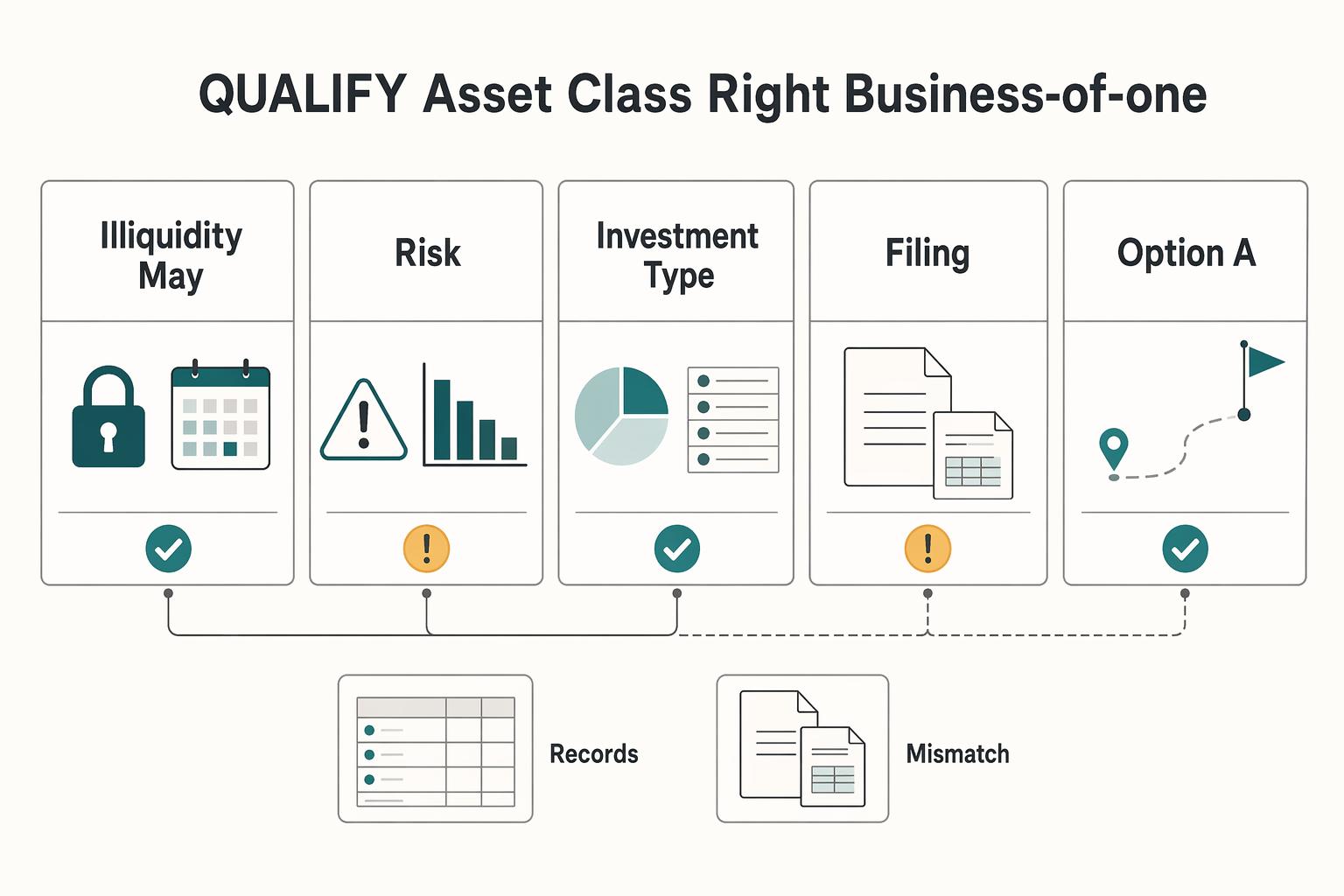
Quick Answer
Start with fit, not yield: investing in private credit is workable only when operating cash is protected and you can absorb illiquidity plus ongoing reporting. Use the Qualify, Analyze, Execute sequence to verify documents, test strategy risk, and confirm execution discipline before funding. For US expats, treat tax handling as part of underwriting by confirming how items like Schedule K-1, FBAR, and Form 8938 could apply to your setup.
Screen the risk and confirm the terms before you commit capital#
Start with a risk screen, not a return target. For this playbook, use these as working labels and confirm the exact meanings in the actual offering documents before you commit capital:
- Private credit: confirm the definition in the specific offering documents.
- Yield: confirm the exact definition and calculation method in writing.
- Illiquidity: confirm how the term is defined in the documents.
- Floating-rate exposure: confirm whether this term applies and how it is defined in writing.
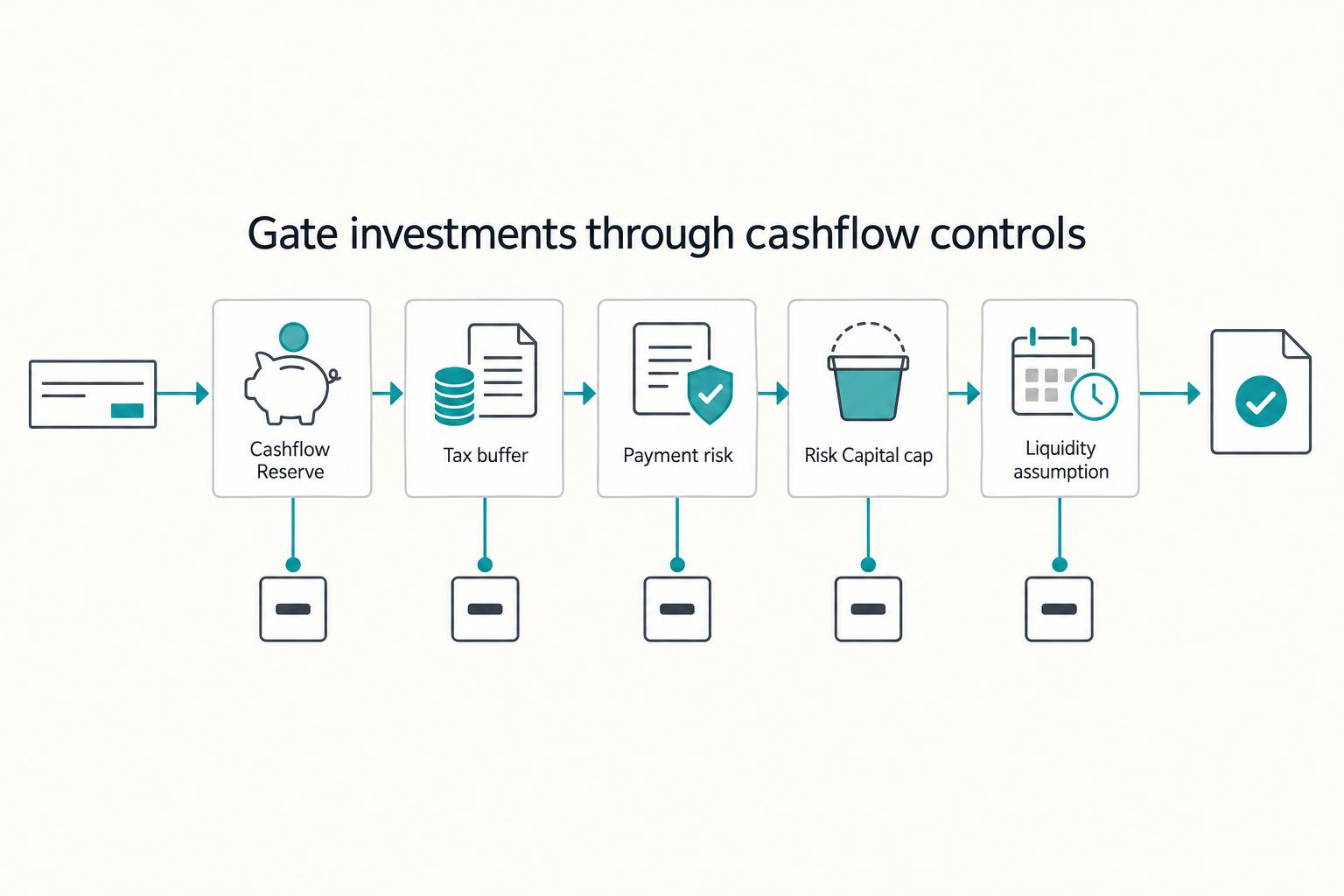
If you run a business-of-one, protect operating cashflow first and treat this as a secondary allocation. Commit only capital you can keep segregated from core operating needs, so a bad timing event does not force a stressed decision.
Keep that posture practical. Use this as a caution-first process, not as the basis for return or suitability claims, and do not move forward without current documents and appropriate professional advisers.
| Fit question | If your answer is low | If your answer is high | Where to go next |
|---|---|---|---|
| Liquidity tolerance | Pause and protect cash reserves first | Continue | Part 1 |
| Admin/compliance tolerance | Prefer simpler structures or pass | Continue with caution | Part 1 and Part 3 |
| Time horizon | Avoid capital you may need soon | Continue | Part 1 |
| Complexity capacity | Stay with holdings you can monitor consistently | Continue with full diligence | Part 2 |
Before you move to Part 1, collect a basic evidence pack. Include the current offering document, fee schedule, cash-movement terms, sample investor reporting, and adviser guidance on ownership and reporting in your situation. If timing, documents, or investor obligations are unclear in writing, stop there and do not proceed on a sales call alone. For related context, see A Freelancer's Guide to Angel Investing and Venture Capital.
Part 1: QUALIFY - Is This Asset Class Right for a Solo Operator?#
Qualify fit before you analyze products. If your cash needs are variable, your records are inconsistent, or extra tax reporting would strain your process, treat that as a stop signal first. For a solo operator, four definitions drive the decision:
- Illiquidity: you may not be able to exit quickly; private-placement style holdings can be highly illiquid.
- Capital call risk: after you commit, the fund can call capital for investments, fees, or expenses, not only at entry.
- Investment-type income (screening use): income that is not pay for personal services; the IRS defines earned income as compensation like wages, salaries, or professional fees.
- Administrative burden: ongoing filing and recordkeeping tied to items like partnership tax reporting and foreign-account reporting.
This screen matters because private-fund style allocations can restrict withdrawals, disclosures can be thinner than in public markets, and private placements can involve total-loss risk. Get your own fit right first, then compare managers.
Segment your capital before you commit anything#
Treat capital segmentation as a hard gate, not a rough budgeting exercise. Only money clearly outside operating, growth, and safety needs should be considered for this allocation.
| Capital bucket | Must stay liquid | Acceptable lock-up | Warning signs |
|---|---|---|---|
| Operating cash | Cash needed for taxes, payroll, rent, software, insurance, and invoice gaps | None | You depend on this bucket to absorb irregular client payments or revenue swings |
| Growth capital | Funds for hiring, equipment, marketing, relocation, or expansion | Short only if project timing is truly flexible | You have near-term projects and no backup funding source |
| Personal safety net | Emergency reserves for health, family, housing, or a business interruption | Minimal to moderate only if other liquid reserves exist | A personal shock would force selling assets or borrowing |
| Surplus long-term capital | Money you do not expect to need for operations, growth, or safety | Confirm an acceptable lock-up horizon with your financial advisor | You are stretching assumptions to make the allocation fit |
Checkpoint: assign dollar amounts to each bucket and test them against real cash swings. If your surplus disappears once you include taxes, delayed client payments, and a downside period, treat that as a no-go.
Treat accredited status as a verification process#
For Rule 506(c), accredited-investor verification is a document process, not a box to check. SEC guidance is facts-and-circumstances based, and verification may involve documents such as tax returns, W-2s, bank statements, brokerage statements, and credit reports. If your records are complex, build a clean file before you start sending documents:
| Path | Threshold | Example documents |
|---|---|---|
| Net-worth pathway | Net worth over $1 million, excluding primary residence | Bank and brokerage statements; dated net-worth worksheet excluding primary residence |
| Income pathway (individual) | Income over $200,000 in each of the prior two years, with expected continuity in the current year | Prior two years of tax returns; current-year income support such as contracts, invoices, or bank records |
| Income pathway (with spouse or partner) | Income over $300,000 with spouse or partner in each of the prior two years, with expected continuity in the current year | Prior two years of tax returns; current-year income support such as contracts, invoices, or bank records |
Common SEC pathways include net worth over $1 million (excluding primary residence). Another path is income over $200,000 individually or $300,000 with spouse or partner in each of the prior two years, with expected continuity in the current year. Verify current eligibility criteria from source records or advisor review before relying on these pathways.
Run a compliance go/no-go test#
Do this before you choose a strategy, because compliance workload changes the real cost of owning the investment. Answer these in writing:
| Area | Question | Threshold or detail |
|---|---|---|
| Tax-document complexity | Can you handle potential Schedule K-1 reporting? | Schedule K-1 can pass through partnership income, deductions, and credits |
| Cross-border exposure | Might FBAR, Form 8938, or both apply? | FBAR can apply when aggregate foreign accounts exceed $10,000 at any point in the year; IRS guidance also cites a $50,000 base aggregate-value trigger for Form 8938, with higher thresholds in some cases; FBAR is due April 15 with an automatic extension to October 15 |
| Recordkeeping capacity | Can you keep required records organized? | Account records, capital-call notices, subscription documents, and annual tax statements |
If deadlines are already slipping, treat that as a red flag. FBAR is due April 15 with an automatic extension to October 15.
Make the call before Part 2#
Use this matrix as the gate. If you do not clear it, there is nothing to underwrite in Part 2.
- High liquidity need, low complexity tolerance: Avoid.
- High liquidity need, high complexity tolerance: Use a liquid proxy.
- Low liquidity need, low complexity tolerance: Consider a limited allocation.
- Low liquidity need, high complexity tolerance: Proceed with full diligence in Part 2.
If you are not in the last quadrant, do not force the allocation. Protect operating resilience first. You might also find this useful: How to Set Up a US LLC from Germany.
Part 2: ANALYZE - What to Verify Before You Allocate#
If Part 1 gave you a real surplus-capital green light, analyze the strategy first and the manager second. In this market, labels are not fully standardized, disclosure can be thinner than in registered offerings, and most loans do not trade in a secondary market. Do not allocate until you can verify both the return drivers and the loss-handling mechanics.
Start with the strategy label#
Treat manager taxonomy as a diligence item, not a fact. There is no universal definition of private credit, even though the core idea is direct lending by non-bank vehicles.
| Strategy | What it means | Return driver | Main burden |
|---|---|---|---|
| Direct lending | Bilateral origination between a borrower and a lender | Loan terms, borrower performance, and capital-structure position | Borrower deterioration and weak protections at origination |
| Specialty finance | Collateral-based underwriting rather than a standardized category | Collateral quality, controls, servicing, and collections | Usually means more ongoing monitoring work |
| Distressed debt | Debt tied to issuers in default, bankruptcy protection, or severe financial distress | Restructuring and recovery outcomes more than steady coupon collection | Workload is often higher because legal process and workout execution matter more |
Direct lending is usually the clearest model to underwrite: bilateral origination between a borrower and a lender. The return drivers are loan terms, borrower performance, and capital-structure position. The main downside is borrower deterioration and weak protections at origination.
Specialty finance is better treated as collateral-based underwriting than as a standardized category. Returns depend heavily on collateral quality, controls, servicing, and collections, so expect more ongoing monitoring work.
Distressed debt means debt tied to issuers in default, bankruptcy protection, or severe financial distress. Returns can depend more on restructuring and recovery outcomes than on steady coupon collection, and the workload is often higher because legal process and workout execution matter more. If the label and the underlying holdings do not match, pause and reconcile that mismatch before moving forward.
Underwrite the risk, not the pitch#
Yield targets are easy to market. What matters is whether the portfolio construction, borrower selection, and downside controls hold up when something goes wrong.
Borrowers in this market are often smaller and riskier than public-market peers, and covenant discipline can weaken. Use a repeatable validation checklist before allocating.
| Risk area | What to verify | Validation action before allocating | Red flag |
|---|---|---|---|
| Portfolio construction | Borrower count, sector mix, geography, seniority mix, and target exposure bands. Confirm the current benchmark range from source records or an advisor. | Review the latest portfolio snapshot and calculate top positions and sector concentration yourself. | Yield targets are clear, but position-level mix is vague. |
| Credit quality | How borrower quality is defined, screened, and monitored. | Request sample underwriting materials and the current watchlist workflow. | Process is described as "relationship-driven" without borrower-level evidence. |
| Covenant strength | Standard covenant package, exception process, and amendment pattern. | Ask for standard term summaries and exception frequency. | Covenant flexibility is framed as normal without clear limits. |
| Concentration risk | Exposure to single borrowers, sponsors, sectors, geographies, or funding sources. | Map concentration across assets and, where disclosed, investor base. | One shock could impair too much of the portfolio at once. |
| Recovery playbook | Lien position, seniority, control rights, and workout ownership. | Confirm capital-structure rank and who leads restructurings. | No clear workout authority or escalation path. |
| Manager incentives | Fee terms, expense allocation, and conflict controls. | Reconcile governing-document fee language against sample investor reporting. | Fee calculations are opaque or conflict disclosures are thin. |
Separate investment risk from tax and reporting risk#
For a business-of-one operator, reporting burden belongs in underwriting because it affects real returns and your ability to stay compliant. Treat it as a parallel workstream, not an afterthought.
| Decision lens | What to confirm | Validation action | Stop sign |
|---|---|---|---|
| Tax character of income | Vehicle type and expected investor tax documents, for example partnership-style reporting via Schedule K-1 where applicable | Request the expected year-end tax package and confirm handling with your tax preparer before subscribing. | You cannot determine likely tax-document flow before funding. |
| Cross-border reporting exposure | Whether custody, domicile, or account setup could trigger FBAR, Form 8938, or both. These are separate filing regimes; FBAR can apply when aggregate foreign accounts exceed $10,000 at any point in the year. Current Form 8938 reporting triggers must be verified from source records, finance records, or advisor review before use. | Map account location, legal ownership, and existing foreign-account inventory before investing. | You assume one filing replaces the other, or cannot identify where assets are held. |
| Document complexity | Subscription documents, capital-call notices, statements, and tax records needed over time. | Request sample subscription and investor-reporting packets before wiring funds. | Ongoing reporting format and timeline are unclear. |
If your filing calendar is already strained, do not add a structure with uncertain reporting complexity.
Match the wrapper to your constraints#
Do not pick the structure with the best headline yield. Pick the one that fits the liquidity and administrative limits you already established in Part 1.
| Structure | Liquidity and disclosure profile | Admin and tax profile | Best fit based on Part 1 |
|---|---|---|---|
| Private fund | Private-placement style access; highly illiquid; less required disclosure than registered offerings. | Often the highest document load, including subscription materials and offering-specific tax reporting that may include Schedule K-1. | Use only if liquidity need is low and complexity tolerance is high. |
| BDC | Can provide exchange-traded closed-end fund access to private-company debt/equity; still requires leverage and portfolio-risk review. | Usually simpler custody than private funds, but confirm actual tax forms and distribution character. | Fits if you want listed access and can accept market-price volatility. |
| ETF | SEC-registered exchange-traded vehicle tradable during market hours. | Typically the simplest custody and reporting path, but verify underlying holdings and exposure method. | Fits if Part 1 pointed to a liquid proxy or a smaller test allocation. |
If you are near your liquidity or admin limits, default to the wrapper that preserves exit flexibility. Once that choice is clear, execution becomes much simpler.
We covered simpler listed access in more detail in A Guide to Index Fund Investing for Freelancers. Before committing to any lock-up, map your cross-border tax exposure so your net-yield assumptions are realistic: Use the tax residency tracker.
Part 3: EXECUTE - A Tactical Guide to Deploying Capital#
Execution should prioritize document verification and preventable-error control. In practice, focus on what you can verify from primary records, because this article does not validate private-credit platform, tax, or suitability specifics.
Compare access paths from primary documents, not summaries#
Treat listing pages and portal summaries as discovery, not evidence. As with any research index, use the underlying record, for example the publisher site or full PDF when available, because inclusion in a database is not endorsement. Complete this comparison from current offering and account documents before you sign:
| Access path | Minimum commitment | Fee model | Liquidity terms | Tax-document type | Reporting burden |
|---|---|---|---|---|---|
| Access option A pending document review | Confirm the minimum from the offering documents | Confirm the fee model from the offering documents | Confirm liquidity terms from the offering documents | Confirm the tax-document type from the offering documents | Confirm the reporting cadence from the offering documents |
| Access option B pending document review | Confirm the minimum from the offering documents | Confirm the fee model from the offering documents | Confirm liquidity terms from the offering documents | Confirm the tax-document type from the offering documents | Confirm the reporting cadence from the offering documents |
| Access option C pending document review | Confirm the minimum from the offering documents | Confirm the fee model from the offering documents | Confirm liquidity terms from the offering documents | Confirm the tax-document type from the offering documents | Confirm the reporting cadence from the offering documents |
If you cannot complete the table from primary documents, stop.
Use decision gates before subscription#
Use explicit stop/go gates, but treat thresholds and limits as unknown unless your signed documents and internal policy define them.
- Pre-subscription document review
Go only when final documents are confirmed and saved.
- Suitability check
Confirm the current status from source records or an advisor, and define your own criteria before subscription.
- Concentration guardrails
Confirm the current status from source records or an advisor, and define your own limits before subscription.
- Funding readiness
Confirm funding requirements from your own account and ownership documents before subscription.
Run a simple post-investment operating cadence#
This article does not verify any specific cadence as best practice. If you invest, document a routine you can actually sustain and tie it to your notices, cash movements, reconciliations, and accountant handoffs.
- On each notice: define and document your notice-handling workflow.
- On each cash movement: define and document your classification workflow.
- Monthly: define and document your reconciliation cadence.
- At handoff points: define and document your transfer workflow.
Execution risk controls#
The available source records do not rank failure modes or validate specific preventive controls. Use this table as a template and complete it from primary documents and internal policy.
| Failure point | Preventive control you can implement now |
|---|---|
| Over-allocation | Define and document a written preventive control for this failure point before subscription. |
| Liquidity mismatch | Define and document a written preventive control for this failure point before subscription. |
| Missed notices | Define and document a written preventive control for this failure point before subscription. |
| Incomplete records | Define and document a written preventive control for this failure point before subscription. |
If required controls remain undefined, defer the allocation. If you want a deeper dive, read the six-month Japan digital nomad visa runbook.
Conclusion: More Than an Investment - A Strategic Capital Allocation#
Treat investing in private credit as a capital-allocation decision only when three gates are clear: fit, diligence quality, and execution readiness. If one gate is weak, pause.
Private credit is lending by institutions other than banks, with loans negotiated directly and not traded in public markets. Your edge here is process, not marketing language.
Qualify is the fit gate: proceed only if you accept nonpublic exposure and can tolerate potentially lower liquidity than publicly traded instruments. Analyze is the diligence gate: classify the strategy, for example direct lending versus another private-credit type. Then confirm rate behavior, since most private-credit lending is floating-rate. Execute is the readiness gate: if your records, approvals, and follow-through are inconsistent, you are not ready to allocate.
Hard cutoffs for liquidity, tax workload, or administrative burden are not provided here, so use the table below as a practical screen, not a fixed rulebook.
| Decision | Liquidity needs | Tax and compliance workload | Admin capacity |
|---|---|---|---|
| Lean proceed | Near-term obligations are covered, and this allocation is not needed for immediate cash use | You have a review plan with qualified professionals and can handle the workload | You can track documents, notices, and ongoing monitoring reliably |
| Pause | You may need the money sooner than planned, or key assumptions are still unclear | Reporting impact is still unclear | You do not yet have a dependable process for records and reviews |
| Use liquid alternative | You want easier access and simpler day-to-day oversight | You prefer a structure with less complexity to verify | You want lower ongoing operational burden |
Before you allocate, verify final offering and account documents, then confirm tax and suitability implications with licensed professionals. Then return to the risk-first workflow and write a one-page decision memo: qualify the capital, analyze the structure, and execute only when the evidence is complete. For a step-by-step walkthrough, see A Guide to Impact Investing for Freelancers.
If your priority is stabilizing operating cashflow before adding private-credit exposure, tighten how you collect and manage client payments first: Explore Gruv for freelancers.
Frequently Asked Questions
What are the main ways an individual can invest in private credit?
Accredited investors have three primary paths:
- Fintech Platforms: Services like Yieldstreet and Percent offer direct access to curated deals and funds with relatively low minimums.
- Direct Investment: Many private equity firms and asset managers allow direct investment into their funds, though minimums are often substantial ($1M+).
- Through a Financial Advisor: A wealth manager specializing in alternative investments can provide access to a curated list of opportunities and handle much of the due diligence.
What are the key tax implications for a US expat?
For a US expat, income from a typical private credit fund is unearned, passive income. It does not qualify for the Foreign Earned Income Exclusion (FEIE). It is reported on a Schedule K-1 and is generally taxed in the U.S. An investment in an offshore fund will likely require annual reporting on FBAR (FinCEN Form 114) and FATCA (Form 8938), depending on your total foreign asset values.
Is private credit a good investment in a high-interest-rate environment?
It presents both opportunities and heightened risks. The opportunity is that most private loans are floating-rate, so their interest payments adjust upward with benchmark rates, potentially increasing your yield. The risk is that higher borrowing costs strain underlying companies, increasing default risk. This makes manager selection and a focus on senior-secured loans with strong collateral more critical than ever.
What is the difference between a BDC, a private credit ETF, and a private fund?
These are three distinct structures for accessing the asset class. A Private Credit Fund is an illiquid, private partnership that issues a complex Schedule K-1, best for investors prioritizing access to top-tier managers. A Business Development Company (BDC) is a publicly traded company offering daily liquidity and a simple Form 1099-DIV, best for those who value liquidity. A Private Credit ETF holds a portfolio of BDCs, offering the most diversified and liquid entry point with a Form 1099-DIV.
Are private credit investments liquid?
No. Traditional private credit funds are fundamentally illiquid investments. You are committing your capital for a "lock-up period" that can last for 5 to 10 years, with very limited, if any, opportunities for early withdrawal. You must be prepared to have this portion of your capital deployed for the full life of the fund.
Try a related tool
Researched and edited by the Gruv editorial team. Gruv builds cross-border billing, payouts, and finance-operations software for global businesses.
Sources
- federalreserve.gov/econres/notes/feds-notes/bank-lending-to-pri...trusted
- federalreserve.gov/econres/notes/feds-notes/private-credit-char...trusted
- investor.gov/introduction-investing/investing-basics/inve...trusted
- investor.gov/introduction-investing/general-resources/new...trusted
- irs.gov/businesses/corporations/do-i-need-to-file-fo...trusted
- irs.gov/businesses/small-businesses-self-employed/re...trusted
- occ.gov/publications-and-resources/publications/comp...trusted
- pmc.ncbi.nlm.nih.gov/articles/PMC9803598trusted
Educational content only. Not legal, tax, or financial advice.
Related Posts

Japan Digital Nomad Visa 2026: Six-Month Planning Runbook
Treat this as your operating model: identify the right mission first, commit to one route, and keep dated records before you make irreversible plans. That is what keeps the rest of your timeline, paperwork, and decisions coherent.
A Freelancer's Guide to Angel Investing and Venture Capital
**Build a decision system that protects your operating cash first, then treat angel investing as an optional use of true surplus.** If you are considering angel investing as part of broader wealth building, you need controls that keep "startup investing" from quietly raiding rent, taxes, or payroll. Knowledge feels productive, but constraints keep you solvent. As the CEO of a business-of-one, your job is to protect the operating cash that keeps the machine running.

How to Set Up a US LLC from Germany
If you run a business of one, you need a repeatable system, not vibes.