
Quick Answer
Start by using inversion for de-risking projects before kickoff: assume failure, list how it could happen, and translate each risk into written controls in your SOW, contract, and milestone records. Require a named approver, testable acceptance criteria, and documented change approval before extra work starts. For cross-border engagements, run an intake check for EU or UK personal-data handling and verify whether NYC Freelance Isn’t Free writing and payment rules apply. Then gate start or pause based on what is already documented.
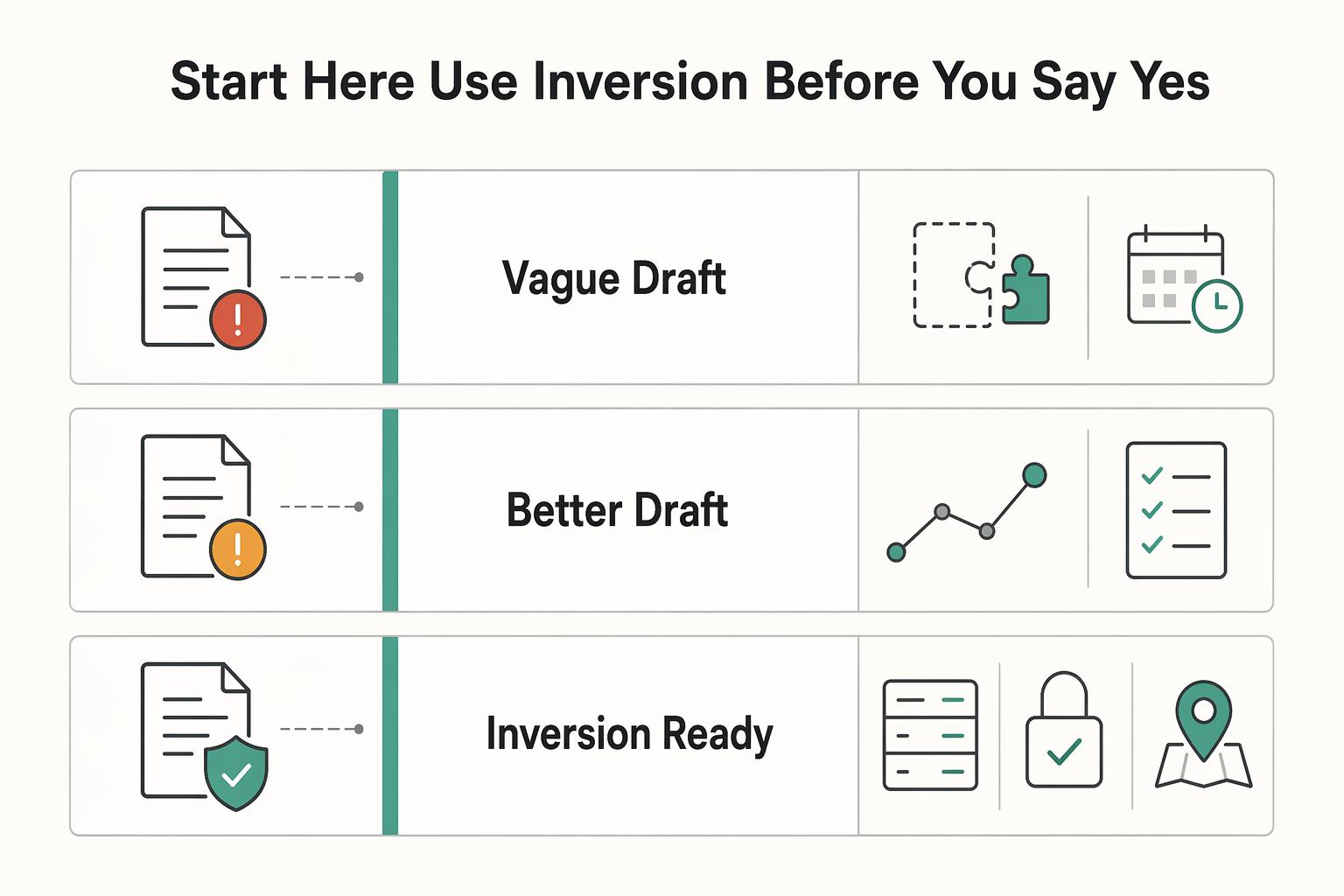
Start here and use inversion before you say yes#
Before you say yes, run a quick inversion check. Assume the project failed, then turn each likely failure mode into one written control in the contract, SOW, or operating record.
Use it as a practical filter for familiar failures. Scope creep becomes unpaid extra work when changes are never documented. Payment delays are more likely when dates are vague. Compliance issues surface after data is shared when jurisdiction and data-handling assumptions were never written down.
| Draft quality | Scope | Payment | Approvals | Records |
|---|---|---|---|---|
| Vague draft | "Website support" | "Paid on completion" | "Client will review" | Messages scattered across email and chat |
| Better draft | Deliverables listed, some exclusions | Amount stated | Review step exists | Signed contract saved |
| Inversion-ready draft | Results defined with exclusions and acceptance criteria | Milestones and invoice dates are written | One named acceptance authority and written change approval | Signed versions, change approvals, invoices, delivery proof, and acceptance records kept together |
Use this as a pre-signature test. If a neutral third party cannot tell what "done" means, who accepts it, when you invoice, and how changes are approved and priced, the draft is not ready. A simple control is to require changes to take effect only when both sides agree in writing, with any cost or timeline adjustment written too.
For cross-border work, add a short intake prompt before kickoff. Ask which jurisdiction is named, where the client is, and whether you will process personal data from people in the EU or UK. If you are offering services into the UK, or EU Article 3(2) targeting may be relevant, verify current applicability before starting. If a local rule matters, verify the current threshold from official source records before using it.
NYC is a useful reminder that verbal-only starts create avoidable risk. Contracts at $800 or more, including agreements totaling $800 in a 120-day period, must be in writing. If no payment date is written, the default is 30 days after completion. That is not a universal rule, but it is a clear warning sign.
Related: A Guide to Using an Escrow Service for High-Value Projects.
Inversion gives you a practical way to prevent project failure#
Use inversion as a documentation discipline, not just a conversation. Decide your approach before kickoff, then keep one written record current as decisions change.
Start simple: keep a short, maintained record of key decisions and current status so the latest direction is easy to find and verify.
Think about the method tradeoffs this way:
| Planning style | What you rely on | How you verify | Common tradeoff |
|---|---|---|---|
| Conversation only | Memory from calls, chat, and email | Ask people what was agreed | Details may be remembered differently |
| Static notes | A document exists, but is not maintained | Check timestamps and version history | Work can continue from outdated assumptions |
| Maintained written method | One current record tied to project docs | Review at kickoff and handoffs | Requires consistent upkeep under deadline pressure |
That tradeoff also shows up in broader communication research: different methods have different strengths and limits. A September 2025 Journal of Business Research article frames this around method selection, implementation, and evaluation. Use that lens on your own process.
Before you move to the next phase, verify that your current record matches your latest scope, approval summary, and delivery plan.
Keep your evidence hygiene tight: use dated files, preserve prior versions, and retain the messages that changed key decisions. For a deeper walkthrough of the thinking step, read How to Conduct a 'Pre-Mortem' to De-Risk a Large Freelance Project.
You might also find this useful: How Availability Heuristic Distorts Risk Assessment for Freelancers.
Build a failure map before kickoff#
Your record only helps if you finish it before kickoff. Map each risk in four fields: what could fail, what you would see first, who acts first, and where the control is written.
This matters because coordination choices can create failure inside the project, not just respond to outside problems. The January 2024 Research Policy analysis of platforms and ecosystems makes that explicit: structures built to address failures can also create failures after formation. Use that as a warning for your own setup. If ownership, decision paths, or control points are unclear in your documents, risk is already present before work starts.
Use four fields and make each one testable#
Keep one line per material risk. Make each line auditable. The four fields below are a practical checklist, not a source-validated freelance template:
- Failure mode: what breaks
- Early signal: the first observable sign
- Owner: who monitors and who acts first
- Control: the written term or decision that limits impact
Make the control traceable to a specific place in your documents. If you cannot point to that location, treat the control as incomplete.
Build the map around decisions that affect execution#
Focus on risks that can block execution in your specific engagement. Build a direct chain from risk to control to retained proof:
| Failure mode | Early signal and owner | Control before kickoff | Evidence artifact |
|---|---|---|---|
| Coordination responsibility is unclear | Tasks stall because each side assumes the other will act first. Owner: named project owner. | Assign one owner per critical decision path in writing. | Signed scope or operating doc with named owners |
| Decision rights are ambiguous | Work advances without a clear approval decision. Owner: designated approver. | Define who approves and what counts as approval. | Written approval rule and approval records |
| Control terms are too abstract to apply consistently | Team members explain controls from memory instead of document text. Owner: you. | Convert controls into specific written terms linked to project docs. | Project document text and version history |
| Documentation fragments across channels | Conflicting instructions appear in separate messages. Owner: you. | Maintain one current source of truth and capture changes in writing. | Dated master record plus change log |
This is a decision tool, not proof of legal sufficiency. If a row has no clear owner, no document location, or no artifact you can retain, treat that row as unresolved.
Verify the control, not just the intention#
Before kickoff, do one hard check. For every row, confirm that you can open the exact document that contains the control. If you cannot, the control is still only an intention.
Use the files you will rely on in delivery, and mark where each control lives. If the control exists only in memory or verbal context, it is not ready.
Set a readiness gate#
Use a strict gate before kickoff. Do not start until key responsibilities, decision paths, and control terms are identifiable in writing. If a neutral reader cannot find those answers directly in current project documents, pause and fix the record first.
For a step-by-step walkthrough, see How to Create a 'RACI' Matrix for Your Team's Projects.
Lock scope so change stays billable#
Your SOW should work as an execution tool, not a sales summary. Make completion testable and make scope shifts visible before they turn into unplanned work.
A practical template for each deliverable is four lines: included, excluded, assumptions, and acceptance test. Keep each line plain enough that someone new can read it and reach the same conclusion you would. Name one acceptance authority so input can be broad, but the final yes or no is clear.
Before kickoff, run a hard check against the signed SOW. Make sure each deliverable is covered by those four lines and a named acceptance decision-maker. If anything is missing, treat scope as unresolved and fix it before work starts.
Treat change as a stop point#
Use one operating rule: if outputs, timeline, dependencies, or commercial terms change, pause and document the change before continuing. Keep the record simple and explicit: what changed, expected billing impact, schedule impact, and who approved it.
At kickoff, watch for informal scope drift. If new details appear, do not let them silently replace signed scope. Either record them as assumptions that still fit the current agreement, or route them through a documented change path.
| Change area | Question to answer before proceeding | Example note to keep |
|---|---|---|
| Output changes | Does this change what is delivered, and should scope or fee be updated? | Written change note or SOW update confirmed by both sides |
| Timeline changes | Do dates change, and does that alter sequencing or cost? | Updated milestone note with written confirmation |
| Dependency changes | Did inputs or access assumptions change, and what follow-on work does that create? | Written assumption update or change note |
| Commercial term changes | Are fees, milestones, payment timing, or review rounds changing? | Written commercial-term update |
Keep the sequence tight: proposal, signed SOW, kickoff notes, first milestone. Kickoff notes should confirm scope, not replace it. If something material changes, document it before the first milestone begins.
Related: How to Create a Disaster Recovery Plan for Your Freelance Business.
Structure payments to protect cash flow and leverage#
Before you sign, make one clear go-or-no-go call: does your payment timing match the risk you are carrying? If most work happens before a billing event, you may be funding the project with your own time and cash.
Use inversion here too. Ask which setup leaves you most exposed if approvals slow, dependencies slip, or payment stalls, then redesign away from that setup.
Match the payment shape to the exposure#
Use this as a working screen, not a legal standard. Freelance billing best practices are not established, so treat this as an illustrative risk-mapping framework.
Check three variables first, then match the structure to the exposure you see:
- Uncertainty: how likely the work is to change after kickoff
- Approval complexity: how many people can delay or reopen decisions
- Delivery dependency: how much progress depends on client inputs such as access, content, data, feedback, or coordination
Then tie each invoice trigger to a defined event already named in your SOW or acceptance test. If you cannot state the trigger in one sentence, treat it as ambiguous and tighten it.
| Payment structure | Exposure pattern to watch | Invoice trigger you should define clearly | Cash-flow predictability | Leverage if payment stalls |
|---|---|---|---|---|
| Single final invoice | Can leave most work unsecured until the end | Final completion event and acceptance event | Often lower when acceptance timing is unclear | Often weaker after most value is delivered |
| Upfront + final | Can reduce early exposure but still leave end-loaded risk | Upfront due event, then final completion or acceptance event | Can be medium when final trigger is explicit | Can be medium |
| Milestone billing | Depends on milestone size and spacing | Each phase submission or approval event | Can improve when milestones are short and explicit | Can improve at phase boundaries |
| Prepaid recurring blocks | Can stay bounded only if prepayment is enforced before work continues | Period start or block start event | Can be higher when enforcement is consistent | Can be higher if work can pause on nonpayment |
A practical tradeoff lens: as uncertainty, approval complexity, or dependency risk rises, shorter intervals between trigger events can reduce unsecured work in flight.
Choose longer net terms only with a clear tradeoff#
Longer terms are a commercial choice, not automatically wrong. If payment moves later, consider rebalancing something else so downside does not quietly stack up.
Possible rebalances include reducing work in flight before the next invoice, splitting delivery into smaller phases, adjusting price for financing burden, or sequencing start dates to required inputs. The goal is to keep risk from compounding while work continues.
Potential compounding exposure signals to review:
- later payment timing combined with end-loaded billing
- multiple approvers without one final acceptance decision-maker
- triggers tied to vague satisfaction language
- repeated client-side dependency delays
- requests to continue work while payment is still unresolved
Put payment controls in the papers and in the admin#
These controls work better when signed terms and billing admin match. Use the same milestone names, trigger events, amounts, and escalation steps in both your documents and invoicing process.
Define the event chain clearly: what counts as milestone submission, what starts the payment clock, what pauses work, and what must happen before restart. This is operational guidance, not a jurisdiction-wide enforceability claim.
Before kickoff, compare your SOW and first invoice draft side by side. If the milestone name, amount, trigger, or recipient does not match, fix it before work starts.
Keep a billing file every cycle#
For each cycle, keep one complete trail so you can check disputes against records: what was delivered, when, under which trigger, and what happened next.
- signed SOW version in force, plus approved changes
- delivery or submission record showing the trigger happened
- acceptance or review response from the named decision-maker
- invoice record with date, amount, recipient, and send confirmation
- follow-up records such as reminders, pause, resume, and restart notices
- payment record or current outstanding status
This pairs well with our guide on A Freelancer's Guide to Occam's Razor for Problem-Solving.
Use contract clauses that lower downside without killing the deal#
Use this clause stack as a discussion checklist, not a legal standard.
Because clause-level drafting rules vary by jurisdiction and contract type, treat each item below as a question to resolve in the signed draft with qualified counsel.
| Clause | Ask before you sign | Red flag if left vague | Fallback if client rejects |
|---|---|---|---|
| Limitation of liability | What does the signed draft actually state, in plain language? | Key terms are undefined or internally inconsistent | Pause and request clearer language before signing |
| Indemnity | What events trigger indemnity, and whose conduct is covered? | Trigger scope is unclear | Request narrower, clearer wording or defer signature |
| Termination | Who can end the contract, and what happens at exit? | Exit terms are not explicit | Document open points and resolve them before signature |
| Governing law | Is governing law named clearly? | Law language is missing or ambiguous | Ask for one clear governing-law clause |
| Dispute resolution | Is dispute path (court or arbitration) stated clearly? | Process language is mixed or incomplete | Ask for one clear process in the same draft |
| Force majeure | What happens during disruption, and what are next steps? | Duties and end conditions are unclear | Ask for explicit duties and endpoint language |
Check the downside boundary first#
Start by mapping what the draft says and what it leaves undefined. Confirm the liability-cap rule, carve-out standard, and any fee-linked formula with qualified counsel before signing.
Keep indemnity inside your control boundary#
No indemnity drafting standard is established here. Treat indemnity language as unresolved until it is clear in the final signed text and reviewed by qualified counsel.
Build a usable exit framework#
If you use a kill-fee concept, leave the payout percentage unresolved until contract review or legal verification confirms it.
Read law, forum, and disruption language together#
Specific governing-law/forum alignment rules, arbitration drafting requirements, or force majeure standards are not established. If wording is mixed or incomplete, resolve it explicitly in writing before relying on it.
If resistance stays broad across this downside stack, decide based on documented risk tolerance and unresolved terms. Keep every redline, comment, and formal notice with the signed contract, current SOW, and payment records. Related reading: A Guide to Key Person Insurance for Small Agencies.
Handle cross-border compliance before it becomes a dispute#
In cross-border work, good clause wording is only step one. Before kickoff, verify four things: whether EU-linked data rules attach, whether your location creates separate legal or tax issues, whether enforcement works where assets sit, and whether your records can prove your case.
Check EU-linked data at intake#
Treat GDPR as a pre-signing intake check whenever personal data is in scope. It can attach based on offering goods or services to people in the Union or monitoring behavior in the Union, not only where your business is established.
Run this checklist before you sign and keep it with the contract draft. Answer it from the actual workflow, not memory:
- Which categories of data subjects and personal data will you handle?
- Are you acting as controller or processor in this engagement?
- What are the disclosure and transfer paths, who receives the data, and are any recipients in third countries?
- What are the deletion, return, or erasure timelines by data category?
- What baseline security measures are actually in place?
- Do written terms match real handling, including processor terms in writing, including electronic form?
If your paperwork says one thing and your workflow does another, fix that before kickoff. A simple test is to trace one sample file from receipt to deletion. If you cannot explain each step clearly, your intake is not ready. If you need more depth, see GDPR for Freelancers: A Step-by-Step Compliance Checklist for EU Clients.
Separate mobility from compliance#
Do not treat visa, visitor, or digital nomad status as a compliance shortcut. Immigration status alone does not settle governing law, forum enforceability, tax posture, or data obligations.
Your tax position follows separate tests. For example, U.S. tax residency can turn on the Substantial Presence Test, and treaty tie-breaker rules can apply when two countries both treat you as resident. Confirm current local requirements from official tax authority or treaty records before relying on them.
If you move during an engagement, pause and re-check contract notice details, tax assumptions, and data-access handling before the next milestone.
Test the enforcement path, not just the clause#
Assume the clause is unproven until you test enforcement for the actual country pair and asset location. Do not rely on generic "covered by convention" assumptions without checking current scope and local procedure.
| Contract wording | Real-world enforcement check |
|---|---|
| Governing law names one country | Verify how that choice interacts with filing location and where assets sit |
| Court forum is exclusive | Verify current Choice of Court Convention coverage and fit for this clause and country pair |
| Arbitration clause names seat and rules | Verify where assets are and what local recognition or enforcement procedure applies |
| Notice and service clause looks complete | Verify transmission channels in the target country, and do not assume Convention channels apply if the address is unknown |
Ask one practical question before kickoff: if payment stops tomorrow, where would you enforce, and through what procedure? If you cannot answer that from the current draft, the clause set still needs work.
Keep a minimum dispute file from day one#
Your first line of defense in cross-border disputes is your record. Keep one minimum dispute file with signed agreements, any award documents if a dispute reaches that stage, and a clear formal-notice or service trail.
This is not a universal statutory bundle. It is a practical proof set for what was agreed, what notice was given, and what enforcement evidence you can produce if needed.
If you want a deeper dive, read Canada's Digital Nomad Stream: How to Live and Work in Canada.
Run delivery checkpoints that catch failure early#
Do not let work roll forward by habit. Treat each milestone as a stop-or-go gate. Move to the next phase only after you have acceptance evidence, approval from the authorized approver, and payment status checked against your contract terms.
Make each milestone a real gate#
Treat a milestone as complete when three things are true: the deliverable conforms to the agreed requirements, acceptance is documented, and the invoice is ready for processing. Use the same milestone record every time so handoffs and audits stay clear.
- Delivery proof: what you delivered, version or file name, date sent, and delivery channel
- Approver signoff: name of the authorized approver, date, and exact acceptance message
- Invoice status: invoice number, invoice date, due date, amount, and receipt or defect status
- Next-phase authorization: written instruction to start the next phase tied to that accepted milestone
| Checkpoint failure mode | Required evidence | Immediate action |
|---|---|---|
| Deliverable sent, but no acceptance record | Delivery record, acceptance criteria, review request to named approver | Hold next-phase work and request explicit acceptance or rejection |
| Client request changes effort or scope | Current scope text, request summary, timeline or fee impact | Classify as clarification or written change request before acting |
| Invoice overdue or disputed | Invoice number or date, due date, receipt status, notice log | Run your written overdue sequence and pause only if contract terms allow |
| Payment received but not matched | Bank or payout record, remittance details, invoice ledger | Reconcile payment before releasing the next deliverable |
Classify requests before you act#
Classify first, then respond. A clarification typically stays within agreed scope, timeline, and fee. A change request can alter deliverables, rounds, dependencies, timing, or price.
Use a written trigger rule. If the request changes what you deliver, when you deliver it, or what you are paid, route it to written approval before extra work starts. Some contract frameworks require continued performance while disputes are being resolved, so if your contract includes that requirement, continue the undisputed baseline work and send notice that added work is pending formal approval.
Prewrite the late-payment sequence#
Handle late payment with a preset sequence, not ad hoc messages. That keeps your notices consistent and easier to prove later:
| Step | Action | Include |
|---|---|---|
| Receipt check | Confirm invoice receipt | Restate the due date and fix missing invoice details quickly |
| Formal overdue notice | Cite the payment clause | Include any agreed late-fee language. Confirm the current statutory remedy with legal counsel or the official source. |
| Pause or suspension notice | Send only when your contract allows it | State cure conditions and delivery-date impact |
Follow the steps in order so your record stays clear.
If NYC Freelance Isn't Free applies, keep payment timing explicit. The NYC model freelance contract states that when no payment date or mechanism is specified, payment is due within 30 days after work is completed.
Keep one dispute-ready audit trail#
Keep one organized file that combines a transaction summary with support documents: signed contract or SOW, milestone records, delivery proofs, acceptance approvals, invoice lifecycle history, notice logs, and payout or bank reconciliation records.
This helps protect you when a client disputes approval, invoice receipt, or payment status. Clear records let you resolve the issue with documents, not memory.
Know the red flags that mean pause or walk away#
Use this as a decision gate, not a frustration check. Pause when risk is still containable with clearer expectations and documented controls. Exit when uncertainty around rules and service access makes normal operations unreliable.
| Signal | Why it increases downside | Required next action |
|---|---|---|
| Regulatory expectations remain unclear and are communicated mostly through informal guidance | Low regulatory clarity increases uncertainty about what activity will be treated as acceptable | Pause new exposure, document assumptions, and get a written legal/compliance position before proceeding |
| Access to core financial services becomes uncertain | The report links uncertain access and low clarity to chilling effects and debanking outcomes | Pause nonessential activity and activate contingency banking/payment paths |
| Banking partners signal supervisory pressure around digital-asset activity | The report says regulators used discretion and pressure to discourage this activity | Pause launches or expansions in the affected area until access terms are explicit and stable |
| Oversight signals are escalating (letters, document requests, hearings) | The investigation described more than 20 letters, thousands of pages reviewed, and two hearings, indicating sustained scrutiny | Pause assumption-driven plans and rerun your risk scenario before committing more resources |
| Leadership is being pulled away from core operations to manage access disruptions | The report describes founders being forced to divert focus from operations | Pause growth work, stabilize operations first, then reassess go/no-go |
Before resuming, run one short gate check:
- You have a current written view of what is clear versus still uncertain in the regulatory environment.
- You have confirmed access status for essential financial services and a fallback path.
- You have documented partner or supervisory constraints that affect planned activity.
- Your team can run core operations without ongoing access-firefighting.
If uncertainty, access risk, and operational distraction remain unresolved, treat it as a stop-and-decide point. Pause, preserve records, then choose to narrow scope, defer, or exit the affected activity.
See inversion in action on one freelance project#
Do not assume freelance-specific evidence for inversion is established, so treat this as an illustrative pre-kickoff workflow.
Use it as a gate: before kickoff, capture each likely failure point as a written control, assign one owner, and save proof.
You may start with a brief that still leaves key terms unclear. Run a short pre-mortem first: if this project failed, where did it break? Then move each risk into a written register before kickoff.
Start with the pre-mortem#
Write the failure story in plain language, then convert it into controls you can point to in written records. If a control exists only in a call or chat, treat that risk as unresolved.
Convert failure modes into controls before kickoff#
| Failure trigger | Written control | Owner before kickoff | Proof artifact |
|---|---|---|---|
| Critical input is missing or inconsistent | Define the required input and acceptance check in writing | One named owner | Dated requirements note and confirmation |
| A dependency has no committed timeline | Record the dependency, target date, and escalation path | Dependency owner | Timeline record and acknowledgment |
| Required access is not provisioned | Document access prerequisites and completion checks | Access owner | Access checklist and completion log |
| Quality checks are undefined | Write pass/fail criteria before execution starts | Quality owner | Criteria document and review record |
| A high-impact risk has no fallback path | Document a fallback step and trigger condition | Risk owner | Risk log entry and fallback plan |
The practical shift is from verbal assumptions to documented operating rules you can execute and review.
Once work starts, keep one rule non-negotiable: if a control is accepted only verbally and not documented, treat the risk as unresolved.
Use this 20-minute pre-kickoff checklist every time#
Treat kickoff as a go or no-go decision point. If any item is still unclear, disputed, or only verbal, pause the start and close it in writing first.
This works as a de-risking framing, but do not assume it establishes specific freelance kickoff mechanics. Use the four checks below as a practical working template.
Before the meeting, confirm these four outputs so the call ends with decisions you can use:
- Set the objective. Write one sentence that defines what this kickoff should decide and what should be closed by the end of the call.
- Confirm coverage, authority, and escalation in one step. List attendees and label who gives final approval, who provides inputs, and who owns escalation if work is blocked.
- Assign delivery roles. Note who drafts, who reviews, who approves, and who only needs updates for each material deliverable.
- Log open risks and blockers. Capture unresolved questions, dependencies, and week-one blockers, then mark what should be resolved now versus carried with an owner.
| Checklist item | What can change if this is missing |
|---|---|
| Written kickoff objective | Decisions can be harder to close and verify after the call |
| Named approver and escalation owner | Approval and unblock paths can remain unclear |
| Clear draft, review, and approve role note | Ownership can become harder to track |
| Open risks and blockers log | Known issues are easier to miss during kickoff |
If decision authority is not explicit in writing, treat that as a pause signal before work starts.
After kickoff, store approved versions, attendance notes, and the decision log with your scope draft and follow-up actions. If you want to turn those notes into a cleaner working draft, the SOW generator is optional.
Make inversion a standard step in every project#
Use inversion as a pre-signature operating gate. Before kickoff, convert likely failure points into written controls across your SOW, contract, kickoff notes, and risk register.
A risk becomes useful only when it becomes operational. For each one, document the owner, trigger, control, and consequence so both sides know what happens next. For example, if approvals may stall, name the approval owner. Define the review-window trigger, set the written deadline, and state the consequence, such as a schedule shift or milestone pause, in the project record.
Turn vague risk into terms both sides can execute#
Use this test: if someone outside the project cannot read the term and predict the next step, the control is still too soft.
| Risk statement | Enforceable control |
|---|---|
| Scope may keep expanding | Define deliverables in measurable terms, state what is out of scope, and require written change approval before extra work starts |
| Feedback may be delayed | Name one approval authority, set a review deadline, and state that late review shifts schedule or pauses work |
| Payment could slip | Use an upfront or milestone schedule, state invoice timing and net terms, and document pause rights for missed payments |
| Success is subjective | Add acceptance criteria that can be checked against agreed standards, examples, or deliverable specs |
| Decisions may be forgotten later | Keep one evidence pack with signed versions, approval emails, invoices, delivery records, and acceptance confirmations |
Do not stop at naming a risk owner. Add a dated or event-based trigger so you can act early, before delay becomes rework or nonpayment.
Use a pre-signature gate with only three outcomes#
Before signing, force one decision. The draft is either ready, needs revision, or should pause until a core control is fixed:
- Ready: scope is measurable, acceptance criteria are testable, payment structure is fully documented, key clauses are reviewed, and records are complete
- Revise: the deal is workable, but one or more controls are inconsistent or weak
- Pause: a core control is missing, so starting now creates avoidable exposure
A common failure mode is leaving key terms in calls, chat, or memory instead of final text both sides have accepted.
Verify local rules, then update your template#
Keep jurisdiction checks explicit and current. Current local written-contract and payment requirements must be verified from legal, policy, or official source records before signature. If EU data may be involved, confirm whether your work is actually offering services to people in EU member states or monitoring behavior there before assuming GDPR scope. For a deeper pass, use Create a freelance contract draft, then tailor it to the jurisdiction, risk level, and evidence pack you will maintain.
For the full breakdown, read A Guide to Errors and Omissions (E&O) Insurance for Software Developers.
Before you send the next proposal, build a first-pass agreement you can tailor to jurisdiction and risk level with the freelance contract generator.
Frequently Asked Questions
What is inversion for de-risking freelance projects, in plain language?
In plain language, inversion means starting with failure. Ask how the project could break, then turn each likely failure into a written control before kickoff. In practice, that can mean a clear scope, acceptance criteria, change control, and a documented exit path.
How is inversion different from a pre-mortem in day-to-day client work?
You can use inversion as an ongoing decision method before signing, at milestones, and when assumptions change. A pre-mortem is one focused exercise that assumes the project has already failed and asks people to name plausible causes. For a fuller workshop format, see How to Conduct a 'Pre-Mortem' to De-Risk a Large Freelance Project.
What failure modes should I always include in a freelance risk register?
Start with common failure modes: scope creep, approval delays, payment delays, and legal or data-use changes. For each risk, record the required artifact, the owner, the trigger, and the decision authority. If an entry does not name all four, it may be too weak to use under pressure.
What must be in my kickoff checklist before I start work?
Before you start, rely on written controls rather than verbal alignment alone. At minimum, confirm a signed contract or SOW, explicit acceptance criteria, named approval and escalation authority, and one evidence pack for approved versions and decisions. If NYC Freelance Isn’t Free applies, agreements at $800 or more, including totals with the same hiring party over a 120-day period, must be in writing and include the work, pay, and payment date.
When should I pause a project versus terminate it?
Pause when the issue is still fixable within your written terms and approval process, then document the pause in writing. That pause record should state what work stops, why, the effective date, what must happen to resume, and who decides restart. Move to termination based on your written terms and governing law, typically after any documented cure path fails and the authorized decision-maker issues a written termination notice that states what ends and when.
How often should I revisit inversion during a multi-month engagement?
A practical cadence is at each milestone, before each phase change, and whenever a material assumption changes. Common triggers can include delayed approvals, deliverable changes, budget resets, new subcontractors, or compliance changes tied to data or jurisdiction. If the next phase changes work scope, reviewers, or payment structure, run a fresh risk review instead of reusing old assumptions.
Try a related tool
Researched and edited by the Gruv editorial team. Gruv builds cross-border billing, payouts, and finance-operations software for global businesses.
Sources
- irs.gov/individuals/international-taxpayers/substant...trusted
- michigan.gov/mdot/-/media/Project/Websites/MDOT/Business/...trusted
- nasa.gov/reference/6-4-technical-risk-managementtrusted
- ntrs.nasa.gov/api/citations/20230011449/downloads/SystemsE...trusted
- nyc.gov/site/dca/workers/workersrights/freelancer-wo...trusted
- nyc.gov/assets/dca/downloads/pdf/workers/Model-Contr...trusted
Educational content only. Not legal, tax, or financial advice.
Related Posts

GDPR Compliance Checklist for Freelancers Working With EU Clients
Start by separating the decisions you are actually making. For a workable **GDPR setup**, run three distinct tracks and record each one in writing before the first invoice goes out: VAT treatment, GDPR scope and role, and daily privacy operations.
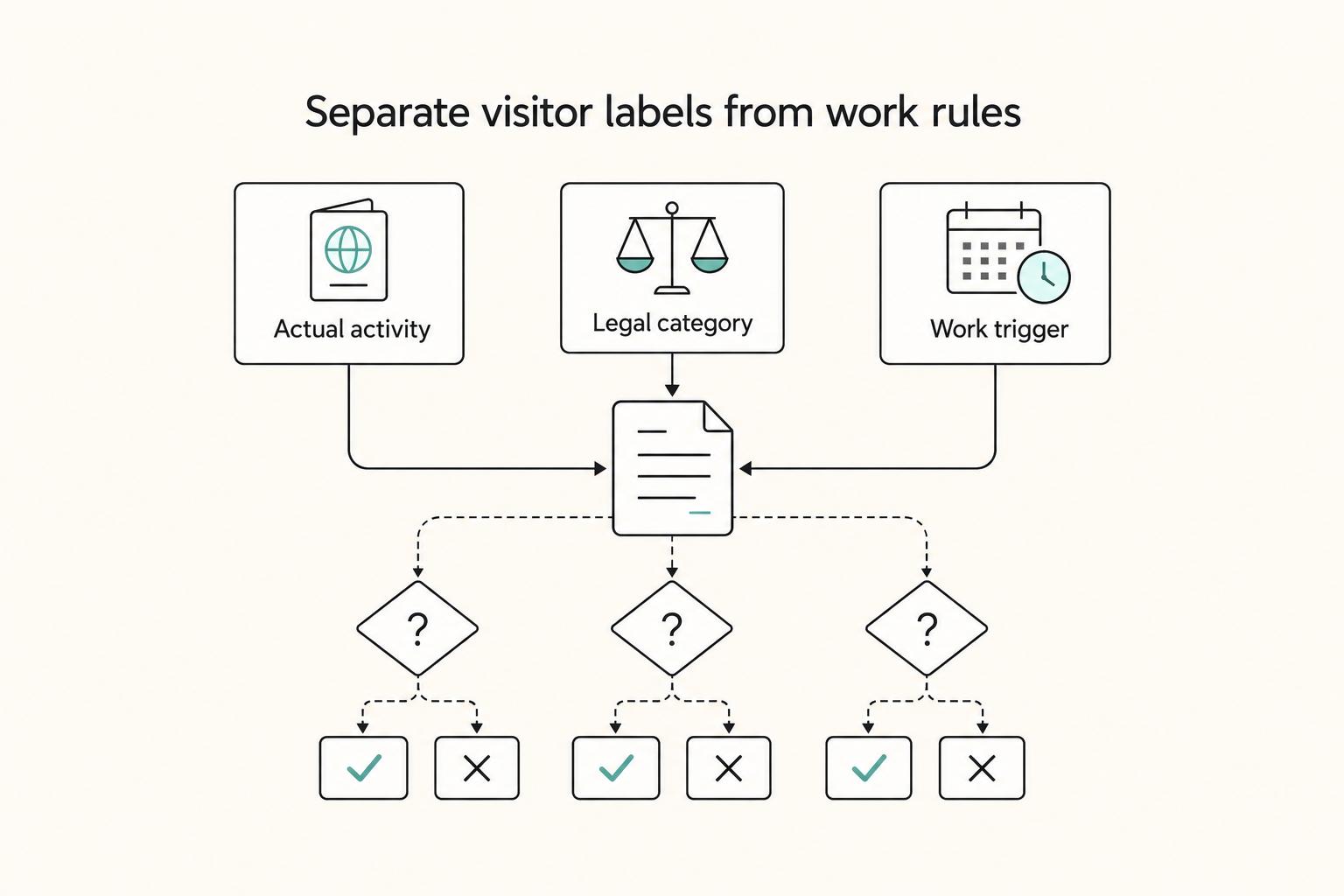
Canada Digital Nomad Visa Planning for Visitor Status and Work Permits
The phrase `canada digital nomad visa` is useful for search, but misleading if you treat it like a legal category. It is shorthand for existing Canadian status options, mainly visitor status and work permit rules, not a standalone visa stream with its own fixed process. That difference is not just technical. It changes how you should plan the trip, describe your purpose at entry, and organize your records before you leave.
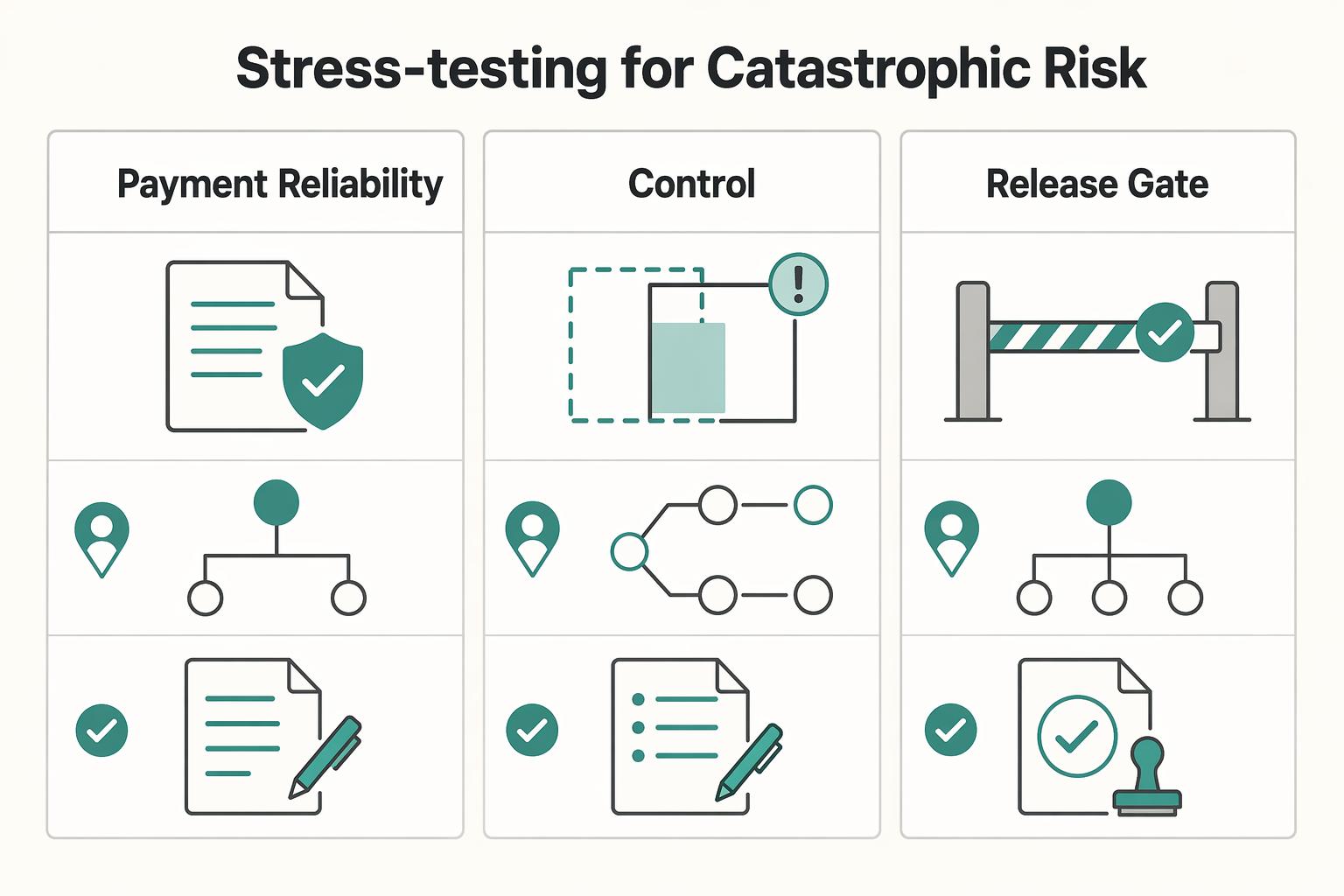
How to Conduct a 'Pre-Mortem' to De-Risk a Large Freelance Project
If you want fewer project surprises, do the risk planning before launch, not after problems show up. A pre-mortem helps because you assume the current plan has already failed, then work backward to identify what likely caused it and how you will prevent it.