
Quick Answer
Yes, treat india angel tax as a split timeline: clean up any share issuances before April 1, 2025 before negotiating new money. Build one dated packet per round with valuation method, assumptions, approvals, allotment filings, and notice or appeal status. If a report is signed but the model, dates, or board papers conflict, move to specialist review under Section 56(2)(viib) before closing.
The abolition of India's "angel tax" is a major reform for startup fundraising, but the old exposure has not disappeared. The change applies only from April 1, 2025, so earlier issuances can still affect deals tied to periods before that date.
For investors and operators, that creates a two-track job. Before the cutoff, you need disciplined diligence to protect capital and avoid inheriting legacy problems. After it, you can structure new rounds for commercial fit instead of around old valuation-defense constraints. This guide covers both.
The Ghost of Angel Tax Past: A Primer for the Prudent#
This article does not establish current law on angel tax in India or confirm that any specific cutoff fully resolves legacy risk. If you are reviewing an Indian startup now, treat unresolved historical records as a diligence item, especially in a cross-border deal where basic compliance hygiene still matters.
| Legacy area | What to check |
|---|---|
| Historical issuance records | Map each primary issuance and verify the valuation method and assumptions from primary records |
| Open assessment or appeal trail | Verify current notice, order, or appeal status from primary records |
| Thin support for valuation assumptions | Check whether the historical valuation approach and assumptions were recorded at the time and can be explained from primary documents |
In legacy files, the practical test is documentation quality: what was decided, what assumptions were used, and whether the record is internally consistent. Early-stage pricing can reflect forward expectations, much like the judgment calls that shape early-stage investing and venture capital. If questions surface later, weak records can shift time and leadership attention away from execution.
The safe approach here is to avoid asserting specific current-rule mechanics that are not supported in this article. Focus instead on whether the historical valuation approach and assumptions were recorded at the time and can be explained from primary documents.
| Evidence boundary in this article | Practical outcome |
|---|---|
| The explicit taxation reference is historical: Burke's "Speech on American Taxation" (April 19, 1774) | Do not treat this section as current legal guidance on India-specific tax provisions |
| Publication delay reflects concern about policy impact | Plan for interpretation and timing uncertainty when assessing legacy issues |
| Investor commentary is generic ("disciplined growth and cleaner underwriting") | Prioritize clean underwriting and documentation over headline narratives |
For diligence, verify cross-border participation in primary records instead of treating any single factor as an automatic shield.
In practice, the issue usually shows up in three places: historical issuance records, any open assessment or appeal trail, and thin support for valuation assumptions.
Before you assess any current opportunity, run one legacy check first. Map each primary issuance, then verify the valuation method, assumptions, and current notice/order/appeal status from primary records. If management relies on press reporting for an old dispute, ask for the underlying assessment file when accounts conflict.
If you want a deeper dive, read The Best Venture Capital Firms for SaaS Startups in India.
Funding Before April 2025: Test the Evidence Behind Each Round#
Once you have the legacy map, sort each round by evidence strength. For any issuance before April 1, 2025, ask a simple question: can the company still defend its fair market value file under Section 56(2)(viib), or does this round need specialist review now?
If an unlisted company issued shares above FMV, the excess could be treated as income from other sources and taxed, potentially up to 30.9%. That is why evidence quality matters more than narrative. Keep your review anchored to what was documented at the time, whether Rule 11UA was followed clearly, and whether the record reads as one coherent file rather than a set of documents assembled later.
It is also a practical lens in early-stage investing and venture capital. Review the file behind the price, not just the headline valuation. A round that looks fine in a pitch deck can still become a problem if the valuation memo, model, board approvals, and allotment trail do not line up.
Validate the valuation, not just the report#
Start with Rule 11UA, but do not stop at the existence of a valuation report. If the file uses NAV or DCF, make sure the method is clear and the support is tied to the actual round. For a DCF-based file, three checks usually tell you quickly whether the record is sound or fragile.
| Check | What to verify | Warning sign |
|---|---|---|
| Signatory and date | Who signed the valuation and when | Dates do not line up |
| Assumptions | What assumptions were used, and whether they were documented | Assumptions are missing |
| Consistency with period materials | Whether those assumptions are consistent with the period business materials, including the plan, deck, and approvals | The model and narrative point in different directions |
If the company points to a third-party valuation report, treat it as one checkpoint, not as automatic protection. A signed report does little if assumptions are missing, dates do not line up, or the model and narrative point in different directions.
One failure mode is a report dated close to closing while the underlying model was recreated much later or cannot be produced in native form. Another is a DCF that assumes a growth path the period materials never mention. If the board papers, investor deck, and valuation model describe materially different businesses, stop treating it as clerical and escalate.
Build one internal diligence packet and escalate on gaps#
Review is faster, and safer, when the company can produce one packet that tells the full issuance story. Ask for that packet up front instead of piecing records together over time.
| Packet item | What it should include |
|---|---|
| Valuation memo or report | The Rule 11UA method and date/signatory details |
| Underlying financial model | The model used for that valuation, if applicable |
| Approvals and share-issue documents | Documents tied to price and timing |
| Business-rationale materials | Materials supporting the premium |
| Tax trail | Notices, replies, orders, stays, and appeals, if any |
Missing document = escalation. If a core item is absent and cannot be supported by dated records, treat the round as potentially exposed.
In practice, the packet should also show the filing trail around allotment. Compliance checkpoints often reviewed include PAS-3 within 15 days of share allotment and, for FDI, FC-GPR within 30 days. You do not need to turn every timing mismatch into a tax conclusion. But missing filing proof, unclear acknowledgement records, or a cross-border round with no traceable filing narrative are good reasons to escalate early.
This is where recordkeeping matters as much as legal theory. For cross-border participation, keep the same compliance hygiene you would expect in any multi-jurisdiction file. That means timestamped approvals, filing receipts, final signed versions, and a clear adviser handoff if something does not reconcile. One avoidable mistake is letting finance, legal, and company secretarial records drift apart until no one can show which version governed the issue price on the actual allotment date.
Verify claimed shields#
If management claims startup recognition or another exemption, verify the underlying record and filing trail before you rely on it. The practical question is not whether the company believes a shield applies. It is whether the file shows that it did.
If a claim depends on a threshold or a period-specific rule, confirm the exact rule and whether it applied before you build your risk view around it.
| Item | Document exists | Document defensible | Action now |
|---|---|---|---|
| Valuation file | Signed valuation report is present | Rule 11UA method is clear; assumptions and dates are traceable | Escalate if assumptions or timeline support is missing |
| Financial model | Model file is available | Inputs align with valuation and period business narrative | Escalate if the model is reconstructed or inconsistent |
| Approvals and issuance docs | Resolutions, allotment, and subscription records exist | Price, timing, and rationale align across documents | Escalate on gaps, undated records, or contradictions |
| Business rationale support | Plan, deck, market, or investor materials exist | Materials support the premium case used at the time | Escalate if support is thin or conflicts with the valuation |
| Exemption, recognition, or tax trail | Claim is backed by records | Eligibility evidence and filing trail are complete | Do not rely on unsupported claims; escalate |
If the packet is complete and coherent, risk is easier to manage. If core records are missing, inconsistent, or clearly backfilled later, move the round to specialist review under Section 56(2)(viib).
You might also find this useful: A Deep Dive into the UAE's Corporate Tax for Freelancers and LLCs.
Structuring Rounds After 2025: Keep Legacy Cleanup Separate#
Going forward, separate new deal design from legacy cleanup. Choose the simplest instrument and entity stack your actual investors will fund, then run any legacy-period exposure as a separate review file.
That matters because market headlines can distort judgment. EY's H1 2025 private credit update showed US$9.0 billion across 79 deals. It also notes that the spike was heavily influenced by one US$3.1 billion transaction and excludes deals below US$10 million. Treat those totals as directional, not exhaustive. The practical takeaway is that market headlines do not price your round for you, and they are a weak reason to add structural complexity.
Choose the instrument by what you can defend commercially now#
Choose the instrument based on your real negotiation position, not abstract preference. A practical approach is to use priced equity when founders and lead investors can align on valuation now, and to use a convertible instrument when valuation disagreement is the blocker and speed matters more than setting price immediately. That is the same tradeoff investors weigh in early-stage angel and venture deals, where alignment on price, rights, and timing usually matters more than clever drafting.
If you use a convertible, reduce future disputes before they start. Define conversion triggers, what happens if the next round is delayed, dilution outcomes, and pro rata treatment in clear terms. A frequent problem is not the instrument itself. It is vague drafting that leaves the next pricing event, discount mechanics, or downside protection open to argument when the company is under pressure.
Whatever instrument you choose, keep execution basics clean: dated approvals, a current cap table by security, clear investor-rights summaries, and a financing model that shows ownership outcomes after conversion or allotment. If you cannot produce that package in one sitting, you are not ready to close fast. That checkpoint matters because drift across legal, finance, and company secretarial records can turn a straightforward round into a later dispute.
Run broader diligence, but keep a legacy tax screen#
Do not let the post-2025 opportunity distract you from basic diligence. Pressure-test unit economics, execution risk, governance hygiene, and cap-table clarity, and do not ignore control rights just because the company is still private. If one holder or sponsor can effectively control voting outcomes, call that out early, because concentrated voting power can determine shareholder-approval outcomes.
| Diligence area | What to test or flag |
|---|---|
| Unit economics | Pressure-test unit economics |
| Execution risk | Pressure-test execution risk |
| Governance hygiene | Pressure-test governance hygiene |
| Cap-table clarity | Pressure-test cap-table clarity |
| Control rights | Do not ignore control rights; call it out early if one holder or sponsor can effectively control voting outcomes |
| Legacy issuances | Match each legacy issuance to its date, price, valuation file, approvals, and tax trail |
| Cross-border participation | Verify live applicability directly rather than assuming the file is clean on first read |
At the same time, keep one focused legacy screen for older issuances. Match each legacy issuance to its date, price, valuation file, approvals, and tax trail, and do not let the new-money process blur that review. Where cross-border participation exists, verify live applicability directly rather than assuming the file is clean on first read, and do not assume any specific post-2025 angel-tax position without current legal confirmation.
Domestic entity vs offshore holdco: no one-size-fits-all answer#
There is no universal winner here. If your likely investors are comfortable funding an Indian operating company directly, a domestic structure may keep execution simpler. If target investors strongly prefer offshore paper, that may push you toward a holdco path.
Then test the operating burden honestly. Extra entities usually mean more intercompany documentation and more legal, tax, and compliance coordination. If you already struggle to keep one set of approvals, filings, and ownership records aligned, adding a holdco usually multiplies that burden instead of solving it. The discipline required looks a lot like the multi-jurisdiction recordkeeping discussed in our cross-border tax and compliance guide, even though the underlying residency questions are different.
With ongoing tax-law rewrite discussions still in play, prefer structures you can run consistently, not structures that only look optimal on day one.
| Structuring choice | Main upside | Main tradeoff | Often a fit when |
|---|---|---|---|
| Priced equity | Ownership and valuation are clear now | More upfront negotiation on price, dilution, and rights | There is enough traction or comparables to price with confidence |
| Convertible instrument | Keeps the round moving when valuation is the blocker | More future interpretation risk if terms are vague | Timing is critical and valuation alignment is not ready yet |
| Domestic Indian entity | Fewer moving parts when investors can invest directly | May not match all foreign investor preferences | Investors are open to local paper and operations are mainly in India |
| Offshore holdco | Can align with some foreign investor expectations | More entity maintenance and cross-border compliance work | There is a clear cross-border capital plan and capacity to manage complexity |
Choose the simplest structure your target investors will fund, and ring-fence legacy-period risk as a separate workstream.
Related: A Deep Dive into the German Trade Tax ('Gewerbesteuer') for Freelancers.
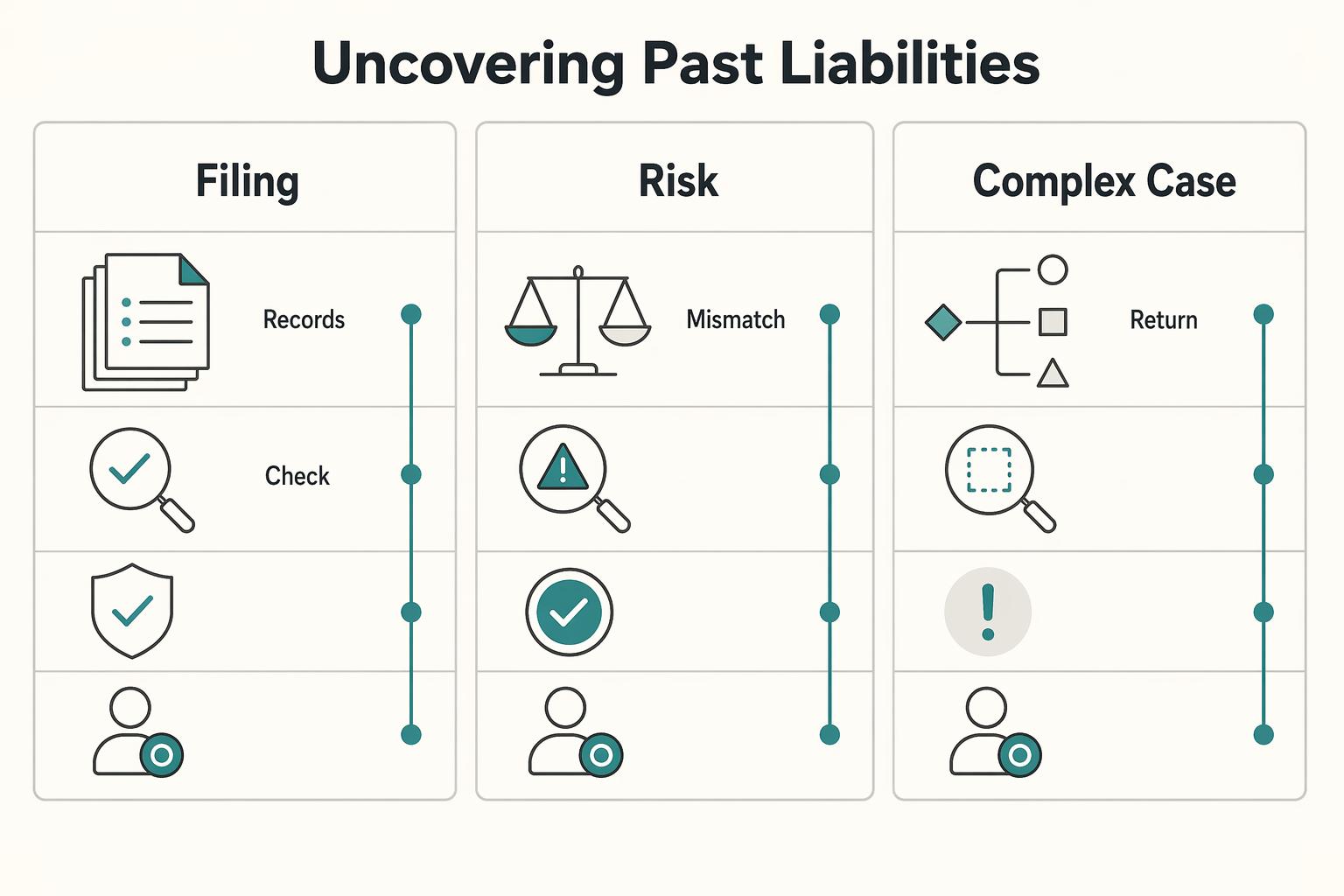
The Investor's Due Diligence Checklist: Uncovering Past Liabilities#
Treat legacy legal and compliance diligence as a go-or-no-go gate. In startup deals, this work usually begins after the term sheet, and the depth should scale with stage, ticket size, and investor profile. For each check below, move in the same order: Exposure identified -> Evidence reviewed -> Status confirmed -> Risk owner assigned. If records are incomplete or inconsistent, pause and involve counsel. Adverse findings can lead to renegotiation or withdrawal, while transparent disclosure can speed deal closure.
| Question | Evidence reviewed | Status or action |
|---|---|---|
| Historical share issuances and compliance | Cap table history, issuance records, board and shareholder approvals, statutory filings, and related compliance correspondence | Require one clear status per issuance: no active issue, issue under review, issue contested, or issue resolved |
| Valuation and pricing consistency across rounds | Any valuation materials used for issuances, plus management's round-by-round explanation of method choice and pricing rationale | Classify each round as Defensible, Needs clarification, or Open risk |
| Current structure and governance | The current group chart, the approval trail for entity changes, and a written plan for what will be kept, simplified, or unwound | Accept only execution-grade answers: named decision-maker, timeline, dependencies, and a rationale investors can follow |
Run the checklist in sequence: start with issuances, then test pricing consistency, then ask whether the current structure is still worth carrying.
1) What historical share issuances could still carry compliance exposure?#
Start by forcing a complete issuance map. Then work through the file in order.
- Exposure identified: Ask for a complete list of historical share issuances, with issue date, investor, issue price, and support used at the time.
- Evidence reviewed: Request cap table history, issuance records, board and shareholder approvals, and statutory filings.
- Status confirmed: Require one clear status per issuance: no active issue, issue under review, issue contested, or issue resolved. Confirm whether the documentation supports compliance with the Companies Act, 2013.
- Risk owner assigned: Name a company-side owner and adviser-side owner for unresolved items, with deadlines. If dates, filings, and records do not reconcile, escalate immediately.
2) Does the valuation file stay consistent across rounds?#
The point is not whether every round used the same method. It is whether each method choice, assumption set, and pricing story still holds together when you line the rounds up.
- Exposure identified: Ask for valuation materials used for issuances, where available, plus management's round-by-round explanation of method choice and pricing rationale.
- Evidence reviewed: Run a consistency test across rounds on method, assumptions, and board rationale. Check whether report timing, assumptions, and approvals align with issued shares.
- Status confirmed: Classify each round as
Defensible,Needs clarification, orOpen risk.Defensiblemeans the report date, method, assumptions, and approvals align with the issued shares. - Risk owner assigned:
Needs clarificationgets a dated reconciliation task for finance plus the external adviser.Open riskis a diligence hold, not memo language used to smooth over the issue.
3) Is the current structure executable, or just legacy complexity?#
If a structure was built for earlier constraints, confirm whether it still serves a live purpose or has become extra maintenance.
| Requested material | What to include |
|---|---|
| Current group chart | Request the current group chart |
| Approval trail for entity changes | Request the approval trail for entity changes |
| Written plan | Show what will be kept, simplified, or unwound |
| Shareholding structure | Include as a core legal record |
| Founder agreements | Include as a core legal record |
| Shareholder agreements | Include as a core legal record |
| Statutory filings | Include as a core legal record |
| IP ownership records | Show key trademarks, software, and inventions are company-owned |
- Exposure identified: Ask why the current structure exists and whether any layer was created mainly to manage earlier legal or compliance friction.
- Evidence reviewed: Request the current group chart, the approval trail for entity changes, and a written plan for what will be kept, simplified, or unwound. Include core legal records such as shareholding structure, founder agreements, shareholder agreements, statutory filings, and IP ownership records showing key trademarks, software, and inventions are company-owned.
- Status confirmed: Accept only execution-grade answers: named decision-maker, timeline, dependencies, and a rationale investors can follow. Vague statements are not a pass.
- Risk owner assigned: Assign structure cleanup to an accountable executive with legal support. If governance records are unclear, treat it as a diligence hold.
For a step-by-step walkthrough, see A Deep Dive into the US-Ireland Tax Treaty for Tech Consultants.
Conclusion: From Compliance Burden to Strategic Catalyst#
After diligence, the right next move is sequencing, not optimism: close legacy exposure first, then structure the next raise for clean execution. One industry explainer on the change says the change applies from FY 2025-26, but you should still verify the live legal position in official notifications before you rely on it in a deal, especially since uncertainty has continued after recent changes.
Start with the past. Audit prior rounds where valuation support is thin, records are fragmented, or assumptions shifted between rounds. Keep one dated file with cap-table history, valuation records, board and shareholder approvals, tax notices, responses, and closure status, and assign one owner to maintain it through signing. That discipline matters because the 3one4 playbook on angel-tax and Section 68 notices describes the latest Rule 11UA changes as not fully resolving projection-versus-actual valuation disputes, and fragmented records can make review and response harder.
For new fundraising, use two tests: how clean the compliance trail is, and how fast you need to close. This keeps old exposure from quietly dictating new terms. If you want a practical companion on investor coordination and deal setup, read A Freelancer's Guide to Angel Investing and Venture Capital.
Do not let basic execution undermine an otherwise sound file. Digital tax compliance can fail on routine issues, including inefficient data transformation and rough submission interactions. Use a version-controlled evidence pack, and verify that file names, dates, and approvals align before anything is filed or shared. If you also need a separate personal cross-border compliance track, the digital nomad tax guide is a useful next read.
Talk to a tax or legal adviser early if any of these apply, then keep the same evidence pack at the center of the review:
- Your ownership or funding structure could create FEMA overlap or related regulatory complexity.
- You still have uncertainty about how recent angel-tax changes apply to your facts.
- Your valuation support is incomplete, inconsistent, or hard to reconcile.
The practical takeaway is to clean up old rounds, centralize evidence, and choose structures you can explain and execute clearly.
If you are rebuilding your funding and payout setup, contact Gruv to confirm market coverage and compliance gating before you execute.
For a separate cross-border tax perspective, see A Deep Dive into the US-Japan Tax Treaty for Remote Workers.
Frequently Asked Questions
Does Section 56(2)(viib) still affect your case?
Treat this as a date-driven question and verify the live legal position before you act. Section 56(2)(viib) is described as an anti-abuse provision, and a secondary source reports that angel tax was abolished from FY 2025-26. If your share issue or notice relates to an earlier period, review that round under the law that applied at the time.
What should you do before issuing shares or reviewing an older round?
Use a simple, repeatable checklist for the relevant period: document issue price, support your FMV position, and map how any excess over FMV could be treated as Income from Other Sources. Keep records complete and response-ready, and remember the private limited company pays angel tax, not investors. Even with a valid valuation report, angel-tax scrutiny can still apply, so notice responses should be complete and adequate.
Did the foreign-investor position become simpler?
Not necessarily. 2023 reporting says the Finance Bill proposed removing exemptions for foreign funds and non-resident investors, but current treatment should be confirmed against live law and dates. Industry coverage also warned this expansion could slow investment momentum and push some startups to flip outside India.
What does the 10% safe harbor mean in practice?
This guide does not provide enough detail to treat a 10% safe harbor as a standalone answer. Keep your FMV method and records defensible for that round, and verify current applicability before relying on any tolerance rule.
Do you still need DPIIT recognition and Form 2 for exemption-based positions?
If you are relying on an exemption path, verify the current official requirements before you file.
Does this change automatically resolve old notices or pending disputes?
Do not assume that. Legacy notices and disputes still need case-specific review, especially when the issue period predates later policy changes.
If you are using the startup exemption path, what threshold should you rely on?
Treat any threshold figure as provisional and verify the live requirement before relying on it.
Try a related tool
Researched and edited by the Gruv editorial team. Gruv builds cross-border billing, payouts, and finance-operations software for global businesses.
Sources
Includes 4 external sources outside the trusted-domain allowlist.
- oecd.org/content/dam/oecd/en/publications/reports/201...trusted
- oecd.org/en/publications/strengthening-fdi-and-sme-li...trusted
- sec.gov/Archives/edgar/data/1873951/0001193125252670...trusted
- sec.gov/Archives/edgar/data/1027596/0000894189260005...trusted
- 3one4-reports.s3.ap-south-1.amazonaws.com/Playbook+for+Handling+Angel+Tax+and+Section+...external
- bhavyasharmaandassociates.com/reports/union-budget-2026-startup-analysis.htmlexternal
- ey.com/content/dam/ey-unified-site/ey-com/en-in/ins...external
- ey.com/content/dam/ey-unified-site/ey-com/en-in/ser...external
Educational content only. Not legal, tax, or financial advice.
Related Posts

Digital Nomad Taxes in 2026 With a Defensible Filing Plan
With digital nomad taxes, the first move is not optimization. It is figuring out where you may be taxable, where filings may be required, and what proof supports that position.
A Freelancer's Guide to Angel Investing and Venture Capital
**Build a decision system that protects your operating cash first, then treat angel investing as an optional use of true surplus.** If you are considering angel investing as part of broader wealth building, you need controls that keep "startup investing" from quietly raiding rent, taxes, or payroll. Knowledge feels productive, but constraints keep you solvent. As the CEO of a business-of-one, your job is to protect the operating cash that keeps the machine running.

The Freelance Payment Penalty: A Modeled Audit of Platform Fees, FX Spreads, and Payout Delays
The money rarely disappears through a single, easy-to-spot fee. The real loss is stacked. A marketplace takes its commission, a processor adds a charge for international cards, a bank or payment company converts the currency at a spread, a platform holds the funds before release, and a wire sheds a little to intermediaries on the way in. Each layer looks defensible on its own, but the worker feels the combined result as a smaller deposit and a later payday.