
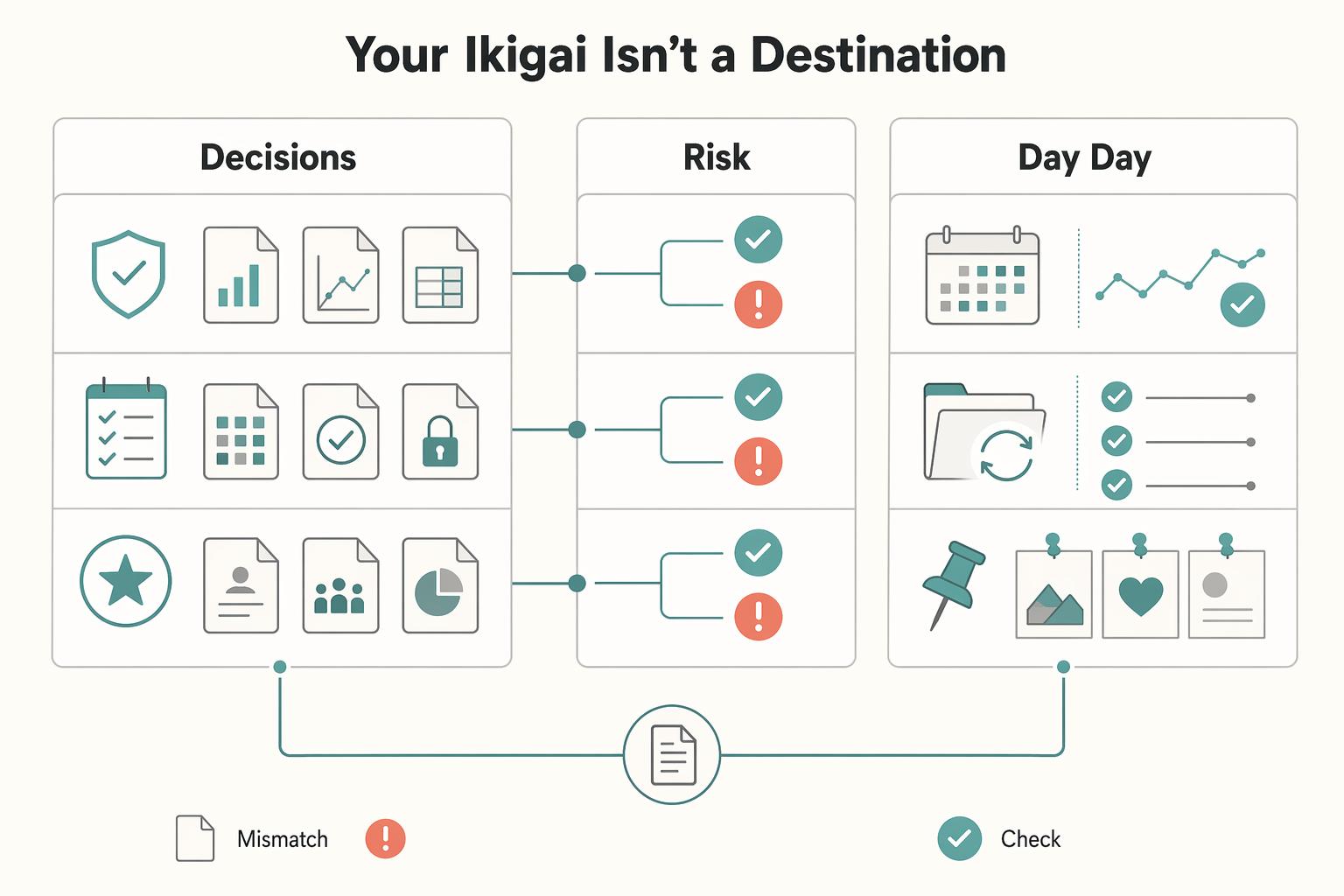
Quick Answer
Start by running your business in sequence: strengthen revenue quality, lock in consistent compliance habits, then choose work that aligns with your direction. This approach replaces one-shot purpose searching with repeatable decisions you can test in real client work. Use a simple monthly check on offers, obligations, and client fit, then adjust based on what the records show. Clarity comes from operating the system, not waiting for a final identity answer.
Beyond the Venn Diagram: Ikigai as an Operating System for the Global Professional#
If you treat ikigai as a one-time insight about purpose, you miss the part that determines whether freelancing is actually sustainable. A more useful approach is to treat it as your system: the choices, habits, and protections that keep good work moving when clients pay late, admin piles up, and your pipeline turns uneven.
That shift matters because the real question is rarely, "What should I do with my life?" More often, it is, "How do I keep doing good work without getting buried by invoice follow-up, contract confusion, records, cross-border client friction, and constant uncertainty about what needs attention first?" If that sounds familiar, do not start with a purpose exercise. Start by building the conditions that make purposeful work possible.
It also helps to be careful with neat, universal claims about ikigai itself. One current essay argues that Western self-help culture has flattened it into a monetized Venn-diagram shortcut, and that critique lands for freelancers. A common failure mode is turning every useful thing you do into a sales tactic. Every generous post becomes a lead magnet, every open share becomes prospecting, and every interest gets judged by whether it can be billed. That can make the work feel more extractive and push decisions toward short-term conversion.
| Decision area | Venn-diagram thinking | OS thinking |
|---|---|---|
| Mindset | Find the overlap and everything clicks | Build a stable base so good work can continue |
| Daily behavior | More introspection, more searching, more "should" | Clear offers, cleaner admin, better client selection, regular review |
| Risk exposure | Underestimates business friction and uncertainty | Names risk early and reduces it before it compounds |
| Business outcome | Can create short bursts of clarity, then relapse into stress | Aims for more consistency, better boundaries, and more room for meaningful work |
For freelancers, this reframe matters because you are not only the maker. You are also sales, finance, operations, and risk control. Any purpose model that ignores those jobs will feel inspiring for a day and thin by Friday.
A practical checkpoint is simple: if this idea is useful, it should show up in your calendar and decisions within a month. You should be able to point to a cleaner offer, a better way to track obligations, a stricter client filter, or a more deliberate use of your time. If nothing changes except your language, you are still consuming ideas, not building something durable.
One verification note matters here. A scraped PDF page for one Ikigai title was password-gated, and another commonly cited page was unstable during capture. So it is smarter to use ikigai as a working lens than to pretend there is one fully settled, source-perfect formula. In practice, the question is not whether you can define the term with precision. It is whether you can make your freelance career sturdier.
That is the path ahead. You will build that foundation through three pillars: a profit engine that makes the work viable, a compliance moat that reduces avoidable risk, and real autonomy that lets you choose better work instead of just taking what shows up.
If you want a deeper dive, read GDPR for Freelancers: A Step-by-Step Compliance Checklist for EU Clients.
Pillar 1: Are You Just Getting Paid, or Are You Building a Profit Engine?#
A profit engine means you set pricing, scope, and operating guardrails before work starts, so one bad project does not wipe out months of effort. The finance anecdote is a useful warning: one mistake was described as erasing savings by a factor of 23, and stacked obligations later created more cash pressure. Different context, same lesson for freelancing: you need downside control, not just good intentions.
Price around outcomes, then show the work#
Use a simple proposal flow so clients can see the value quickly:
| Step | What to do | Article detail |
|---|---|---|
| Define the client outcome | Write it in one sentence | Example outcomes: less rework, faster launch, clearer positioning |
| Map each deliverable | Link it to that outcome | Explain what decision or result each deliverable supports |
| Lead with outcomes | List tasks after the outcome | Keep tasks and timelines, but make the opening about what changes for the client |
You are not promising results you cannot prove. You are making the commercial logic clear.
Use your SOW as a guardrail, not paperwork#
Treat your SOW as the boundary document that prevents silent scope drift. At minimum, include:
- Deliverables (named, specific)
- Timeline and milestones
- Review and approval points
- Assumptions and client dependencies
- Revision limits
- Out-of-scope items
- Fees, payment timing, and change triggers
Use one change-request workflow every time:
- Client submits request in writing.
- You assess impact (scope, fee, timeline) in writing.
- Client approves in writing.
- Work starts after approval.
If you expect common extras, pre-scope add-ons with separate price and timing so "can you also..." becomes a clean decision.
Count non-billable work and price with it#
If you do not track admin and sales time, you are probably underpricing delivery. Use a monthly log like this:
| Work type | Example tasks | Monthly hours (your actuals) | Pricing input |
|---|---|---|---|
| Billable delivery | production, delivery meetings, execution | [enter hours] | sets delivery capacity |
| Client acquisition | discovery, proposals, follow-up | [enter hours] | distribute across new work |
| Business overhead | invoicing, records, tools, planning | [enter hours] | include as operating cost |
A defensible niche can make this system easier to run. Pick one problem domain, define who you serve, codify proof assets, and reuse that package so fit decisions are faster and clearer.
Use a 30-day check: one outcome-led proposal format, one enforced change-request path, and one month of billable/non-billable tracking. If those are missing, you are likely getting paid project to project, not running a profit engine.
For a step-by-step walkthrough, see A guide to 'Bullet Journaling' for freelancers.
Pillar 2: Why Your Purpose is Impossible Without a "Compliance Moat"#
Your purpose-driven work stays stable only when your compliance basics are systemized. If a client challenges an invoice, a tax authority asks for support, or you change countries, you need records you can retrieve quickly without rebuilding the story from memory.
Run one operating checklist across every client#
Use one checklist across every client so your process stays consistent:
| Workflow stage | Core action | What to capture or keep |
|---|---|---|
| Onboarding | Capture | Client legal name, billing contact, and tax profile notes |
| Contracting | Store | Signed agreement, scope, change approvals, and final client version; save related email/chat threads when terms change |
| Invoicing | Issue and review | Issue from one system, tie each invoice to signed scope, and review payment status on a fixed cadence |
| Recordkeeping | Keep | Proposals, SOWs, invoices, receipts, bank confirmations, and delivery evidence in one client file structure |
| Dispute handling | Maintain | A dated timeline, approval evidence, and payment reminder history |
Jurisdiction-specific requirements belong in this checklist only once they have been verified for the client location, your business setup, and the filing workflow involved.
Reactive workflows look cheaper until they fail. In one reported case, reconciling three missing cents in a spreadsheet consumed five hours. That is the hidden cost of messy operations.
| Approach | Effort pattern | Risk visibility | Client trust signal | Decision speed |
|---|---|---|---|---|
| Reactive compliance | Low setup, high cleanup | Gaps surface late | Feels improvised | Slow, because facts must be reconstructed |
| Systemized compliance | Moderate setup, lower repeat effort | Gaps surface early | Feels reliable | Faster, because records are ready |
Build a safety-net allocation you can run automatically#
Do not rely on memory or willpower. Route incoming client payments through a clearing flow, then auto-transfer into separate accounts using rules you review monthly:
- Tax reserve: Use a reserve percentage or transfer rule only after your current filing obligations are verified.
- Personal pay: Document the owner-pay rule once you have confirmed your cash-flow needs and business obligations.
- Business overhead: Keep a reviewed allocation for recurring tools, insurance, subcontractors, and operating costs.
- Long-term reserve: Set the target after reviewing runway needs, upcoming obligations, and the income volatility you want to absorb.
Each month, reconcile account balances against invoices issued, invoices paid, and known filing obligations. If rules are skipped, tighten automation instead of adding manual reminders.
Keep cross-border documentation as a standing workflow#
If you work across borders, keep records continuously: a travel log, source documents (for example, flight and accommodation records), and a filing calendar of items to verify by jurisdiction. This is risk control and optionality, not legal advice.
The operational point is simple: response channels can change. HMRC dropped its 10-minute Agent Dedicated Line commitment on 2 October, rerouted some PAYE queries, and directed agents to the Income Record Viewer for records including P45 and P60 details. That is UK-specific, not a global rule, but the lesson is universal: your compliance system should not depend on getting someone on the phone.
Your minimum command center is one invoicing tool, one ledger, one document store, and one calendar linked by client name and invoice ID. Add governance basics: access control, scheduled backups, and a retention rule once your applicable period is verified. We covered this in detail in A Guide to 'Deep Work' for Freelancers.
Pillar 3: How to Activate True Autonomy (Once Your Foundation is Secure)#
Once your cash flow, reserves, and records are stable, autonomy becomes an operating routine, not a mood. Your job is to decide what to keep, what to fix, and what to create space for without destabilizing the business.
The common failure mode is autopilot: saying yes because something is familiar, flattering, or emotionally appealing. You stay autonomous by filtering opportunities against what your business can actually absorb.
Use a simple decision filter before you say yes#
Run each new project, partnership, or mission-aligned idea through four checks:
| Check | What to assess | Instruction |
|---|---|---|
| Opportunity fit | Does this match the work you want more of next year? | Judge the actual work, not the logo or narrative around it |
| Downside containment | Contained loss in time, margin, attention, reputation, or delivery reliability | Set the limit in writing before you decide |
| Capacity impact | What this will displace in your current schedule | If it pushes out recovery time, admin discipline, or delivery for core clients, it is not truly additive |
| Next action | Choose one action | Accept, test small, defer, or decline |
Use a short monthly note to stay honest: one theme and 3 prompts. Let the first two prompts surface clutter, then use the third to reframe with precision.
Audit the client portfolio you already have#
Autonomy is usually funded by improving your current client mix. Review each client on profitability quality, energy cost, strategic fit, and boundary compliance using simple labels (High/Medium/Low), then map to an action path.
| Client profile | Profitability quality | Energy cost | Strategic fit | Boundary compliance | Action path |
|---|---|---|---|---|---|
| Anchor client | High | Low | High | High | Retain and protect; review scope and pricing before renewal. |
| Well-paid drain | High | High | Medium | Low | Renegotiate; tighten scope, approvals, and communication boundaries. |
| Mission seed | Low or Medium | Low | High | High | Keep small and time-boxed; treat as a test. |
| Chronic violator | Low | High | Low | Low | Transition out with a clean handoff plan. |
Do the audit from records, not memory: invoices, scope changes, payment timing, revision patterns, and approval delays.
Turn the audit into a cadence#
Keep the loop operational:
- Retain: renew strong-fit clients early and document what is working.
- Renegotiate: use concrete examples from recent work.
- Transition out: exit professionally, complete commitments, and close records cleanly.
- Replace: prospect for the client profile you actually want next.
This is the practical flywheel: stable core work funds mission-aligned tests, and those tests sharpen how you position your work. If you add coaching or advisory offers, prepare them and avoid improvisation. Group formats can reach more people, while personalized work is often perceived as higher value and usually requires stronger preparation.
Mission-aligned work can strengthen positioning and may improve fit of new inquiries, but it is not guaranteed. It comes down to control: core work buys choice, and repeated choices improve your next portfolio cycle. Related: How to Deal with Imposter Syndrome as a Freelancer.
Your Ikigai Isn't a Destination; It's Your Operating System#
Treat ikigai for freelancers as a system you run, not a final answer you discover once. Your direction gets clearer through small, steady actions and regular adjustments, not through a one-time identity decision. In this guide's framework, that means: stabilize revenue quality, make compliance routines consistent, then choose more purpose-aligned work from a stronger base.
When work feels off, do a practical check before you over-interpret it as a purpose crisis. Review the 4 domains briefly: passions, talents, social need, and practical contribution.
| Destination mindset | Operating-system mindset |
|---|---|
| Decisions | Waits for perfect clarity before acting |
| Risk exposure | Feels high because each move seems permanent |
| Day-to-day behavior | Keeps searching for the "right" diagram answer |
Use the Venn-style model as a heuristic, not a verdict. If you feel stuck, run one small experiment instead of rewriting your whole identity: refine one offer, tighten one compliance routine, or replace one misaligned client segment.
Use this monthly prompt: What paid work is improving revenue quality, what routine is making compliance more reliable, and what project would I choose next from a secure base? If your answers change, adjust your system.
You might also find this useful: A freelancer's guide to 'Grit'.
Frequently Asked Questions
How do you actually apply ikigai for freelancers without turning it into another abstract exercise?
Start with questions, not a manifesto. One source makes this explicit with “Step 1: Start with Questions,” and others offer 5 or 8 prompts. So begin by writing your answers to what you love, what you are good at, what people will pay you for, and what kind of contribution matters to you. Then test those answers in small, practical steps and refine as you learn.
What is the real business logic behind this approach?
Treat purpose as something you clarify through focused action, not something you must perfectly define before you can act. Freelancers can feel overwhelmed and unfocused, and trying to serve everyone can leave you spread too thin. Using the four elements as a filter helps you narrow priorities and decide what to test next.
Do I need to care about the Venn diagram version of ikigai?
Not too much. One source says the Japanese principle of ikigai has nothing to do with the popular Venn diagram, so treat that graphic as a thinking aid, not a rule you have to "solve." If the circles help you ask better questions, use them. If they make you stall, move on and test your answers in real client work.
Can this reduce burnout or anxiety, or is that oversold?
It may help with common overload and focus problems, but it is not a guarantee and it is not a medical fix. A practical approach is to narrow what you are testing, avoid trying to do everything at once, and adjust one step at a time.
How often should you review your direction?
Do not force a fixed cadence just because it sounds disciplined. Revisit your direction when you notice recurring overwhelm or a mismatch between your work and your priorities. Keep short notes on what you are testing so you can adjust gradually.
Is this only relevant if you are a digital nomad?
No. If you work independently, the same four elements still apply whether you stay local or work across borders. The core process is the same: answer the key questions, test in real work, and iterate.
Try a related tool
Researched and edited by the Gruv editorial team. Gruv builds cross-border billing, payouts, and finance-operations software for global businesses.
Sources
Includes 6 external sources outside the trusted-domain allowlist.
- erau.edu/hub-spoke/exploretrusted
- europarl.europa.eu/RegData/etudes/STUD/2022/729533/EPRS_STU(202...trusted
- bauthenticinc.com/post/ask-yourself-these-5-questions-to-find-...external
- dokumen.pub/download/ikigai-how-to-choose-your-career-pa...external
- feeds.buzzsprout.com/727083.rssexternal
- financialsamurai.com/how-to-overcome-financial-hopelessness-when-...external
- freelancer.com/jobs/custom-project-jul.2363333/88external
- freelancesuccess.co.uk/freelancers-guide-to-ikigai-finding-your-fre...external
Educational content only. Not legal, tax, or financial advice.
Related Posts

GDPR Compliance Checklist for Freelancers Working With EU Clients
Start by separating the decisions you are actually making. For a workable **GDPR setup**, run three distinct tracks and record each one in writing before the first invoice goes out: VAT treatment, GDPR scope and role, and daily privacy operations.
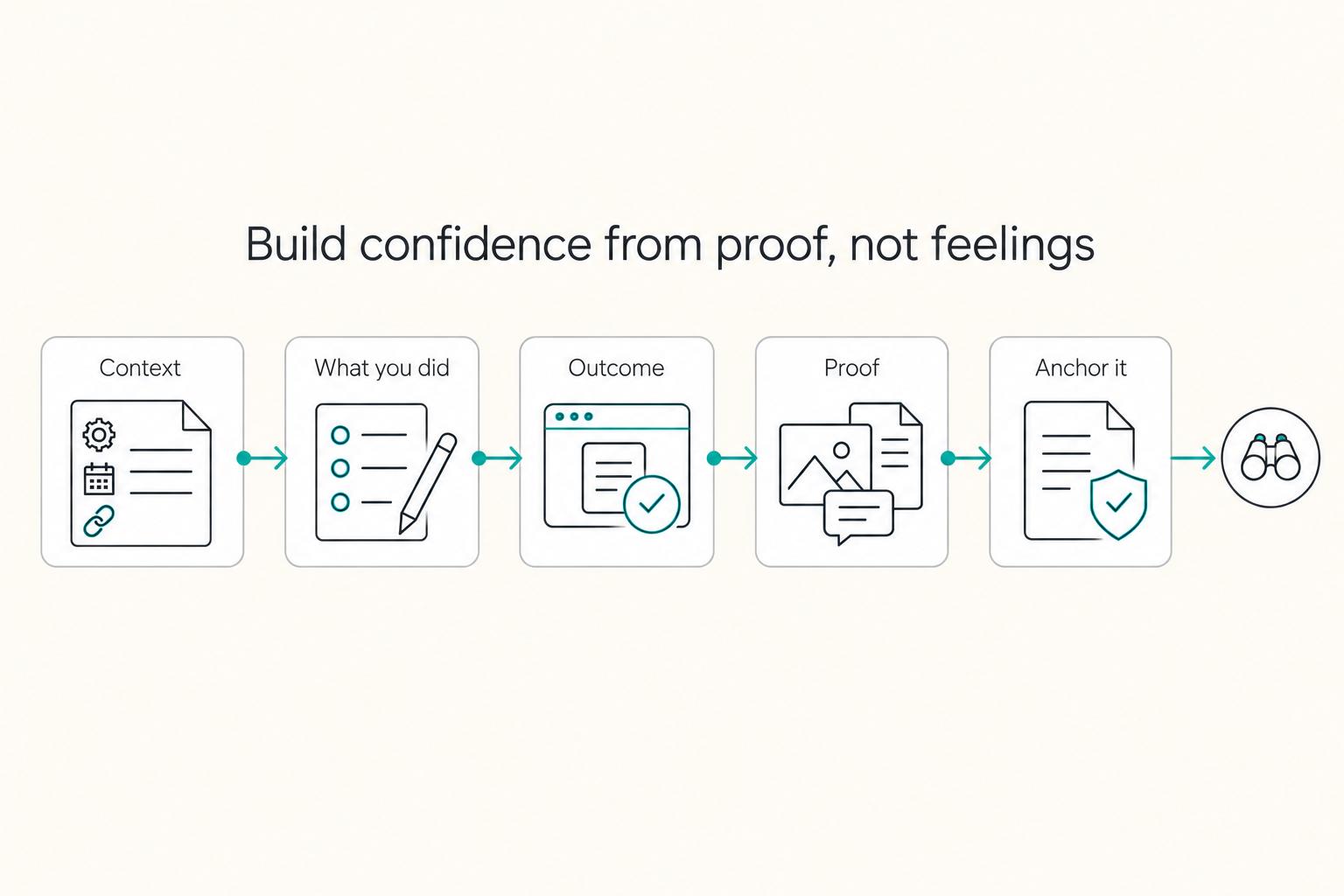
How to Deal with Imposter Syndrome as a Freelancer
**Freelance impostor feelings can flare when your work lacks clear, documented boundaries-even when you *do* have talent.** You're the CEO of a business-of-one, and your job is to turn shaky moments into repeatable operations.

The Freelance Payment Penalty: A Modeled Audit of Platform Fees, FX Spreads, and Payout Delays
The money rarely disappears through a single, easy-to-spot fee. The real loss is stacked. A marketplace takes its commission, a processor adds a charge for international cards, a bank or payment company converts the currency at a spread, a platform holds the funds before release, and a wire sheds a little to intermediaries on the way in. Each layer looks defensible on its own, but the worker feels the combined result as a smaller deposit and a later payday.