
Quick Answer
The best work snacks are pre-decided, low-mess, portable options matched to the task at hand. Choose familiar items for deep work, clean and quiet options before meetings, and shelf-stable backups for travel, then keep a short approved list and restock it routinely so busy days do not force reactive choices.
Why Your Snacking Strategy is a Hidden Tax on Your Productivity#
If your food choices happen only when you are already hungry, distracted, or rushing, you are making those decisions under pressure. This is not just a discipline problem. It is also a decision-load problem. Unplanned eating often shows up at the exact moments when your attention is already split.
| What to track | Detail |
|---|---|
| Trigger | What pushed the decision: hunger, stress, boredom, time pressure, or travel |
| Snack choice | What you actually grabbed |
| Energy impact | How you felt during the next work block |
| Work impact | Whether you finished the task cleanly, switched tasks, or stepped away |
| Pattern check | If the same trigger leads to the same low-quality choice three or four times in a week, treat it as an operating issue worth fixing |
For independent professionals, the pattern can look familiar. It shows up in the ten minutes between calls, the slow start before a deep work block, the station or airport grab before a travel day, or the late afternoon stretch when you want something fast and easy. In those moments, your snack choice is worth tracking alongside what happens next in your workflow.
Do not rely on broad estimates of lost output unless you have a source you trust. A practical way to diagnose the issue is to track one simple chain for five workdays:
- Trigger: What pushed the decision? Hunger, stress, boredom, time pressure, travel.
- Snack choice: What did you actually grab?
- Energy impact: How did you feel during the next work block?
- Work impact: Did you finish the task cleanly, switch tasks, or step away?
The checkpoint that matters is pattern, not one bad afternoon. If the same trigger leads to the same low-quality choice three or four times in a week, you are looking at an operating issue worth fixing.
One red flag up front. Do not base your plan on hypey nutrition content. Headlines like "50lbs in 61 Days" or product pitches such as TrimLabs BHB Trim Gummies are marketing artifacts, not evidence for healthy snacks for work or better productivity.
The next step is simple. Instead of vague advice to "eat better," pre-decide your default snack options for common trigger moments and review your five-day notes. Related: How to Integrate Calendly with Your Website.
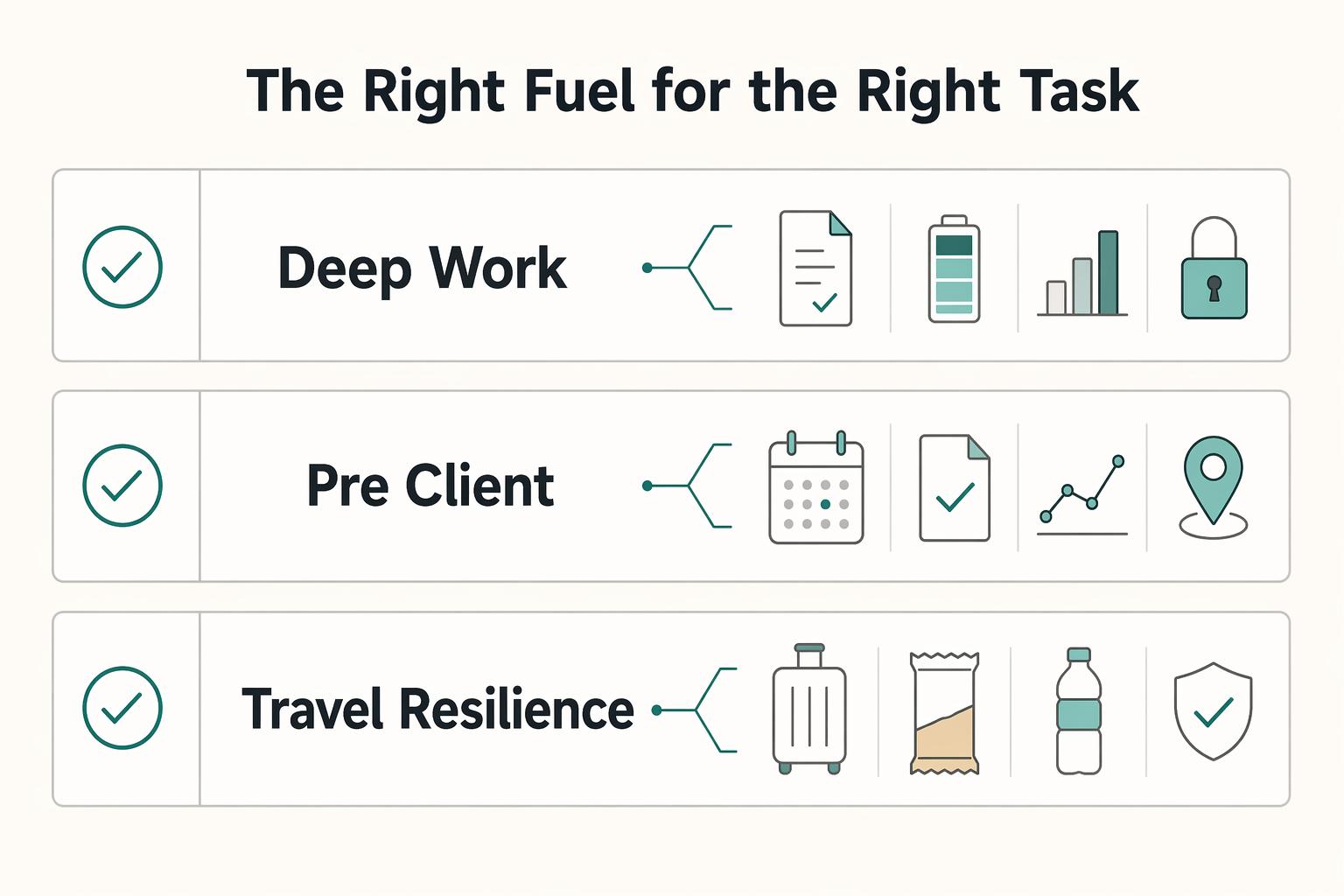
The Performance Snacking Matrix: The Right Fuel for the Right Task#
Use this matrix to choose by task, not by marketing language. Your goal is simple: pick the option that is most likely to keep your work block smooth, with fewer extra decisions and fewer avoidable interruptions.
| Stack | When to use | What to prioritize | What to avoid | Portable examples for home office and travel |
|---|---|---|---|---|
| Deep work stack | Before a focused block when you want fewer interruptions | Familiar options, easy portions, low mess, labels you can verify quickly | Snacks that are messy, distracting, or likely to trigger immediate second-snack decisions | Nuts or seeds, roasted chickpeas, cheese portions when practical, a packaged bar you have already label-checked |
| Pre-client stack | Before calls, presentations, interviews, or networking | Quiet to eat, clean handling, minimal odor, easy to finish fast | Crumb-heavy, sticky, powdery, or strong-smell options that can distract you right before speaking | Apple slices, berries, a small piece of dark chocolate, a simple packaged snack with clean handling |
| Travel resilience stack | Transit-heavy days when meal timing is uncertain | Shelf stability, bag durability, clear labels, enough substance to reduce convenience grabs | Fragile, melt-prone, or refrigeration-dependent options if your day cannot support them | Protein bars, nut butter packets, tuna or salmon pouches, roasted legumes, nut packs |
Three fast decision rules#
For deep work, choose the snack least likely to create a second decision. If it is messy, hard to portion, or leaves you immediately searching for more, it is not the right fit for that block.
For client-facing moments, prioritize execution over perfection. Pick something that keeps your hands, teeth, and attention clean so you can focus on the conversation.
For transit-heavy days, plan redundancy. Carry multiple shelf-stable options so delays do not force a rushed purchase. If travel is frequent, pair this with How to Stay Healthy and Fit While Traveling.
Packaged options: verify, then trust#
Use the same label-check sequence each time. The FDA Food Labeling Guide is nonbinding guidance, FDA does not pre-approve food labels, and the guide itself notes it cannot answer every labeling question, so consistency in your own checks matters.
- Ingredient list first (section 6, p.17): confirm the product is what you expect.
- Nutrition labeling second (p.25): compare on the same serving basis before comparing values.
- Claims last (p.72; Appendix A definitions, p.87): treat front-of-pack language as a prompt to verify, not proof.
Keep two internal guardrails in your workflow for packaged options:
- Protein target: Use your own current target, or leave this blank until you have one.
- Added-sugar guardrail: Use your own current limit, or leave this blank until you have one.
If you compare packaged options, keep serving size aligned, and remember FDA rounding rules can affect label values (Appendix H, p.129). The aim is not to prove any snack will boost output; it is to make steadier, lower-friction choices that support smoother task execution. Next, move from "choose by task" to "stock consistently" so these choices are available by default each week. You might also find this useful: A Guide to 'Deep Work' for Freelancers.
The "Buy, Don't Make" Doctrine: Your Vetted List of High-Performance Snacks#
For most workweeks, buying is the practical choice once you know which snack type fits the task. It is not about perfection; it is about reducing friction so your plan survives real days.
That tradeoff is grounded in a real pattern: in a December 2022 qualitative study using 118 stories, healthy eating was framed as the right thing to do and also as difficult, sometimes effectively impossible. The same analysis surfaced recurring threats across multiple dimensions, including affordability. A checklist-based buying approach helps close that gap by reducing decisions before you purchase.
Use a short, reusable shortlist by category, then keep only options that pass your label rules.
| Category | Portability | Ingredient profile to prefer | Best use case | What to watch for |
|---|---|---|---|---|
| Protein or mixed-macro bars | Very high | Short ingredient list; clearly named protein source; single-serve format | Desk backup, travel days, missed-meal gaps | Serving-size mismatches, front-label claims, texture/mess in transit |
| Roasted legumes or bean snacks | High | Simple savory ingredients; legumes clearly listed | Plant-based routine, afternoon coverage | Sodium level, large packs that invite over-portioning, fragile packaging |
| Nuts, seeds, or seed-only mixes | High | Minimal added flavoring; clearly listed oils/seasonings | Higher-satiety option, compact carry | Allergen fit, oily residue, portion control |
| Meat sticks or fish pouches | Medium to high | Clearly named protein source; shelf-stable packaging | Long transit windows, uncertain meal timing | Odor, post-opening storage needs, not ideal right before calls |
| Example brands (optional) | N/A | Keep as a private shortlist only | Fast reordering | Verify current availability and formula before every restock; do not assume the label stayed the same |
Label Rules You Can Apply in Under a Minute#
| Rule | What to do |
|---|---|
| Ingredient list first | If the product is hard to decode quickly, skip it |
| Serving size second | Compare products on the same serving basis |
| Thresholds third | Apply only the protein and added-sugar limits you already use; leave either blank if you do not have a current value |
| Constraint fit fourth | Filter for plant-based, nut-free, higher-satiety, no-refrigeration, travel-safe, quiet to eat, and low-mess fit |
| Claims last | Treat terms like high protein or natural as marketing until the back label confirms fit |
Where this usually fails is buying for one metric and ignoring context. A snack can look good on paper and still fail if it is messy at your desk, awkward before a call, fragile in a bag, or too expensive to repurchase consistently.
Once a few options pass your checklist, stop browsing and convert them into a repeatable purchase list by location: home office, daily bag, and travel backup. Then set a simple restocking routine so this runs in the background. For a step-by-step walkthrough, see Blue Light Glasses for Screen-Heavy Work That Actually Hold Up.
How to Automate Your Nutrition and Reclaim Cognitive Bandwidth#
Treat snack automation as routine risk management: you are reducing predictable failures like skipped meals, a 3 p.m. dip, and last-minute choices made only because nothing usable is available.
| Step | Action |
|---|---|
| Choose approved categories | Pick a small set of approved snack categories you actually use |
| Assign real scenarios | Match each category to a real scenario in your week: deep work, pre-meeting, or travel |
| Set recurring reordering | Use one recurring reorder reminder and one backup channel if your first option is unavailable |
| Save verification notes | Keep ingredient list, serving size, allergy fit, and storage or portability notes for each approved item |
| Keep home prep small | If you also prep food at home, pick 2-3 simple recipes, make one grocery list, and reserve one fixed 2-hour prep block |
The practical goal is fewer food decisions during the week. Keep a short approved list by category, set recurring purchase rules, and define a backup buying channel for stockouts so your routine survives busy weeks.
A simple setup:
- Choose a small set of approved snack categories you actually use.
- Assign each category to a real scenario in your week (deep work, pre-meeting, travel).
- Set one recurring reorder reminder and one backup channel if your first option is unavailable.
- Save quick verification notes for each approved item (ingredient list, serving size, allergy fit, and storage/portability notes).
If you also prep food at home, keep that system small too: pick 2-3 simple recipes, make one grocery list, and reserve one fixed 2-hour prep block. Starting small is usually what makes the routine stick.
Reusable purchase template#
| Stack | Preferred item | Shelf stability | Reorder trigger |
|---|---|---|---|
| Deep work | Your chosen item | Your storage note | Not set yet; choose after the item is selected |
| Pre-meeting | Your chosen item | Your storage note | Not set yet; choose after the item is selected |
| Travel | Your chosen item | Your storage note | Not set yet; choose after the item is selected |
Keep this in your notes app, shopping list, or spreadsheet. Before each reorder, re-check the ingredient list and serving size, since formulas and packaging can change.
Maintenance loop#
Run a short review on a cadence you can maintain:
- Check inventory across home office, daily bag, and travel backup.
- Replace items you keep avoiding, even if they looked good on paper.
- Confirm upcoming travel or heavy meeting days and adjust quantities early.
If your routine needs too many tools or too much admin, simplify it. The point is to reduce daily scramble and protect mental bandwidth.
Consistency comes from a few durable defaults, not constant food decisions. The FAQs next can help you adapt this system to edge cases. For adjacent habit design, see A Digital Detox Routine for Freelancers.
Conclusion: Choose your snack criteria, then restock and pre-position options#
After the label checks, desk backups, and travel kits, the main decision is simple: stop treating snacks as an afterthought. For a solo operator, food choices made in a rush can turn into avoidable interruptions, extra purchases, and one more thing to solve in the middle of a workday.
You do not need a perfect plan for healthy snacks for work. You need a short set of criteria you can repeat. Pick options you will actually eat and that fit how you work. Match them to the constraints of the day: low mess for meetings, easy reach for long focus blocks, and portable backups for travel or commute days.
| Reactive snacking | Planned fueling |
|---|---|
| You choose when you are rushed | You choose once, then repeat |
| Your options depend on what is nearby | Your desk, bag, or kitchen already has backups |
| Each purchase is a fresh decision | You restock from a short approved list |
| Problems show up mid-day | Gaps are easier to spot before they matter |
A useful checkpoint is verification. Before you reorder, confirm the product still matches what you expect: packaging, ingredients, serving format, and whether it still works at your desk or in your bag. One practical failure mode is buying in bulk because it feels efficient, then realizing the item is messy, inconvenient, or not something you want to eat during work.
Next, choose your snack criteria, set a repeatable restock routine, and pre-position options for different kinds of workdays. Then maintain that setup. This is not a one-time fix. It can be a simple form of risk reduction for a business of one and may help reduce reactive choices throughout the day.
We covered this in detail in The Best Tea Kettles for a Home Office.
Frequently Asked Questions
What are the best non-refrigerated high-protein snacks?
Portable options include plain nuts, single-serve nut butter packs, protein bars, roasted legumes, and fish pouches if they fit your routine. Focus on items that travel well and help cover the gap between meals. Before buying in bulk, verify the nutrition panel, serving size, sodium, and added sugar for the portion you plan to eat.
Are protein bars a good snack for focus?
Protein bars can be useful when convenience matters, but they should be screened like any other packaged food. Check protein and fiber, added sugar, sodium, and serving size on the back label. Use them as satiety support between meals, not as a guaranteed focus boost.
What snacks are best for avoiding afternoon slumps?
Snacks built around protein and fiber are the best fit for avoiding afternoon slumps because they digest more slowly and can help you feel fuller for longer. Options mentioned in the article include nuts, yogurt with fruit and seeds, cheese with whole-grain crackers, and hummus with sliced vegetables if you have refrigeration. If afternoons get chaotic, keep a shelf-stable option at your desk or in your bag.
How do I build a healthy snack stack for a business trip?
Build a business-trip snack stack for reliability first with portable options that are fine without refrigeration for the length of your travel day. Bring a small mix of protein and fiber-rich items you already know you will eat when flights, meetings, or hotel timing shift. Check serving sizes before you leave, especially for nuts and nut butters. A typical portion is about 1 oz for nuts and around 2 tbsp for nut butter.
What should I eat right before a big meeting for quick energy?
Right before a big meeting, keep the snack light, familiar, quiet to eat, and easy to handle. A modest portion of nuts or whole-grain crackers with a simple topping can work well. Stick to portions you tolerate well, and check serving sizes so the snack stays practical right before you speak.
Try a related tool
Researched and edited by the Gruv editorial team. Gruv builds cross-border billing, payouts, and finance-operations software for global businesses.
Sources
- cfo.asu.edu/cfo-pdf-site-maptrusted
- cms.gov/files/document/12220-opps-final-rule-cms-173...trusted
- coloradowic.gov/sites/default/files/media/document/Colorado%...trusted
- ctcd.edu/sites/myctcd/detailtrusted
- ctcd.edu/sites/myctcd/discover/news.htmltrusted
- dhcs.ca.gov/ar/provgovpart/Documents/CalAIM-Eval-Design-...trusted
- dial.iowa.gov/licenses/building/plumbing-mechanical/plumbi...trusted
- epa.gov/system/files/documents/2024-12/label_review_...trusted
Educational content only. Not legal, tax, or financial advice.
Related Posts

How Remote Professionals Stay Healthy During Long Stays Abroad
Use this sequence before workload, housing, and travel friction make health tasks harder to execute. If you are traveling for months, treat this as four pass-fail gates. A gate is closed only when you have a written output you can verify.

A Digital Detox Routine for Freelancers Who Need to Stay Reachable
Use your devices as operating tools, not open doors to constant interruption. The goal is not to quit screens. It is to control when they get to interrupt your work.

How to Integrate Calendly with Your Website
Start with a simple three-step launch sequence: choose the embed path that fits the page, lock in your real availability, then validate the booking flow before you publish. That turns a Calendly embed into a client-facing booking process, not just a design element on the page.