
Quick Answer
Choose GKV if you want contributions that flex with freelance income and possible Familienversicherung, and choose PKV only after underwriting terms and deductible exposure are clear. In Germany, resident coverage is mandatory, and moving back from private insurance can be constrained, especially around age 55. For artistic or publicistic self-employment, check KSK first because KSVG-based contribution support can significantly change your expected out-of-pocket cost.
What to weigh before you choose GKV or PKV#
Your health insurance choice is a business decision, not a paperwork task. As a freelancer in Germany, you're choosing between two legal and financial systems that affect monthly cash flow, family costs, and how easy or hard it will be to change course later.
GKV (Gesetzliche Krankenversicherung) is Germany's statutory health insurance system. PKV (Private Krankenversicherung) is its private health insurance system. These are separate systems, and switching between them is restricted, so your first decision should rest on more than whichever option looks cheaper today. Keep these four lenses in mind as you read on:
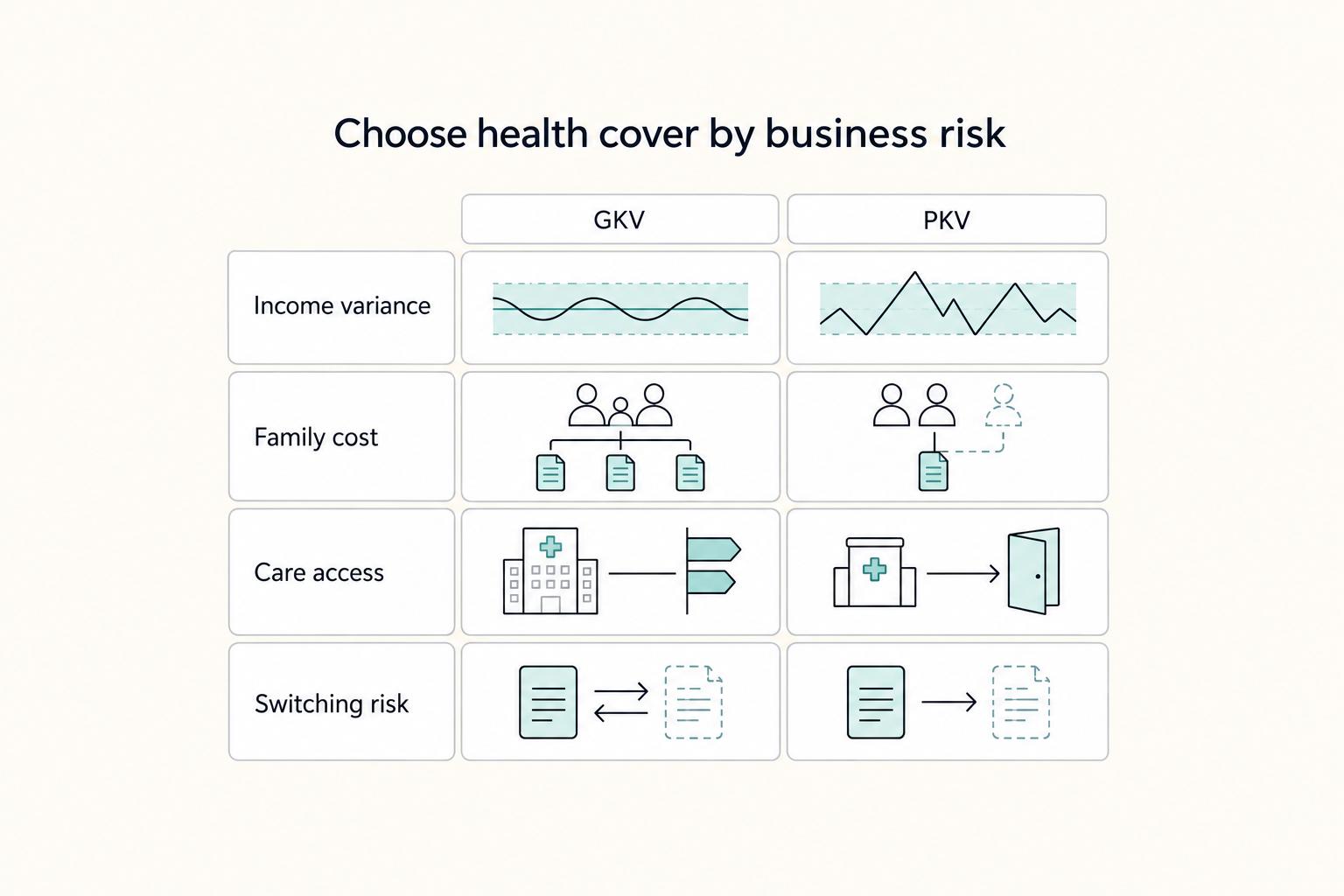
- Cash-flow flexibility: GKV contributions are income-linked, which can help when freelance income fluctuates.
- Long-term cost structure: PKV premiums depend on risk profile, age, tariff, and deductible, not income.
- Family coverage model: In GKV, children can be co-insured at no extra premium; in PKV, dependents generally need separate contracts.
- Switch-back constraints: Movement between systems is limited, and a major restriction is that switching back to statutory insurance can become unavailable after age 55.
Treat compliance as immediate, not optional. Health insurance is compulsory for people living in Germany, and proof of coverage may be required during visa or residence processes. In immigration workflows, adequate health coverage is part of livelihood checks, so confirm in advance which documents your insurer and immigration office expect and keep that confirmation on hand.
One point is worth checking case by case. Some official guidance says self-employed people can choose between GKV and PKV, while other wording ties private eligibility to an income condition. If a threshold matters in your case, confirm the current figure before you rely on it.
With that frame in place, compare GKV and PKV as business models, not marketing labels. For a step-by-step walkthrough, see Health Insurance for Freelancers in France During Your First Year.
The Core Decision: A Variable-Rate Social Contract vs. an Individual Risk Portfolio#
At the core, this is a choice between two risk models, not a contest for the "better plan." Do you want costs that move with your income, as in GKV? Or costs set by individual underwriting, as in PKV?
How each model behaves#
In GKV (Gesetzliche Krankenversicherung), contributions are calculated as a percentage of contributable income, and for voluntary members the assessment considers your overall economic capacity. If your freelance income drops, contributions can drop with it.
In PKV (Private Krankenversicherung), premiums are based on entry age and assessed health risk, not mainly on current income. Lower income does not automatically reduce your premium. Insurers can also reject applications due to pre-existing conditions or age, and private coverage also requires private mandatory long-term care insurance (Pflege-Pflichtversicherung).
Side-by-side decision criteria#
| Decision criterion | GKV | PKV |
|---|---|---|
| Cost basis | Percentage of contributable income | Premium based on entry age and assessed health risk |
| If freelance income falls | Contributions can fall with income assessment | Premium does not automatically fall |
| Underwriting | Contribution setting follows income-based rules | Individual risk assessment; rejection is possible due to age or pre-existing conditions |
| Family coverage model | Non-working spouse and children can be included without extra premium under family insurance | Free family co-insurance is a GKV feature; check dependent coverage terms in PKV contracts |
| Switching reality | Separate system from PKV; switching is constrained | Separate system from GKV; switching is constrained |
| Long-term predictability | Primarily tied to income-based contribution rules | Premium adjustments are legally possible under defined conditions |
Who this usually fits#
- Volatile income:
GKVis often easier to manage because the contribution logic follows earnings. - Stable high income and comfort with underwriting risk:
PKVcan be worth comparing, but you should stress-test long-term affordability and family plans first. - Planned non-earning dependents:
GKVoften becomes more favorable because of family insurance rules. - Pre-existing conditions or older entry age: Treat
PKVeligibility as uncertain until underwriting is confirmed. - Self-employed artists/publicists: Check
KSKeligibility. Under KSVG, eligible people can be in statutory pension, health, and long-term care protection while paying only about half of contributions themselves.
What compliant coverage means for permit workflows#
This is also a permit issue, not just a pricing choice. Health insurance is compulsory in Germany, and this duty has applied since 1 April 2007 / 1 January 2009. For freelance visa and residence workflows, you generally need accepted proof of health insurance in your document set. Entry-visa issuance requires valid insurance proof. After arrival, you must take out new health insurance.
| Stage | What to confirm | Practical note |
|---|---|---|
| Residence in Germany | Health insurance is compulsory | Duty has applied since 1 April 2007 / 1 January 2009 |
| Freelance visa or residence file | Accepted proof of health insurance | Generally needed in your document set |
| Entry-visa issuance | Valid insurance proof | Required for issuance |
| After arrival | New health insurance | Must be taken out after arrival |
| Before filing | Insurer proof document and accepted format | Confirm both with insurer and immigration office |
| If a threshold matters | Current GKV/PKV eligibility threshold | Verify before relying on it |
| If considering PKV | Basistarif ceiling in downside planning | Around €1,018/month from 1 January 2026 |
Before you file, use this checklist:
- Confirm with your insurer which proof document they issue for immigration use.
- Confirm with your immigration office which proof format they accept and what policy start date is required.
- Verify whether any current eligibility threshold affects your GKV/PKV path.
- If you are considering
PKV, include the legally defined Basistarif ceiling in your downside planning: around €1,018/month from 1 January 2026.
Related: Can Digital Nomads Claim the Home Office Deduction?.
The Freelancer's Risk Mitigation Matrix: Which System Protects You Best?#
Because health insurance is mandatory for residents in Germany, the real decision is which system best protects you against the risk most likely to hit your business, not which option has the lowest starting quote. This matrix focuses on four risks that often drive the choice.
| Risk | What to check | GKV impact | PKV impact | Decision signal |
|---|---|---|---|---|
| If your income drops for a period | How volatile your income is, your cash buffer, and whether a weak year would force fixed-cost cuts | Contributions are income-linked (tied to income, not your personal medical risk profile) | Premium logic is fixed/contract-based (independent of income; based on contract and risk factors) | If your income is seasonal, volatile, or still ramping, GKV is often the safer cash-flow fit |
| If your household grows or one partner stops earning | Whether you expect children or a non-earning spouse/partner, and whether legal conditions for family inclusion are met | Family co-insurance can include children and a spouse/registered partner without extra contribution, but only under specific conditions | Each family member generally needs a separate contract | If family expansion is realistic, check GKV first and verify eligibility before assuming free inclusion |
| If you want to switch systems later | Your age, employment status, prior statutory insurance history, and any current eligibility threshold that may affect your case | Staying in GKV avoids return-path risk | Switch-back constraints apply; return to GKV from PKV is legally limited and case-dependent, especially around age 55 and prior insurance in the last 5 years | If reversibility matters, treat PKV as hard to unwind unless a specialist confirms a valid route back |
| If you are planning beyond year one | Whether you want costs to move with business results or remain contract-driven during lean years | Cost logic remains tied to income rules | Cost logic remains separate from income, so lower earnings do not automatically reduce premiums | Do not choose PKV on entry price alone if your long-term income path is uncertain |
Keep these in mind before you model costs:
- Income-linked contributions (GKV): contribution amount follows income rules.
- Fixed premium logic (PKV): premium is not directly reduced by lower freelance income.
- Family co-insurance (GKV): possible without extra contribution only if legal conditions are met.
- Switch-back constraints (PKV to GKV): return is legally constrained and depends on your case.
Before you move to cost projections, rank your top two risks. That step usually clarifies the decision faster than any headline premium.
If you want a deeper dive, read The Crypto Cautionary Tale: Why Freelancers Should Be Wary of Crypto Payments.
Beyond Premiums: How to Project Your Lifetime Health Insurance Costs#
The starting premium is not the decision. The cost pattern over time is. Build one simple forecast for each option so you can see where each path stays manageable and where it starts to strain cash flow.
Build a like-for-like scenario model#
Build a like-for-like scenario model and use the same inputs for every quote.
| Model input | What to include | Why it matters |
|---|---|---|
| Baseline monthly cost | Actual quote or statutory estimate | Mark any statutory cap, limit, or threshold for verification |
| Future premium-change assumption | Low, base, and stress cases | Do not rely on one optimistic assumption |
| Income-path assumptions | Steady income, a flat period, and a weak year | Shows how each option behaves when revenue is not smooth |
| Family-status assumptions | Single, partner with lower or no income, and children | Do not assume identical treatment across systems unless verified |
| Out-of-pocket design | Any Selbstbeteiligung | A lower monthly price can shift risk into higher out-of-pocket spending |
Then work through each input:
- Baseline monthly cost
Use the actual quote or statutory estimate for your case. If any statutory cap, limit, or threshold affects your estimate, mark it for verification until you confirm the current rule.
- Future premium-change assumption
Run three cases for each option: low, base, and stress. Do not rely on one optimistic assumption.
- Income-path assumptions
Test at least steady income, a flat period, and a weak year. This shows how each option behaves when revenue is not smooth.
- Family-status assumptions
Model at least single, partner with lower or no income, and children. Do not assume identical treatment across systems unless you have verified it for your case.
- Out-of-pocket design
If a lower private quote depends on a Selbstbeteiligung, include that deductible in your cash-flow model. A lower monthly price can simply shift risk into higher out-of-pocket spending.
Read results as operating costs, not just insurance prices#
In practice, GKV usually behaves more like an income-linked cost, while PKV behaves more like fixed monthly overhead tied to personal risk factors and plan design, such as age, sex, known health issues, and what the plan includes. That difference can matter most in weak-income periods and in later-life planning, when premium pressure can become harder to absorb.
| Time horizon | GKV signal | PKV signal | Decision signal to watch |
|---|---|---|---|
| Short term | Tracks your income assumptions in your model | Can look cheaper at entry, especially in favorable personal profiles | Do a weak-year test before trusting entry-price savings |
| Mid term | Cost remains tied to your income-path scenario and verified rules | Premium increases over time plus deductible usage can change total cost materially | Note when PKV total cost catches up to or exceeds GKV in your own model, if it does |
| Long term | Still scenario-driven by income assumptions and verified limits | Age-related premium pressure and retirement affordability become core risks | If later-year PKV costs break your base case, treat that as an active warning now |
If your model fails under low-income years, family-change scenarios, or retirement stress, choose stability first. If it still holds up after stress-testing increases, deductibles, and life changes, a flexibility-first choice may still fit. Employment status can also change which option is available to you, so verify eligibility separately.
We covered this in detail in The Best Private Health Insurance Providers for Expats in Germany.
If tax residency is part of your planning, use the Tax Residency Tracker before you lock in a long-term insurance strategy.
What KSK changes for artistic and journalistic freelancers#
If your work is artistic or journalistic, check KSK eligibility before you lock in your long-term insurance path. For eligible freelancers, KSK can materially change the cost structure.
The key point: KSK is not an insurer and does not provide medical treatment benefits. It is the administrative body for social insurance contributions under the KSVG framework, which covers statutory pension, health, and long-term care insurance. In practice, insured members typically carry only about half of the contribution burden, with the rest financed through the KSK system.
How KSK changes the payment logic#
| Setup | Payment flow | How subsidy/share is determined | Reimbursement model | Where your out-of-pocket risk can still rise |
|---|---|---|---|---|
| KSK + GKV | KSK collects and forwards contributions to statutory carriers; you pay your insured share | Contribution split follows KSVG compulsory-insurance logic | GKV is usually a benefits-in-kind model, so you normally do not pay providers upfront | Exception scenarios should be clarified with your statutory fund or KSK |
| KSK + PKV | You pay the private insurer; KSK subsidy is granted on application if you are exempt from KSVG compulsory health insurance | Not automatically half of your PKV invoice: subsidy is tied to the half-share formula and capped against what you actually pay | PKV commonly uses invoice-and-reimbursement flow | Premium level and reimbursement timing can still create monthly cash-flow pressure |
Do not assume KSK makes PKV behave like statutory insurance costs. On the private route, subsidy mechanics and caps matter, so your remaining exposure can still be substantial.
A quick eligibility screen#
Start with four basics: self-employed, artistic or publicistic activity, commercially pursued, and not only temporary. "Commercially" means a sustained activity aimed at earning income. Publicistic work includes writers, journalists, similar roles, and teaching journalism/publicistics. Use this self-check before applying:
| Screen item | What to check | Detail |
|---|---|---|
| Self-employed | One of the four basics | Part of the self-check before applying |
| Artistic or publicistic activity | One of the four basics | Your core self-employed activity should match |
| Commercially pursued | One of the four basics | Sustained activity aimed at earning income |
| Not only temporary | One of the four basics | Included in the quick screen |
| Income baseline | 3.900,00 Euro yearly / 325,00 Euro monthly | Special handling in the first three years after first starting self-employed artistic/publicistic work |
| Proof expectation | KSVG questionnaire plus supporting evidence by post | Be ready to submit |
| Edge-case check | Confirm non-standard activity setups directly with KSK | Do not assume treatment |
- Primary activity: Is your core self-employed activity artistic or publicistic?
- Income baseline: The KSK prerequisites page lists 3.900,00 Euro yearly / 325,00 Euro monthly as the minimum projected work income, with special handling in the first three years after first starting self-employed artistic/publicistic work.
- Proof expectation: Be ready to submit the KSVG questionnaire plus the requested supporting evidence by post.
- Edge-case check: For non-standard activity setups, confirm treatment directly with KSK instead of assuming.
What to do next#
Start with the application file. Prepare the KSVG questionnaire, a clear activity description, and evidence showing ongoing paid artistic or publicistic work.
While waiting, keep compliant health coverage in place and do not assume approval. If you are considering PKV, confirm whether a KSVG exemption is required for the subsidy path.
If eligibility is denied, go back to the standard GKV versus PKV decision model without subsidy assumptions, and clarify unusual cases with your statutory fund or KSK. For deeper preparation, use A Guide to the German 'Künstlersozialkasse' (KSK) for Freelance Artists.
Your Final Checklist: Making the Irreversible Decision with Confidence#
Before you choose, run these four tests with your actual numbers and plans. Health insurance is mandatory if you reside in Germany. If you cannot pass each test with confidence, pause and verify before signing.
| Test | What to verify now | What can change later | Risk you are accepting |
|---|---|---|---|
| Income volatility test | Compare your likely contribution behavior in both systems. In GKV, contributions follow contributory income principles and, in 2026, are calculated up to 5,812.50 EUR/month (69,750 EUR/year), with a 14.6% general rate or 14.0% reduced rate where no sick-pay entitlement applies. In PKV, pricing is tied to your entry profile and tariff, not mainly your income. | Your income can rise or fall, and contribution or premium settings can change over time in both systems. | GKV contributions rise with contributory income up to the assessment ceiling. PKV can leave you with per-person costs even when business is weak. |
| Household coverage test | Check whether your spouse/partner or children could qualify for Familienversicherung in GKV under current rules. In PKV, plan on a separate premium for each insured person. | Family structure, partner work status, and dependent eligibility can change. | GKV may offer more flexibility for non-earning dependents. PKV can increase total household cost as your household grows. |
| Long-horizon cost test | Request the exact tariff basis and current premium logic in writing, then run a 10-year scenario for both paths. Include the possibility of future contribution or premium increases in both systems. | Tariff choices and system-level financing pressure can shift. | You are choosing between income-linked cost behavior and tariff-based long-term pricing exposure. |
| Reversibility test | Confirm you are not under compulsory GKV insurance before assuming PKV is open to you. If you are considering leaving voluntary GKV, confirm the coverage-proof requirement for cancellation effectiveness and verify the current re-entry conditions before you assume a later return path. | Your legal and employment status can change, but return routes from PKV to GKV are legally constrained. | You may be accepting a path that is difficult to unwind later. |
Before you sign#
Get your file in order now. Gather current income proof (requirements vary by insurer), such as your latest tax assessment or other accepted evidence, residence details, household details, and proof of alternative coverage if you are terminating GKV membership. If you are a creative professional or publicist, run a separate KSK eligibility check before you commit.
Then get three points confirmed in writing by the insurer or an independent adviser: how your premium or contribution is calculated, how dependents are handled, and what conditions would apply if you later want to move back to GKV. Final go/no-go check: if your income is variable, your family plans are still open, or you want maximum flexibility, only proceed with PKV if your stress-tested scenario still fits your risk tolerance.
This pairs well with our guide on The Best Health Insurance for Digital Nomad Families.
If you want a cleaner setup for invoicing clients and getting paid across borders while you relocate, review Gruv for Freelancers.
Frequently Asked Questions
How much does freelancer health insurance cost in Germany?
There is no single freelancer price. The decision framework: freelancers must be insured, can choose statutory or private insurance at business start, and generally do not get an employee-style employer premium split. | System | What sets your premium | What can change over time | What can raise your total bill | | --- | --- | --- | --- | | GKV | Your insurer quote under your current eligibility path | Eligibility can depend on residence/business-registration status and timing windows | Freelancers generally pay without an employee-style employer contribution | | PKV | Insurer underwriting and offer in your case | Offers can differ by applicant profile | Freelancers generally pay without an employee-style employer contribution |
Can you switch from private back to public health insurance as a freelancer?
Do not treat a move into PKV as a short-term toggle. Whether you can move back to GKV is case-specific and depends on your status path and current rules. If your only reason for PKV is short-term savings, that is usually a weak basis for the decision.
Is public or private insurance better if your freelance income is high?
High income alone does not settle it. Compare the route you can actually use (public-insurance eligibility versus private underwriting), your household setup, and the fact that freelancers generally do not receive an employer premium contribution. PKV can still be worth comparing, but include the risk that some applicants with pre-existing conditions may not get coverage.
Is there an income threshold for freelancers to choose private insurance?
The cited rule is that at business start, freelancers can choose statutory or private insurance regardless of income. A key checkpoint is your status: if you move permanent residence to Germany and register freelance activity there, you can access public insurance.
Do you have to pay separately for a non-working spouse or children?
It depends on system and plan. In GKV, non-earning family members may be covered via Familienversicherung, but eligibility details must be checked against current rules. In PKV, do not assume family members are automatically included without extra cost. Before choosing, request a written household-cost scenario so you can see how partner or child coverage would be priced in your case.
Can you use an international or expat plan instead?
For long-stay freelance residence in Germany, you need compliant health coverage because insurance is mandatory for residents, including freelancers. The temporary home-country route is framed for cases where residence and business activity stay in the home country, with A1/S1 forms and up to 2 years. It is not presented as an option once you register freelancing in Germany and work for local clients. Before permit submission, get written confirmation from the insurer that the policy is acceptable for your residence purpose and confirm that acceptability with the authority handling your application.
Try a related tool
Researched and edited by the Gruv editorial team. Gruv builds cross-border billing, payouts, and finance-operations software for global businesses.
Sources
Includes 7 external sources outside the trusted-domain allowlist.
- pmc.ncbi.nlm.nih.gov/articles/PMC4884042trusted
- berlin.de/einwanderung/_assets/merkblatt_zur_krankenve...external
- bundesgesundheitsministerium.de/private-krankenversicherung/seiteexternal
- bundesgesundheitsministerium.de/en/themen/krankenversicherung/online-ratgebe...external
- buzer.de/6_SGB_V.htmexternal
- feather-insurance.com/blog/health-insurance-germany-freelancer-guideexternal
- formatera.com/germany/life/health-insurance-in-germany-for...external
- fraserinstitute.org/sites/default/files/health-care-lessons-from...external
Educational content only. Not legal, tax, or financial advice.
Related Posts
Freelance Crypto Payments That Protect Cashflow and Reduce Disputes
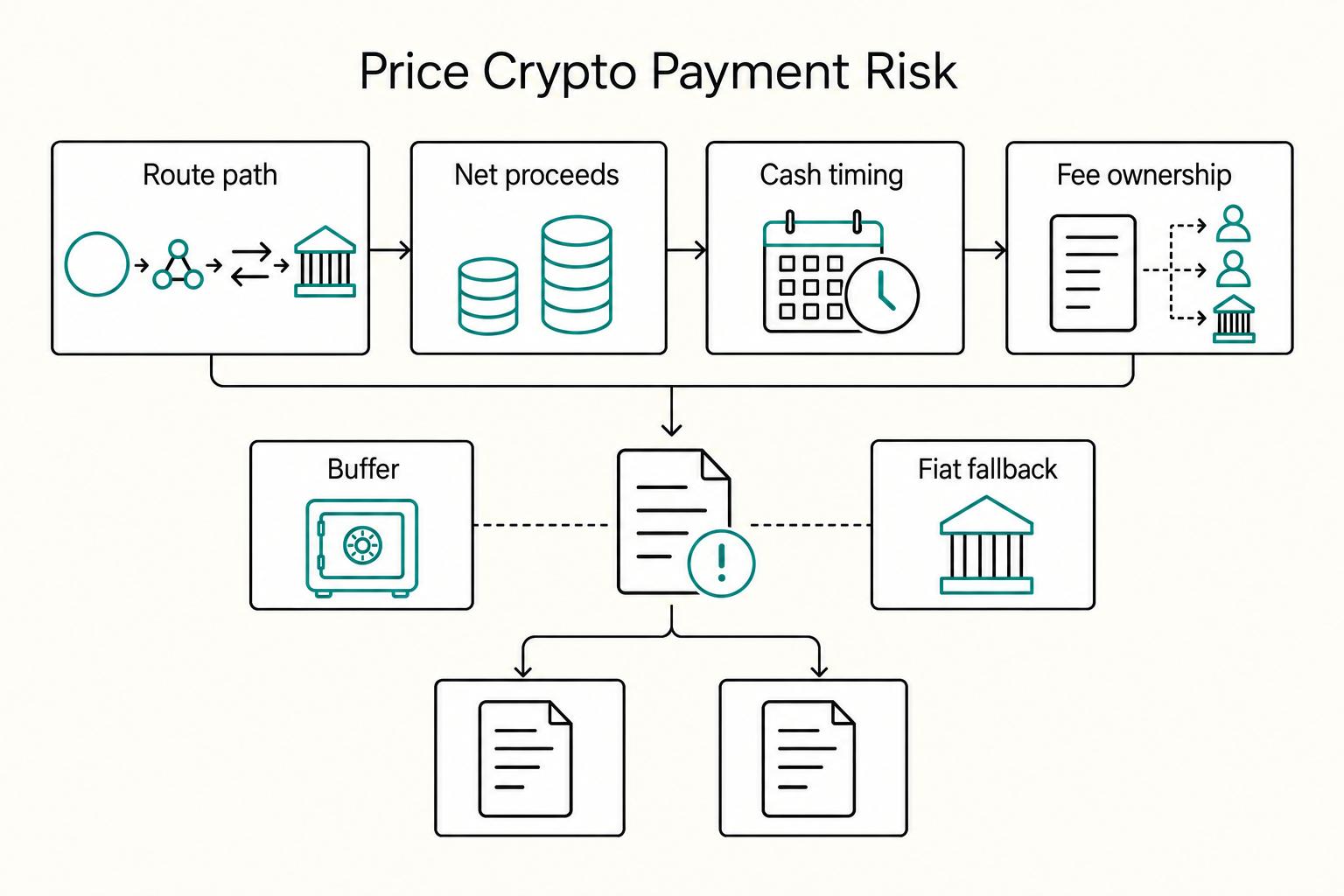
Crypto payments make sense only when they improve how reliably you get paid after you plan conversion, compliance, and recordkeeping up front. They can reduce friction in some international setups where traditional platforms add fees, restrictions, or extra steps. They also move risk onto conversion timing, exchange-fee exposure, and documentation quality, so use a simple acceptance test before you agree:

Can Digital Nomads Claim the Home Office Deduction?
Claim the deduction only when your facts and records can carry it. With the home office deduction for digital nomads, the real decision is usually a three-way call: claim it, do not claim it, or pause and get help because your file is not ready.
KSK Compliance Playbook for Freelance Artists in Germany
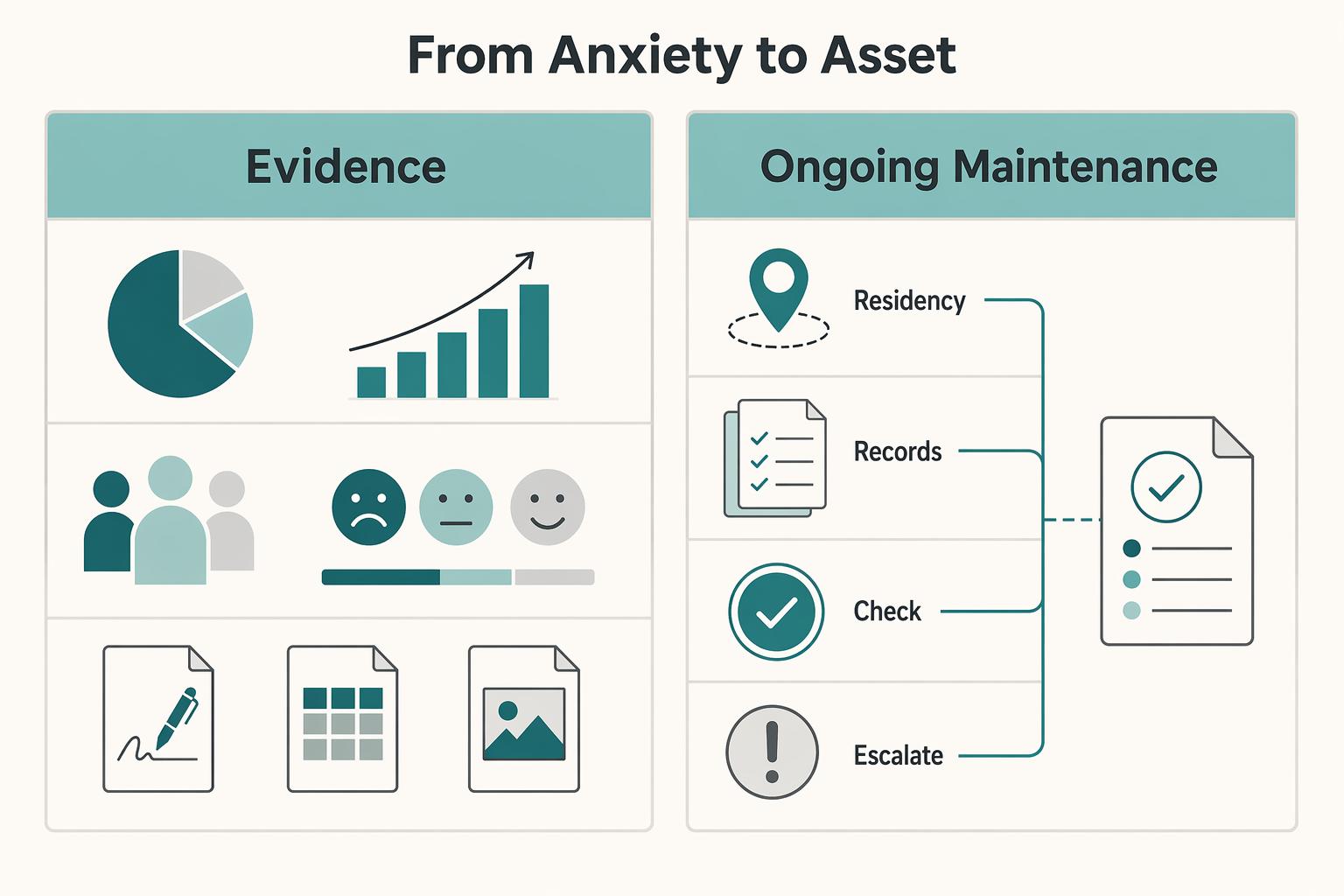
Treat KSK as one part of your Germany compliance setup, not as a shortcut that solves everything else. For a freelance operator, the real risk is building pricing, cash flow, and admin assumptions around a status you have not fully validated.