
Quick Answer
Start by treating harassment training for remote teams as an operating system, not a one-time course. Build a live roster by physical location and worker type, then assign training and notices based on verified state or city rules such as California and New York City triggers. Pair that with a short conduct code, multiple confidential reporting routes, and a documented investigation flow. Keep completion records, evidence logs, and assignment check dates so your process stays defensible when a complaint arrives.
Why Your Current Approach to Harassment Prevention is a Ticking Clock#
If your current plan is "we shared a policy and everyone clicked through a course," your risk may still be high. For a small distributed business, harassment training for remote teams is not just a legal checkbox. One complaint can disrupt delivery, fracture trust, and pull leadership into urgent response work.
The accountability gap is usually personal#
In a small remote company, accountability does not disappear because there is no HR department. It concentrates. Founders set the tone, managers shape day-to-day conduct, and solo consultants may still be responsible for boundaries in client work. When norms are vague, people fill the gap with personality or pressure, and preventable escalation can follow.
Use role clarity as a basic checkpoint. In the 2026 Nashville Learning and Development catalog, "Sexual Harassment Prevention" appears on pg. 9, while "Sexual Harassment Prevention for Supervisors" appears separately on pg. 11. That is not a template to copy into every business, but it is a practical signal. Authority roles need different instructions and different accountability.
If you cannot answer these three questions in one minute, your exposure may be higher than you think, because gaps often show up in reporting, manager action, and recordkeeping:
- Who receives a complaint if it involves the founder or a direct manager?
- What must managers do when they observe potential misconduct in day-to-day remote collaboration?
- Where are screenshots, message exports, and interview notes stored if a report comes in?
A checklist is not prevention#
Mandatory courses can support formal compliance. Nashville's 2026 catalog says mandatory courses help employees remain in compliance with executive orders, civil service rules, policies, ordinances, and codes. Useful, but not enough on its own.
A better standard is how your company actually behaves. EEOC best-practices guidance says a best practice complies with the law and includes management commitment, accountability, and management-employee communication. If your setup does not define how respectful conduct works in daily remote operations or how escalation is handled, training stays disconnected from real work.
There is also a maintenance risk: stale guidance. The EEOC page itself notes that contrary information is superseded by Groff v. DeJoy, 143 S. Ct. 2279 (2023). If your policy packet has not been reviewed in years, treat that as an operational red flag. The same update discipline you apply to contracts or payroll should apply here. If you need help tightening day-to-day expectations for distributed collaboration, Gruv's guide on how to manage a global team of freelancers is a useful companion.
The costs are broader than the legal line item#
The legal line item matters, but operational damage can last longer. The direct costs need current verification, and hidden costs can hit a small team first.
| Visible costs | Hidden operational costs |
|---|---|
| Outside counsel, formal advice, or settlement exposure: confirm the current cost range from legal advisers or your own records | Founder and manager time can shift into interviews, evidence review, and client communication |
| Internal or external investigation work: confirm the current cost range from legal advisers or your own records | Projects can slow while access logs, screenshots, and records are collected |
| Backfill, onboarding, or role changes: confirm the current cost range from legal advisers or your own records | Attrition can remove context from a small team and raise delivery risk |
| Insurance, PR, or contract fallout: confirm the current cost range from legal advisers or your own records | Reputation risk can weaken hiring, referrals, and client confidence after the incident |
In practice, do not buy a better checkbox. Build a small, explicit operating model for respectful digital conduct, role-based response ownership, and a clear reporting path. The next section turns that into something you can actually use.
Make Respectful Conduct Explicit in Daily Work#
For small remote teams, respectful conduct has to be explicit in daily work, not implied. Build a short written code, define visible digital behavior standards, and use a few repeatable habits so ambiguity is less likely to become conflict or complaints.
Code of Digital Conduct#
Keep your code short enough that people will actually use it. It should work as a practical operating document: where to communicate, how to communicate, and how to escalate concerns. Make it easy to find in onboarding materials and pin it in your main team space so people can reach it quickly when something goes wrong.
At minimum, cover:
- Channel-use rules
- Response-window expectations for urgent vs. non-urgent work
- Meeting etiquette
- Escalation path for concerns
- Where formal records are stored
Set expectations by channel, not by personality. Communication across Slack, Zoom, and email moves fast, and remote issues can unfold on-screen in real time, where nuance is easy to lose. If your team spans countries or time zones, say that directly and prioritize clarity. One message can be read in three time zones and through three cultural lenses. Without in-person cues, inappropriate behavior can also go unnoticed or unreported.
Do not anchor decisions only on stated intent. Intent can matter, but it is often hard to infer consistently from text alone, so your code should guide people to evaluate impact, pattern, and context.
Digital Body Language#
This is where a written code either becomes useful or stays abstract. Use concrete examples so people can apply standards consistently across chat, email, and video tools.
| Scenario | Risk signal | Preferred behavior |
|---|---|---|
| Public thumbs-down emoji on a colleague's idea | Can be a risk signal when it becomes a pattern of dismissal or pile-on behavior | Ask a clarifying question or move disagreement into a respectful written reply |
| Private side channel about a teammate | Can be a risk signal when it excludes the affected person or turns into commentary about them instead of work coordination | Use private channels for legitimate task needs, and route performance feedback to the right manager or documented project thread |
| Late-night non-urgent messages from a manager | May create pressure to stay constantly available | Schedule-send non-urgent notes or state clearly that no immediate response is expected |
| Calling out a person's mistake in a main channel | Can be a risk signal when correction turns into public shaming | Correct work in the shared space when needed, then give individual feedback privately and document repeated performance issues in the proper place |
Culture-Setting Rituals#
You do not need a heavy program. You need habits that reduce distributed-work blind spots. Start with simple rituals like individual "How to Work With Me" pages and a clear channel map:
| Channel type | Purpose | Boundary |
|---|---|---|
| Main project channel | Task updates, blockers, decisions | No personal criticism or side commentary about people |
| Team social channel | Casual chat, non-work connection | Keep it optional and free of sexualized, demeaning, or exclusionary content |
| Manager or people channel | Sensitive support, escalation, accommodations | Limit access and document any formal concern in the designated record location |
| Formal follow-up, decisions that need a durable record | Do not use it to avoid the reporting path or bury a complaint |
If you are refining collaboration norms more broadly, Gruv's guide on how to manage a global team of freelancers is a useful companion.
Then close the loop with data and feedback. After onboarding and at regular intervals, check whether people know where the code lives, how to report concerns, and which channels to use for what. If the answers are unclear, make the document easier to find and more specific.
The Response Protocol: A Clear, Defensible System for Handling Complaints#
A defensible complaint process is calm, repeatable, and documented from first report to closeout. Once your conduct rules are explicit, this is the control that keeps responses fair under stress instead of ad hoc, confusing, or vulnerable to retaliation concerns.
That structure is not just legal hygiene. Clear procedures can help people understand their rights and obligations. Clearer rules may also reduce avoidable conflict and litigation costs. In remote teams, design the intake path, first response, and fact-finding process before you need them.
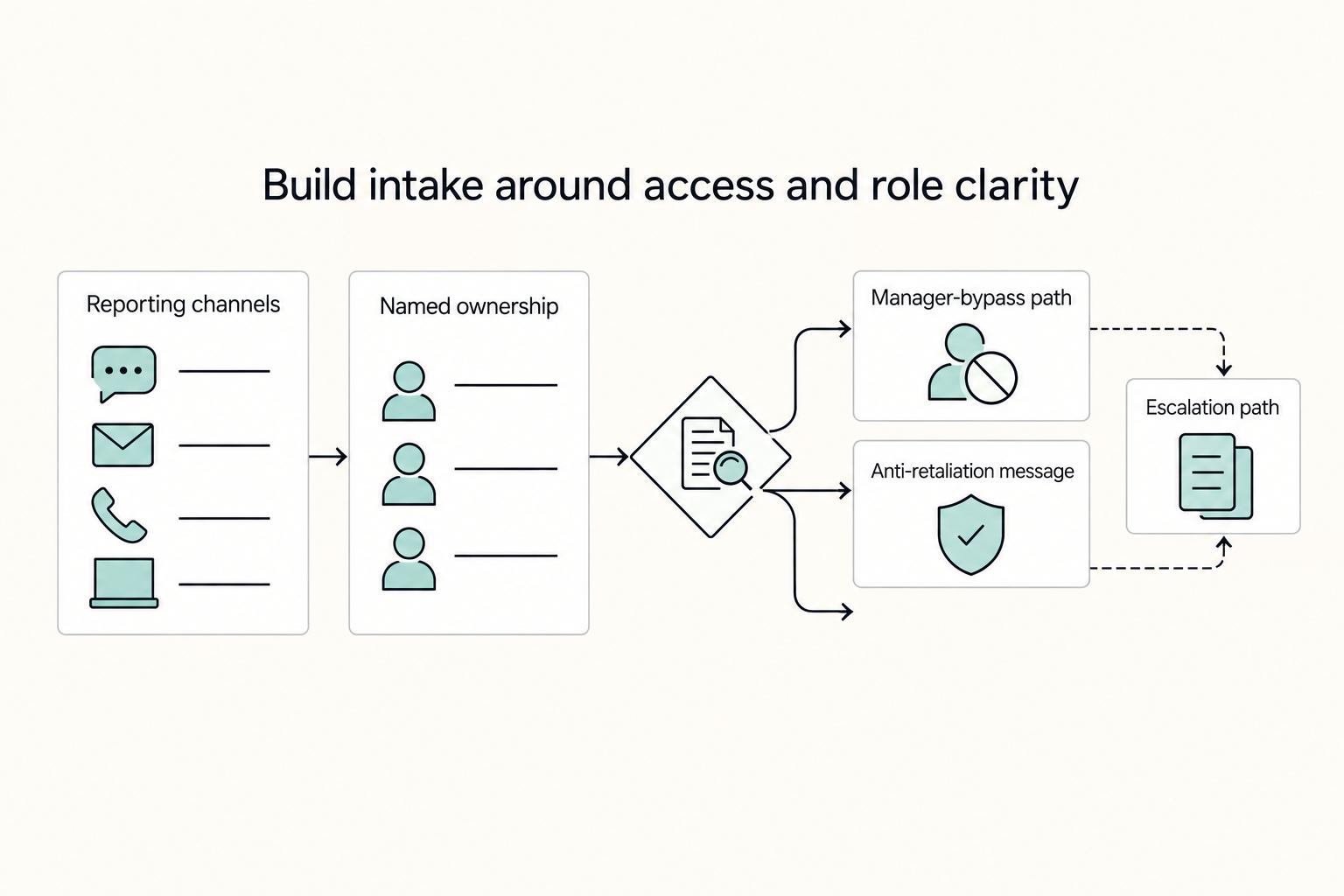
Build intake around access and role clarity#
Your reporting system should not rely on one person, one tool, or one manager. Consider offering multiple confidential reporting routes, assigning an owner for each route, and documenting those owners where people can find them quickly.
Use a simple intake framework:
- Multiple channels: provide more than one practical way to report, for example an inbox and a form, or a direct people-contact route.
- Named ownership: define who monitors each channel and who sends acknowledgment.
- Manager-bypass path (example): if the direct manager is implicated, route the complaint to a clearly named alternate owner.
- Anti-retaliation message (example): include plain language that reporting concerns or participating in a review should not lead to punishment, exclusion, or pressure.
- Escalation path: for very small teams, identify the fallback owner in advance, such as founder, external HR support, or counsel.
Then test it like any other business control. Submit a mock intake, confirm where it lands, confirm who receives it, and confirm who responds.
Use first-response language that stays neutral and supportive#
Your first response should acknowledge the report, explain the process, and avoid prejudging the outcome. In remote settings, treat written and recorded replies as part of the review record, so neutral phrasing matters. Start with open questions and what the person wants to share. Avoid leading questions or early conclusions.
| Do say | Avoid saying |
|---|---|
| "Thank you for telling me. I'm taking this seriously." | "I'm sure this is just a misunderstanding." |
| "I want to understand what happened and follow the right process." | "I know they would never do that." |
| "We will share this only with people who need to help address it." | "I'll keep this completely off the record." |
| "Retaliation for reporting or participating in a review is not acceptable." | "Just stay away from them and let's not make this bigger." |
Investigate in phases and produce a record at each step#
Do not improvise here. A small team does not need a heavy system, but you do need the same documented structure every time. For deeper interview and evidence process detail, see Gruv's guide on how to conduct a workplace investigation.
- Intake record
Log when the concern was received, by whom, through which channel, and the allegation as reported. Note any interim protective steps without implying fault.
- Evidence log
Track what you collected and where it came from, for example chats, emails, screenshots, calendar records, recordings, and policy acknowledgments. For remote matters, capture date and time context and whether records are partial.
- Interview notes
Interview the reporting person, respondent, and relevant witnesses separately. Keep a standard note format: date, participants, questions, key facts, and follow-ups.
- Determination memo
Summarize what was reviewed, what facts were found, and whether written conduct standards were violated.
- Closeout communication
Tell relevant parties the review is complete and that action was taken where warranted. Close the loop even when details remain limited.
This is where training becomes operational. Managers need to know how to receive reports, preserve records, and avoid check-the-box responses. If you keep one rule, keep this one: do not improvise under stress. A short written protocol with named owners, backup routes, and standard records helps protect fairness and control.
Decide Coverage by Worker Location and Engagement Model#
After you set your complaint process, make coverage decisions by worker location and engagement model rather than defaulting to company headquarters or payroll labels alone. The goal is a review process you can repeat, so moves and new engagements do not create silent gaps.
For remote teams, two risky breakdowns are checking rules only in the company's home state and excluding contractors from conduct systems. Both can create gaps in training assignment, reporting access, and documentation. Keep a live roster with each person's physical work location, city if relevant, worker type, start date, assigned training, and record owner.
Build a location review you can actually maintain#
Use location as the trigger, then verify current obligations on official state or city pages before assignment. Keep the process lightweight, but do not treat it as a one-time spreadsheet exercise. The EEOC best-practices page is still useful for accountability and communication. It also flags that contrary information may be superseded after Groff (2023), which is a clear signal to revalidate older guidance.
A compact decision grid helps, especially if you want one repeatable way to assign training and document why:
| Location mapping | Requirement check | Assignment | Documentation owner | Review cadence |
|---|---|---|---|---|
| California employee | Confirm the current California harassment-prevention requirement with the relevant state authority. | Assign baseline training plus any verified California-specific content; confirm complaint-path visibility. | People lead or compliance owner | At hire, on address change, and on scheduled legal recheck |
| Worker in a state/city with possible local rules | Confirm the current local training requirement with the relevant labor or civil-rights authority. | Assign required local variant, or baseline with approved local addendum. | Compliance owner with manager support | At hire, relocation, and periodic review |
| Contractor, unpaid intern, volunteer, or other service provider | Confirm the current nonemployee coverage or related-duty rule from official sources or counsel. | Apply conduct standards, reporting path, and role-relevant training expectations where appropriate. | Contract owner plus People lead | At contract start and renewal |
| No verified local mandate yet | Confirm no current local rule has been identified from official sources; record check date. | Assign baseline conduct and reporting training anyway as a best-practice control. | People or ops owner | Annual review and any move or status change |
The critical artifact is the validation record behind each assignment. Track the check date, official link used, training version assigned, acknowledgment status, and next review date.
Treat contractors as part of the conduct perimeter#
Use one practical rule: apply conduct standards and reporting expectations across employees and contractors, even when legal duties differ by jurisdiction. That keeps culture expectations consistent and makes investigations cleaner when incidents happen in shared digital channels.
California materials are a useful example because they discuss complaint-mechanism responsibilities and explicitly address people performing services pursuant to a contract, unpaid interns, and volunteers. That does not prove identical training duties everywhere. It does show that engagement model belongs in your compliance design.
In day-to-day operations, if someone collaborates in your shared work channels, treat them as inside the conduct perimeter. Investigation evidence may come from the same places, including instant messages, posts, and emails. Also avoid single-path reporting structures that route contractor concerns only to one manager.
If your team relies heavily on freelancers across borders, Gruv's guide on how to manage a global team of freelancers covers broader distributed governance.
Put the expectations into contracts before you need them#
Put the standard into the contract before a problem forces the conversation. Use contract clauses as clear frameworks, then localize with counsel when risk or deal size requires it. The point is practical clarity, not template-heavy legal prose.
- Professional conduct clause
Set expectations for respectful, non-harassing behavior across meetings, messages, shared tools, and other work-related settings.
- Reporting path clause
Name a role or contact point for concerns, define how notice is given, and avoid making one direct manager the only route.
- Remediation clause
State that concerns are reviewed promptly, corrective steps are taken as appropriate, and sharing is limited to those who need to act.
- Termination or suspension rights clause
Reserve rights to pause or end work for serious misconduct or unresolved reported issues.
This is the risk-control pattern in practice: everyone knows the standard, everyone has a reporting path, and every assignment has a documented review trail.
Conclusion: Install Your New Operating System for a Resilient Remote Culture#
Remote culture does not hold itself together. If you rely on ad hoc, reactive measures, you are leaving too much to chance. Real resilience does not come from a single training module or a hastily written policy. It comes from building a better system for how your business works.
This framework rests on three connected pillars, and each one needs to be concrete enough to use:
- The Digital Blueprint: Build from credible training resources. The ILO's 2024 enterprise training manual offers a foundation for preventing and addressing workplace violence and harassment, and its CC BY 4.0 terms allow reuse and adaptation with attribution. Just remember that non-ILO third-party material in that publication is outside that license and may require separate rights clearance.
- The Response Protocol: Define a clear, written process before an issue appears, and include implementation checkpoints such as privacy-policy acknowledgment and explicit opt-in for communications.
- The Liability Shield: Keep compliance language narrow and context-specific. For example, some higher-education course libraries are presented as helping with Title IX and Clery requirements, but no single training catalog should be treated as a universal legal guarantee.
Implementing this system is a basic act of leadership. It helps you run a more consistent process, protect trust with your team and clients, and reduce avoidable confusion when concerns are raised.
More importantly, it reduces the persistent anxiety of "what if." A complaint is still serious, but it does not have to throw your business into chaos. With clear training inputs, scoped compliance claims, and privacy-aware checkpoints in place, you can respond with more confidence and focus.
Frequently Asked Questions
How do you implement harassment training for a small remote team?
Start with a live roster showing each person’s physical work location, worker type, start date, assigned training, and record owner. Check location-specific rules before you assign one course to everyone. California coverage can apply when you have 5 or more employees, and NYC has annual training, notice, and fact-sheet duties for covered employers, including the 15+ employee or 1+ domestic worker trigger.
What are a freelancer's legal rights if a client harasses them online?
The cited materials do not establish one universal freelancer-rights rule across jurisdictions. Do not assume employee protections apply the same way to freelancers in every jurisdiction. Use a clear contract and a defined reporting path, and if the issue crosses state or city lines, or your agreement is unclear, treat it as a legal question and get counsel in the relevant jurisdiction.
Does harassment training need to be state-specific for independent contractors?
Use a verify-first approach instead of a blanket rule. California’s cited FAQ says independent contractors, volunteers, and unpaid interns are not required trainees under that specific training requirement. That does not mean other jurisdictions follow the same rule. Even where legal duty is unclear, applying your conduct standard to contractors in shared channels can improve consistency and reporting.
How do you create a remote work code of conduct?
Make it specific to real channels like Slack, email, video calls, and shared docs. Define unacceptable conduct, reporting routes, anti-retaliation expectations, and who owns follow-up when concerns are raised. If you run a distributed nonemployee team, How to Manage a Global Team of Freelancers is a useful companion for shared operating norms.
What are the essential elements of a remote harassment policy?
A practical baseline is to define prohibited digital conduct, provide more than one reporting route, and explain how complaints are reviewed and escalated. Pair the policy with a process people can follow in practice, not just a general promise to investigate. For an operational walkthrough, see How to Conduct a Workplace Investigation.
Can online harassment training be as effective as in-person training?
It can be, when it is interactive and covers the required material. California allows classroom, online, or another effective interactive format. It also allows segmented completion if the required total hours are met. For defensible records, keep the completion date, training version, and the exact official rule used for assignment.
Try a related tool
Researched and edited by the Gruv editorial team. Gruv builds cross-border billing, payouts, and finance-operations software for global businesses.
Sources
- calcivilrights.ca.gov/wp-content/uploads/sites/32/2022/11/Sexual-H...trusted
- calcivilrights.ca.gov/wp-content/uploads/sites/32/2017/06/FinalSta...trusted
- clame.nyu.edu/scholarship/E1EGJI/316746/SkillsoftHarassmen...trusted
- dcjs.virginia.gov/sites/dcjs.virginia.gov/files/publications/l...trusted
- dot.ga.gov/PartnerSmart/Business/Source/construction/cm...trusted
- edocs.rentonwa.gov/Documents/DocView.aspxtrusted
- eeoc.gov/best-practices-private-sector-employerstrusted
- eeoc.gov/sites/default/files/2022-07/EXCEL%20FY%20202...trusted
Educational content only. Not legal, tax, or financial advice.
Related Posts

Germany Freelance Visa Application Path for Freiberufler and Gewerbe
Choose your track before you collect documents. That first decision determines what your file needs to prove and which label should appear everywhere: `Freiberufler` for liberal-profession services, or `Selbständiger/Gewerbetreibender` for business and trade activity.
How to Manage a Global Freelance Team Without Compliance Gaps
If you want to manage a global freelance team without constant cleanup, use the same intake-to-payout process for every engagement and save an artifact at each gate. Common failure points are instinct-based classification, vague scope, and payments approved in chat with no audit trail.
How to Conduct a Workplace Investigation That Holds Up Under Review
When a client faces allegations of harassment, fraud, or other serious misconduct, they are not paying you for a generic compliance exercise. They need order, judgment, and a process that can hold up under pressure. Your job is to define the assignment, control risk, develop facts carefully, and give the company something it can actually act on.