
Quick Answer
Negotiate the relocation package around move-critical support first, not just salary. Confirm immigration help, relocation logistics, temporary housing, tax handling, and how payments or reimbursements work, then compare the package on net value after tax, housing, and currency effects. Before signing, get the policy terms, approval owners, payment timing, and family or operational support in writing.
Pillar 1: Architecting a Compensation Package That Truly Rewards Your Global Move#
Do not start by negotiating the number at the top of the offer. With a strong relocation package, the better sequence is to lock in move-critical support, model the real net impact, and then negotiate upside that fits the assignment.
Salary alone hides too much. A package can look generous on paper and still leave you carrying key relocation costs or taking a pay cut once tax, housing, and currency conversion hit. If you need a market reference point before you start, use A Guide to Salary Bands and Compensation for a Global Remote Team for the benchmarking side. Then bring that back into this move-specific negotiation.
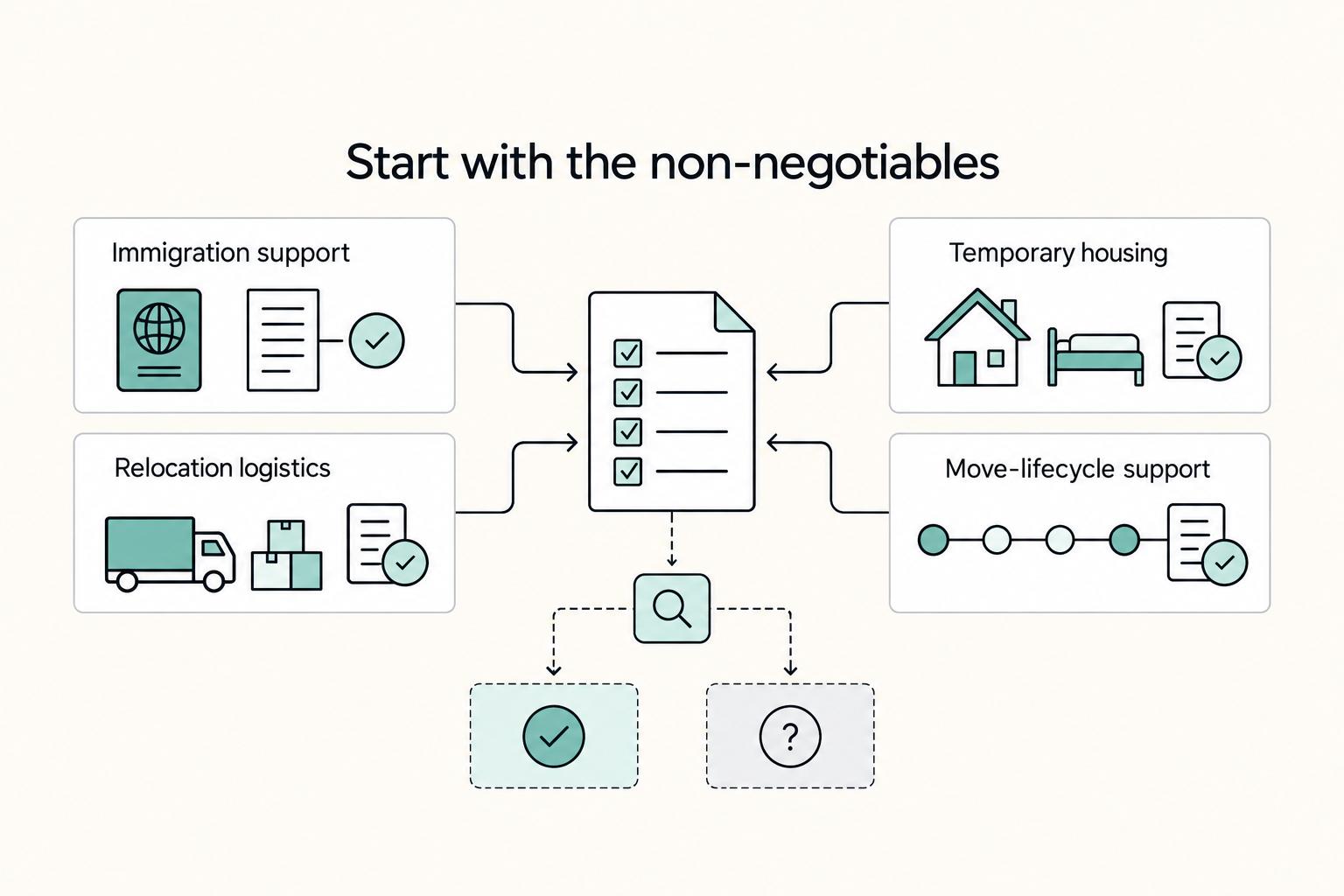
Start with the non-negotiables#
Start with the non-negotiables, because these are not perks. They are the operating costs of getting you productive in-country and moving without avoidable friction.
| Support area | What it covers | What to confirm |
|---|---|---|
| Immigration support | Employer or partner help with visa and work permit paperwork | Who covers required filing and processing costs; which form, category, and processing office apply before tying this to a start date |
| Relocation logistics | Separate budget lines for core move components | Household-goods movement, home-purchase support where applicable, and tax allowances; ask for shipment caps or reimbursement ceilings in writing, and confirm current policy limits with the employer or in the contract |
| Temporary housing | Temporary quarters or short-term lodging | What the lodging includes, plus duration and extension terms; confirm current policy limits with the employer or in the contract |
| Move-lifecycle support | Handling of remaining move-phase costs across the full relocation lifecycle | Whether support is lump sum, reimbursement, or payrollable allowance, and whether tax treatment is coordinated |
- Immigration support: employer or partner help with visa and work permit paperwork. Confirm who covers required filing and processing costs. Visa timing is case-specific, so ask which form, category, and processing office apply before you tie this to a start date.
- Relocation logistics: separate budget lines for core move components, for example household-goods movement, home-purchase support where applicable, and tax allowances. Ask for any shipment caps or reimbursement ceilings in writing, and confirm current policy limits with the employer or in the contract.
- Temporary housing: spell out what "temporary quarters" or short-term lodging actually means. Vague wording can create avoidable disputes around duration or extensions. Confirm duration, extension terms, and current policy limits with the employer or in the contract.
- Move-lifecycle support: confirm how remaining move-phase costs are handled across the full relocation lifecycle, not just at offer stage. Clarify whether support is lump sum, reimbursement, or payrollable allowance, and whether tax treatment is coordinated.
Once those basics are clear, compare package structures on real value instead of headline numbers.
Model the net value before you compare structures#
Use a net-to-net comparison of home versus destination pay with tax, housing, and living-cost inputs. Then stress-test it across four lanes: purchasing power for local price levels, exchange-rate exposure for currency risk, tax treatment coordination, and assignment duration. If your package assumes a tax-day rule, payroll threshold, or residency trigger, verify the value from official guidance, payroll records, or advisor review before using it unless you already have jurisdiction-specific advice.
For US taxpayers only, this can matter more than most people expect. The 2026 Foreign Earned Income Exclusion cap is $132,900 per qualifying person, with a $39,870 housing amount limitation reference. Qualification depends on tests such as 330 full days in 12 consecutive months or bona fide residence for an entire tax year. Those rules are not global defaults.
| Structure option | Cash flow stability | Downside risk | Long-term upside | Best fit |
|---|---|---|---|---|
| Higher base salary | High | Lower if costs run long | Moderate | You need predictable monthly take-home |
| Targeted allowances | Medium | Medium if caps, taxability, or receipts apply | Low to moderate | The move has clear near-term costs |
| Base plus equity mix | Lower to medium | Higher if vesting outlasts assignment | Higher, but uncertain | You believe in the company and can absorb volatility |
Negotiate a transition fund with line items#
Ask for a written transition fund or setup allowance with line items attached. Prioritize concrete relocation components such as immigration paperwork support, temporary housing, household-goods movement, and any tax-allowance handling that applies to your case. Frame each item as business-critical because it shortens time to productivity and reduces first-month friction.
Before you accept, confirm three things in writing: when it is paid, what receipts are required, and whether any unused amount must be repaid. Reimbursement-only support can shift the early cash burden onto you at the most expensive point of the move.
If you want a deeper dive, read The 2026 Global Digital Nomad Visa Index for 50+ Countries.
Pillar 2: Why Your 'Compliance Shield' Is More Valuable Than Any Perk#
After you price the move, lock down compliance terms before you sign. In practice, this is what protects you from preventable filing gaps, timing mistakes, and unclear responsibilities later.
If an employer offers "tax support," treat it as incomplete until the policy name, owner, and written follow-up are confirmed.
Put the employer tax policy in writing#
Keep tax equalization as your anchor, but verify the actual policy language. The label alone is not enough.
| Policy label in offer | What it tells you today | Who carries risk if details are missing | What to request in writing |
|---|---|---|---|
| Tax equalization | Employer signals structured support | Shared risk stays unclear until terms are documented | Policy document or assignment appendix, scope, timelines, and responsibility split |
| Tax protection | Employer signals some downside support | Scope risk can remain with you if triggers/caps are undefined | Covered taxes, trigger rules, caps, timing, and process owner |
| No standing policy / ad hoc reimbursement | No reliable baseline support | You likely carry most execution risk unless terms are added | Exactly what is covered, approval steps, and reimbursement timing |
If your move may involve ending U.S. citizenship or long-term U.S. resident status for federal tax purposes, make the timing explicit. IRS expatriation rules state that different rules apply by expatriation date, include the post-June 17, 2008 pathway, and use the earliest of multiple legal dates for relinquishment, not simply your move date.
Use the pre-move tax consultation as a decision meeting#
Go in with your draft offer or assignment letter, expected move timing, expected work and living locations, compensation components, and any expected account changes. Then use the call to confirm assumptions and next actions, not just collect general commentary.
Ask directly:
- Which deadlines happen before departure vs after arrival?
- Which filings are likely based on your current facts?
- Which assumptions could change your compliance path?
- If U.S. expatriation rules could become relevant, how do the 5-year compliance window and Form 8854 fit your timeline?
Request written follow-up you can execute against: assumptions used, filing timeline, records to retain, and employer-vs-employee responsibility notes.
Run this compliance checklist before signing#
| Topic | What to confirm | Grounded details |
|---|---|---|
| Tax residency | Expected residency treatment, effective date, and governing test | Jurisdiction-specific triggers must be verified from official rules or advisor guidance before use |
| Foreign account reporting | What reporting may apply and when if you expect non-home-country accounts | Any legal trigger must be verified from official rules or advisor guidance before use |
| Home-country exit obligations | Whether covered expatriate analysis is needed for U.S. citizens renouncing citizenship or long-term residents ending status | IRS references Form 8854 certification, a $2 million net-worth trigger, and a $206,000 (2025) average annual net income tax test across the prior 5 years; IRS also flags a significant penalty risk for not filing the expatriation form |
| Health coverage and repatriation | Coverage scope, evacuation pathway, return logistics, and employer/insurer/employee responsibility split | Validate the contract language before departure so execution is clear |
- Tax residency: confirm expected residency treatment, effective date, and governing test. Jurisdiction-specific triggers must be verified from official rules or advisor guidance before use.
- Foreign account reporting: if you expect non-home-country accounts, confirm what reporting may apply and when. Any legal trigger must be verified from official rules or advisor guidance before use.
- Home-country exit obligations: for U.S. citizens renouncing citizenship or long-term residents ending status, confirm whether covered expatriate analysis is needed. IRS references Form 8854 certification, a $2 million net-worth trigger, and a $206,000 (2025) average annual net income tax test across the prior 5 years. IRS also flags a significant penalty risk for not filing the expatriation form.
Health coverage and repatriation should be validated in the same contract review. Check the language for coverage scope, evacuation pathway, return logistics, and employer, insurer, and employee responsibility split so execution is clear before departure.
For a step-by-step walkthrough, see How to Handle Tax Equalization for Expat Employees.
Pillar 3: Designing Your Operational Success Plan for Peak Performance#
Your operational plan should get you productive quickly after landing, not just add perks. In practice, that means securing workable housing, stabilizing family logistics, and completing local admin steps on time.
Choose housing for speed, not just comfort#
Pick your first housing setup based on how fast it helps you settle and how much admin risk it creates. A tenancy agreement is a legal contract, so if you move straight into a local lease, review the draft terms and confirm who supports that review.
| Housing option | Speed to settle | Admin burden | Flexibility | Risk exposure | Best fit when... |
|---|---|---|---|---|---|
| Corporate housing | Often fast to start because it is furnished and ready for temporary occupancy | Low | Medium | Lower early-stage risk, but less choice | you need immediate stability in the first weeks |
| Temporary quarters | Fast for arrival, but designed as a bridge | Medium | High | Medium, since you may still need a second move | you want short-term lodging while you confirm neighborhood, school, or commute fit |
| Self-sourced long lease with allowance | Often slower at the start | High | High | Higher, because you manage search, contract terms, deposits, and local rules | you already know the local market or need tighter location control |
A housing allowance is not always the easiest path. If market knowledge is limited, you can lose early work capacity to viewings, paperwork, and setup tasks. If you are renting in the UK, confirm current lease terms and support expectations because private-renting rules changed from 1 May 2026.
Lock key decisions on the right timeline#
Most relocation friction comes from sequencing, so map decisions to phases before you move.
| Phase | Main actions | Timing examples |
|---|---|---|
| Pre-move | Confirm the initial housing plan, start school applications where relevant, align manager goals and role expectations, and prepare medication for the full trip plus extra for delays | UK secondary applications close by 31 October and primary by 15 January; Singapore 2027 AEIS lists July 2026 applications with tests in September or October 2026 |
| Arrival | Complete short-deadline local admin | Germany requires residence registration within two weeks of moving in; Spain requires many non-EU residents staying over 180 days to apply for a TIE within one month of entry |
| Early months | Finish post-arrival items that can still block stability | France requires VLS-TS validation within 3 months of arrival; if the assignment is longer term, temporary housing should convert to a durable setup |
- Pre-move: confirm your initial housing plan, start school applications where relevant, align manager goals and role expectations, and prepare medication for the full trip plus extra for delays.
- Arrival: complete short-deadline local admin. Examples: Germany requires residence registration within two weeks of moving in, and Spain requires many non-EU residents staying over 180 days to apply for a TIE within one month of entry.
- Early months: finish post-arrival items that can still block stability. Example: France requires VLS-TS validation within 3 months of arrival. If your assignment is longer term, this phase is also when temporary housing should convert to a durable setup.
School timelines can start earlier than your move. In the UK, secondary applications close by 31 October and primary by 15 January. In Singapore, international students may need AEIS or S-AEIS, and the 2027 AEIS cycle lists July 2026 applications with tests in September or October 2026.
Negotiate family and integration support like operating requirements#
Treat family support as assignment-risk control, not a side benefit. Family concerns are a leading assignment-refusal factor, and spouse career continuity is linked to willingness to relocate.
Use this negotiation checklist:
- dependent schooling support, admissions guidance, and tuition scope if offered
- partner career continuity support, for example coaching, networking, or certification support
- childcare backup terms, with any eligibility cutoff pending employer policy or contract verification
- mental-health continuity, including provider access and referral path, with any cap pending employer policy or insurer verification
Then connect integration support to job outcomes. Ask for a language plan, pre-departure cultural onboarding, local admin onboarding, and recurring manager check-ins at 30, 60, and 90 days with goals, role clarity, and blockers documented.
Before signing, get this pillar in writing:
- support scope and what is excluded
- named owner for each support stream
- reimbursement workflow and required documentation
- approval timelines
- escalation path if housing, school, or local-document steps stall
Related: The Best International Moving Companies for Digital Nomads.
Are You a Contractor? How to Build Relocation into Your Statement of Work#
If you are a contractor, treat relocation as project mobilization cost, not employee benefits. Scope the costs, choose a billing structure that fits the engagement, and lock payment and change terms into the written Statement of Work (SOW) before travel. Do this in writing, because a written subcontract can supersede prior negotiations, and later changes may be invalid unless both parties sign them.
Unlike employee relocation packages, your move is part of project delivery economics. Frame every request as project readiness: costs required to start on time and operate compliantly in the work location.
Scope costs first, then discuss price#
Build a short mobilization checklist by function so procurement can review it quickly.
- Immigration and admin: visa or permit fees, required registrations, translation, notarization, courier costs, advisory support. Current reimbursement ceiling pending contract or client approval verification.
- Travel and logistics: flights, baggage, shipping for essential work equipment, airport transfers, temporary local transport. Current reimbursement ceiling pending contract or client approval verification.
- Setup and enablement: temporary furnished housing, secure internet, SIM setup, urgent equipment replacement, initial workspace costs needed to begin delivery. Current reimbursement ceiling pending contract or client approval verification.
Keep your backup concise: line item, estimate, timing, and the delivery dependency it unlocks. This reduces informal approvals that never make it into contract terms.
Choose billing structure based on risk, not preference#
There is no universal "best" model. Pick based on cash-flow timing, procurement friction, margin risk, and how likely scope changes are.
| Billing structure | Best fit when | Cash flow | Procurement friction | Margin risk | Change-order handling |
|---|---|---|---|---|---|
| Itemized mobilization line item | Upfront costs are heavy and start date is clear | Strong early recovery | Can be higher if one-time fees are resisted | Lower for you | Usually cleaner if line items are pre-approved |
| Amortized into your rate | Engagement is longer and client resists separate startup charges | Slower recovery | Often lower | Higher if term shortens | Must define what happens if scope or duration changes |
| Task-order or milestone-based mobilization | Work is staged or the amount will be set in a later task order | Depends on trigger design | Moderate | Moderate | Works well only when triggers are written precisely |
If your upfront spend is material and duration is uncertain, itemized or milestone-based structures are usually safer.
Lock execution terms in the SOW#
Your SOW should not only describe the work; it should define how mobilization gets approved, invoiced, and paid. Use this checklist:
- mobilization deliverables tied to readiness, for example: arrival complete, required submissions filed, equipment live, work start enabled
- reimbursement workflow, including required receipts, backup format, invoice format, and approval owner
- invoice routing and payment trigger, including named recipient or contact and exact trigger event
- written change control for rebooking, added lodging, permit delays, and changed start dates
- dispute and escalation path, including commercial owner and final approver
Keep your compliance shield focused on execution. Pre-move, advisory support should cover document review, required registrations or permissions, invoicing and tax setup, and recordkeeping expectations. During delivery, it should cover renewal and checkpoint tracking, work-location or duration changes, and evidence retention for reimbursed costs. Contract language helps operations, but it does not override statutory requirements.
Use this negotiation pattern: "To start on the agreed date and avoid preventable delays, I need mobilization handled as project readiness in the SOW. I can structure it as itemized, in-rate, or task-order based, but we should finalize the payment trigger, approval owner, and written change process before travel is booked."
You might also find this useful: A Guide to Pet Relocation for Digital Nomads.
You're Not Relocating a Job; You're Architecting Your Next Chapter#
Before you sign, use one test: can you verify what is covered, who owns each decision, and which items are still missing evidence?
Use the three pillars as a practical check:
For compensation, the outcome is written scope you can actually review, not verbal summaries. The avoidable risk is treating unclear or inaccessible terms as settled.
For compliance, the outcome is retrievable documentation you can rely on. The avoidable risk is moving forward when key material is still blocked; if a policy page is access-denied or blocked by a WAF rule, treat it as unresolved evidence and use the listed contact path to fix access first.
For operational support, the outcome is a documented process with clear ownership. The avoidable risk is preventable delays because responsibilities were assumed instead of written down.
| Area | Standard package | Fit-for-purpose package |
|---|---|---|
| Compensation | High-level coverage language | Written, reviewable coverage scope |
| Compliance | Assumed understanding | Accessible, verifiable documentation |
| Operational support | General support intent | Documented process with clear owners |
Next step: prepare a one-page negotiation brief plus an evidence list that separates confirmed items, escalation items, and unresolved access blocks.
We covered this in detail in Munich Expat Guide for Remote Professionals in 2026.
Frequently Asked Questions
What is the real difference between basic and expanded expat relocation packages?
The real difference is who carries the risk when the move gets messy. A baseline package gets you to the location, while an expanded package can absorb more tax, family, and compliance drag so you can start working faster. Ask the employer to map support against actual move phases, not vague package labels.
How should you negotiate the package without sounding like you are asking for perks?
Tie each request to business continuity, legal compliance, or speed to productivity. Asking for written tax handling and reimbursement approvals before travel is booked lands better than asking for more benefits. Bring a short evidence pack and ask for the approval owner, payment trigger, and written policy.
What does tax equalization actually mean, and should you push for it?
Tax equalization is meant to keep you tax neutral on assignment, and it is a cornerstone of the home-based balance sheet approach. It can preserve your home-country purchasing power, but it is also one of the more expensive approaches, so not every employer offers it. If your move creates meaningful cross-border tax exposure, ask whether the company uses equalization, tax protection, or neither, and get the answer in writing.
If you are a contractor, can you still get relocation covered?
Yes, but usually through contract terms rather than standard employee benefits. Price the move as project mobilization costs in the SOW, and put the cost lines, receipts standard, and payment trigger into the contract before you travel. As a self-employed person, you generally still file an annual return and pay estimated taxes quarterly.
What hidden risks cause the most damage?
Starting work without the right authorization is a major risk. A UK Standard Visitor can visit for up to 6 months but cannot work for a UK company or as a self-employed person outside specific permitted activities, and a Canada visitor visa does not itself give you the right to work. In the U.S., filing adjustment paperwork does not by itself authorize employment, so verify your exact work permission before your start date.
What should you check before you sign?
Check that the offer or assignment letter clearly states salary, allowances, move scope, tax handling, reimbursement coverage, any company policy, repatriation or return-move terms, and the approval workflow. Confirm who approves expenses, what receipts are required, and when payment is due. If any of that is missing, pause and ask for a revised draft.
Try a related tool
Researched and edited by the Gruv editorial team. Gruv builds cross-border billing, payouts, and finance-operations software for global businesses.
Sources
- congress.gov/congressional-record/volume-160/issue-151/ho...trusted
- dgs.ca.gov/en/-/media/Divisions/OLS/Resources/SCM-V1---...trusted
- ecfr.gov/current/title-41/subtitle-F/chapter-302/subc...trusted
- ecfr.gov/current/title-41/subtitle-F/chapter-302trusted
- egov.uscis.gov/processing-timestrusted
- gsa.gov/policy-regulations/policy/employee-relocatio...trusted
- irs.gov/individuals/international-taxpayers/expatria...trusted
- irs.gov/individuals/international-taxpayers/figuring...trusted
Educational content only. Not legal, tax, or financial advice.
Related Posts

The 2026 Global Digital Nomad Visa Index for 50+ Countries
Start with legal fit, not lifestyle filters. The practical order is simple: choose a route you can actually document, then decide where you want to live. That single change cuts a lot of wasted comparison work and stops you from falling in love with places that were never a real filing option.

The Best International Moving Companies for Digital Nomads
Treat this as an execution decision, not a brand popularity contest. You are not picking from a generic pool of movers. You are testing whether a provider can explain your route, show who owns the risky steps, and put that in writing before you commit.
How to Set Compensation for a Cross-Border Remote Offer
If you work across borders, the offer in front of you is not just a salary discussion. It is a business deal. Review it that way.