
Quick Answer
Define manuscript scope, interviews, revision rounds, review windows and invoice due dates before drafting. Use milestone amounts and signed change orders, with notice/cure, lawful suspension, termination accounting and cross-border fee/withholding terms. Distinguish work made for hire from an assignment or license; only the latter follows a drafted payment condition when the writer owns the rights. Align confidentiality, indemnity and liability limits with applicable law, and retain the signed agreement, versions, approvals, invoices and receipt records.
Introduction: From Legal Formality to Your Primary Business Tool#
A ghostwriting contract should explain what you deliver, when each invoice is due, who can use the drafts, and what happens if the project changes or stops. A signed agreement and linked delivery/payment records make those decisions easier to administer when expectations diverge.
Before the work starts, use the contract to settle three things:
- Commercial terms: scope of work, payment terms, deadlines, and what happens when the brief changes.
- Rights and confidentiality: distinguish initial ownership, assignment or license, and information-handling duties. Under U.S. law, voluntary copyright-ownership transfers generally need a writing signed by the rights owner or authorized agent; valid work made for hire follows a different initial-ownership rule.
- Dispute and liability allocation: governing law, forum or arbitration structure, and who covers defined losses through indemnification and related liability terms.
Two early checkpoints matter more than most writers think. Do not assume that calling something "work made for hire" automatically settles ownership. Also, do not start work until the signed contract matches your proposal on deliverables, pay timing, rights language, and confidentiality. Freelancer protections are jurisdiction-specific. For example, NYC and Illinois use different contract-coverage thresholds, so your draft should match the rules that actually apply to your deal.
This guide helps you:
- choose clauses that protect payment, time, and IP control
- catch failure points before you sign
- make practical drafting decisions for domestic and cross-border client work without getting lost in legal theory
Pillar 1: Define Payment Triggers and Non-Payment Remedies#
Your payment clause should reduce guesswork. It should say when work starts, when invoices go out, what happens after a missed payment, and when rights transfer, if they transfer at all.
Tie payment to clear triggers#
A safer payment schedule is built around objective events you can prove later, not vague expectations. In practice, that can mean:
- Work starts only after the contract is signed and the first required payment clears.
- Invoices are issued at defined events you can prove, such as signed agreement, outline delivery, first draft delivery, or final manuscript delivery.
- For a payment-conditioned assignment or license, specify the covered rights and the verified payment condition; valid work made for hire has different initial ownership.
Set amounts and invoice events explicitly. A hypothetical $12,000 manuscript fee could be $3,600 after signature, $4,800 on first-draft delivery and $3,600 on final-stage delivery, totaling $12,000. State a due date or due period for each invoice, the review window and what happens if comments arrive late. A $600 approved extra interview/revision change order raises the total to $12,600; it should name its own payment event rather than silently increasing an old invoice. Then adjust the split to actual risk:
- Move more value to the front when discovery is heavy, interviews are sensitive, or payment history is unknown.
- Use milestone billing when deliverables are easy to verify in stages.
- For repeat clients with strong payment behavior, you can use a less front-loaded split, but keep milestone triggers specific.
Avoid invoice triggers that depend on broad "satisfaction" language. That kind of wording can give the client room to delay payment without pointing to a concrete failure.
Audit your clause for weak spots#
A quick clause audit can tell you whether the payment section can hold up under pressure.
| Issue | Weak clause | Strong clause |
|---|---|---|
| Due date | "Client will pay promptly." | States when each invoice is issued and the due event or due period. |
| Start of work | "Project starts on signing." | Work starts only after signature and cleared initial payment. |
| Acceptance | "Final payment due after acceptance." | Payment tied to defined delivery milestones with narrow review language. |
| Missed payment | No suspension language. | Gives you a contractual right to pause work after a defined overdue trigger. |
| Rights transfer | Silent or disconnected timing. | For assignment/license, identify covered rights and payment condition; assess work-made-for-hire status separately. |
Keep one project record with the signed contract, scope, invoices, delivery messages, approvals, and payment confirmations. If timing is disputed later, documents are more reliable than memory.
Handle late payment and early termination before they happen#
You need mechanics here, not aggressive language. For late payment, define:
[late fee terms][overdue trigger for pause]- whether deadlines move while payment is outstanding
For early termination, define:
- payment for work completed through the termination date
[cancellation charge or reserved-capacity amount/formula]- credit any deposit or installment against the agreed earned amount; define refunds, unpaid expenses and treatment of unfinished drafts without double charging
Set late fees, notice/cure periods, suspension and cancellation amounts according to the agreement and applicable law; a signed clause does not guarantee enforceability. For example, if a termination formula values completed work at $5,000 and a $3,600 deposit is credited against it, the remaining work fee is $1,400 before any separately valid expenses or cancellation amount. State how overlapping reserved-capacity charges are avoided. If approvals or payments repeatedly slip, shorten billing intervals or reconsider the engagement.
Separate cross-border payment terms from dispute terms#
Cross-border deals can go sideways when commercial terms and dispute terms get blended together. Keep them separate. Commercial terms should cover:
| Item | Category | What to state |
|---|---|---|
| Invoice currency | Commercial terms | State the invoice currency |
| Payment method | Commercial terms | State the payment method |
| Transfer or intermediary fees | Commercial terms | State who pays transfer or intermediary fees |
| Tax or withholding documents | Commercial terms | State how tax or withholding documents are handled if needed |
| Governing law | Dispute terms | State the governing law |
| Forum or arbitration | Dispute terms | State the forum or arbitration |
| Notice mechanics | Dispute terms | State the notice mechanics |
Confirm the payment route works for both parties’ locations, account types and currencies before invoicing. State the invoice amount, who bears conversion and intermediary fees, any required withholding and its evidence, and which receipt record confirms payment. A hypothetical $1,000 invoice credited as $970 after a $30 fee is either a $30 shortfall when the client bears that fee, or settlement under an agreed writer-bears-fee term. Applicable withholding may require a different gross/net reconciliation. A payment screenshot is not proof of funds credited, and some payment methods can later be returned or disputed.
Dispute terms should separately cover governing law, forum or arbitration, and notice mechanics. Before signing, run this checklist:
- Is the invoice currency clearly named?
- Is the payment method currently usable by both sides?
- Does the contract assign transfer, conversion, and intermediary fees?
- Does it define start of work, invoice triggers, and pause rights for non-payment?
- If a payment-conditioned assignment or license is intended, does every relevant clause use the same effective condition?
For a related look at IP protection, see A Biotech Consultant's Guide to IP Protection in Contracts.
Pillar 2: Define Scope, Feedback, and the Path for Extra Work#
Scope needs to be testable. If it is not, scope creep will quietly turn into unpaid time. In ghostwriting work, a practical approach is to define the required result, the included inputs, the feedback process, and the written path for extra work.
Define scope so someone outside the project could verify it#
A good scope clause lets a neutral reader tell what is included and what is not. Broad labels like "manuscript" are not enough on their own. Use this checklist when you draft:
- Deliverables: exact outputs for each stage, such as draft, revised draft, and final file package.
- Included research inputs: what source materials are included, and any limits.
- Interview access: how many interviews are included, expected length, and who handles scheduling.
- Revision format: how many included rounds, and that feedback must be consolidated in writing.
- Acceptance criteria: objective completion standards tied to the listed deliverables.
| Issue | Weak wording | Strong wording |
|---|---|---|
| Deliverable | "Writer will prepare a manuscript." | "Writer will deliver [deliverable(s)] with [format], by [milestone/date], as listed in this Agreement." |
| Research inputs | "Writer will research the topic." | "Included research is limited to the client-provided materials and the agreed amount of independent desk research." |
| Interview access | "Writer will interview key people." | "Included interviews are capped at the agreed number and length. Client is responsible for access and scheduling unless otherwise stated." |
| Revisions | "[Set number] rounds of revisions." | "Included revisions are the agreed number of consolidated written rounds. Piecemeal comments across multiple channels are not complete feedback." |
| Acceptance | "Final draft subject to client approval." | "A draft is accepted when it meets the listed deliverables and acceptance criteria for that stage." |
| Extra work | "Additional requests may cost extra." | "Out-of-scope work requires a signed written change order that states added fee, timeline impact, and revised deliverables before work starts." |
Control revisions and feedback windows#
If feedback timing and format are left open, the project timeline will keep resetting. Put the mechanics in your contract. Use terms like these:
- Feedback is due within a specified number of business days of delivery.
- Feedback must be one consolidated written set tied to the delivered draft.
- Delay shifts your deadlines by at least the length of the delay.
- If delay exceeds
[pause threshold], include a suspension clause that allows work to pause until the client completes their responsibilities.
New York’s model freelance agreement calls for the hiring party to respond to contact within three business days. That model term is not a universal statutory manuscript-acceptance deadline. Specify a separate substantive feedback window, objective objections, rescheduling and any agreed deemed-acceptance effect.
Make client responsibilities contractual, not assumed#
Client cooperation should be written as an obligation, not treated as a courtesy. If your draft depends on client materials, interview access, or approvals, name those duties directly:
| Client responsibility | What to state |
|---|---|
| Source materials | Provide source materials on time |
| Interview access | Provide access to interviewees on time, if interviews are in scope |
| Feedback approval | Designate who can approve feedback |
| Factual review | Review factual statements based on client-provided information |
For covered NYC freelance work, agreements totaling $800 or more with the same hiring party in any 120-day period must be written and identify the work, pay and payment date. Without a payment date, payment is due within 30 days after completion. Illinois uses $500 in 120 days for covered work in Illinois or for an Illinois hiring entity, for contracts taking effect after July 1, 2024. Its no-date payment rule is also 30 days after completion. New York State protections took effect August 28, 2024. Determine coverage rather than treating one threshold or chosen governing law as universal.
Convert extra requests into paid scope#
This is where a lot of unpaid work starts, so the path needs to be simple and consistent. Use one escalation path for out-of-scope work:
- Client submits the request in writing.
- You send a written impact summary showing the added work, added fee, and schedule change.
- Both sides sign a written change order.
- No extra work starts before that sign-off.
That keeps scope, price, and timeline aligned before more effort is spent. It also stops "just one more thing" requests from quietly becoming default scope. For related drafting language, see How to Write a 'Work Made for Hire' Clause Correctly. Before kickoff, define deliverables, revision boundaries, and change-order triggers in writing with the SOW Generator.
Pillar 3: Allocate Ownership, Confidentiality and Liability#
This part of the contract is about boundaries. A handshake deal leaves too much to assumption, and a generic template often misses the protections that matter in a ghostwriting project. Use clauses that assign responsibility on purpose.
Make IP transfer depend on final payment timing#
Choose the ownership model before drafting the payment trigger. Under U.S. rules, a valid work made for hire makes the employer or qualifying commissioning party the author and initial copyright owner, subject to a signed agreement to the contrary. For an independent-contractor commission, a signed express agreement and an eligible statutory category are required; a stand-alone ghostwritten book is not automatically eligible merely because it was paid for. Where the writer owns the rights, use a signed assignment or license that identifies the work, covered rights, reserved material and effective condition. If the intended assignment takes effect on verified final payment, avoid a conflicting immediate assignment elsewhere and define limited draft-review permission. See Copyright Office Circular 30.
Define indemnity clearly#
Allocate claims by responsibility: client-provided factual allegations or unlicensed source material, writer-created infringement, and each party’s own conduct. Define notice, defense control, settlement consent and cooperation, then say whether defense costs and indemnity sit inside or outside the liability cap. Client indemnity can fund a remedy if enforceable and collectible; it does not stop a third party from bringing a defamation or infringement claim. Keep evidence and escalate a claim promptly.
Treat confidentiality as mutual and operational#
Make confidentiality mutual and practical. State what nonpublic project information each party must protect, and spell out document-handling rules for draft access, source-file delivery, retention, and portfolio use permissions.
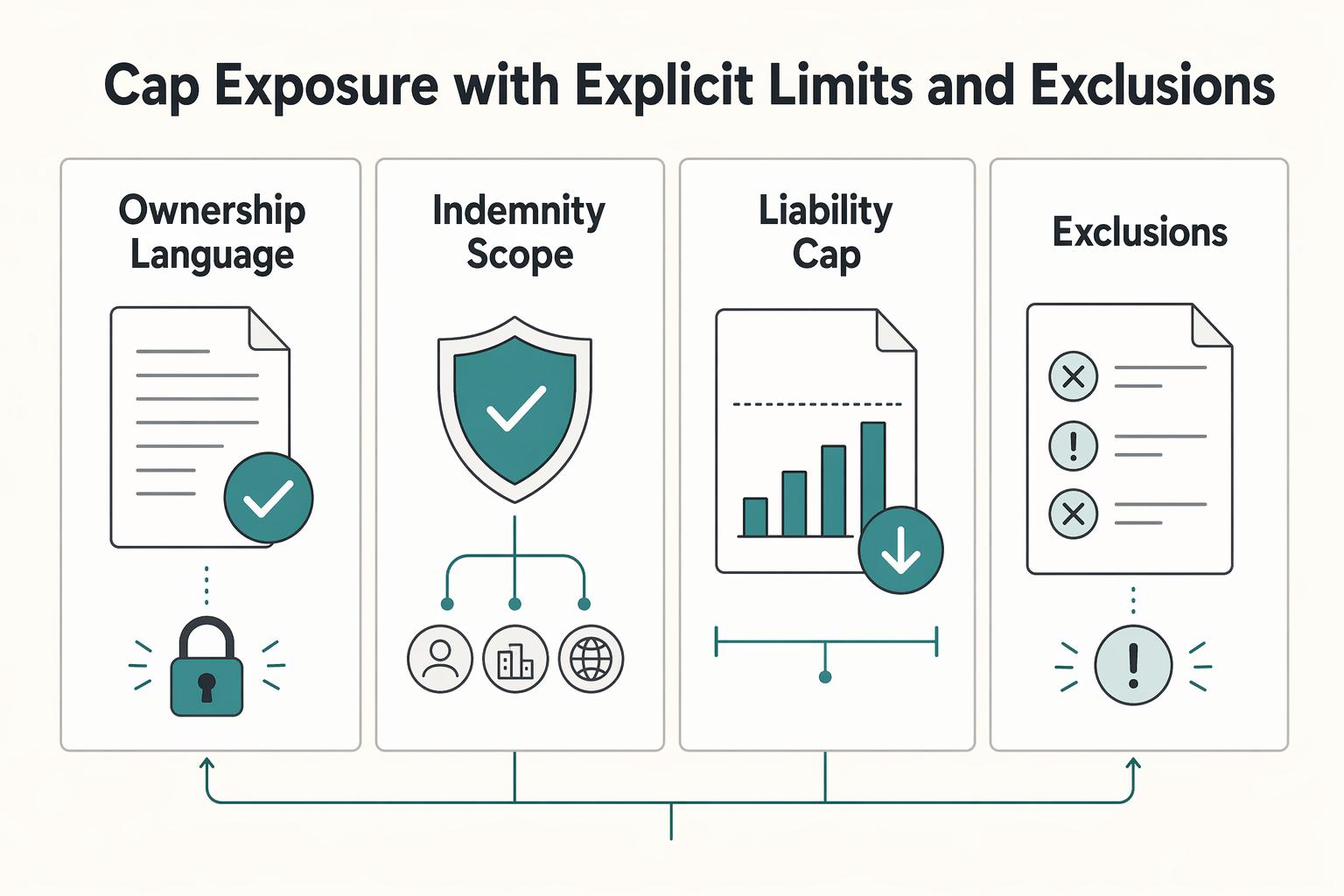
Cap exposure with explicit limits and exclusions#
Define the cap amount or calculation, whether it is aggregate, which claims it covers and any exclusions. State separately any excluded damage categories; a cap exception for a defined claim is different from excluding a type of damage. Check how indemnity and confidentiality interact with the cap, and preserve mandatory statutory rights. Enforceability depends on applicable law, facts and wording.
| Issue | Weak clause | Stronger clause |
|---|---|---|
| Ownership language | "All rights belong to client." | The agreement distinguishes work made for hire from assignment/license, and states any payment condition consistently. |
| Indemnity scope | "Writer indemnifies client for all claims." | "The clause defines which claims are covered and how responsibility is allocated between parties." |
| Liability cap | "Writer is liable for all losses." | "Writer's total liability is capped at the amount stated in the contract." |
| Exclusions | No exclusions stated. | Identify cap carve-outs and excluded damage categories separately; check mandatory rights and enforceability. |
Related reading on legal-system differences: A guide to the Common Law vs. Civil Law systems for international contracts.
Your Contract Is Your Confidence#
A solid written contract makes the project easier to run and easier to trust. When the terms are explicit, you and your client can work from the same expectations instead of negotiating problems in the middle of the job.
A lot of contract trouble starts with basics that were never nailed down in writing. That includes how revisions work, who owns the manuscript, when ownership transfers in your workflow, and who pays if work stalls. Good terms protect both sides and help strong working relationships stay strong.
Before you send any ghostwriting contracts#
| Checkpoint | What to confirm |
|---|---|
| Written agreement | Use a written agreement, not oral promises |
| Core terms | Confirm price, deadlines, revision terms, confidentiality, and the effective date are clearly stated |
| Ownership transfer | State what happens at handoff and which contract terms must be satisfied before ownership transfers |
| Unclear terms | Resolve conflicting or vague language before signature |
| Records | Save the signed contract and related written confirmations together |
If the deal starts on a call, one practical checkpoint for smaller projects is to send a written email summary for confirmation, then move to the full written contract. Save the signed agreement and the related written confirmations together so disputes are easier to untangle if they arise.
You do not need a dramatic contract. You need one that is clear, complete, and usable in real work. That is how you protect the relationship while cutting avoidable risk.
Related reading on asset handover terms: A UX/UI Designer’s Guide to Drafting a Handover Clause for Figma Assets.
When you are ready to turn this checklist into a client-ready draft, start with the Freelance Contract Generator.
Frequently Asked Questions
How do you handle non-payment?
Verify the invoice, due date and receipt status; send notice through the contract’s required channel. Pause future work or withhold undelivered files only where the agreement and applicable law permit, observing any cure period. Payment-conditioned assignment/license rights follow their drafted condition; non-payment does not automatically undo valid work-made-for-hire ownership or an already effective transfer. Preserve delivery, approval and bank records and assess applicable complaint or court remedies.
What should your cancellation term say?
Apply the contract as written: confirm termination in writing and invoice for completed work plus any pre-agreed cancellation amount. This works best when the term is clear and agreed in advance. You should confirm local enforceability rather than assume a fixed percentage will always hold.
How do you stop scope creep without a fight?
Move the request into a signed change order before you do the work. Update the fee and timeline in writing first. Once you start extra work without that paper trail, it can be much harder to prove what was outside the original scope.
Who owns the copyright?
Under U.S. law, authors normally own copyright initially, but valid work made for hire has a different author/initial owner. A voluntary copyright-ownership transfer generally needs writing signed by the rights owner or authorized agent; a nonexclusive license is distinct. Confirm the actual work category, employment/commission facts, signed language and any effective condition rather than treating work-for-hire and payment-conditioned assignment as interchangeable. See Work for Hire vs. Assignment of Rights.
Can the client protect you if their facts are wrong?
Build your evidence file now: client materials, written instructions, approvals, and any stated fact-check limits. Indemnity means compensating a party for losses, and the clause is usually clearer when responsibility is tied to the source of the claim instead of broad one-sided wording.
What changes when the client is in another country?
Read governing law and forum selection separately. Then check dispute method, venue, and currency terms together. Governing law selects the applicable law, while forum selection addresses where disputes are heard. Neither clause by itself guarantees jurisdiction or venue. For cross-border terms, confirm local enforceability before relying on them, including arbitration pathways.
Should you include confidentiality in ghostwriting contracts?
Yes. Use a mutual confidentiality clause, define what is protected, and state handling rules for drafts, source files, and portfolio use. Consider practical carve-outs for information already public, already known, or legally required to be disclosed. Do not assume confidentiality terms are automatically perpetual or unlimited, because enforceability can be limited by statute or public policy.
Try a related tool
Researched and edited by the Gruv editorial team. Gruv builds cross-border billing, payouts, and finance-operations software for global businesses.
Sources
- copyright.gov/title17/92chap2.htmltrusted
- copyright.gov/circs/circ30.pdftrusted
- dol.ny.gov/system/files/documents/2024/08/freelance-wor...trusted
- dol.ny.gov/freelance-isnt-free-acttrusted
- labor.illinois.gov/laws-rules/legal/freelance-worker-protection...trusted
- nyc.gov/site/dca/workers/workersrights/freelancer-wo...trusted
Educational content only. Not legal, tax, or financial advice.
Related Posts

Work for Hire vs Assignment of Rights for Freelancers
A freelance agreement is not just about price and scope. It decides who controls the rights in the work. If the ownership language is loose, rights can move earlier than you expect, cutting down your control once the work is delivered or used.

Germany Freelance Visa Application Path for Freiberufler and Gewerbe
Choose your track before you collect documents. That first decision determines what your file needs to prove and which label should appear everywhere: `Freiberufler` for liberal-profession services, or `Selbständiger/Gewerbetreibender` for business and trade activity.

How to Write a 'Work Made for Hire' Clause Correctly
If you are using a U.S.-law contract, start here. A **work made for hire clause** is only reliable when it fits **17 U.S.C. Section 101** and, for commissioned work, is documented in a **written instrument signed by both parties**.