
Quick Answer
Do this first: align your listing, photos, and in-unit setup so guests see exactly what was promised. To get five-star review on airbnb, require turnover proof photos with wide shots and close-ups of common complaint spots, release the unit only after a pass/fail check, and send check-in instructions at least 24 hours before arrival. At checkout, request honest feedback in neutral wording and use the 14-day review window to reply quickly.
If you want better Airbnb reviews, reduce surprises first. For many high-achievers, managing a property creates a familiar kind of anxiety: the low-grade fear that one missed detail will turn into a visible, costly problem. In a career role, that might mean a missed deadline or a flawed report. In short-term rentals, it often shows up as a negative review that sits in public and affects both reputation and revenue.
That is why generic advice to "be a great host" misses the point. It glosses over the real operating risk tied to your investment. The more useful shift is to stop thinking of yourself as a host and start thinking like an operator. This is not a charming side hustle. It is a revenue-producing asset, and it needs the same rigor you would apply to any other part of your business.
Skip the vague checklists and feel-good slogans. The practical way to protect reviews is to reduce surprises, document what matters, and make good outcomes repeatable. The sections below focus on the controls that actually move results: listing accuracy, turnover quality, guest communication, and a feedback loop that turns reviews into better operations.
The Foundation: Build an Unbreakable Brand Defense#
If you want stronger reviews, start by reducing two common failures behind early complaints: the place is not as described, or turnover misses something obvious. Your first line of defense is not charm. It is a documented standard for what guests see, what they get, and what you can prove if something is challenged.
Airbnb's own guidance is clear on the areas that matter here. Your listing should accurately describe the home and reflect the features and amenities available during the stay. Quality is also scored in categories you can directly influence: cleanliness, accuracy, check-in, communication, location, and value. That gives you a useful priority order. Lock down the rated basics before you spend time on extras that look good in a reel but do little to protect the stay.
Build a turnover SOP that produces evidence#
A cleaner checklist helps, but on its own it is too subjective. Two people can read "clean bathroom" and picture very different results. The fix is to turn each turnover into a room-by-room SOP with reference photos for every guest-accessible space.
| Turnover control | What to verify | Release rule |
|---|---|---|
| Photo standard | Wide shots of each room plus close-ups of toilet, shower drain, sink, stovetop, fridge shelves, bed linens, and entry area. | Take photos after cleaning and staging, with lights on and the full area visible. |
| Pass or fail checks | No visible hair, crumbs, dust, stains, trash, bad odors, missing setup items, mold, or pests. | Fail anything a guest could photograph in the first five minutes and fairly complain about. |
| Named handoff accountability | The cleaner submits the photos and checks off completion, then you or the co-host approves the unit for check-in. | No approval, no release. |
Airbnb also advises full visual coverage in the listing. The same standard is useful for internal quality control. Cover the bedroom, bathroom, kitchen, entry, living area, balcony, and any shared spaces guests can use.
For each turnover, require three things before handoff:
- Photo standard
Ask for wide shots of each room plus close-ups of the most common complaint points: toilet, shower drain, sink, stovetop, fridge shelves, bed linens, and entry area. Take photos after cleaning and staging, with lights on and the full area visible.
- Pass or fail checks
Keep the judgment binary. Pass means no visible hair, crumbs, dust, stains, trash, bad odors, or missing setup items. It also means no health hazards such as mold or pests, which Airbnb explicitly calls out. Fail means anything a guest could photograph in the first five minutes and fairly complain about.
- Named handoff accountability
One person cleans; one person releases the unit. If you use a co-host or remote cleaner, the cleaner submits the photos and checks off completion, then you or the co-host approves the unit for check-in. No approval, no release.
That last step is where preventable problems slip through. A common failure mode is one unchecked defect discovered after arrival, when it becomes both a support issue and a review risk. Keep the same evidence habit for damage too: photos or video, plus repair or cleaning estimates and receipts. If you need reimbursement, Airbnb says to file within 14 days of checkout, and the guest gets 24 hours to respond.
Write a defensive listing that filters bad-fit bookings#
Once turnover is under control, the next job is to stop avoidable mismatches before they book. A defensive listing does not undersell the property. It removes ambiguity. Airbnb recommends making your listing appealing while being honest about what you offer. Be transparent about what guests will find, and go into detail about the neighborhood and amenities so guests can judge fit.
| Reality you need to disclose | Vague listing language | Expectation-setting language |
|---|---|---|
| Walk-up access | "Charming historic apartment" | "Located on the fourth floor with no elevator. Best for guests comfortable carrying luggage upstairs." |
| Street noise | "Lively downtown location" | "In a busy central area with weekend street noise. Light sleepers should expect city sounds at night." |
| Compact layout | "Cozy studio with everything you need" | "Compact studio with limited floor space and a small kitchenette. Suited to short stays and guests packing light." |
Update this copy whenever an amenity changes. If parking is temporarily unavailable, if the dryer is out of service, or if part of the building is under repair, your listing and messages should reflect that immediately. Many "accuracy" complaints start with mismatch, not the issue itself.
Treat photography as a breakeven decision#
Photos matter, but the decision to upgrade them should still be grounded in math. Do not rely on recycled claims about fixed revenue lifts. Use current local numbers and any benchmark only after you verify it.
| Input | Placeholder | How it is used |
|---|---|---|
| Photographer cost | $___ | Part of fixed photo cost. |
| Staging or refresh cost | $___ | Part of fixed photo cost. |
| Expected ADR increase | $___ | Expected price gain per booked night. |
| Expected added booked nights per month | ___ | Use this if photos are expected to increase occupancy rather than rate. |
| Variable cost per stay or night | $___ | Subtract from expected price gain per booked night. |
Use the SBA breakeven logic for a simple decision: Breakeven booked nights = Fixed photo cost ÷ (Expected price gain per booked night - Variable cost per booked night). If you expect photos to increase occupancy rather than rate, estimate added booked nights per month from your own before-and-after data and divide total photo cost by monthly added contribution.
Your inputs are straightforward: photographer cost $, staging or refresh cost $, expected ADR increase $___, expected added booked nights per month , variable cost per stay or night $. If the breakeven math only works under an aggressive assumption, wait. If it works under a conservative case and your current photos do not show every guest-accessible space, the upgrade is easier to justify. The red flag is using better photos to sell a reality your copy still does not explain. That can improve clicks and hurt reviews at the same time.
Related: The Pros and Cons of Short-Term vs. Long-Term Rentals.
The Scalable Guest Experience: Systematize Five-Star Hospitality#
If you want more consistent five-star outcomes, run each stay with a repeatable communication and operations system instead of ad-hoc replies. Fast, preventive communication helps ratings; passive hosting often leads to mediocre reviews and weaker listing performance over time.
Use a booking-cycle message workflow#
Use one stage-based workflow for every reservation so guests get the right information before friction starts. For each message, define the trigger, intent, and fallback before you need it.
| Stage | Trigger | Intent | Fallback action |
|---|---|---|---|
| Booking confirmed | Reservation is received | Confirm dates, guest count, and the next contact point; restate any high-risk listing details. | If details are missing or conflicting, request clarification in-platform and flag for manual review. |
| Pre-arrival | Your standard pre-check-in window | Send access details, arrival steps, and your digital guidebook link. | If a critical item is unconfirmed or changes, send an updated note and switch to manual follow-up. |
| Arrival day | After expected arrival | Confirm successful entry and invite early issue reporting. | If any issue is reported, stop templated replies and handle manually until resolved. |
| Mid-stay | Longer stays or relevant stays | Catch minor issues before they become review issues. | If no reply, do not chase; if a defect appears, open a task and close the loop with the guest. |
| Pre-checkout | Your standard checkout reminder window | Give clear checkout steps to reduce last-minute confusion. | Handle late checkout, storage, or exceptions manually based on your rules and availability. |
Keep messages short, specific, and context-aware for the property.
| Communication style | Reactive / generic pattern | Early / context-aware pattern | Why this lowers review risk |
|---|---|---|---|
| Timing | Waits for guest problems | Sends key info before each stage | Prevents avoidable support requests |
| Content | Reuses the same broad template | States property-specific details that cause confusion | Reduces mismatch and repeat questions |
| Format | Long, mixed instructions | Short, task-based instructions | Makes next actions obvious |
| Exceptions | Treats all issues the same | Escalates edge cases to manual handling | Protects the stay when reality goes off script |
Standardize your welcome system#
Your digital guidebook should be the single source of guest information, whether guests access it by QR code or custom URL. Include recurring items guests ask about most: WiFi access, appliance instructions, parking, checkout steps, house rules, and simple use notes such as coffee maker instructions.
Automate stable information and keep manual handling for edge cases, including early check-in requests, maintenance disruptions, and special accessibility needs. Some operators report guidebooks can reduce repetitive messages by up to 80%, but treat that as a benchmark to validate on your own property. For a deeper template, see Write an Airbnb Welcome Book Guests Can Use Without Messaging You.
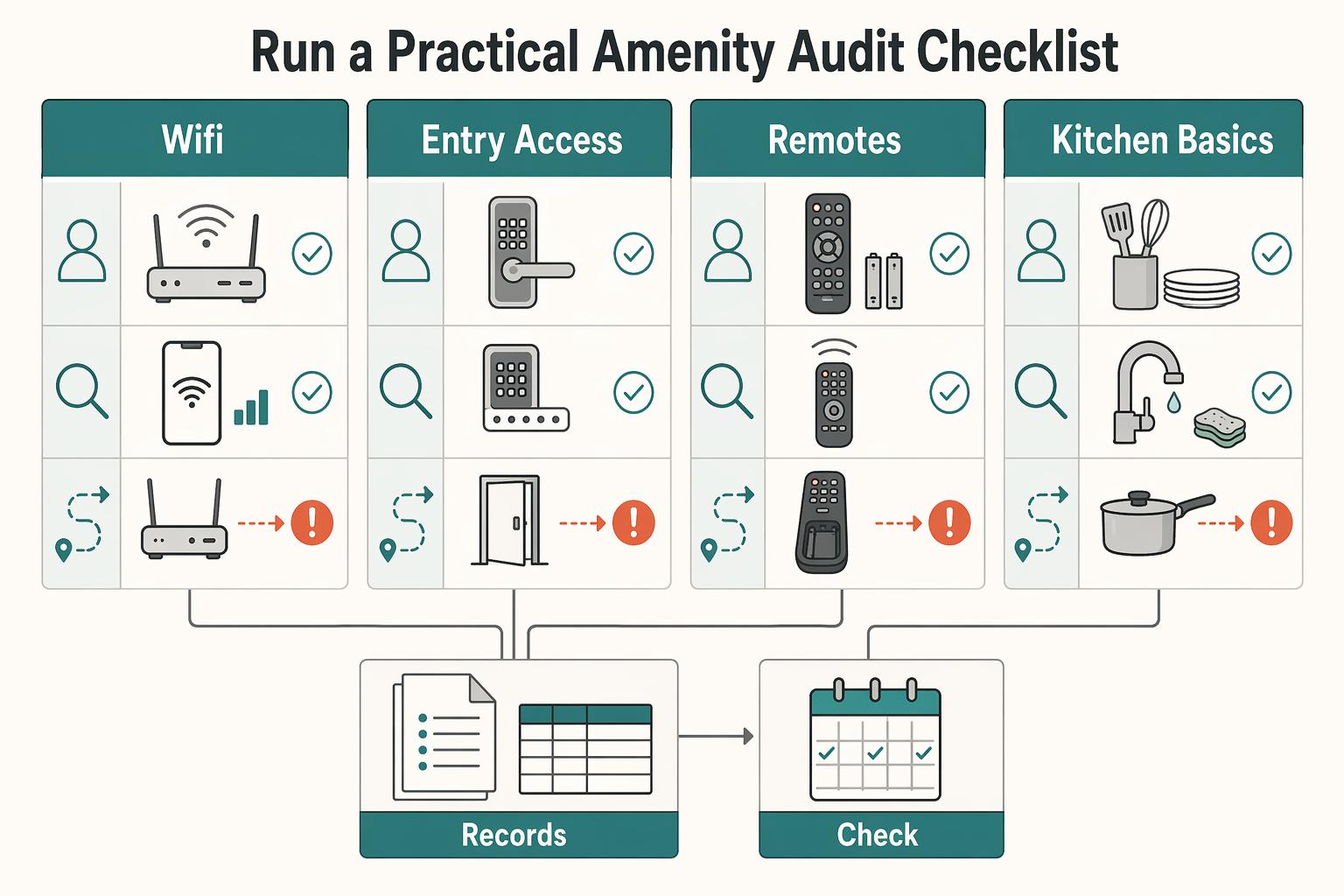
Run a practical amenity audit checklist#
Use a recurring audit with a named owner, a verification method, and a clear escalation path so you catch basic failures before check-in.
| Amenity | Owner | Verification method | Escalation path |
|---|---|---|---|
| WiFi | Host or co-host | Test connection stability and speed; record the result and any guest-impacting issues. | Reset equipment, contact provider, and notify incoming guests if unresolved. |
| Entry access | Cleaner or turnover lead | Test lock/keypad flow, backup access, and battery status. | Replace batteries/hardware before release; use manual handoff if unresolved. |
| TV and remotes | Cleaner | Confirm power-on and remote battery function. | Replace batteries immediately; remove from amenity promise until fixed. |
| Kitchen basics | Cleaner with host review | Check inventory against your master list. | Restock before check-in; if unavailable, update guidebook and pre-arrival message. |
Log the audit date, checker, and failed items each cycle. Small misses like unstable WiFi or dead remote batteries are often what guests remember as "poor management."
The Optimization Loop: Turn Guest Feedback into Your Greatest Asset#
Use reviews as operating data, not personal judgment. Your job after each stay is to spot repeat friction, fix root causes, and verify the fix in your next turnovers.
On Airbnb, reputation directly affects how guests choose and how your listing performs. Airbnb says reviews and ratings help guests decide, and better reviews and ratings can lead to more bookings and higher earnings. After 3 guests rate your listing, your average star rating appears in search and on your listing. Airbnb also says guest reviews are part of listing quality signals in search, and more popular listings tend to rank higher.
If you track status signals, a 4.8+ overall rating is one Superhost requirement. Airbnb's Guest favorites filter is built from ratings, reviews, and reliability data from over half a billion trips. On Vrbo, review volume and search appearances are also tracked as ranking metrics. Reputation work is operational work.
Ask for reviews without creating policy risk#
Make your review ask routine, neutral, and part of checkout. Airbnb hosting guidance supports a scheduled checkout message, and both sides have 14 days after the stay ends to submit a review.
| Type | Item | Article guidance |
|---|---|---|
| Routine | Checkout instructions first | Send clear departure steps. |
| Routine | Neutral feedback request | Add a short neutral request for feedback in the same message. |
| Routine | Review timing | Review the guest promptly; both sides have 14 days after the stay ends to submit a review. |
| Avoid | Specifically five-star ask | Do not ask for a specifically five-star review. |
| Avoid | Review incentives | Do not offer discounts, gifts, or late checkout in exchange for a review. |
| Avoid | Pressure | Do not pressure guests to change, remove, or withhold feedback. |
- Send checkout instructions first (clear departure steps).
- Add a short neutral request for feedback in the same message.
- Review the guest promptly, since Airbnb notes that reviewing guests can remind them to review you.
Keep the review request neutral, focused on honest feedback, and verify the final wording against Airbnb's current Reviews Policy before publishing or automating it.
Avoid these policy risks:
- Asking for a specifically five-star review.
- Offering value (discounts, gifts, late checkout) in exchange for a review.
- Pressuring guests to change, remove, or withhold feedback.
Respond to bad reviews like an operator#
Treat your public response as context for future guests. Airbnb allows hosts to post a public response and to request removal when a review violates policy.
- Valid complaint: Acknowledge, apologize plainly, state the fix, and confirm what changed.
- Mixed complaint: Confirm the fair part, correct one material point briefly, and reference prior disclosure if relevant.
- Unfair complaint: State the key fact once, stay calm, and move on. If policy may be violated, file a removal request, but do not assume removal.
For safety or serious policy incidents, escalate immediately: contact local emergency services if needed and report the issue to Airbnb.
Before you respond or dispute, assemble evidence: listing disclosures, message-thread screenshots, check-in instructions sent, turnover photos, lock/access logs, and repair records.
| Recurring complaint theme | Likely root cause | Fix type | Effort level | Expected guest-experience impact |
|---|---|---|---|---|
| Check-in was confusing | Instructions are long or unclear; access steps not tested | Rewrite steps, add photos, test entry each turnover | Low | High |
| Night noise complaints | Noise expectations under-disclosed; sleep setup weak | Tighten listing disclosure; improve sleep setup | Low to medium | High |
| WiFi felt unreliable | Signal/router/provider issues not monitored | Troubleshoot network, adjust hardware, add backup plan | Medium | High |
| Kitchen felt understocked | No reliable restock standard | Set par levels and verify at turnover | Low | Medium |
| Cleanliness felt inconsistent | Checklist/proof process is weak | Tighten cleaning SOP and require proof photos | Medium | High |
Track this in one operating sheet: stay date, rating, theme, root cause, owner, due date, and proof of fix. Escalate recurring themes as projects instead of reacting to one-off comments.
You might also find this useful: Welcome Gift Ideas for Airbnb Guests That Improve First Impressions.
Conclusion: Your Property Is an Asset. Manage It Like One.#
If you want steadier reviews, treat the stay like an operation you check, not a mood you hope for. The basics still shape outcomes: cleanliness, listing accuracy, timely communication, and a review loop that turns guest feedback into action.
That means holding the line where Airbnb is explicit. Cleanliness matters. Your listing should give a complete and accurate account of the space and not oversell it. Check-in instructions should go out at least 24 hours in advance so guests can read them and ask questions before arrival. After checkout, remember the review window is 14 days, and the overall rating is its own category, not an average of the subratings. An avoidable mistake is assuming small category wins will cancel out a weak overall impression. They do not. Start with this:
- Recheck your current listing against the real unit today. Photos, amenities, descriptions, and quirks should match what a guest will actually see.
- Confirm your cleaning standard is current and being followed on every turnover, not just when you are personally involved.
- Verify your message timing, especially check-in instructions at least 24 hours before arrival.
- Review the last few stays for repeated friction, then make one concrete fix before the next booking.
If you track performance, use verified benchmarks instead of vague confidence. Follow the indicators you can verify, such as overall rating, response rate, cancellation rate, and progress toward any Superhost thresholds you are targeting.
Manage those four areas consistently and you give yourself a better shot at fewer operational surprises, a more reliable guest experience, and stronger review consistency.
For a step-by-step walkthrough, see How to Handle a Negative Review on Airbnb.
Frequently Asked Questions
How do you automate messages without sounding scripted?
Use automation for timing and completeness, not fake warmth. A useful checkpoint from Airbnb’s host guidance, updated Aug 20, 2025, is a scheduled message a few days before check-in asking about guest comfort needs. Before you publish or automate anything, verify the current Airbnb policy language for messaging and review requests.
What should you do if a guest leaves a negative review?
Answer for future guests, not to win the argument. Acknowledge the real issue, correct one material fact only if needed, and name the fix if you actually made one. If star categories look odd, do not overread them: guests may leave an overall rating without filling every category, so the written details matter more than the icons. | Review response element | Good answer | Risky answer | | --- | --- | --- | | Tone | Calm, brief, specific | Defensive, sarcastic, emotional | | Facts | Refers to one verifiable point from the listing or message thread | Adds new claims you cannot prove | | Fix | States what changed if you fixed it | Promises changes you have not made |
What makes a welcome flow reliable enough to support a five-star review?
A reliable arrival removes avoidable questions before they happen. Send pre-check-in details on time, and make sure your self check-in instructions, listing photos, and on-site setup match what guests will actually see. The common failure mode is drift: your message says one thing, your listing photos show another, and the property setup has already changed.
Which amenities deserve priority if you want stronger reviews?
Start with what Airbnb identifies as high-demand: self check-in, wifi, washer, dryer, TV or cable, and a BBQ grill. Then verify that your listing description, photos, and amenities match what the space currently offers, because mismatches can increase review risk. If you add, remove, or replace an amenity, update the listing promptly.
How do you make the place fit business travelers without overbuilding it?
Focus on friction, not luxury language. Reliable wifi and self check-in are practical starting points, then make sure your photos and amenity list accurately show what is available now. If you offer accessibility features, upload clear photos to the listing’s Accessibility section so guests can verify the setup before booking.
Should you ask every guest for a review?
Use a neutral, consistent request for honest feedback, and confirm the current reviews policy before finalizing any template. The safer move is to improve the stay and avoid language that pushes for a specific rating.
Try a related tool
Researched and edited by the Gruv editorial team. Gruv builds cross-border billing, payouts, and finance-operations software for global businesses.
Sources
Includes 5 external sources outside the trusted-domain allowlist.
- sba.gov/business-guide/plan-your-business/calculate-...trusted
- airbnb.com/resources/hosting-homes/a/get-more-5-star-re...external
- airbnb.com/resources/hosting-homes/a/create-a-5-star-st...external
- join.globalvacationrentals.com/blog/tips-for-hosting-on-airbnbexternal
- minut.com/blog/how-to-get-5-star-reviews-on-airbnbexternal
- smoothstay.io/articles/hosting-tips-airbnbexternal
Educational content only. Not legal, tax, or financial advice.
Related Posts

Thailand's Long-Term Resident (LTR) Visa for Professionals
For a long stay in Thailand, the biggest avoidable risk is doing the right steps in the wrong order. Pick the LTR track first, build the evidence pack that matches it second, and verify live official checkpoints right before every submission or payment. That extra day of discipline usually saves far more time than it costs.
The Pros and Cons of Short-Term vs. Long-Term Rentals
You are probably not chasing the biggest headline revenue number. You want rent that arrives, stays collected, and does not turn into a second job or a cross-border tax headache. For an owner living internationally, the real choice between a short stay and a long-term lease is about risk first. Which model gives you lower compliance exposure, less remote operating drag, and more cash left after fees, taxes, and reporting?

The Freelance Payment Penalty: A Modeled Audit of Platform Fees, FX Spreads, and Payout Delays
The money rarely disappears through a single, easy-to-spot fee. The real loss is stacked. A marketplace takes its commission, a processor adds a charge for international cards, a bank or payment company converts the currency at a spread, a platform holds the funds before release, and a wire sheds a little to intermediaries on the way in. Each layer looks defensible on its own, but the worker feels the combined result as a smaller deposit and a later payday.