
Quick Answer
Choose by work pattern: Spain’s Digital Nomad Visa fits active remote earners, but self-employed activity for Spain-based companies is capped at 20%. Spain’s Non-Lucrative Visa fits people living on savings or non-work income and does not allow teleworking. If your plan is capital deployment, review Greece’s investor route under Article 20/20B of Law 4251/14 instead of Spain’s closed investor channel. In every case, verify requirements with the exact consulate or authority handling your file.
Start from what you can verify, then choose a route#
Start from a conservative planning position. If your move depended on a Golden Visa path, do not build your timeline around assumptions. Confirm current eligibility and process details through official channels before you commit. In practice, the decision is simpler than it feels: choose a residency route based on how you earn, what work you plan to do after arrival, and how you want to live.
Use two planning labels to classify yourself quickly. These are working labels, not legal categories. Capital-led means your strongest asset is accumulated capital or passive means that can support your plan without relying on active work after you move. Income-led means your strongest asset is ongoing earned income from work you expect to continue.
Apply this three-question filter before you compare pathways:
- What is your primary asset? Ongoing income, accumulated capital, or a mix.
- What work will you actually do after arrival? No work, remote work, employer work, or business management.
- What is your lifestyle and tax posture? Full-time base, part-year presence, or mobility-first.
Then match your answers to evidence you already have: contracts, invoices, bank records, ownership records, or savings documentation. If you use a relocation provider, confirm scope early. Some market end-to-end visa support plus tax residency registration or compliance assistance, and some also state that they do not assist with job search. Form-verification or submission issues can also happen, so keep copies of everything you submit.
With that filter in place, reset assumptions and focus on options you can verify today.
The Situation Room: What the End of the Golden Visa Means for You#
Current closure-era implementation details are not confirmed. If your plan depended on the old investment route, pause major commitments and verify your current status first.
Under the earlier framework in Law 14/2013, the route was described as a one-year visa via a Spanish consulate, followed by a two-year residence approval, including filing through UGE-CE. Older process references, including the historic 10 working day visa benchmark and 20 day residence-permit benchmark, should be treated as historical context until current rules are confirmed.
What changed#
This section does not confirm whether new applications under the prior investor track are currently open or closed. In practical terms, do not tie funds, travel, or a property timeline to this route until you confirm the current official position.
Why it changed#
Take a verification-first approach here. The final official rationale is not confirmed. Check any published legal instrument and explanatory text directly once verified, then apply that wording to your case.
Who is affected#
Your next step depends on whether you are still planning, already filed, or already hold status. If closure or rule-change measures are confirmed, a new applicant is someone who had not formally lodged an application before the relevant cutoff. Property research, a reservation, advisor engagement, or draft paperwork typically do not by themselves mean you were in process.
An in-process applicant is someone who had already filed and can prove it with an official submission record. Keep the filing acknowledgment and your completed and signed application form. If a representative filed, keep that representative-filing documentation as well.
An existing holder is someone who already holds a valid visa or permit issued under the earlier route.
| Your status | Practical next action | Key risk to check |
|---|---|---|
| Planning to apply | Verify whether this route currently accepts new filings before committing funds or travel plans. | Treating preparation work as a lodged filing. |
| Already filed | Collect proof of submission and confirm the filing channel used, for example consulate or UGE-CE. | Assuming a sent package equals an officially accepted filing. |
| Current permit holder | Verify renewal and status rules from current official guidance well before expiry. | Assuming prior renewal practice still applies without confirmation. |
Once you know where you stand and confirm current rules, decide whether this route is still viable or whether an alternative better fits your work pattern, asset base, and intended life in Spain. For a wider tax-planning example, see Tax Guide for Digital Nomads in Thailand.
Which lane fits your income, work plans, and capital#
Use this section as a fast filter. The right lane depends on how you earn, whether you will work after moving, and how much capital you can deploy without straining liquidity.
An income-led profile is powered by recurring earned income, with ongoing work as part of the plan, and no interest in tying residency to locked-up capital. A passive-resident profile fits when you want to live in Spain, do not need work activity in your filing story, and can support yourself through non-operating income or savings. A capital-led profile fits when you can deploy meaningful capital and your priority is residency or mobility optionality rather than ongoing earned income.
Treat innovation-led founder routes as their own lane, not as a fallback label. A 2026 industry analysis reviewing 2023 to 2024 outcomes reported denials approaching 40% where innovation assessments were not persuasive. Treat that as an industry signal, not an official government statistic.
| Lane | Work rights check | Tax exposure check | Documentation burden | Physical presence check | Long-term fit |
|---|---|---|---|---|---|
| Income-led route in Spain | Confirm the route allows your real work pattern. | Verify where living and working may create tax residency. | Prepare route-specific evidence of income and activity based on current official requirements. | Confirm current in-country requirements directly. | Best when residence is tied to ongoing activity. |
| Passive-resident route in Spain | Confirm you can truthfully maintain a no-work fact pattern if required. | Verify tax treatment of passive income in your case. | Prepare route-specific self-support evidence based on current official requirements. | Confirm current in-country requirements directly. | Best when living in Spain is the priority and work is not central. |
| Capital-led route outside Spain | Confirm your priority is residency or mobility optionality, not day-to-day work rights in Spain. | Verify when tax residence is triggered in the chosen jurisdiction. | Focus on investment execution and route-required source-of-funds evidence. | Confirm current in-country requirements directly. | Useful when Schengen mobility across 27 nations is a core goal. |
| Innovation-led founder route | Confirm you are truly building active operations, not repackaging a solo profile. | Verify where management and operations may trigger tax or reporting exposure. | Expect higher subjectivity and deeper operating evidence. | Plan for multiple steps, from company formation to biometric processing. | Best only when active business operations are genuinely your plan. |
Before you let citizenship planning drive the choice, verify the current residency-to-citizenship timelines and any nationality-based exceptions. Industry commentary also flags long naturalization windows in parts of Western Europe and family reunification complexity as common delay points.
Choose your lane#
Use these questions as a checkpoint before you go deeper into any one route.
- Do you need active earned income to sustain your move?
- Can you honestly support a no-work filing story if a route requires it?
- Can you fund this plan without creating liquidity stress?
- Is your target Spain-specific residence, or broader EU mobility optionality?
- Are you ready for full evidence from setup through biometrics, not just headline eligibility?
If you are choosing between income-led and capital-led routes, use the Digital Nomad Visa tool to compare viable visa paths before you commit.
Pathway Analysis #1: Spain's Digital Nomad Visa (The Income-Led Route)#
If your move depends on active remote income and you plan to keep working, this is usually the first Spain route to test. It is built for non-EU nationals doing remote work or professional activity, and it works when you want legal work rights without forcing a passive-income narrative.
The first issue to settle is your work structure. As an employee, your work must be for companies outside Spain. As a self-employed applicant, Spain-based company work is allowed only up to 20% of your total professional activity. If local Spain revenue will be a core part of your model, stop there and re-check fit before filing.
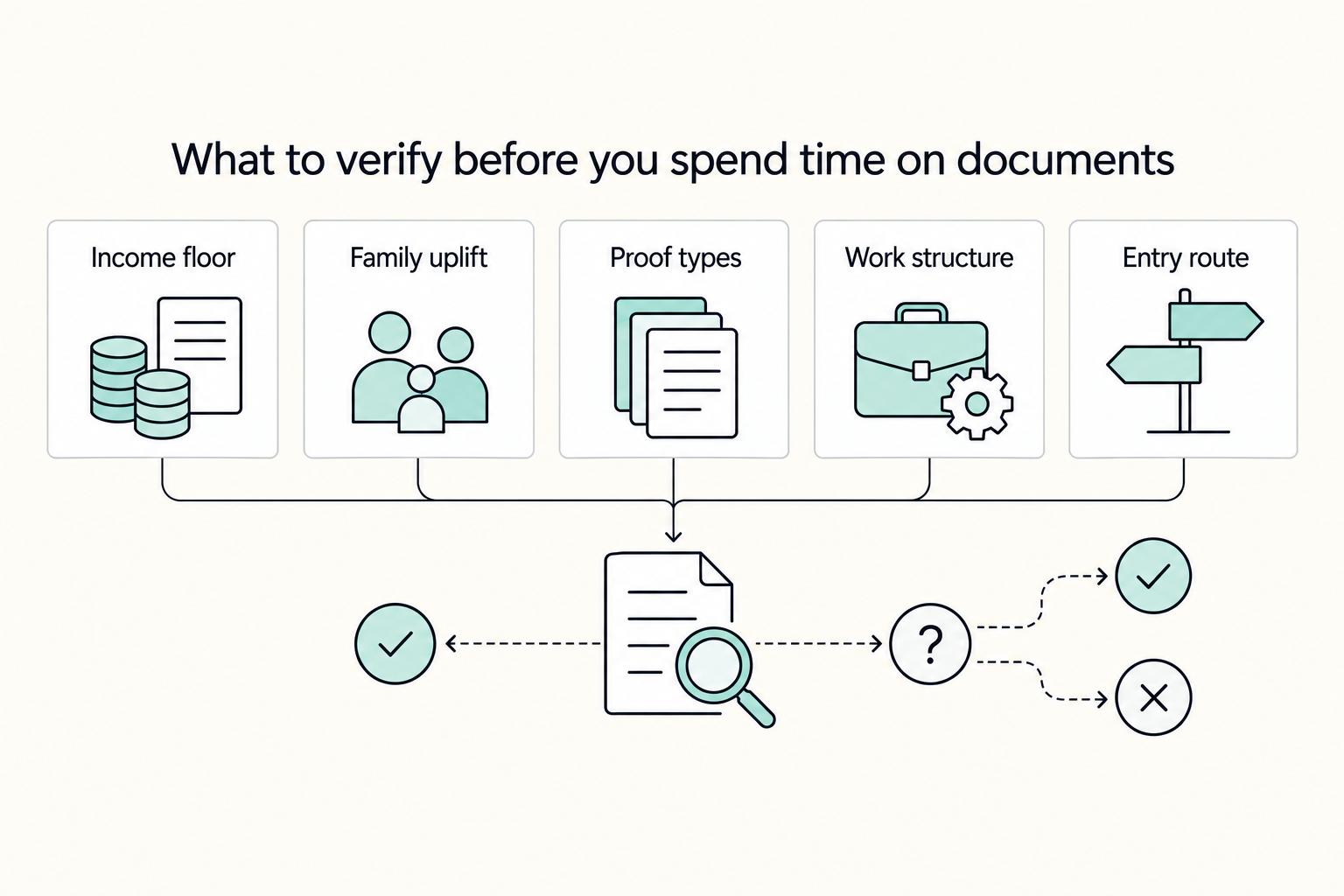
What to verify before you spend time on documents#
Do not build your file around generic blog summaries. Confirm the current rules for your exact filing channel, then build evidence around what the handling authority actually accepts.
| Checkpoint | What to verify |
|---|---|
| Income floor | Verify the current income threshold with the handling authority. |
| Family uplift | Verify the current dependent uplift rules with the handling authority. |
| Proof types | Contract, bank statements, payslips, and other evidence accepted by your consulate |
| Work structure | Employee vs self-employed rules, especially any planned Spain-based company work |
| Entry route | Consular telework visa abroad, or direct telework residence authorization if you are already legally in Spain |
| Identity setup | You need a NIE before applying |
The file has to line up end to end. Your contract or client agreements should match bank inflows. If you are self-employed, invoices and payer mix should match your declared activity profile.
Also verify criminal-record rules with your own consulate. Official pages are not fully aligned. Some cite a 2-year lookback and others 5 years. Confirm the correct window before you start collecting documents.
Tax treatment is elective, with a filing window#
The special tax regime under Article 93 is an option, not an automatic result of visa approval. If you want to use it, check these points first:
| Point | Current detail |
|---|---|
| Eligibility gate | You must meet Article 93 conditions. AEAT guidance states the framework was broadened from 1 January 2023, including a prior non-residence reference of 5 years. |
| Timing window | The option is filed through Model 149, within 6 months from the activity start date. |
| Income scope | Verify the current income scope before you rely on it. |
| Rate and cap | Verify the current rate and income cap before you elect it. |
| If you do not opt in or do not qualify | Standard resident IRPF treatment generally applies, which means taxation on worldwide income subject to treaty relief where relevant. |
Quick fit check#
| Employment setup | Client mix | Expected compliance workload | Avoid this route if |
|---|---|---|---|
| Employee of a foreign company | Foreign only | Medium | You plan to work for a Spanish employer under this permit |
| Self-employed consultant or freelancer | Mostly foreign, with limited Spain-based company work | Medium to high | Spain-based company work will exceed the 20% cap |
| Founder with complex cross-border income flows | Mixed and hard to document | High | You cannot show a clean, consistent income trail |
Treat this as a residence route that may support later settlement, not as an automatic bridge. Verify the current permanent-residency timeline, citizenship timeline, and any exceptions under the separate rules that govern each stage.
Choose this route if your income is active, documented, and mostly foreign-sourced, and you want to keep working after relocation. Avoid it if Spain-based business activity will be substantial, your tax elections are unresolved, or your documentation will not stand up to detailed review.
Pathway Analysis #2: Spain's Non-Lucrative Visa (The Passive Investor)#
If your plan is to live in Spain without working, this is the route to review. Spain's Non-Lucrative Visa is a residence permit without work rights, and consular guidance is explicit that teleworking is not allowed.
This route only works if you are financially independent. If you will fund your stay with savings or regular non-work income, it can fit. If you plan to keep a foreign job, freelance, consult, or do paid client work from Spain, move to the telework route instead.
What non-lucrative means in practice#
The main mistake here is treating this as a lighter work category. It is not. "Non-lucrative" means no gainful work or professional activity, including remote or online work.
Use that as your first filter. If your real plan includes active earning after arrival, this permit does not match your facts. Since Spain repealed Articles 63 to 67 of Law 14/2013, the former investor-visa framework, some financially independent applicants now look at NLV, but the no-work condition still applies in full.
What your financial proof needs to show#
Your file has to show that you can cover the initial year of residence, or that you have a regular source of income. The official reference is IPREM: 400% of IPREM for the main applicant, plus 100% of IPREM per family member.
Verify the current income or savings threshold and the current dependent increment with your own consulate before filing.
In practice, your evidence should show three things clearly: the funds exist, they are available to you, and they are enough for year one. Keep the file internally consistent so amounts, ownership, and access are clear.
Tax checklist before you file#
Run the tax analysis before submission, not after arrival.
| Tax point | Current detail |
|---|---|
| Count your days | Spain's Tax Agency treats you as resident if you remain in Spain for more than 183 days in a calendar year. |
| Worldwide-income exposure | Once tax resident, you are generally taxed in Spain on worldwide income. |
| Modelo 720 structure | Modelo 720 is organized into three separate information blocks. |
| Refiling trigger | Refiling can be required when a block rises by more than 20,000 euros versus the declaration that triggered filing. |
| When to bring in counsel | Do this before filing if you expect to cross 183 days, have multi-country income, or hold foreign assets across multiple Modelo 720 blocks. |
If several of those points apply to you, get the tax analysis done before you submit.
NLV fit check#
| Good fit | Poor fit | Common rejection risk |
|---|---|---|
| You can fund your first year in Spain from savings or regular non-work income | You plan to keep any remote job, freelance work, consulting, or other professional activity | Your file suggests ongoing work or online income under a non-working permit |
| You want residence in Spain, not work rights | You need legal permission to keep earning after arrival | Financial proof is unclear, inconsistent, or below 400% IPREM plus 100% IPREM per dependent |
| Your finances are straightforward and easy to document | Your funds are difficult to evidence cleanly | You rely on stale euro figures instead of current IPREM-based requirements |
Remote work is a hard no under this permit, so do not treat it as a workaround while you keep earning online.
Long-term path#
This route can support a longer stay, but only if you plan from current rules rather than old forum summaries.
- Initial NLV stage: Prove sufficient means and comply with the no-work condition.
- Renewal stage: Provide updated financial evidence and confirm you still meet route requirements. Verify current renewal timing and rules before planning.
- Long-term residence milestone: Verify the current permanent-residency timeline before you rely on it.
- Citizenship milestone: Verify the current citizenship timeline and any nationality-based exceptions before you rely on them.
If you are truly living from passive means, this is a workable post-closure Spain pathway. If your plan depends on active income, treat that as a disqualifier and switch routes early.
Pathway Analysis #3: The Greek Golden Visa (The Capital-Led Pivot)#
If you still want a capital-led residency route after Spain ended its investor path, Greece is one of the main options to evaluate. This route is built around investment and residency status, not around salary or remote-work qualification tests.
Greece's Ministry of Foreign Affairs describes this as a route for non-EU property buyers and their family to obtain a 5-year renewable residence permit in Greece, valid across all Schengen countries. In practical terms, you get residency status and Schengen mobility. You should not assume automatic local employment rights or a quick citizenship outcome.
What you should verify before you buy#
Start with verification, not property selection. Public materials point to multiple investment tracks with different conditions, and official pages are not fully harmonized, including legacy-looking €250,000 wording in parts of migration guidance.
Use the investor-permit framework under Article 20 / 20B of Law 4251/14 as your anchor, then match your exact property type and location to current implementation notices.
| Route type | Property conditions | Location scope |
|---|---|---|
| Standard residential purchase in higher-demand markets | A government-affiliated update stated €800,000 and a 120 sq.m. minimum for qualifying residential real estate. Re-verify current legal text before filing. | Verify current high-demand area list. |
| Standard residential purchase in other areas | A government-affiliated update stated €400,000, with the same 120 sq.m. condition for qualifying residential real estate. Re-verify current legal text before filing. | Verify current geographic scope outside higher-demand areas. |
| Converted industrial building or historic-building route | A government-affiliated update stated €250,000 for industrial-to-housing conversions and historic buildings. Confirm route-specific restoration and use conditions. | Route-specific eligibility. Confirm current building and implementation rules. |
Also verify use restrictions before you commit funds. A public update says qualifying residential real estate under newer rules cannot be used for short-term rentals, but confirm how that applies to your exact route.
What the permit gives you, and what it does not#
Treat this as a residence-and-mobility permit. It gives you renewable Greek residence status with Schengen validity. It does not automatically give local labor-market access.
Family inclusion is part of the framework, but dependent files need separate verification. Confirm current eligible categories, any age or status limits, and the required documents for each family member before purchase completion.
Tax flexibility only works if you plan it early#
This route can support flexibility if you are not relocating full-time, but immigration status and tax residence are separate. Greek tax guidance says residence can be triggered by presence over 183 days in any 12-month period, and it also considers your center of vital interests.
If you expect substantial time in Greece or a shift in personal or economic ties, get cross-border tax advice before you apply.
Citizenship is a separate commitment#
If citizenship is part of your goal, plan for a separate timeline and evidence process. Simplified official guidance states a baseline of 7 years of permanent and legal residence in Greece before a non-EU applicant can naturalize. Preparation materials cover history, culture, geography, and civics.
| Citizenship point | Current detail |
|---|---|
| Residence baseline | Simplified official guidance states a baseline of 7 years of permanent and legal residence in Greece before a non-EU applicant can naturalize. |
| Preparation materials | Preparation materials cover history, culture, geography, and civics. |
| Nominal timing | Official simplified guidance notes a nominal 1 year. |
| Timing in practice | Official simplified guidance notes 2 to 4 years in practice. |
| What to verify | Verify current citizenship criteria, continuity requirements, and language or integration expectations before treating this as your end-state plan. |
Who this fits, and who should choose another path#
This path fits if you want a capital-led route after Spain's closure, your goal is Greek residency status plus Schengen mobility, and you are willing to verify route-specific investment and documentation rules before signing.
Choose another path if you need clear rights to work locally, your plan depends on a fast or low-friction citizenship path, or you are not prepared to verify threshold, location, size, use, and dependent-document requirements up front.
For a step-by-step walkthrough, see Greece Golden Visa Guide: Eligibility, Property Rules, Documents, and Timeline.
Conclusion: Your Next Move is a Strategic Upgrade#
Spain's investor route is closed for new filings, so buying property in Spain is no longer a new investor-residency path. The decision now should follow four filters: how you earn, whether you plan to work, how long you expect to stay in Spain, and what you want this permit to do over time.
Use this checklist in order. If you earn through active remote work for companies outside Spain, test the Digital Nomad Visa first. If you will live in Spain without working, the Non-Lucrative Visa is the better fit. If you want an investment-led residence route, review Greece's investor pathway under Article 20B.
| Pathway | Work rights | Residency-use pattern | Tax-residency exposure |
|---|---|---|---|
| Spain Digital Nomad Visa | Yes, if your activity fits telework rules. Employees may work only for companies outside Spain; self-employed applicants may do Spain-based work only within the 20% cap. | Best if you plan to live and work remotely from Spain. Verify the current stay requirement before filing. | More than 183 days in Spain in a calendar year is one tax-residency trigger. Verify current tax treatment details before you rely on them. |
| Spain Non-Lucrative Visa | No. This visa does not authorize work. | Best if you want to live in Spain without paid professional activity. Verify the current stay requirement before filing. | The same Spanish 183-day test can apply. |
| Greek Golden Visa | Verify the current work-rights position before you rely on it. | Better for a capital-led plan under current Greek qualifying investment rules, including real-estate threshold changes cited as effective 31 March (€800,000 in higher-tier areas and €400,000 in others). | Do not assume immigration status alone determines tax residence. Check presence-based and local tax rules. |
Do not buy property in Spain expecting the old investor route to reappear. Treat that path as closed and plan from the alternatives that are actually open.
- Choose the pathway that matches your work intent and asset type.
- Confirm current eligibility rules with the authority handling your file.
- Validate tax implications with cross-border advice before committing to presence or property.
- Prepare the matching evidence set: remote-work proof, non-work support proof, or qualifying investment documents.
Before you submit any residency application, run your travel and stay assumptions through the Tax Residency Tracker so your visa decision and tax posture stay aligned.
Frequently Asked Questions
Is the Spain investor visa still available?
Current Spanish consular guidance says investor visas were abolished for new filings. Some consular notices also indicate transition handling for applications submitted before entry into force, and that already issued visas or authorizations remain valid for their issued period. Verify your exact status and transition rule with the authority handling your file.
Can you still get residency in Spain just by buying property?
You should treat the answer as no for Spain's former investor-visa filing route. The investor filing channel is shown as closed for new applications, so a property purchase by itself does not reopen that route. Check your visa pathway first, then make property decisions.
What is the best alternative now?
Pick by profile, not by hype. If you are an active remote earner working for non-Spanish employers or clients, start with the Digital Nomad pathway. If you will not work, review the Non-Lucrative pathway. If you want an investment-led route, review the Greek Golden Visa pathway. Confirm current eligibility details before filing.
What is the difference between Spain's Digital Nomad Visa and the Non-Lucrative Visa?
The Digital Nomad Visa is a remote-work route tied to work outside Spanish territory. The Non-Lucrative Visa is a non-work residence route and is not a work permit. Your document set should reflect that difference from day one.
Can you work remotely on a Non-Lucrative Visa?
You should plan on no. The non-lucrative route is for residing in Spain without work or professional activity, and at least one consulate explicitly states this visa type does not allow teleworking. If you intend to keep paid remote work, use a work-authorizing route instead.
How does the Greek Golden Visa compare with Spain's old investor route?
Greece's MFA describes a 5-year renewable residence permit in Greece, valid across Schengen countries, for non-EU property buyers and family. Verify current investment track rules and filing requirements before you commit funds.
Do these permits automatically settle your tax position?
No. Immigration permission and tax residence are separate, and in Spain, staying more than 183 days in the calendar year is one tax-residency trigger. If you expect long stays or split-country living, check tax treatment before filing.
What should you verify first before filing anything?
Start with the exact official page for the consulate or authority that will receive your application. Then verify the route-specific documents you need for your chosen pathway. If family members are included, confirm their current document and eligibility rules before booking appointments.
Try a related tool
Researched and edited by the Gruv editorial team. Gruv builds cross-border billing, payouts, and finance-operations software for global businesses.
Sources
- data.consilium.europa.eu/doc/document/ST-16143-2025-INIT/en/pdftrusted
- europarl.europa.eu/RegData/etudes/etudes/join/2013/513510/IPOL-...trusted
- exteriores.gob.es/Consulados/losangeles/en/ServiciosConsulares...trusted
- exteriores.gob.es/Consulados/sanfrancisco/en/ServiciosConsular...trusted
- foreign.senate.gov/imo/media/doc/SFRC_Majority_China_Europe_Rep...trusted
- lamoncloa.gob.es/serviciosdeprensa/notasprensa/vivienda-agend...trusted
- nebraska.edu/docs/board/agendas/Agenda%202-9-24%20with%20...trusted
- newsletters.enterprisegreece.gov.gr/newsletter-articles/greece-adjusts-golden-vi...trusted
Educational content only. Not legal, tax, or financial advice.
Related Posts

The 2026 Global Digital Nomad Visa Index for 50+ Countries
Start with legal fit, not lifestyle filters. The practical order is simple: choose a route you can actually document, then decide where you want to live. That single change cuts a lot of wasted comparison work and stops you from falling in love with places that were never a real filing option.

Thailand Tax for Digital Nomads Without Residency Mistakes
The most expensive mistakes here happen before anyone opens a tax return. People pick a visa, assume the tax answer comes with it, then try to rebuild the year from scraps after the fact. By then, the damage is usually not one dramatic error. It is a pile of small gaps: an unverified day count, a transfer with no clear purpose note, invoices that do not line up cleanly with payments, and assumptions nobody wrote down when the facts were still fresh.
A Guide to Spain's Non-Lucrative Visa
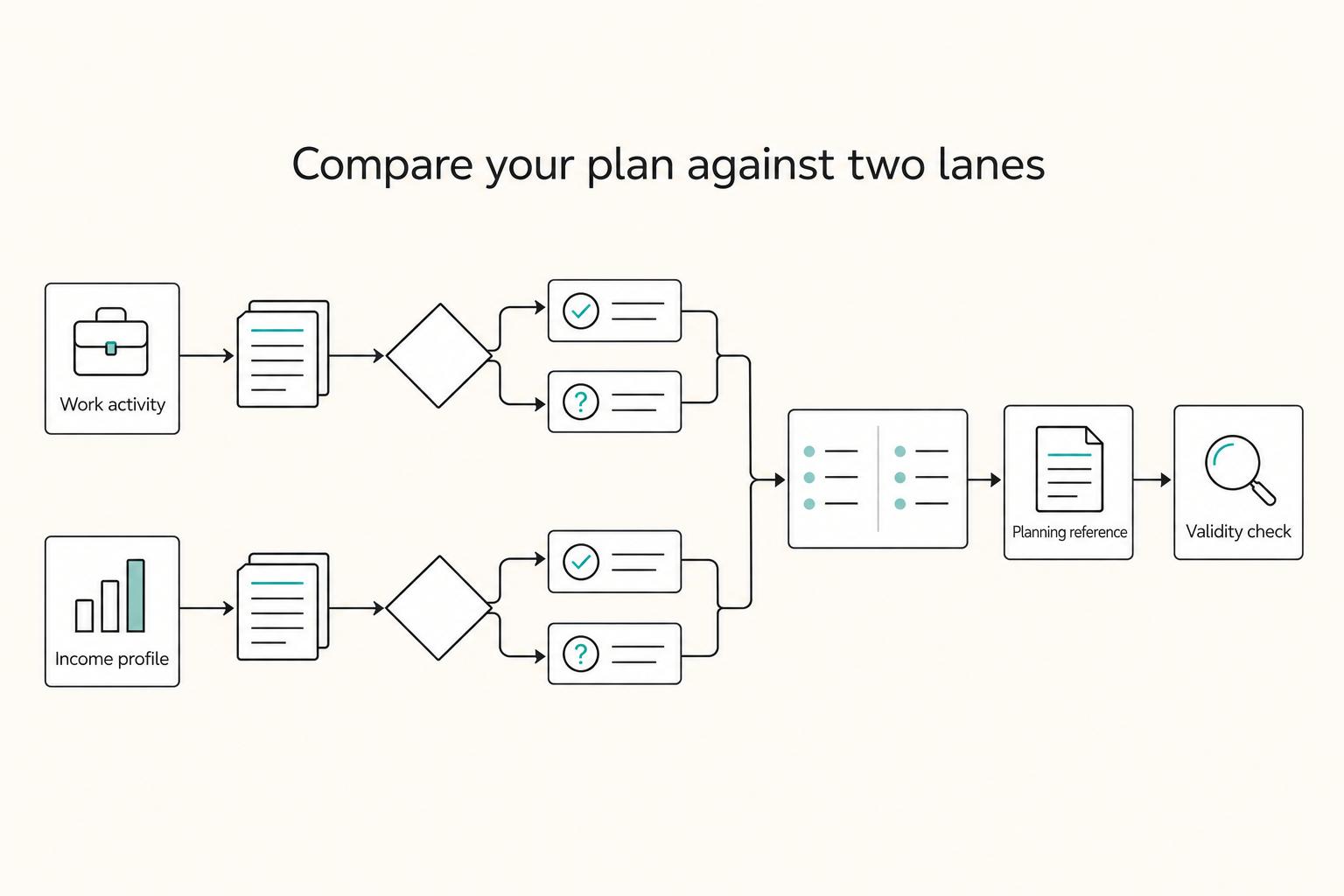
**Use a consulate-aware workflow: lock confirmed rules first, separate local unknowns, and move in sequence to reduce preventable delays in the Spain non-lucrative visa process.**