
Quick Answer
Yes. Portugal’s ARI route is still presented as an investment-led residency path, with real-estate options removed and qualifying funds at the center. For this portugal golden visa guide, the practical sequence is to confirm route eligibility in writing, obtain a NIF, open a Portuguese bank account, complete the investment, and file with AIMA before biometrics. If your plan is full relocation rather than flexibility, compare D7 or D8 first.
Start with intent: residency flexibility or relocation to Portugal#
Choose the Golden Visa if you want residency flexibility with limited time in Portugal. Choose D7 or D8 if you plan to relocate and use Portugal as your primary base.
The first decision is intent. Portugal's Golden Visa, or ARI, is a residency-by-investment route, not citizenship-by-investment. In practice, the split is simple: do you want flexibility and a long-term mobility path, or do you need a relocation visa for day-to-day life in Portugal now?
Use four filters before you go any further#
Run these filters in order before you spend time on documents, funds, or advisers:
| Filter | Grounded detail |
|---|---|
| Liquidity comfort | The fund route is quoted at €500,000. This is a real capital commitment into a qualifying fund, not a filing cost. |
| Time-in-country flexibility | The Golden Visa is described as having a minimal stay requirement of about 7 days/year on average. |
| Administrative tolerance | The process can involve tax complexity and slow timelines. Do not treat it as easy just because it is investment-led. |
| Route fit | ARI fits investment-led residency. D7 and D8 fit relocation-led residency based on income type. |
Compare the three routes honestly#
The clearest comparison is capital commitment versus relocation expectations.
| Route | Core qualification | Capital or income indicator | Stay expectation | Best for |
|---|---|---|---|---|
| Golden Visa / ARI | Qualifying investment, commonly via an eligible fund route | €500,000 fund investment | About 7 days/year | You want residency flexibility without full-time relocation |
| D7 | Passive-income residence visa | Verify the current income requirement. 2025 source example: €870/month (about €10,440/year) | Verify current stay expectation | You have stable passive income and plan to live in Portugal |
| D8 | Remote-work-income residence visa | Verify the current income requirement. 2025 source example: €3,480/month | Verify current stay expectation | You earn remotely and plan to relocate to Portugal |
If you expect to spend most of the year in Portugal, relocation-led routes may be the cleaner fit. If you want residency flexibility while keeping your base elsewhere, ARI is the route to examine more closely.
Real estate is no longer the main question#
Do not start with property. Start with the program structure.
Real estate routes were suspended in October 2023, and the current structure points to qualifying funds as the primary pathway. That changes the upfront work. Instead of comparing properties, you need to confirm fund eligibility.
Based on the quoted rules, verify that the fund has at least 5 years minimum duration at subscription and that at least 60% of capital is invested in commercial companies headquartered in Portugal. Also verify the regulatory setup, including the CMVM supervision context, and ask for a clear explanation of the multi-entity oversight structure described in the fund model.
Quick go or no-go check#
Use this as an early screen, not a final answer:
- Can you commit €500,000 without weakening business or personal liquidity?
- Do you want minimal stay requirements more than immediate relocation?
- Are you comfortable with a 5-year path to citizenship eligibility?
- Can you handle slow processing risk and cross-border tax complexity?
- Are you aligned with a fund-based route rather than a real-estate-led plan?
If you answer "no" to two or more, pivot early to D7 or D8. If most answers are "yes," the next step is fund due diligence.
If you want a deeper dive, read our digital nomad visa index for 50+ countries.
Treat fund selection as an investment decision with immigration consequences#
If you use the fund route, fund selection is the core risk. Treat it as an investment decision with immigration consequences. Do not commit until the terms and exit mechanics are clear.
One 2025 guide notes that Portugal ended real-estate Golden Visa investments in late 2023 and now lists fund investments (about $500K), cultural donations ($200K), and business-creation routes. If you choose the fund path, weak diligence can turn into an expensive mistake. Treat those figures as directional and verify current legal thresholds before you commit.
Start with independent legal-entity verification, not the sales deck#
Your first gate is independent verification of the exact fund entity and manager names across legal documents, subscription materials, and adviser communications.
If names drift, documents are outdated, or the sponsor stays vague about legal entities, stop. Given the scrutiny around due diligence in golden-visa programs, early inconsistency is a serious warning sign.
Split advisor roles before you commit#
Do not let one conversation blur immigration eligibility and investment suitability. Those are different questions, and you should test them separately.
| Role | What to validate |
|---|---|
| Immigration lawyer | Whether the route is being presented as Golden Visa-compatible, what filing evidence may be needed, and how the investment should be documented for your case. |
| Investment professional | Strategy, manager quality, fees, liquidity terms, conflicts, and fit with your risk tolerance. |
| One adviser claims to cover both | Ask what they are formally regulated to advise on, and get a second opinion if scope is unclear. |
Request documents before discussing performance#
An official fund-screening document set for Portugal is not defined here, so use this as a practical diligence checklist, not a legal one. Ask what documents are available, keep a dated folder, and compare the legal terms with the marketing language.
- offering and subscription documents
- investor-summary materials (if provided)
- governance and conflict-management terms
- service-provider setup (for example custody, administration, and audit)
- redemption, transfer, withdrawal, and manager-discretion terms
- full fee schedule with worked net-outcome examples
Break fees into net impact#
If a fee cannot be found in writing and explained with an example, treat it as a risk. You are not only checking what the fund charges. You are checking how those charges affect deployed capital, ongoing drag, and your ability to exit.
| Fee type | Where it appears | What to confirm | Net outcome impact | Red-flag wording |
|---|---|---|---|---|
| Entry/subscription fee | Subscription agreement, fee schedule | Exact rate and calculation method | Reduces capital deployed on day one | "May apply," "case by case," no worked example |
| Annual management fee | Offering docs, manager disclosures | Basis points and charging base | Ongoing drag regardless of performance | "Standard fee" with no calculation basis |
| Performance/carried fee | Waterfall and investor terms | Hurdles and worked examples | Reduces your share of upside | No hurdle detail, no example |
| Admin/custody/audit/operating costs | Expense policy, reports | Which costs are fund-borne and any caps | Compounds friction over time | "As incurred" with no caps or illustrations |
| Exit/redemption/transfer fee | Redemption and transfer clauses | Conditions, timing, and any penalties | Can make exits costly or slow | "At manager discretion," no clear timetable |
Run a strategy-and-exit fit test against your residency timeline#
Before you commit, run a simple screen on program-level constraints: minimum investment threshold, physical-stay burden, and citizenship-path timing and conditions. Then check whether the fund's liquidity and exit terms actually fit that timeline.
Also plan for policy movement. Spain ended new Golden Visa applications on April 3, 2025, which is a practical reminder that program conditions can change quickly.
Related: A Guide to Getting a Golden Visa in Greece.
If you are still weighing Golden Visa versus lower-commitment routes, run a side-by-side check before you commit: Visa options for digital nomads.
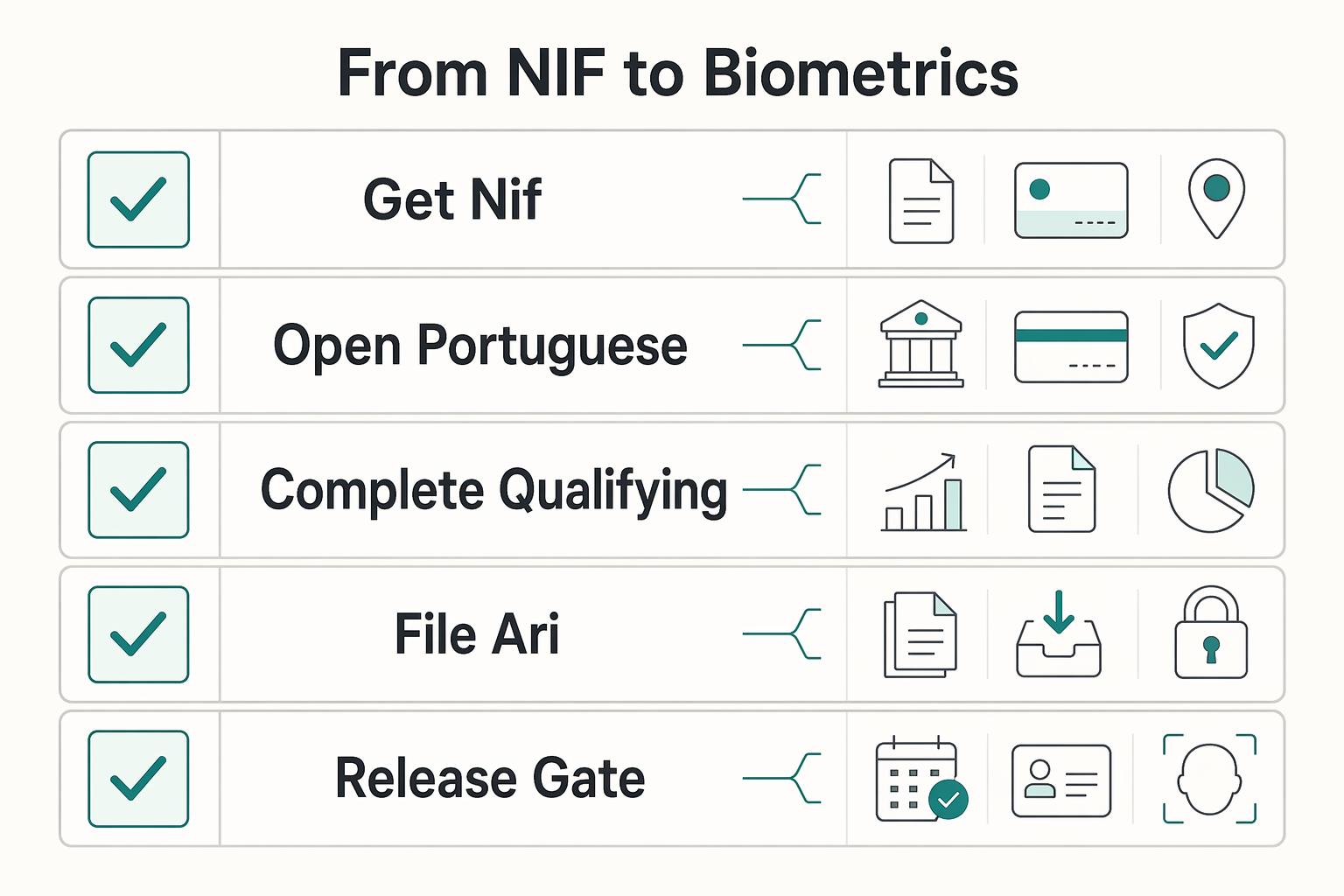
The Core Application Roadmap: From NIF to Biometrics#
Once you choose the investment route, a common working sequence is: NIF -> Portuguese bank account -> qualifying investment -> ARI filing with AIMA -> pre-approval -> biometrics. Exact operational steps can change, so confirm the current AIMA flow before each submission stage. In practice, momentum comes from one thing: keeping your identity details and supporting documents aligned at every step.
| Phase | Main owner | Dependency | Status trigger | Timing |
|---|---|---|---|---|
| Get NIF | You + lawyer | Passport and supporting ID documents | Nine-digit NIF issued | Confirm current processing window |
| Open Portuguese bank account | You + bank | NIF issued | Account active and able to receive funds | Confirm current processing window |
| Complete qualifying investment | You + investment counterparty + bank | Account open | Investment executed and proof issued | Confirm current processing window |
| File ARI with AIMA | Lawyer + you | Identity, compliance, banking, and investment pack complete | ARI application submitted | Confirm current processing window |
| Pre-approval and biometrics scheduling | AIMA + you | ARI application submitted | Pre-approval notice and biometrics appointment notice received | Confirm current processing window |
| Attend biometrics | You + dependents, if included + authority | Appointment notice | Biometrics captured | Confirm current processing window |
Phase-by-phase execution#
The process is straightforward on paper, but small mismatches create delays. Handle each phase as if the next one will reuse the same data.
1) Get your NIF. Submit the NIF request (including e-balcão for eligible foreign-citizen requests), then make sure your identity details match your passport format exactly. Required output: issued nine-digit NIF you will reuse across bank and application records. Common failure point: foreign-language documents are not translated or provided as certified copies where required.
2) Open your Portuguese bank account. Open the account after NIF issuance, then confirm it is ready to receive your transfer. Required output: active Portuguese account with a clear transaction trail. Common failure point: account profile details do not match your passport and NIF details used in other documents.
3) Complete the qualifying investment. Execute the investment steps and funding through the account, then collect the formal confirmation documents. Required output: executed investment plus proof your lawyer can file. Common failure point: relying only on transfer receipts without the full investment confirmation set.
4) File with AIMA. Assemble the full pack, complete the current filing flow (including portal steps where applicable), and submit the ARI application. Required output: submitted ARI file. Common failure point: uploading mixed document versions or inconsistent names across identity, banking, and investment records.
5) Track pre-approval, then attend biometrics. Monitor for pre-approval and appointment notice, then prepare the originals and required IDs for appointment day based on the current notice. Required output: biometrics successfully captured. Common failure point: treating pre-approval as final issuance or arriving without the appointment-day document set confirmed by your counsel.
Document pack by phase#
A clean file is easier to build now than to reconstruct later. Organize the pack by document type and keep the same naming convention throughout.
- Identity documents: obtain them, then certify/apostille and translate if required.
- Compliance documents requested for your case: obtain them, then certify/apostille and translate if required.
- Banking documents, including NIF record, bank onboarding file, and transfer evidence: obtain and file them as issued.
- Investment documents, including the executed investment file and confirmation evidence: obtain and file them as issued.
- Family documents for the path you choose (initial inclusion or later reunification): obtain them, then certify/apostille and translate if required.
Family branch: include now or reunify later#
This is mainly a timing and document-readiness decision. If family records are complete now, one synchronized case may be cleaner. If not, delaying them may keep your own filing moving.
| Path | Choose this path if... | What to verify before you commit |
|---|---|---|
| Add dependents at initial filing | You already have family civil-status records ready and want one synchronized case | Current AIMA document requirements and filing flow for initial inclusion |
| Use later reunification | Your own file is ready now, but family documents would delay submission | Current Article 98 eligibility conditions, applicable exceptions, and current AIMA practice |
For reunification timing, Article 98 sets a general rule tied to valid residence duration and also lists exceptions for certain permit holders (including family members of holders under Articles 90, 90-A, or 121-A). Confirm the current eligibility criteria and operational practice right before you make that branch decision.
For related mobility-planning context, see A Guide to Greece's Digital Nomad Visa and its 50% Tax Break.
Beyond the Application: Managing Your Asset for the Long Term#
Approval is not the end of the job. After approval, the work becomes operational: keep the qualifying investment, presence records, and identity documents organized so each renewal, and any later citizenship application, can be built from a live file rather than rebuilt under pressure.
That discipline matters. Residency-by-investment programs are associated with corruption, money-laundering, and tax-evasion concerns, and a clean, continuous record is one of the few protections you control directly.
Treat this as a live evidence workflow#
Do not wait for renewal to start organizing. Save each new document the day it is issued, keep prior versions, and use consistent filenames such as YYYY-MM-document-type.pdf so you can find the current file quickly.
Use two storage locations:
- A structured cloud folder shared with your counsel
- An offline backup copy
Suggested core folders:
- Identity
- Residence cards
- Travel evidence
- Fund documents
- Bank evidence
- Criminal record
- Insurance
- Family documents
- Authority correspondence
Monitor the two items that usually create gaps#
Common renewal gaps are missing evidence of continued investment or weak travel records. Your holding period is active, not passive. Keep proof that the qualifying fund position is still held, not just proof of the original transfer, and keep your travel evidence current as trips happen.
Market sources often summarize the stay requirement as an average of 7 days per year, but you should confirm the current legal rule and counting method before relying on that figure.
A practical budget note: one market source estimates ongoing legal support for renewals at about €1,500 every two years. Treat that as planning input, not an official fee schedule.
Renewal readiness by trigger point#
Renewals usually go more smoothly when you treat them as a series of checkpoints rather than a single deadline.
| Trigger point | What to check and save | Why it matters |
|---|---|---|
| Before submission | Confirm the qualifying investment is still held. Collect currently valid identity documents, travel log evidence, and other renewal documents as applicable. Confirm the current document-validity rule. | Missing or expired documents are a common failure point. |
| At submission | Save the exact set filed, or sent to counsel, along with submission receipts and a dated index of included files. | You need a frozen record of what was actually submitted. |
| After submission | Save acknowledgments, appointment notices, follow-up requests, and every reissued document version. Confirm the current response deadline rule. | Delays can come from missed follow-ups or wrong document versions. |
Do not assume healthcare access starts immediately after submission. Confirm your current entitlement and arrange interim coverage if needed.
Make tax decisions by profile#
Generic tax advice is not enough here. Use your actual profile and cross-border exposure.
| Profile | Recommended step |
|---|---|
| U.S. person | Treat specialist cross-border tax advice as required early. |
| Non-U.S. with ties in multiple countries | Get advice when income, assets, or residence links cross borders, to reduce dual-reporting or disclosure risk. |
| Plan to spend substantial time in Portugal | Get country-specific advice before your first full tax year so your immigration and tax records stay aligned. |
Treat citizenship as a milestone path, not an automatic result#
A later citizenship application is possible only if the underlying record stays intact. Commercial sources commonly describe a path to apply for citizenship after 5 years, but the outcome depends on execution.
Keep these dependencies intact throughout the period:
- Maintain the qualifying investment for the required term.
- Keep complete stay evidence for the residence history you claim.
- Keep renewal records consistent and audit-ready.
Confirm current citizenship eligibility criteria, timing rules, and required supporting documents before you rely on the timeline.
For a step-by-step walkthrough, see A Deep Dive into Portugal's 'Golden Visa' Real Estate Fund Option.
Conclusion: Treat this as a decision process#
Treat this as a decision process, not a lifestyle purchase. Confirm route fit, verify the current eligibility details, execute cleanly, and set up your documentation workflow from day one.
The most avoidable mistake is acting on stale visa content. Practical guides can help you compare options, but they are curated, not exhaustive, and they do not replace legal advice. Treat Portugal-specific Golden Visa thresholds, timelines, stay requirements, and family eligibility details as unconfirmed. Before you move funds or lock document timelines, get a written eligibility view from qualified immigration counsel based on the rules in force now.
| Reactive approach | Planned approach |
|---|---|
| Starts with headline benefits and assumes the route still fits. | Tests route fit first, then compares alternatives for your actual timeline and goals. |
| Treats details from an article as final. | Confirms the qualifying route and current requirements in writing before transfer. |
| Waits to organize records until requested. | Sets up a document process early, tracks expiries, and keeps a live evidence file. |
| Treats approval as the finish line. | Plans for follow-through and record retention from the start. |
What to do next:
- Confirm whether this route fits your real objective: mobility, relocation, or another long-stay option, and test it against any 6-12 month planning horizon that matters to you.
- Verify current eligibility and qualification details in writing before any transfer or filing step.
- Align your advisers early so legal and reporting work stay consistent.
- Build your documentation process now so execution stays predictable.
If this route still fits after verification, and you can carry the obligations it requires, it can support long-term optionality. If family inclusion is part of your plan, treat it as conditional and confirm eligibility and document rules before relying on it.
Related reading: A Guide to Getting a Golden Visa in Spain.
As you move from decision to execution, keep your travel pattern and residency evidence organized with the tax residency tracker.
Frequently Asked Questions
Is the Golden Visa still a real pathway in 2026?
Yes, as framed here it remains a residency-by-investment path, not direct citizenship by purchase, and one advisory source refers to the framework as ARI. What you still need to verify is the exact qualifying category and minimum amount before moving funds. Advisory sources state a fund route starting at EUR500,000 and that real estate ended in October 2023, but you should confirm what is valid now. Your next action is to ask counsel for a written eligibility memo that names your exact route under the rules in force today.
How should you choose a qualifying fund?
Choose based on whether you can hold and document the investment through the required period, not just whether the fund is easy to enter. Advisory guidance cites a 5-6 year holding window, so confirm lock-up, liquidity, fees, redemption terms, and current ARI qualification in writing. Your next action is simple: do not transfer capital until counsel confirms the fund still qualifies for your case.
What about tax and compliance?
Immigration approval does not remove reporting risk. Investment-migration programs are scrutinized for money-laundering and tax-evasion concerns, so your filing position needs to match your citizenship, residence pattern, and assets. Confirm that position with a cross-border tax adviser. Your next action is to set up your source-of-funds and account-record process before your first filing cycle.
Can you include your family?
Possibly, but family inclusion is highly fact-specific and the evidence rules can change. Confirm current eligibility and document requirements, including whether apostilles, translations, or refreshed certificates are needed. Your next action is to build a separate family document pack early so expiring records do not block your filing window.
How much time do you need to spend in Portugal?
Relocation expectations are often summarized loosely in market materials, but shorthand is not a legal rule. Confirm the current minimum stay requirement, counting method, and accepted proof standards, adding the current requirement after verification. Your next action is to keep a live travel log from day one with supporting entry, exit, and trip records.
What is the main risk to plan around?
The main planning risks are processing variability and policy movement. One advisory estimate shows 12-18 months, and a March 2026 advisory update says proposed nationality-law changes were not law and that key provisions were found unconstitutional. What matters is checking current queue conditions and nationality-law status, since Parliament can revise and resubmit changes. Your next action is to budget for delays and compare non-investment alternatives, including the Portugal Digital Nomad (D8) Visa: A Complete Guide and A Guide to Portugal's D7 Visa for Passive Income Earners.
Try a related tool
Researched and edited by the Gruv editorial team. Gruv builds cross-border billing, payouts, and finance-operations software for global businesses.
Sources
Includes 2 external sources outside the trusted-domain allowlist.
- europarl.europa.eu/cmsdata/155728/EPRS_STUD_627128_Citizenship%...trusted
- gepac.gov.pt/apoios-e-incentivos/aritrusted
- info.portaldasfinancas.gov.pt/en/tax-information/getting-started-in-portug...trusted
- oecd.org/content/dam/oecd/en/publications/reports/202...trusted
- state.gov/page/13trusted
- www2.gov.pt/pt/servicos/renovar-a-autorizacao-de-residenciatrusted
- abrotherabroad.com/long-term-visa-residency-directory-for-nomad...external
- amirismail.com/european-golden-visas-guideexternal
Educational content only. Not legal, tax, or financial advice.
Related Posts

The 2026 Global Digital Nomad Visa Index for 50+ Countries
Start with legal fit, not lifestyle filters. The practical order is simple: choose a route you can actually document, then decide where you want to live. That single change cuts a lot of wasted comparison work and stops you from falling in love with places that were never a real filing option.

Portugal Digital Nomad Visa Decisions That Prevent D8 Delays
Start with verification, not paperwork. In this research set, some material is useful only as EU VAT context, not as D8 instruction, and mixing those categories is one of the fastest ways to build the wrong plan. We use the same separation rule in [Global Digital Nomad Visa Index](/blog/global-digital-nomad-visa-index) comparisons.

A Guide to Portugal's D7 Visa for Passive Income Earners
**Run your D7 process like an operating plan with decision gates, not a one-time application.**