
Quick Answer
To get a Greece Golden Visa, first confirm you qualify as a non-EU investor applicant, then verify the current property route and threshold for the exact asset, prepare your identity, visa, insurance, and property documents, file the residence permit application, and attend in-person biometrics in Greece. Do not rely on older summaries because property rules and appointment timing can affect the whole plan.
Start here and set expectations#
If you are a non-EU remote professional planning a real move, a part-year base, or a longer stay in Greece, treat this as a residence-permit process first and a property purchase second. This guide helps you sequence the work correctly: timeline, document checklist, and decision checkpoints that can save you from moving money or booking travel too early.
This is for readers who need more than short Schengen travel and are considering the Greece Golden Visa Program. If your plan is only occasional travel of up to 90 days in any 180-day period, you are in Schengen short-stay territory. If you expect to stay longer than 90 days, you move into national-procedure territory. That makes permit details the core planning issue.
The goal here is practical. By the end, you should know what to verify first, which documents to prepare in parallel, and where delays usually start. The common pressure points are file readiness, health insurance evidence, and biometric appointment timing.
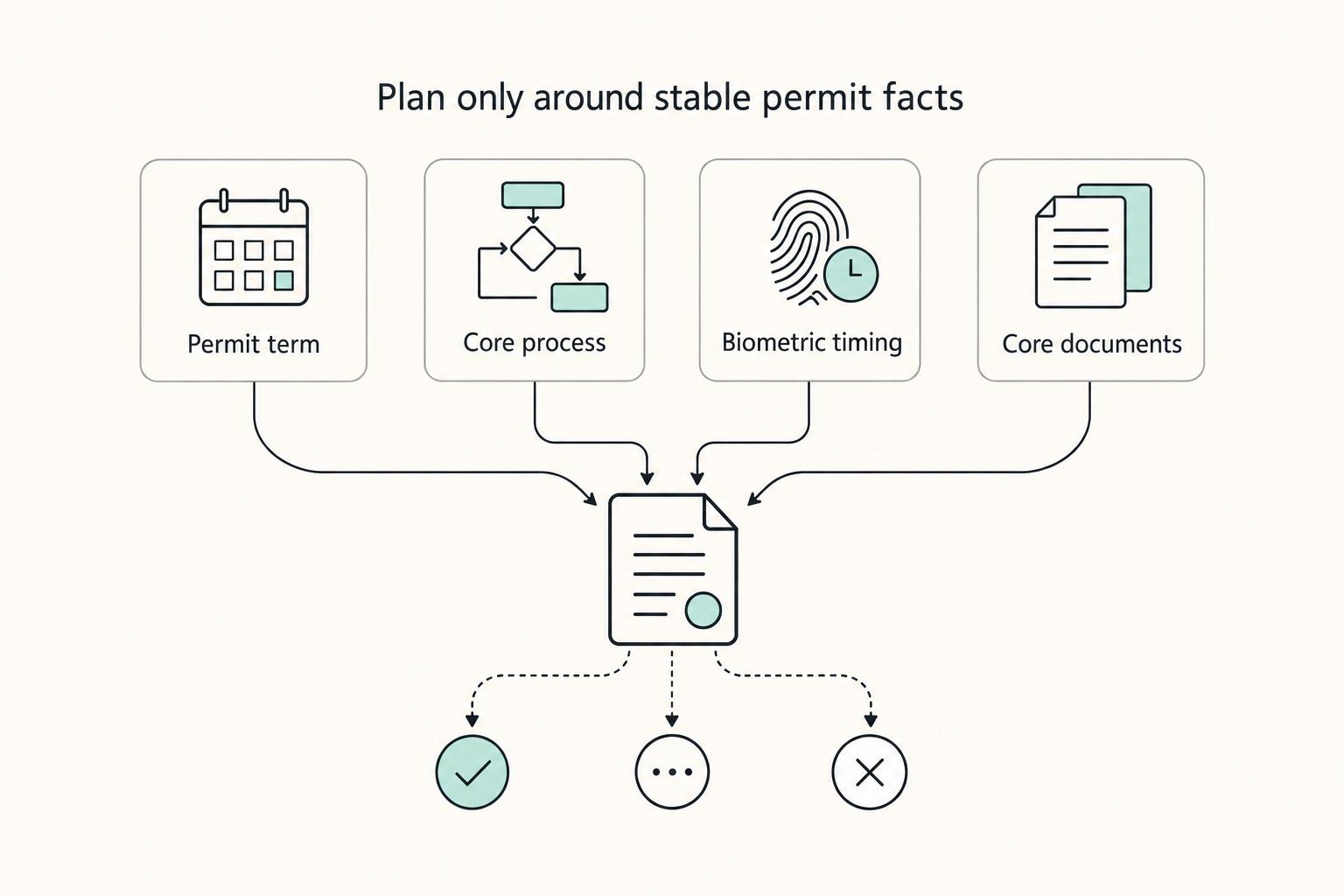
What is stable enough to plan around#
| Planning point | Current detail |
|---|---|
| Permit term | The Ministry of Foreign Affairs presents this as a route for non-EU property buyers and their family members to obtain a 5-year renewable residence permit in Greece. |
| Core process | The process includes an application file, documentary evidence, and a biometric submission step. |
| Biometric timing | Investor biometric appointments are released through ministry notices, so appointment windows can become the pacing item even in clean cases. |
| Core documents | Core document requirements include a certified copy of a valid passport, or other recognized travel document with the valid national visa referenced in ministry requirements, and private health insurance covering health and safety risks. |
The practical takeaway is simple: if your relocation date is fixed, do not assume biometric timing will naturally line up with your property timeline.
What must be re-verified before you commit#
The program is stable enough to plan around, but the investment rules are not something to treat as static. A ministry circular dated 25-09-24 states that Law 5100/2024 amended the framework, and published amounts include €800,000, €400,000, and €250,000 cases. The same guidance also references property-specific constraints, including a single property rule in certain cases and a 120 m² minimum in specified built-property scenarios.
So treat thresholds, property-configuration rules, and implementation details as live checks, not assumptions pulled from older summaries or buyer anecdotes. Be equally precise about fees. The ministry page lists €16 for printing the electronic residence permit document, but that is only one line item in the wider cost picture.
If you keep one rule from this guide, use this one: verify current eligibility and property-route rules before you pay a deposit or lock travel. A strong property cannot fix an ineligible route, and a strong file can still stall if it is built on outdated assumptions. For a step-by-step walkthrough, see A Guide to Getting a Golden Visa in Spain.
Understand what this permit is and what it is not#
This is a classification step, not a marketing decision. The current evidence pack is VAT-focused and does not verify Greece permit or citizenship rules, so treat those points as unverified until you have current immigration law in writing.
The safest way to avoid an expensive mistake is to separate outcomes that often get blurred together in sales conversations. For now, treat property purchase, residence status, travel convenience, and citizenship as separate questions that need separate confirmation.
Ask your lawyer or adviser for a one-page written memo that states:
- the exact status you would hold
- the rights it grants now
- the limits that still apply
- the conditions you must keep meeting after approval
- whether citizenship is part of that status or a separate pathway
Use a hard rule here: if you cannot explain in one sentence what this status gives you today and what it does not, pause before signing anything. If your main goal is immediate passport access, reassess this route before you commit capital.
Confirm your eligibility before you view properties#
Do an eligibility pre-check before viewings, reservations, or deposits. If your applicant status, criminal-record requirements for your route, or insurance evidence is unclear, resolve that first.
Official materials frame this route for non-EU, or third-country, applicants and reference the initial permanent investor residence permit under article 20B. Start by confirming that this is the investor path you are using. Then confirm that you can produce the core identity set, including a certified copy of a valid passport or other travel document recognized by Greece, with a valid national visa where required.
| Pre-check item | What to confirm now | Proof to gather now | Where certified/public documentation matters |
|---|---|---|---|
| Non-EU applicant scope | You are applying as a third-country national under the investor route | Passport/travel document and any visa relevant to your filing path | Certified copy of the valid passport or recognized travel document |
| Criminal-record requirement | Whether your route asks for criminal-record evidence, and from which country or countries | If available, any existing police certificate, residence-history summary, and written legal guidance for your case | If requested, use records issued by the relevant public authority |
| Health insurance requirement | You can show private coverage that meets the filing standard | Insurance contract covering health and safety risks | Keep the full contract or policy document, not only summaries |
Treat the criminal-record point as unresolved until it is confirmed for your case. Non-official sources conflict on when and where criminal-record checks apply. Get written confirmation from your lawyer or the relevant Greek consular channel before you commit funds.
Use a practical go or no-go rule: if criminal-history handling is unclear, insurance evidence is incomplete, or identity documents do not align, pause the property side and fix the file first. Migration ministry materials also state that a document issued by a public authority must be provided, so prepare at least one such document early.
Use this one-sitting self-audit before you move on to real estate:
- I am a non-EU, or third-country, applicant pursuing the investor residence route in Greece.
- I have a valid passport or recognized travel document and can provide a certified copy.
- My identity details are consistent across core records.
- I have confirmed whether my route includes a consular step.
- I have asked whether criminal-record evidence is required for my specific route.
- If criminal-record evidence may be required, I know which country or countries would issue it.
- I can provide a private insurance contract covering health and safety risks.
- I have at least one public-authority document ready for legal review.
- If any item is uncertain, I will resolve it before paying a deposit.
You might also find this useful: How to Dissolve a US LLC.
Choose the investment route with clear decision rules#
Once your eligibility file is basically sound, choose the property route by legal fit first and price second. If eligibility depends on special property status, especially an industrial-to-residential conversion or historic-building category, do not move funds until your lawyer confirms in writing that the asset fits the current investor residence permit rules.
Current official materials under Law 5100/2024 and Article 100 (type B.5) support three practical screening buckets:
| Route type | Minimum amount referenced in current materials | Where it applies | What to verify before signing |
|---|---|---|---|
| Standard purchase in high-demand areas | €800,000 | Greater Athens, greater Thessaloniki, Mykonos, Santorini, and islands with more than 3,100 inhabitants | Confirm the property is in the higher-threshold geography and that the minimum value is tied to one property |
| Standard purchase in other areas | €400,000 | Areas outside the high-demand group above | Confirm location classification and whether built or permit status triggers additional area rules |
| Conversion or special category route | €250,000 | Industrial buildings converted into housing, and historic buildings | Confirm the conversion or special status is formally documented and accepted before deposit or closing funds move |
What to verify before you sign anything#
Check these points in order, because each one affects the next:
- Property classification: confirm whether the asset is residential, a qualifying industrial-to-residential conversion, or another category that may not fit the €250,000 path.
- Geography: confirm whether the asset falls into the €800,000 or €400,000 tier, especially in boundary cases.
- Permit and area rules: for built property, or property with a building permit, current materials reference a 120 sq.m. minimum main area. That minimum does not apply to unbuilt property or property without a building permit.
The operator check that prevents expensive mistakes#
Before reservation money is sent, ask for a short written legal memo that states:
- Property classification
- Municipality or island location
- Applicable tier (€800,000 / €400,000 / €250,000)
- Whether the 120 sq.m. rule applies
- Why the one-property rule is satisfied
Confirm operating restrictions early as well. Current government communication says qualifying residential property cannot be used for short-term rentals. If your economics depend on short-term rental income, reassess before purchase.
Lowest entry price vs lower execution risk#
The €250,000 route is the lowest entry point in current materials, but it can carry higher execution risk because eligibility may depend on formal conversion or special-status documentation. In practice, that means deeper property due diligence and much less room for assumption.
The €400,000 or €800,000 standard purchase routes require more capital, but they may be easier to validate when location and classification are clear.
What is still unknown and must be confirmed locally#
The tier structure is clear, but a full municipality-by-municipality matrix is not available here. Treat boundary and exception cases as unresolved until local counsel confirms them in writing against Law 5100/2024 and Article 100. If that verification is not possible before funds move, pause the transaction.
Need the full breakdown? Read A Guide to Indonesia's 'Second Home' Visa. Before you commit funds, compare this path against other relocation options with the Visa Cheatsheet for Digital Nomads.
Assemble your document pack in the right order#
A practical way to manage this is to run two parallel tracks that merge only when both are internally consistent: personal evidence and property evidence. This reduces late mismatches that can delay filing and biometric scheduling.
There is no official fixed certification, translation, and legalization sequence in the material provided here, so use the order below as a working method and let local counsel adjust it for your case.
Use a working order that reduces rework#
| Step | Working order |
|---|---|
| 1 | Lock the exact filing list first and confirm which personal and property documents are actually required for your permit file. |
| 2 | Collect the latest source versions and do not process older versions if a document has been renewed, corrected, or reissued. |
| 3 | Check identity fields before processing so names, passport details, dates, and document numbers align across the file. |
| 4 | Complete required certifications or legalizations on final versions and avoid processing documents that may still change. |
| 5 | Translate only after source documents are settled to prevent translation-to-source mismatches. |
| 6 | Build submission-ready sets and keep clean digital and paper sets where each source document maps clearly to its processed version. |
Run personal and property evidence in parallel#
| Track | What belongs here | What must match before merge |
|---|---|---|
| Personal evidence | Passport and other identity-linked documents; entry-stamp evidence if your route requires it | Identity fields match across all personal records; only current versions are included |
| Property evidence | Purchase or ownership documents and route-specific proof | Property classification, location, and route basis are consistent across records |
| Final submission set | Combined file for filing and appointment support | Each processed document maps to the correct source document, with no conflicts between personal and property records |
If you are relying on the €250,000 special category, make sure the property file clearly documents successful change of use to residential before you finalize the combined pack.
Treat in-person steps as timeline anchors#
Do not assume a fully remote route until your counsel confirms your exact process in writing. Some guidance says applicants must visit Greece at least once for an entry stamp before applying, while other guidance markets a remote path. Since those claims conflict, plan conservatively.
What is clearly supported is that biometric submission is in person at the Decentralized Authority and includes facial image, fingerprints, and signature capture.
The delay pattern to avoid#
A common delay pattern is a file that looks almost complete but still has mismatched identity fields, outdated source documents, or incomplete processed records. Those issues can delay filing acceptance, push back biometrics, and force parts of the document chain to be redone.
Before filing, do one final page-by-page consistency check so the personal track, property track, and appointment set all tell the same story. If you want a deeper dive, read The 2026 Global Digital Nomad Visa Index for 50+ Countries.
Map your timeline from first call to permit card#
Work backward from your biometric submission trip in Greece. If your move date is fixed, lock the biometrics travel window early and treat everything else as dependency management: lawyer onboarding, property closing, document processing, filing, then biometrics.
There is no official government week-by-week SLA for the full path, so use this as a working sequence, not a promise. For most third-country nationals, a Type D national visa is part of the route before the in-country permit step. The investor permit track is listed as article 20B. Filing can be done by a lawyer under Power of Attorney. Biometrics require in-person attendance.
| Sequence checkpoint | What usually happens | Dependency checkpoint |
|---|---|---|
| Pre-filing setup | Route confirmation, lawyer onboarding, and document preparation | Nationality, entry route, and investment route confirmed in writing |
| Property + file prep | Property closing and permit file assembly | Personal and property files are complete and internally consistent |
| Filing | Permit file submitted, via lawyer where permitted | Filing accepted by the competent authority |
| Post-filing | Filing certificate, often called the blue paper, issued; biometrics booked when slots open | Booking channel is active for investor appointments |
| Post-biometrics | Case proceeds to decision and permit card issuance | No unresolved corrections remain |
The booking constraint to plan around#
Biometric booking is a real dependency, not a final formality. Ministry notices show investor biometric slots are activated operationally through the lawyers' platform, so do not assume immediate next-day availability after filing.
For planning, add buffer when travel demand is high. Related MFA appointment guidance points to peak visa months often falling in May through September. Before you book travel, ask your lawyer how and when investor biometric slots are currently released for your filing location.
Clean-file path vs correction path#
A clean file usually moves in a straight line: onboard counsel, close property, file, receive the filing certificate, attend biometrics, then wait for permit issuance. Some practitioner sources describe the route as mostly remote-capable with in-person biometrics, but treat that as common rather than universal.
A correction path usually adds delay in one of these places:
- Document inconsistencies that require file corrections before or after filing
- Additional property or personal paperwork requested before final review
- Late biometric booking because filing happened too close to the intended move date
If any of those show up, build in more time before you commit to move-date obligations.
What to expect after filing#
After submission, you should receive temporary proof of filing, often called the blue paper or filing certificate, while the case is pending. That is the checkpoint showing the case is in queue.
Issuance timing is the least predictable part. Non-government sources cite roughly 2 to 6 months for initial permits, with regional variation, and another cites timelines from 4 months. Use those only as planning ranges. Also account for the listed €16 fee for printing the electronic residence permit document. Related: The Taiwan Gold Card: A Visa for High-Skilled Professionals.
Budget the full move, not just the headline investment#
The property threshold is only the entry ticket. Before you commit funds, build an all-in model for the real estate investment route in Greece. Include the qualifying asset amount, transfer tax, permit-side fees, document and admin steps, professional support, and relocation overhead.
| Cost line | Required or variable | What to budget now | What to verify before paying |
|---|---|---|---|
| Qualifying property amount | Required | €800,000 in higher-threshold markets, €400,000 in other areas, or €250,000 for industrial-to-housing conversions and historic buildings | Confirm location, asset type, and that any exception category applies to your case under current rules |
| Real Estate Transfer Tax | Required for purchase | 3% of the taxable property value, buyer responsibility | Confirm the taxable value basis used for your transaction |
| Electronic fee (Article 132) | Required in the permit process | Confirm with the relevant authority | Confirm current amount and payment method at filing |
| Electronic residence permit printing fee | Required | €16 | Confirm timing and who will process payment |
| Notary and land-registry documentation | Effectively required for the property route | Variable professional and administrative cost | Request written estimates tied to your transaction structure |
| Other professional and relocation costs | Variable | Budget as ranges, not assumptions | Get line-item quotes instead of a bundled total |
The threshold rules themselves can change your total plan. The cited update shows a split between €800,000 and €400,000 by area, with €250,000 tied to specific categories rather than all properties. It also states that residential assets acquired under the new rules must be at least 120 sq.m. and cannot be used for short-term rentals, which affects both eligibility and how you can use the property.
If your margin is thin, stop until every non-property cost line is modeled. Fee schedules and implementation details can shift, and the framework has been updated through Law 5100/2024, so re-verify current practice before you sign, wire, or file.
Plan what can be remote and what requires travel#
Build your plan around one hard boundary: biometric submission is the in-person step in Greece. Much of the rest is often handled remotely, so biometrics is usually the key travel dependency. A practical split looks like this:
| Commonly handled before travel | Typically requires presence in Greece |
|---|---|
| Selecting a qualifying property | Biometric submission for the residence permit process |
| Completing purchase steps under Greek rules | |
| Preparing certified documentation | |
| Coordinating residence permit application steps |
Keep one distinction clear in your planning: a Type D entry visa and a Greek residence permit are different stages. Do not build your timeline as if one automatically replaces the other.
A practical way to minimize trips#
Use a travel-readiness checkpoint:
- property-side prerequisites are in place for your case
- certified documentation is prepared
- your residence permit filing steps are organized
- any Type D visa question is resolved so visa-entry and permit-card stages are not mixed
- travel is aligned with the biometric step, not unfinished prep work
The process is often described as straightforward, but it still rewards careful sequencing. We covered related planning in Portugal Golden Visa in 2026 for Remote Professionals.
Avoid the delay traps that derail otherwise strong applications#
Many avoidable delays start with file quality. Before biometrics, fix gaps in property due diligence, health insurance proof, and identity consistency, because incomplete files can be returned as incomplete and push your timeline back by weeks or months.
The three risks that matter most#
| Risk | What the file should show |
|---|---|
| Property due diligence gaps | Property documentation clearly connects the contracted parties' personal data, the property details, and the payment type, and the certificate of encumbrance from the land registry or national cadastre shows no encumbrance. |
| Weak health insurance proof | Private insurance covers health and safety risks. |
| Identity discrepancies across documents | Names, passport details, and other personal data match across passport, translated records, property paperwork, insurance, and application forms. |
If you see weakness in any of those three areas, fix it before submission rather than hoping it will pass on review.
Red flags that your file may stall#
Treat your file as high risk for delay if you see:
- a foreign public document missing Apostille where Apostille validation is required
- a private document translated before authentication or certification
- property papers that do not clearly evidence legal status and payment traceability
- insurance proof that does not clearly show the required coverage
- inconsistent identity details across documents
Recovery actions that actually help#
If certification or translation is the issue, fix the document chain rather than arguing around it. Complete required Apostille or legalization first, then official translation for Greek use. If identity details conflict, correct the source document where possible and update the translation so the full pack is consistent.
If property due diligence is unclear, pause submission until legal status and encumbrance status are clear in writing. After submission, track your case through the official residence-permit progress service and follow up based on actual file status. Follow up again only after correction documents are complete and tied to your application reference.
Know your long-term obligations before you commit#
Approval is the start of the compliance phase, not the end of the process. Before you commit capital, get your post-approval obligations for the Greek residence permit in writing, because Greece-specific renewal, travel, and citizenship rules still need direct verification.
The European Union VAT One Stop Shop (OSS) rules illustrate how long-term obligations work: a participant registers in one Member State of identification, must keep records, and can be excluded by a Member State. That is VAT guidance, not immigration guidance, but it reinforces a useful point: assumptions create risk when long-term obligations are not documented.
Get the post-approval answers in writing#
For residence permit renewal, do not stop at "it's renewable." Ask for the operating details you will actually need later: what starts the timing, when filing can begin, which documents are re-checked, how personal-data changes are handled, and whether dependent timelines match the main applicant.
Ask for one written note that connects your permit type to renewal logic and required documents. If you cannot get that in writing before investing, treat that as a real decision risk.
Keep permit status separate from future outcomes#
No citizenship pathway from permit status has been established here. Plan around the status you actually hold now, not a future outcome that is unverified.
Apply the same caution to cross-border assumptions. If living or working across borders is central to your plan, get a current written clarification before purchase.
Build your calendar on day one#
You can still set up a practical compliance system as soon as you are approved, without asserting Greece-specific deadlines:
- Document log: Keep one folder for approvals, identity records, filings, and receipts.
- Open-questions tracker: List unresolved items (renewal timing, required documents, mobility scope) and close each one with written guidance.
- Identity consistency: When any personal detail changes, check that the full file still matches across documents.
- Periodic review: Reconfirm with a current Greece-specific source that requirements and procedures have not changed.
If you keep one rule from this section, use this: approval does not end compliance. Leave the process with written guidance, a complete document archive, and realistic expectations on status and future options. Related reading: A Guide to Getting a Long-Stay Visa in France.
Make your first decision this week#
Make one decision now: if your eligibility file is not clearly ready, run an eligibility-first check before you spend time on listings or deposits. If your baseline is already strong, move straight to property-route validation and confirm whether a specific asset fits the current rules.
Start with the weaker side of your file#
Delays often come from file readiness, not intent. If you are still unsure about non-EU eligibility, visa posture, or insurance, start there. The route sits under the Article 20B investor permit. The core pack includes a certified copy of a valid passport, or other recognized travel document, a valid national visa, and private health insurance covering health and safety risks.
That order matters. A property can look perfect and still stall if your personal file is not submission-ready. Confirm early whether your stay is expected to exceed 90 days, because that points to long-stay national-visa rules. Also plan around the consular reality: visa filing is in person and appointment-based, so timing can move before you ever reach the residence-permit stage.
If your eligibility is solid, pressure-test the property route#
If passport, visa path, and insurance are already in place, use this week to validate the real-estate route in writing. Ask for written confirmation of the asset category, location, applicable threshold, and whether eligibility depends on a special category such as a conversion case.
Do not treat reported thresholds as interchangeable. Reported changes effective March 31 point to €800,000 and €400,000 levels by area, with €250,000 reported for some industrial-to-housing and historic-building cases. There is also a reported 120 sq.m. minimum for certain residential assets, plus a reported restriction on short-term-rental use for qualifying residential property. If a deal only works because someone says it qualifies as a conversion case, pause until your lawyer confirms that classification against current migration guidance.
Settle work-rights assumptions before capital moves as well. This route provides a renewable 5-year residence permit in Greece with Schengen mobility scope, but an official publication states it does not entitle holders to work in Greece.
Keep the sequence tight#
Use the checkpoints in this order:
- Confirm eligibility and visa posture.
- Validate the investment route and exact property classification.
- Build the document pack, keeping personal documents separate from property evidence.
- Map timing, including consular appointments and biometrics after filing.
- Book travel only when the earlier steps are actually ready.
This order reduces avoidable rework. Biometrics are a post-filing dependency, and appointment activation notices are published for investor applicants who have already filed.
If you want operational help with cross-border money movement during your relocation plan, book a demo to confirm market coverage.
Frequently Asked Questions
What is the minimum investment for the Greece Golden Visa Program, and when does the lower threshold apply?
There is no single flat minimum. Current materials reference €800,000 in specified high-demand locations, €400,000 in other areas, and €250,000 only for specific categories such as qualifying conversions and historic-building cases. In certain built-property scenarios, current guidance also references a 120 m² minimum main area, so confirm the asset category and location before paying.
How long does a Greek residence permit application usually take from submission to decision?
There is no single dependable timeline. Estimates cited in the article range from 2 to 6 months and 3 to 12 months, so timing varies in practice. If your move date is fixed, plan around document readiness, property closing, and biometrics scheduling rather than any promised processing window.
Can I complete the process remotely, or do I need to travel to Greece?
Plan for at least one trip to Greece. Many steps can often be handled remotely, but biometric submission requires an in-person visit. Book travel only after your personal and property documents are ready so the trip is for biometrics rather than unfinished prep.
What documents are most likely to cause delays if they are prepared incorrectly?
The highest-risk delay items are identity, insurance, and property documents. The article highlights the certified copy of a valid passport or other recognized travel document, a valid national visa where required, private insurance, and property papers that clearly show the contract, payment method, and no encumbrance. Mismatched identity details or weak document chains can push the file back.
How long is the permit valid, and what is required for residence permit renewal?
Official channels present the investor residence permit as valid for 5 years and renewable. One official renewal page cited in the article states that the real estate must remain in the ownership and possession of the interested party. Get the current renewal document list in writing before you invest.
Does this permit automatically lead to Greek citizenship?
No. The residence permit and citizenship are separate tracks. Official guidance cited in the article frames citizenship as a naturalisation process with its own filing steps and references 7 years of permanent and legal residence in Greece. The permit itself is not an automatic path to a passport.
What should I verify first before paying for a property?
Verify asset eligibility first. Get written confirmation of the applicable threshold, the property's classification, whether any lower threshold depends on a conversion or special category, and whether it fits the investor permit track under article 20B. Then validate contract terms, the payment route, and title cleanliness before funds move.
Researched and edited by the Gruv editorial team. Gruv builds cross-border billing, payouts, and finance-operations software for global businesses.
Sources
- home-affairs.ec.europa.eu/policies/schengen/visa-policy_entrusted
- migration.gov.gr/en/golden-visatrusted
- migration.gov.gr/wp-content/uploads/2024/10/9%CE%95%CE%B3%CE%...trusted
- newsletters.enterprisegreece.gov.gr/newsletter-articles/greece-adjusts-golden-vi...trusted
- oecd.org/content/dam/oecd/en/publications/reports/202...trusted
- taxation-customs.ec.europa.eu/archives/taxable-persons/vat-cross-border-ru...trusted
- vat-one-stop-shop.ec.europa.eu/one-stop-shop_entrusted
- vat-one-stop-shop.ec.europa.eu/index_entrusted
Educational content only. Not legal, tax, or financial advice.
Related Posts

The 2026 Global Digital Nomad Visa Index for 50+ Countries
Start with legal fit, not lifestyle filters. The practical order is simple: choose a route you can actually document, then decide where you want to live. That single change cuts a lot of wasted comparison work and stops you from falling in love with places that were never a real filing option.
Taiwan Gold Card Application Strategy for Remote Professionals
Treat this process as a chain of linked decisions, not a race to submit. If you are planning a serious move or a long stay in Taiwan, the safer outcome usually comes from choosing the right route first and proving each core claim before you pay or file. The Taiwan Employment Gold Card rewards that discipline because it combines four functions in one status: a work permit, resident visa, Alien Resident Certificate (ARC), and re-entry permit.

How to Dissolve a US LLC Without Leaving Loose Ends
Before you file anything, run one checkpoint. If you cannot list every state where your LLC is registered and your federal tax classification, you are not ready to close. Treat the LLC as closed only when both tracks below are complete and documented.