
Quick Answer
Start by treating the german artist visa process as an evidence review: prove financial viability, show real client demand, and use the filing route that matches your nationality. Assemble documents so your service story stays consistent across the business plan, forecast, and supporting records, then confirm whether you file through a mission abroad or after arrival with the Ausländerbehörde. After entry, complete Anmeldung, submit tax registration through ELSTER, choose your VAT approach, and set invoice wording to match it before paid work begins.
Phase 1: Why Your Application is a Business Proposal, Not a Plea#
For this route, your application is assessed on evidence, not on artistic merit alone. You need to show two things clearly: you can support yourself, and your freelance activity is expected to create a positive economic or cultural effect. If either point is weak, your file reads as higher risk.
The anchor here is Plausibilitaet. The case has to be credible on paper, not just persuasive in conversation. That is why the business plan matters so much, and why every supporting document has to reinforce the same story.
| What the officer sees | Plausible story | Weak story |
|---|---|---|
| Income path | Forecast shows how current work connects to projected income, with the amount verified against source records and demand evidence behind it | Large revenue claims with no support or no clear link to your current work |
| Market demand | Berlin letters of intent describe cooperation and the type and scope of work | Generic references or vague interest without defined scope |
| Overall consistency | CV, portfolio, forecast, and financial records support the same service line | Documents point to mismatched services, clients, or income levels |
That is the shift. You are still a creative professional, but the file has to read like a sustainable business case. Keep the legal framing straight. This is a freelance residence permit basis within self-employment, not a standalone legal category called an "artist visa."
What this changes in your file#
Build your file around one clear business story.
- Positioning: define your service, target client type, and market focus clearly.
- Evidence quality: prioritize documents that prove demand and viability. Baseline items commonly include the application form, passport, business plan, and health insurance proof.
- Consistency: make sure your CV, portfolio, client letters, and financial narrative support the same core story.
Do not treat each document as a separate task. You are building one argument across multiple documents. Phase 2 covers how to make the forecast credible, and Phase 3 covers how client letters support that forecast.
If you want a separate walkthrough of the broader freelancer route, see How to Get a Residence Permit in Germany as a Freelancer.
Phase 2: Building Your Financial Moat: Crafting a Revenue Forecast That Inspires Confidence#
Your financial section has one job: show, quickly and credibly, that you can support yourself. The file is reviewed as a whole, not line by line, so your bank proof, letters of intent, health insurance, and forecast need to line up.
Applications are assessed case by case. Use current official guidance as your primary reference, and match your labels and document order to the latest checklist for the residence permit for freelance employment.
Build this section as three linked proofs#
Think of the financial section as a sequence, not a spreadsheet dump.
| Proof | Focus | Article detail |
|---|---|---|
| Sufficient funds (present tense) | Present funds | Show accessible funds clearly, with current bank evidence that matches the rest of your file |
| Rentabilitaetsvorschau (future income) | Future income | Show a realistic income and cost forecast grounded in actual demand evidence |
| Finanzierungsplan (bridge plan) | Bridge plan | Show how current funds cover early costs until recurring income carries more of your baseline |
- Sufficient funds (present tense): show accessible funds clearly, with current bank evidence that matches the rest of your file.
- Rentabilitaetsvorschau (future income): if your checklist uses this label, show a realistic income and cost forecast grounded in actual demand evidence.
- Finanzierungsplan (bridge plan): if your prep materials use this label, show how current funds cover early costs until recurring income carries more of your baseline.
Fill your numbers in reviewer order#
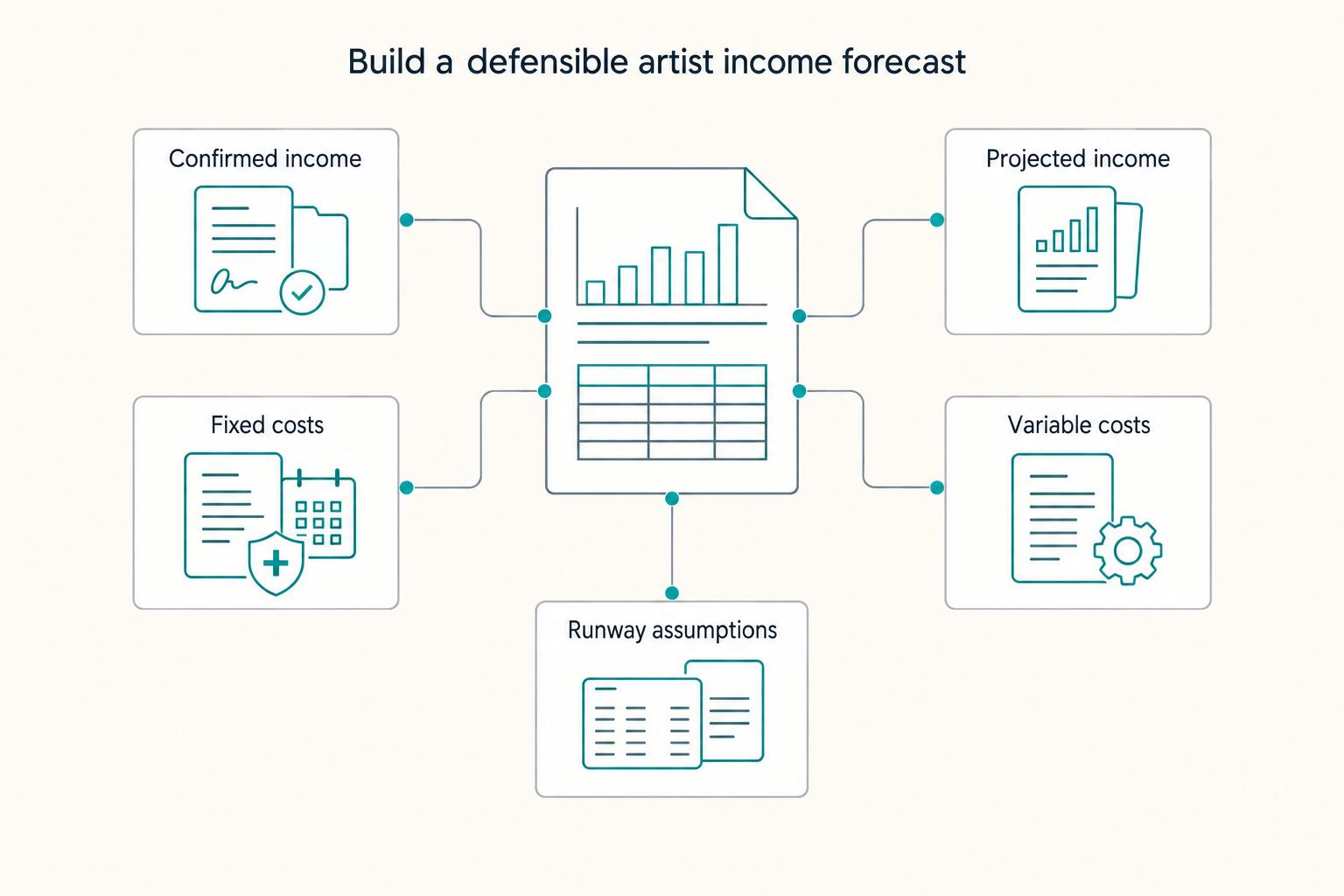
Fill this in the order a reviewer is likely to read it: funds on hand, confirmed income, projected income, then costs. Keep fixed and variable costs separate so the reviewer can follow your runway logic without guessing.
| Line item | Should be supported by | What the reviewer is checking |
|---|---|---|
| Confirmed income | Letters of intent and matching file evidence | Whether near-term income is already grounded |
| Projected income | Clear assumptions tied to your current service line | Whether projections are plausible |
| Fixed costs | Ongoing baseline commitments, including health insurance where applicable | Whether your baseline is realistic |
| Variable costs | Delivery-related costs that rise or fall with projects | Whether margin assumptions make sense |
| Runway assumptions | Bank statements plus bridge-plan narrative (if used) | Whether existing funds appear to cover the gap before income stabilizes |
Use current figures only after you verify them. Keep dates and currency treatment consistent across every row.
Consistency checks before submission#
Most weak financial sections fail on mismatch, not math. Run these checks before you submit:
- Match each confirmed-income line to the Phase 3 demand evidence with consistent scope and timing.
- Make sure bank proof and runway assumptions use the same balances, dates, and currency logic.
- Keep health insurance treatment consistent between your cost section and supporting documents.
- Relabel or remove projected lines that are not yet supported by evidence.
- Organize your dossier in checklist order, for example binder sections with matching sequence, to reduce avoidable review friction.
- Start collecting letters of intent early so your forecast and demand evidence are ready together.
Phase 3: Securing Your Revenue Pipeline: Turning 'Letters of Intent' into Proof of Demand#
Treat each Letter of Intent as evidence, not decoration. If a letter does not map clearly to a revenue line in your Rentabilitätsvorschau, it will be harder to use as support and may lead to follow-up document requests.
At this stage, your job is to show demand for the work you plan to deliver. Berlin's LEA accepts Absichtserklärungen and expects collaboration details plus a clear description of activity type and scope. Requirements can vary by mission and location, so confirm the checklist with the embassy, consulate, or authority handling your case before you finalize anything.
What a reviewer needs to see#
A useful LOI should support the same story as your business plan and three-year revenue forecast. Do not assume one universal LOI count or template across Germany; verify local expectations first. Before using a fixed LOI count in your prep tracker, confirm the current expectation for client letters with the relevant immigration office or source records.
| Area | Strong LOI | Weak LOI |
|---|---|---|
| Collaboration details | Confirms intended engagement and explains the planned working relationship | Only says the client is "interested" or "may work with you" |
| Type and scope of activity | States concrete services, deliverables, or support scope | Uses vague language like "creative help" or "consulting services" |
| Compensation detail | Includes rate, fee, budget, or volume assumptions when available, and these can be traced to your forecast | Gives no commercial detail, so the revenue line cannot be checked |
| Client identity | Clearly identifies the potential client making the statement | Uses an unclear sender identity or missing identifying details |
Plausibility is the test#
A strong LOI works because it is plausible in context, not because it looks polished. Before you submit, check each letter against this list:
- It maps to one
Rentabilitätsvorschauline with consistent service, timing, and value logic. - It is consistent with your business plan and stated service offering.
- It is concrete enough that a reviewer can understand the work without guessing.
- It can stand up to follow-up document requests during review.
A common mismatch is a forecast with multiple income streams while the letters support only one vague stream.
A clean way to ask clients#
Make the request short and practical. Ask for the points that tend to matter in review:
- Context: you are preparing a freelance residence application in Germany and need a brief statement of intended collaboration.
- What to include: collaboration details, service type, scope, and any rate, fee, or budget detail the client can confirm.
- Deadline: give a clear date so letters and forecast are finalized together.
- Format: request a client statement that clearly identifies who is making it.
Prepare LOIs as upload-ready files. In Berlin's online flow, the total upload size is capped at 100 MB and each file at 7 MB. Keep files clearly named and easy to match to forecast lines.
Phase 4: The Definitive German Visa Checklist (Your Professional Dossier)#
By this point, the goal is not to add more paperwork. It is to remove doubt. For your Ausländerbehörde review, each document should support one coherent story: you can carry out your freelance work and support yourself.
Audit your dossier like a reviewer#
Use this as an operational check, then confirm your exact venue requirements before filing.
| Core dossier item (verify for your venue) | What it proves | Common rejection trigger |
|---|---|---|
Valid passport, VIDEX application form, biometric photos | Identity and basic completeness | Expired passport, incomplete or wrong form, unusable photo, or treating a driving licence as a travel document |
Proof of accommodation and, where relevant, Anmeldung | A real address trail and plausible local setup | Address details conflict across documents, or registration is missing where your local process expects it |
| Travel health insurance document | Active coverage for your application path | Policy details are unclear, dates do not align with your timeline, or identity/coverage period is unclear |
| Professional background evidence (for example CV, portfolio, diplomas, or certifications), if requested | Your claimed freelance activity is plausible | Evidence does not clearly match the services you say you provide |
| Financial proof (for example bank statements and any venue-required planning documents) | Financial viability and runway | Financial evidence is unclear or conflicts with the rest of your file |
| Client-demand evidence (for example letters of intent), if requested | Real demand for your services in your target market | Evidence is too vague to support your service and revenue story |
One classification point can affect the whole file: Germany distinguishes Freiberufler and Gewerbetreibender. If your activity description and supporting evidence point in different directions, your category choice can look inconsistent.
Run one plausibility check across the whole file#
Read the dossier horizontally, not one document at a time. Your address documents, insurance, professional evidence, and financials should all describe the same working reality.
If your Anmeldung, professional profile, and revenue plan point to different activities or timelines, the file can look inconsistent even when each document is individually valid. Aim to keep one primary activity clear and make sure your supporting evidence follows the same logic as your financial plan.
Decide your application venue before final assembly#
This decision affects the whole assembly process, so verify it before you package anything. Do not rely on forum summaries. Confirm current routing with the embassy or consulate responsible for your case and, if relevant, the local Ausländerbehörde.
| Status | Route note | Verify |
|---|---|---|
| EU/EEA/Swiss citizen | Non-government guidance says you can move to Germany and freelance without a visa | Verify it before you package anything |
| Passport from Australia, Canada, Israel, Japan, New Zealand, South Korea, the UK, or the USA | Non-government guidance describes a procedural advantage | Treat this as a verification prompt, not an automatic approval path |
| Other nationalities | Embassy routing may apply | Confirm the exact process with the responsible mission |
Once you verify your route, record the responsible mission or office, the date checked, and whether you can apply in Germany in your file.
Final pre-appointment prep#
Before the appointment or online submission, do one final clean pass.
- Put files in a consistent order: identity, address, insurance, professional proof, financial proof, client evidence.
- Use clear filenames and keep originals plus clean copies aligned to your checklist.
- Confirm translation, certification, or notarization requirements for your exact venue before submission.
- Recheck names, dates, addresses, and activity wording across all documents so your plausibility story stays consistent.
Phase 5: Your First 30 Days in Germany: The Freelancer's Compliance Kickstart#
Once the application side is under control, the next risk is operational slippage. Your first month is an admin sprint: get registered, start tax setup, choose your VAT path, and make sure your invoicing setup matches that choice.
Priority map (what depends on what):
- After
Anmeldung: startELSTERregistration, prepare tax-registration data, set up banking, draft invoice templates. - After
Finanzamtreview: receive yourSteuernummerby post. - After
FinanzamttoBZStrouting (if requested): receive yourUSt-IdNr.by post. - In parallel: confirm your residence route is valid for in-country freelance setup. For this route, a Schengen
Cvisa is not sufficient.
Register with the tax office first#
Treat Steuernummer setup as an early task. The Fragebogen zur steuerlichen Erfassung is submitted electronically, and it must be sent within one month of starting your activity.
- Register for
ELSTERfirst, because it is required for submission. - Prepare your core inputs before filing, including your registered address and the activity details requested in the questionnaire.
- Submit the
Fragebogen zur steuerlichen ErfassunginELSTER. - If needed, request your
USt-IdNr.in the questionnaire, or apply later via the BZSt online form.
A practical note: save your ELSTER submission confirmation and date. Steuernummer and USt-IdNr. are separate, and VAT ID routing can take weeks, so do not plan cash flow around immediate issuance.
Choose your VAT route on purpose#
Make the VAT decision early, because it affects invoices, pricing, and setup. Decide whether Kleinunternehmerregelung under §19 UStG fits your business model.
Kleinunternehmerregelungmay fit if you want simpler billing, expect lower turnover, and do not need meaningful input VAT recovery.- Standard VAT handling may fit better if you have material setup costs or want full VAT treatment from day one.
- Tradeoff to remember: under
Kleinunternehmerregelung, you do not charge VAT, but you also cannot deduct input VAT.
Do not rely on old threshold figures. §19 UStG was recast from 1 January 2025, so verify current limits for your start year before deciding.
Set up banking and invoices in parallel#
Once you choose the VAT path, your banking and invoicing setup should follow it.
| Setup choice | Usually fits when | What to check now |
|---|---|---|
| Personal account | You need the fastest start and can still keep records clean | Bank terms and whether business flows stay clearly trackable |
| Dedicated account | You want cleaner bookkeeping from day one | Opening requirements and payment operations for client billing |
| Standard VAT invoice template | You are not using Kleinunternehmerregelung | Required invoice content under §§ 14 and 14a UStG, including VAT where applicable |
Kleinunternehmer invoice template | You are using §19 treatment | Required invoice content under §§ 14 and 14a UStG plus no-VAT wording, e.g. Als Kleinunternehmer im Sinne von § 19 Abs. 1 UStG wird Umsatzsteuer nicht berechnet |
If account opening is delayed and you are legally resident in the EU, check whether a Basiskonto is available as a fallback for basic payment access.
Common week-one mistakes to avoid:
- Waiting to start tax registration until your first client invoice is due.
- Using outdated VAT threshold numbers without checking the current year.
- Drafting invoice wording before deciding your VAT treatment.
By day 30, confirm these checkpoints#
By the end of the first month, you should be able to confirm the basics without guessing:
| Checkpoint | What to confirm |
|---|---|
| Address registration | Your address registration is complete within the two-week window |
| ELSTER and tax questionnaire | Your ELSTER access is active and your Fragebogen zur steuerlichen Erfassung was submitted within one month of activity start |
| USt-IdNr. | You tracked whether you requested a USt-IdNr. and planned for separate postal issuance |
| VAT path | Your VAT path is chosen after checking the current §19 UStG rules for your start year |
| Banking and invoices | Your bank setup and invoice template match the VAT treatment you selected |
| Residence route | If your residence process is still in progress, your path for in-country freelance setup is valid and not based on a Schengen C visa assumption |
Conclusion: Submit one coherent file and keep operating after approval#
At this point, the task is simple in concept: submit one coherent file that shows real demand for your work, proof of financial means for your project and living costs, and a compliance setup that matches your route.
That is the practical frame for what many people call the German "artist visa." In practice, "artist visa" is usually a label for the freelance visa/residence path, not a separate legal category. The outcome depends on route fit, document consistency, and correct filing steps, not the nickname. Uncertainty is normal, and local requirements can change, so confirm current embassy, consulate, or local Ausländerbehörde rules before you book, file, or travel.
Before you submit or move forward, run this check:
- Route confirmed: You have verified whether your case is visa-first or post-arrival residence-permit filing, based on your specific situation.
- Stay length aligned: If you plan to work independently for more than 90 days, your route and paperwork match that longer-stay path.
- Document set is consistent: Your application documents and financial evidence tell one consistent story on services, timing, and income assumptions.
- Local filing channel verified: If you are filing in Berlin, you use the LEA online application for initial or extension filings, and you are not treating a short-stay Schengen C visa as sufficient for this route.
- Arrival admin planned: If you file after arrival, you plan your
Anmeldungwithin 14 days of moving in. - Follow-up buffer ready: You are prepared to provide additional documents if the office requests them after filing.
If any point is weak, fix it before you file. The most common avoidable problem is not one missing page. It is a package that tells two different stories.
Approval is the start of operations in Germany, not the end of the process. After approval, you still need to run the freelance activity cleanly, complete required tax registration steps, including ELSTER where applicable, and maintain viable income for extensions. In Berlin, permits are time-limited, and renewal depends on sustained, successful activity.
Frequently Asked Questions
Can you apply from inside Germany, or do you need a visa before travel?
Start with your nationality, because that determines the route. The cited route states that British citizens, plus citizens of Australia, Canada, Israel, Japan, New Zealand, Korea (Republic), and the United States of America, can apply after arrival through the local Ausländerbehörde, while other nationalities need a visa before travel. Confirm the current eligible nationality list before you book travel.
If you apply after arrival, how quickly do you need to act?
Act immediately after landing. The cited guidance says to contact immigration authorities as soon as possible and apply within the first 90 days of your stay. Treat appointment booking as an immediate task so delays do not consume your timeline.
When can you actually start paid freelance work?
Do not start paid work until your visa or residence permit explicitly authorizes self-employment. Entry permission and work authorization are separate, even when you enter visa-free. Read the exact wording on your document before invoicing or starting economic activity.
What are the most common route mix-ups?
Use this quick check before you file: | Confusing point | What it means for you | What to verify next | |---|---|---| | Apply after arrival in Germany | Available only to certain nationalities | Confirm the current eligible nationality list and contact the Ausländerbehörde quickly after arrival | | Apply from home country before travel | Required for other nationalities | Follow your German mission checklist and complete the VIDEX online application form if listed | | Visa-free stay vs work authorization | Not the same permission | Confirm your document explicitly authorizes self-employment before working |
What financial proof should you prepare?
Use your mission checklist and current official guidance for the financial evidence your case needs, and keep figures consistent across your file.
What documents should show client demand?
Use the document list from your mission or Ausländerbehörde, and keep any client-work evidence specific and consistent with the rest of your application.
How do you check whether your demand documents are strong enough?
Review them as one package before submitting. Names, dates, services, and payment assumptions should not conflict across your CV, portfolio, and financial narrative. Fix contradictions before filing to avoid avoidable questions.
Do you need `Anmeldung` before the immigration step?
Plan for it early if you are applying after arrival. The cited guidance says to register your residence (Anmeldung) with the local Meldebehörde within 2 weeks of moving in. Keep the registration proof ready and keep your address consistent across documents.
What should you do about insurance?
Treat insurance as a verification step, not an assumption. The acceptance standard is not defined here, so confirm current requirements directly with your German mission or the Ausländerbehörde handling your case. Check that policy details and dates match your planned stay before submission.
Do you need German language skills for this route?
If your office communications are in German, arrange translation support early so admin steps do not delay your file.
Try a related tool
Researched and edited by the Gruv editorial team. Gruv builds cross-border billing, payouts, and finance-operations software for global businesses.
Sources
Includes 2 external sources outside the trusted-domain allowlist.
- curia.europa.eu/site/upload/docs/application/pdf/2025-08/ra_...trusted
- ec.europa.eu/citizensrights/front_end/docs/faq.pdftrusted
- lawreview.uchicago.edu/sites/default/files/2024-09/Testing%20for%20...trusted
- lourdes.edu/wp-content/uploads/2024/02/2013-14-Academic-...trusted
- okwu.edu/wp-content/uploads/2024/08/2024-2025-TRAD-Un...trusted
- scad.edu/sites/default/files/PDF/scad-2025-2026-acces...trusted
- bogota.diplo.de/resource/blob/2593948/ce3614703809d3b2d0854d...external
- chelseadinen.com/freelance-visa-in-germanyexternal
Educational content only. Not legal, tax, or financial advice.
Related Posts

The 2026 Global Digital Nomad Visa Index for 50+ Countries
Start with legal fit, not lifestyle filters. The practical order is simple: choose a route you can actually document, then decide where you want to live. That single change cuts a lot of wasted comparison work and stops you from falling in love with places that were never a real filing option.

Can Digital Nomads Claim the Home Office Deduction?
Claim the deduction only when your facts and records can carry it. With the home office deduction for digital nomads, the real decision is usually a three-way call: claim it, do not claim it, or pause and get help because your file is not ready.

How to Get a Residence Permit in Germany as a Freelancer
**Treat your German freelance residence permit like an operations project, and you will cut avoidable delays before they start.** The hardest part is often not the forms but the uncertainty around procedure, especially if you are working from Berlin-based experience while local office workflows shift as you prepare paperwork. Confusion costs time, money, and momentum.