
Quick Answer
Start by aligning your books and tax return, then choose the method your reviewers need. For most private solo businesses, GAAP is not automatically required outside SEC filing contexts, but lenders or investors may still expect accrual-style statements tied to U.S. GAAP in the FASB Codification. Cash basis is simpler for daily tracking, while accrual better reflects period performance when invoice timing and cash timing diverge. If you change tax method, confirm the Form 3115 process before filing.
Is GAAP a Legal Requirement for Your Solo Business?#
Usually not, at least for private solo businesses outside SEC filing contexts. The legal mandate is tied to SEC filings. Regulation S-X (17 CFR Part 210) governs financial statements filed with the SEC, and public companies file a 10-K each year. For most private owner-operators, the practical question is whether outside parties still expect formal financial statements.
| Situation | Legal requirement | Commercial expectation | Operational benefit |
|---|---|---|---|
| Public company SEC filer | Yes. SEC-filed statements are expected to follow GAAP unless the SEC provides otherwise | Very high | Required for filing and external reporting |
| Private solo business in funding discussions | Usually no blanket GAAP mandate | Often higher, since lenders, crowdfunders, or investors may expect financial statements | Can make external review easier with more formal statements |
| Private owner-operator with no outside financial review | Usually no | Lower | Priority is keeping books and tax method consistent |
If someone asks for "GAAP," they usually mean U.S. GAAP as defined through the FASB Codification, not just tidy bookkeeping. Your immediate decision, though, is often your tax accounting method. IRS rules require you to use a consistent method. Cash method reports income when received and expenses when paid. Accrual method reports income when earned and expenses when incurred. When GAAP statements are not required, FRF for SMEs is also a non-GAAP framework option.
Before you change anything, confirm your current method in both your books and your last filed return. If you need to change your tax accounting method, use Form 3115.
- Confirm whether your books and tax return use cash or accrual.
- Identify who reviews your financials today: only you, or outside funding parties too.
- Decide whether to keep your current tax method or prepare more formal statements for funding conversations.
If you want a deeper dive, read Hiring Your First Subcontractor: Legal and Financial Steps.
The Professionalism Signal: How GAAP Principles Win Enterprise Client Trust#
Client trust often comes down to whether your records are consistent, traceable, and easy to follow. In practical terms, your contract terms, invoices, and bookkeeping should tell the same story without extra interpretation.
Here, professionalism is less about labels than about a repeatable, traceable workflow.
What reviewers need to see#
You may deal with multiple reviewers during onboarding, but the core need is the same: your file should be clear, consistent, and traceable.
| Documentation area | What should be easy to verify |
|---|---|
| Scope and terms | What was agreed, and what changed |
| Timing and coverage | When work happened and what each invoice covers |
| Record traceability | How invoices and supporting documents align with internal records |
Ad hoc vs standardized presentation#
| Dimension | Ad hoc presentation | Standardized, traceable presentation |
|---|---|---|
| Credibility signal | Can look reactive when documentation changes each cycle | Usually looks more deliberate when records follow a repeatable structure |
| Due-diligence readiness | More follow-up is often needed to clarify context | Review is typically simpler when documents are organized and internally consistent |
| Review friction | Clarification loops are more likely when records do not match | Fewer clarification loops when details are consistent and easy to trace |
What "speaking their language" looks like#
Keep your documentation structure consistent every time. Use the same naming and formatting conventions across contracts, invoices, and internal records. Keep the support package easy to trace back to the underlying agreement: signed contract, scope changes, invoice, delivery or acceptance evidence when relevant, and matching record detail.
Many organizations use repeatable review processes. If your records are standardized and traceable, reviewers can move through them with less ambiguity.
Short execution checklist#
Before onboarding starts, tighten the package so reviewers do not have to guess what happened.
- Standardize invoicing inputs so key fields are named and formatted the same way every cycle.
- Keep internal records aligned to a consistent timeline and documentation structure.
- Package support before onboarding: contract, scope changes, invoices, delivery or approval evidence, and matching record detail.
- If you use outside help, keep accounting and finance training assignable and track completion.
For a related documentation workflow, we covered this in detail in A Guide to 'E-Discovery' for Small Businesses.
The Clarity Engine: How to Predict Your Next Cash Flow Crisis#
If you want early warning before cash pressure hits, use a weekly projection, not your bank balance alone. Cash-only tracking shows what already moved. A projection that tracks open receivables, expected payment timing, and committed outflows helps you see timing gaps before they become problems.
That matters in practice. Profit is often reviewed monthly, but cash moves daily. A weekly view gives you a control point to manage timing, not just totals.
| Forecast question | Cash-only view | Projection view with timing assumptions |
|---|---|---|
| When does revenue show up in planning? | When payment arrives | Expected collections are tracked before cash lands |
| What obligations are visible? | Mostly what is due now or already paid | Upcoming payables and other commitments can be included ahead of payment |
| How useful is it for next-period planning? | Limited when timing is unclear | Stronger, because expected inflows and outflows are mapped by date |
| Main risk | False comfort from a healthy current balance | Better visibility, but only if payment timing assumptions are realistic |
A short scenario that changes the decision#
A healthy balance today can make new spending look safe. Then reality catches up. Open invoices may pay later than expected, while payables and committed costs still come due on schedule.
The core forecasting question is whether likely collections will land before planned outflows. Receivables and payables do not follow the same schedule, so a business can look profitable on paper and still face liquidity strain.
A weekly workflow you can actually run#
The fix is not complicated. Run one weekly review before you approve new spending.
| Step | Details |
|---|---|
| Review open invoices | Assign realistic expected payment dates |
| Review upcoming obligations in one view | Vendors, contractors, renewals, and other committed costs |
| Compare inflow timing and outflow timing week by week | Spot shortfalls early |
| Run a pre-commitment check | If spend lands before likely collections, delay spend, accelerate collections, or line up contingency funding first |
Multi-currency needs one anchor#
If you operate in multiple currencies, keep currency labels explicit in your forecast so timing and amounts stay easy to review. ISO 4217 currency tags such as USD and CNY can help keep entries consistent. Detailed accounting treatment for currency translation is not covered here, so confirm your approach with your accountant before using it in formal financial reporting.
For the bookkeeping side, see How to Manage Bookkeeping for Your Freelance Business.
The Risk Shield: Building a Defensible Record for Taxes and Life Goals#
If you want lower compliance risk and cleaner financing or diligence conversations, build your evidence chain before anyone asks for it. Keep your records period-aligned and connected from agreement to invoice to delivery support to expense backup, so a third party can follow what happened and when.
That discipline matters because the IRS places the burden of proof on you, and deductions generally need documentary support. Cash-method books can still be valid when used consistently. But cash timing alone can make income and expense timing harder to explain when payments are delayed or prepaid.
| Record style | Tax defensibility | Lender readability | Due diligence readiness |
|---|---|---|---|
| Cash-only records | Can support returns if maintained consistently, but timing can blur when income was earned and when costs relate to the work | Bank activity may look uneven when large payments land late or early | May require extra cleanup to explain open invoices, unfinished work, or obligations not yet paid |
| Accrual-aligned records | Stronger period matching because income is recorded when earned and expenses when incurred | P&L and balance sheet views are often easier to read as operating performance, not just cash movement | Often a better starting point for partner, investor, or sale review because records track activity by period |
Build the evidence chain before scrutiny#
For each material revenue line, keep one linked packet: terms or agreement, invoice date and amount, and delivery support appropriate to the work. You do not need one perfect document type; you need a traceable chain from contract terms to earned income.
For expenses, keep support that identifies the payee, amount paid, proof of payment, and date incurred. One weak point is relying only on a card statement without the underlying receipt or bill. Another is recording the item in a period that does not match the underlying transaction.
Turn irregular cash timing into lender-ready reporting#
Before you seek funding, keep financial statements current and easy to reconcile. SBA guidance emphasizes showing revenue, expenses, and profit over time, so your job is to make that trend readable from your books.
- Maintain a consistent P&L and balance sheet each close period.
- Reconcile major payment delays or prepayments so cash timing is clearly separated from earned income.
- Keep open invoices, major contracts, and unusual one-time items flagged for follow-up questions.
If cash is uneven but underlying earnings are steadier, accrual-aligned records make that easier to show. That is the practical value here: not a universal legal requirement, but a clearer operating record.
Keep controls simple enough to repeat#
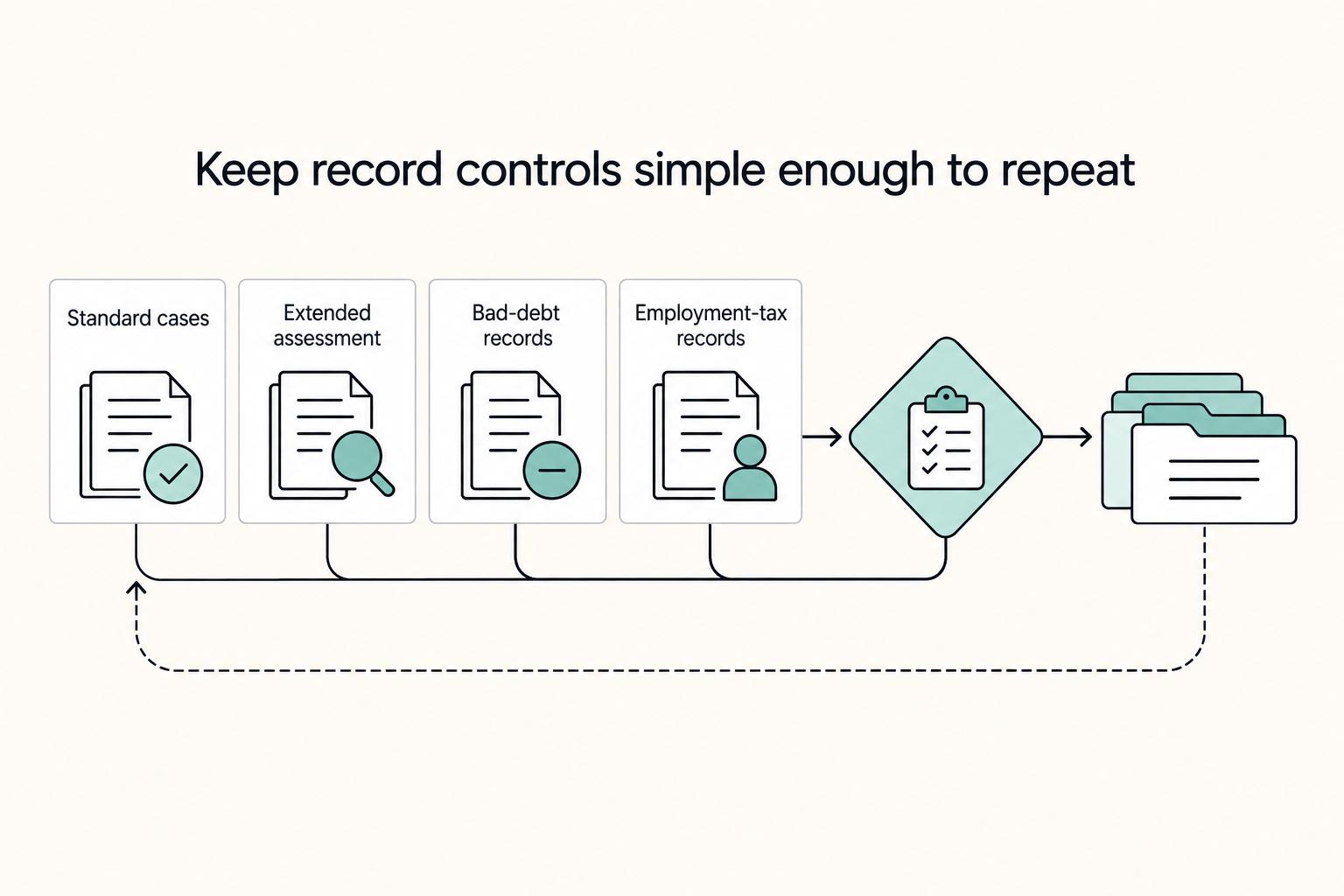
The standard only matters if you can keep it up. Use a monthly close routine, keep source documents with transaction batches, and apply retention rules you can sustain.
| Situation | Retention timeline |
|---|---|
| Standard cases | 3 years |
| Unreported income exceeds 25% of gross income shown on the return | 6 years |
| Certain bad debt or worthless securities claims | 7 years |
| Employment tax records | At least 4 years |
- Confirm invoices and bills are recorded in the correct period.
- Match each material revenue item to terms and delivery support.
- Match each material expense to receipt or bill and proof of payment.
- Retain records for applicable IRS timelines: 3 years in standard cases, 6 years when unreported income exceeds 25% of gross income shown on the return, 7 years for certain bad debt or worthless securities claims, and employment tax records for at least 4 years.
- For state, local, cross-border, or industry-specific rules, verify the current retention requirement before you set your schedule.
If you do one thing consistently, make the monthly close your checkpoint while facts are still easy to verify. You might also find this useful: A Guide to IFRS 9 (Financial Instruments) for Small Businesses.
Choosing an Accounting Method You Can Explain and Apply Consistently#
Choose the accounting method that helps you run the business clearly now and explain your numbers later. This is not just a bookkeeping preference. It affects how comparable and understandable your reporting is for external readers such as investors, regulators, and creditors.
For many businesses, accrual becomes a better fit when work timing and payment timing no longer match cleanly, or when outside review becomes likely. Cash can still work in a simpler setup, with tradeoffs in period-by-period visibility.
Three methods, three tradeoffs#
Cash basis: Often simpler to run day to day. You gain a straightforward cash snapshot. You may lose period-performance comparability when cash timing shifts between periods.
Modified cash: A hybrid approach used in practice, but definitions vary. You may gain some accrual-like visibility. You accept consistency risk if the approach is not applied the same way each period.
Accrual: Records revenue when earned and expenses when incurred, regardless of cash timing. You gain stronger comparability and understandability for external stakeholders. You accept higher implementation effort, including consistent application and fuller records and disclosures.
| Method | Implementation effort | Reporting clarity | Stakeholder fit | Common failure modes |
|---|---|---|---|---|
| Cash | Often lower | Cash-focused view; period comparability may be limited | Internal use when external comparability needs are limited | Limited comparability across periods |
| Modified cash | Varies | Can improve visibility, but depends on consistent rules | Context-specific use | Inconsistent period-to-period application |
| Accrual | Often higher | Strongest period-based comparability and understandability | External-facing reporting for investors, regulators, creditors, and similar stakeholders | Administrative burden, inconsistent application, incomplete disclosure |
The practical question is simple: do you mainly need a cash snapshot, or a period-performance view that holds up under scrutiny?
How to choose without overcomplicating it#
Use four filters to keep the choice practical instead of theoretical. Then pick the simplest method that still lets you explain performance without caveats every month.
| Filter | Article guidance |
|---|---|
| Reporting audience | If investors, regulators, or creditors will rely on the statements, comparability and understandability matter more |
| Timing of activity vs. cash | If revenue and expenses are earned/incurred in different periods than cash movement, accrual gives a clearer period view |
| Consistency | Whatever method you choose, apply it consistently across reporting periods |
| Implementation capacity | GAAP adoption can unlock opportunities but also add administrative burden, so plan rollout deliberately |
Where OCBOA fits#
You may also see non-GAAP bases discussed under OCBOA, including tax basis or FRF for SMEs. This article does not establish when those bases are preferred, so treat them as context-specific choices.
When you need broadly understandable, comparable external reporting, GAAP-aligned accrual is often the practical default. GAAP is the U.S. financial reporting framework used to improve comparability and understanding for external stakeholders. Public companies are required to follow it under SEC oversight. GAAP is not mandatory for all small businesses, and private businesses and nonprofits may adopt it based on reporting needs.
For a step-by-step walkthrough, see A Guide to 'Accrual' vs. 'Cash Basis' Accounting for a Small Agency. Before you lock in your method, create one standardized invoice format you can apply consistently with this free invoice generator.
Conclusion: It's Not Bookkeeping, It's Empire-Building#
The takeaway is simple. If you need clearer period performance, stronger external credibility, and records that hold up under review, GAAP-aligned accrual is usually a practical choice, even though private companies are not universally required to follow GAAP.
Under accrual, you record income when earned and expenses when incurred, not when cash moves. That can improve timing visibility for planning and support more standardized statements for lenders or other reviewers, especially when your documentation is complete and consistent.
Use software for what it does well: automation, reconciliation support, and more consistent reporting. But tools do not set your accounting method or policy. They do not replace judgment on revenue timing, expense recognition, and record support.
Your operating checkpoint is simple: after reconciliation, your accounting ending balance should match your bank or account statement. If it does not, resolve the difference before outside review. The same goes for weak support on invoices, bills, contracts, receipts, and related records.
- Choose the method you can explain and apply consistently.
- Document the policy, especially revenue timing, expense timing, and month-end close steps.
- Keep the supporting records for as long as needed to substantiate reported income and deductions.
If your process cannot pass those checks, fix that before adding more tools. Clear method, documented policy, and consistent application are what make the system reliable.
This pairs well with our guide on A Guide to Transfer Pricing for Small International Businesses. If you want to explore operational setup options as you grow, review Merchant of Record for freelancers.
Frequently Asked Questions
What is the core difference between cash basis and GAAP for small business?
The core difference is timing and standardization. Cash accounting records income and expenses when money changes hands, while GAAP-style reporting uses standardized rules and accrual-style timing, where activity is recorded when invoices and bills are created. In practice, accrual can give you earlier visibility into receivables, payables, and period performance before cash moves.
As an LLC, am I legally required to use GAAP?
There is no universal rule you can apply everywhere. Whether GAAP-style reporting is required depends on your jurisdiction and applicable regulatory or standard-setting requirements. Before you choose a method, verify the current requirement for your specific location and use case.
What is the easiest accounting method for a solo professional?
Cash basis is usually simpler to run because it follows cash in and cash out. The tradeoff is that it can hide unpaid invoices and unpaid bills that still affect your real period results. If you make decisions based on forecasting or monthly performance, you may need accrual-style tracking sooner than you expect.
Can you switch from cash basis to accrual accounting?
Yes, but treat it as a structured accounting-method change. You need to map open invoices, unpaid bills, and cutoff timing so opening accrual balances are supportable. If tax reporting is affected, confirm the current IRS process and year-specific filing rules for your filing year, and involve a CPA when the treatment is unclear.
How does using GAAP principles change your day-to-day bookkeeping?
You track when business activity happens, not just when cash clears the bank. In practice, you record invoices when issued, track receivables to payment, record bills when created, and track payables until paid. At month-end, reconcile bank activity and also confirm receivables and payables against the underlying invoices and bills before you rely on the reports.
Will GAAP-style reporting help you get paid faster by large companies?
It can reduce friction, but it is not a guarantee. Standardized reporting is easier for others to review and compare, and consistent invoice timing and documentation can reduce avoidable questions. Your best operational advantage is tighter alignment between contract terms, invoice records, and revenue timing.
Is accrual accounting too complex for a business of one?
Not necessarily, but it does require consistent process and documentation. The main risk is partial adoption, where timing is applied inconsistently across invoices, bills, and period cutoffs, which can create misleading statements. Escalate to a bookkeeper or CPA if you are unsure about revenue recognition timing, cutoff decisions, or month-end support.
Try a related tool
Researched and edited by the Gruv editorial team. Gruv builds cross-border billing, payouts, and finance-operations software for global businesses.
Sources
- ecfr.gov/current/title-17/chapter-II/part-210/subject...trusted
- federalregister.gov/documents/2023/05/31/2023-07230/small-busine...trusted
- gao.gov/assets/a257564.htmltrusted
- irs.gov/businesses/small-businesses-self-employed/bu...trusted
- irs.gov/businesses/small-businesses-self-employed/wh...trusted
- sba.gov/business-guide/grow-your-business/get-more-f...trusted
- sba.gov/business-guide/manage-your-business/manage-y...trusted
- sec.gov/about/divisions-offices/division-corporation...trusted
Educational content only. Not legal, tax, or financial advice.
Related Posts

Hiring a Subcontractor for the First Time Without Costly Surprises
**Start with a risk-control sequence, not an ad hoc handoff.** As the Contractor, your goal is simple: deliver cleanly, control scope, and release payment only when the work and file are complete.

Freelance Bookkeeping for Faster, Safer Client Payments
Control over cash starts with records you trust. When entries are current, categorized, and easy to trace, you spot risk earlier and make calmer decisions about follow-up, spending, and month close.
Choosing Functional Currency for Your Business
Your functional currency for business is the currency of your business's primary economic environment. It is the base currency you use to measure performance. Use the wrong base, and results can look weaker or stronger because of translation noise rather than real operating change.