
Quick Answer
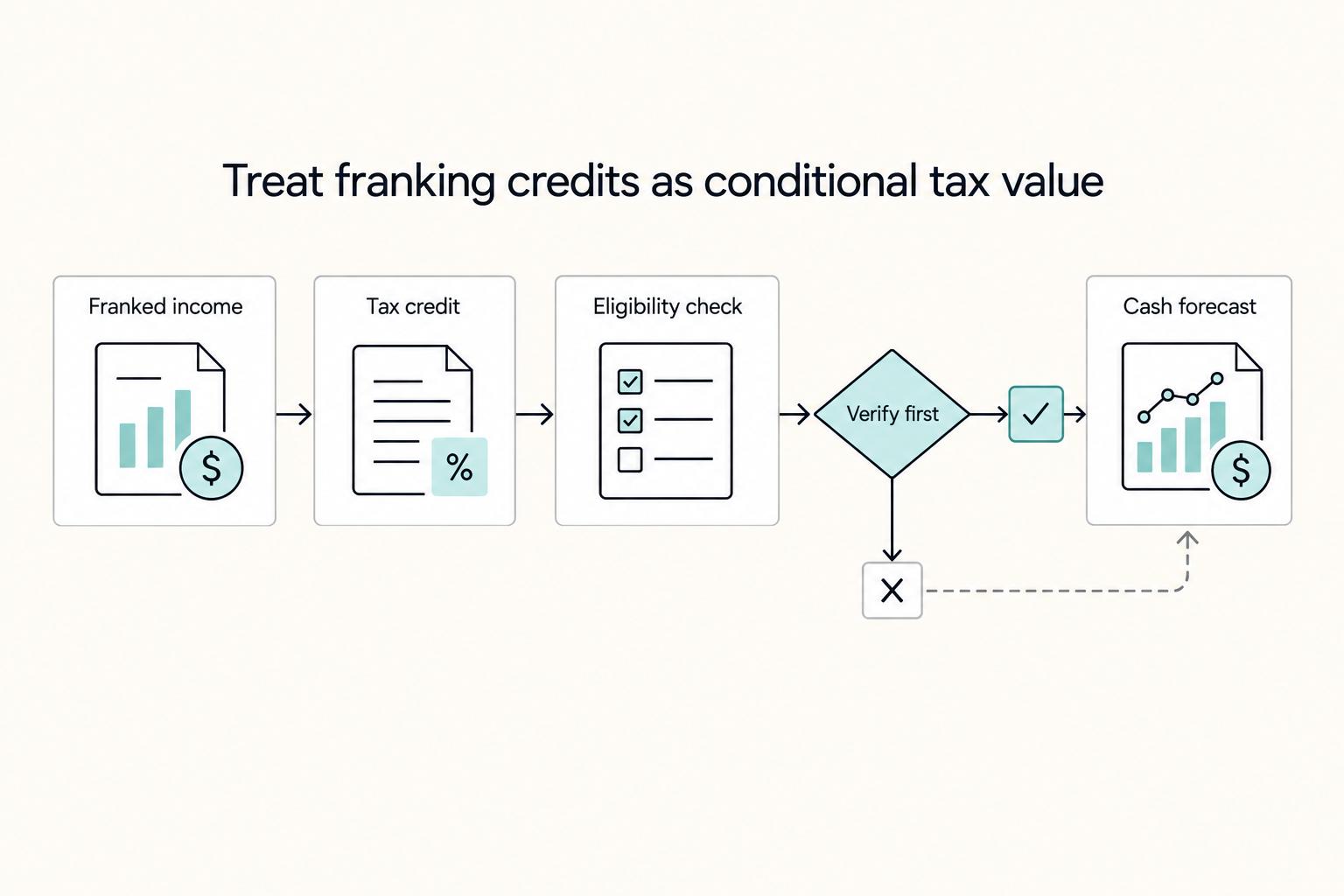
Treat franking credits australia as potential tax upside, not operating cash. Confirm the dividend statement shows a franked or partly franked amount and an attached franking credit, then reconcile it with your broker summary before relying on any result. If residency status, holding-period treatment, or payer details are still unclear, keep the amount out of your baseline monthly plan. Use client receipts and reserves for fixed commitments, and wait for assessment before treating any credit-related outcome as usable.
Franking credits are conditional tax upside: verify eligibility before forecasting any benefit#
If you earn client income and also hold dividend-paying shares, franking credits in Australia are best treated as conditional tax upside rather than operating cash. The ATO states credits may be refundable only when eligibility criteria are met, so the right starting point is verification, not assumption.
Franking credits arise when certain Australian-resident companies pay income tax and distribute after-tax profits as franked dividends, with credits attached. That can be useful at tax time, but it is not cash you should count on for this week's expenses.
That distinction matters most when income is uneven. Client-payment timing risk is immediate. Any refund outcome is determined later and depends on facts you still need to confirm. If you treat a possible refund as working capital, you can create avoidable cashflow pressure. To keep this practical, the guide follows a clear order:
- Confirm whether the dividend and attached credit are in scope.
- Check your records before relying on any expected benefit.
- Prepare your return from reconciled documents, not memory.
- Put cashflow guardrails in place so uncertain outcomes do not fund fixed commitments.
One early check matters more than most people expect. Franked dividends can reach you directly as a shareholder or indirectly as a trust beneficiary, so your records may come from more than one source. Keep dividend statements, broker summaries, and issuer details together from the start.
Also verify New Zealand dividend credits carefully. If a New Zealand company does not specify whether a franking credit is Australian or New Zealand, contact the company to confirm. If it is not specified as Australian, it is usually treated as a New Zealand franking credit, and New Zealand franking credits cannot be claimed.
Keep one simple posture throughout: treat credits as attached to franked dividends, not guaranteed cash, until the evidence supports the outcome. In practice, that means your working assumption should stay conservative at every stage: before the dividend arrives, when you build your monthly cash plan, when you prepare your return draft, and before you finalize decisions.
Related reading: A Guide to Employee Retention Credits (ERC) for Small Businesses.
Build the right mental model first#
Franking credits are tax credits attached to franked dividends, not extra spendable cash. They are also called imputation credits, and they sit with franked income as a tax attribute rather than as working cash in your operating budget.
| Question | Issue | Planning treatment |
|---|---|---|
| Did cash from the dividend arrive? | Bank-balance issue | Dividend cash affects cashflow when received |
| Does the statement show a franking credit attached to that dividend? | Recordkeeping issue | Use the statement to confirm whether a franking credit is attached |
| Can you actually rely on that credit affecting your final tax outcome? | Eligibility-and-return-position issue | Treat credits as potential tax upside until your eligibility and assessment position are confirmed |
Under the dividend imputation system, Australian-resident companies pay tax on profits and may distribute those profits as franked dividends. The attached franking credit represents tax already paid at company level and is designed to help prevent the same profits being taxed in the company and again on distribution.
Use that distinction when you plan. Dividend cash affects cashflow when received, while franking credits are applied through tax assessment as tax offsets that can change tax payable or refundable outcomes. Because refund outcomes are conditional, treat credits as potential tax upside until your eligibility and assessment position are confirmed.
Keep three questions separate when you plan or prepare your return:
- Did cash from the dividend arrive?
- Does the statement show a franking credit attached to that dividend?
- Can you actually rely on that credit affecting your final tax outcome?
Those questions are related, but they are not the same. The first is a bank-balance issue. The second is a recordkeeping issue. The third is an eligibility-and-return-position issue. Mixing them is how people end up counting a possible tax result as if it were already available cash.
That mental model helps with day-to-day decisions. If a client invoice is late, a dividend statement showing a credit does not solve the shortfall. If you are deciding whether to add a recurring cost, the only safe baseline is money you control now or can predict with high confidence. The tax attribute may still help later, but it should not carry this month's commitments.
Know who is usually eligible before doing any math#
Start by settling your tax status for the relevant period. If that is unclear, treat any franking-credit estimate as provisional, not as a planning number.
This is a basic control, not over-caution. ATO administration already applies different treatment to non-residents in related areas, including identity requirements and GST registration pathways, so unresolved status can spill into tax assumptions.
If you are globally mobile, pause the forecast until your status position is clear. A dividend statement can show franked income, but it does not, by itself, remove status uncertainty for your specific case.
Use this checkpoint before you model dividend tax effects:
- Confirm your broader Australia tax status position first.
- If status is still open, park the estimate as upside only.
- Use current ATO guidance, not archived forum replies that may be out of date.
- For travel-heavy setups, start with A Guide to Tax Residency in Australia for Digital Nomads.
If you are unsure whether your status is genuinely unclear, use a practical test. Ask whether you could explain your treatment for the year from your existing records without improvising. If the answer is no, you are not ready to use a franking-credit number in planning. Resolve the status question first, then return to the dividend calculation.
This matters most in years with movement or change: extended travel, offshore client work, relocation, or a period where your setup changed partway through the year. In those cases, do not let a neat-looking dividend statement create false confidence. The cleaner the statement looks, the easier it is to forget that unresolved status can still limit how much confidence you should place in a forecast.
Map where credits appear in your tax workflow#
Use this section as a record-control workflow around ABN and GST steps.
Capture both parts of the event#
When GST registration may be required, keep the core records together:
- evidence you commenced, or took steps to commence, your business or enterprise
- your GST registration notice, including the effective date
- a short working note with when registration became required and your filing plan
Keep the note simple. The goal is traceability, so the key dates and obligations in your draft tie back to a source document.
A practical way to do this is to create one file note when the registration trigger is reached and build from that point, not from memory. Start with records showing when GST registration became required, including the $75,000 turnover trigger where relevant. Then match that to your ABN/GST paperwork and write the dates into your working note.
If you are managing more than one entity or account, keep each path separate until reconciliation is complete. Separate files now make the final review faster.
Reconcile before you lodge#
Do not guess exact individual return labels for franking credits from old screenshots, forum posts, or last year's draft.
Use one hard checkpoint before lodgment: if your ABN evidence, GST registration records, and filing plan do not line up, pause and fix the gap first.
That pause matters because mismatches usually come from a small number of practical failures:
- evidence of commencement steps was never retained
- the GST registration effective date was not recorded from the written notice
- the 21-day registration window was missed after registration became required
- BAS timing or lodgment method was assumed instead of confirmed (for standard non-resident GST, BAS is monthly or quarterly, electronic lodgment from outside Australia is not available, and you may need an Australian registered tax agent)
You do not need a complex system to catch those failures. A basic cross-check is often enough: confirm your records show ABN entitlement evidence, the GST effective date, and how BAS will be lodged.
Keep outcome expectations provisional#
Do not lock in a tax outcome while your records are still being assembled and checked. Until reconciliation is complete and your full return position is reviewed, treat any expected upside as provisional.
This is especially important if you are preparing your own draft return in stages. Early drafts are useful, but they create a risk. Once a number is in the draft, people start treating it as settled. Resist that. A draft is only a staging area.
Do not assume GST refunds are claimable unless entitlement is established. Applying for ABN/GST and claiming GST refunds when not entitled can carry serious enforcement risk.
Run eligibility checks before you count on a benefit#
Eligibility is a hard gate. Do not count a franking credit in your plan until the dividend type, company status, and eligibility checks are clear for your facts.
Confirm the dividend is the right kind of payment#
Under the dividend imputation system, Australian-resident companies can allocate tax paid to shareholders as a franking credit attached to a dividend. Before you model any benefit, confirm the payment came from an Australian-resident company.
| Record source | What it shows | Treatment |
|---|---|---|
| Issuer dividend statement | Shows the dividend as franked or partly franked and includes both the franked amount and the franking credit | Use as the primary record |
| Broker export showing "dividend" without those fields | Only shows cash received, or shows "dividend" without the franked amount and franking credit | Treat the credit as unconfirmed |
| Portfolio tools / broker dashboards / app summary screen | A payment might appear under a generic dividend heading even when the information needed for tax treatment is missing from the summary screen | The issuer statement matters more than the app view |
| Reinvested payment records | The lack of a cash transfer can make the record easier to overlook, but the document trail still matters | Do not rely on memory later to reconstruct which payment was reinvested and what the attached details were |
Use the issuer dividend statement as the primary record. For filing, you need records that show the dividend as franked or partly franked and include both the franked amount and the franking credit. If your records only show cash received, or a broker export labels it "dividend" without those fields, treat the credit as unconfirmed.
Be careful with shorthand labels in portfolio tools and broker dashboards. A payment might appear under a generic dividend heading even when the information you need for tax treatment is missing from the summary screen. For planning and filing, the issuer statement matters more than the app view. If the app total and the statement disagree, the statement should trigger the review.
If the payment was reinvested rather than paid out in cash, keep the same discipline. The lack of a cash transfer can make the record easier to overlook, but the document trail still matters. Do not rely on memory later to reconstruct which payment was reinvested and what the attached details were.
Treat unresolved eligibility criteria as a hard gate#
Do not assume you pass every eligibility criterion. If your records are complex, or you are unsure how a criterion applies to your timeline, keep your planning conservative until you verify current ATO guidance.
If you cannot clearly show why eligibility is satisfied for your circumstances, keep the credit out of your baseline forecast and treat it as potential upside only.
Operationally, this means you should review your records before you ever get to the return. If a payment cannot be clearly matched to the details you need for reporting, flag that payment for extra review in your working papers. Do not wait until lodging week to notice that a gap makes the credit harder to rely on.
A simple internal note is enough at this stage. Either "no obvious eligibility issue from current records" or "review required before relying on credit" will do. That kind of note does not answer eligibility by itself, but it stops you from accidentally treating an unresolved amount as settled.
Use your marginal tax rate as context, not as the decision#
Your marginal tax rate helps with scenario planning, but it does not decide eligibility or guarantee a refund. ATO guidance indicates franking credits can reduce tax, and any refund is handled only after tax and Medicare levy liabilities are met and after other tax offsets are taken into account.
So do not make decisions from a quick rate-based estimate alone. Keep outcomes provisional until your full return position is assembled and each eligibility condition is checked. If anything is unclear, use current ATO guidance. The refunds page, last updated 6 November 2025, states eligibility applies only if all of the following apply.
Rate-based shortcuts are attractive because they seem fast. The problem is that they answer the wrong question too early. A rough estimate can help you see whether the amount is potentially material, but it cannot replace the underlying checks. Use it as a sensitivity exercise, not as permission to spend or commit against the expected result.
Compare common dividend situations before choosing your plan#
If residency or eligibility is ambiguous, keep credits in upside only, not in baseline cashflow.
Use this table as a conservative triage tool. It separates what you can model now from what should wait for verification against current ATO guidance.
| Scenario | Expected treatment of tax offsets | Dividend statement evidence | Issuer details | ATO guidance checkpoint | Additional records to keep | Decision |
|---|---|---|---|---|---|---|
| Resident status appears clear; dividend is franked or partly franked | Treatment is not established by this evidence pack | Keep the full dividend statement | Confirm payer identity and match to your records | Use current ATO return guidance before lodging | Keep supporting records for review | Use in forecast now only when evidence is complete and treatment is verified |
| Resident status appears clear; dividend is non-franked | Offset treatment is not established, so do not assume one | Keep the full dividend statement | Confirm payer identity and match to your records | Verify current ATO treatment before filing | Keep supporting records for review | Exclude until verified with ATO |
| Non-resident status; dividend is franked or partly franked | Unclear | Keep the full dividend statement | Confirm payer identity and your status for the period | Verify current ATO treatment before filing | Keep supporting records for review | Exclude until verified with ATO |
| Residency is ambiguous; dividend is franked or partly franked | Too uncertain for baseline planning | Keep the statement, but treat it as incomplete until status is resolved | Confirm payer identity and resolve status first | Pause assumed treatment until status is clear | Preserve records now so review is easier later | Treat as upside only |
If residency status is the open issue, resolve that first, then model the amount. For that specific check, use A Guide to Tax Residency in Australia for Digital Nomads.
One practical caution from ATO material is that non-resident processes can carry extra admin friction. That can include different proof-of-identity requirements and, in one GST process, no electronic lodgment from outside Australia and possible need for an Australian registered tax agent. Also avoid relying on archived community threads or the PCG 2025/3EC compendium as authoritative support.
Use the table as a triage step, not a substitute for review. Its job is to tell you whether an amount belongs in your operating forecast now, in a provisional tax estimate, or outside both until the evidence is stronger. If a scenario lands in the uncertain middle, the safe move is not to force an answer. It is to keep the amount off your baseline until the supporting records and current guidance line up.
Related: A Guide to Superannuation for Australian Freelancers.
If residency is the blocker in your forecast, run a quick check with the Tax Residency Tracker before you lock in any franking-credit assumptions.
Set cashflow guardrails so tax upside does not fund operations#
Do not run your operating month on expected franking credits or a possible tax refund. Keep operations funded by invoice collections, cash in bank, and reserves you control, and treat any credit-related tax outcome as conditional upside.
The distinction is practical. Cash flow is money in and out of the business, and you need enough at the right time to cover bills and obligations. Franking credits are tax paid by the company and attached to a dividend. They can reduce tax liability, and any refund is only after tax and Medicare levy liabilities are met.
Keep operating cash and tax effects on separate tracks#
Use one monthly cash flow view with separate tracks. That way, you do not fund fixed commitments with unproven tax outcomes.
| Track | Include | Use for | Rely only when |
|---|---|---|---|
| Core work cash | Cash received from clients, near-due invoices with strong collection confidence, existing reserves | Baseline operating decisions and fixed commitments | Expected receipts match real due dates and debtor status |
| Committed outflows | Rent, contractor retainers, software, insurance, tax set-asides, other fixed costs | Non-negotiable payments | Fully covered by core work cash and reserves |
| Conditional tax effects from franked income | Attached credits and any possible refund outcome | Upside planning only | Dividend records, integrity rules, and return position are clear |
If dividend cash has landed, it may support operations. The attached credit is a tax attribute, not extra operating cash. To make this practical, keep the conditional line visible but separate. Do not hide it inside projected closing cash. Put it in a notes column, a separate worksheet, or an upside scenario tab. The exact format matters less than the discipline. Anyone looking at the forecast should be able to tell, at a glance, which amounts are available now and which amounts depend on later tax assessment.
Use a hard rule when the buffer is thin#
When cashflow is volatile, protect fixed costs first and prioritize predictable collections, faster follow-up, and tighter debtor management. If one late client payment would put fixed commitments at risk, treat all dividend-linked tax effects as non-core.
That means:
- Do not use expected credits to justify a new recurring cost.
- Do not rely on expected credits to close a monthly shortfall.
This is where eligibility checks become operational. A franking credit tax offset depends on integrity rules, and holding-period/related-payments rules can affect whether a claim is available. If those checks are still open, keep the amount in upside, not baseline cashflow.
A simple scenario contrast helps. In a strong month, you may have enough collected cash and reserves to cover all fixed costs, with expected franking-credit benefit sitting outside the core plan. That is fine. In a weak month, if the same expected benefit is the only reason the forecast looks workable, the plan is too fragile. The fix is not a better estimate of the credit. The fix is to rework collections, timing, or spending so the month survives without it.
Build one monthly control you will actually maintain#
Run a simple monthly control:
- Start with opening bank cash.
- Add expected client receipts by actual due date.
- Subtract fixed and variable operating costs.
- Test the month assuming no credit-related benefit arrives.
Then keep a separate line for conditional tax effects from franked income. At month end, compare forecast with actual collections and confirm next month's fixed costs are still covered without credit-related benefit.
Avoid double counting. Dividend cash may be available now, but any credit-related outcome depends on your full tax position. Keep operations funded by invoices and reserves, then let any credit-related result improve outcomes later instead of carrying core commitments.
If you want one rule that is easy to maintain, use this: your base case should still work if the credit-related tax result is delayed or unavailable after assessment. That does not mean you ignore the possible benefit. It means you assign it the right role. Upside can improve resilience, rebuild reserves, or shorten a recovery period after a weak quarter. It should not be the reason your baseline budget balances.
Keep a compact evidence pack for audit-ready filing#
Keep one evidence pack per tax year and reconcile it before you lodge. The aim is simple: every figure in your return should trace back to a document you can find quickly.
Build one file that explains every amount#
Use one folder that includes:
- Original statements for the amounts you are reporting, for example dividend statements
- Any broker or platform year summary
- A short working note that maps each amount to the return entry you plan to use
The supplied ATO excerpts do not provide a complete franking-credit document checklist, so treat this as a practical control list rather than a prescribed filing standard.
Make the working note explicit enough that someone else could follow it without guessing. At minimum, record the payer, payment date, cash amount, and the return entry used. If you used multiple accounts or changed brokers mid-year, keep separate subfolders so partial summaries do not get mixed together.
If the year includes both direct shareholdings and amounts reaching you through another structure, keep that distinction visible in the folder layout. The goal is not to create more admin. It is to stop unlike records from being merged too early. When everything is in one undifferentiated pile, you spend the final review figuring out what each amount actually represents instead of checking whether the return is right.
Make your residency position explicit#
If you had heavy travel, offshore work, or a move into or out of Australia, add a short residency note in the same folder. State how you are treating your status for the year and keep the dates and facts you relied on.
The supplied ATO excerpts for this section do not set out franking-credit-specific residency rules. They do show that non-residents can face different proof or process requirements in other tax areas, including different proof-of-identity requirements for GST registration, so it helps to keep one consistent record of your status. If your position is unclear, resolve that before you rely on any credit-related tax outcome. See A Guide to Tax Residency in Australia for Digital Nomads.
Keep this note short and factual. It does not need to read like formal advice. Its purpose is to record the position you are using so the rest of your tax file makes sense. If you revisit the file later, you should be able to see immediately whether a residency question was settled, still open, or treated conservatively.
Reconcile before you lodge, not after#
Before filing, total the statements yourself and compare them against your broker summary and your draft return figures. If those views do not match, stop and resolve the mismatch first.
Practical checks:
- Mark each statement as included once it is in your reconciliation
- Save the exact final exports or PDFs you relied on
- Keep your own crosswalk between source documents and return entries
A useful discipline is to freeze the exact file set used for lodgment. Save the final versions in one place and do not keep editing them after the return is submitted. If you later update a spreadsheet for your own records, keep that separate from the file pack you actually relied on. That avoids confusion about which version supported the lodged figures.
Use the same checklist every year#
Reuse one short checklist so you are not rebuilding the process under deadline pressure:
| Item | What to keep or confirm | Note |
|---|---|---|
| Dividend statements and broker annual summary | Save in one folder | Use one folder for the year |
| Reconciliation note | Link amounts to each return entry | Draft a reconciliation note linking amounts to each return entry |
| Residency note | Write or update for the year | Keep it with the same file pack |
| GST registration details | Confirm registration was completed within 21 days and keep the written registration details, including the effective date | If GST registration became required |
| BAS/GST lodgment timing | Track BAS/GST lodgment timing and note that electronic lodgment from outside Australia is not available | If you are in standard GST registration as a non-resident; monthly or quarterly |
| Foreign income tax offset evidence | Keep evidence that the foreign tax was paid before the claim | If you claim a foreign income tax offset |
| Lodged return copy and final working papers | Save together | Keep the lodged return copy and final working papers together |
This is not about building a perfect archive. It is about keeping a coherent, reviewable file you can still understand later. Consistency is the real advantage here. A repeatable checklist reduces the chance that one year's filing depends on memory, inbox searches, or whatever records happen to be easy to find. You want a routine that still works in a messy year, not just in a clean one.
For a step-by-step walkthrough, see A Guide to GST for Australian Freelancers.
Avoid the mistakes that create preventable tax risk#
Treat any expected benefit from franking credits as non-cash until eligibility and records are confirmed. Franking-credit rule detail is not set out here, so if that point affects your filing, pause and verify current ATO guidance before lodging.
Do not delay GST action once registration is required. If you are required to register, the ATO says you need to do so within 21 days, and penalties may apply if you fail to register when required.
Do not file with incomplete records and plan to reconstruct them later. For ABN and GST steps, keep the documents you relied on, including evidence that you commenced, or took steps to commence, your business and the ATO's written GST registration details, including the effective date.
Do not rely on generalized online tax claims without a current official check. ATO pages were updated on 23 May 2025 and 11 September 2025. They show a practical pattern: timing, status, and documentation drive outcomes, and unsupported assumptions can lead to penalties. In severe cases, applying for ABN/GST and claiming GST refunds when not entitled can lead to prosecution or criminal charges.
Common avoidable errors usually come from process shortcuts rather than complex tax analysis. Examples include:
- assuming you can register for GST without first confirming ABN entitlement
- ignoring the $75,000 GST turnover trigger shown on the ATO registration page
- applying as a non-resident without preparing additional proof-of-identity documents
- overlooking that non-residents cannot lodge electronically from outside Australia and may need an Australian registered tax agent
- proceeding without keeping the ATO's written GST registration details, including the effective date
Use this rule set:
- no ABN entitlement clarity, no ABN or GST application
- no documentary evidence, no lodgment shortcut
- no current ATO check, no reliance on generalized online claims
Handle uncertainty directly and verify what matters#
When a point is unresolved, treat the outcome as unconfirmed until current ATO guidance resolves your specific scenario. You cannot determine the exact result for the holding period rule, non-resident treatment, or any final offset or refund outcome without confirming your position with the ATO.
If those points are unclear, do not build expected credits into operating cashflow. Resolve status questions first, then confirm dividend treatment on current official pages. If your year includes cross-border complexity, review residency first, using A Guide to Tax Residency in Australia for Digital Nomads.
Use a strict source hierarchy when information conflicts:
- current ATO primary guidance first
- non-official explainers only as secondary context
- archived community/forum content as non-authoritative, because the provided ATO Community thread explicitly says it may be out of date
Before relying on any outcome, keep an evidence trail:
- note the exact ATO page title and last-updated date you used
- save the records you used for your numbers
- if a current ATO answer is still unclear, treat the amount as upside only, not baseline cash
Leaving an uncertain amount out of baseline planning is the lower-risk default while you verify it. The real risk is the opposite: acting as if uncertainty has already been resolved. Conservative treatment now is easier to reverse later than a stretched cashflow plan built on an assumption you cannot support.
Conclusion#
Treat franking-credit assumptions in Australia as conditional until your records are verified against current ATO guidance. Do not treat any assumed tax upside as a replacement for client payments, reserves, or this month's operating cash.
The key takeaway is process, not a new credit rule. Much of the official ATO material on GST registration, especially for non-residents, does not cover detailed dividend-credit mechanics. It does show a clear compliance pattern: confirm status first, complete required setup, keep the right documents, and avoid assuming outcomes before the evidence is in place.
Use that same sequence for your own return:
- confirm the status and eligibility details that apply to your filing before forecasting any tax benefit
- reconcile your statements and summaries before lodgment
- file an evidence-backed tax return only after gaps are resolved
For cross-border freelance income, keep this discipline tight. The GST excerpts show why. There can be ABN-first setup, potential 21-day registration timing once required, different non-resident identity requirements, and standard-registration process constraints such as not lodging electronically from outside Australia and potentially needing an Australian registered tax agent, plus BAS lodgment monthly or quarterly and written ATO registration details. Those points do not determine franking-credit outcomes, but they reinforce the same operating rule: verify early, document clearly, and keep tax upside separate from core cashflow until the return is complete.
Keep operating cashflow tied to confirmed client receipts by standardizing disbursements with Gruv Payouts, so tax-time upside stays separate from day-to-day obligations.
Frequently Asked Questions
What are franking credits in Australia in plain English?
Operationally, a franking credit is an amount shown on a dividend statement. Keep the definition tight: it is an item shown on the statement. Check your dividend or distribution statement and confirm whether a franking credit is shown. Avoid assumptions beyond what your records and current ATO guidance confirm.
Do franking credits reduce tax, create a tax refund, or both?
The ATO has a dedicated refund-of-franking-credits FAQ, so refund scenarios are part of the ATO application context. For planning, treat the result as dependent on your full return and current ATO guidance. The safest workflow is to delay the outcome call until your full return position is assembled. That avoids overstating the practical value of the credit before the surrounding facts are known.
Who can usually claim franking credits in Australia?
Do not rely on broad summaries when current ATO guidance has not confirmed who qualifies. Verify your circumstances against current ATO guidance before you treat any credit as usable. As a planning rule, if you cannot point to the current guidance and your own supporting records, do not move the amount out of the "possible" category.
Are non-resident taxpayers treated differently from Australian resident taxpayers?
If your residency status is unclear, resolve that first before forecasting any credit result. If your situation is cross-border, review residency first, using A Guide to Tax Residency in Australia for Digital Nomads. The practical takeaway is not to guess through status-sensitive issues. Clear the residency question first, then revisit the dividend treatment.
How does the holding period rule affect whether credits can be used?
If the holding period rule may affect you, do not treat credits as baseline cashflow until you confirm the current ATO position. Avoid relying on archived ATO Community content, as it may be out of date. In workflow terms, this is a review trigger. If this rule could apply to your case, mark the item for verification and keep the forecast conservative until that review is complete.
Where do franking credits appear in a tax return, and what records should I keep?
Keep your dividend or distribution statements, including final dividend statements and payment dates, because the FAQ includes timing scenarios tied to when a final dividend was paid, including after 30 June 2022. Keep reinvestment records too, since reinvested dividends are explicitly raised as a separate FAQ scenario. Also keep the working records you used to prepare the return, not just the underlying statements. The point is to preserve the path from source document to return figure.
Try a related tool
Researched and edited by the Gruv editorial team. Gruv builds cross-border billing, payouts, and finance-operations software for global businesses.
Sources
- abr.gov.au/business-super-funds-charities/applying-abn/...trusted
- ato.gov.au/individuals-and-families/investments-and-ass...trusted
- ato.gov.au/forms-and-instructions/refund-of-franking-cr...trusted
- business.gov.au/finance/cash-flow/improve-your-cash-flowtrusted
- community.ato.gov.au/s/question/a0J9s0000001Dmq/p-00029303trusted
Educational content only. Not legal, tax, or financial advice.
Related Posts
Australia Tax Residency for Digital Nomads With GST and ABN Checkpoints
The goal is a defensible, low-drama position the Australian Taxation Office (ATO) can follow from your records, not a clever workaround. For a digital nomad, that usually means keeping two tracks straight: residency and GST/ABN admin. Consistency is what holds up over time: use real facts, take steps in a clear order, and keep documents that still match months later.

The Freelance Payment Penalty: A Modeled Audit of Platform Fees, FX Spreads, and Payout Delays
The money rarely disappears through a single, easy-to-spot fee. The real loss is stacked. A marketplace takes its commission, a processor adds a charge for international cards, a bank or payment company converts the currency at a spread, a platform holds the funds before release, and a wire sheds a little to intermediaries on the way in. Each layer looks defensible on its own, but the worker feels the combined result as a smaller deposit and a later payday.

How to Respond to a Subpoena for Business Records
Move fast, but do not produce records on instinct. If you need to **respond to a subpoena for business records**, your immediate job is to control deadlines, preserve records, and make any later production defensible.