
Quick Answer
Form 8233 generally claims treaty withholding exemption for a nonresident alien's U.S. personal-service compensation. Noncompensatory scholarship alone usually uses W-8BEN, or payer-elected W-4. A linked scholarship claim can use 8233 when the same withholding agent also pays treaty-exempt service compensation. Confirm residency and taxable categories first, then track payer acceptance, transmission and the required waiting period.
If a U.S. university pays you a scholarship, fellowship or teaching stipend, start by separating education support from compensation for work. Form 8233 is generally the treaty-withholding claim for a nonresident alien's U.S. personal-service compensation. Scholarship income alone usually follows another documentation route; a U.S. award or payer does not automatically mean all funding faces 30% withholding.
This guide follows the award from classification through form preparation and payer review. The useful result is a file that explains which payment is taxable, which treaty provision applies and when the withholding office can use the claim.
We will move through three phases: Pre-Contract, Execution, and Post-Submission. That structure helps you make the right call early, submit a clean packet, and stay on top of the file until the withholding treatment is clear.
Phase 1: Confirm Residency, Income Type and Treaty Eligibility#
Before you choose any withholding form, confirm three facts in order: your U.S. tax residency, your payment type, and your treaty eligibility. If those are not clear, Form 8233 may be the wrong path.
Most avoidable problems start when someone picks a form first and classifies the income later. For scholarship or fellowship payments, that can put the wrong document in the wrong office and trigger withholding before anyone fixes it.
Confirm you are still a nonresident alien#
For a non-U.S. citizen, the green card and substantial presence tests are the starting point for tax residency, with exceptions and treaty rules. Students often have special day-count rules. Immigration status and tax residency are different; an 'exempt individual' is exempt from counting specified days, not automatically exempt from tax.
| Check | Threshold or test | Notes |
|---|---|---|
| Green card test | Review lawful permanent-resident status | Exceptions/treaty treatment require separate review |
| Substantial presence baseline | 31 current-year days and 183 weighted days | Count eligible days: current year + 1/3 prior year + 1/6 second prior year |
| Eligible student day exclusions | F/J/M/Q student rules, generally first five calendar years | Review prior exempt years, applicable exceptions and Form 8843; not five rolling years |
| Resident after excluded years | Reassess treaty saving-clause exception | Scholarship treaty benefit may survive, using W-9 with required attachment rather than automatically8233 |
Calculate substantial presence using countable days, not every day physically present. For eligible F/J/M/Q students, generally exclude days during the first five calendar years, including relevant prior exempt years; later exclusions require meeting additional conditions. Review Form 8843 and any closer-connection or treaty-residency question with the institution's tax office. A simple travel-day counter cannot make this decision.
Keep entry/exit records, visa/status history, prior exempt calendar years and the residency conclusion. If you become a resident, a treaty saving-clause exception may preserve a scholarship benefit, but review the W-9 and attached-statement route instead of automatically renewing Form 8233.
Classify the payment before choosing the form#
Form choice follows income type, not whatever label appears in an email or award notice. For grant income that is not earned from personal services, the standard treaty-claim route is Form W-8BEN.
If any part of the payment is compensation for personal services performed in the United States, that portion follows personal-services withholding rules. Treaty exemption for that income is claimed on Form 8233. In mixed cases, noncompensatory scholarship or fellowship income can be claimed on Form 8233 only when you are also claiming treaty exemption for personal-services compensation.
| Your situation | Usually use | Why | Who you give it to |
|---|---|---|---|
| Noncompensatory scholarship or fellowship only | Form W-8BEN | Income is not earned from personal services | The payer or withholding agent |
| Compensation for personal services performed in the United States | Form 8233 | Personal-services treaty claims use Form 8233 | The withholding agent |
| Same institution pays both treaty-exempt service compensation and treaty-exempt scholarship/fellowship | Form 8233 | IRS allows both in this combined case | The same withholding agent |
| Payment classification or eligibility is unclear | Verify with payer before submitting | The payer must not apply treaty rates if ineligibility is known | Confirm with the withholding agent first |
Identify the withholding agent early#
Find the withholding agent before the first payment is processed. For treaty claims, that is the payer applying the withholding rules to your payment. At schools and large institutions, the office name varies, so confirm the exact team and submission channel up front.
Ask directly: who is the withholding agent for this payment, and where should treaty documents be sent? That one step can keep your paperwork out of the wrong queue while default withholding is being applied somewhere else.
Get your TIN and packet ready before first payment#
TIN readiness is part of treaty readiness. For scholarship or fellowship treaty claims on Form W-8BEN, the withholding agent cannot accept the treaty exemption without the payee TIN. If you are using Form 8233 and do not yet have an SSN or ITIN, apply and be ready to provide TIN-application evidence where required.
Prepare the core treaty packet for the current year. For Form 8233, the instructions require a separate form for each tax year, each withholding agent, and each income type.
Use this pre-submission checklist:
- Signed form for this payment, either
Form W-8BENorForm 8233 - SSN/ITIN, or TIN-application evidence where applicable
- Exact withholding-agent contact and submission path
Withholding depends on income category. Taxable U.S.-source noncompensatory scholarships generally face 30%, with 14% available for qualifying F/J/M/Q recipients and funding conditions, or a lower treaty rate. Compensation for employment follows graduated wage withholding unless an applicable exemption is established. Qualified education amounts may be excluded from income before withholding is considered.
Ask the tax office to identify the taxable portion first: tuition support, required educational costs, living allowance and service compensation may be treated differently. Keep the award terms and any service obligation with the determination.
Form 8233 vs. W-8BEN: Using the Right Tool for the Job#
Once the facts are clear, the form choice is usually straightforward. Use Form 8233 for treaty-exempt compensation for personal services performed in the United States. Use Form W-8BEN for noncompensatory scholarship or fellowship income when you are not also claiming treaty exemption for personal-services compensation from the same withholding agent.
If you choose a form before you classify the payment, you can send the wrong document and end up with withholding you did not expect. If anything is unclear, confirm classification with the payer's tax office before you submit.
Use this decision rule#
For scholarship and fellowship funding, split the payments into two buckets: noncompensatory scholarship or fellowship income and compensation for personal services. Then map each part to the right form.
Form 8233 is for nonresident alien individuals claiming exemption from withholding on compensation for personal services. It can also include noncompensatory scholarship or fellowship income, but only when you are also claiming treaty exemption for personal-services compensation from the same withholding agent. If you only have noncompensatory scholarship or fellowship income, the IRS form table points to Form W-8BEN, or Form W-4 if elected by the withholding agent.
Compare them side by side#
| Your situation | Typical income category | Usually use | Who files/submits | Payer/IRS handling | Commonly used when |
|---|---|---|---|---|---|
| Scholarship or fellowship payment with no required services | Noncompensatory scholarship or fellowship income | Form W-8BEN | Follow payer or withholding-agent instructions | Payer reviews and retains the certificate | Scholarship or fellowship amount that is not compensation for services |
| Payment for services you perform in the United States | Compensation for personal services | Form 8233 | You complete it and give it to the withholding agent | Payer accepts, sends to IRS within 5 days and observes required waiting period | Service compensation with a treaty claim |
| Same withholding agent pays both treaty-exempt service compensation and treaty-exempt noncompensatory scholarship or fellowship income | Mixed income with same withholding agent | Form 8233 | You complete it and give it to that withholding agent | Same agent reviews linked claims, sends accepted form and observes waiting period | Mixed funding where both streams are being claimed under treaty rules with the same withholding agent |
Form 8233 is not a blanket filing. The instructions require a separate form for each tax year, each withholding agent, and each type of income.
Watch for these common misclassification traps#
The practical rule is simple: split the payment by type, then map each part to the right form.
- A "stipend" includes required services: treat that service portion as compensation for personal services.
- One award letter covers multiple payment streams: do not force the full amount onto one form. Separate the noncompensatory and service portions.
- Scholarship or fellowship income only, but you submit Form 8233 just because a treaty exists: use W-8BEN unless the same withholding agent is also paying treaty-exempt service compensation.
- You assume one institution means one withholding agent: confirm the actual withholding agent before filing.
If treaty terms or payment classification are unclear, stop and get confirmation from the payer's tax office before the first payment.
Worked classification example: an award gives a degree candidate $10,000 for qualifying tuition, $8,000 living support and $6,000 for required teaching. Assume the tuition satisfies the qualified-scholarship rules and no special exception changes the service treatment. The tax office separates excluded tuition, taxable noncompensatory support and teaching compensation. If an eligible treaty exempts both taxable streams and the same withholding agent pays them, Form 8233 may claim both using the separate income fields. With only the $8,000 noncompensatory stream, use the W-8BEN route (or payer-elected W-4). These amounts illustrate classification, not eligibility for a particular treaty.
Phase 2: Align treaty basis, award documents, and payer records before submitting#
At this point, the real job is not data entry. It is making sure your treaty basis, award documents, and payer records all describe the same payment facts before anything is submitted.
Check 1. Confirm the form is still in scope#
Start with scope by payment type and withholding agent. Form 8233 is for treaty-exempt compensation for personal services. It can also include noncompensatory scholarship or fellowship income only when both income streams come from the same withholding agent.
If you only have noncompensatory scholarship or fellowship income from that payer, this is outside Form 8233 scope. In that case, the IRS points to Form W-8BEN, or Form W-4 if the withholding agent elects that route.
Do a quick validation pass before you fill anything in: identify the payer, list each payment stream, and confirm whether one withholding agent is paying both service income and any grant income.
Check 2. Match the treaty article to grant eligibility#
Treaty article selection is the highest-risk step. For scholarship or fellowship amounts, use the treaty article that governs student or trainee grant treatment, and confirm that you meet that article's eligibility criteria.
Check the actual treaty article, its residence requirement, limits and duration. Personal-service compensation and noncompensatory support may use different provisions. Do not copy an article number from another student's packet. For scholarship claims the U.S. TIN is normally needed; if using Form 8233 while an application is pending, use the application evidence permitted by its instructions rather than inventing a number.
Check 3. Write facts that are specific enough to verify#
Match the facts to the current form. Part I identifies the beneficial owner, taxpayer IDs, treaty residence and relevant immigration details. Part II describes services and estimated compensation at line11, the personal-service treaty claim at line12, and linked noncompensatory scholarship amounts and treaty basis at line13. Line14 states why the treaty conditions are met. Attach the additional student/trainee/teacher/researcher statement where required; the award description alone may not satisfy it.
Use detail like:
- "Paid by a U.S. university under a doctoral award; notice describes stipend support and required teaching duties."
- "Paid by a U.S. research institute under a postdoctoral fellowship; award documents describe research support and related academic activity."
- "Paid by a U.S. college under a graduate scholarship; award materials separate tuition support from any employment-related component."
Avoid vague labels like "student funding" when your records show separate service and non-service components.
Check 4. Reconcile supporting documents before submission#
Even a clean form can stall if surrounding documents describe the payment differently. Before handoff, reconcile the form against your award letter and related payer records. Amounts, payment type, dates, and payer identity should match across the form, award notice, and any payroll, bursar, or departmental documentation.
If the same payment is classified differently across documents, stop and resolve it first. Ask the payer's tax office to confirm whether the payment is noncompensatory scholarship or fellowship income, compensation for personal services, or a split arrangement.
Handle the withholding-agent handoff carefully#
After your handoff, the withholding agent reviews eligibility and completes Part IV if accepting the claim. It forwards the accepted form with attachments to the IRS within five days. Under the current instructions, it must wait at least ten days after properly mailing the form to see whether the IRS objects. This is a withholding procedure, not a promise of an IRS approval letter.
| Step | Requirement |
|---|---|
| Review | The payer, as withholding agent, must review the completed Form 8233 |
| Acceptance | Sign the acceptance section |
| IRS handoff | Forward the accepted form to the IRS within 5 days of acceptance |
| Eligibility limit | If the payer has reason to know you are not eligible for the treaty benefits claimed, they must not apply the treaty rate |
| Waiting period | Wait at least 10 days after proper mailing to IRS for objections before relying on the exemption |
| Copies | Give the recipient a complete copy; keep a copy and send the IRS copy with attachments |
Use this pre-submit checklist with the payer:
- Review treaty basis, TIN, payment classification, and supporting award documents
- Sign the acceptance section
- Transmit the accepted form to the IRS within 5 days
- Record acceptance and IRS transmission dates, required waiting period, any objections and the first covered payment
If classification is still unclear, escalate to the institution's tax office or a qualified tax professional before the first payment.
You might also find this useful: A Guide to Tax Withholding on US Fellowship and Grant Income for Foreigners.
If you need to separate Form 8233 for services from W-8 paperwork for other income, draft the W-8 side cleanly before submission. Use the W-8 form generator.
Phase 3: The Post-Submission Protocol - Managing the Waiting Game#
Track payer acceptance, IRS transmission and the required waiting period separately from your initial submission. The withholding office must not apply a treaty rate when eligibility cannot be determined or it knows the claim is false. An IRS objection or later disqualifying fact requires the payer to act under the instructions; silence is not an approval certificate.
Until timing is confirmed, build in extra lead time before your next disbursement cycle.
Confirm the handoff with the withholding office#
Do not assume the file moved just because you submitted it. Follow up with the office that handles withholding for your payments. In one message, ask for:
- confirmation they received your completed Form 8233
- current processing status
- the follow-up contact for corrections
- acceptance and IRS transmission dates, completion of the waiting period and whether any objection or missing item affects the next payment
Those checkpoints make it easier to spot delays if corrections are needed.
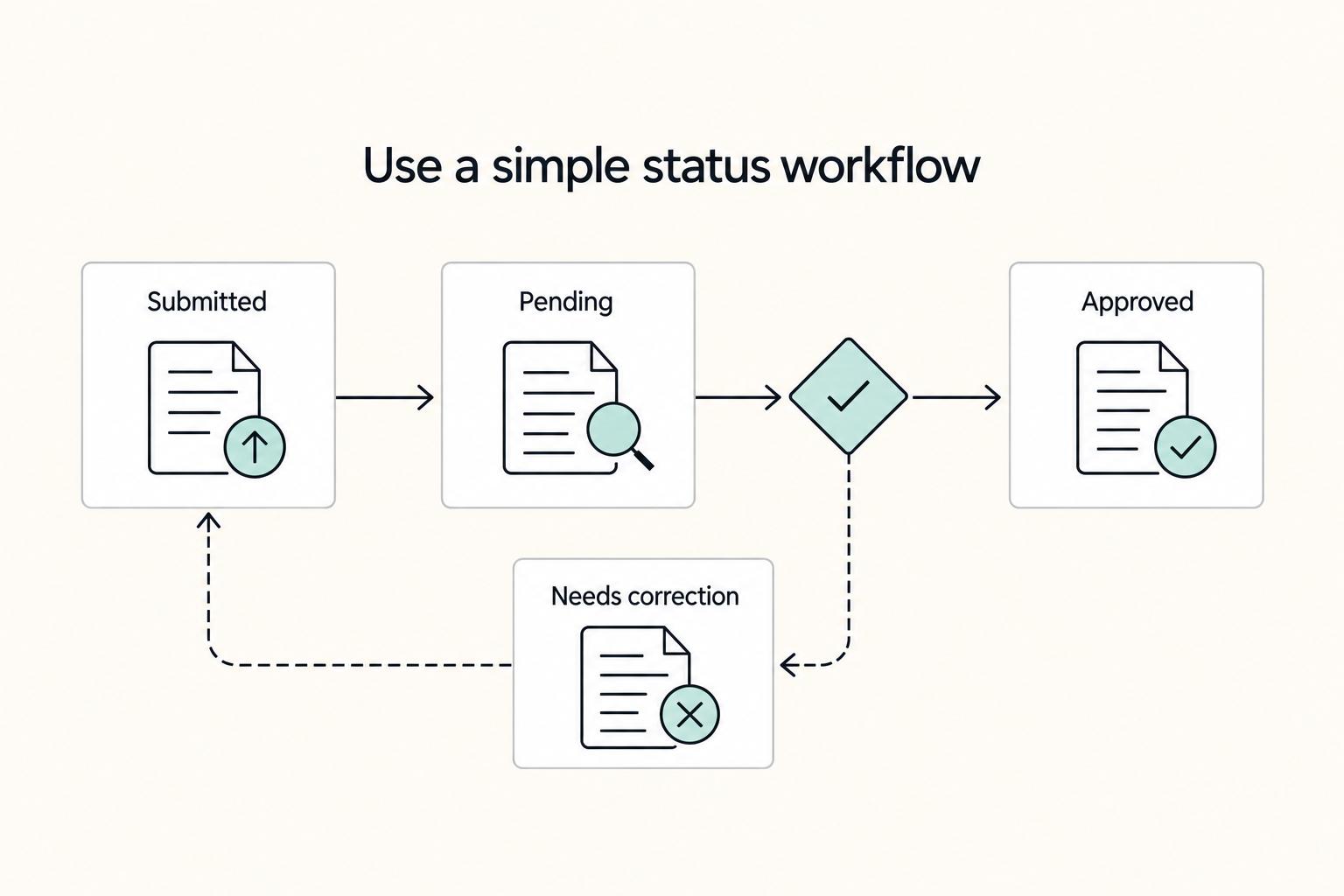
Use a simple status workflow#
| Status | What it means | Your action |
|---|---|---|
| submitted | You gave the completed form to the withholding agent | Save proof of handoff and confirm receipt and follow-up contact |
| pending | Payer review, transmission or required waiting period is incomplete | Identify the owner, missing item and next review date |
| approved (internal status) | Payer confirms applicable withholding treatment for specific payments after required steps | Confirm payment type, year, treaty limit and period; this is not an IRS approval letter |
| needs correction | A blocking issue was identified | Get the reason in writing, then correct and resubmit |
Do one scope check during pending or approved. Form 8233 is separate for each tax year, each withholding agent, and each income type. If your claim includes noncompensatory scholarship or fellowship income, confirm that you are also claiming treaty exemption for compensation for personal services from the same withholding agent; otherwise Form W-8BEN (or, if elected by the withholding agent, Form W-4) may be the indicated form.
If it comes back for correction#
If corrections are requested, ask for the reason in writing, then re-check the areas below:
| Correction area | What to re-check |
|---|---|
| Treaty terms | Whether the treaty terms for the claim fit your facts |
| Identifier fields | Missing required identifiers, such as U.S. TIN or foreign TIN fields |
| Attached statement | Missing required attached statement in student, trainee, professor, or researcher cases |
| Linked claim | Noncompensatory scholarship or fellowship income claimed on Form 8233 without a linked personal-services treaty claim from the same withholding agent |
If you still cannot align treaty terms, required identifiers, and attached statements after one full review with the payer, escalate to a qualified tax advisor.
Renew before each new funding cycle#
Treat this as recurring compliance, not a one-time filing. A separate Form 8233 is required for each tax year.
Before each cycle, verify:
- current form and instructions, including any attached-statement requirement
- whether the same withholding agent is paying the relevant income streams
- treaty-term fit based on current facts
- identifier fields and required statements against upcoming payments
If any input changed, update it before the first payment of the new tax year.
Keep the Claim and Payment Records Together#
Treat Form 8233 as a repeatable workflow, not a one-time task. For each applicable tax year, run the same sequence: confirm eligibility facts, complete the form carefully, and follow up with the payer on handling.
Before renewing, reassess tax residency, service and scholarship categories, treaty limits and the payer. Check the current form and required statements rather than copying last year's facts. If a TIN application is pending, provide the evidence allowed by the Form 8233 instructions.
Then make sure your contract, invoice, and payer setup all describe the payment the same way. Recheck the form's DO NOT Use This Form... section each cycle so you do not carry forward a setup that no longer fits, and use the alternate form indicated there when applicable, for example, Form W-4 in covered cases.
What this changes for you#
- A clearer basis for planning cash flow for a U.S. engagement
- Lower risk of withholding surprises from avoidable classification mismatches
- Earlier visibility into required documents and checks
- Cleaner review cycles because form details, attachments, and payment description align
If treaty eligibility, taxpayer ID status, or form selection is unclear, pause and get qualified tax advice before you rely on exemption treatment.
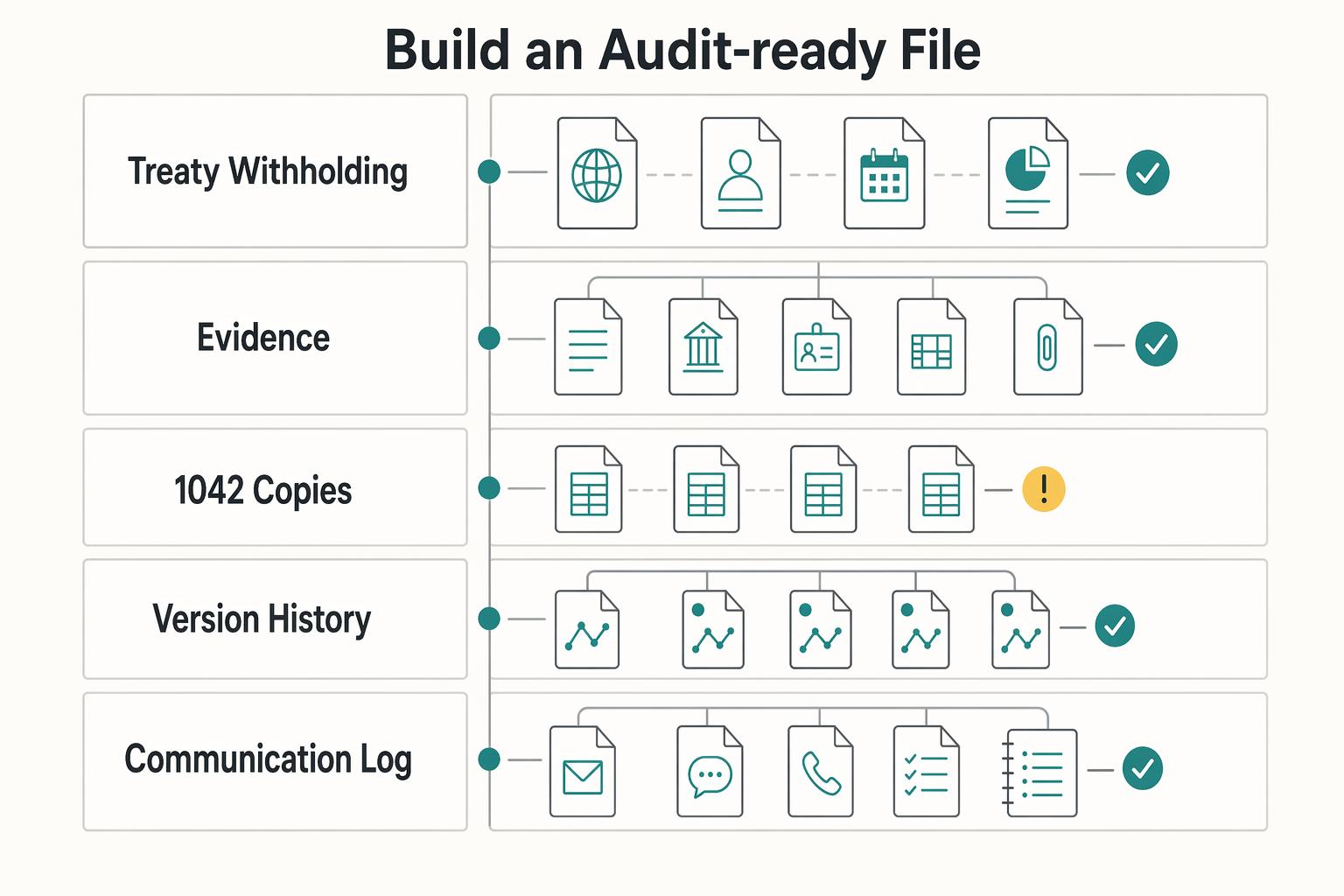
Keep the award breakdown, completed packet, correction history and payer's confirmation together. Recheck eligibility, limits and covered payments at renewal rather than assuming last year's treatment continues.
Next action: send the institution's withholding office the award breakdown and ask which form, treaty provision, supporting statement and timetable apply. A qualified tax adviser can resolve treaty or residency questions; a payment provider does not determine eligibility.
Frequently Asked Questions
How do you choose between Form 8233 and Form W-8BEN?
Use Form 8233 when you are a nonresident alien individual claiming treaty-based exemption from withholding on compensation for personal services. If the income is not compensation for personal services, Form 8233 materials point you to other forms, including Form W-8BEN.
How long should you expect the process to take?
Plan for payer review and the required IRS handoff: the agent sends an accepted form within five days and must wait at least ten days after proper mailing for possible objections. Internal review or corrections can add time. Confirm transmission and the next covered payment; do not expect a routine IRS approval letter.
Can you use it if you are self-employed, consulting, or receiving scholarship income?
If you are a nonresident alien individual and the payment is compensation for personal services with a treaty basis that fits your facts, Form 8233 is the form to review. If you have a U.S. office or fixed base available to you, a treaty exemption for independent personal services is generally not available. For noncompensatory scholarship or fellowship income, Form 8233 applies only if you are also claiming a treaty exemption for personal-services compensation from the same withholding agent.
What should you check before submission to reduce rejection risk?
Match residency, treaty conditions, payment classification, form fields and attachments. Confirm a valid U.S. TIN or the permitted pending-application evidence on Form 8233; scholarship W-8BEN treaty claims need the payee TIN. Check the estimated compensation, linked scholarship amount, treaty article and required additional statement against the award and payer records. If any item is unclear, resolve it with the tax office before relying on exemption treatment. Keep the correction request and the amended packet together so the payer uses the latest version.
What should you do if your U.S. client has never seen this form before?
Make the handoff easy. Send a short packet with your completed draft and the current Form 8233 page or instructions. Add a one-line note that you are providing the completed form to the withholding agent for a treaty claim on compensation for personal services. Ask for written confirmation of the file owner, planned submission date, delivery method, and whether they need any additional attachment or ID validation from you. If they cannot identify the file owner, cannot explain their handling path, or keep reclassifying the payment away from personal services, escalate to a qualified tax professional before the next payment run.
Try a related tool
Researched and edited by the Gruv editorial team. Gruv builds cross-border billing, payouts, and finance-operations software for global businesses.
Sources
Educational content only. Not legal, tax, or financial advice.
Related Posts

Digital Nomad Taxes in 2026 With a Defensible Filing Plan
With digital nomad taxes, the first move is not optimization. It is figuring out where you may be taxable, where filings may be required, and what proof supports that position.

183-Day Rule Tax Myths That Trigger Residency Filing Mistakes
If you are a mobile freelancer or consultant, start here: the "183 day rule tax" idea is not a single universal test. It is a shortcut phrase people use for different residency rules that do not ask the same question. If you mix federal and non-federal residency logic, you can create filing risk even when your travel calendar looks clean.
US Fellowship and Grant Withholding for Foreign Grantees
You secured the grant. That validates your expertise. But getting the money into your account without losing too much to avoidable withholding is a separate job. For many global professionals, a meaningful share of funding disappears because the payment was classified incorrectly, the treaty claim was not set up in time, or the payer defaulted to automatic withholding.