
Quick Answer
Yes. For most new residents, the florida homestead exemption works when three items line up: qualifying title by January 1, permanent-residence facts that do not conflict with another state claim, and a complete DR-501 filed with the county property appraiser by March 1. The article also flags common blockers such as LLC or corporate title, missing spouse SSN details, and address mismatches across tax, voter, bank, and utility records.
Separate the Three Benefits, Then Prove Residency and Ownership#
Treat the Florida homestead exemption as a compliance decision first, not a perk. If your residency facts, title status, and filing dates are not aligned, you can create avoidable tax and residency problems.
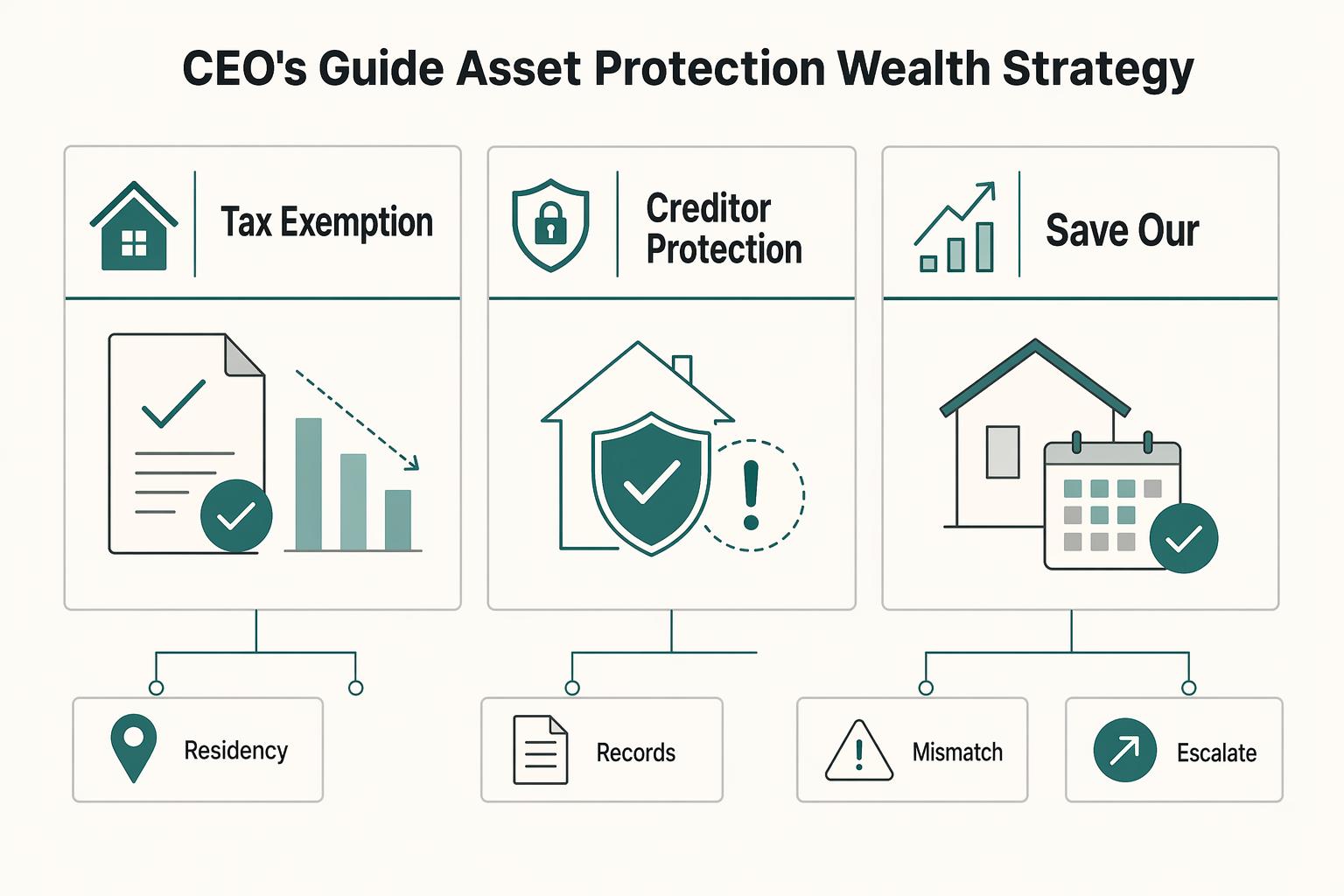
In practice, this breaks into three separate outcomes, not one. You may qualify for a property-tax exemption, homestead-related creditor protection with explicit exceptions, and access to the Save Our Homes assessment limit after initial qualification.
| Outcome | What it does | Key limit or trigger |
|---|---|---|
| Tax exemption | Reduces taxable value on a qualifying permanent residence | Base exemption up to $25,000, plus an additional exemption on value above $50,000 for non-school levies |
| Creditor protection | Can protect the home from some creditor claims | Not absolute; exceptions include taxes, assessments, and purchase-money obligations |
| Save Our Homes cap | Limits future assessment growth | After initial qualification, annual growth is capped at 3% or CPI, whichever is lower |
Use this quick filter. If you hold legal or qualifying beneficial title as of January 1, your permanent Florida residence is established as of January 1, and you are not currently claiming residency or homestead elsewhere, this is often a residency-and-filing execution task. If title or beneficial-interest arrangements are complex, or prior-state ties are still active, treat it as higher risk. The county property appraiser makes a fact-based residency determination and may require additional ownership documents.
Safe default checklist#
Before you rely on the benefit, confirm:
| Checkpoint | What to confirm |
|---|---|
| Title status | You had legal title or qualifying beneficial title by January 1, and the deed or other ownership instrument is recorded in county records |
| Filing date | You are prepared to file with the county property appraiser by March 1; missing that date is treated as a waiver unless a statutory exception applies |
| DR-501 consistency | Your DR-501 responses are consistent, especially on whether you claim residency or homestead in another county or state |
| Permanent residence | Your facts support permanent Florida residence as a whole, not just one indicator |
With that framing in place, the rest of the decision is straightforward: separate the three benefits, prove residency with a consistent file, and make sure your ownership structure does not undercut the filing.
You might also find this useful: A Deep Dive into Florida's Money Transmitter License Rules.
The Three Pillars of Homestead Value#
Once your filing facts are aligned, treat homestead as three separate benefits you manage in parallel: legal protection, tax reduction, and long-term assessment protection.
Legal protection#
This pillar is about forced-sale protection, not a blanket shield, and it is separate from the homestead tax exemption. Florida's constitutional homestead protection can protect a qualifying primary residence from many creditor forced-sale claims, which is a meaningful risk-control benefit if you run a business of one.
It does not protect against everything. Explicit exceptions include taxes and assessments on the property, plus obligations tied to the home's purchase, improvement, or repair. A sound default is to assume broad protection, then actively check whether an exception applies to your specific exposure.
Tax reduction#
This is the immediate tax-bill lever. Exemptions are subtracted from assessed value to determine taxable value, and taxable value is multiplied by local millage rates to calculate tax due.
The base exemption is $25,000. Florida law also allows an additional exemption on assessed value above $50,000 for non-school levies, and that second tier is adjusted for inflation each January 1. For 2026, the additional maximum is $26,411, so some county records show a total homestead exemption of $51,411 rather than a flat $50,000. Before you rely on the savings, confirm on your county property appraiser record that the exemption is applied to taxable value, not just shown as pending.
Long-term assessment protection#
This is usually the longer-term predictability lever. Save Our Homes limits annual assessed-value growth to the lesser of 3% or CPI, and it starts the year after your homestead exemption is first granted.
| Scenario | Assessed value treatment |
|---|---|
| No homestead cap | Can rise with reassessment |
| Homesteaded property with SOH | Annual assessed growth limited to the lesser of 3% or CPI |
| First year exemption granted | Cap begins the following year |
Decision cue: prioritize tax reduction first if your goal is immediate relief, continuity for SOH first if your goal is long-term predictability, and legal protection first if lawsuit-risk mitigation is your top concern.
Those benefits only matter if your residency file holds up.
If you want a deeper dive, read the digital nomad tax guide.
Bulletproofing Your 'Permanent Residency' Status#
Your homestead benefits are only as strong as your facts. For Florida homestead, the county property appraiser decides whether you established permanent residence, and no single document is conclusive on its own.
Treat this as a consistency test across records, not a one-box filing task. If your Florida claim conflicts with your tax, banking, civic, or day-to-day records, your file gets weaker.
Build a body of evidence, not a single proof#
The strongest files use several kinds of evidence at once.
Identity records show formal intent. A Florida driver license or ID helps, and evidence that you gave up another state license strengthens that signal.
Financial records show where you operate. Florida law points to the address on your federal income tax return and where your bank accounts are registered.
Civic records show public ties. Florida voter registration, with the voter card address aligned to the home, supports your claim.
Daily-life records show where life actually happens. Utility payments at the property, employment location, and dependent school location are all relevant facts.
Self-audit before you file#
Do the consistency check before you file DR-501, not after. Review your federal return, bank records, voter record, driver license or ID, and other address-based records you use. The goal is simple: remove contradictions before the property appraiser sees them.
Also verify timing. Permanent Florida residency is required as of January 1, and the application is due by March 1. Missing March 1 can waive the exemption for that year, with limited statutory exceptions.
| Evidence item | Why it matters | Common contradiction to avoid |
|---|---|---|
| Florida driver license or ID | Official identity record tied to Florida | Active license from another state |
| Federal income tax return address | Cross-agency residency signal | Filing with a non-Florida address |
| Florida voter registration | Civic record tied to Florida address | Remaining registered elsewhere |
| Bank account address | Financial residency signal | Accounts still using old-state address |
| Utility records at the home | Supports actual occupancy | Little or no utility activity at the claimed home |
| Other-state homestead/tax credit | Direct eligibility conflict risk | Claiming another state's residency-based property tax benefit |
Where the Declaration of Domicile fits#
A recorded Declaration of Domicile is useful supporting evidence, and Florida law recognizes it as one factor. It is strongest when it matches the rest of your file. It is weak when other records point to a different state.
If you have multi-state facts, a recent move near January 1, split family records, or any prior-state residency-based tax benefit, get Florida property-tax or legal advice before filing. Improperly granted homestead can be clawed back within the prior 10 years, with a 50% penalty on unpaid taxes plus 15% annual interest.
Once your evidence is consistent, the next step is execution: file cleanly, track the application, and fix any county questions before they become a denial.
Need a separate cross-border tax topic? Read A guide to 'Totalization Agreements' for a US citizen working in France.
Verify Timing, Assemble Documents, File DR-501, and Track Status#
Treat this as a controlled sequence: verify timing, assemble a consistent document package, file DR-501 with the correct county office, and track status until the exemption appears in county records.
1) Verify timing before you start the form#
Do not start with the form itself. Start with the dates.
Confirm the current rule on the latest DR-501 and your county property appraiser site, then record it in your checklist as:
- Exact eligibility date rule, verified against current county or official source records and approved filing records before use.
- Exact filing deadline, verified against current county or official source records and approved filing records before use.
The baseline on the current statewide form is straightforward: permanent Florida residency is required on January 1, and Form DR-501 is due by March 1 to the county property appraiser. Missing March 1 can waive that year's exemption, with limited statutory late-file paths tied to required notice mailings. If you missed the deadline or omitted required SSNs, verify the corrective path immediately. A timely filing without required SSNs is incomplete and may be cured by April 1.
2) Build a pre-flight package#
Build the package before you submit anything. That is the easiest way to avoid technical denials.
| Category | What to gather | Verify before filing |
|---|---|---|
| Owner identity | Identity documents your county requires for each owner; SSNs for applicant and spouse (if any) | Names and property address match the application; no unresolved conflicting out-of-state residency or homestead claim |
| Property ownership | Recorded deed or other ownership instrument | Deed or instrument is recorded in county official records; owner names match DR-501 |
| Residency proof | Residency documents required by your county | Address information is consistent across the records you submit |
| Special-case docs | Spouse information (if applicable); immigration number or Resident Alien Card number (if not a U.S. citizen) | Required spouse and non-citizen fields are complete |
If your county requests additional ownership proof, provide it quickly.
3) File DR-501 with the county property appraiser#
File only after you have cleaned up obvious conflicts. Use only the filing channels your county currently accepts, and follow county instructions exactly. The county property appraiser decides eligibility.
Before submitting, run this denial-risk check and fix issues first:
- Conflicting out-of-state claims: If you still claim a residency-based homestead exemption or tax credit elsewhere, resolve it and keep proof.
- Mismatched addresses: If records you plan to submit show different addresses, align them or be ready to explain them.
- Incomplete spouse details: If married, include the required spouse SSN and make sure spouse information is complete.
DR-501 asks whether you currently claim residency or homestead in another county or state. Answer that section carefully and only after conflicts are resolved.
4) Run a post-filing control loop#
Do not assume filing ends the job. Save submission proof immediately. If you receive a filing receipt, retain it with tax records, since possession of that receipt is conclusive proof of timely filing.
| Post-filing step | What to do | Detail |
|---|---|---|
| Submission proof | Save submission proof immediately | If you receive a filing receipt, retain it with tax records; possession of that receipt is conclusive proof of timely filing |
| Status tracking | Track status in county tools until the exemption is shown in county records | Watch for follow-up requests from exemption staff and respond quickly |
| TRIM Notice check | Use your TRIM Notice as a later-cycle checkpoint | Some counties confirm status there, for example in August, but county timelines vary |
| Stalled or denied case | Contact the property appraiser first | Ask what specific document, field, or residency fact is missing |
| Disputed residency or prior-state benefit case | Consider qualified property-tax or legal advice before refiling or responding | Applies if the case involves disputed residency facts or prior-state residency-based tax benefits |
Track status in county tools until the exemption is shown in county records. Watch for follow-up requests from exemption staff and respond quickly. Use your TRIM Notice as a later-cycle checkpoint. Some counties confirm status there, for example in August, but county timelines vary.
If status stalls or a denial is issued, contact the property appraiser first and ask what specific document, field, or residency fact is missing. If the case involves disputed residency facts or prior-state residency-based tax benefits, consider getting qualified property-tax or legal advice before refiling or responding.
Title documentation can also become a failure point.
This pairs well with our guide on A Guide to 'Making Tax Digital' for UK Freelancers.
Keep your residency evidence, filing checkpoints, and move timeline organized with the Tax Residency Tracker.
Advanced Ownership: Fortifying Your Exemption with Trusts and LLCs#
Ownership form can decide your eligibility even when your residency evidence is strong. If your primary home is titled to an LLC, partnership, or corporation, treat that as a likely disqualifier unless your county property appraiser confirms otherwise. A trust can qualify, but only when the deed and trust establish rights that meet homestead requirements.
Use these definitions to screen your setup quickly:
- Natural person: an individual owner, not a business entity.
- Revocable trust: a trust you can modify or terminate during your lifetime, if you have capacity.
- Beneficial/equitable title for life: your trust interest must support homestead eligibility for life.
- Present possessory interest: you must have a current right to occupy the home, not only a future interest.
- Abandonment: renting the homesteaded dwelling in a statutorily disqualifying way can end homestead status.
Quick title-risk map#
Title needs to be in qualifying form by January 1. That means qualifying legal title, or beneficial title in equity, plus permanent-residence use, and the deed or instrument must be recorded before the exemption is granted.
| Ownership structure | Likely homestead outcome | Common failure mode | Verify with county appraiser before filing |
|---|---|---|---|
| Individual owner in your own name | Usually the cleanest path if residency facts align | Deed not recorded; permanent-residence facts do not support the filing | Deed is recorded and any additional ownership documents requested to establish title are ready |
| Revocable trust with qualifying language | Can qualify if you hold beneficial or equitable life interest and present possessory rights | Trust or deed language shows only future or contingent rights | Exact trust pages required, whether deed language alone is enough, and whether full or partial trust copy is needed |
| Trust beneficiary without present possessory rights | High denial risk | You can benefit later but lack current occupancy rights | Whether county reviewers see present possessory rights in deed or trust text |
| LLC, corporation, or partnership title | Usually disqualifying | Assuming entity title is treated like personal title | Whether denial is expected and what correction path is needed before January 1 |
| Certain spousal transfer into a community property trust | Narrow reassessment exception, not blanket homestead approval | Assuming all trust transfers are treated the same | Whether the June 20, 2025 change applies to your transfer and county handling |
Trust checklist before you transfer the deed#
If you are moving title into a trust, review the trust and deed together before you record anything.
- Confirm the trust setup gives you beneficial/equitable title for life and present possessory interest.
- If you are using a revocable trust, confirm the trust is clearly revocable in the document.
- Review deed language and trust language together. If deed language is incomplete, county staff may review the trust itself.
- Confirm the county packet requirements, including pages showing required beneficial-interest language and signature or notary pages where requested.
- Verify the exact trust clause wording the county wants reviewed against current county or official source records, counsel or adviser records, and any approved filing records before use.
- Record the deed early enough so title is in qualifying form by January 1.
Ongoing triggers that can break eligibility#
Approval is not the end of the analysis. Ownership and use changes can break eligibility after the fact.
| Trigger | Example | Possible result |
|---|---|---|
| Deed or ownership changes | Transfers, added or removed owners, trust changes, sale, or disposition | Can trigger review; the June 20, 2025 community-property-trust spousal rule is limited, so verify applicability |
| Occupancy or rental pattern changes | Renting substantially all of the dwelling; one statutory threshold is more than 30 days per calendar year for 2 consecutive years | Can be treated as abandonment |
| Residency shifts | The property is no longer your permanent residence, or you receive a residency-based ad valorem exemption or tax credit in another state | You can be disqualified |
If homestead was improperly received, recovery can reach the prior 10 years, with a 50% penalty on unpaid taxes plus 15% annual interest, and a 30-day pay window after notice before lien steps. Keep a compliance file with recorded deed copies, relevant trust pages, filing records, and any written county guidance.
The 'Save Our Homes' Cap: Your True Financial Superpower#
Once your ownership and residency setup is solid, the long-term advantage is the Save Our Homes cap. It limits growth in assessed value, not market value, and assessed value is a key input to your future property-tax exposure.
The key planning point is simple: county taxes are based on taxable value × millage rate, not directly on market value. For a qualifying homestead, annual reassessment changes are limited to the lower of 3% or CPI-U, and assessed value cannot exceed just value. Even when market value drops, assessed value can still rise within the allowed limit.
How to read this#
Use the terms precisely, because they do different jobs in the tax calculation.
| Term | What it means | What the county taxes |
|---|---|---|
| Market value (just value) | County estimate of market worth | Not taxed directly |
| Assessed value | Just value after assessment limits, including Save Our Homes | Intermediate step, not final tax base |
| Taxable value | Assessed value minus exemptions | Yes: this is the tax base |
| Year | Market value path | Assessed value without cap | Assessed value with cap | Tax impact view |
|---|---|---|---|---|
| Purchase year | [purchase value] | [purchase value] | [purchase value] | Typically no Save Our Homes gap yet |
| Year 2 | [purchase value × (1 + market growth)] | Same as market value | [prior assessed × (1 + lower of 3% or CPI-U)] | Gap starts if market growth is higher than the cap |
| Year 5 | [purchase value × (1 + market growth)^4] | Same as market value | [capped growth applied annually] | Taxable value often lower than uncapped path |
| Year 10 | [purchase value × (1 + market growth)^9] | Same as market value | [capped growth applied annually] | Larger accumulated benefit if market outpaces cap |
If market value grows faster than the cap, the gap between market, or just, value and assessed value widens over time. That accumulated gap is the Save Our Homes benefit, and it helps keep your taxable base more predictable.
Checkpoints before you count on it#
This cap is usually most valuable when you expect to hold the home for years in a market that may rise faster than the annual cap.
- The benefit can reset after a change of ownership. In general, the property is assessed at just value on the following January 1.
- Ownership changes are broad, for example sale, foreclosure, or transfers of legal or beneficial title, so do not assume retitling is neutral.
- County property appraisers make final determinations, so confirm details with your county before filing or changing title.
If you move within Florida, treat portability as a sequence, not an automatic carryover:
- Abandon or sell the prior homestead.
- Establish the new homestead.
- File DR-501 and DR-501T for the new home.
- Confirm timing and transfer details with your county appraiser: portability is tied to a three-year window from January 1 of the year you abandoned the old homestead, and forms are generally due by March 1 (with statutory exceptions).
From New Resident to Fortified Homeowner#
After your Florida homestead exemption is approved, you may secure three practical outcomes: a taxable-value reduction under the exemption structure, potential homestead-related forced-sale protection with constitutional exceptions, and access to the Save Our Homes (SOH) assessment limit.
For planning, the key timing detail is that the SOH cap starts the year after homestead is granted, not the first year. After that, assessed-value growth is limited to 3% or CPI change, whichever is lower, which can make future property-tax increases more predictable than market-value swings.
Stay compliant after approval#
The operating rule after approval is simple: keep title, occupancy, and residency records aligned.
- Monitor ownership changes. Sale, transfer, retitling, including into a trust, inheritance, or other restructuring can require county review or refiling.
- Monitor occupancy and rental use. Renting all or substantially all of the home can trigger abandonment treatment, including the rule tied to more than 30 days per calendar year for 2 consecutive years.
- Keep residency records aligned. Your records and any other-state homestead position should not conflict.
- Confirm homestead treatment remains active and, in later years, that assessed-value movement follows homestead treatment.
Escalate to a qualified Florida real-estate lawyer or county-focused property-tax professional if you are changing ownership structure, amending trust arrangements, moving across state lines, handling an inherited home, or resolving conflicting residency facts. If treatment is later found improper, review can reach the prior 10 years, with back taxes plus a 50% penalty and 15% annual interest.
When a new filing is required, eligibility is measured as of January 1 and the application is generally due by March 1.
Related: Moving From Hourly to Project-Based Rates.
If your trust, ownership, or multi-state facts are complex, use Contact Gruv to confirm the safest implementation path.
Frequently Asked Questions
What is the difference between the florida homestead exemption and the Save Our Homes cap?
Eligibility: the homestead exemption is the property-tax benefit tied to your primary Florida residence and qualifying title and residency facts.
Proof: your county property appraiser reviews your DR-501 and supporting records, and qualifying homestead status is what allows the Save Our Homes assessed-value limit to apply under the statutory formula.
Next action: treat the exemption as the entry point, then review later assessment notices to confirm assessed-value growth is following homestead rules instead of market value.
How do you prove permanent residency?
Eligibility: permanent residency is a facts-and-circumstances call made by your county property appraiser.
Proof: you need a consistent set of ownership and residency records, not one standalone document.
Next action: build a clean evidence pack before filing and use your county checklist so your address, occupancy timeline, and supporting documents all align.
What is the real deadline to apply?
Eligibility: your status must match the required homestead timing checkpoints for the tax year you want.
Proof: DR-501 and state law set baseline dates (January 1 residency and March 1 filing), but county operations can handle specific-year dates differently.
Next action: put both the January 1 residency checkpoint and your county’s current-year filing deadline on your checklist, because late filing can waive that year’s exemption.
Can you qualify if the home is in a trust or another entity?
Eligibility: trust-held property can qualify when your occupancy rights match the required statutory beneficial-life-interest language.
Proof: county processing commonly requires trust documentation, and wording in the trust instrument can determine the result.
Next action: treat LLC, corporate, or other entity title as a red flag and get county or legal review before filing or retitling.
Why does spouse documentation matter if only one spouse is on title?
Eligibility: marriage does not remove the county’s need to evaluate household residency facts.
Proof: the application requires Social Security information for the applicant and spouse, if any, and missing required SSNs can leave an otherwise timely filing incomplete.
Next action: gather spouse documentation early and confirm county-specific spouse requirements instead of assuming title alone controls.
What is portability, and how do you claim it after a move?
Eligibility: you may qualify to transfer some or all prior homestead assessment difference if your prior Florida homestead falls within the required lookback window.
Proof: portability is not automatic and requires filing DR-501 and DR-501T with the county for the new homestead.
Next action: submit both forms together and verify your county’s filing deadline for the move year so you do not lose time or value.
What happens if you inherit a home that already had homestead treatment?
Eligibility: inheritance does not automatically preserve the prior owner’s exemption or accumulated Save Our Homes benefit.
Proof: a change of ownership can trigger just-value assessment in the following year, subject to statutory exceptions, so transfer records are central to review.
Next action: if you plan to live in the inherited home, confirm county treatment and file your own exemption application instead of assuming prior treatment continues.
What mistakes cause avoidable denials, delays, or surprise tax resets?
Eligibility: common failures are incorrect status at the eligibility checkpoint, late filing, and assuming title changes are neutral.
Proof: incomplete DR-501 filings, missing spouse SSN details, missing trust records, and ownership changes that trigger reassessment are recurring issues.
Next action: before filing or retitling, run one full pre-check for title, occupancy date, required attachments, and county instructions.
When should you escalate to a pro instead of handling it yourself?
Eligibility: self-service is usually fine only when title, residency facts, and filing history are straightforward.
Proof: escalate when you have trust amendments, entity-held title, ownership changes, or inheritance and estate transitions that could affect reassessment or residency treatment.
Next action: pause and get a Florida real-estate lawyer or county-focused property-tax professional to review the deed, trust language, and filing set before submission.
Try a related tool
Researched and edited by the Gruv editorial team. Gruv builds cross-border billing, payouts, and finance-operations software for global businesses.
Sources
- flhouse.gov/Statutes/2024/0196.061trusted
- flsenate.gov/Laws/Statutes/2025/0196.031trusted
- flsenate.gov/Laws/Statutes/2025/196.011trusted
- miamidadepa.gov/pa/exemption/homestead.pagetrusted
- miamidadepa.gov/pa/exemption/homestead-change.pagetrusted
- paslc.gov/210/Exemption-Application-Statustrusted
- pbcpao.gov/homestead-exemption.htmtrusted
- pcpao.gov/learn-about/save-our-homestrusted
Educational content only. Not legal, tax, or financial advice.
Related Posts

Digital Nomad Taxes in 2026 With a Defensible Filing Plan
With digital nomad taxes, the first move is not optimization. It is figuring out where you may be taxable, where filings may be required, and what proof supports that position.
Moving From Hourly to Project Rates Without Hurting Cashflow
The right pricing model matches uncertainty and cashflow risk. It should fit how clearly the work can be defined, approved, and defended, not just what you are used to selling. Hourly billing gives you room to work while requirements are still moving. Fixed project pricing gives the client stronger budget clarity once deliverables are stable enough to pin down.

The Freelance Payment Penalty: A Modeled Audit of Platform Fees, FX Spreads, and Payout Delays
The money rarely disappears through a single, easy-to-spot fee. The real loss is stacked. A marketplace takes its commission, a processor adds a charge for international cards, a bank or payment company converts the currency at a spread, a platform holds the funds before release, and a wire sheds a little to intermediaries on the way in. Each layer looks defensible on its own, but the worker feels the combined result as a smaller deposit and a later payday.