
Quick Answer
Start by filing Formulaire 2042, then add 2042-C-PRO for non-salaried income, 2047 for foreign-source income, and 3916/3916-bis for each foreign account opened, held, used, or closed during the year. For filing first tax return in france, treat URSSAF declarations and the annual income-tax return as separate obligations, then activate your space on impots.gouv.fr. Keep submission evidence and account records so your avis d'impôt sur les revenus is usable for later administrative steps.
--- France offers real opportunity and a quality of life that draws independent professionals from all over. But a first tax return can still feel like a bureaucratic black box. The stress usually comes from the same places: unfamiliar terms, separate agencies, and the sense that one wrong step could create avoidable problems.
This guide gives you a practical three-phase approach to getting your tax identity in place, filing the first return correctly, and setting yourself up so future years take less effort. By the end, you should have a repeatable way to handle your obligations in France with more confidence.
Phase 1: Establish Your Legal & Financial Identity (Before You File)#
Before filing season starts, lock in three things: usable tax identifiers, a regime that fits how your business actually works, and records clean enough to support every figure you report. Get this right early, and Phase 2 becomes execution instead of cleanup.
Choose your regime using a tradeoff check, not habit#
For many micro-entrepreneurs, the régime micro-fiscal applies by default when the business is created unless you opt for a régime réel d'imposition. The real choice is simple: lighter administration or the ability to deduct actual expenses.
If your cost base is light, micro can be a sensible default. If your operating costs are meaningful, that is usually the deciding factor: under micro-BIC or special-BNC, you do not deduct actual charges from taxable results, while under a real regime, expenses are deducted at their actual amount.
| Option | Expense deductibility | Admin load | VAT exposure |
|---|---|---|---|
| Micro-fiscal + franchise en base de TVA | No deduction of actual business charges | Lower | No VAT declaration or payment while you remain in franchise scope |
| Micro-fiscal (outside franchise en base de TVA) | No deduction of actual business charges (income tax side) | Medium | VAT obligations apply once you are outside franchise scope |
| Régime réel d'imposition | Actual expenses can be deducted | Higher | VAT obligations depend on your VAT position and activity |
The VAT franchise has a clear upside and a clear cost. It removes VAT declaration and payment obligations, but you also cannot deduct VAT on professional purchases. Official pages have shown threshold inconsistencies, so do not rely on copied tables. Verify the current threshold from official tax authority records before using it.
Run URSSAF and tax admin as two separate systems#
A common first-year mistake is assuming one filing covers everything in France. It does not. URSSAF handles turnover declarations and social contributions. The tax administration handles the annual income tax return.
| Body | What it collects | What you file | Rhythm |
|---|---|---|---|
| URSSAF | Social contributions based on declared turnover | Turnover declaration | Monthly or quarterly (your option), including zero-turnover periods |
| Tax administration (impôts) | Annual income-tax declaration | Formulaire n°2042 (plus related forms when required) | Annual, even with withholding at source |
Common failure modes to avoid:
- Assuming URSSAF declarations replace your annual income-tax return.
- Skipping a zero-turnover URSSAF declaration (fixed penalty can apply: 60,1 € per missing declaration).
- Forgetting to file Formulaire n°3916-3916 bis for foreign accounts opened, held, used, or closed during the year, alongside the income return.
Start your numéro fiscal process early#
Your numéro fiscal is your 13-digit identifier for French tax procedures and access to your tax space. Start early so account setup does not end up blocking the return.
- Start as early as practical once you know you will need to file in France.
- Contact the Centre des Finances Publiques linked to your residence.
- Prepare what the office asks for: civil status, postal address, and an ID copy. Identity verification is required if you did not receive a tax letter.
- If you receive online activation steps, complete them quickly. The email activation link is valid for 8 hours.
- If online filing is still not available in time, file first on paper using Formulaire n°2042 from impots.gouv.fr or your local public-finance center, and send it to the tax office for your residence.
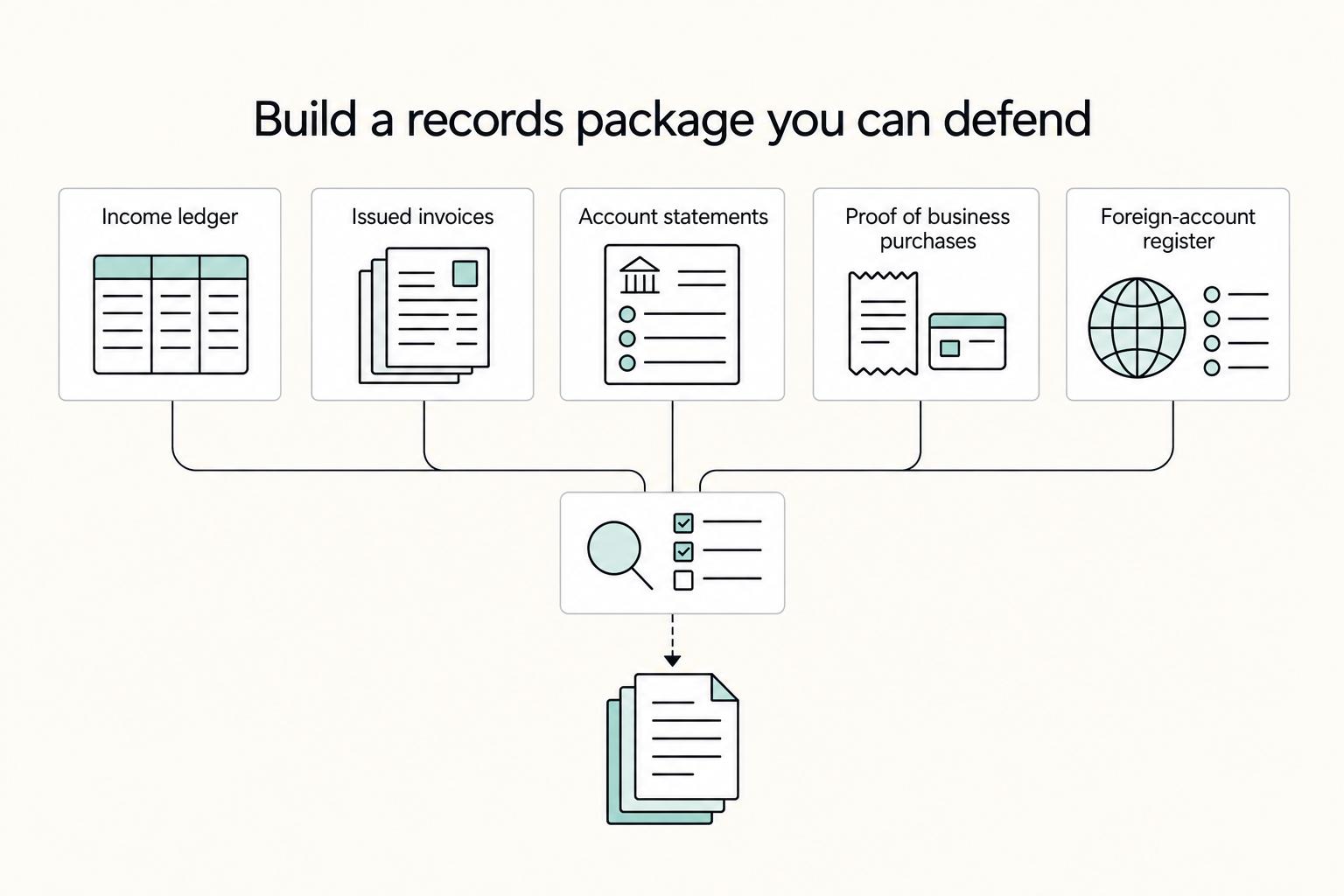
Build a records package you can defend#
Clean records matter more than most first-time filers expect. Separate business and personal flows from the start. Even though a dedicated account becomes mandatory for micro-entrepreneurs only after turnover exceeds 10 000 € for 2 consecutive years, separating flows earlier makes reconciliation much easier.
| Record | Requirement |
|---|---|
| Income ledger | Keep it filing-ready |
| Issued invoices | Retain the complete set |
| Account statements | Keep statements for the account receiving business income |
| Proof of business purchases | Keep it filing-ready |
| Foreign-account register | Log accounts opened, held, used, or closed during the year |
For retention, the baseline is simple:
- Keep livre de recettes and registre des achats information for 10 years.
At a minimum, your invoices should show:
- Issue date.
- Unique invoice number in a continuous chronological sequence.
- Seller identity.
Before Phase 2, your filing pack should include:
- Household income inputs for Formulaire n°2042.
- Foreign-account details for Formulaire n°3916-3916 bis.
- URSSAF turnover declarations.
- Year-end turnover total reconciled to your receipts.
If any part of that pack is incomplete, close the gap before deadlines arrive.
Related: Can Digital Nomads Claim the Home Office Deduction?.
Phase 2: Execute the Declaration with Precision#
Once your records reconcile, the filing itself should be controlled rather than improvised. Match each dataset to the right form, handle foreign items in the right order, and keep a file trail you can defend later.
If this is your first filing and online access is not available in time, file on paper with Formulaire n°2042. Annual filing is still required even with prélèvement à la source.
Map each dataset to one form first#
Do not start by typing figures into forms. Sort the data first. In practice, that means assigning each category once so the same amount does not get missed or duplicated.
| Dataset | Form | What you report |
|---|---|---|
| Household income of the tax household | 2042 | Main income tax return for the foyer fiscal |
| Non-salaried professional income | 2042-C-PRO | Supplementary return for professional income |
| Income received from outside France | 2047, then transfer to 2042/2042-C/2042-C-PRO | Foreign-source income and treaty-relief entries |
| Foreign bank, payment, or digital-asset accounts | 3916 / 3916-bis | One declaration per account concerned |
The key split is this: 2042 is the main household return, and 2042-C-PRO is the professional supplement for non-salaried activity.
If you are a micro-entrepreneur, enter gross annual turnover: total receipts before deductions, not net profit. The taxable base is gross turnover minus the fixed allowance: 71% for purchase-resale or lodging, 50% for BIC services, or 34% for BNC or liberal activity, with a minimum allowance floor of 305 euros.
Choose BIC or BNC based on the activity itself, not preference. BIC covers commercial, industrial, or artisanal activity. BNC covers non-commercial professional activity. If your activity is mixed and classification is not obvious, verify it before you file.
Run a foreign-account decision checklist before submission#
Foreign-account disclosures are a common error point on first returns. Before you submit, run each non-French account or platform account through the same checklist.
| Account factor | What to check |
|---|---|
| Opened during the year? | Check whether the account was opened during the year |
| Held at any point during the year? | Check whether it was held at any point during the year |
| Used during the year? | Includes receipts or transfers |
| Closed during the year? | Check whether the account was closed during the year |
| Covered account type? | Bank, payment, or digital-asset account |
| Payment-platform account? | Verify exception conditions instead of assuming exclusion |
Common misses include accounts closed mid-year, foreign accounts linked to a French account, and accounts you could use under power-of-attorney or equivalent control. Keep notes and statements showing why you declared each account or treated it as outside scope. Check current penalty amounts before final submission.
Handle foreign income in treaty order#
When foreign-source income is involved, sequence matters. Complete 2047 first, then transfer the result to the main return. Do not reverse the order.
- Identify the income type: salary, professional, investment, rental, or other.
- Check the France-country treaty for that income type.
- Enter the income on Form 2047.
- Complete treaty-relief handling on 2047, in section 6 or 7 depending on treaty design.
- Transfer amounts to the corresponding lines in 2042, 2042-C, or 2042-C-PRO.
The core rule is simple: foreign tax paid is not deducted from income. Relief is handled through treaty-based tax-credit mechanics. If you have mixed-source income, multiple countries, cross-jurisdiction characterization conflicts, or uncertainty between household and professional reporting, escalate to a tax professional.
Convert currency with a method you can defend#
Currency conversion is one of those details that feels minor until it goes wrong. Use a method that matches the rule and leaves a clear audit trail.
| Method | When to use it | Evidence to keep |
|---|---|---|
| Transaction-date rate | Default rule for foreign-currency income | Invoice, payment date, account statement, conversion worksheet |
| Annual average rate | Only where a specific tolerance applies (for example, regular Franco-Swiss frontier wages/related expenses) | Source used, scope note, and proof the tolerance fits your case |
| Self-chosen blended average | Not a default method; verify before use | Method note and validation record |
The default rule is to use the exchange rate in Paris on the day of receipt. If you apply an average-rate tolerance, document why it applies and verify current accepted guidance before you file.
Finish with a consistency check#
Before you file, do one final pass across the whole return.
- 2042-C-PRO turnover matches your annual receipts total and bank inflows.
- Amounts declared on 2047 are transferred to the matching main-return sections.
- Every foreign account opened, held, used, or closed has its own 3916 or 3916-bis.
- If prefilled data is incomplete, rebuild totals from annual summaries, statements, or payslips and file from your own verified figures.
For a deeper dive, read the digital nomad tax guide.
Before you submit, run a quick self-check with the tax residency tracker so your travel history and residency evidence stay organized for this return and next year's file.
Phase 3: Optimize for Year Two and Beyond#
From year two onward, the goal is not to reinvent the process each season. You want a repeatable setup: one tax account, one checklist, a clear split between tax and social charges, and records that already support the next return.
Activate your online tax account#
After your first return, activate Mon espace Finances publiques on impots.gouv.fr. This becomes your main hub for declarations, tax documents, and payments.
You need three identifiers to create access: numéro fiscal, numéro d'accès en ligne, and revenu fiscal de référence. Use the latest numéro d'accès en ligne, since it changes each year, and complete email activation within 8 hours.
Once activated, verify two things right away:
- You can access your tax documents.
- You understand the difference between proof documents: ASDIR appears immediately after online filing, while the final avis d'impôt sur les revenus is issued later in your online space.
If you still do not have a numéro fiscal, contact your local centre des Finances publiques. If another identifier is missing, resolve access before the next filing period.
Know the split between PAS and URSSAF#
Income tax and social contributions run in parallel. Paying one does not complete the other, and people often assume the system is more automated than it is.
| Item | Who collects it | What still stays on you |
|---|---|---|
| Income tax on salary or pension income | Employer or pension body via prélèvement à la source | File the annual income tax return |
| Income tax on independent income via PAS acomptes | Tax administration via PAS acomptes debited from your bank account | For micro-entrepreneur income, file 2042 and 2042-C-PRO each year |
| Social contributions on micro-entrepreneur turnover | URSSAF | Declare turnover to URSSAF and pay contributions, including when turnover is 0 |
For independent income, PAS installments are automatically recalculated after annual filing, so review updated debits after assessment.
Run a recurring checklist by cadence#
Once the first return is behind you, the easiest way to reduce future filing risk is to review the same items on a fixed schedule.
| Cadence | What to do | Timing note |
|---|---|---|
| Monthly (or your URSSAF cadence) | Record gross receipts, reconcile invoices to bank inflows, and submit URSSAF turnover declarations on time | First turnover declaration is available after at least 3 months (90 days) from activity start |
| Filing season | Reconcile 2042-C-PRO turnover against annual receipts and URSSAF declarations; document any differences and keep supporting records | Confirm the current filing window with the tax authority or an advisor. |
| Post-assessment | Download the ASDIR, then retrieve the final tax notice in your account when issued; confirm whether your PAS rate or installments changed | ASDIR appears immediately after online filing; the final tax notice is issued later |
| Year-end | Log each foreign account opened, held, used at least once, or closed during the year, with supporting statements and opening or closing records | Prepare your next 3916 / 3916-bis cycle |
Escalate when facts change#
Get help early when the facts change. That includes a new income mix, a status change, foreign-source income from new countries, or uncertainty around activity classification. It is much easier to adjust before filing than to fix a mismatch afterward.
You might also find this useful: A Guide to France's Micro-Entrepreneur Regime for Freelancers.
Conclusion: Confirm the return is complete, then set up next cycle#
A first return is only truly complete when four things are in place: the main return is filed, any required attachments are included, your online tax account is active, and you can expect or already access your avis d'impôt sur les revenus.
The three phases work best as one sequence:
- Tax identity setup: confirm you have your numéro fiscal, the 13-digit identifier used for tax procedures.
- Correct declaration submission: file Formulaire 2042 as the base return, add 2047 if you received income outside metropolitan France, and add 3916 / 3916-bis for foreign accounts opened, held, used, or closed during the year.
- Year-two compliance setup: activate your account on impots.gouv.fr and use it to access notices and declarations, file future returns, manage withholding, and pay taxes.
Completion errors are a real risk: filing 2042 but missing 2047 or 3916 / 3916-bis where required, or stopping before account activation is finished. Once the activation email is sent, you must click the link within 8 hours.
Use this completion check:
- Done: 2042 filed; required 2047 and/or 3916 or 3916-bis attached based on your facts; online account activated; filing records saved; avis d'impôt sur les revenus expected or received.
- Not done: a required attachment is missing, account activation is incomplete, or you cannot show what was filed and when.
Treat your avis d'impôt sur les revenus as an operational document. It supports the income you declared and is often required for administrative and financial steps, including bank requests.
For your next cycle:
- Store: filed forms, submission records, account opening or closing records, income support, and tax notices.
- Monitor: filing calendar, foreign-account changes, new income types, and online-account access.
- Escalate: if you run into difficulty, use official support pathways.
For a step-by-step walkthrough, see The US Solopreneur's First-Year Blueprint: From Wyoming LLC Formation to Filing Your First Expat Tax Return.
If your France filing also ties into cross-border invoicing and payouts, contact Gruv to confirm what compliance controls and audit-ready workflows are supported for your setup.
Frequently Asked Questions
Do I need to disclose a foreign account?
It depends on your situation and current filing rules. If you hold accounts with non-French institutions, treat this as a verify-before-filing item and confirm current reporting requirements before you submit. Next step: run the Phase 2 account sweep and keep an evidence pack with the provider name, account identifier, and opening or closing records.
Do Wise and Revolut count as foreign accounts?
They can, depending on the legal institution and account setup. Do not classify by app brand alone. Confirm the institution and account location in your account documents before filing. Next step: if your case includes cross-border income or multiple account types, consider escalating to a qualified professional.
How do I get a numéro fiscal if I have never filed before?
First-time filers can get stuck in a loop because online steps ask for a number they have not yet received. Start on impots.gouv.fr and use the path “Vous n’avez pas encore de numéro fiscal ?”. After first processing, your tax assessment may also provide your identifier. Next step: use Phase 1 to complete identity setup, then move to Phase 3 once your online account is active.
How do freelancers declare income?
Use 2042 as the base return when residency criteria apply, then follow the business-income path in Phase 2. Verify the exact business-income treatment for your case before filing, especially how your receipts should be reported. Next step: reconcile figures to invoices and bank inflows, and pause to fix mismatches before submission.
Do I need an accountant for my first return?
Not always. You may be able to file yourself in a straightforward case. If you have mixed income sources, cross-border residency questions, a move during the year, or a status change, professional advice can help reduce filing risk. Next step: use Phase 2 for straightforward cases and bring in a qualified professional as complexity appears.
When do I become a French tax resident, and what income is in scope?
You are generally treated as fiscally resident if at least one connection test applies, such as your main home, principal place of employment, or economic interests being in France. Residents are described as declaring worldwide income, so moves and overlapping country ties are common error points. Next step: use Phase 1 to document when your facts changed, and get professional advice if another country may still claim residency.
When do I file, and can I wait for a reminder?
Do not wait for a reminder. The system is self-reporting. The tax year runs from January 1st to December 31st, and filing is typically in the late-April-to-early-June period, but you must verify the current 2026 calendar and channel rules before submitting. Next step: file within the verified window and keep proof of submission.
Try a related tool
Researched and edited by the Gruv editorial team. Gruv builds cross-border billing, payouts, and finance-operations software for global businesses.
Sources
Includes 6 external sources outside the trusted-domain allowlist.
- digitalcollections.library.gvsu.edu/items/browsetrusted
- taxation-customs.ec.europa.eu/system/files/2023-08/ART%20-%20Report%202023...trusted
- entreprendre.service-public.gouv.fr/vosdroits/F36232external
- entreprendre.service-public.gouv.fr/vosdroits/F36244external
- frenchentree.com/living-in-france/french-tax/when-do-i-need-t...external
- frenchtaxonline.com/blog/demystifying-income-tax-in-france-your-...external
- immifrance.com/tax-filing-for-first-year-residents-avoiding...external
- impots.gouv.fr/professionnel/questions/je-suis-micro-entrep...external
Educational content only. Not legal, tax, or financial advice.
Related Posts

Digital Nomad Taxes in 2026 With a Defensible Filing Plan
With digital nomad taxes, the first move is not optimization. It is figuring out where you may be taxable, where filings may be required, and what proof supports that position.

Can Digital Nomads Claim the Home Office Deduction?
Claim the deduction only when your facts and records can carry it. With the home office deduction for digital nomads, the real decision is usually a three-way call: claim it, do not claim it, or pause and get help because your file is not ready.

How Freelancers Can Decide on France’s Micro-Entrepreneur Regime
Low-stress compliance starts with one question: does the Micro-entrepreneur regime match your real setup right now? It is often presented as a simplified option for lower-revenue activity, so use it as a fit test, not a shortcut.