
Quick Answer
Yes: treat a california employee handbook as a practical requirement, even when one single consolidated document is not always expressly required. Begin with AB 5 and the ABC test to confirm status, then draft core written policies, including FEHA prevention language and Labor Code 2810.5 notice handling. Finish by documenting delivery and timing through acknowledgment records, Form I-9 completion, and new-hire reporting to EDD.
Sequence Your First California Hire in Three Decisions#
If you are making your first hire in California, one major risk is sequence, not templates. The practical order is to make three decisions: classify the worker, set written policy foundations, and complete onboarding paperwork on time.
This guide stays focused on that first-hire scope. It is a practical playbook for clearer policies, cleaner onboarding, and reduced dispute risk about what you communicated and when.
| Stage | Core decision | Outcome |
|---|---|---|
| 1 | Employee or contractor under AB 5 and the ABC test | You avoid building the hire on the wrong legal status |
| 2 | What must go into your written policies | You create a usable handbook foundation instead of a generic packet |
| 3 | How to deliver documents and track deadlines | You can show what was delivered and when |
Start with classification before drafting policies. California's AB 5 framework, effective January 1, 2020, affects whether a worker is treated as an employee or independent contractor. For covered purposes, the default presumption is employee status unless the hiring entity can prove otherwise.
Once that is settled, build the written foundation around what California clearly requires you to communicate. For example, employers must maintain and distribute a written policy for prevention of harassment, discrimination, and retaliation. At hire, employers must also provide the Labor Code 2810.5 Notice to Employee, and when notice information changes, written updates are required within 7 calendar days.
Execution is the final step. Your onboarding checklist should include Form I-9 Section 2 within 3 business days of hire. It should also include new-hire reporting to EDD within 20 days of the employee's start-of-work date. A common avoidable breakdown is having documents drafted but no clear delivery record, and no deadline tracking when required notice information changes.
You might also find this useful: A Guide to Employee Handbooks for a Remote-First Company.
Stage 1: Employee or Contractor? Mastering California's Foundational Hiring Decision#
Make the classification call before you draft handbook policy. If you skip that step, you risk building onboarding, pay, and wage and hour practices around the wrong relationship model.
Treat classification and handbook drafting as separate decisions. CalOSBA presents them as distinct topics in practice, and its schedule lists classification before handbook guidance. Use that sequence as an operational workflow, not as a statement of legal mandate.
That matters even more when the compliance picture is moving. In 2026, employers are already handling important employment-law updates. Classification sits alongside hiring, wage and hour, and leave compliance. Treat it as a threshold call, not cleanup.
A practical classification screen for founders#
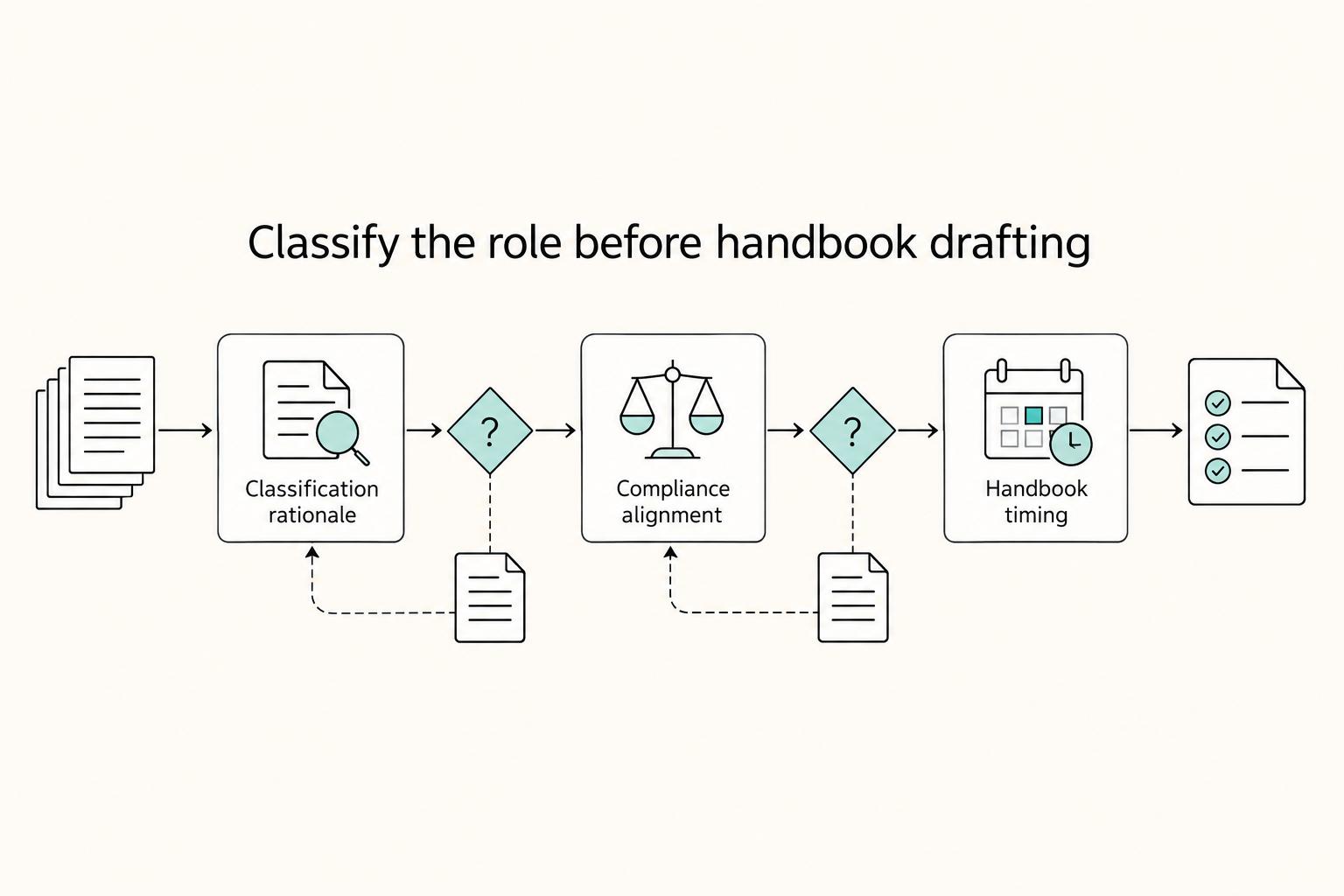
Use a simple internal screen before policy drafting. This is an operational check, not a legal test.
| Checkpoint | What to confirm now | Documentation to keep |
|---|---|---|
| Classification rationale | You can clearly explain why the role is being treated the way it is | Written rationale, scope notes, agreement terms |
| Compliance alignment | Hiring, onboarding, pay, wage/hour, and leave handling match the current role setup | Onboarding docs, pay process notes, policy drafts |
| Handbook timing | Handbook language is drafted after classification assumptions are reviewed | Version history, review notes, approval records |
If contract language and day-to-day execution do not match, pause and reassess before moving forward.
Quick self-audit for first-hire misclassification traps#
Run this quick self-audit before you move ahead:
| Trap | What the article says |
|---|---|
| Unclear role setup | No documented rationale for the current classification approach. |
| Compliance mismatch | Hiring, pay, wage/hour, or leave practices are being handled inconsistently. |
| Policy drift | Handbook language is moving ahead while classification decisions are still unresolved. |
If more than one trap appears at once, treat that as a no-go signal for moving ahead casually.
What the risk usually looks like#
Classification mistakes can create more than one issue at once. California small-business guidance frames compliance as a way to reduce liability and avoid penalties, wage disputes, and legal challenges. California labor law also sets baseline protections around wages and hours.
| Risk lane | What the article says |
|---|---|
| Penalty exposure | Compliance gaps can trigger penalties. |
| Wage-dispute exposure | Disputes can arise over whether wage-and-hour protections should have applied. |
| Legal-challenge exposure | Unresolved issues can escalate into legal challenges. |
Review the risk across these three lanes, then confirm exact legal thresholds separately before you make a final call.
Go or no-go before Stage 2#
Use this decision rule: if your classification rationale is weak or unclear, pause and resolve it before Stage 2. If your rationale still looks strong after review, document it and keep execution consistent with that choice.
If the answer is still unclear, re-scope before drafting handbook policy or get legal guidance for the specific facts. For a deeper read on the classification framework, see our AB 5 guide. Related: Moving From Hourly to Project-Based Rates.
Before you lock your handbook language, sanity-check your classification assumptions with the W-2 vs 1099 calculator.
Stage 2: Building Your "Minimum Viable Handbook" for Maximum Protection#
Do not overbuild your first handbook. Start with the smallest policy set that makes it usable and ready for local overlays before release.
Draft for situations people will actually face, not broad culture language. Keep the four pillars, and write each item so a manager can apply it without guessing.
| Pillar | Policy area | Why it matters | Include now | Optional later |
|---|---|---|---|---|
| 1. Status and conduct | At-will statement | California's baseline is that employment may be terminated at the will of either party. | State that employment is at will and may be ended by either party. Check the rest of the handbook so no section reads like a guaranteed employment term. | Performance philosophy and manager documentation guidance. |
| 1. Status and conduct | Anti-harassment, anti-discrimination, and anti-retaliation (FEHA) | California requires a written prevention policy and distribution to employees. | Prohibit harassment, discrimination, and retaliation; provide clear reporting paths; state confidentiality to the extent possible; commit to timely response and impartial, timely investigations; and state clearly that employees can raise concerns without retaliation. | Investigation role map, complaint form, and training calendar. If you have five or more employees, track the separate training cadence, at least one hour every two years. |
| 2. Pay and time rules | Wage-and-hour baseline | Clear pay, break, and overtime rules reduce avoidable disputes. | Write plain rules for timekeeping and breaks: meal period for shifts over 5 hours, at least 30 minutes, paid rest period of 10 minutes per 4 hours worked, overtime over 8 hours/day at 1.5x, and over 12 hours/day at 2x. Include the statewide minimum wage baseline of $16.90/hour, effective January 1, 2026, then apply local overrides after verification. | Scheduling examples and expanded payroll/travel-time examples. |
| 3. Leave and safety | Paid sick leave baseline | State minimums and local requirements often diverge. | Set paid sick leave at no less than the statewide baseline, 40 hours or five days per year for most workers. Note that an employee who works in California for 30 or more days within a year from start of employment is entitled to paid sick leave, and that stricter local rules apply where required. | Expanded leave matrix and role-specific call-out procedures. |
| 3. Leave and safety | Workplace safety and IIPP | California requires an effective Injury and Illness Prevention Program (IIPP). | Include a safety policy that requires reporting of hazards and injuries and points to your IIPP as the operating program for prevention and response. | Detailed forms, ergonomics guidance, and job-specific safety appendices. |
| 4. Reimbursement and remote/hybrid operations | Expense reimbursement and communication norms | Clear reimbursement and communication rules help reduce avoidable disputes. | State reimbursable job-cost categories, submission steps, approver, and response timeline. At minimum, cover required tools and supplies and mileage when a personal car is used for work. For remote or hybrid roles, define how employees document work-related costs, plus expected availability windows and urgent and non-urgent channels. | Home-office setup guidance, optional stipend language, and role-based equipment lists. |
Statewide baseline vs local overlay checkpoint#
Before you finalize language, map where each employee actually works: primary city, regular secondary city if any, and remote, hybrid, or on-site status. Then verify local rules for each location and treat any unconfirmed local requirement as pending, not final handbook language. Use this as a release gate: do not publish until you have checked local overlays for wage and leave rules.
For a step-by-step walkthrough, see A Guide to California's Meal and Rest Break Laws.
Stage 3: Deliver, Acknowledge, and Reinforce the Handbook at Onboarding#
A solid handbook can still fail if rollout is loose. It works best when each new hire gets the current version, acknowledgment is captured, and managers reinforce the same expectations.
Treat this as part of the hiring lifecycle, not post-offer admin. Before you hire, decide which onboarding documents you keep, how you keep them, how long you keep them, and who owns the process.
| Action | Owner | Timing | Proof to retain |
|---|---|---|---|
| Align offer and onboarding templates with handbook language | Founder, HR, or counsel | Before offers are sent | Current offer/onboarding template version |
| Share the handbook used for onboarding | HR or hiring manager | Before or at orientation | Copy of the handbook version shared and share date |
| Capture handbook receipt/acknowledgment | HR or hiring manager | During onboarding | Signed or logged acknowledgment tied to the handbook version shared |
| Cover expectations in orientation and early follow-ups | Direct manager | Orientation and early check-ins | Orientation agenda and brief follow-up notes |
Connect the offer letter to the handbook#
Use your offer letter to connect the role to your handbook in plain language. Keep references consistent with handbook language on expectations, reporting paths, and scheduling, and check for conflicts before sending.
A short line is enough: employment is subject to company policies, including the handbook provided on or before the start date.
Capture acknowledgment cleanly#
Use an acknowledgment record you can retrieve quickly. The goal is usable documentation, not a bloated packet. Your record should confirm:
| Record point | What the record can confirm |
|---|---|
| Handbook delivery | The employee received the handbook and the version or effective date shared. |
| Policy expectations | The employee is expected to read and follow handbook policies. |
| Questions and reporting | The employee knows how to ask questions and report concerns. |
| Policy updates | Policy updates may occur and will be communicated. |
Store these records in a secure, searchable location so they are easy to retrieve with the related onboarding documents.
Use orientation to make the handbook usable#
Do not treat orientation as a document drop. Supervisors should use orientation and early follow-ups to communicate department needs, expectations, and performance standards clearly and regularly.
Focus on the practical policies the employee will use right away, and use early check-ins to surface and address issues before they grow.
We covered this in detail in A Guide to Professional Employer Organizations (PEOs) in California.
Beyond Compliance: Your Handbook as a Foundation for Growth#
A good handbook should help you run the business, not just check a box. When it sets clear expectations, names where to get clarification, and keeps one current version in circulation, people can make better day-to-day decisions with less guesswork.
Stage 1 sets direction before work begins. Stage 2 gives you written policies that set clear expectations. Stage 3 makes onboarding more repeatable by ensuring people receive the right documents at hire and understand what they are expected to read, understand, and follow.
| Dimension | Compliance-only handbook | Growth-enabling handbook |
|---|---|---|
| Purpose | Show that a policy exists | Guide employees on employment terms and conditions |
| Day-to-day use | Rarely used after onboarding | Used to answer routine questions and reinforce standards |
| Owner and manager behavior | Filed away by HR or founder | Applied consistently by managers, with clear escalation to supervisor, manager, or HR |
| Update triggers | Revised only after issues surface | Revised when policies change, when a new edition replaces a prior version, or when related documents shift |
Use this practical test: can a supervisor answer a real question from the handbook without improvising? Effective performance management systems use explicit expectations, clear standards, accurate measures, reliable feedback, and consistent application. If the handbook is vague, managers may fill gaps differently, which can create inconsistent treatment and avoidable conflict.
Keep the document set clean. If you also issue a code of conduct or operating rules, label each document clearly and note which one governs each topic. Assign one handbook owner, maintain a version log when a new edition replaces a prior one, and clearly state where employees should go for policy clarification.
Next steps: assign handbook ownership, set a review process, and document how policy changes are communicated. That keeps the handbook useful for daily management, not just initial drafting.
If you want to turn this guide into a repeatable workflow, explore the tools library.
Frequently Asked Questions
1. Do you actually need a handbook in California?
Usually, yes for practical compliance. California does not require every employer to maintain one single consolidated handbook in all cases, but employers still need to deliver required written policies and notices, and a handbook is often the clearest way to manage distribution and consistency. Send the version that matches the employee’s work location, then retain the send date and any acknowledgment records with the personnel file. Confirm current state and local requirements before rollout.
2. What should you do before writing any policy?
Classify the worker first using California’s ABC test, because if all three conditions are not met, the worker is an employee. Document your classification analysis and store it in the hiring or engagement file so you can show your decision path if questioned. Willful misclassification can carry civil penalties of $5,000 to $25,000 per violation. Confirm current state and local requirements before rollout.
3. Can you start from a generic template?
Yes, but only as a draft. A generic template can miss California and local requirements, so it should not be your final handbook. Build a simple policy matrix that maps state baseline rules, any city overlay, and the exact handbook section where each rule appears, then confirm current state and local requirements before rollout. | Option | What you get | Risk left open | |---|---|---| | Generic national template | Fast starting point, broad policy language | Can miss California-specific rules, local sick-leave standards, and workplace-specific posting issues | | California-tailored handbook | Better state alignment on core policies | Still may miss city or county overlays if employees work in different locations | | California handbook plus local addenda by work location | Clearer delivery by location and fewer known gaps | Requires version control, redistribution, and tracking when locations or laws change |
4. Which policies should you prioritize first?
Start with a written harassment, discrimination, and retaliation policy, because California requires employers to develop and distribute one. Make sure the complaint process includes a reporting path that is not limited to an immediate supervisor, and keep records that show complaints were tracked to reasonable progress. Then lock in wage-and-hour basics, including meal periods for shifts over 5 hours, a second meal period over 10 hours, and paid sick leave at least at the current state floor of 5 days or 40 hours (or more if a local rule is higher). Confirm current state and local requirements before rollout.
5. How often should you update the handbook?
Review it at least annually and any time you add a work location, change scheduling practices, or learn a required notice changed. For 2026 operations, include the annual workplace rights notice process due on or before February 1, 2026, and each year after, since the notice is updated annually. Keep a dated version log, redistribute updates by email, text message, or in person, and retain proof of who received which version. Confirm current state and local requirements before rollout.
Try a related tool
Researched and edited by the Gruv editorial team. Gruv builds cross-border billing, payouts, and finance-operations software for global businesses.
Sources
- bart.gov/sites/default/files/2025-08/Non-Represented%...trusted
- calcivilrights.ca.gov/2025/12/17/civil-rights-department-reminds-e...trusted
- calcivilrights.ca.gov/wp-content/uploads/sites/32/2025/04/Harassme...trusted
- calosba.ca.gov/for-small-businesses-and-non-profits/busines...trusted
- dgs.ca.gov/OHR/Resources/Hiring-Handbooktrusted
- dir.ca.gov/dlse/Governor_signs_Wage_Theft_Protection_Ac...trusted
- dir.ca.gov/dlse/PubsTemp/DLSE%20Brochures/Recover%20you...trusted
- edd.ca.gov/siteassets/files/pdf_pub_ctr/de34.pdftrusted
Educational content only. Not legal, tax, or financial advice.
Related Posts

Germany Freelance Visa Application Path for Freiberufler and Gewerbe
Choose your track before you collect documents. That first decision determines what your file needs to prove and which label should appear everywhere: `Freiberufler` for liberal-profession services, or `Selbständiger/Gewerbetreibender` for business and trade activity.
Moving From Hourly to Project Rates Without Hurting Cashflow
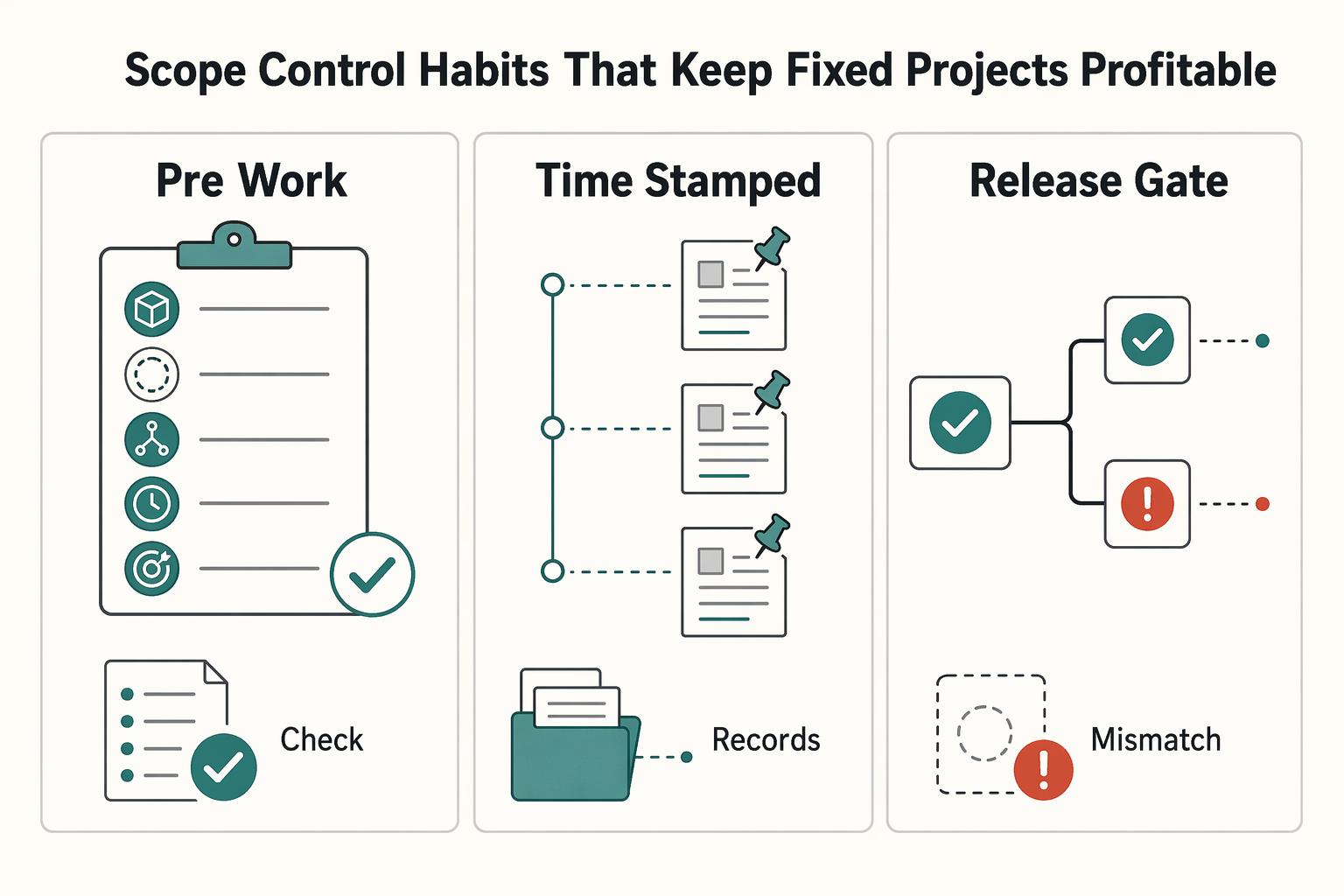
The right pricing model matches uncertainty and cashflow risk. It should fit how clearly the work can be defined, approved, and defended, not just what you are used to selling. Hourly billing gives you room to work while requirements are still moving. Fixed project pricing gives the client stronger budget clarity once deliverables are stable enough to pin down.
Build a Remote Employee Handbook Your Team Can Run
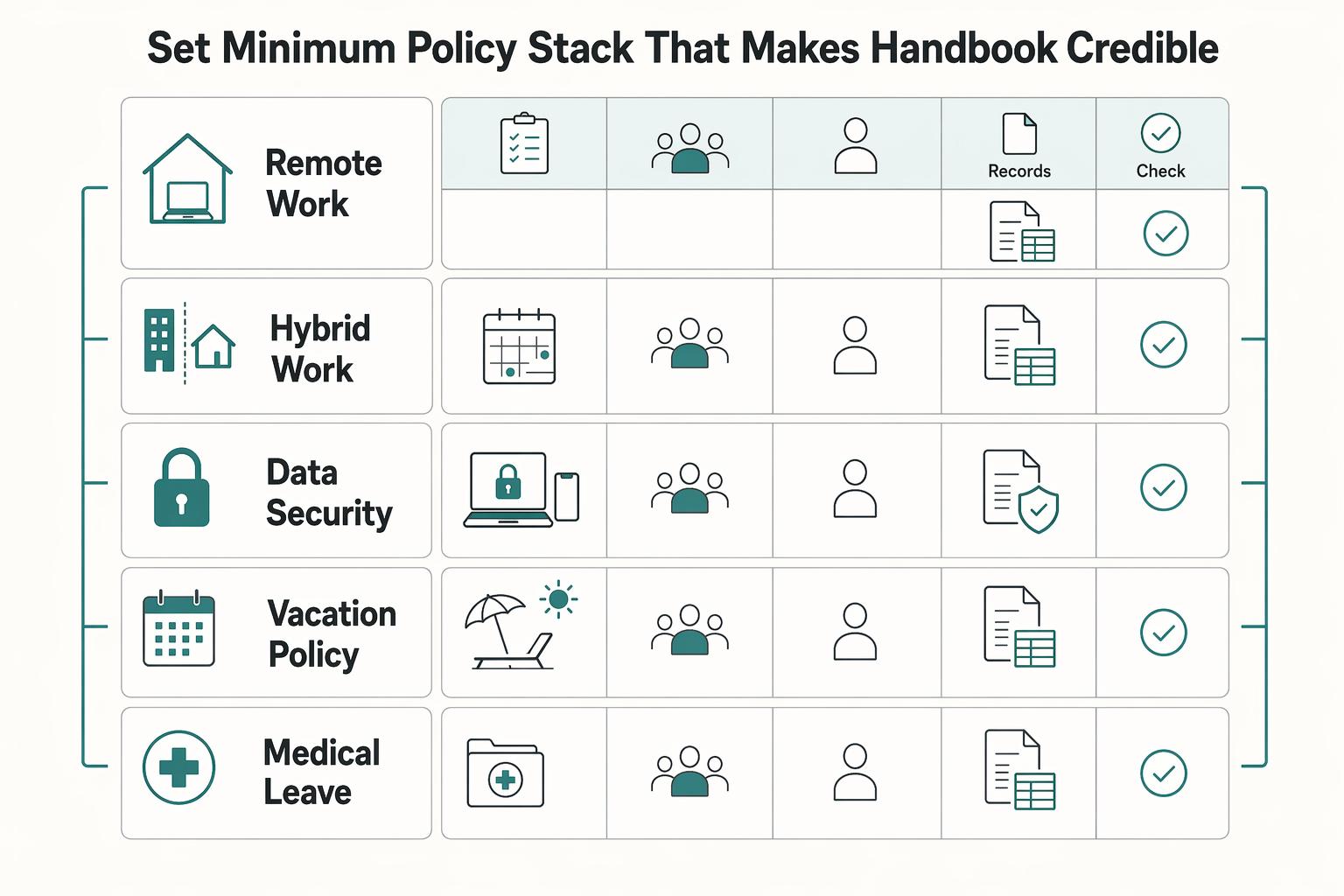
Your remote employee handbook should be an operating document, not a culture poster. It should make day-to-day rules clear enough to apply, enforce, and maintain as you scale.