
Quick Answer
Start by treating the remote employee handbook as a controlled policy set: define what lives in the Employee Handbook, map local requirements in each Country Employee Handbook, and assign an author, approver, and publisher for every major section. Require rollout evidence through a version log, acknowledgement log, training log, and exception log. For U.S. onboarding and pay setup, include Form I-9 first-day controls and Form W-4 handling rules, then pause relocation changes until Taxation and Compliance review is documented.
Start here with the operating promise#
Your remote employee handbook should be an operating document, not a culture poster. It should make day-to-day rules clear enough to apply, enforce, and maintain as you scale.
That operating focus matters even more in remote and hybrid teams because the handbook helps keep flexibility practices and expectations consistent across roles and locations. Employees need to know the baseline. Managers need policies they can apply the same way.
- Clear ownership: Human Resources, managers, ops, and specialist teams like IT each know what they draft, approve, and maintain.
- Clear update discipline: policies include effective dates and tracked changes as legal requirements and operations evolve.
Keep the scope practical. This guide focuses on HR Compliance, policy structure, and execution checkpoints. That includes version control with effective dates and evidence that policy procedures are followed in systems like time, attendance, and pay records.
Two failure modes are worth watching. First, teams treat the handbook as HR-only even when critical sections, such as data security for remote work, are owned elsewhere. Second, they assume one global handbook is always enough. Employment-law implementation varies across countries, and global tracking often spans broad multi-country and multi-topic coverage. Use this guide as your operating model, then validate local legal requirements in each country where you hire.
Define the handbook before you write a single policy#
Set the boundary before you start drafting. Your Employee Handbook should be the primary source for employee policy expectations. An Employee Field Guide or Staff Manual can carry onboarding context, practical tips, and culture.
For remote and hybrid teams, that split helps keep policy expectations separate from culture guidance. Put practical culture guidance in the guide. Keep actual policy language in the handbook set.
Be explicit about what stays in the handbook and what is linked out. At minimum, make sure the handbook set clearly covers:
- Data Security Policy
- Remote/Hybrid Work Policy
Link to standalone versions where that helps, but keep the handbook-level baseline clear and easy to find. For data security in particular, it is reasonable to maintain both handbook coverage and a standalone policy document.
Treat clarity as an operating control, not a formatting preference. If employees are not clearly aware of expectations, or do not understand them, the policy will not be effective. A quick check helps here: confirm employees can find each policy and understand what it requires.
Set the minimum policy stack that makes the handbook credible#
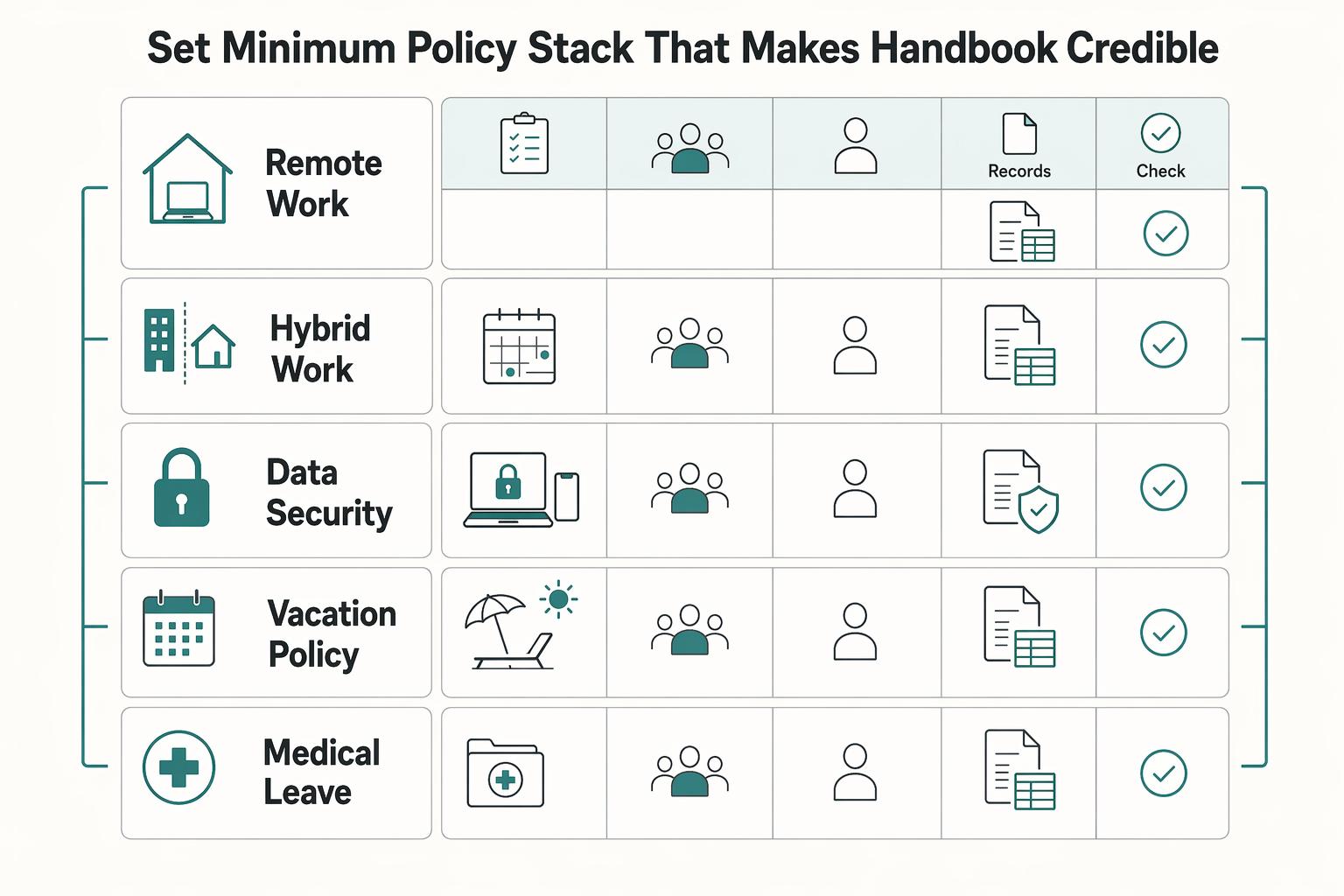
A handbook is most credible when managers can enforce each policy consistently and HR can show it was communicated. Keep the core stack tight, but make every policy enforceable with a clear owner, audience, evidence trail, and review trigger. Use this test: if a manager cannot explain how enforcement works clearly, the policy is too vague and needs a rewrite.
| Policy name | Owner | Applies to whom | Evidence required | Review trigger |
|---|---|---|---|---|
| Remote Work Policy | HR with manager input | All fully remote employees, plus approved exceptions | Signed acknowledgement; approved work location on file | New location types, repeated exceptions, schedule disputes |
| Hybrid Work Policy (if used) | HR with business leadership | Employees on mixed in-office and remote schedules | Team schedule record; acknowledgement | Attendance model changes, team restructuring, repeated overrides |
| Data Security Policy | IT / Security | Anyone accessing company systems remotely | Security training record; device/access approval; acknowledgement | New tools, security incidents, changes to permitted remote access or allowed devices |
| Vacation Policy | HR | Employees eligible for employer-provided vacation or PTO | Acknowledgement; leave request and approval records | Policy complaints, leave-related pay errors, expansion into new jurisdictions |
| Medical Leave Policy | HR with legal review | Employees who may request medical or protected leave | Leave notices, eligibility communications, acknowledgement | Law changes, leave disputes, new leave types |
| Dress Code Policy | HR | Roles where attire or grooming rules are relevant | Acknowledgement; accommodation request records where applicable | Customer-facing role changes, safety changes, accommodation issues |
| Remote Onboarding | HR and hiring manager | All new remote hires | Completed onboarding checklist; identity/work-eligibility records where required | New hiring markets, missed start-date tasks, onboarding audit failures |
| Payroll | Finance / Payroll | All employees | Form W-4 where applicable; pay-setup confirmation; change records | New provider, withholding issues, missed cutoff errors |
| Benefits | HR / Benefits admin | Benefit-eligible employees | Enrollment records; SPD delivery records where applicable | New plans, eligibility disputes, carrier changes |
| Taxation and Compliance escalation path | HR with finance/legal escalation owner | Managers, HR, and employees requesting exceptions | Escalation log; documented decision; exception approval | Relocation requests, cross-border hiring, recurring tax/compliance questions |
Each core policy should answer the operational question first. Remote and hybrid policies should set schedule and exception expectations clearly. Data security should state permitted remote access methods and allowed telework devices so teams do not improvise.
Leave and dress-code language need the same level of precision. Vacation and sick-time terms should be explicit. Medical leave materials should handle FMLA general notice where employer coverage and employee eligibility apply. If you include dress or grooming rules, include a clear accommodation path for religious practices unless undue hardship applies.
The sections teams skip are usually the ones that create avoidable failures later. Remote onboarding should include Form I-9 process controls for U.S. hires, including Section 1 completion by the first day of employment. Pay administration should require Form W-4 at hire and define how replacement W-4 changes are applied, including the withholding timing rule tied to the 30th day. Plan administration should map to governing plan materials and SPD delivery records, with timing controls, including the 90-day benchmark after participation where applicable. Taxation and Compliance should have a formal escalation path for moves, new jurisdictions, and manager exception requests.
Split global rules from country rules without creating policy drift#
Use a two-layer handbook model. Keep one global baseline in the Employee Handbook, and maintain a Country Employee Handbook or local addendum for each hiring market. That keeps core standards consistent while letting you update local legal and notice content without rewriting the full set.
A single document gets hard to maintain once requirements differ across federal, state, local, and international rules, and once employees are physically located in different places. The global-local split keeps updates clear instead of fragile.
Keep the baseline global and the rights local#
| Keep in the global Employee Handbook | Put in the Country Employee Handbook |
|---|---|
| Values, code of conduct, reporting channels, anti-retaliation standards | Statutory leave entitlements and local leave processes |
| Security minimums: permitted remote access methods, approved device types, access scope | Local pay and payroll-compliance language |
| Core remote-work expectations that apply everywhere unless local law overrides | Statutory notices, poster equivalents, and other jurisdiction-specific employment communications |
| Baseline disciplinary and investigation standards | Country-specific wording for working time, holidays, and labour standards |
| Global benefits philosophy and eligibility categories | Country-specific plan terms where local law or plan design differs |
Security is a strong example of what belongs in the global baseline. A telework policy should define permitted remote access methods, device types, and access scope. Leave is often local by design because legal entitlements vary across jurisdictions.
Use Employer of Record language on purpose#
For cross-border hiring, define when Employer of Record is used and who can approve alternatives. An EOR model can handle employment administration such as pay and compliance while your business keeps day-to-day managerial control.
Keep the rule operational and documented. If a hire will work remotely from another country, decide up front whether to use EOR or another approved model. Record the employment model, work location, and effective date.
Make drift visible before it spreads#
Treat section mapping as an internal control. Each local addendum should map to a global section ID and state whether it replaces, supplements, or leaves that global section unchanged. This is not a legal requirement. It is a practical way to prevent silent drift. Use this review checkpoint:
- Every local section cites the related global section ID.
- The addendum states
replacesorsupplements. - Owner and last review date are visible.
Keep statutory notice obligations in local material, not buried in global text. Posting requirements vary by statute, and federal and state poster rules are separate, so local updates should stay local.
For a step-by-step walkthrough, see Your First California Employee Handbook Without Guesswork.
Lock in location, schedule, and exception decisions early#
Set three rules early and in writing: where work can happen, when work is expected, and what triggers an exception review. If your Remote Work Policy leaves "remote" or "flexible" undefined, teams may interpret it differently, and location, pay, tax, and attendance decisions can drift.
Treat work location as an approved term, not a preference#
Work location should be an approval decision, not an informal preference. Whether you use country-restricted, region-restricted, or location-flexible as internal labels, each employee should still have a documented primary work jurisdiction and a clear approver.
Keep that record in your handbook system or a linked policy record. At minimum, capture:
- approved primary work location, including country and subnational jurisdiction where relevant
- whether secondary or temporary work locations are allowed
- any office-attendance requirement and who can approve exceptions
- effective date, owner, and last review date
Be specific. Under some rules, recurring in-office cadence can affect worksite treatment. For example, a federal telework rule uses at least twice each biweekly pay period in official-worksite determination. That does not make it a universal rule, but it shows why "occasional office attendance" is too vague.
Define schedule expectations so "flexible" stays operational#
"Flexible" should still come with clear operating expectations. State whether people set their own hours, what overlap windows are required, expected async response times, and how time is recorded.
| Work-time item | Threshold | Rule |
|---|---|---|
| Short breaks | about 5 to 20 minutes | Compensable |
| Meal periods | typically at least 30 minutes | Generally not compensable |
| Overtime for covered nonexempt workers | after 40 hours in a workweek | Must receive overtime; record all hours worked, including unscheduled after-hours work |
This is also a compliance control. Federal wage-and-hour principles apply whether work is done on-site, at home, or elsewhere. Short breaks of about 5 to 20 minutes are compensable. Meal periods, typically at least 30 minutes, generally are not. Covered nonexempt workers must receive overtime after 40 hours in a workweek. If you employ nonexempt staff, say directly that all hours worked should be recorded, including unscheduled after-hours work.
Make hybrid override rules explicit#
If you run mixed models, make the hierarchy explicit. When a role is hybrid, Hybrid Work Policy should override conflicting remote defaults on attendance and office presence. Keep everything else aligned unless the hybrid policy says otherwise. Use this quick test: if a manager cannot say which document controls attendance this week, your policy stack is still ambiguous.
Use relocation as a hard stop for compliance review#
Relocation requests should be approval gates, not FYI updates. If an employee moves to a new jurisdiction, pause approval until Taxation and Compliance review is complete and the approved location record is updated.
This matters because remote arrangements can create state tax obligations for both employer and employee. Pennsylvania guidance shows that even one teleworking employee in Pennsylvania can create nexus for an out-of-state business. The same guidance also shows source-income outcomes can differ between Pennsylvania residents teleworking from Pennsylvania and nonresidents teleworking full-time from another state.
There is no single withholding rule that covers every move. Reciprocity can apply in some jurisdictions, but only where agreements exist. For each relocation review, document the new jurisdiction and effective date. Also record temporary versus permanent status, the pay review outcome, and any required local handbook or addendum acknowledgment before the change goes live.
Build onboarding, pay, and benefits paths that match policy text#
This is an operating control, not a documentation exercise. Use one written path for onboarding, pay setup, and plan enrollment, and define clear handoffs. When HR and finance run different intake paths, the handbook is less useful as a shared reference.
Keep the internal order simple and explicit, and tailor it to your policies rather than copying a template. One example sequence is:
| Step | Owner | Completion proof |
|---|---|---|
| Offer acceptance | HR | Recorded acceptance |
| Policy acknowledgement | HR | Logged acknowledgement of current policies |
| Remote onboarding docs | HR or hiring ops | Completed onboarding records |
| Payroll setup | Payroll or finance ops | Confirmed ready-to-pay status |
| Benefits enrollment | HR or benefits admin | Enrollment or waiver recorded |
Define the artifact for each step, not just the task name. "Complete" should mean someone can find the record quickly and confirm the handoff is valid.
Plan for common operational misses up front: incomplete records, inconsistent data between teams, and timing gaps between teams. Also watch the quieter failure mode: if people do not engage with the handbook, the effort is wasted.
Use a single "ready to start" status when required records are in place. Otherwise, treat the handoff as incomplete until the missing step is closed. You might also find this useful: How to Onboard a New Employee in a Remote-First Company.
Assign policy ownership so updates do not stall#
If you do not assign a clear owner, approver, and publisher for each major section, updates can stall. The handbook can stop functioning as a clear source of company rules, policies, and expectations.
Use functional ownership so the team closest to the policy maintains it. One practical approach is to map workplace policy text to HR, data security text to IT or security, and jurisdiction-sensitive wording to legal or compliance review. This is a governance choice, not a legal requirement.
| Handbook area | Primary author | Approver | Publisher |
|---|---|---|---|
| Workplace policies in the Employee Handbook | Human Resources | HR or compliance lead | Handbook admin or HR ops |
| Data Security Policy | IT or security lead | Security or compliance lead | Handbook admin or IT ops |
| Jurisdiction-sensitive language | HR with legal/compliance input | Legal or compliance lead | Handbook admin |
Separate who writes, who signs off, and who publishes#
Keep drafting, approval, and publishing as distinct roles whenever possible. This can reduce silent edits and gives you a clear checkpoint before policy text goes live.
Use a lightweight change log for each update: section name, version date, author, approver, publish date, and what changed. If you maintain country addenda, track the linked global section so global edits trigger local review.
Use visible update status, not memory#
Make version status explicit in the handbook itself. A practical benchmark is how official references expose status clearly: the eCFR labels content as "authoritative but unofficial" and shows both "up to date as of 3/25/2026" and "last amended 3/24/2026."
Your handbook does not need legal publishing infrastructure, but it should show when the current version went live and when each section was last updated. Without visible dates, teams can enforce different versions at the same time.
Consider one escalation owner for policy conflicts#
If policy conflicts are common, naming one escalation owner can help resolve them when culture preferences and compliance constraints collide. This role exists to force timely decisions, not to centralize every edit.
A simple governance check works well here. For each major section, you should be able to answer who can change it, who must approve it, and who publishes it. If any answer is unclear, ownership is still too loose.
Roll out the handbook with proof, not assumptions#
A handbook rollout is complete only when you can prove who received which version, who was briefed to enforce it, and what exceptions were approved.
Publish by version and capture acknowledgment by employee group#
Release the Remote Employee Handbook as a named version, not a silently edited page. For each release, record the version date, effective date, sections changed, and the employee groups required to acknowledge it.
Use a formal receipt step instead of assuming a chat or email announcement was enough. An Employee Handbook Receipt Acknowledgment is designed to document handbook receipt. If you also maintain standalone policies, for example remote work or security, tie each acknowledgment to the exact document version.
Use this verification checkpoint: compare your in-scope employee list against the acknowledgment log and confirm dated receipt for the current version. If acknowledgments are incomplete, treat those policies as not yet implemented for that population. That is an operating control, not a universal legal conclusion.
Brief managers on high-risk sections before enforcement#
Manager briefing is the point where policy turns into consistent practice. Require it for the sections most likely to fail in day-to-day use: Remote Work Policy, leave policies, and security obligations.
For remote work, brief the enforceable details managers need to apply consistently, such as work hours, timekeeping, accessibility, secure access procedures, and work expenses. For leave, managers should know what to escalate immediately and avoid improvising. Where FMLA applies, employers must include the general notice in handbook materials or other written guidance. Eligibility notice is time-bound to five business days after a qualifying request or sufficient employer knowledge.
A useful benchmark is U.S. federal telework practice: telework programs include training for both employees and managers, and employees complete telework training before entering a written telework agreement. Even when that rule does not govern your organization, the sequence is still practical: brief first, enforce second.
Keep a small evidence pack that is easy to retrieve#
Keep four logs, and keep them current:
- Version log: document name, version date, effective date, sections changed, owner, approver, publication date
- Acknowledgment log: employee, employee group, document version, receipt date, capture method
- Training log: briefing date, attendees, topics covered, follow-ups
- Exception log: approved deviation, approver, time limit, linked policy section
Two failure patterns are worth avoiding. One is missing reconstructable versions. The other is a mismatch between what managers were trained on and what employees acknowledged. Where FMLA recordkeeping applies, required records must be kept for no less than three years, including documentation of employer policies and practices and employee benefits. Even outside that exact requirement, the same discipline reduces rollout disputes and enforcement gaps.
Set a review cadence and objective trigger list#
A handbook is not finished after rollout. Keep it current with two review paths: a scheduled cadence and a trigger list.
| Trigger | Article detail | Disposition options |
|---|---|---|
| Country change | Country Employee Handbook update or entry into a new hiring country | no change / handbook revision / country addendum revision |
| Pay error pattern | material pay error pattern that reveals unclear pay, timekeeping, expense, or cutoff language | no change / handbook revision / country addendum revision |
| Repeated exceptions | repeated manager exceptions on the same section, especially Remote Work Policy, leave, or security rules | no change / handbook revision / country addendum revision |
| Monitoring or algorithmic-tool incident | policy incident involving monitoring, location tracking, or algorithmic decision tools | no change / handbook revision / country addendum revision |
Set the cadence first, then document it. Use cadence as an operating rhythm, but do not assume there is one universal legal interval or one proven frequency for every company. Define your schedule for the handbook, record it in your version log, and confirm with counsel whether specific jurisdictions or policies need faster checks.
Then make the trigger list explicit enough to remove debate about whether review is required. Standardized numeric thresholds for triggers are not established, so define your internal thresholds in advance. Objective triggers can include:
- a
Country Employee Handbookupdate or entry into a new hiring country - a material pay error pattern that reveals unclear pay, timekeeping, expense, or cutoff language
- repeated manager exceptions on the same section, especially
Remote Work Policy, leave, or security rules - a policy incident involving monitoring, location tracking, or algorithmic decision tools
Treat monitoring and algorithmic-tool changes as high-priority triggers. Workplace surveillance practices are evolving, including location and movement monitoring, and data and algorithm use can materially affect workers. If you add new monitoring or decision tools, review handbook language, notices, and linked policies before day-to-day practice drifts ahead of documentation.
Use a simple verification checkpoint: keep a trigger log next to your version log. For each trigger, record date, source, affected section, owner, and disposition as no change, handbook revision, or country addendum revision. A common failure is not just missing reviews, but relying on only one signal. If you only track one signal, policy failures in practice can go unnoticed.
Fix the failure modes that create most legal and operational risk#
Legal and operational risk in a remote handbook often comes from four repeat failures. Treat each one as a control gap to fix, not a writing preference.
| Failure mode | Example | Control response |
|---|---|---|
| Vague policy language that managers interpret differently | "flexible hours," "reasonable response times," or "manager approval required" | Rewrite the rule so the decision path is explicit |
| Global-only handbook language that ignores local rules | one global statement on leave, payroll, or tax compliance | Keep global principles in the main handbook, then place jurisdiction-specific requirements in each Country Employee Handbook |
| Security policy separated from the handbook set | Data Security Policy lives only in an IT wiki | Keep the enforceable summary in the controlled handbook set and link out to the detailed technical policy |
| Fast-growth hiring that outruns handbook governance | start dates are promised before compliance steps are complete | Pause exceptions and update handbook text, onboarding checklist, and approvals together |
- Vague policy language that managers interpret differently
Ambiguous phrases like "flexible hours," "reasonable response times," or "manager approval required" can create inconsistent decisions across teams. Test this directly: give the same leave, schedule, expense, or conduct scenario to three managers and compare outcomes. If answers differ, rewrite the rule so the decision path is explicit. This also supports enforcement, since EEOC guidance emphasizes clearly communicated standards and consistent accountability.
- Global-only handbook language that ignores local rules
A single global statement on leave, payroll, or tax compliance can be misleading across jurisdictions. U.S. federal baseline rules under the FLSA do not require paid vacation, sick leave, or holiday pay, while EU Working Time rules include at least 4 weeks of paid annual leave and a 48-hour average weekly cap, including overtime. Keep global principles in the main handbook, then place jurisdiction-specific requirements in each Country Employee Handbook.
- Security policy separated from the handbook set
When the Data Security Policy lives only in an IT wiki, frontline managers may apply it unevenly. NIST telework guidance says organizations should define permitted remote-access methods and related policy details, and secure all components, including BYOD devices. Keep the enforceable summary in the controlled handbook set and link out to the detailed technical policy.
- Fast-growth hiring that outruns handbook governance
Remote Hiring can move faster than documented policy, especially when start dates are promised before compliance steps are complete. For U.S. hiring, Form I-9 completion and retention is required for each covered hire, and pay setup must align with Publication 15 duties for withholding, depositing, reporting, and paying employment taxes. If practice changes first, pause exceptions and update handbook text, onboarding checklist, and approvals together.
Related reading: How to Create a Flexible Work Hours Policy.
Build the handbook your team can actually run#
Treat your handbook as a controlled document set, not a one-time writing project. Every policy should have clear wording, a named owner, a current version, and evidence that people received it and managers were trained to apply it.
Handbooks help set expectations and can support legal notice obligations, but publication alone is not execution. If managers cannot apply a rule, or you cannot show who received the latest version, the policy is not operational.
Start with one master set and split local rules cleanly#
For remote and multijurisdiction teams, structure policies around where employees are physically working. The practical pattern is a master handbook for baseline rules plus jurisdiction-specific addenda for local requirements.
| Layer | Keep here | Operator note |
|---|---|---|
| Master handbook | conduct, reporting paths, core security expectations, company-wide standards | Keep language precise and review for labor-law risk. Under the NLRB standard announced on August 02, 2023, overbroad work rules may be presumed unlawful if they reasonably tend to chill employee rights. |
| Local addenda | leave entitlements, pay mechanics, statutory notices, jurisdiction-specific monitoring rules | Map each addendum to a master section so updates stay aligned. |
| Required related documents | documents legally separate from the handbook but still controlled and distributed | In the UK, the written statement of employment particulars is separate from the employment contract: principal terms on day one, wider statement within 2 months, and changes communicated within one month. |
If you operate in Ontario and have 25 or more employees on January 1, a written electronic monitoring policy may be required and must be distributed. The point is operational control across the full policy set, not just the handbook file.
Make acknowledgements and training auditable#
Use acknowledgements as evidence, not ceremony. A signed or clicked receipt is not universally required, but keeping one is a strong control, especially where policy distribution must be documented. Your minimum evidence pack should include:
- version log
- acknowledgement log by employee group
- manager training log for high-risk sections
- exception log for approved deviations
- distribution records for local policies and addenda
If acknowledgements or required distribution are incomplete, treat the update as not fully rolled out. Train managers on what they enforce, especially remote work, leave, security, and conduct.
Keep payroll, benefits, and compliance paths boring and inspectable#
As you scale internationally, failures can show up in execution, not just in policy wording. Make the path from offer acceptance to onboarding, pay setup, and plan enrollment explicit, and do not confirm start dates until policy acknowledgement and pay-eligibility checks are complete.
For pay administration, keep records accurate, retained, and inspection-ready. Under FLSA recordkeeping rules, preserve payroll records for at least three years, and keep wage-calculation records, such as time cards and schedules, for two years. Records must be open for inspection, and employers must deposit and report federal employment taxes. Your handbook should point to these auditable processes, not vague statements like "pay is handled locally."
Common breakdowns can include missing tax forms, mismatched legal names, local coverage gaps, and stale addenda after rule changes. Assign section owners, review country changes with HR Compliance, and keep documentation as disciplined as policy language.
Frequently Asked Questions
What should a remote employee handbook include at minimum?
At minimum, include your core handbook policies plus a clear Remote and Hybrid Work Policy and Data Security Policy. The remote or hybrid policy should define what remote or hybrid work means for your organization. The security policy should set how employees protect company data at home and in public spaces. Keep these policies in the handbook or as clearly linked standalone policies, and make sure employees understand the expectations.
Do remote companies legally need an employee handbook?
You should not assume one universal legal rule applies everywhere. A remote handbook is still a practical control because remote and hybrid work create compliance and cultural challenges. Adapting your policies supports a consistent approach to workplace flexibility. If your practices are changing but expectations are undocumented, risk can increase.
How is a remote handbook different from a standard handbook?
A remote handbook is a standard handbook adapted for remote or hybrid operations. It should clearly define remote and hybrid work parameters for your organization, including expectations such as hours, jurisdiction, and in-office requirements where relevant. It also needs explicit security expectations for work done away from a central office.
Should we maintain a country-specific handbook for each hiring market?
If you hire across countries, a country-specific handbook can be a clear way to localize policy. These materials can cover local essentials like documentation, payroll, taxes, benefits, and onboarding. You do not need to assume every market legally requires a separate handbook to justify this structure.
Who should own handbook updates across HR, IT, and legal?
There is no single legally fixed ownership model. In practice, assign clear owners by policy area across HR, IT, and legal. Data Security Policy updates are often led by IT or security. Whichever model you use, employees need to be aware of and understand policy expectations for those policies to be effective.
How often should we update a remote employee handbook?
There is no universal legally mandated update cadence in this material. Use a review rhythm you can maintain, and also update when operational changes create new expectations. Policy effectiveness depends on employees being aware of and understanding those expectations after each update.
Try a related tool
Researched and edited by the Gruv editorial team. Gruv builds cross-border billing, payouts, and finance-operations software for global businesses.
Sources
- csrc.nist.gov/CSRC/media/Projects/risk-management/800-53%2...trusted
- dol.gov/agencies/whd/fact-sheets/28d-fmla-employer%2...trusted
- dol.gov/general/topic/workhours/vacation_leavetrusted
- ecfr.gov/current/title-5/chapter-XVI/subchapter-B/par...trusted
- ecfr.gov/current/title-5/chapter-I/subchapter-B/part-...trusted
- irs.gov/retirement-plans/plan-participant-employee/4...trusted
- irs.gov/forms-pubs/about-publication-15trusted
- nlrb.gov/news-outreach/news-story/board-adopts-new-st...trusted
Educational content only. Not legal, tax, or financial advice.
Related Posts

Germany Freelance Visa Application Path for Freiberufler and Gewerbe
Choose your track before you collect documents. That first decision determines what your file needs to prove and which label should appear everywhere: `Freiberufler` for liberal-profession services, or `Selbständiger/Gewerbetreibender` for business and trade activity.
How to Manage a Global Freelance Team Without Compliance Gaps
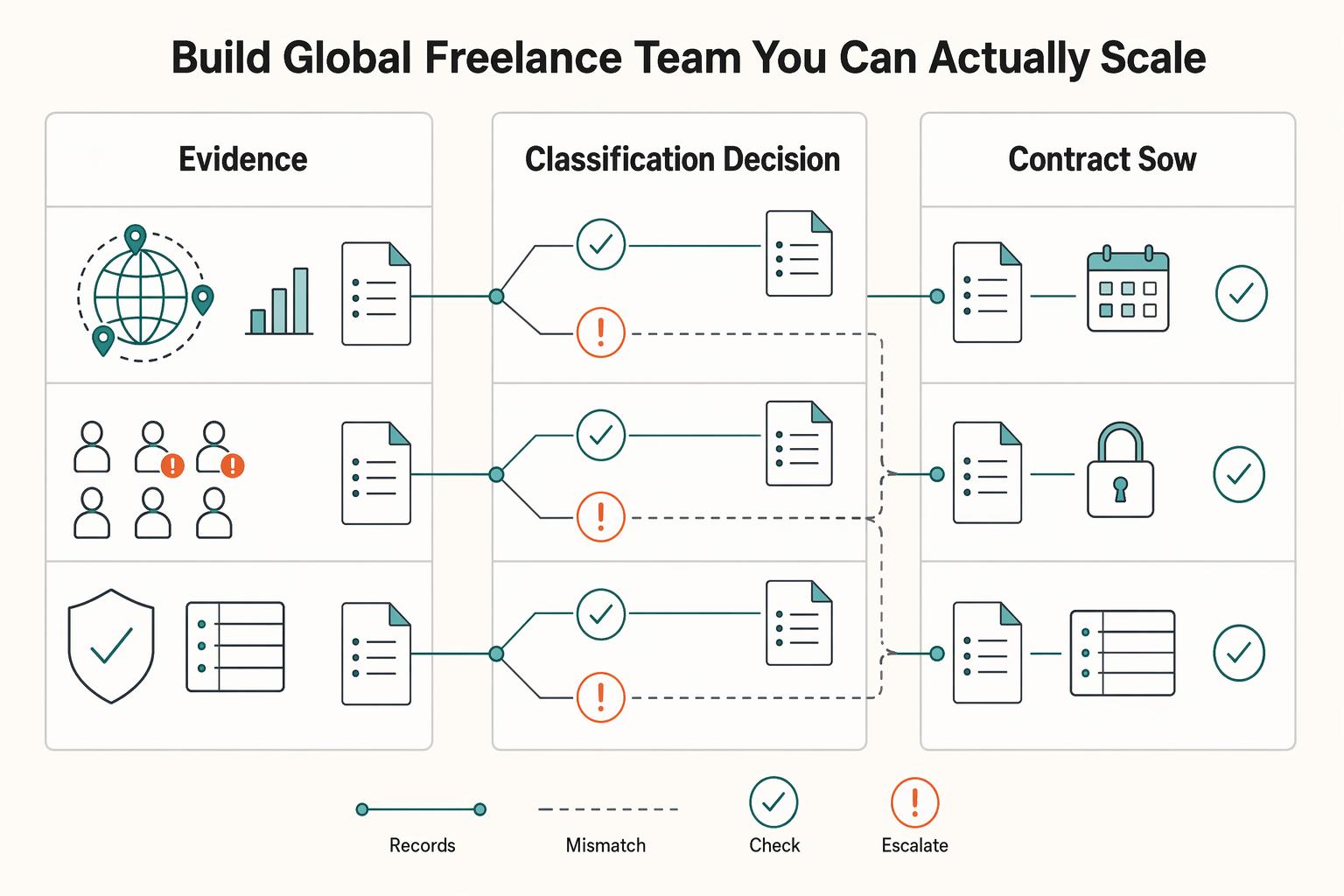
If you want to manage a global freelance team without constant cleanup, use the same intake-to-payout process for every engagement and save an artifact at each gate. Common failure points are instinct-based classification, vague scope, and payments approved in chat with no audit trail.
How to Onboard a New Employee in a Remote-First Company
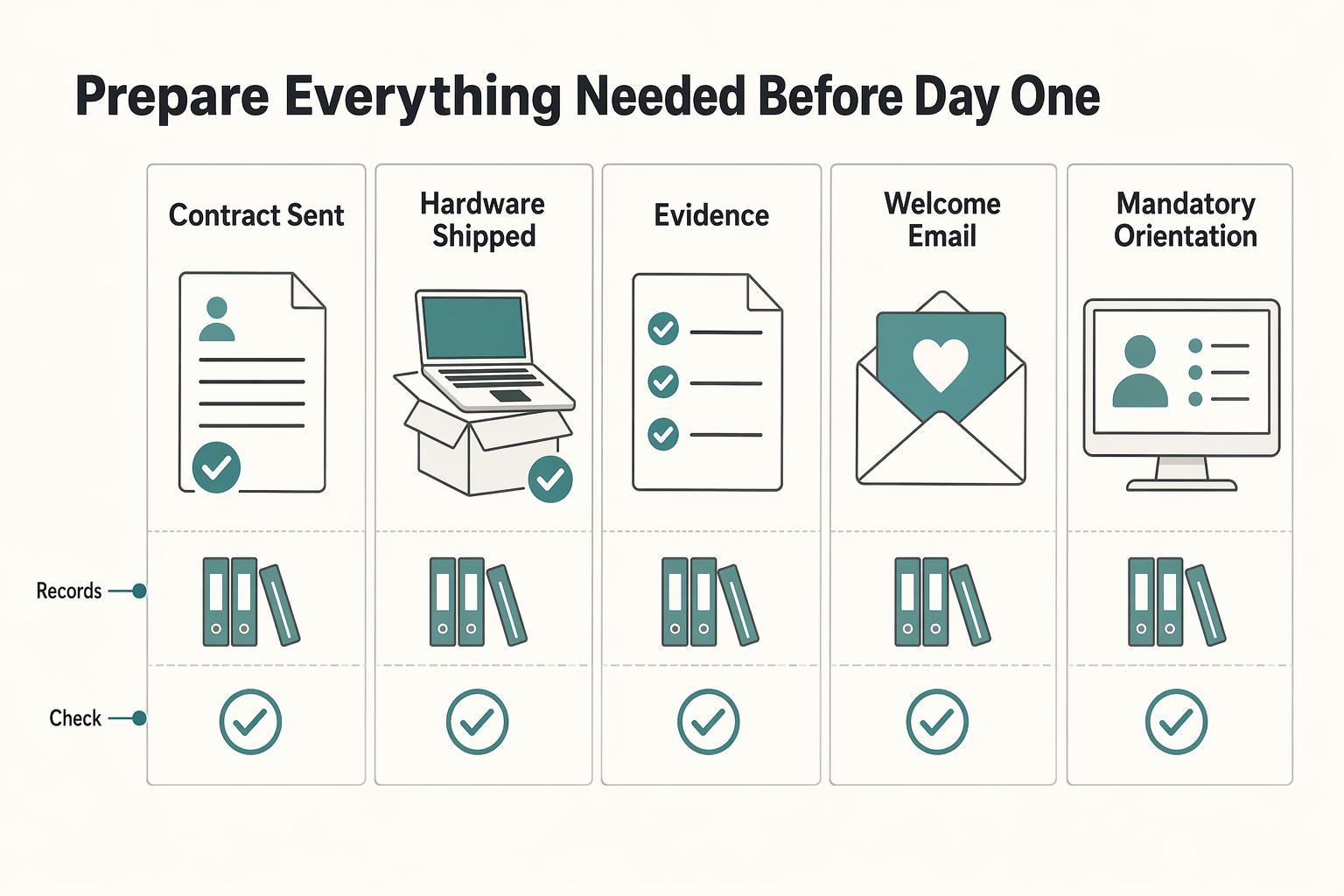
**Step 1. Treat remote employee onboarding as an operating task, not a welcome gesture.** If you want fewer dropped handoffs, the goal is not a big HR program. It is a lightweight, repeatable way to orient, equip, and connect a new hire across practical stages like pre-start, first week, and early ramp. For most small teams, that means enough structure to prevent obvious misses without creating enterprise overhead you will not keep up with.