
Quick Answer
Start with scope classification before any drafting: are you a Relevant Entity carrying on Relevant Activities? For economic substance cayman islands compliance, submit the ESN first because it is required before the Annual Return, then prepare any ES Return on financial-year timing. Support each filing statement with activity mapping, governance records, and CIGA evidence, and escalate to Cayman counsel when classification or exemption points remain unclear near deadline.
Classify scope before deadline pressure starts#
Use this as a yearly operating plan, not a filing-week scramble. If you run an independent business through a Cayman entity, your job is to classify likely exposure early, keep supportable records, and avoid rushed filing positions.
The legal anchor is Cayman's Economic Substance framework. The Department for International Tax Cooperation (DITC) states that the Economic Substance Act contains the rules for satisfying substantial activities standards, and DITC administers Cayman's international tax cooperation legal frameworks. The regime came into force on 1 January 2019. DITC says it was enacted following Cayman's collaboration with the OECD Forum on Harmful Tax Practices and European Union Commission Services. In practice, that means substantial activities backed by records.
This guide is educational and compliance-first, not legal advice. It is grounded in the Economic Substance Act, DITC guidance and FAQs, and DITC's ES legislation/resources page. For entity-specific positions, use Cayman legal counsel rather than relying on a general summary.
Before you rely on any summary, confirm the current legal text. DITC's ES legislation page lists the International Tax Co-operation (Economic Substance) Act (2021 Revision), while a Cayman Government listing shows an International Tax Co-operation (Economic Substance) Act (2026 Revision) Gazette supplement published on 5 February 2026. Use DITC's current legislation/resources page for materials in effect, and check the official Gazette if revision history affects your position. By the end of this guide, you should be able to:
- make a first-pass call on whether your setup is likely in scope, likely out of scope, or uncertain
- assemble an evidence file that supports what you plan to state in annual filings
- identify when uncertainty is high enough to escalate to counsel before deadlines tighten
One process detail matters from day one: the Annual Economic Substance Notification is a required prerequisite to filing an Annual Return, and it is due annually. That means activity mapping and evidence collection need to happen before return-filing pressure starts.
Economic substance in Cayman in plain English#
In plain English, start with this mental model:
- The Economic Substance Act is the rulebook for Cayman's substantial-activity standard.
- A Relevant Entity is an entity type that may be in scope.
- A Relevant Activity is the specific business activity being tested.
- The ES test is applied to each in-scope activity, not just to the entity in general.
The policy direction is clear. The regime came into force on 1 January 2019 and was enacted through Cayman's collaboration with the OECD Forum on Harmful Tax Practices and European Union Commission Services. The focus is real economic activity and substantial presence rather than paper structure alone.
The practical rule is simple. A relevant entity carrying on a relevant activity must satisfy the ES test for that activity. If one entity carries on more than one relevant activity in a financial year, it must submit a separate ES Return for each activity. DITC also monitors compliance, so your classification and filing position should be supportable, not merely form-complete.
Slow down on edge cases. Public summaries do not provide reliable numeric thresholds for what counts as "adequate" staff, spending, or premises, and some exemption mechanics depend on current statutory wording. Read the current DITC legislation/resources page alongside the Act and the Economic Substance Guidance (July 2022, Version 3.2). If your mapping is still unclear, treat the position as uncertain and confirm it with Cayman counsel before drafting filings. See also Satisfying Economic Substance: A Practical Guide for Solo Entrepreneurs.
First-pass scope check before you do anything else#
Treat this as scope triage, not return drafting. First decide whether your entity is in the Economic Substance Act reporting population, then decide whether it carries on Relevant Activities. If either point is unclear, pause and confirm your interpretation with Cayman counsel before filing season tightens.
Start with a simple if/then triage#
If you have a Cayman entity that may be in scope, ask two questions in order:
- Are you a Relevant Entity?
- Are you carrying on any Relevant Activities in the financial year?
The ES test applies when both conditions are met, not just because an entity exists on paper. Keep legal form separate from actual operations from the start.
Map scope to reporting early#
Your first-pass classification should already reflect reporting consequences. DITC materials say that a relevant entity carrying on a relevant activity may need an Economic Substance Return. If more than one relevant activity is conducted in a financial year, a separate ES Return is required for each activity.
Keep both deadlines visible in your first-pass note, where applicable:
- Economic Substance Notification is tied to the Annual Return workflow and is due no later than 31 March each year for entities required to report under the ES Act (trusts are not required to submit an ESN).
- ES Return must be submitted within twelve months after the end of the financial year.
Failure to report by the due date can trigger penalties, so avoid any version of "we will sort it later."
Do not confuse registration with substance#
Registration is not the same as meeting the ES test. The test looks at what the business actually does and how it is directed and managed in the Islands, supported by evidence.
Run a quick alignment check across incorporation or registration documents, accounting labels, and actual month-to-month operating reality. If those three do not line up, treat that as a scope risk, not a drafting problem.
Produce a one-page scope note#
Write a one-page control note that covers:
- scope status: in scope, out of scope, or uncertain
- entity and financial year
- owner (validation and filing)
- assumptions used
- evidence on hand versus missing
- next action and deadline
If wording or revision history matters, verify current text on the DITC legislation/resources page and confirm prior-version questions against the official Gazette.
For a step-by-step walkthrough, see Economic Substance in the BVI for Solo Founders.
Map your real business activities to ESR categories#
If your scope note lands on "possibly in" or "uncertain," the next step is to map what actually generates revenue to the Cayman Relevant Activities. Clear activity statements are easier to defend in both classification and filing.
Start with revenue, not branding#
Do not start with broad labels like "consulting" or "advisory." Start with each income line, describe what happens in practice, and then map that activity statement to the Relevant Activities framework.
For each activity statement, capture what clients pay for, how the income is generated in practice, who manages the activity, and where related employees, management, and expenses sit.
That approach matters because the framework tests operating reality, not just paper descriptions. For in-scope activities, your records should support substance through employees, management, and expenses in Cayman.
Avoid overgeneralizing "consulting"#
A generic label can hide important differences in what the business is actually doing. That raises classification risk and weakens consistency across your filing narrative and governance documentation.
If key records use different descriptions for the same work, treat that as a risk signal and fix the mismatch before you finalize classification.
Reconcile records before you lock your category#
Before you lock a category, line up the records and checkpoints that support your position:
- your scope view on whether activities are relevant
- how you meet ES Test criteria in practice
- filing correctness and governance documentation
A yearly evaluation with your Cayman service providers is a practical control for catching gaps in governance documentation, management trail, or expense support.
Keep BVI comparisons in context#
BVI materials can help you frame questions, but they do not classify a Cayman entity. For Cayman, your position should be supported under Cayman definitions and Cayman evidence. If the call is close, validate it with Cayman counsel before filing.
What directed and managed plus adequate substance look like in practice#
Once you have mapped revenue to a possible Relevant Activity, the real question is whether your facts support that position. As a rule of thumb, if real decisions, real execution, and real records mostly sit outside Cayman, treat that as a filing risk and remediate before you file.
Directed and managed is about where real control happens#
For an in-scope entity, the Act requires it to be directed and managed in an appropriate manner in the Islands for that relevant activity. Guidance makes this practical by pointing to board meetings held in the Islands at a frequency that matches the level of decision-making required. This is a governance test tied to the relevant income-generating activity, not a box-ticking exercise.
Your file should show that the people authorized to make relevant decisions did so in Cayman and that the business followed that decision trail. If strategy is set in one country, approvals happen from another, and Cayman minutes only restate decisions already made elsewhere, treat that as a red flag.
Use a simple year-end test. Pick one material decision and trace it end to end. Where was it considered, who approved it, what record exists, and does that trail point back to Cayman governance?
Adequate substance is not a vibe#
Read "adequate" or "appropriate" substance from the legal framework and guidance, not from generic summaries. The ES test includes specific limbs, including adequate operating expenditure incurred in the Islands, and it requires core income generating activities (CIGA) to be carried on in the Cayman Islands.
In practice, your substance position should fit your activity profile. If you claim Cayman-based activity, your records should show Cayman-based execution of CIGA, with governance and expense support in Cayman that fits the way income is actually generated. Do not invent fixed minimums for headcount, office size, or spend where none are stated.
Match governance records to CIGA records#
Strong files connect governance proof to operating proof. Minutes and resolutions should line up with records showing the claimed work was actually carried out.
A practical evidence set usually includes board or manager minutes, written resolutions, and meeting materials showing the Cayman decision trail; operational or service-delivery records tied to claimed CIGA; and expense records supporting operating expenditure incurred in the Islands where your position depends on it.
Common weak spots are polished governance documents with thin operating support, or strong delivery records with no clear Cayman control trail. Either mismatch can weaken your position.
Use the right source hierarchy#
For close calls, follow the official hierarchy and read the main materials together: the International Tax Co-Operation (Economic Substance) Regulations, 2020, the International Tax Co-Operation (Economic Substance) Act, DITC Guidance Notes, and Enforcement Guidelines. The Enforcement Guidelines direct readers to interpret enforcement in line with the Guidance Notes and practice points.
| Source | How to use |
|---|---|
| International Tax Co-Operation (Economic Substance) Regulations, 2020 | Read with the other main materials for close calls |
| International Tax Co-Operation (Economic Substance) Act | Read with the other main materials for close calls |
| DITC Guidance Notes | Read with the other main materials; the Enforcement Guidelines are interpreted in line with these and practice points |
| Enforcement Guidelines | Use for enforcement questions and read them in line with the Guidance Notes and practice points |
Also verify revision currency before relying on downloaded copies. Official PDFs can carry different revision labels, so if wording is outcome-critical, check the current Cayman legislation source before you finalize your position.
Your annual compliance timeline and filing sequence#
Get the sequence right first. Finalize classification and evidence review before you draft any return narrative, because the Annual Economic Substance Notification (ESN) determines whether an ES Return is required.
Start before the year starts#
Treat setup as compliance work, not admin. Before the financial year begins, confirm likely relevant-entity status, likely relevant-activity status, and who owns each filing step. If classification is unclear, escalate early instead of carrying that uncertainty through the year.
Build your calendar on the entity's financial year, since the ESN is financial-year based. Also remember the order. ESN is a prerequisite to filing the Annual Return, so a late ESN can delay that filing.
A practical day-one control is a simple evidence index that covers your classification memo, governance calendar, CIGA support, Cayman expense support, and a filing folder.
Run the year in three passes#
The easiest way to avoid a year-end scramble is to collect and test support as you go.
Early in the year, capture evidence while facts are fresh. Keep records for material decisions and execution, especially where your position depends on Cayman-based CIGA and related governance evidence.
Mid-year, run one reconciliation check. Do revenue description, internal reporting, and likely ESN answers still align? If they do not, fix the record then rather than at filing time.
Before year-end close, test one material income stream end to end. What activity produced it, who directed it, where did the work happen, and what records support that trail?
File in the required sequence#
The sequence matters. Submit the ESN through General Registry CAP, then file the Annual Return, and if ESN answers confirm relevant entity plus relevant activity, file the ES Return.
| Filing step | Practical owner | Required input | Verification checkpoint | Escalation trigger |
|---|---|---|---|---|
| Pre-year classification | Finance lead with counsel input as needed | Entity type, activity mapping, prior filings, current operating model | Written conclusion on relevant-entity and relevant-activity status | Classification unclear or facts changed materially |
| In-year evidence capture | Operations lead plus company secretary/admin support | Minutes, service records, Cayman expense support, CIGA execution records | Periodic check that each material claim maps to retained support | Governance trail and operating trail do not align |
| Annual Economic Substance Notification (ESN) | Filing owner on General Registry CAP | Final classification, financial-year details, status answers | ESN answers match classification memo and support file before submission | Deadline is near and any ESN answer relies on unsupported assumptions |
| ES Return | Finance lead with advisor review as needed | ESN outcome, relevant-activity details, supporting information, per-activity analysis | Confirm whether separate ES Returns are required for each relevant activity and whether support corroborates each claim | Data gaps, multiple relevant activities, or likely Authority follow-up |
| Post-filing record keeping | Compliance owner | Submitted forms, workpapers, evidence index, follow-up correspondence | Complete, searchable file retained for six years after financial year end | Authority requests additional information or filing record is incomplete |
On timing, do not rely on one recycled deadline chart across all entities. DITC ESN material states no later than 31 March each year, while other published calendars have shown different dates by entity type. Confirm current DITC and General Registry deadlines for your entity type. For ES Returns, the rule is clearer. They are generally due within 12 months after financial year end, with separate returns where more than one relevant activity is carried on.
Hard stop near deadlines#
If core data is still missing close to a deadline, do not file unsupported claims. Escalate to counsel, document assumptions, and keep a dated record of what evidence is missing and what has been requested.
The obligation does not end when a deadline passes. A missed ES Return is still required. If it is not submitted within 30 days of a Penalty Notice, the entity is deemed to have failed the ES test. After filing, retain the full support file for six years after financial year end, and be ready for Authority requests for additional information.
Related reading: A Deep Dive into the Foreign Tax Credit (Form 1116).
Build a minimum evidence pack that survives scrutiny#
The best file is lean and claim-based, not a large admin archive. For Cayman ES reporting, treat it as a practical control: each ESN and ES Return statement should map to a document you can produce on request.
What the minimum pack should contain#
| Pack component | What it should prove | Common failure mode |
|---|---|---|
| Activity mapping memo | Why the entity is, or is not, carrying on each relevant activity | Income streams are described broadly but not tied to the activity analysis |
| Governance records for directed and managed | Board meetings and decision-making were held in the Cayman Islands at an adequate frequency, with a usable decision trail | Minutes are generic or do not match the operating reality |
| Operational proof of core income generating activities | The activities central to generating relevant income happened as reported | Outcomes are documented, but who did the work, where, and under whose oversight is unclear |
| Filing workpapers | How each ESN and ES Return answer was derived | Final submissions exist, but the basis for answers cannot be reconstructed |
This structure fits how the ES Return is used. It provides the required information and supporting evidence for the Authority's ES-test assessment.
Tie each artifact to a specific claim#
Treat this as a hard rule. If a filing claim cannot be traced to a retained document, it is still an assumption. Keep an evidence index with, at minimum, document ID, claim supported, period, owner, and storage location, plus version date if files are shared.
Special care where CIGA is outsourced#
If another person performs CIGA, keep more than the contract and invoices. Your file should also support expenditure details and show that the entity monitored and controlled that activity in the Islands. Without oversight records, outsourced execution can weaken your position.
Run a regular operator checkpoint#
A quarterly cadence can be an operating control, not a legal threshold. It helps you fix missing records while facts are still fresh and test whether one material filing statement can be backed immediately by documents.
If the entity carries on more than one relevant activity, keep separate evidence folders by activity so separate ES Returns can be supported cleanly.
Keep ownership and versions explicit#
Assign one owner for the full evidence pack and clear owners for each source stream, including governance, operations, and filing workpapers. Keep versioned logs and dated drafts so handoffs do not break the compliance trail. The minimum standard is simple: every reporting claim has a current, retrievable support document.
If you want your evidence pack to stay consistent quarter after quarter, review Gruv docs for traceable workflow patterns.
Mistakes that trigger avoidable risk and penalties#
Most avoidable risk starts when the filing narrative gets ahead of the records. Incorporation alone is not proof you meet the ES test, and last-minute drafting can expose gaps you may not be able to fix cleanly before filing. If uncertainty affects classification, exemptions, or filing language, escalate to Cayman legal review before submission.
The Tax Information Authority monitors compliance and enforcement, and the ES Return is used to assess whether the ES Test was satisfied for a relevant entity carrying on a relevant activity. That is why a certificate of incorporation or polished minutes is not enough on its own if contracts, invoices, and operating records point somewhere else.
Weak activity mapping can trigger avoidable issues. When the business is labeled broadly, for example as generic "consulting" or "management," without being reconciled to the relevant activity analysis, the ESN and ES Return can drift away from the actual facts. You then spend time defending inconsistencies instead of answering the substance question directly.
Timing errors create the same pattern. The ESN is a prerequisite to filing the Annual Return, and the ES Return is due within 12 months after financial year end. Those windows close quickly if you still need to reconstruct decision-making, CIGA execution, or oversight of outsourced work.
The enforcement path is explicit in the Cayman ES Enforcement Guidelines. They address missed reporting (section 7(8A)), first-year ES Test failure (section 8(2)), subsequent-year failure (section 8(4)), and misclassification. Public Conyers commentary also reports increased enforcement activity in 2024 and describes potential exposure from CI$5,000 plus continuing daily penalties for non-filing to higher amounts for ES Test failure and repeated failure. Treat those figures as secondary-source commentary, not statutory text.
Before filing, reconcile four records side by side: incorporation documents, accounting labels, governance records, and customer or service contracts. If they do not describe the same operating reality, pause and fix that first. Also verify current DITC timing directly, since secondary sources conflict on ESN timing, including 31 January versus 31 March references.
Red flags worth treating seriously#
- Records conflict across minutes, contracts, invoices, and bookkeeping categories.
- Control location for key decisions is unclear.
- Claims of adequate substance are not backed by a document trail showing who did the work, where, and under whose oversight.
- Outsourced CIGA is supported only by contract and invoices, with limited evidence of monitoring or control in the Islands.
- Filing narrative is drafted first, with evidence gathered afterward.
If any red flag appears, escalate early, especially where your position depends on classification or an exemption call.
Cayman versus BVI decisions for independents#
Choose based on the filing rhythm and evidence trail you can reliably maintain, not on labels. This comparison can help with structure choice, but filing duties remain jurisdiction-specific.
| Decision criterion | Cayman Islands | British Virgin Islands |
|---|---|---|
| Main ES touchpoints | DITC materials show ESN through CAP, with ES Returns submitted to the Tax Information Authority. Cayman legislation resources list the International Tax Co-operation (Economic Substance) Act [2024 Revision] and related materials. | ITA rules say a legal entity carrying on a relevant activity during a financial period must comply with ES requirements. Declarations are now submitted through VIRRGIN, and ITA guidance states filings are made via Registered Agents. |
| Annual filing pattern | ESN is a prerequisite to the Annual Return and is due by 31 March each year. ES Return is due within 12 months after each financial year-end, with a separate ES Return for each relevant activity. | ITA guidance states declarations are due six months after the end of the financial period. ITA also states the filing channel moved from BOSS (ES) to VIRRGIN without changes to the ESA or Rules. |
| Operational burden | Sequence is front-loaded: ESN timing affects Annual Return filing, and multiple relevant activities can mean multiple returns. | Sequence is agent-mediated in ITA guidance: submit complete facts early and confirm current VIRRGIN filing steps with your Registered Agent. |
| Evidence demands | Separate returns per relevant activity require clear activity mapping and records tied to each financial year and activity. | The trigger is carrying on relevant activity during the financial period, so records should support activity analysis, period timing, and declaration inputs. |
| Advisory/support check before incorporation | Official sources do not rank advisory depth. Confirm who handles CAP access, ESN timing, and ES Return preparation. | Official sources do not rank advisory depth. Confirm your Registered Agent is operating on current VIRRGIN process steps. |
If your priority is predictable compliance, focus on who will manage records, timing, and submissions from day one. If your priority is cost control, test whether your chosen setup still covers clean evidence capture and deadline execution.
Before incorporation, confirm the setup choices that usually shape ES compliance most:
- legal form and likely relevant-entity treatment
- financial year or financial period end date
- who controls submissions in CAP or VIRRGIN
- where key decisions are made and how they are recorded
- whether relevant activity is outsourced and how oversight will be evidenced
Do not reuse a Cayman filing narrative for a BVI structure, or the reverse. The channels, timing, and authority steps differ enough that copy-paste compliance can fail when the evidence is reviewed.
How Gruv can support your documentation discipline#
Use your systems as operational infrastructure, not legal proof. Aim to maintain a consistent record trail you can explain quickly during annual reporting and any follow-up requests.
Your process needs to keep records complete, dated, and internally consistent from transaction to accounting treatment to retained support. If your team has to rebuild that trail manually at year end, the control is weaker than it looks.
A simple control check helps here. Pick three material transactions and trace each one end to end in minutes. The commercial record, payment record, accounting entry, and review history should align on date, amount, counterparty, and description. If they do not align, fix the process before filing season.
The avoidable failure mode is retroactive cleanup. Instead, review records at each close, keep naming conventions stable, and maintain a short index showing where support for each filing statement lives.
Where the line is#
Gruv is not a substitute for legal interpretation of the Economic Substance Act. It does not decide whether an activity is in scope or whether your facts meet a legal test. Use legal counsel and official guidance for legal conclusions.
When to escalate to specialists and official guidance#
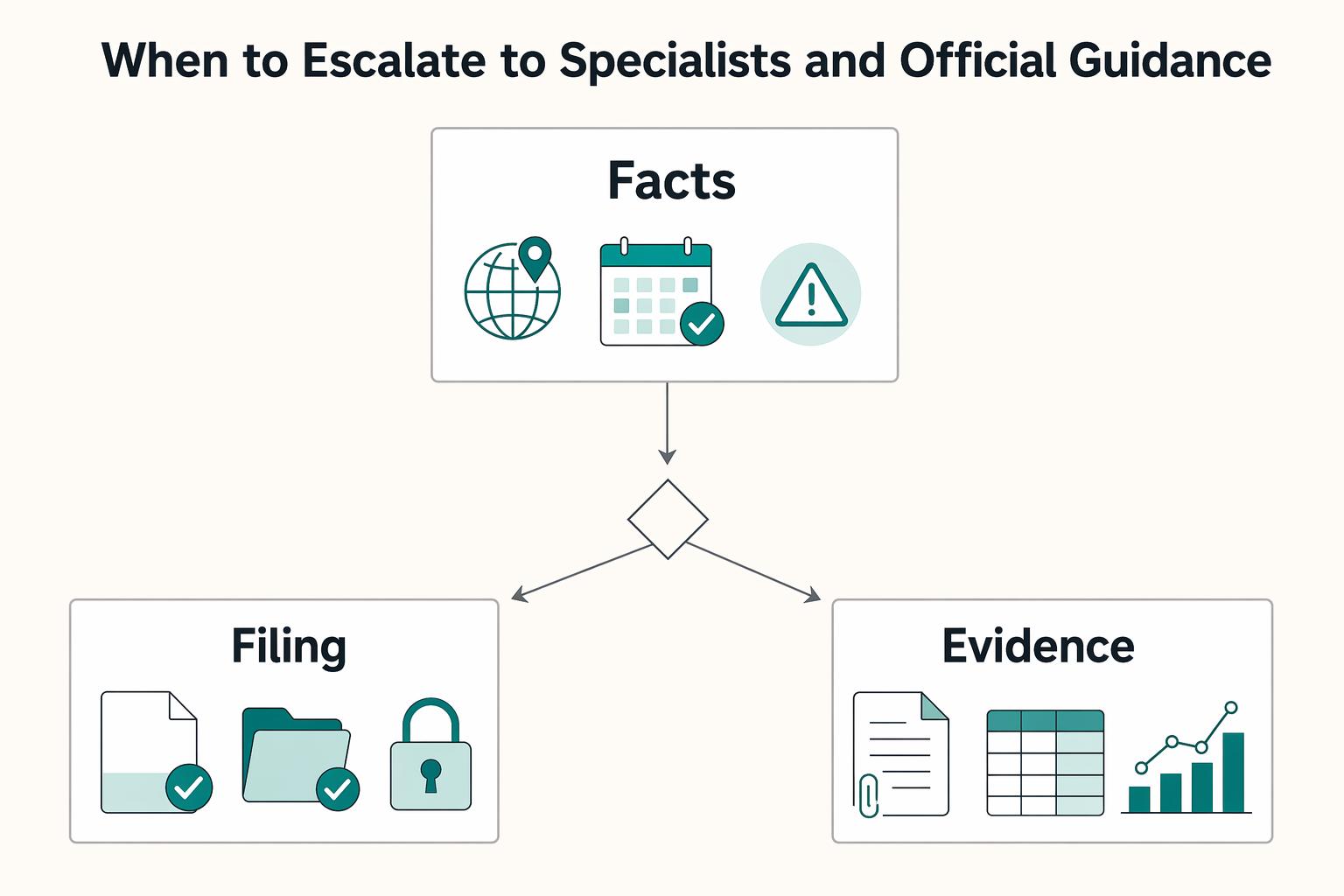
Escalate before filing whenever your position depends on legal judgment you cannot clearly defend with your current records. A practical rule is simple: if your file would be hard to defend today, pause and get specialist input before submission.
Three escalation triggers come up repeatedly:
- You are not confident about Relevant Activities or relevant-entity classification.
- You plan to rely on an exemption-style position, especially tax resident outside the Islands, but do not yet have the required form and substantiating documents.
- Your facts do not match your directed and managed narrative, including where board meetings occur and how monitoring and control are carried out.
Use a strict source hierarchy. Start with the Department for International Tax Cooperation ES Legislation & Resources page for current laws and regulations, and check the official Gazette when revision-year differences matter. Do not treat the DITC Portal user guide as legal interpretation; it is technical portal guidance. If interpretation is still uncertain after reviewing official materials, validate the filing position with qualified Cayman counsel.
As a final check, compare your narrative to evidence the Authority may request, including board-meeting location records and information showing monitoring and control in the Islands. If that evidence is incomplete by the ESN stage, due by 31 March each year, or still weak before your return filing, escalate instead of filing first and defending later.
Conclusion#
Strong Cayman ES outcomes come from early classification, steady evidence capture, and disciplined filing, not last-minute drafting. When scope, evidence, and filing narrative are left to year end, preventable issues become much harder to defend.
Start by deciding whether you may be a relevant entity carrying on a relevant activity, then keep records that match that position throughout the year. DITC materials make clear that this is a real compliance regime, not a box-ticking exercise.
Your next move should be concrete:
- Finish a first-pass scope check now. Record whether you are likely in scope, out of scope, or uncertain, plus owner, assumptions, and open questions. If you cannot clearly explain your relevant-activity position, pause and get Cayman advice before drafting filings.
- Build an evidence-pack index before filing season. Map each expected filing claim to supporting documents, for example activity mapping, governance records, operating evidence, and filing workpapers. If a sentence in your draft return cannot be traced to a retained record, remove it.
- Set recurring checkpoints during the year. This is an operating habit, not a legal requirement. Regular reviews help catch missing records, inconsistent activity descriptions, or control decisions that could create filing gaps later.
Keep the filing sequence clear. The Annual Economic Substance Notification (ESN) is an annual prerequisite to the Annual Return. The ES Return sample states the return is due within twelve months after the last day of the end of each financial year for in-scope entities. Also verify ESN timing against current DITC materials before locking your calendar, since public guidance has shown conflicting dates, including 31 March in DITC user guidance versus 31 January in at least one legal briefing.
If your facts are complex, cross-border, or hard to support from your records, escalate early. DITC return notes emphasize providing required information with appropriate supporting evidence, and enforcement guidance includes a quoted ES test failure penalty of ten thousand dollars. The practical recommendation is simple: confirm your position with qualified advisors where needed, then operationalize it in your compliance and record-keeping process.
When you are ready to turn this checklist into a controlled operating process, talk to Gruv about your setup and coverage.
Frequently Asked Questions
What is economic substance in the Cayman Islands in one sentence?
Economic substance in the Cayman Islands is the legal framework for meeting the international substantial-activities standard. DITC states that the ES Act contains those rules, and the regime has been in force since 1 January 2019.
Who has to comply with Cayman economic substance requirements?
Treat this as a two-layer question. The Annual Economic Substance Notification (ESN) is described in DITC guidance as required by all entities and as a prerequisite to filing an Annual Return, while the ES test applies to relevant entities carrying on relevant activities. If you are unsure where you fall, treat it as a classification issue to resolve, not a filing shortcut.
What does the ES test usually require in practice?
In practice, the ES test requires a relevant entity carrying on a relevant activity to show it conducts core income generating activities for that activity and is directed and managed in an appropriate manner in the Islands. Your filing position should match how the business is actually controlled and where income-producing work happens. If those facts and your narrative do not align, address that gap before filing.
What are core income generating activities and why do they matter?
CIGA are activities "of central importance" to generating the entity's relevant income. They matter because they are part of the ES test itself, so broad or generic business descriptions are not enough. A practical check is whether your ES filing description matches real revenue activity, not just incorporation paperwork.
What is the difference between annual notification and annual reporting?
The ESN is the annual notification step, and the ES Return is the economic substance report submitted to the Authority for ES-test assessment. They are separate filings. The ES Return sample states it must be submitted within twelve months after the last day of the end of each financial year, so completing the notification does not complete the reporting obligation.
Who administers Cayman economic substance rules and where should I verify updates?
Cayman ES is administered through the Department for International Tax Cooperation, which carries out the functions of the Tax Information Authority for this framework. It is not administered by CIMA, which DITC identifies as the financial services regulator. For current rules and materials, verify updates first on DITC's ES Legislation & Resources page.
What details can be unclear without specialist advice?
Judgment calls include relevant-entity status, relevant-activity classification, and whether your facts support your "directed and managed" position. A related risk is treating portal instructions as legal interpretation, even though the DITC portal guide says it is not business or policy/regulatory guidance. If your position or evidence would be hard to defend with your current records, get Cayman specialist advice before submission.
Try a related tool
Researched and edited by the Gruv editorial team. Gruv builds cross-border billing, payouts, and finance-operations software for global businesses.
Sources
Includes 3 external sources outside the trusted-domain allowlist.
- data.consilium.europa.eu/doc/document/ST-10421-2018-INIT/en/pdftrusted
- legacy.trade.gov/guide_to_exporting.pdftrusted
- oecd.org/en/topics/harmful-tax-practices.htmltrusted
- sec.gov/Archives/edgar/data/2088749/0001193125253165...trusted
- sec.gov/Archives/edgar/data/1180262/0001047469040302...trusted
- conyers.com/publications/view/increased-enforcement-acti...external
- ditc.ky/wp-content/uploads/Economic-Substance-Notifi...external
- ditc.ky/esexternal
Educational content only. Not legal, tax, or financial advice.
Related Posts

Sole Proprietorship vs LLC for Global Freelancers in 2026
For most freelancers in 2026, the practical default is still simple: use the simplest structure you can run cleanly, then formalize when risk actually rises. If your work is still in validation mode and the downside is contained, a sole proprietorship is often the practical starting point. When contract exposure, delivery stakes, or dispute risk starts climbing, forming an LLC deserves earlier attention.
Economic Substance for Solopreneurs Who Need Defensible Records
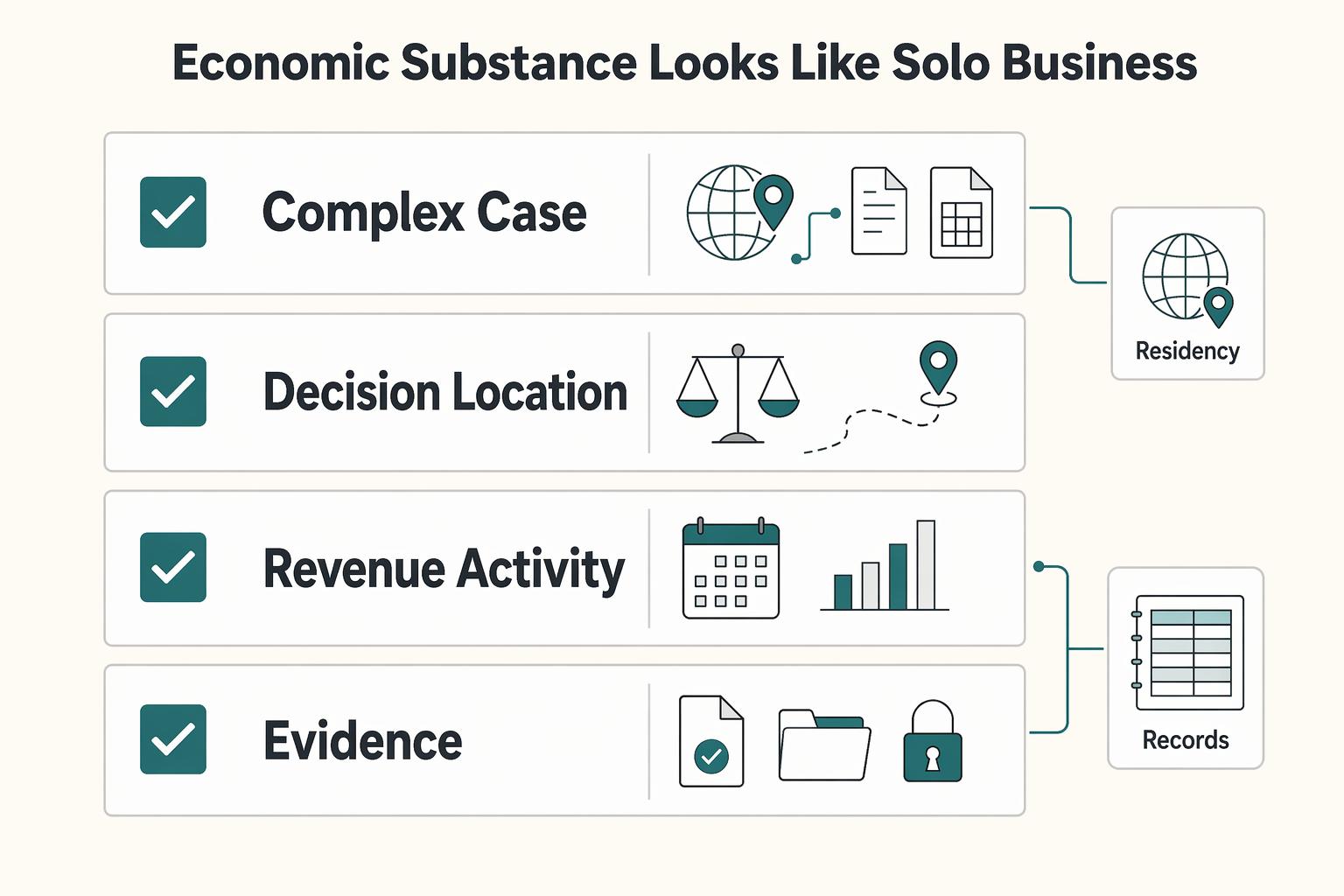
If you run a one-person business through a Single-Member LLC or an offshore company, start with a simple question: which compliance and reporting obligations may apply now, and what is the smallest structure you can defend with records. Make that call before you change entities, move banking, or submit filings that lock in a story you cannot support later.
How to Incorporate a Company in the Cayman Islands
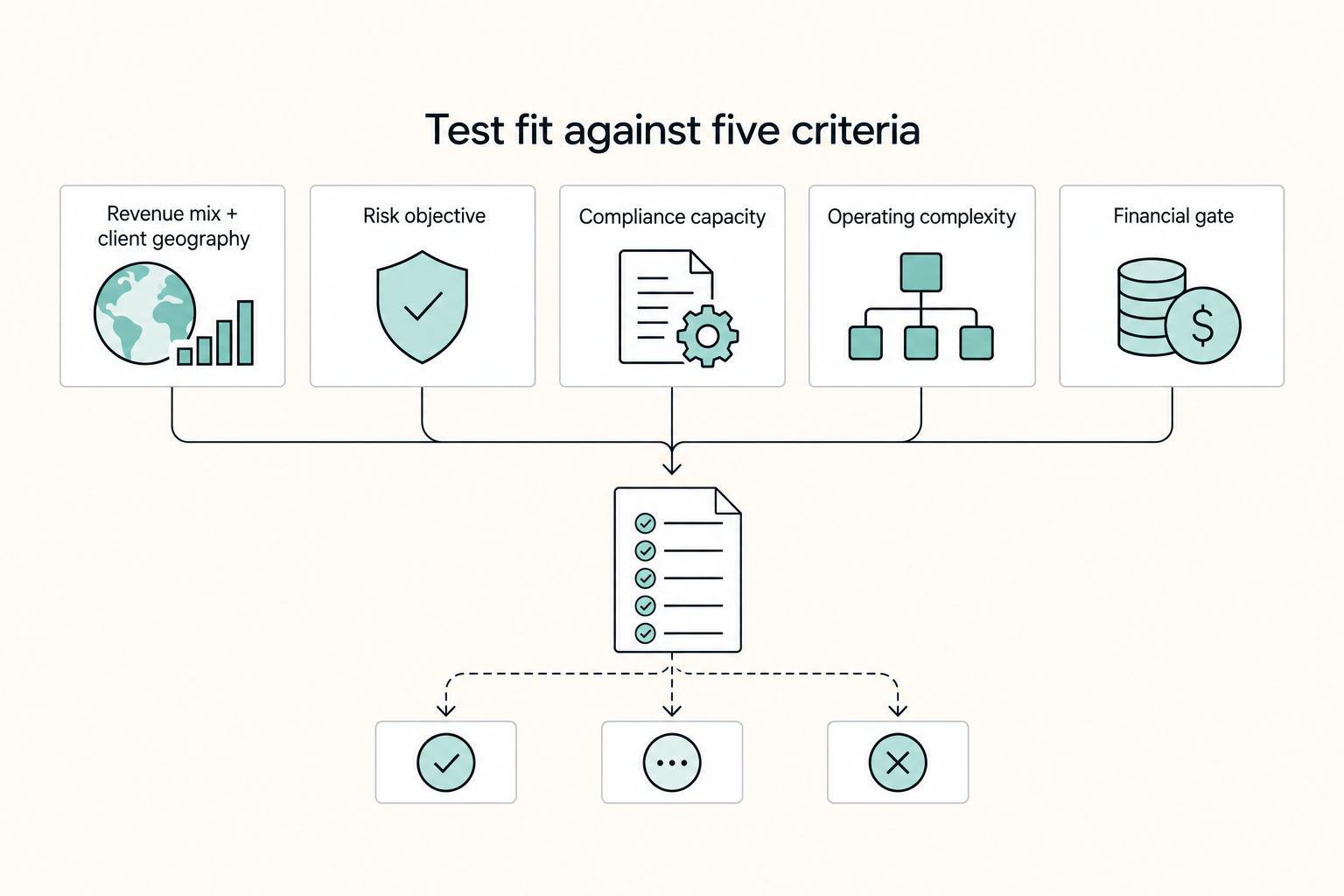
**Start with fit, not forms.** If you're considering a Cayman company, first test whether it solves a real cross-border problem in your business. Do not start with whether it sounds sophisticated. A Cayman structure may be useful in some cases, but this is not enough on its own to confirm legal or tax specifics.