
Quick Answer
A solo founder's BVI entity needs economic substance compliance only if it carries on a relevant activity in the financial period. If it may be in scope, you need evidence that decisions are directed and managed in the Virgin Islands, CIGA is carried on there, and you have adequate local people, premises, and expenditure. Declarations are made through your registered agent within six months after period end.
From Simple Structure to Compliance Nightmare?#
The shift is practical. If your BVI entity carries on a relevant activity in a financial period, compliance is about demonstrating real activity, not just keeping incorporation documents in order.
That can feel out of step with what started as a simple setup. The legal framework is not new. The Economic Substance (Companies and Limited Partnerships) Act, 2018 came into force on 1st January, 2019. In practice, the key question is scope. If you carry on a relevant activity, you must meet the requirements for that activity. If you do not, the ES requirements do not apply.
This guide is for solo consultants, small agency owners, online operators, and other small cross-border founders using a BVI company or limited partnership. It is not a playbook for large multinational structuring or transfer-pricing design. Start with two checks.
- Confirm your entity type and filing path with your registered agent. ES declarations now go through VIRRGIN, available from 2nd January 2026, and that portal change did not alter the underlying substance rules.
- Confirm your financial period and what your contracts, invoices, and internal records say your company actually does. Scope is often misread when a company is treated as passive even though its records show active operations, or when small size is assumed to mean exemption.
Treat compliance as date-and-evidence driven. Verify filing requirements and timing before you file. Then work through this in order: scope, what substance looks like in practice for a business-of-one, and whether the BVI still fits your strategy.
For a step-by-step walkthrough, see A Guide to Economic Substance Requirements in the Cayman Islands.
Step 1: The "Am I Affected?" Plain-English Self-Assessment#
Start by deciding whether your company might be in scope at all. This is a fact-finding step, not a legal conclusion.
| Document | What it covers |
|---|---|
| One-page summary | What the company does in practice |
| Income-type breakdown | By source |
| Related-party map | Ownership and control links |
| Supporting contracts | For each income stream |
Use this as a preparation checklist and confirm scope with your registered agent against current BVI authority materials.
Use a simple yes-or-no triage based on what the company actually earns, then validate it with your registered agent.
| Activity pattern to review | Yes/No question to ask now | Why this needs a scope check | Evidence to pull |
|---|---|---|---|
| Services and revenue streams | Can you clearly describe each service or income stream the company has? | Clear categorization reduces classification errors during advisor review. | Customer list, invoices, service agreements |
| Equity and investment income | Is any income tied only to holding investments rather than operating work? | Different income types should be reviewed separately before a scope call. | Investment records, bank statements, shareholder records |
| IP-related income | Does the company receive income connected to owned or licensed IP? | IP-linked income should be isolated so facts are reviewed accurately. | IP assignments, license terms, revenue breakdown |
| Specialized contractual terms | Do contracts include technical or regulated terms that may change how activity is viewed? | Unusual terms should be flagged early for classification review. | Contracts, term sheets, onboarding docs, service descriptions |
Keep third-party and related-party work mapped in separate records so your advisor can review the full fact pattern.
Do not assume one label defines the whole company. If you have mixed income streams, document each stream separately and then review the full picture together. If you have not already done it, pull the four documents from the table above.
Before you finalize a scope decision, confirm the current legal definitions and scope tests with your registered agent. If the result is "possibly in scope," move to Step 2 for a detailed requirements review.
You might also find this useful: How to Incorporate a Company in the British Virgin Islands (BVI).
Step 2: What Substance Requires Under Each of the Three Tests#
If you are possibly in scope after Step 1, the real test is practical: can you show a credible BVI operating trail for each relevant activity you carry on? If not, your file can end up looking like income is booked in the BVI while control, work, and spend happen somewhere else.
| Test | Key requirement | Evidence named |
|---|---|---|
| Management and direction | Decisions for the relevant activity are actually directed and managed in the Virgin Islands, taking account of your scale and model | Notices, agendas, resolutions, minutes, attendance records, and supporting decision papers |
| Core income-generating activities | Conduct CIGA in the BVI, and CIGA cannot be outsourced outside the BVI | Engagement records, work logs, approvals, local communications tied to decisions, contracts showing delivery responsibility, and records showing the key value-creating steps occurred in the BVI |
| People, premises, and expenditure | Adequate qualified employees physically present in the Virgin Islands, adequate expenditure incurred there, and physical offices or premises appropriate for the CIGA | Qualification records, premises agreements, local invoices and payment records, and a short narrative linking those costs to the activity that earns income |
Substance is assessed per relevant activity. If your entity carries on more than one relevant activity in a financial period, you need to meet the requirements for each one. For a business-of-one, the cleanest way to manage this is to organize your records around three tests: management and direction, CIGA, and adequate people, premises, and expenditure.
Management and direction#
This is where paper compliance often breaks down. You need to show that decisions for the relevant activity are actually directed and managed in the Virgin Islands, taking account of your scale and model.
Your evidence should read as one consistent board trail: notices, agendas, resolutions, minutes, attendance records, and supporting decision papers. Market guidance points to board meetings in the BVI with quorum physically present. Declaration forms have also asked whether minutes are held in the BVI, so records discipline matters. Confirm the current evidentiary expectation with a BVI adviser.
If you use a resident or nominee director, keep records that show involvement before decisions were finalized.
Core income-generating activities#
CIGA is the center of the file. The test requires you to conduct CIGA. The Rules state that CIGA must be carried on in the BVI and cannot be outsourced outside the BVI.
Map each income stream to the relevant activity, then document the specific revenue-driving steps for that activity. Keep it concrete. The current VIRRGIN ES flow asks you to select CIGA for the activity, which is a useful reminder that vague descriptions do not help.
Your proof should tie task, person, and place together. Keep engagement records, work logs, approvals, local communications tied to decisions, contracts showing delivery responsibility, and records showing the key value-creating steps occurred in the BVI. If you rely on a BVI provider, keep the engagement letter, scope, invoices, and delivery trail. If material value creation occurs outside the BVI, do not assume BVI administration fixes it. Confirm the current evidentiary expectation with a BVI adviser.
People, premises, and expenditure#
This limb is usually tested against reality, not labels. The statute looks for adequate qualified employees physically present in the Virgin Islands, adequate expenditure incurred there, and physical offices or premises appropriate for the CIGA.
Adequate is context-dependent, but the file still has to be operationally credible. A registered office alone is not automatically the same as premises appropriate to CIGA, and stand-alone local invoices are weak if they do not connect to income-generating work.
Build a local operating pack with people records, whether employment or contractor. Include qualification records where relevant, premises agreements, local invoices and payment records, and a short narrative linking those costs to the activity that earns the income. If your model depends on outsourced support in the BVI, keep detail on what was done locally and by whom.
| Cost category | What the spend buys operationally | Usually fixed or variable | Current range |
|---|---|---|---|
| Governance support | Board administration, meeting coordination, minutes, and local governance participation where used | Usually fixed, with variable add-ons for extra meetings or transactions | Verify current range |
| BVI activity execution | Local personnel or BVI service-provider work tied to selected CIGA | Mostly variable, based on activity volume and complexity | Verify current range |
| Premises and office presence | Physical office or workspace appropriate to CIGA and related facilities records | Usually fixed | Verify current range |
| Filing and evidence assembly | Registered-agent coordination, declaration support, document collation, period-end review | Fixed base with variable uplift for complex or multi-activity filings | Verify current range |
Plan around the filing mechanics too. Declarations are made through your registered agent, and the deadline is six months after your financial period end. VIRRGIN ES became available on 2 January 2026, and ITA guidance states there were no ESA or Rules changes from that portal transition.
If your current model cannot support this level of evidence each period, go to Step 3 before the next filing cycle and test whether another jurisdiction fits your actual operations better. For a fuller walkthrough, see Satisfying Economic Substance: A Practical Guide for Solo Entrepreneurs.
Step 3: Is a BVI Company Still the Smart Choice? A Strategic Alternatives Matrix#
The right jurisdiction is the one you can actually run and document, not the one that looks cleanest in a summary. If you cannot keep a coherent governance and records trail each period, the structure will be hard to defend.
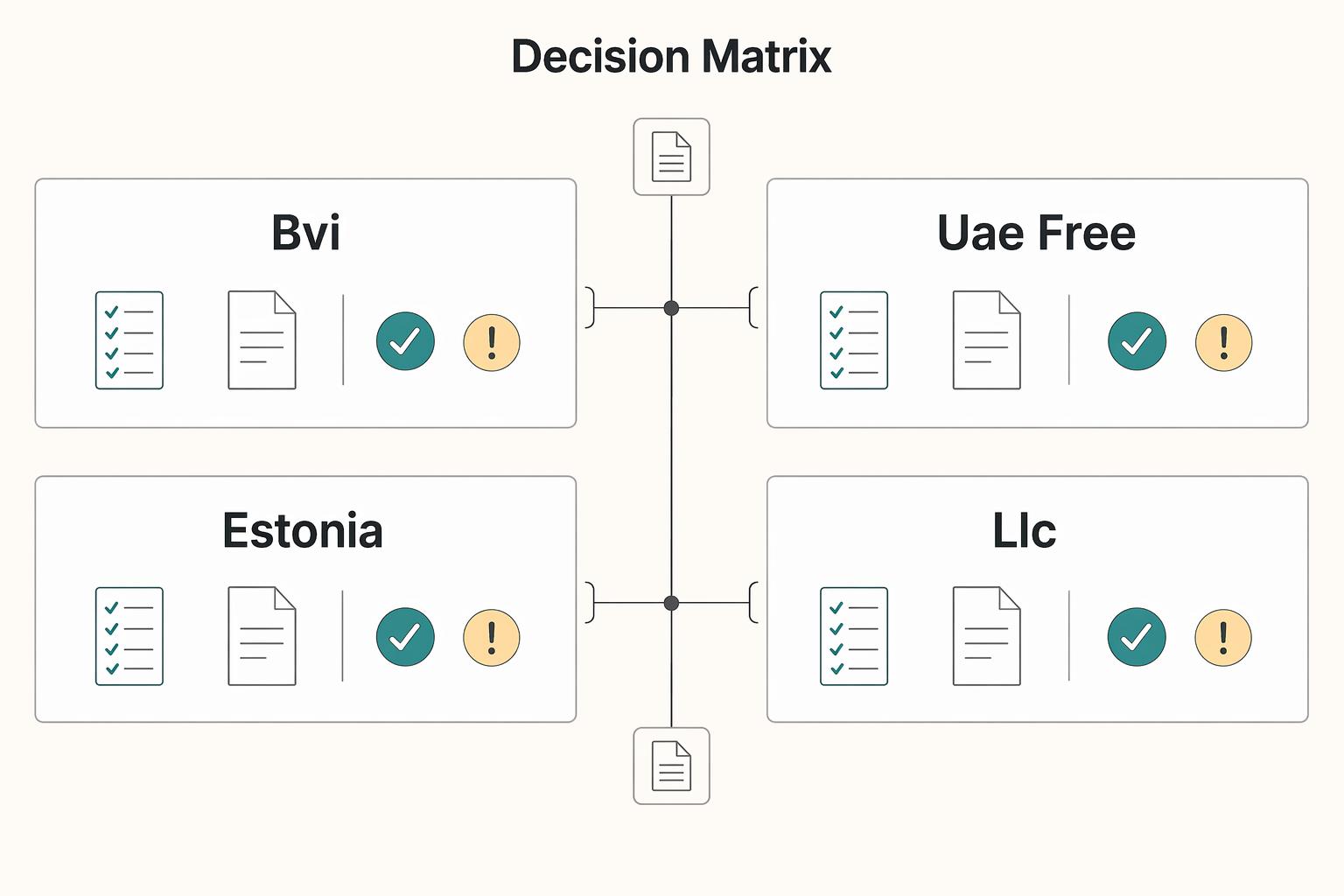
Decision matrix#
Use this as a fit test, not a ranking. For each option, get local legal and tax advice on your exact facts. Where tax or eligibility drives the decision, verify current treatment and eligibility conditions.
| Option | Best-fit profile | Substance burden | Compliance and admin complexity | Banking and credibility considerations | When to avoid |
|---|---|---|---|---|---|
| BVI | You have a clear reason to keep a BVI vehicle and can maintain real governance documentation over time. | BVI economic-substance thresholds, tests, penalties, or exemptions are not established; verify locally. | Keep incorporation, management, operations, and records coherent across periods. | Jurisdiction-specific banking outcomes are not established. | Avoid if your real decisions and delivery happen elsewhere and you cannot close that gap operationally. |
| UAE Free Zone | Potential alternative only after local legal and tax advice. | Not established. | Not established. | Not established. | Avoid if the decision depends on unverified assumptions. |
| Estonia | Potential alternative only after local legal and tax advice. | Not established. | Not established. | Not established. | Avoid if the decision depends on unverified assumptions. |
| US LLC | Potential alternative only after local legal and tax advice. | Not established. | Not established. | Not established. | Avoid if the decision depends on unverified assumptions. |
Practical read of the options#
A public filing example shows why coherence matters. An SEC Form F-1 filed on August 20, 2025 lists BAO Holding Limited as incorporated in the British Virgin Islands. It also lists principal executive offices in Hong Kong and Cogency Global, Inc. in New York as agent for service. That does not prove BVI compliance, but it does show how quickly a multi-jurisdiction footprint becomes visible when documents are read together.
Use that as your benchmark. Your structure should tell one clear, defensible story across incorporation, management, operations, and records.
Selection checklist#
Before you choose, pressure-test five points. If the answers are still unclear, pause and resolve them before you choose a jurisdiction.
- Business model: Where is the value actually created, and by whom?
- Residency reality: Where do you really live, travel, and make decisions?
- Client geography: Which countries drive contracts, invoicing, onboarding, and disputes?
- Risk tolerance: How much multi-country ambiguity can you realistically manage?
- Admin capacity: Can you keep filings, approvals, and evidence current every period?
If you want a deeper dive, read Sole Proprietorship vs. LLC: The Definitive Guide for Global Freelancers.
Before you commit to a structure change, pressure-test the operational side, including collection, payout flow, and admin load, with practical calculators and generators in Gruv Tools.
Your Path to Compliance Confidence#
You now have the decision path: confirm scope, define how your setup meets the substance test, then decide whether to keep the structure or move to an alternative in the earlier matrix. The point is not whether the structure looks acceptable in theory. It is whether you can defend it in practice.
Confirm scope first#
Start with the classification record. Document who made the activity classification decision, when it was made, and what evidence supported it. Your first checkpoint is whether the entity carried on a relevant activity during the financial period. If it did, compliance is required for that activity. If it carried on more than one relevant activity, the test applies to each.
Keep this as a dated record, not a verbal conclusion. A short memo, director note, or resolution explaining why you are in scope, out of scope, or partially in scope gives you a more defensible basis for annual review.
Match operations to the test#
If you are in scope, shape the operating file around what the test requires: direction and management in the Virgin Islands, CIGA carried on in the Virgin Islands, and adequate expenditure and premises there. A key risk is a mismatch between what the filing says and how the business actually runs.
Pressure-test the mechanics now: who approves contracts, where decisions are made, who performs CIGA, and what local support or premises exist? If the answers depend on future cleanup, treat that as a decision signal and revisit the earlier matrix before you continue with the same structure.
Choose structure and lock the next review cycle#
Once you know whether the structure still fits, turn that conclusion into an annual compliance file.
| Action | Detail |
|---|---|
| Record the financial period | Based on the entity's incorporation or formation date |
| Diary the ES declaration filing period | Within 6 months after financial period end |
| Confirm filing route | Through VIRRGIN, not BOSSs, and verify the current filing requirement |
| Prepare annual review support | Resolutions, meeting records, service agreements, invoices, and CIGA evidence |
| Check for legislative updates | Make a current legislative update check part of the pre-filing control |
| Decide ownership | Who is responsible for classification, evidence quality, and final filing sign-off |
If staying in the BVI remains the better fit, strengthen the file. If not, move deliberately to the alternative structure you can actually operate and evidence. You are in a stronger position to demonstrate compliance when your structure, documentation, and actual operations match.
We covered this in detail in BVI vs. Cayman Islands: Which is Better for an Investment Holding Company?.
If you want a second pass on your setup before you execute, discuss your compliance and money-movement workflow with the team via Gruv Contact.
Frequently Asked Questions
Does economic substance BVI apply to your one-person company?
It applies only if your entity has to comply with the Substance Legislation and carries on a Schedule 1 relevant activity. Start with scope first, then keep a short written basis for your in-scope or out-of-scope view.
What counts as adequate substance if you are in scope?
It depends on your facts and the applicable substance requirements. In practice, build an operational file around management and direction in the Virgin Islands, CIGA in the BVI, and adequate local people, premises, and expenditure. Plan around scope determination, Annual Review, and ES Declaration handling where required.
Is a BVI company still a good fit if you are a freelancer or digital nomad?
It can be, but only if scope works and you can run the required compliance process. For a one-person setup, decide based on whether the entity is in scope, whether a relevant activity applies, and whether you can keep records aligned with Annual Review and ES Declaration steps where required.
What happens if your company does not comply?
Treat non-compliance as an operational risk and verify the current consequences directly before you act. Fix weak records, missed reviews, and ES Declaration issues early.
How much should you budget for compliance?
It depends on your classification and the compliance steps required. The article groups costs into governance support, BVI activity execution, premises and office presence, and filing and evidence assembly, with current ranges to be verified. Ask for a written fee breakdown tied to your activity profile.
Try a related tool
Researched and edited by the Gruv editorial team. Gruv builds cross-border billing, payouts, and finance-operations software for global businesses.
Sources
- bvi.gov.vg/Economic-Substancetrusted
- congress.gov/113/chrg/CHRG-113shrg80221/CHRG-113shrg80221...trusted
- onlinesocialwork.vcu.edu/blog/empowerment-theory-in-social-worktrusted
- pli.edu/globalassets/company/bs-1998-pubs-catalog-20...trusted
- science.gov/topicpages/r/relacion+dosis-respuesta+observadatrusted
- science.gov/topicpages/i/ictus+estudio+caso-controltrusted
- sec.gov/Archives/edgar/data/2049184/0001641172250249...trusted
- sec.gov/Archives/edgar/data/1966678/0001493152240355...trusted
Educational content only. Not legal, tax, or financial advice.
Related Posts

Sole Proprietorship vs LLC for Global Freelancers in 2026
For most freelancers in 2026, the practical default is still simple: use the simplest structure you can run cleanly, then formalize when risk actually rises. If your work is still in validation mode and the downside is contained, a sole proprietorship is often the practical starting point. When contract exposure, delivery stakes, or dispute risk starts climbing, forming an LLC deserves earlier attention.
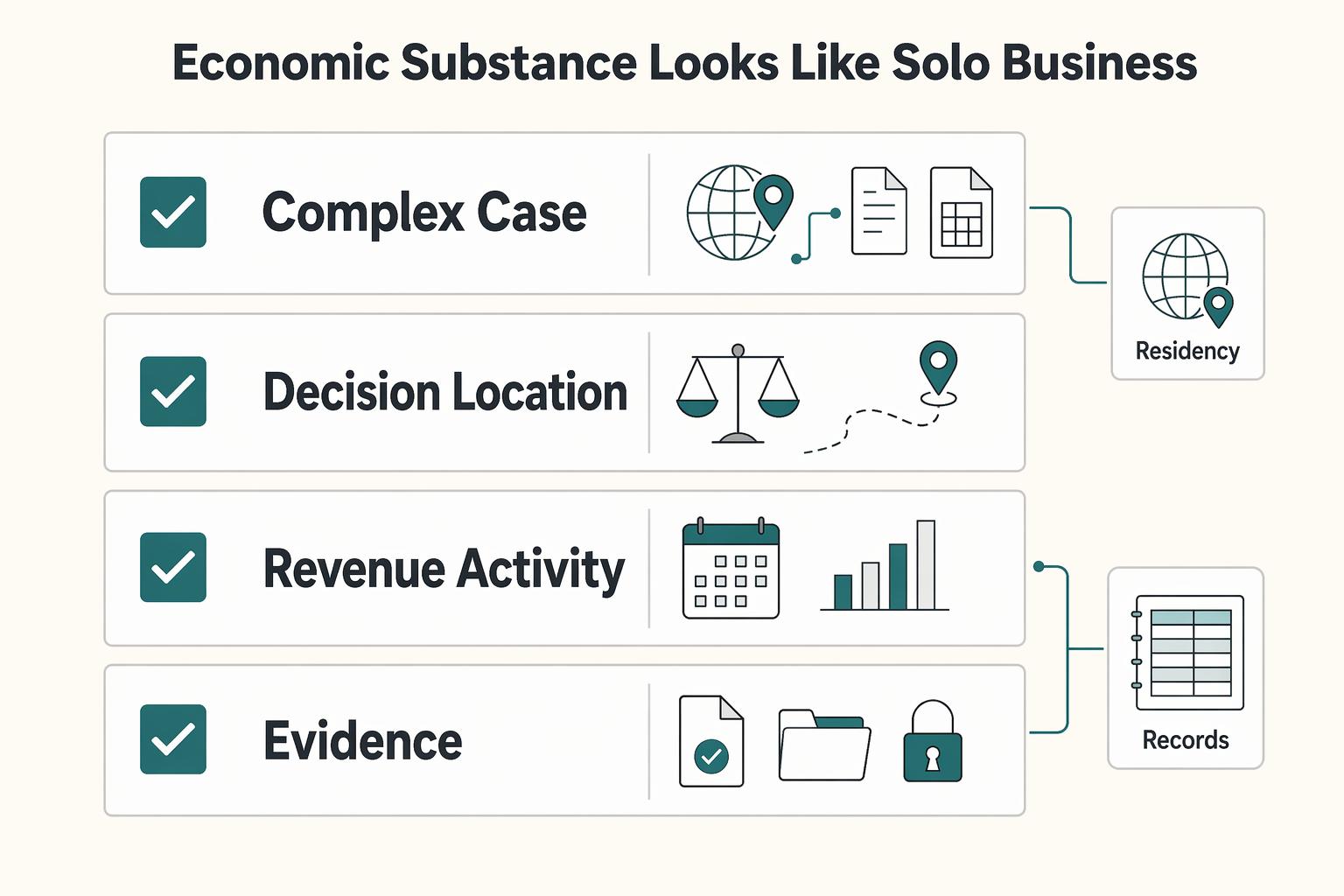
Economic Substance for Solopreneurs Who Need Defensible Records
If you run a one-person business through a Single-Member LLC or an offshore company, start with a simple question: which compliance and reporting obligations may apply now, and what is the smallest structure you can defend with records. Make that call before you change entities, move banking, or submit filings that lock in a story you cannot support later.
How to Incorporate a Company in the British Virgin Islands (BVI)
A BVI company can be useful for a solo operator, but only in a narrow set of circumstances. If your business is genuinely cross-border, your clients are comfortable contracting with an entity, and you are prepared for real compliance and documentation work, it can be a strong tool. If you are looking for a shortcut on tax, admin, or banking, it is usually the wrong one.