
Quick Answer
Start with your residency timeline, then build the filing package around IRS Publication 519. A dual-status alien tax return is defensible only when income and deductions are allocated to the correct resident and nonresident periods, with the main return and Dual-Status Statement aligned to that timeline. Before submission, verify any First-Year Choice or treaty position and complete a separate FBAR/Form 8938 check so cross-border reporting obligations are not missed.
Start Here if You Changed U.S. Tax Residency Midyear#
If you were a nonresident for part of the year and a U.S. resident for the rest, first confirm whether you are a dual-status individual. If you are, treat this as a dual-status filing year, not a one-status year.
| Item | What to gather |
|---|---|
| Travel or presence timeline | A dated travel or presence timeline for the year |
| Income records | Records showing when income was earned and whether it was U.S.-source or non-U.S.-source |
| Residency support | Documents supporting any residency position, including a possible First-Year Choice |
| Treaty notes | Notes on any treaty position you may take |
The IRS definition is simple: dual-status means you were both a U.S. resident and a nonresident in the same tax year. This is about tax residency, not citizenship. For the resident part of the year, you are taxed on income from all sources. For the nonresident part, you are generally taxed on U.S.-source income only.
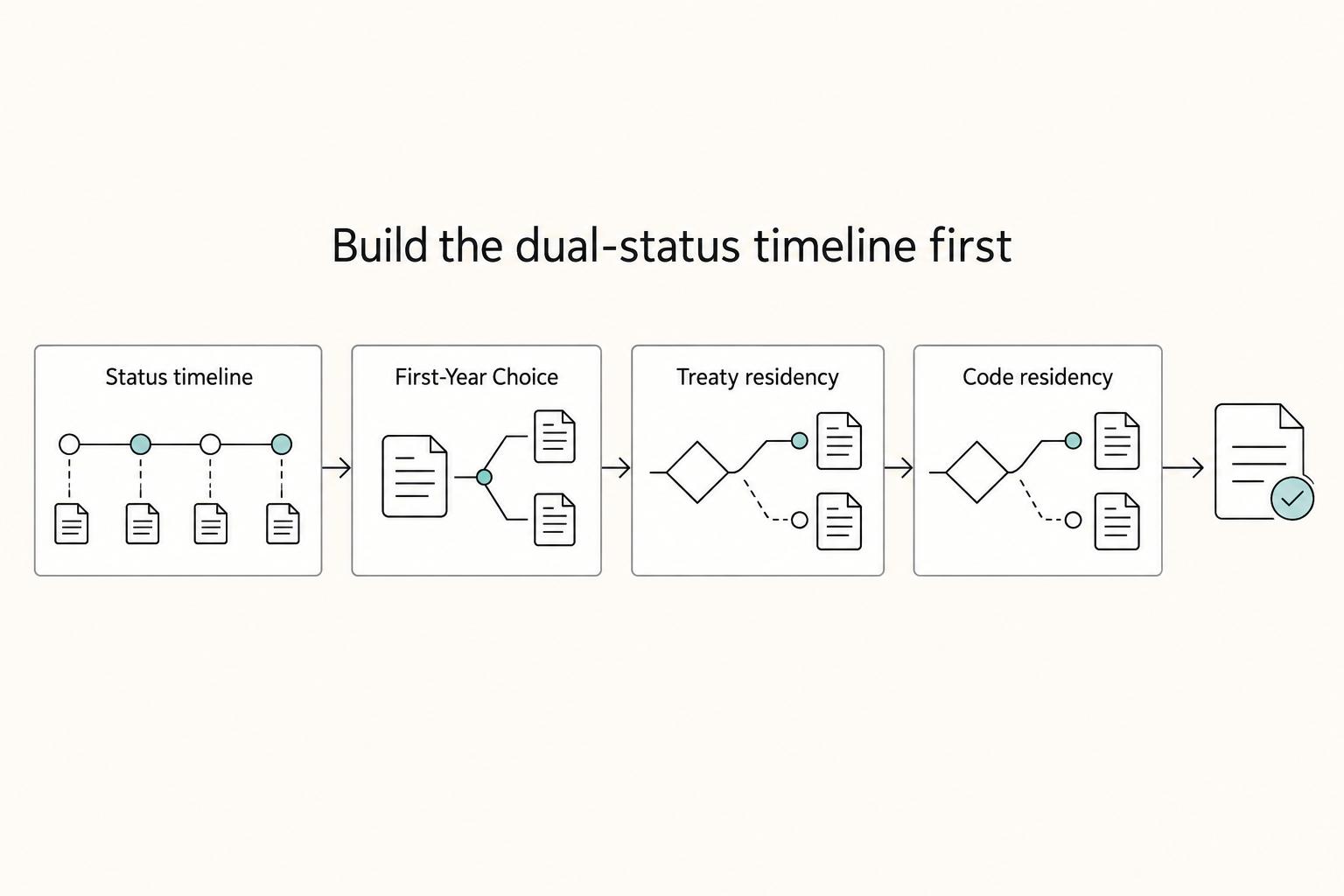
Start with residency, not forms. Build your residency timeline and status dates first, then use that timeline to choose the filing path, including whether a First-Year Choice may apply. For return mechanics, use IRS Publication 519 as your main checkpoint.
If you cannot clearly support when your U.S. tax residency began or ended, pause. Fuzzy dates create downstream errors in income allocation, treaty treatment, and return assembly.
Build a minimum evidence pack before you draft anything. The table above covers the basics: your dated travel or presence timeline, income records showing timing and source, residency support for any First-Year Choice, and notes on any treaty position.
Treaty issues need extra care. Treaty residency can differ from Internal Revenue Code residency, and treaty provisions generally apply only to the nonresident part of the year, with an exception. If a treaty changes your result, treat that as a formal review point.
The goal is a clean, defensible filing, not an aggressive one. By the end of this guide, you should have a filing sequence based on IRS residency rules, a practical document checklist, and clear escalation triggers for higher-risk cases.
A simple control helps here: if you cannot explain your residency change date, income split, and any treaty or first-year position in plain sentences, you are not ready to file.
Escalate early when needed. Get specialist review before filing if any of these apply:
- Your residency dates are unclear
- You are relying on treaty-based residency treatment
- Income spans the status-change period and cannot be assigned cleanly
- A First-Year Choice could change your filing treatment
This guide is built for a defensible answer with low surprises, starting from a clear residency split. For a related mixed-status scenario, see Tax Implications of a US Citizen Marrying a Non-Resident Alien.
Dual-status means two tax periods in one year#
A dual-status year is one tax year split into two residency periods: you were both a U.S. resident and a nonresident in the same year. It is a tax residency concept, not a citizenship or passport concept.
For the resident period, you are taxed on income from all sources. For the nonresident period, you are taxed on U.S.-source income only.
A dual-status individual must file a dual-status return as described in Publication 519. As a working rule, year-end status helps determine which form is the main return, and Publication 519 should guide the final filing package.
| Year-end tax status | Main return form |
|---|---|
| You became a U.S. resident during the year and were a U.S. resident on the last day of the tax year | Form 1040 |
| You gave up U.S. residence during the year and were not a U.S. resident on the last day of the tax year | Form 1040-NR |
The filing also includes an attached statement for the other period of the year. IRS instructions allow Form 1040 or Form 1040-NR to be used as that statement when labeled Dual-Status Statement. When Form 1040-NR is the main return, it should be marked Dual-Status Return.
Before you draft, confirm your status-change timeline and year-end status under Publication 519. Then make sure the filing package matches that timeline.
Build your status timeline before you touch any form#
Build the timeline first. In a dual-status year, the filing path depends on when resident and nonresident treatment starts and ends.
The IRS identifies arrival and departure years as the most common dual-status years, so anchor those dates before you start filing.
Build a defensible date spine#
Create a one-page timeline for the full tax year. Start with facts, then test conclusions:
- U.S. arrival dates
- U.S. departure dates
- Other status-change dates that could affect when resident or nonresident treatment begins or ends
If someone else cannot follow your timeline and identify the likely status-change window, tighten it before you move on.
Test status before choosing forms#
Run your timeline through the Substantial Presence Test, then check whether First-Year Choice could apply. IRS guidance allows that choice in some cases where a nonresident becomes a U.S. resident under substantial presence in the following tax year, and Publication 519 is the checkpoint before you finalize treatment.
Flag unclear segments for separate review. If your year includes periods where resident versus nonresident treatment is uncertain, verify those segments in Publication 519 before you lock the dates.
Default to conservative when records are thin. If your evidence is incomplete or conflicting, take the more conservative position and verify it against Publication 519 before filing. Keep treaty analysis separate from your base timeline, because treaty residency can differ from Internal Revenue Code residency.
Before you start forms, map your key dates in a Tax Residency Tracker so your residency timeline stays consistent end to end.
Choose the year-end return and the attached statement correctly#
Treat it as a dual-status return first, then verify the filing package in IRS Publication 519. In a dual-status year, you are filing for two tax periods under different rules, so using one rule set for the full year can cause errors.
For the resident period, you are taxed on worldwide income. For the nonresident period, you are taxed on U.S.-source income only.
Quick routing view (verify in Publication 519)#
| Situation | Common working start (not final) | What to verify in Pub. 519 | Common mistake |
|---|---|---|---|
| Clear resident and nonresident periods in one year | Build a timeline of when your status changes | Dual-status return treatment for each period | Applying one tax rule set to the entire year |
| First-Year Choice may apply | Keep the timeline and facts open until reviewed | Chapter 1 First-Year Choice guidance | Finalizing filing treatment before checking First-Year Choice rules |
| Treaty residency is part of the analysis | Review treaty residency and Code residency separately | How treaty residency can differ from Internal Revenue Code residency | Assuming treaty and Code residency always match |
Use this table as a working aid, not the rule set. Your filing approach still has to match Publication 519 for your facts.
Verification checkpoint before submission. Before you submit anything, make sure you can connect your timeline to your filing approach:
- Confirm your resident and nonresident periods from the timeline
- Confirm the return format as a dual-status return under Publication 519
- If First-Year Choice is involved, verify that section in Chapter 1 before finalizing
- If treaty residency is part of your analysis, pressure-test that separately because treaty and Internal Revenue Code residency can differ
If you cannot clearly explain which part of the filing reflects each period, pause and reconcile the package before you allocate income. Related: 183-Day Rule Explained: Stop the Tax Myths Before They Cost You.
Split income and deductions by period without double counting#
Split first, calculate second. In a dual-status year, assign each income item to the resident or nonresident period before you apply tax rules. If you do not, you increase the risk of putting income in the wrong bucket.
Start with timing and source, not the form line#
Use the IRS period split as your anchor. For the resident part of the year, income from all sources is in scope. For the nonresident part, U.S.-source income is in scope. Foreign-source income that is not effectively connected with a U.S. trade or business is not taxable when received during nonresident status. U.S.-source income is generally taxable in either period unless a Code or treaty exception applies.
| Allocation field | What to record |
|---|---|
| Income item | What the income was |
| Receipt date | When you received it |
| Source | Whether it was U.S.-source or foreign-source |
| Status period | Which status period applied on that date |
| Supporting record | What record supports that call |
Before you finalize the return, build an allocation sheet for each payment using those five fields. If you cannot show payment date and source from your records, stop before you finalize the split.
Apply the same discipline to deductions. Use a period-by-period approach and avoid carrying assumptions from a normal full-year filing. If you cannot support where a deduction belongs from your records, resolve that before you lock the numbers.
Validate treaty edge cases before final numbers. Treaty treatment is not a late-stage add-on. IRS guidance says treaty provisions generally apply to the nonresident period, with exceptions, and treaty residency can differ from Internal Revenue Code residency. If a treaty position changes whether an item is taxable, validate that position before final review.
A practical red flag is using treaty treatment to exclude an item without a clear, documented basis for the period and sourcing.
When not to force an allocation#
If an item cannot be cleanly tied to one period from the timeline and records, do not guess just to finish the return. Flag it for additional review and keep your timeline, source support, and draft allocation notes so the issue gets resolved before filing.
Filing status and credit limits that change your outcome#
Once the income split is right, filing status and credit eligibility are the next major outcome drivers. In a dual-status year, start from a restrictive default: assume common statuses and credits are unavailable unless an IRS election or resident-treatment rule clearly allows them.
Start from the restrictive default#
For dual-status filers, IRS rules say you cannot use the Head of Household Tax Table column or Tax Rate Schedule. The Form 1040-NR instructions also state that a nonresident alien filing Form 1040-NR cannot use Married Filing Jointly or Head of Household filing status.
Use this practical default: if your filing path runs through Form 1040-NR, do not expect Head of Household or joint filing. IRS language on nonresident spouses notes that some taxpayers may be able to use Head of Household, so treat it as a narrow exception you need to support, not a standard option.
Before you finalize, make sure your draft filing status matches all three of these: your year-end form path, the IRS dual-status rules, and the Form 1040-NR instructions.
Married Filing Jointly is usually an election question. By default, a dual-status individual cannot file a joint return. The IRS exception is that a married dual-status individual with a U.S. citizen or resident spouse may elect to file jointly.
In many mixed-status cases, Married Filing Separately is the working default unless a valid election changes the treatment.
| Filing choice | Default in dual-status context | What controls availability |
|---|---|---|
| Married Filing Separately | Usually the starting position | Mixed-status facts and nonresident-period treatment |
| Married Filing Jointly | Not available by default | Specific election eligibility, including spouse status |
If someone assumes MFJ is always better before confirming election eligibility and downstream effects, stop and verify first.
Credits people overclaim in mixed-status years#
Credits that are often misapplied in mixed-status years are the ones tied most closely to resident-treatment rules:
| Credit | What the article says |
|---|---|
| Earned Income Credit | Generally unavailable if you were nonresident for any part of the year |
| Education Credits | Generally unavailable to nonresidents, with an exception when a dual-status taxpayer chooses full-year U.S. resident treatment |
| Credit for the Elderly or Disabled | Eligibility in mixed-status years may depend on choosing full-year resident treatment |
A useful rule is this: if a credit is available only because of full-year resident treatment, treat it as a high-risk position and document your basis clearly.
You might also find this useful: A Guide to Filing Your Final US Tax Return After Renouncing Citizenship.
Spouse elections and first-year choices where errors get expensive#
These are decision points, not cleanup tools. If a spouse election or First-Year Choice might apply, model both filing paths before you file. In a dual-status year, those choices can change filing status, disclosure requirements, and in some spouse-election cases the income scope reported to the IRS.
First-year choices should be modeled, not improvised#
A First-Year Choice may change the return path you use, but the exact eligibility and mechanics are fact-specific. In a dual-status year, test both paths side by side before you lock in resident and nonresident period treatment.
The practical default is simple: do not wait until the return is mostly complete and then force an election to rescue the outcome. Build your status timeline first, then compare outcomes before you finalize Form 1040 or Form 1040-NR.
If your timeline or residency logic is still unclear, pause and resolve that before filing. When first-year treatment and spouse elections are both in play, that is a strong point for professional review.
Spouse elections can change more than the filing status line#
In mixed-status marriages, the safe default is narrow: a nonresident spouse generally must make a special election to file jointly with a U.S. tax-resident spouse. Without that election, the couple generally cannot use Married Filing Jointly on Form 1040, and if the nonresident spouse has a U.S. filing requirement, the default described is Married Filing Separately on Form 1040-NR.
Use this rule in this context: no election, no joint return. Do not assume marriage alone opens MFJ in a mixed-status year.
The key authority identified here is IRC 6013(g), which can enable MFJ and treat the nonresident spouse as a U.S. tax resident for the full tax year, and later years while in effect. The tradeoff is practical and important. Joint treatment can require reporting both spouses' worldwide income. That is why you should model the full impact, not just the filing-status line.
Scenario contrasts that deserve a pause:
| Scenario | Likely path | What to verify before filing | Red flag |
|---|---|---|---|
| No election | Usually Married Filing Separately; if the nonresident spouse has a U.S. filing requirement, Form 1040-NR may apply | Confirm each spouse's status and whether the nonresident spouse has a separate U.S. filing requirement | You prepared a joint Form 1040 only because you are married |
| Election considered | Compare with-election and without-election outcomes; if joint treatment is used, confirm election and disclosure steps | Check whether worldwide income reporting for both spouses follows from the election and whether your facts support it | The election is being used only to chase a lower tax result without reviewing the broader reporting impact |
| Election likely inappropriate | Stay on the default path until facts are clear | Recheck unresolved residency timeline issues and cross-border complexity | You still cannot clearly support who was treated as a U.S. tax resident and when |
Use the 2024 form checkpoint as a control. Use the 2024 Form 1040 filing-status area as a hard control point. One source notes added election-related filing-status information tied to IRC 6013(g) or 6013(h)-type elections, including a required box and additional identifying detail.
Operationally, your filing-status line, election treatment, and disclosures should all tell one consistent story. If they do not, stop and fix that before you file.
Because these elections can have lasting consequences, do not use one as a last-minute patch. If handled poorly, these filing choices can lead to audits, penalties, or unexpected tax bills.
Filing mechanics that can force paper submission#
Plan for possible paper filing early. IRS confirms that a dual-status individual must file a dual-status return, but the provided IRS excerpts do not say dual-status filings are always paper-filed.
The non-negotiable IRS point is that a dual-status individual must file a dual-status return, with IRS Publication 519 as the guide. Another core risk is using the wrong residency position: IRS says dual-status determinations are made under both Internal Revenue Code rules and tax treaty rules, and those results may differ.
Use this working order:
- Confirm whether your year is dual-status, often an arrival or departure year, and map your residency timeline.
- Determine your residency position under both Internal Revenue Code rules and any applicable treaty rules.
- Prepare your dual-status return using Publication 519, applying the correct rules to each part of the year.
- Reconcile your treatment across both parts of the year so the resident and nonresident portions are internally consistent.
- Validate your filing path before the deadline. If your chosen filing method cannot support the required package, plan for paper submission early.
Before submitting, run a short control check:
- Confirm your residency position is consistent across all return materials
- Confirm your forms and statements align with Publication 519 for a dual-status year
- Confirm your filing method, e-file or paper, is still valid for your package
Keep an evidence file that can survive an IRS review#
Build one dated evidence file that shows why your residency status, forms, and income split are correct.
Build one dated residency file#
Keep one folder, digital or paper, with date-based proof for your residency timeline, including visa-history records and Green Card documentation where relevant. If your visa type changed during the year, keep a dated statement and supporting record showing the new visa type and the date it was acquired.
Your file should let a reviewer see when your tax treatment changed and which rule drove that change.
Keep the day-count support, not just the conclusion#
If you used the Substantial Presence Test, retain your day-count worksheet showing the 31 days current-year test and the 183 days 3-year formula. If you excluded days as an exempt individual or for a medical condition, keep the support and include a copy of Form 8843 with the return.
If you used the first-year choice, keep the date math that supports it. That includes the 31 consecutive days, the 75% presence test for days after that period, and any use of the up to 5 days absence treatment.
Preserve form logic and income split#
Keep a short note that explains:
- Why Form 1040 or Form 1040-NR was the main return based on your year-end status
- Which attached form was used as the Dual-Status Statement
- How income was split between resident and nonresident periods
Also keep copies of the filed return package and the records supporting income, deductions, and credits. A common baseline is 3 years, with 6 years in situations involving unreported income.
Do not miss related filings outside the income tax return#
A correct dual-status income tax return does not settle foreign account or asset reporting by itself. Filing a dual-status return does not replace FBAR or Form 8938 analysis.
| Item | What it is | Where it goes | Core trigger or timing | What people get wrong |
|---|---|---|---|---|
| FBAR | Foreign bank and financial account report on FinCEN Form 114 | Filed separately with FinCEN, not with the IRS income tax return | May apply if the aggregate value of foreign financial accounts exceeded $10,000 at any time during the year; due April 15 with an automatic extension to October 15 | Assuming no taxable income from the account means no filing |
| FinCEN | Treasury bureau that receives FBAR filings | Filing destination for FBAR | Relevant when FBAR applies | Treating FBAR as an attachment to an income tax return |
| FATCA | Broader foreign asset reporting regime | For individual taxpayers, reporting may run through Form 8938 on the income tax return | Separate from FBAR and can apply in the same year | Treating FATCA/Form 8938 as a substitute for FBAR |
| Form 8938 | Statement of specified foreign financial assets | Attached to the annual income tax return | IRS notes a $50,000 baseline threshold for certain U.S. taxpayers, with higher thresholds in some cases | Assuming one universal threshold applies to everyone |
Use one checkpoint before you file. Answer these three questions:
- Did you have any foreign financial accounts at any point during the year?
- Did the combined highest value of those accounts go over $10,000, even briefly?
- Do you hold specified foreign financial assets that may require Form 8938?
If the first two are yes, check FBAR immediately. If the third might be yes, review the Form 8938 rules before you treat the return as complete.
What to verify and what to save. Use the same evidence standard you used for the residency file. Keep year-end and peak-balance statements, ownership records, and a simple account list with institution, country, and highest yearly value. For Form 8938, keep the asset list used for your threshold decision and the filed form if required.
When to stop DIY#
If your facts are cross-border and account-heavy, treat that as an automatic escalation trigger. In a dual-status year, separate FinCEN and possible FATCA/Form 8938 reporting create enough moving parts that a short specialist review can reduce filing-risk mistakes.
If you want a deeper dive, read our guide to a defensible 2026 filing plan.
Know when to stop DIY and bring in a specialist#
Stop DIY when your return depends on judgment calls you cannot explain clearly. The IRS says a dual-status individual must file a dual-status return under Publication 519. Risk rises when your residency position, return structure, and related reporting are not aligned.
Escalate before filing if any of these apply:
- You are considering a spouse election, for a dual-status person married to a U.S. citizen or resident, or a first-year choice
- Treaty residency may affect your position, since treaty residency can differ from Internal Revenue Code residency
- Your status dates are still unclear, or you are unsure how to treat items across resident and nonresident periods
Escalate again if foreign asset or account reporting may also apply. Form 8938 and FBAR are not interchangeable. Form 8938 is attached to the annual return, including Form 1040 or Form 1040-NR, and filed by that return's due date, including extensions. Filing Form 8938 does not remove a separate FinCEN Form 114 requirement.
Bring one complete packet to make a focused specialist review easier:
- Your status timeline and any election decisions
- Your draft return set, including Form 1040 or Form 1040-NR plus dual-status materials
- Your support file for income allocation, treaty position if used, and foreign account or asset analysis for Form 8938 and FBAR
Final checklist before you file#
Before you submit, resolve three items in order: your status timeline and form path, your status-sensitive tax choices, then your evidence and escalation issues.
1) Confirm your status timeline and lock the correct form path#
Start with residency facts, then choose forms. Recheck your Substantial Presence Test count, 31 days in the current year and 183 days over the 3-year test, then confirm whether you were resident or nonresident at year-end.
- If you were a U.S. resident on the last day of the tax year, use Form 1040 or 1040-SR as the main return
- If you ended the year as a nonresident, verify the Form 1040-NR path in Publication 519 and the Form 1040-NR instructions
- Mark the main filing as
Dual-Status Returnand attach the companion period asDual-Status Statement - Make sure any statement includes your name, address, and taxpayer identification number
2) Verify filing status, deduction method, and credit eligibility before final numbers#
Treat these as hard checks, not assumptions carried over from a full-year resident return:
- You cannot use the Head of Household tax table column or rate schedule
- Joint filing is generally restricted, except when a married dual-status individual elects to file jointly with a U.S. citizen or resident spouse
- Dual-status taxpayers are generally ineligible for the standard deduction
- Earned Income Credit, the credit for the elderly or disabled, and education credits may be unavailable unless an election applies
If your result depends on a spouse election or treaty position, verify it in Publication 519 before filing.
3) Complete the evidence file and clear escalation triggers#
A complete filing includes support for status decisions and every item claimed:
- Keep records that support income, deductions, and credits, and plan retention around at least the general 3-year assessment period
- Keep your residency timeline support and day-count workpapers
- Keep a short note showing why Form 1040, 1040-SR, or Form 1040-NR is primary, plus copies of the
Dual-Status Return,Dual-Status Statement, and income-allocation workpapers
Clear cross-border reporting separately. FBAR is not filed with the income tax return. It is due April 15 with an automatic extension to October 15. Form 8938 is separate, with thresholds that depend on context, and the IRS cites a base aggregate value over $50,000 in some cases.
If treaty residency could change the outcome, or if any election, treaty claim, or cross-border reporting item is still unresolved, stop and get specialist review before filing.
If you need operational records from Gruv for your preparer, contact Gruv.
Frequently Asked Questions
What is a dual-status alien tax return?
A dual-status return is used when you are both a U.S. resident and a nonresident in the same tax year for U.S. tax purposes. This is about tax residency, not citizenship. Different tax rules apply to each part of the year, and these years are often arrival or departure years.
Do I file Form 1040, Form 1040-NR, or both?
There is no single Form 1040/Form 1040-NR pairing rule that covers every dual-status scenario. What is supported is that a dual-status individual must file a dual-status return as described in Publication 519.
Which return depends on my status on the last day of the year?
There is no blanket year-end-status rule for choosing Form 1040 vs. Form 1040-NR. If First-Year Choice, treaty position, or unclear status dates may affect the result, verify the filing package in Publication 519 before you file.
Can dual-status taxpayers take the Standard Deduction?
There is no blanket rule on Standard Deduction eligibility for dual-status taxpayers. If this changes your outcome, confirm the rule directly in Publication 519 for your facts instead of carrying over assumptions from a full-year resident return.
Can I file Married Filing Jointly as a dual-status taxpayer?
Sometimes. The IRS says a dual-status individual married to a U.S. citizen or resident may elect to file a joint return with their spouse. That does not make joint filing automatic or best in every case, so review the election rules carefully, especially if a First-Year Choice is involved.
Do dual-status returns require paper filing?
There is no blanket rule that dual-status returns must be paper-filed. What is supported is that dual-status filings should follow Publication 519 instructions. Confirm the filing method early if your facts are complex.
What is the one document I should keep beside me while preparing this?
Keep IRS Publication 519, U.S. Tax Guide for Aliens, open while you prepare the return. It is the IRS guide referenced throughout dual-status filing, and Chapter 1 is where you review First-Year Choice details. If Internal Revenue Code residency and treaty residency point to different outcomes, pause and resolve that before filing.
Try a related tool
Researched and edited by the Gruv editorial team. Gruv builds cross-border billing, payouts, and finance-operations software for global businesses.
Sources
Educational content only. Not legal, tax, or financial advice.
Related Posts

Digital Nomad Taxes in 2026 With a Defensible Filing Plan
With digital nomad taxes, the first move is not optimization. It is figuring out where you may be taxable, where filings may be required, and what proof supports that position.

183-Day Rule Tax Myths That Trigger Residency Filing Mistakes
If you are a mobile freelancer or consultant, start here: the "183 day rule tax" idea is not a single universal test. It is a shortcut phrase people use for different residency rules that do not ask the same question. If you mix federal and non-federal residency logic, you can create filing risk even when your travel calendar looks clean.
First-Year Election for US Tax Residency
For global professionals establishing a foothold in the United States, the IRS first-year choice can be a powerful tax decision. Used well, it can let you control your tax residency start date and change what you can claim. Used poorly, it can create a large and avoidable tax problem.