

Quick Answer
A sole proprietor can use a DBA for a trade name while remaining the legal owner behind the business. Check the local filing rules and exemptions. Choose entity formation separately based on contracts, insurance and personal exposure; an LLC can also use a DBA. S-corporation tax treatment requires eligibility and a separate cost and tax analysis.
What is a DBA, and When is it the Right First Step?#
For a sole proprietor, a DBA is a naming tool, not a new business. It lets you operate under a name other than your legal, or "true," name while keeping the same underlying legal identity.
For a sole proprietorship, your legal business name is your own name. If you want to invoice, market, or present yourself as something else, like a studio or consulting brand, operating under that different name typically requires a DBA filing. That is why a DBA is often the right first move when you are still validating an offer and want a cleaner public-facing brand without forming a company yet.
| What it can do | What it cannot do |
|---|---|
| Let you use a trade name, assumed name, or fictitious business name | Replace your legal identity as the owner |
| Help you present a consistent brand on invoices and client materials | Turn that filed name into a separate legal identity |
| Give you a public-facing business name that differs from your legal name | Change the fact that, for a sole proprietorship, the legal name is the owner's name |
It makes sense at launch when the work is still simple: one owner, straightforward service delivery, low operational risk, and a need to test demand before adding more structure. A practical checkpoint is this: if you are doing business under a name that is not your own legal name, a DBA filing is typically required.
A common failure mode is treating the DBA as if it changes the underlying owner. It does not. A DBA is mainly a public-facing naming layer tied to the underlying legal name, not a replacement for it. It is a clean way to launch, but the next question is when that light structure starts creating real risk. Related: How to Choose the Right Business Structure for Your Freelance Business.
When should you review the business structure?#
A DBA does not create liability protection at any stage. The question is whether operating personally still fits the risks you accept. Review the contracts, insurance and entity options before taking on obligations you could not absorb.
An LLC may separate some business obligations from its owner under applicable law, but it does not eliminate every personal exposure. Personal guarantees, your own wrongful conduct and other exceptions can still matter. Client concentration is also a cashflow risk that forming an entity does not fix.
| Risk signal | Why it raises personal exposure | Recommended structure move |
|---|---|---|
| Revenue is concentrated in one or two clients | A lost client can disrupt cashflow; this is distinct from legal liability | Review runway and client diversification; assess entity choice separately |
| Contracts place substantial obligations on you | As a sole proprietor, you are the legal party behind performance and payment terms | Review contract/signature structure before new deals; evaluate LLC timing |
| Your work can cause meaningful client loss | Claims tied to advice, delivery, or outcomes can be directed at you personally | Assess LLC formation and insurance together |
| You handle personal or sensitive data | Errors can create remediation costs and dispute risk that you absorb personally | Reassess entity structure and compliance controls |
| You are entering regulated or licensed activity | Compliance gaps are harder to contain without entity separation | Verify local requirements, then align structure before scaling |
| Disputes are becoming more frequent | Repeated scope, delivery, or payment conflicts increase practical claim risk | Move from DBA-only operations to formal entity planning now |
The Florida checkpoint that matters#
In Florida, a fictitious name is generally a business name different from the individual’s or entity’s legal name. Check the Department of State registration rules and exemptions before conducting business under it. The page lists a USD 50 registration fee, a newspaper advertisement in the principal-place-of-business county before filing, and a five-year registration expiring December 31 of its final year. The applicant certifies advertisement; proof is not submitted. Registration identifies the operator publicly but grants no exclusive rights to the name.
Common pressure patterns to watch#
Risk usually shows up in day-to-day operations before it shows up in branding. Watch for repeated pressure in contracts, scope ownership, data-handling responsibilities, and payment workflows. If several of these signals are active at once, move to LLC evaluation and implementation next.
If you want a deeper dive, read Sole Proprietorship vs. LLC: The Definitive Guide for Global Freelancers.
Compare naming, entity formation and tax election separately#
These are separate decisions, not a required growth ladder. You can form an LLC before launching, and an LLC can also use a DBA if it trades under another name. S-corporation treatment is an optional election for an eligible entity; growth or stable income alone does not establish eligibility or a tax saving.
| Option | Best for | Main protection | Operational overhead | Common trigger to advance |
|---|---|---|---|---|
| Sole proprietor using a DBA | Early validation, light client work, fast branding | Brand visibility only; no liability shield | Low | Personal exposure starts showing up through contracts, disputes, data handling, or delivery risk |
| LLC operations | Ongoing delivery, vendor relationships, higher-stakes work | State-law entity separation, with limits | Moderate | You need stronger operational discipline, clearer market credibility, and cleaner tax-planning options |
| LLC with S-corp election | Established income and stable admin capacity | Same entity protection as the LLC; tax treatment changes | Higher | First establish eligibility, then model reasonable compensation, payroll, filing and advisor costs against tax outcomes |
Launchpad#
This phase is for speed, not protection. A DBA can help you launch a professional name and basic operations quickly, but it does not create a separate legal entity or liability shield, and filing rules can sit at the state, county, or city level.
| Record | Keep aligned to |
|---|---|
| Invoices | Legal owner name and registered business name |
| Proposals | Legal owner name and registered business name |
| Contracts | Legal owner name and registered business name |
| Website footer | Legal owner name and registered business name |
| Payment profiles | Legal owner name and registered business name |
| Bank records | Legal owner name and registered business name |
Core objective: clean operating basics. Keep invoices, proposals, contracts, website footer, payment profiles, and bank records aligned to the legal owner name and registered business name so clients and institutions can clearly identify who is behind the business.
Ready to move: if you are still a sole proprietor and personal liability risk is becoming practical, treat this phase as temporary and schedule an entity review.
LLC operations#
An LLC is formed under state law and can be appropriate before the first client, not only after validation. A single-member LLC is generally disregarded for federal income tax unless it elects corporate treatment; employment and certain excise taxes have separate treatment.
Core objective: run the business as an entity in practice, not just on paper. Use dedicated banking, consistent company-name contracting, aligned vendor and insurance records, and clean documentation across client-facing systems.
Ready to move: if you need added tax-structure flexibility and can maintain higher admin discipline, evaluate the next layer. Before you change structure, confirm your state's current formation, reporting, publication, and conversion rules.
LLC with S-corp election#
An eligible LLC can elect S-corporation tax treatment using Form 2553. This does not create a new state-law entity or extra liability protection. Eligibility includes limits on shareholders and stock classes; nonresident alien shareholders are not allowed. Living abroad does not itself determine U.S. tax residency, so establish the owner’s status before considering the election.
Fit check before electing:
- The entity and all owners satisfy S-corporation eligibility requirements, including the nonresident-alien shareholder restriction.
- Income is consistent enough to model payroll and tax impact with real numbers.
- You are operationally ready to run payroll and maintain salary documentation.
- You have advisor support to set and defend reasonable compensation.
Ongoing duties increase after election. Compliance can include Form 1120-S, and IRS e-file requirements can apply when filing-volume rules are met (including the 10-or-more-returns standard effective for returns required to be filed on or after January 1, 2024).
Before you switch phases, confirm current state rules and coordinate legal and tax setup together.
For a step-by-step walkthrough, see The Best Business Bank Accounts for Canadian Sole Proprietors.
How a DBA Fits into Your Global Operations#
A DBA can reduce naming friction in US-facing operations, but it does not change your legal identity. For a sole proprietor, your legal business name is your personal name, and a DBA is the filed trade name you use when operating under a different name.
In cross-border work, keep that split clear: a DBA is a naming and public-notice tool, not a legal-entity upgrade. It can improve name consistency across client-facing workflows, but it does not create a separate entity or replace local compliance checks.
| Area | What it helps with | What it does not change |
|---|---|---|
| Invoicing and proposals | Supports consistent use of your filed trade name in US-facing materials when you operate under a name different from your legal name | The contract still needs the correct legal party behind that name |
| Payment rails and account setup | Helps align naming across invoices, payment profiles, and account records where a provider allows trade-name display | Does not guarantee bank approval, payout access, or identical treatment across institutions |
| Jurisdiction and legal status | Provides public notice of the name in the filing jurisdiction | Does not grant operating rights in other countries or change your status there |
Banking and payout setup#
Treat this as a workflow, not a single filing. Requirements vary by institution and country.
| Step | What the article says |
|---|---|
| DBA registration | File the DBA if you are using a name different from your legal name |
| Bank/provider compliance checks | Be prepared for checks against legal owner name, trade name, identity records, and tax profile |
| Payout or merchant profile setup | Configure display/business-name fields to match your filed name where supported |
| Receiving account | Choose an eligible account that supports the actual business and payment currencies; assess local bookkeeping and reporting separately |
Keep your documents aligned across spelling, ownership, and address so your legal-name records and trade-name records tell one consistent story.
Cross border guardrails#
Use a DBA for US-facing naming convenience, then separately verify the items it does not solve:
| Topic | Verify | Article cue |
|---|---|---|
| Immigration/work authorization | Confirm local work-right rules where services are performed | verify in-country |
| Tax residency and filings | Confirm residency and reporting obligations in each relevant country | verify with local tax rules |
| Foreign registration triggers | Confirm whether repeated contracting/marketing/local presence requires registration | verify local threshold tests |
| Contract enforceability | Confirm governing law, dispute forum, and correct legal party naming | verify local-law enforceability |
If these checks become complex, keep the DBA for branding and pair it with local legal-tax planning before scaling cross-border activity.
You might also find this useful: What is an EIN and Does Your Freelance Business Need One?.
What to Verify Before You File or Change Structure#
Make this a transition plan, not a motivation exercise: separate your naming decision from your structure and risk decisions, then verify each step before you file anything.
Use these labels as planning buckets so you do not treat one filing as a cure-all:
- DBA (brand name filing, as used in this guide): the name you present publicly.
- Legal entity formation: the step that changes the legal structure you operate through.
- Liability shielding: protections that depend on entity choice and correct setup in your jurisdiction.
| Decision factor | Why it matters | What to verify | Next action |
|---|---|---|---|
| Revenue concentration | Shows how dependent your operations are on a small set of clients. | Current concentration by client, cash runway, and contingency plan. | Review client diversification and cash reserves. An LLC does not prevent revenue loss when a client leaves. |
| Contract exposure | Your obligations are set by contract terms, not branding. | Largest active terms (scope, payment, IP, liability, termination), plus renewal pipeline. | Stay with DBA for now if obligations remain low-complexity and manageable. Move to LLC review now if obligations are expanding or harder to absorb personally. |
| Service risk | Delivery errors can create escalation paths. | Rework/refund history, escalation patterns, and claim scenarios from recent work. | Stay with DBA for now if issues are limited and controlled. Move to LLC review now if downside scenarios are increasing. |
| Hiring | Team growth changes compliance and operating complexity. | Current worker model, planned hiring timeline, and advisor input on setup changes. | Stay with DBA for now if you are remaining solo. Move to LLC review now if near-term hiring is planned. |
| Cross-border complexity | More jurisdictions can add process and compliance friction. | Where clients, records, filings, and tax/ops responsibilities currently sit. | Stay with DBA for now if your setup is still simple. Move to LLC review now if multi-jurisdiction complexity is growing. |
For example, Alice operates as “North Studio” as a sole proprietor. A DBA identifies Alice behind that name; it does not make North Studio a separate contracting party. If Alice later forms North Studio LLC, new contracts must identify the company correctly. Existing personal contracts, guarantees and liabilities do not automatically move to the LLC; review any assignment or novation and required consent before updating payment details.
Do the transition in order:
- Review entity, insurance and tax questions before filing or expanding obligations.
- Confirm the filing authority, exemptions and any profession-specific naming rules.
- Identify the legal party on each existing contract and whether transfer needs consent.
- Align new contracts, tax records, banking and invoice details with the actual operator; preserve the prior records.
- Assign an owner and deadline for each required change.
We covered this in detail in Sole Trader vs. Company: A Guide for Australian Freelancers.
Frequently Asked Questions
Is a DBA the same as an LLC?
No. A DBA is a name registration, while an LLC is a different business structure you form under state law. If your goal is only branding, verify the local trade-name filing authority first. If your goal is liability planning, compare structures before you file anything.
When is a DBA enough, and when should I move beyond it?
A DBA is enough when your problem is naming, not structure. You want invoices, proposals, and payment profiles to show your brand instead of only your personal name. Move beyond it when client risk, contract exposure, or insurance requirements make the lack of structural separation hard to justify. If you use an internal numeric trigger, verify that threshold against your state, profession, and risk profile before relying on it.
How much personal liability do I have with a DBA?
With a sole proprietorship, you can be held personally liable for the debts and obligations of the business. The filing does not create a legal wall between you and the work. A good next check is to list the specific ways a client dispute, refund demand, or unpaid vendor bill could become a personal exposure problem.
Does a DBA change taxes for a sole proprietor?
No. A DBA filing by itself does not change federal tax classification. U.S. sole-proprietor business income is commonly reported on Schedule C, but the return and self-employment tax treatment depend on the owner’s tax status and applicable rules. An owner living abroad should confirm that treatment rather than assuming the same forms apply to every sole proprietor. Keep the legal owner and trade name clear in tax, contract and invoice records.
Do I need a new EIN if I start using a trade name?
Usually not if you only changed the business name or address, and a sole proprietor generally needs only one EIN even if using multiple trade names. An EIN can still be useful for banking or state tax administration even when it is not required for federal tax purposes. Check whether your bank or state agency wants an EIN before you submit Form SS-4 or apply online.
Will a bank open an account just because I filed the DBA?
Not necessarily. Banks must follow risk-based Customer Identification Program rules, so they may ask for your name, date of birth, address, identification number, and other account-opening documents. Exact document lists vary by institution, so ask for the sole proprietor opening checklist before you pay filing fees.
Where do I actually file it?
That depends on jurisdiction. The filing authority may be at the state, county, or city level, and registration mechanics vary, so copying advice from another state is a common mistake. Confirm the exact filing office, renewal rules, and any publication or notice step, if applicable, before you order branding materials.
Can I register and use one if I live outside the United States?
Sometimes, but do not assume the filing authority, bank, or payment provider will accept the same setup in every case. Address and identity checks are common during bank or payment-provider KYC, and the filing does not resolve your home-country taxes or determine whether your U.S. income is treated as ECI or FDAP for IRS purposes. Verify the local filing office, your bank's address policy, and your cross-border tax treatment before you onboard U.S. clients at scale.
Can I get an EIN from abroad?
Yes, there is an IRS path for international applicants, and the IRS lists a phone option at 267-941-1099, available 6 a.m. to 11 p.m. Eastern Time, Monday through Friday. If you have no legal residence or principal place of business in any U.S. state, the IRS also provides an international Form SS-4 filing channel. Gather the responsible party details first and apply only once you know the exact name and address you will use across tax and bank records.
Try a related tool
Researched and edited by the Gruv editorial team. Gruv builds cross-border billing, payouts, and finance-operations software for global businesses.
Sources
- bsaaml.ffiec.gov/manual/AssessingComplianceWithBSARegulatoryR...trusted
- dos.fl.gov/sunbiz/start-business/efile/fl-fictitious-na...trusted
- ftb.ca.gov/file/business/types/sole-proprietorship.htmltrusted
- irs.gov/businesses/small-businesses-self-employed/so...trusted
- irs.gov/businesses/small-businesses-self-employed/si...trusted
- sba.gov/business-guide/launch-your-business/choose-y...trusted
- sba.gov/business-guide/launch-your-business/choose-b...trusted
Educational content only. Not legal, tax, or financial advice.
Related Posts

Sole Proprietorship vs LLC for Global Freelancers in 2026
For most freelancers in 2026, the practical default is still simple: use the simplest structure you can run cleanly, then formalize when risk actually rises. If your work is still in validation mode and the downside is contained, a sole proprietorship is often the practical starting point. When contract exposure, delivery stakes, or dispute risk starts climbing, forming an LLC deserves earlier attention.
Choose a Freelance Business Structure: Liability, Tax and Costs
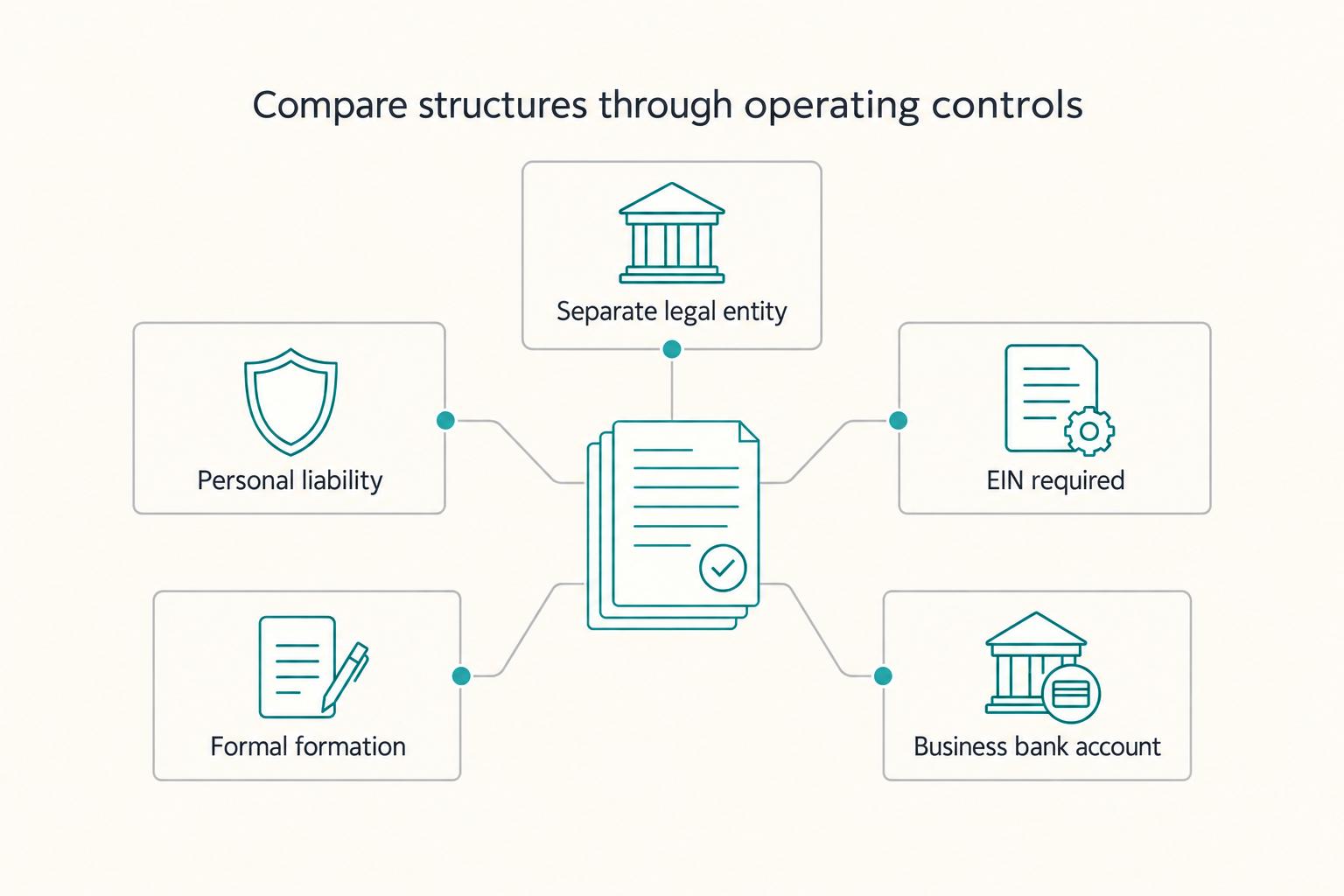
For a US freelance business, compare the work’s liability exposure, ownership, expected profit and the ongoing administration you can support. A sole proprietorship is often a practical starting point for one owner. An LLC can provide a separate legal entity, while an S corporation election changes the federal tax treatment of an eligible entity. Neither forming an LLC nor making a tax election is an automatic requirement when you gain a large client or hire help.
Do Freelancers Need an EIN? Requirements, W-9s and Applying
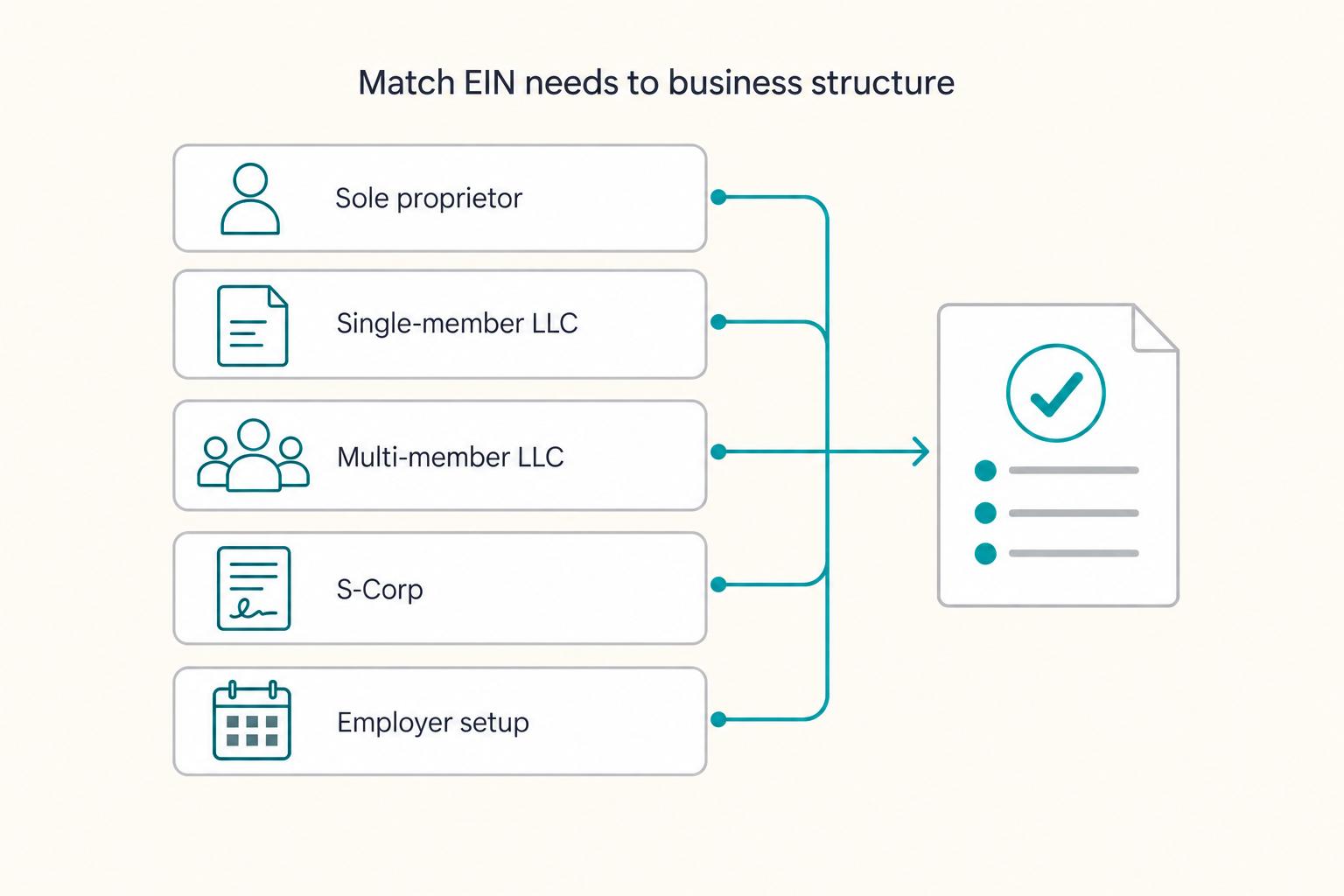
An Employer Identification Number is a nine-digit federal tax identifier issued by the IRS. A solo US freelancer operating as a sole proprietor often can use an SSN without obtaining an EIN. Employees, corporate or partnership tax classification, certain excise-tax filings and other specific obligations can change that answer. A bank’s account-opening requirement is a separate reason to obtain one.