
Quick Answer
Custodial accounts let you make an irrevocable gift to a minor, with the custodian managing the assets until the child reaches the age of majority. For U.S. expats and other global professionals, the main concerns are foreign-account reporting, brokerage restrictions for foreign addresses, and the fact that the beneficiary eventually gains full control. If longer-term control matters, a 529 plan or trust may be a better fit.
What domestic custodial-account advice leaves out: foreign addresses and FBAR#
Standard financial advice on custodial accounts is a compliance trap for the global professional. Guides written for a domestic audience - with a U.S. address and a financial life contained within 50 states - are not just incomplete for you; they are a direct threat to your financial autonomy. They fail to warn you that many U.S. brokerages may refuse to open an account for a client with a foreign address, or worse, freeze your assets if they discover you've moved abroad. They omit the most critical compliance tripwire of all: the Report of Foreign Bank and Financial Accounts (FBAR).
This is not another encyclopedic list of facts. This is a strategic playbook. It is designed for you - the U.S. expat, the cross-border consultant, the digital nomad operating as a "Business-of-One" - to assess, implement, and manage a custodial account without triggering your worst compliance anxieties. You've built a career on mitigating risk and executing with precision; it's time to apply that same strategic rigor to your family's financial future.
The Domestic Baseline: Core UTMA/UGMA Mechanics#
To dismantle the compliance traps, you must first understand the instrument itself. A custodial account established under the Uniform Transfers to Minors Act (UTMA) or Uniform Gifts to Minors Act (UGMA) is a vehicle for executing an irrevocable gift. The moment you transfer assets, they legally belong to the minor beneficiary. You, as the custodian, are merely the steward of those assets until the child comes of age - an appointed executive tasked with prudently managing a portfolio on behalf of its sole owner.
UGMA vs. UTMA: The Key Distinction
While often grouped together, the difference is vital for a professional with a diversified portfolio.
- UGMA (Uniform Gifts to Minors Act): The older of the two, UGMA accounts are generally restricted to financial assets like cash, stocks, bonds, and mutual funds.
- UTMA (Uniform Transfers to Minors Act): The modern standard, UTMA expands the scope to include everything UGMA does, plus physical assets like real estate, art, and patents. For a global professional whose wealth might be tied up in non-traditional assets, the flexibility of a UTMA is clearly the superior choice.
The Gifting Framework and the Age of Majority
Custodial accounts allow you to use the annual gift tax exclusion to transfer significant wealth over time. For 2025, this exclusion is $19,000 per recipient. A married couple can combine their exclusions to gift up to $38,000 per child annually without needing to file a gift tax return. Investment earnings within the account are taxable, and beyond a certain threshold, the "Kiddie Tax" applies, taxing gains at the parents' higher rate - a factor to manage within your broader tax strategy.
A important date on your timeline is the "age of majority" (or "age of termination"), when the beneficiary gains full, unrestricted control of the assets. This age varies by state but is typically 18 or 21, though some states allow it to be extended to 25 at the time of account creation. This is not a risk to be ignored, but a deadline for a critical deliverable: making sure the beneficiary is financially literate and prepared for the responsibility.
The Cross-Border Compliance Gauntlet#
The domestic mechanics are straightforward. For a global professional, however, the cross-border compliance market presents a far more immediate and persistent set of challenges. This is where standard advice fails and your operational rigor becomes essential.
| Framework | Trigger | Required action |
|---|---|---|
| FBAR | A UTMA or UGMA is held at a foreign financial institution and aggregate foreign accounts exceed $10,000 at any point during the year | The custodian reports it on FinCEN Form 114 for the minor |
| FATCA | A foreign financial institution holds an account for a U.S. taxpayer | The institution reports account information directly to the IRS |
| Form 3520 | A child who is a U.S. person receives gifts from a foreign individual totaling more than $100,000 in a year | File Form 3520 to disclose the gift |
1. The FBAR Tightrope: Is Your Child's UTMA Reportable?
If a UTMA or UGMA is held at a foreign financial institution, and the aggregate value of all your foreign accounts (including the child's) exceeds $10,000 at any point during the year, then you, the custodian, are responsible for reporting it. The U.S. government requires this disclosure on a FinCEN Form 114, the FBAR. Age is not a factor; you are the responsible party for filing on the minor's behalf.
The penalties for non-compliance are severe. A non-willful failure to file can result in a penalty of over $16,000 per violation. A willful violation can trigger a penalty of over $165,000 or 50% of the account balance, whichever is greater. This is not a risk worth taking.
2. Opening an Account as a US Expat: The Practical Hurdles
You might assume that as a U.S. citizen, opening a custodial account with a U.S. brokerage would be simple. In reality, many U.S. financial institutions are hesitant to take on clients with foreign addresses due to regulatory complexities. You have two primary paths forward:
- Use a U.S. Address: With explicit permission, you can use the address of a trusted family member in the U.S. This often satisfies brokerage requirements but demands a high level of trust.
- Seek Expat-Friendly Institutions: A better long-term solution is to work with firms that specialize in serving Americans abroad. Institutions like Charles Schwab International and Interactive Brokers are equipped to handle your unique situation.
3. The Non-Resident Gifter Dilemma
What if a non-resident alien - a foreign spouse or grandparent - wishes to contribute to your child's U.S.-based UTMA? The rules are surprisingly favorable. A non-resident is generally only subject to U.S. gift tax on transfers of U.S.-based real estate and tangible personal property. Gifts of intangible property, such as stocks and bonds in U.S. companies, are not subject to the gift tax for non-resident donors. This allows a foreign relative to gift U.S. stocks or cash to the account without creating a U.S. gift tax liability for themselves.
4. FATCA and Form 3520: Parallel Reporting
Finally, be aware of two other reporting frameworks:
- FATCA (Foreign Account Tax Compliance Act): This is the flip side of FBAR. Under FATCA, foreign financial institutions report information about accounts held by U.S. taxpayers directly to the IRS. This means the IRS will likely learn about a foreign custodial account even if you fail to report it.
- Form 3520: This form relates to the recipient of gifts. If your child (a U.S. person) receives gifts from a foreign individual totaling more than $100,000 in a year, you must file Form 3520 to disclose it. No tax is due, but the penalty for failing to file this informational return is steep - up to 25% of the gift's value.
The Autonomy Dilemma: How to Gift Assets Without Losing Strategic Control#
Handling the web of FBAR and FATCA is a important defensive maneuver, but protecting your legacy also requires a sharp offensive strategy. The irrevocable nature of a custodial account presents a deep challenge: the complete loss of control once your child reaches the age of majority. For a professional who has built a life on careful planning, handing over a significant sum to an 18-year-old with no restrictions can feel like a catastrophic failure of your long-term plan. This is a risk to be managed from day one.
Here are your primary mitigation tactics:
- Implement a Mentorship Mandate: Treat the custodianship period as a formal financial apprenticeship. Systematically educate your child on budgeting, compounding interest, and the specific investments within their account. The goal is to transfer not just assets, but wisdom. By the time they gain control, they should be equipped with respect for the capital you've built on their behalf.
- Structure Contributions with Intent: Instead of large, lump-sum gifts, adopt a strategy of gifting smaller, regular amounts. This approach turns each contribution into a teachable moment about disciplined investing and dollar-cost averaging. It also builds the account balance over time, reducing the psychological shock of a single, massive transfer of control.
In the end, the limitations of a custodial account must be respected. If your objective is to exert control over how the funds are used after the age of majority - stipulating they must be used for education or disbursed in stages - a UTMA is the wrong tool. At that point, a formal trust becomes the necessary next step to achieve granular control and make sure your legacy unfolds exactly as you intend.
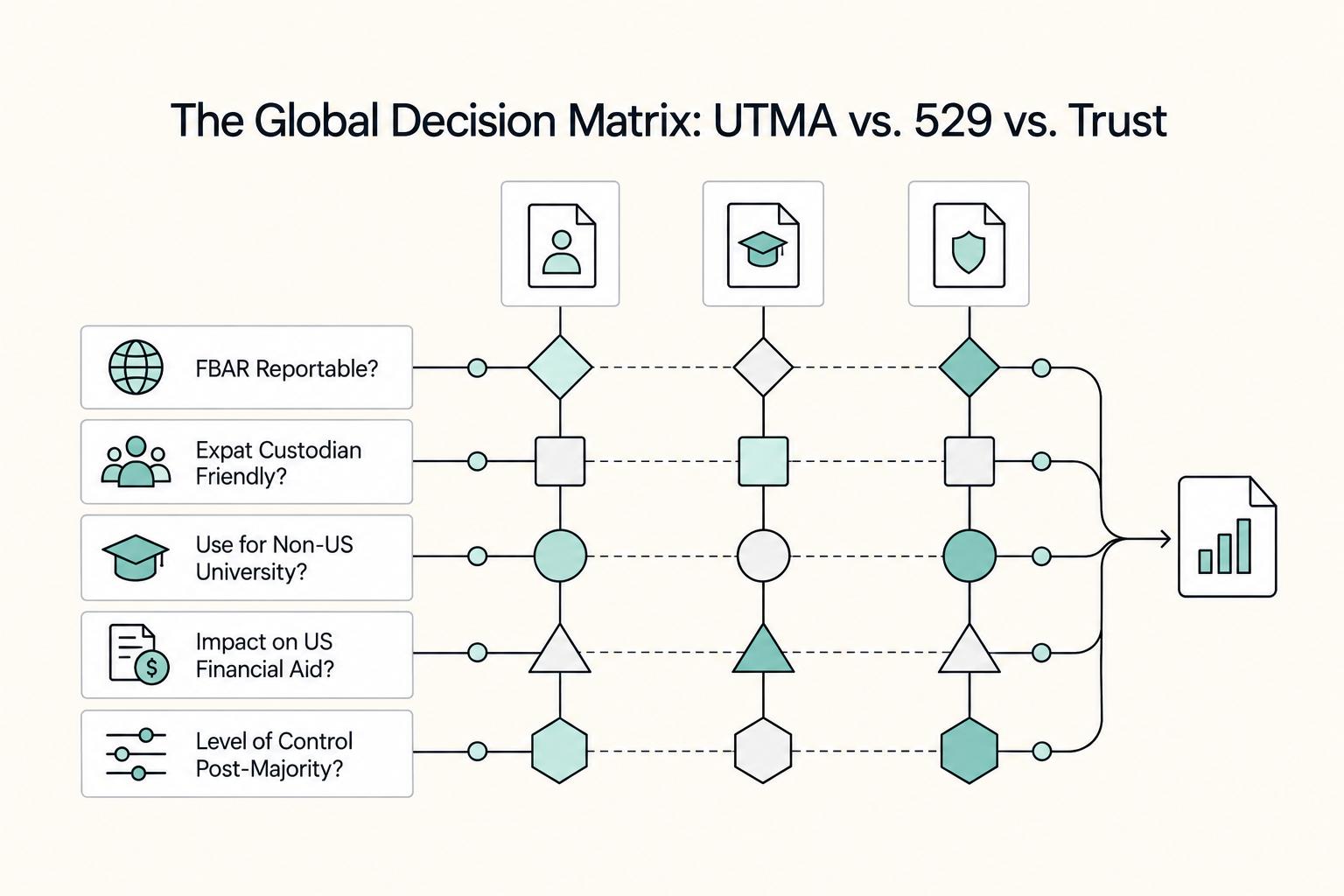
The Global Decision Matrix: UTMA vs. 529 vs. Trust#
Choosing the right strategic alternative hinges on your unique pressures: cross-border compliance, flexibility for international education, and the preservation of control. This matrix filters the options through the lens of a "Business-of-One" operating on a global scale.
| Criterion | Custodial Account (UTMA) | 529 Plan | Irrevocable Trust |
|---|---|---|---|
| FBAR Reportable? | Yes, if held at a foreign institution and aggregate foreign accounts exceed $10,000. | Generally No, as it is a US-based account. | Depends on the trust's structure and location. |
| Expat Custodian Friendly? | Challenging. Many US brokerages hesitate to open accounts for custodians without a US address. | Varies. Opening an account from abroad can be difficult. | Highly Flexible. Can be structured to accommodate global grantors, trustees, and beneficiaries. |
| Use for Non-US University? | Yes. Absolute flexibility. Funds can be used for any purpose, anywhere. | Yes, but with limits. Funds can be used at eligible foreign universities for qualified expenses only. | Yes. The trust document dictates how funds can be used, offering complete customization. |
| Impact on US Financial Aid? | High Negative Impact. Considered a student asset, reducing aid eligibility significantly. | Low Impact. Treated as a parental asset, with a minimal effect on aid eligibility. | High Negative Impact. Generally reported as the beneficiary's asset. |
| Level of Control Post-Majority? | Zero. The beneficiary gains full, unrestricted control at the age of majority. | High. The account owner (typically the parent) retains control over withdrawals and can change the beneficiary. | Absolute. The grantor defines the terms, dictating exactly when, how, and for what purpose funds are distributed. |
As the matrix reveals, the ideal tool depends entirely on your primary objective:
- UTMA: For simplicity and maximum flexibility, if you accept the total loss of control.
- 529 Plan: For tax-advantaged education savings with retained control and minimal financial aid impact.
- Irrevocable Trust: For absolute, multi-generational control and legacy protection that transcends education.
Frequently Asked Questions#
Do custodial accounts trigger annual tax filing for the minor?#
Potentially. Filing depends on unearned income, realized gains, and whether the child meets IRS filing thresholds in that tax year.
When does FBAR or Form 8938 become relevant for cross-border custodial assets?#
It becomes relevant when account location, ownership, and annual aggregate balances cross the applicable reporting thresholds for US persons.
Is a 529 plan or trust better if parents need longer-term control?#
In many cases, yes. A 529 plan or trust can preserve more control over timing and permitted uses, while custodial accounts generally transfer control at the age of majority.
Conclusion: A Tool for Your Global Legacy, Not a Compliance Trap#
A custodial account is a simple tool, but its application in your world is anything but. For the Global Professional, its potential is unlocked only when you shift from a simple savings strategy to a "compliance-first" doctrine that accounts for your global footprint from day one.
By early addressing the critical questions, you neutralize the primary threats. You understand that FBAR reporting is a clear directive. You recognize the practical hurdles with US brokerages and know how to handle them. Most importantly, you have a framework for mitigating the strategic risk of losing control by treating the custodianship as a formal mentorship.
You built your career on expertise and strategic planning. The way you build a legacy for the next generation should be no different. An investment for your children is not a passive act but an executive decision. Armed with a clear understanding of the cross-border implications and a strategy to maintain influence long after you've lost formal control, you can confidently use this tool to its maximum effect - building a secure financial future for your family, no matter where in the world your work, or their ambition, takes you.
Related Guides and Official References#
- Use this related guide to align your scope and pricing assumptions before execution.
- Cross-check execution steps with this workflow and tighten approval checkpoints.
- Review a contingency pattern in this disaster recovery plan before rollout.
- Benchmark assumptions against this supporting article to avoid planning drift.
- Track legal/compliance edge cases in this linked explainer if your setup is cross-border.
Use official documentation for policy and filing details, including primary guidance, administrative rules, and reference material.
Quick Comparison Table#
| Decision area | Custodial account signal | Alternative to evaluate |
|---|---|---|
| Control after majority age | Low control | 529 or trust if control is critical |
| Cross-border reporting | Higher coordination burden | Specialist-led trust structure |
| Use of funds flexibility | Broad use case | 529 for education-focused planning |
Frequently Asked Questions
Do UTMA accounts need to be reported on FBAR?
Yes, potentially. If the account is at a foreign financial institution and the aggregate value of all your foreign accounts exceeds $10,000, an FBAR must be filed. The responsibility for filing falls on you, the custodian.
Can a US expat open a UTMA account for their child?
It presents a practical hurdle. While legal, many US brokerage firms are hesitant to open accounts for custodians without a permanent US address. The best solutions are using a trusted US address (with permission) or seeking out financial institutions that specifically cater to the expat community.
What is the difference between a UTMA and a 529 plan for an expat's child?
The core differences are control and flexibility. A 529 plan offers tax advantages for qualified education expenses, and you retain control. A UTMA offers ultimate flexibility—the money can be used for anything once the child is of age—but you surrender all control at that point, and it has a much higher negative impact on US financial aid eligibility.
Can I use UTMA funds to pay for my child's international school tuition?
Yes. As the custodian, you can use the funds for any expense that benefits the minor, including private K-12 tuition, both in the US and abroad. This is a key advantage over more restrictive accounts.
What happens to the UTMA if the custodian passes away?
Control of the account passes to a successor custodian. You should designate a successor when you establish the account to avoid a court-appointed process.
Are there contribution limits for a UTMA account?
There are no technical contribution limits, but contributions are irrevocable gifts subject to the annual gift tax exclusion ($19,000 for an individual, $38,000 for a married couple in 2025). Gifting above this amount requires filing a gift tax return and counts against your lifetime exemption.
Researched and edited by the Gruv editorial team. Gruv builds cross-border billing, payouts, and finance-operations software for global businesses.
Sources
Includes 1 external source outside the trusted-domain allowlist.
Educational content only. Not legal, tax, or financial advice.
Related Posts

Japan Digital Nomad Visa 2026: Six-Month Planning Runbook
Treat this as your operating model: identify the right mission first, commit to one route, and keep dated records before you make irreversible plans. That is what keeps the rest of your timeline, paperwork, and decisions coherent.

Build a Freelance Press Page Clients Can Verify
Your freelance press page should do two jobs at once: help prospects assess your credibility quickly, and keep weak, inflated, or poorly sourced claims off your site. Treat it as a short evidence archive on your website, not a brag wall.
How to Handle the Kiddie Tax for Your Child’s Investment Income
Here's the quick rule: if your child has **unearned income** and clears the IRS Form 8615 gates, you likely need **Form 8615**. Use **Form 8814** only when its narrower election rules are fully met, and only after you compare the tax result.