
Quick Answer
Publish clear discretionary-vacation terms, train managers, and arrange coverage without obstructing protected leave. Preserve prior earned balances and local statutory minimums. Ordinary approval rules must not delay FMLA, sick-leave, or accommodation processes. Audit access and cancellations alongside usage during the first 90 days.
Build an unlimited PTO policy that stays flexible without losing control#
Unlimited PTO usually means discretionary paid vacation without a fixed annual accrual allowance. It does not mean every absence follows that discretionary process. Statutory holidays, sick leave, family or medical leave, disability accommodation, and local minimum paid-leave rights still need their own legal handling.
This guide concerns employee policies, not a freelancer's self-funded time off. Define the employees and locations covered, preserve existing earned balances, and design approval and coverage rules that do not obstruct protected leave. The jurisdiction examples are starting points checked against primary guidance, not a complete global leave schedule.
Check readiness before you call it flexible#
Most confusion starts when the label does more work than the policy design. If someone hears "unlimited" and assumes it means the same thing in every company, expectations can drift.
Before you use the label, make sure you can explain the policy in plain language across three basics:
- Who the discretionary vacation policy covers and which statutory rights remain separate.
- How ordinary vacation requests are decided and who arranges coverage.
- How employees can actually use leave without hidden caps or a requirement to remain available while away.
A short "at a glance" summary can help set those expectations early.
Keep the first version clear and explicit#
Write the discretionary policy and location addenda together. Keep the current policy and applicable legal entitlements operating during the transition; a new handbook draft is not a reason to suspend employees' existing leave rights.
Unlimited PTO changes the cap structure. It does not replace the need for a clear, shared policy.
Define unlimited PTO in operational terms#
This model changes accrual mechanics, not your need for a consistent request, approval, and coverage process.
- Accrued PTO: time off is earned over time, balances are tracked, and managers approve based on timing and coverage.
- Traditional PTO: a fixed annual grant (often two or three weeks) is tracked against usage, and managers decide if timing works.
- Unlimited vacation: the intended design has no fixed annual accrual bank for this discretionary benefit. Requests and use are still recorded, and managers coordinate timing and coverage. Actual law and practice determine whether a benefit is earned; the label alone does not.
| Model | Tracking method | Manager decision burden | Exception handling | Failure risk when processes are weak |
|---|---|---|---|---|
| Accrued PTO | Earned balance over time | Moderate | Check balance, timing, and team coverage | Balance becomes the focus while coverage standards stay vague |
| Traditional PTO | Fixed annual grant and remaining days | Moderate | Check allowance, timing, and team coverage | Similar requests get different outcomes across managers |
| Unlimited PTO | No accrual bank; requests may still be logged for planning and compliance | High | Review overlaps, short notice, peak periods, and longer absences with clear guardrails | Inconsistent approvals, undocumented denials, and underuse |
What you still need to control:
- One ordinary vacation request path, plus a protected-leave route with HR review.
- clear approval criteria managers apply the same way
- Manager-owned coverage and handoff planning before planned vacation begins.
- one escalation path for non-standard requests
Use consistent decision reasons and an escalation path. Keep medical details out of the shared coverage calendar. Operational records can show who is unavailable and who owns a task without disclosing diagnoses or certification documents.
Decide if unlimited PTO fits your current team stage#
Use unlimited PTO only when approvals are consistent across managers and coverage stays reliable when people are out. If either control is still informal, keep a traditional policy until you can run one repeatable request process and protect workload continuity.
| Team stage | Go signal | No-go signal |
|---|---|---|
| Solo founder with first hires | Every request follows one manager path, approvals use the same logic, and a basic Coverage plan exists for critical work | Requests are ad hoc, one absence can stall delivery, or handoff ownership is unclear |
| Small team with some shared roles | Managers explain decisions in consistent terms, backups cover core tasks, and handoffs are expected before leave starts | Similar requests get different answers, backup depth is thin, or coverage relies on informal favors |
| Larger team with backups | Approvers stay calibrated, request logging is consistent, and longer absences can be covered without disrupting operations | Teams apply different standards, exception handling is unclear, or coverage ownership is undocumented |
Before rollout, confirm four readiness points:
- Define covered employee groups and locations; contractor arrangements remain separate and do not determine employment status by label.
- Set ordinary-vacation eligibility rules and any waiting period subject to local rights; probation does not suspend statutory leave.
- Train approvers to apply the same operational criteria and recognize a potentially protected request.
- Make managers responsible for workable coverage, with employees supplying a handoff when reasonably practicable.
- Define how overlap, short notice, longer absences, and unresolved decisions are reviewed.
A hidden annual limit is a red flag. If managers automatically deny requests after a particular number of days, either change that practice or describe the actual benefit accurately. An expected minimum usage or planning benchmark must not become an undisclosed maximum.
Publish the discretionary policy before rollout#
Publish and explain the new discretionary vacation policy before relying on it for ordinary approvals. Until then, apply the existing policy and legal rights. Do not delay protected leave because the new handbook, acknowledgment, or coverage plan is incomplete.
In McPherson v. EF Intercultural Foundation, the California Court of Appeal applied vacation-payout rules to the purported unlimited policy on the case's facts. It did not hold that every genuine unlimited policy creates the same payout obligation. Clear written terms, fair access, and actual practice matter together; a signed acknowledgment alone does not settle the result.
| Clause | What to write in the handbook | Operational consequence |
|---|---|---|
| Eligibility | Who is covered, who is excluded, and whether a probation period applies | Prevents managers from changing scope case by case |
| Notice expectations | Standard submission timing, short-notice handling, and response timing | Reduces ad hoc decisions and sets a shared baseline |
| Blackout handling | Restricted periods, what qualifies as an exception, and who can approve exceptions | Protects coverage during critical periods |
| Handoff duties | Employee provides available task information; manager assigns and confirms coverage for planned vacation | Avoids making a worker solely responsible for finding their replacement |
| Escalation ownership | Who decides when a manager is unavailable, conflicted, or handling a non-standard request | Keeps decisions moving and accountable |
| Protected-leave boundary | Ordinary notice, blackout, performance, and coverage rules do not override legal leave rights | Routes potentially protected requests to the appropriate process promptly |
Make the request workflow as explicit as the policy. You can use your own forms, but every request should require:
- submission channel
- approver role
- response expectation
- coverage confirmation
- exception path
For ordinary vacation, use those fields to keep decisions consistent. For an unexpected illness or potentially protected absence, start the appropriate review promptly using the information available; do not wait for a complete discretionary-vacation form.
Illustrative discretionary policy language: 'Eligible employees may request paid vacation without a fixed annual accrual allowance under this policy. Managers consider the dates, overlapping planned absences, and specific service commitments, arrange coverage, and give a documented decision. If the requested dates cannot be accommodated, the manager discusses workable alternatives and the employee may ask HR to review the decision. This policy does not reduce statutory leave, accommodation rights, or previously earned balances.' Adapt eligibility, notice, and local addenda before adopting it.
Under 29 CFR 825.500, required FMLA records are retained for at least three years, and medical records are maintained separately with confidentiality protections. Keep routine coverage notes separate from medical evidence. Other record types and locations may require different retention.
For planned ordinary vacation, choose an internal response target you can meet, such as three working days, and an escalation owner for overdue decisions. That is an illustrative service target, not a legal safe harbor; statutory notice deadlines can be different.
Set approval and coverage rules managers can enforce#
Use a common ordinary-vacation request path and operational reasons for decisions, with a separate route for potentially protected leave. Consistency means applying the appropriate rule to comparable requests, not treating illness, accommodation, and discretionary vacation as interchangeable.
Use one approval path for every team#
Employees submit planned vacation through the chosen channel and wait for the ordinary approval decision. Managers arrange coverage and document any genuine conflict. A request mentioning surgery, a medical condition, or family care may need protected-leave review even if the employee calls it PTO or does not use a statutory label.
Before approval, require confirmation of:
- in-flight work and temporary owner
- service, queue, or client-response continuity
- fallback owner if the first backup becomes unavailable
- handoff completion criteria before leave starts
A handoff transfers the information and authority needed for the work. Employees identify open tasks when practicable; the manager confirms temporary and fallback owners. If the first backup declines or is unavailable, the manager resolves staffing rather than automatically making the employee's leave impossible.
Document a decision employees can understand#
Worked coverage example: two employees request the same Friday off and one qualified person must cover a client deadline. The manager checks whether a third trained colleague can cover, whether the deadline can move, and whether work can be completed earlier. If none works for ordinary vacation, record the specific conflict, apply the published overlap rule consistently, offer alternative dates, and provide an HR review path. A potentially protected absence follows its own rules; it is not denied through this ordinary overlap example.
Use operational reasons such as an unresolved coverage conflict or overlapping planned absences. Do not use vague 'poor performance' or 'too much leave' labels as automatic gates. Manage performance separately, and send requests that may involve statutory rights or disability accommodation to HR before applying a discretionary denial.
For non-standard cases, require escalation ownership in writing and second-level review when blackout periods, conflicting approved absences, or other verified trigger conditions apply.
Audit consistency before it becomes resentment#
Consistency checks only work if managers use the same vocabulary. Create shared reason codes for approvals, denials, and exceptions, then review decisions on a recurring cadence to compare similar cases across teams and catch drift early.
For covered employers, FMLA eligibility notice is generally due within five business days of a request for FMLA leave or learning that leave may qualify, absent extenuating circumstances. That differs from the designation notice, due once enough information establishes qualification. The employee need not say 'FMLA.' ADA leave guidance also requires consideration of reasonable accommodation rather than automatic denial under a standard policy.
Handle legal and payout risk across jurisdictions#
Your policy label does not control legal outcome. Before you launch or expand, verify how each location treats leave at separation, final pay, and payroll handling.
Review mandatory leave access and notice requirements as well as payout and final pay. A discretionary policy can be generous yet still fail if employees cannot use protected sick time or the employer misclassifies it in payroll.
Verify in order#
Start with the U.S. federal baseline, not the final answer. Under the FLSA, paid vacation is not required for time not worked, and vacation benefits are generally agreement-based. Then move to state and country rules, where your real risk sits.
In California, earned vacation cannot simply be forfeited. Massachusetts treats promised vacation payments as wages; separation procedures must reflect the relevant final-pay rule. New York looks to the policy's terms, including communicated written forfeiture conditions. Do not transplant one state's separation wording into all three.
| Jurisdiction | What to verify | Why it changes risk | Owner | When to escalate to counsel |
|---|---|---|---|---|
| U.S. federal baseline | Confirm paid vacation is not federally required for time not worked and benefits remain agreement-based | Prevents treating federal law as a complete compliance answer | HR and employment counsel | If anyone treats federal silence as a substitute for state review |
| California | Check whether policy text or manager behavior implies earned vacation | Earned vacation is protected and cannot be forfeited | HR, payroll, counsel | If accrual-like wording appears or separation payout treatment is unclear |
| Massachusetts | Confirm promised vacation wage treatment and separation-pay process | Wage treatment and final-pay timing both raise exposure | HR, payroll, counsel | If you terminate there or use one national termination checklist |
| New York | Confirm exactly what is promised in handbook, offer letter, and onboarding | Wage-supplement obligations follow what you promised | HR and legal | If documents conflict or manager explanations exceed policy wording |
| Colorado | Check earned-and-determinable vacation and separation payout | Calling the policy unlimited does not by itself eliminate earned vacation rights | HR, payroll, counsel | If actual practice creates an earned benefit or the separation treatment is disputed |
| Illinois | Confirm earned vacation final compensation by the next regular payday, and separately test applicable statutory paid-leave access | Forfeiture-on-separation terms for earned vacation are barred | Payroll and counsel | If termination workflow uses blanket forfeiture language |
| UK or other non-U.S. country | Track the statutory annual-leave entitlement and pay, plus the discretionary overlay | Many five-day UK workers have a minimum 5.6 weeks, usually 28 days; part-time and other schedules differ | Local counsel, HR, payroll | If you plan to reuse U.S. wording outside the U.S. |
Review handbook language, offer letters, payroll, and manager practice together. Preserve existing earned balances when transitioning: if a worker has eight earned vacation days under the old plan, switching the label to unlimited does not erase those days. Record their lawful use or payout treatment separately from new discretionary vacation, with the applicable location rule.
Keep wage treatment and accounting review together#
Finance should review the actual benefit under the company's accounting framework. IAS 19 distinguishes accumulating paid absences, recognized as service increases the entitlement, from non-accumulating absences, recognized when the absence occurs. A non-accruing label does not automatically remove a liability for legacy earned balances or another accumulating obligation. Align the accounting conclusion with the legally effective policy and actual practice.
Maintain a jurisdiction file#
Keep one location file and update it before hiring or expansion. Include:
- the exact policy clause in use
- the payout position for unused leave
- the final-pay process and timing rule
- the validation owner (HR, payroll, or local counsel)
- the last review marker (date and source checked)
Use a local addendum where needed. UK annual-leave guidance sets a 5.6-week statutory entitlement for most workers, usually 28 days for a five-day week; bank holidays can count toward it. Track the local minimum and applicable pay, carryover, and termination rules even when additional vacation is described as unlimited.
Catch underuse and uneven access#
After launch, your biggest risk is execution drift, not policy wording. If you do not monitor usage and manager decisions, the policy will be shaped by habits instead of your rules.
Low discretionary-vacation use can signal workload or approval problems. Review it separately from statutory leave access; protected absences are not evidence of poor performance or excessive use of the discretionary benefit.
Check usage where norms start to drift#
Set your expected pattern before launch based on your own baseline and coverage reality. Then review each cycle for patterns such as teams with very low usage, new hires who avoid time off, or sudden drops after a manager change.
Do not rely on company-wide averages. Segmenting by team and manager is what shows whether the issue is coverage planning, approval behavior, or local culture.
Audit manager decisions the same way every time#
Use the same enforcement checklist for every manager so comparisons stay fair and repeatable:
- request volume by employee and team
- approval, denial, and partial-approval patterns
- response timing, including cases that may trigger FMLA notice timing requirements
- documentation quality for decisions and changes
- coverage and handoff notes tied to each request
Keep request, decision, and leave dates, the operational reason, and coverage notes. Restrict sensitive records and compare genuinely similar cases. Do not circulate individual diagnoses or penalize a manager's team for having more legally protected leave.
Treat anecdotes as triggers, not proof#
An anecdote can trigger an operational audit, but an employee's own request or report of a possible rights violation deserves prompt appropriate handling. Do not delay protected-leave review or a discrimination complaint until enough aggregate data exists to call the problem systemic.
Run this operating rhythm every review cycle:
- confirm your expected leave-use pattern still fits your team
- review usage and decision patterns by team, tenure, and manager
- investigate outliers with request records and coverage notes
- coach managers or tighten policy wording before broader changes
In Illinois, an unlimited label does not automatically meet the Paid Leave for All Workers Act: actual access to the applicable leave and correct pay matter. Determine coverage, exemptions, and local rules, and keep statutory paid-leave handling separate from discretionary vacation approval. Illinois vacation final-pay law separately protects earned vacation in final compensation.
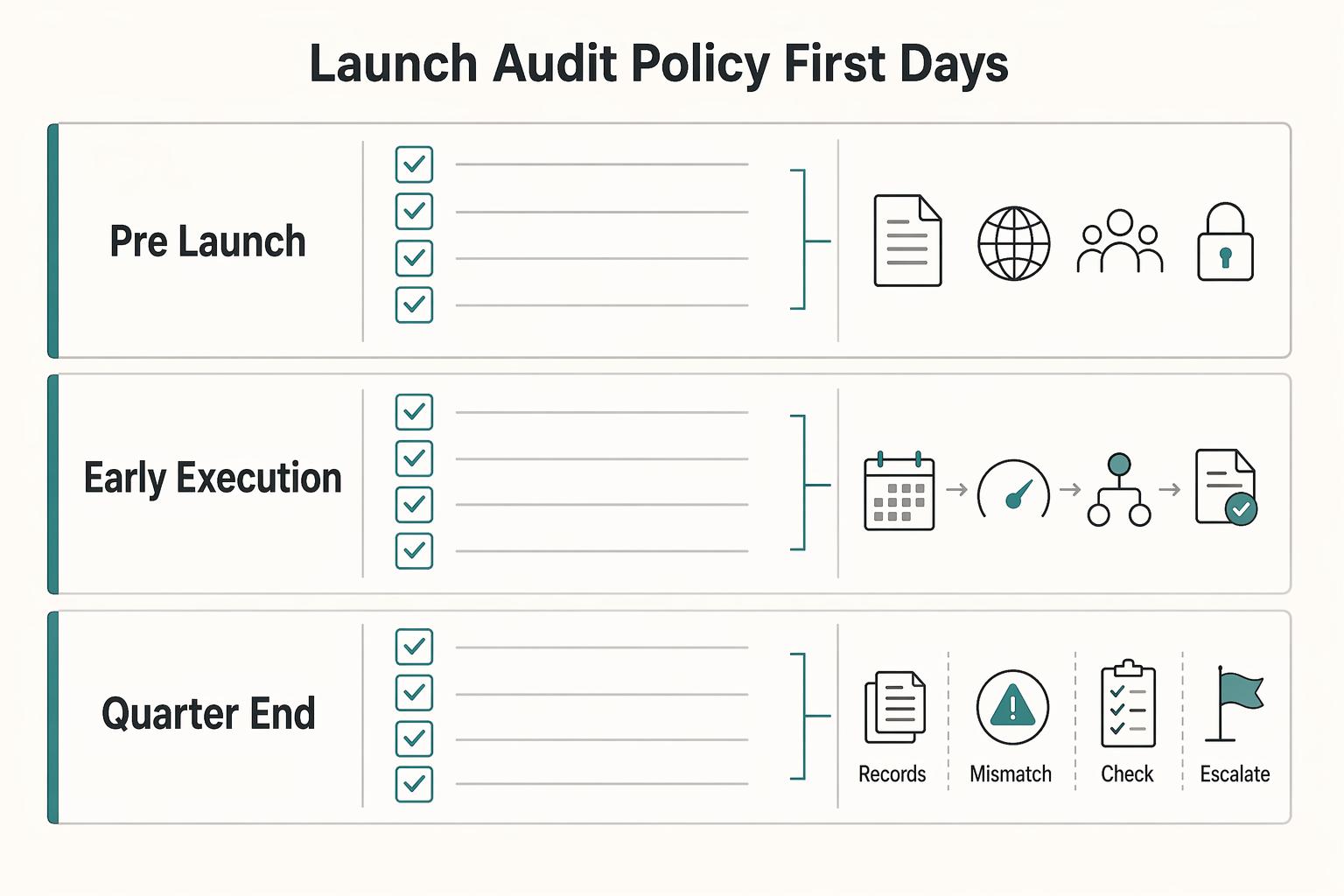
Launch and audit your policy in the first 90 days#
Treat your first 90 days as an operating test. You are verifying that managers apply the written rules consistently, not just announcing a benefit.
| Phase | What you verify | Evidence to collect | Owner |
|---|---|---|---|
| Pre-launch | Final policy text, jurisdiction review, manager calibration, handbook publication, acknowledgment capture | Final handbook language, jurisdiction review notes, manager training record, employee handbook receipt acknowledgment | HR or founder plus counsel |
| Early execution | Approval consistency, exception logging quality, response handling, coverage handoffs | Request log, approval and denial reasons, exception log, response timestamps, coverage notes | HR or ops lead |
| Quarter-end audit | Usage patterns, drift from written policy, burnout risk signals, required policy/process fixes | Team and manager usage report, cancellation patterns, repeat exception themes, policy/process updates | HR or leadership |
Before launching the new discretionary policy, finalize its text, local addenda, manager training, payroll treatment, and employee communication. Keep the existing policy and protected-leave processes running during preparation. A missing acknowledgment is not a reason to withhold an employee's legal entitlement.
In month one, compare ordinary decisions, exception reasons, response time, and manager-owned coverage. For a potentially FMLA-qualifying request, follow the eligibility-notice trigger and deadline promptly, then designation once the necessary information is available. Do not wait for a coverage solution to begin that process.
At quarter end, investigate repeated cancellations or teams that never take discretionary vacation. Fix staffing, approval delays, or unclear alternatives. Track whether employees can use local statutory entitlements independently; low use is not a saving target.
Make your policy predictable before you call it unlimited#
Call your policy unlimited only when execution is predictable, not just when the label sounds flexible. If your written rules, manager decisions, and records do not match, your answer is no-go for now.
Use a clear go/no-go check#
Use this before launch:
- Policy text is current, published, and easy for employees to access.
- Requests follow one workflow with consistent approval criteria and coverage handoff expectations.
- Jurisdiction review is documented in order, with verified notes:
Complete the location review before changing the discretionary benefit, and keep legal rights operating while it is in progress. Specify the current minimum leave, pay, carryover, separation, notice, and recordkeeping treatment in each location addendum.
If any part is unclear, pause the label and verify first.
Assign accountable owners before rollout#
Set ownership in writing so decisions do not drift by manager or channel:
| Owner | Responsibilities |
|---|---|
| People/HR owner | eligibility; policy text; updates; employee acknowledgments; jurisdiction notes |
| Manager owner | ordinary-vacation decision; prompt protected-leave referral; coverage assignment; documented operational reason |
| Employee owner | ordinary request details and available handoff information; protected-leave notice under applicable rules |
| Ops/HR admin owner | exception log; decision records; policy change history |
Validate practice before expanding scope#
Before you widen eligibility or market the benefit harder, run a simple validation loop:
- Compare written policy to real approvals, denials, usage, and exceptions.
- Check whether similar requests get similar outcomes across teams.
- Confirm handoff notes and exception reasons are complete.
Maintain an evidence pack you can defend later without reconstruction:
- Current policy text.
- Dated change history.
- Jurisdiction review notes.
- Manager decision records.
- Employee acknowledgments.
- Exception documentation.
Flexible work hours can help with scheduling, but they do not replace statutory leave. Keep contractor availability arrangements distinct from this employee policy and its legal protections.
Frequently Asked Questions
What is an unlimited PTO policy, and how is it different from accrued PTO?
An unlimited PTO policy can remove the fixed balance bank, but it does not remove approval rules, coverage planning, or documentation. Employees still request time off, managers can still approve it in advance, and teams should still name who is covering deadlines and customer work. Accrued PTO works differently because people earn time as they work, and that balance can matter at separation depending on the jurisdiction.
Is unlimited PTO legally safer than a traditional PTO policy?
Not by default. The FLSA does not generally require paid vacation, but state and local rights, contract promises, and actual policy practice still matter. In McPherson, the California appellate court found payout obligations under the facts of that purported unlimited policy; it did not rule that every genuine unlimited policy has the same result. Do not assume the label eliminates earned balances or statutory leave.
Do employees usually take more time off under unlimited PTO?
Do not assume they will, and do not base your decision on market averages. Pull your own request data each quarter and compare usage by team, manager, approval rate, cancellation rate, and notice given. If one group consistently takes less time off, keeps canceling leave, or gets slower responses from the same manager, treat that as a warning sign.
What rules must be written into the policy before launch?
Define employee and location eligibility, ordinary-vacation requests, notice and response targets, manager-owned coverage, overlap handling, review routes, and recordkeeping. Preserve legacy earned balances and specify that blackout, performance, or handoff rules do not override statutory leave or accommodation rights. Publish the new discretionary terms while continuing existing and protected entitlements.
How should managers approve or deny requests consistently?
Use the same operational criteria for comparable ordinary-vacation requests, record the specific conflict, consider coverage alternatives, and offer workable dates or an HR review. Managers own staffing; employees provide handoff information when practicable. Requests that may involve protected leave must enter the appropriate legal process rather than be denied for missing coverage.
What are the top failure modes, and how do you catch them early?
Watch for hidden caps, delayed decisions, repeat cancellations, and an inability to use required leave. Separate discretionary vacation records from protected-leave handling. California generally requires at least 40 hours or five days of paid sick leave, whichever provides more time, with applicable local requirements. Massachusetts generally allows eligible workers to earn up to 40 hours of sick time, with paid status depending on employer size; a compliant combined policy can affect separate accrual-record requirements.
Try a related tool
Researched and edited by the Gruv editorial team. Gruv builds cross-border billing, payouts, and finance-operations software for global businesses.
Sources
- cdle.colorado.gov/sites/cdle/files/info_%233e_payment_of_earne...trusted
- dir.ca.gov/dlse/FAQ_Vacation.htmtrusted
- dir.ca.gov/dlse/Paid_Sick_Leave.htmtrusted
- dol.gov/general/topic/workhours/vacation_leavetrusted
- dol.ny.gov/wages-and-hours-frequently-asked-questionstrusted
- ecfr.gov/current/title-29/subtitle-B/chapter-V/subcha...trusted
- ecfr.gov/current/title-29/subtitle-B/chapter-V/subcha...trusted
- eeoc.gov/laws/guidance/employer-provided-leave-and-am...trusted
Educational content only. Not legal, tax, or financial advice.
Related Posts

The Freelance Payment Penalty: A Modeled Audit of Platform Fees, FX Spreads, and Payout Delays
The money rarely disappears through a single, easy-to-spot fee. The real loss is stacked. A marketplace takes its commission, a processor adds a charge for international cards, a bank or payment company converts the currency at a spread, a platform holds the funds before release, and a wire sheds a little to intermediaries on the way in. Each layer looks defensible on its own, but the worker feels the combined result as a smaller deposit and a later payday.

How to Respond to a Subpoena for Business Records
Move fast, but do not produce records on instinct. If you need to **respond to a subpoena for business records**, your immediate job is to control deadlines, preserve records, and make any later production defensible.

A US Expat's Guide to Investing in UCITS ETFs to Avoid PFIC Issues
The real problem is a two-system conflict. U.S. tax treatment can punish the wrong fund choice, while local product-access constraints can block the funds you want to buy in the first place. For **us expat ucits etfs**, the practical question is not "Which product is best?" It is "What can I access, report, and keep doing every year without guessing?" Use this four-part filter before any trade: