
Quick Answer
Start with net income, then reconcile to operating cash by adding non-cash expenses and adjusting Accounts Receivable, Accounts Payable, and Deferred Revenue. That is the statement of cash flows indirect method, and it shows why reported profit and bank cash can diverge in the same period. Use this reconciliation before owner pay, hiring, or new commitments so your choices reflect actual cash movement, not accrual timing alone.
You've just closed your most profitable quarter yet. The Profit & Loss statement, or P&L, looks great. On paper, the business is performing. But when you check the bank account, the cash is tighter than you expected. That disconnect is where the real stress starts. You are profitable, yet the money available to pay yourself, invest in growth, or build a buffer does not seem to match.
That gap usually does not mean the business is broken. It means your reporting is telling two different stories at once: profit and cash. The fix is learning how to translate between them, so the accounting stops feeling like a backward-looking report and starts becoming a decision tool.
This guide walks through that translation. You will see why profit and cash diverge, how to build the bridge between them, and how to use that bridge to make better operating decisions.
The Core Disconnect: Accrual vs. Cash#
If profit looks healthy but cash feels tight, the issue is often timing. Accrual accounting records income when it is earned and expenses when they are incurred, even if cash has not moved yet. Cash accounting records income when cash is received and expenses when cash is paid. You need both views. Accrual helps show whether core operations are profitable. Cash shows what is available to fund near-term obligations.
| Checkpoint item | What it shows | What to note |
|---|---|---|
| Net income | Whether core operations are profitable under accrual reporting | Review it for the same period as ending cash and accounts receivable |
| Ending cash | What is available to fund near-term obligations | Review it for the same period as net income and accounts receivable |
| Accounts receivable | Reported profit that has not turned into cash yet | If profit rises and receivables rise too, some earnings are still sitting in uncollected invoices |
In a typical service workflow, you complete client work and issue an invoice for [Invoice amount]. Under accrual reporting, that revenue appears in the period the work was earned. If payment does not arrive until [Collection date], cash does not increase until then. In the meantime, payroll, software, taxes, and other obligations may still come due.
A useful checkpoint is to review net income, ending cash, and accounts receivable for the same period. If profit rises and receivables rise too, some of that reported profit has not turned into cash yet. That does not automatically mean collections are a problem. It does mean part of what looks like earnings is still sitting in uncollected invoices.
| View | What it records | What you can decide from this view | Common misread risk |
|---|---|---|---|
| Accrual | Revenue when earned; expenses when incurred | Whether core operations are profitable | Treating reported profit as spendable cash |
| Cash | Money received and money paid | Whether near-term obligations are fundable | Missing costs already incurred but not yet paid |
| Statement of cash flows | Actual cash inflows and outflows, reconciling beginning and ending cash | Why profit and cash moved differently in the period | Focusing only on ending cash and missing the drivers |
This is where the indirect method helps. You start with net income, then adjust for non-cash items and timing changes in current assets and current liabilities to see how profit did, or did not, turn into cash.
For a step-by-step walkthrough, see A Guide to 'Accrual' vs. 'Cash Basis' Accounting for a Small Agency.
Your Financial Rosetta Stone: The Statement of Cash Flows#
When the decision in front of you is about actual spending power, the cash flow statement can matter more than the P&L alone. Check it before owner pay, new spending, or growth moves that could outpace available cash.
Treat the statement of cash flows as your working reference for how cash moved during the period, alongside your other reporting.
For this guide, the direct and indirect method comparison is mainly a reading and preparation checkpoint. You do not need a perfect year-end presentation. You need regular reporting you can use for real decisions.
| Component | What it means | Common mistake |
|---|---|---|
| Direct and indirect method | A way to compare how the operating section is presented | Treating method choice as more important than decision-ready reporting |
| Preparing a cash flow statement | The workflow for building the statement | Skipping preparation steps and acting on an unverified draft |
| Common indicators and red flags | Signals worth reviewing before major cash decisions | Ignoring warning signs while planning larger payouts or new spending |
Keep the reporting period consistent, and make sure your cash-flow reporting is internally consistent before you act. A clear warning moment is planning larger payouts or new spending while the cash picture is weakening.
Build the statement in sequence, then review it for indicators and red flags before you approve larger payouts or new spending. Related: How to Build a 3-Statement Financial Model.
A Practical Framework: Building Your Statement in 3 Steps#
The operating section is easiest to trust when you build it the same way each time. Start with net income, add back non-cash items, then adjust for working capital. In the statement of cash flows indirect method, that sequence is the reconciliation from profit to net cash provided by (or used in) operating activities.
| Step | Main task | Key check |
|---|---|---|
| Step 1 | Start with net income from your income statement | Use the exact net income line for the same reporting period shown in the cash flow statement, and align that period with the balance sheet opening and closing dates |
| Step 2 | Adjust for non-cash expenses | Include depreciation and amortization, and exclude gains or losses on disposal of long-term assets from this operating reconciliation step |
| Step 3 | Adjust working capital to remove accrual timing effects from operations | Calculate each period-to-period change, commonly ending balance minus beginning balance, for Accounts Receivable, Accounts Payable, and Deferred Revenue, then apply the cash effect |
This format is permitted under ASC 230-10-45-28 and IAS 7. You are not trying to recreate every cash receipt and payment. You are reconciling net income to operating cash flow.
Step 1. Start with net income from your income statement#
Start with net income from your income statement. Use the exact net income line for the same reporting period shown in the cash flow statement.
Before you do anything else, confirm that the periods line up. Your income statement period and your balance sheet opening and closing dates need to match that same period. If they do not, stop and align them first.
Step 2. Adjust for non-cash expenses such as depreciation and amortization#
The next adjustment is for non-cash expenses that reduced net income without using cash in the period. The main lines are usually depreciation and amortization. Use a simple include or exclude check:
- Include non-cash expense lines such as depreciation and amortization.
- Exclude gains or losses on disposal of long-term assets from this operating reconciliation step.
Keep this step narrow and accurate. A short, clean list is better than a long list that mixes operating and non-operating items.
Step 3. Remove accrual timing effects from working capital#
This is the part that usually explains the gap between profit and cash. Adjust working capital to remove accrual timing effects from operations. Calculate each period-to-period change, commonly ending balance minus beginning balance, then apply the cash effect.
For this build, focus on Accounts Receivable, Accounts Payable, and Deferred Revenue. That last account may appear as unearned revenue, customer deposits, or another operating liability label.
| Account | If balance increases | If balance decreases | Cash-flow logic |
|---|---|---|---|
| Accounts Receivable | Subtract from operating cash flow | Add to operating cash flow | Higher receivables mean revenue was recognized ahead of cash collection |
| Accounts Payable | Add to operating cash flow | Subtract from operating cash flow | Higher payables mean expenses were recognized ahead of cash payment |
| Deferred Revenue | Add to operating cash flow | Subtract from operating cash flow | Higher deferred revenue means cash was collected before revenue recognition |
Keep the classifications clean. Adjust operating current assets and liabilities that reflect accrual timing. After these three steps, you should have net cash provided by (or used in) operating activities, which is the number you will use in the next section.
If you want a deeper dive, read Hiring Your First Subcontractor: Legal and Financial Steps.
Read the Statement With a Verification Mindset#
Once the statement is built, the next step is to read it with a verification mindset. If your report is organized into Operating, Investing, and Financing sections, use those labels as a review structure, then confirm how each line was classified in your own records.
That structure still matters because classification can change interpretation. If categories look blended or inconsistent period to period, verify the format before relying on conclusions.
Operating#
Use this section to confirm what your team has classified as operating activity and whether that treatment is consistent. If the classification shifts from one period to the next, pause before you use it as a decision signal.
Investing#
Use this section to identify transactions your report treats as investing activity and verify that the same treatment is being applied consistently. If a line looks unfamiliar or newly reclassified, check the underlying entry before you draw conclusions.
Financing#
Use this section to review how funding and owner-related cash movements are classified in your report. Before you approve discretionary outflows, check them against your internal policy and the broader cash picture.
| SCF category | Question answered | Common misread | Next decision |
|---|---|---|---|
| Operating | How is cash activity currently being classified? | Treating labels as sufficient without checking mapping | Verify classification against underlying records |
| Investing | Which cash movements are being grouped as investing? | Assuming the grouping alone implies a decision | Confirm consistency and escalate unclear items |
| Financing | Which cash movements are being grouped as financing? | Assuming discretionary outflows are safe without policy checks | Apply internal cash policy before approving outflows |
Keep the cadence practical: review during close, flag unusual classification changes, and resolve open items before major cash decisions.
For related context on how cash expectations affect valuation, see A Guide to Discounted Cash Flow (DCF) Valuation. If your cash diagnostics keep pointing to slow collections, standardize your billing workflow with the free invoice generator.
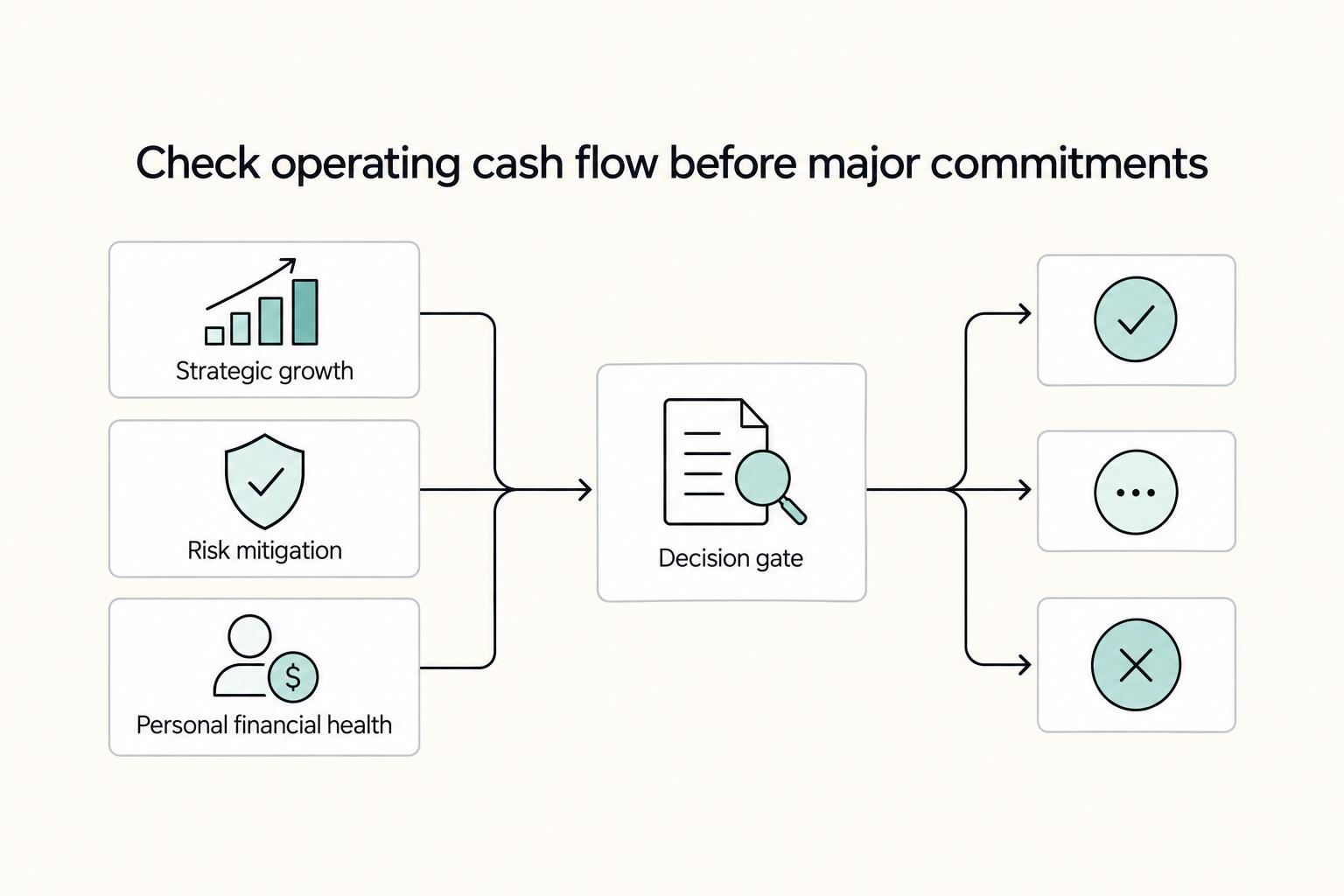
Treat Cash Flow From Operations as a Check Before Major Commitments#
Once you can review the operating section with confidence, the shift is managerial. Use the statement of cash flows with your income statement and balance sheet. Then make decisions as clear yes, not yet, or no calls based on what the full set shows.
| Area | What to review | Response in the article |
|---|---|---|
| Strategic Growth | Before approving a hire, tool, campaign, or other expansion step, write down when cash goes out and when you expect it to come back | If the results do not appear where you expected across your statements, pause before adding another fixed commitment |
| Risk Mitigation | If operating cash flow weakens or stalls, review the decisions behind the pressure points | Ignore sunk costs and evaluate operating performance separately from financing effects |
| Personal Financial Health | Set your draw after close and review recent operating direction and near-term obligations | If operating cash is uneven, reduce or delay the draw and reassess next period |
At each close, treat cash flow from operations as a key check before major commitments. Profit still matters, but when timing conflicts with cash reality, cash flow can guide spending, hiring, and owner pay.
Strategic Growth#
Growth decisions are stronger when you start with cash timing, not just whether something looks attractive on paper. Before approving a hire, tool, campaign, or any other expansion step, write down when cash goes out and when you expect it to come back.
Then compare that expectation to what shows up after close. If the results do not appear where you expected across your statements, pause before adding another fixed commitment.
Risk Mitigation#
Risk can show up as a timing problem. If operating cash flow weakens or stalls, treat that as a signal to review the decisions behind the pressure points.
Keep two filters in place each cycle: ignore sunk costs when deciding what to do next, and evaluate operating performance separately from financing effects. That keeps your next move tied to incremental cash outcomes rather than past spend or funding noise.
Personal Financial Health#
Owner pay can be safer when it follows operating performance rather than a single strong bank snapshot. Reported profit and available cash can diverge because of timing.
Set your draw after close, when you can review recent operating direction and near-term obligations. If operating cash is uneven, reduce or delay the draw and reassess next period.
What you do next#
Before the next period starts, do three things:
- Review the trend in cash flow from operations, not just one period.
- Flag cash-flow pressure points and tie each one to a decision you made.
- Set one cash-policy decision for the next period, such as delaying discretionary spend, pausing a hire, or limiting owner pay.
That is the practical shift in confidence. Every decision creates transactions, and every transaction leaves a footprint in your statements. When you review that footprint each cycle, you are not reacting to the bank balance. You are managing the business with intent.
You might also find this useful: A Guide to Creating a 'Pro Forma' Financial Statement.
When you're ready to operationalize this process across client payments and withdrawals, review Merchant of Record for freelancers.
Frequently Asked Questions
Why is net income different from cash flow?
Net income is accrual-based, so it records revenue and expenses when they are recognized, not when cash moves. Cash flow shows actual cash movement during the period. In the indirect method, you bridge that gap by adjusting profit for non-cash items and timing items like receivables, payables, and deferred income.
Can you show a simple indirect-method walkthrough without using fixed dollar assumptions?
Use this sequence each period: start with net income [A], add non-cash expenses [B], subtract operating current-asset increases such as receivables [C], add operating current-liability increases such as payables [D], then adjust other operating timing balances like deferred income [E] based on the period movement. The operating result is [A] + [B] - [C] + [D] +/- [E]. Do not just run the math and move on. Rising receivables usually mean cash is lagging recognized revenue, while rising payables mean some recognized expenses have not yet been paid in cash.
What is the difference between the direct and indirect method?
The difference is in how the operating section is presented. The direct method shows gross cash receipts and gross cash payments, while the indirect method reconciles profit to operating cash flow. Under ASC 230, either method is allowed and the direct method is encouraged. | Method | What it shows | Setup effort | When to use it | | --- | --- | --- | --- | | Direct method | Major classes of gross cash receipts and gross cash payments | Depends on whether you can produce gross cash-in and cash-out detail by category | Use when you want a plain cash-in versus cash-out operating view | | Indirect method | Profit or loss reconciled to operating cash flow | Depends on how you maintain accrual records and operating balance changes | Use when your main question is why profit and cash differ | | Same operating total | Net operating cash flow should reconcile to the same amount | Effort differs by data setup, not by target outcome | Use the method you can prepare consistently and explain clearly |
If you run a service business with no inventory, which operating accounts deserve the most attention?
Start with accounts receivable, accounts payable, and deferred income because they are core operating timing balances. If receivables rise, collections may be trailing recognized revenue. If payables rise, recognized expenses may be trailing cash payment. Review deferred income movement against billing and delivery timing before you conclude that operating cash is strong or weak.
How do you use each cash flow section to make actual operator decisions?
Use Operating to judge runway and whether core activity is funding day-to-day needs before you expand commitments. Use Investing to time reinvestment, separating essential spend from optional upgrades when operating cash is tight. Use Financing to plan debt and owner pay, especially if financing inflows are covering operating pressure. For a deeper read, use How to Read a Cash Flow Statement.
What should you verify before trusting the operating section?
First, confirm the method shown, because direct and indirect present operating cash differently. If it is indirect, you should see a profit starting point, non-cash adjustments, and operating timing adjustments, including receivables, payables, and deferred income. If one of those pieces is missing, pause and reconcile before using the number for decisions.
What documents do you need to prepare or review this cleanly each period?
Keep your period income statement, balance changes for current operating accounts, and support for non-cash expenses together. Then tie receivables, payables, and deferred income movements back to underlying invoices, bills, and customer prepayments before you rely on the operating cash figure. That check helps prevent profit-based decisions when cash timing is telling a different story.
Try a related tool
Researched and edited by the Gruv editorial team. Gruv builds cross-border billing, payouts, and finance-operations software for global businesses.
Sources
Includes 3 external sources outside the trusted-domain allowlist.
- irs.gov/publications/p538trusted
- pmc.ncbi.nlm.nih.gov/articles/PMC10122550trusted
- scholarship.claremont.edu/context/cmc_theses/article/1074/viewcontent/...trusted
- sec.gov/files/cash-flow-statement-bblocks.pdftrusted
- sec.gov/newsroom/speeches-statements/munter-statemen...trusted
- corporatefinanceinstitute.com/resources/accounting/indirect-methodexternal
- corporatefinanceinstitute.com/resources/accounting/deferred-revenueexternal
- dart.deloitte.com/USDART/home/codification/presentation/asc230...external
Educational content only. Not legal, tax, or financial advice.
Related Posts

Hiring a Subcontractor for the First Time Without Costly Surprises
**Start with a risk-control sequence, not an ad hoc handoff.** As the Contractor, your goal is simple: deliver cleanly, control scope, and release payment only when the work and file are complete.
How to Read a Cash Flow Statement
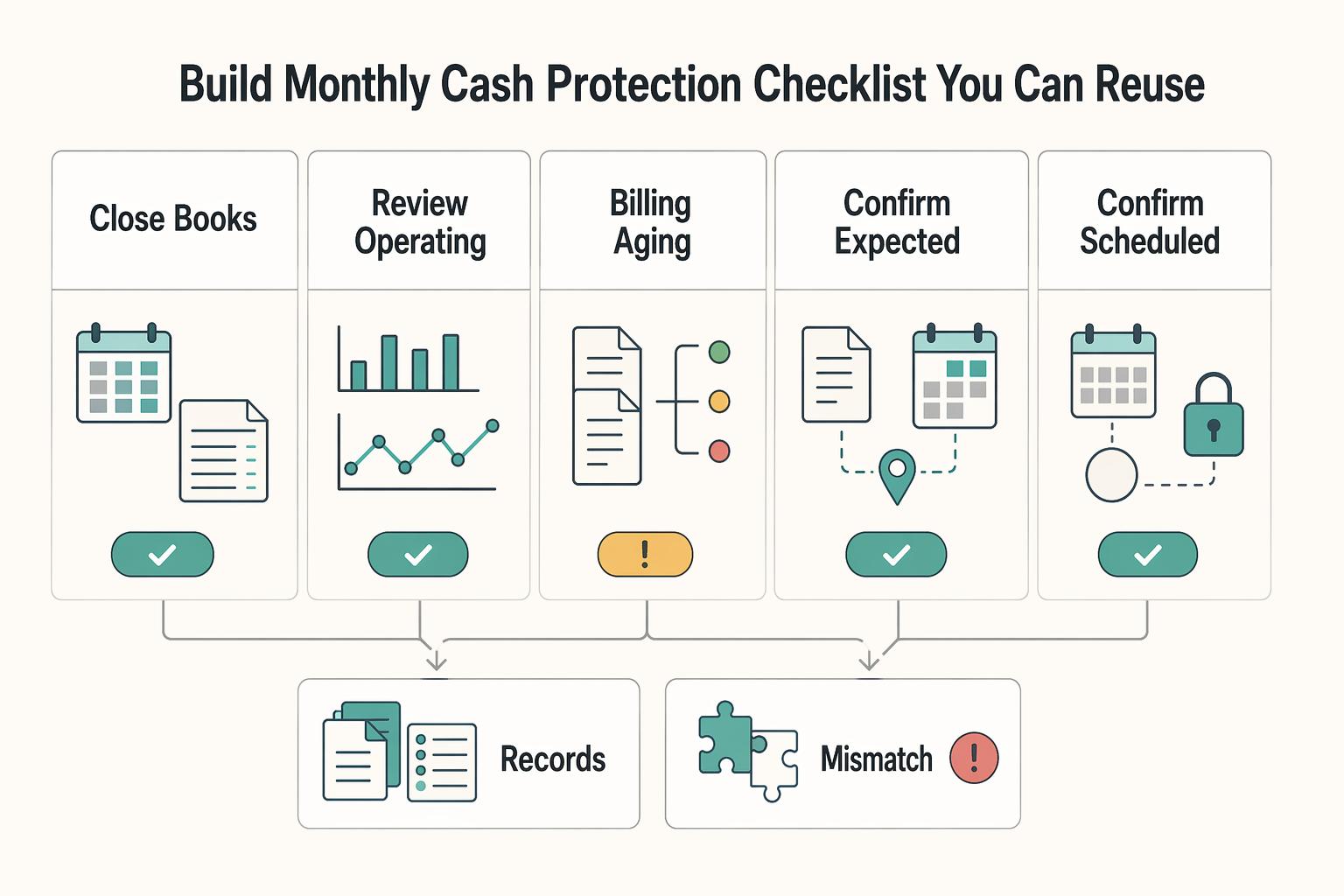
Start with one operating question: will cash arrive in time to cover what you must pay? If that answer is uncertain, prioritize cash reliability before you add optional spend, hiring, or growth bets.
How to Build a 3-Statement Financial Model
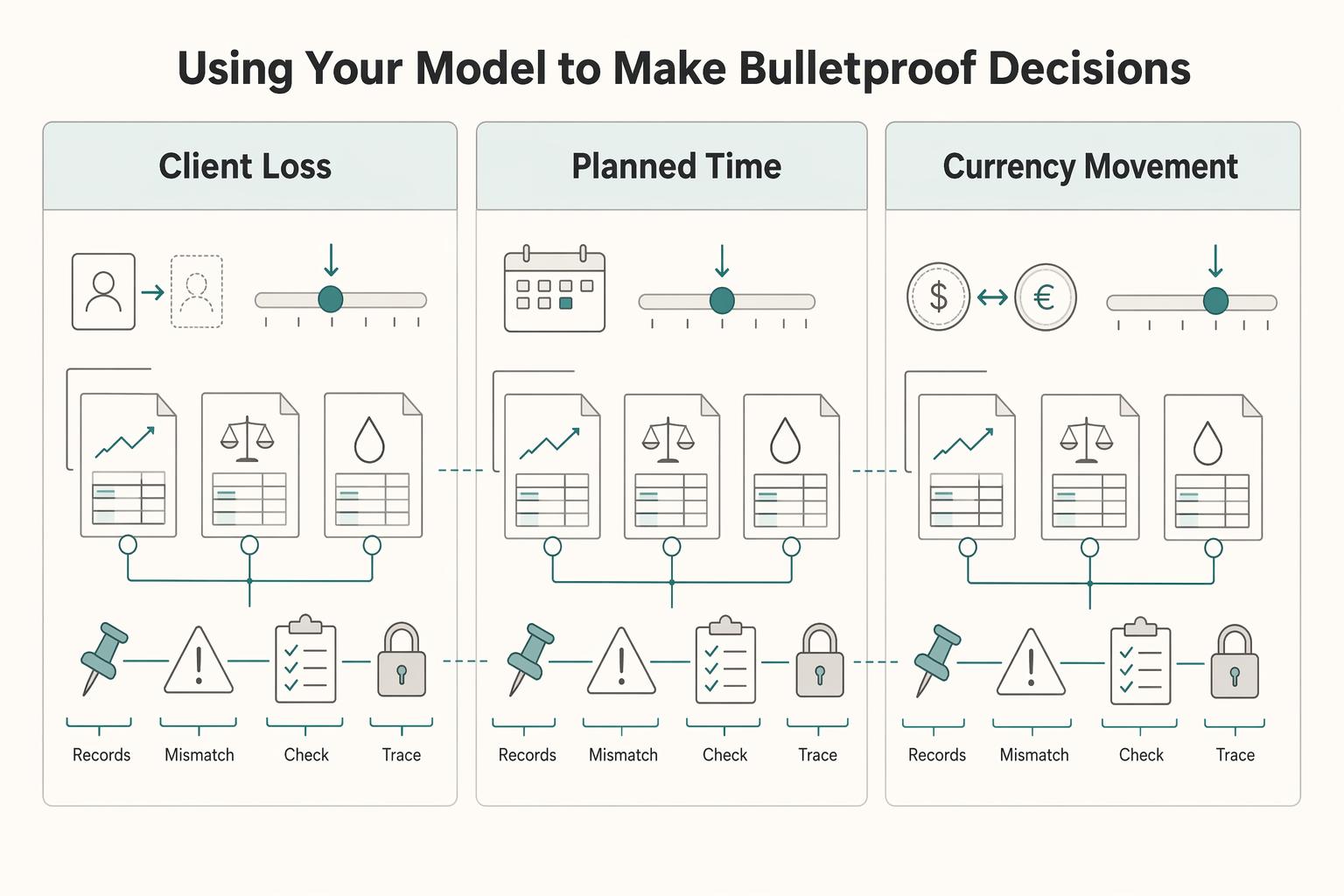
Use this model as an operating tool for getting paid and staying liquid, not only as a valuation exercise. If you invoice clients, your real questions are practical: when cash will arrive, what you already owe, and what happens if a client pays late, disputes a payment, or pushes unclear payment terms.