
Quick Answer
A freelance pro forma is a forward-looking model that helps you test profit and cash timing before you commit. Build it with an income view for expected revenue, direct costs, operating costs, and projected profit, plus a cash movement view for when money should come in and go out. Keep assumptions explicit, run base and conservative scenarios, and update the model by comparing projections with actual results.
What a Pro Forma Is for a Solo Business#
Use a pro forma to decide your next move before you commit. For a business-of-one, it is a forward-looking model built on assumptions so you can test outcomes, not a record of what has already happened. In practice, you can build it with two planning views:
- A forward-looking income view: expected revenue, direct costs, operating costs, and projected profit.
- A cash movement view: when cash is expected to come in and go out.
The cash view matters just as much as the income view because timing can break a plan even when projected profit looks fine. Late client payments, long net terms, or clustered outflows can create a squeeze. In U.S. contexts, tax timing matters too because taxes are paid as income is earned. Many individuals generally need estimated payments if they expect to owe $1,000 or more at filing.
| Tool | Main purpose | Inputs | Best for deciding |
|---|---|---|---|
| Pro forma | Test future outcomes before acting | Assumptions on revenue, costs, taxes, and timing | Scenario changes in pricing, client mix, and costs |
| Budget | Plan money for a defined period | Planned spending and revenue targets | Spending limits and allocation choices |
| Bookkeeping | Record completed transactions | Actual financial activity | What happened and what needs to be recorded |
For what-if analysis, focus on variables that can materially change outcomes: client mix, pricing, payment timing, operating costs, tax assumptions, and currency exposure when clients pay in foreign currency. Tie each assumption to evidence you can defend, such as signed agreements, recent invoices, recurring bills, or stated payment terms. Keep the scope clear. SEC Article 11 pro forma rules apply to specific filing situations, not to a required format for solo operators.
Keep a simple assumptions discipline:
- List key assumptions in one place with the evidence behind each one.
- Set a review cadence for cash assumptions and a separate cadence for the full forecast.
- Flag assumptions that are volatile or outside your control, and verify them before major decisions.
Once those guardrails are in place, you can build the model one layer at a time. You might also find this useful: How to Create a Financial Forecast for a Funding Round.
Building the Pro Forma: Five Steps From Drivers You Can Defend#
Build from drivers you can defend, not from a target number you hope to hit. If an input is not supported by historical data, market research, or a clearly labeled assumption, mark it provisional. Then review it on a schedule.
| Step | Focus | What to do |
|---|---|---|
| Step 1 | Revenue line items | List each offer, the unit you sell, your price per unit, expected volume, and expected timing. |
| Step 2 | Expenses | Keep expenses in a separate section with clean categories and a consistent structure over time. |
| Step 3 | Assumptions | Model assumptions explicitly and keep uncertain inputs marked as unconfirmed until you confirm them. |
| Step 4 | Conservative projections | Combine historical data, market research, and realistic assumptions; lower optimistic numbers and rerun the model. |
| Step 5 | Cash flow test | Calculate expected cash in, subtract expected expenses, and confirm the result under key scenarios. |
Step 1. List revenue line items and their timing#
Start with revenue line items. On one sheet, list each offer, the unit you sell, your price per unit, expected volume, and expected timing so you can see how revenue assumptions drive outcomes.
Then stress-test those assumptions with scenarios. Keep invoicing timing and expected cash timing separate so revenue and cash flow do not get blended together.
Step 2. Keep expenses in clean, consistent categories#
Keep expenses in a separate section with clean categories so the model stays useful and easy to maintain. Use categories that match how you actually spend, and keep the structure consistent over time so comparisons stay clear.
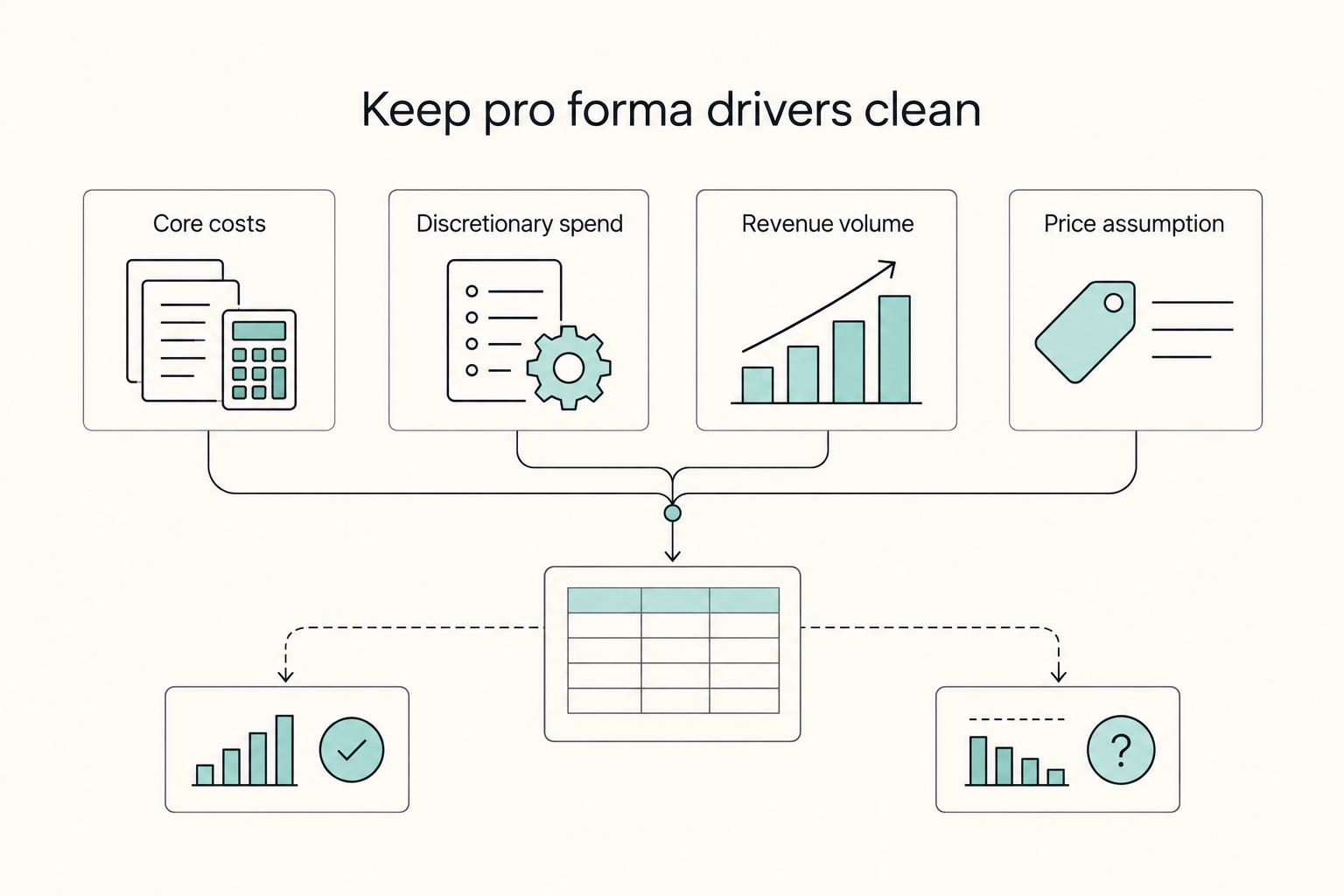
When cash gets tight, this split helps you decide what to touch first:
| Line item or assumption | Fixed or variable | Controllable or less controllable | First move when cash is tight |
|---|---|---|---|
| Core operating costs | Mostly fixed | Usually partly controllable | Remove overlap, downgrade, or renegotiate |
| Discretionary spending | Variable | Usually controllable | Pause or defer first |
| Revenue volume assumption | Variable revenue driver | Partly controllable | Update quickly if demand changes |
| Price assumption | Variable revenue driver | Controllable | Re-test against market conditions |
Step 3. Model assumptions explicitly and mark uncertain inputs#
Model assumptions explicitly instead of burying them in totals. Keep uncertain inputs marked as unconfirmed until you confirm them.
If you need alternate outcomes, duplicate the model into clear scenarios, for example base and conservative, so only the inputs that actually change move.
Step 4. Keep projections conservative and realistic#
Keep projections conservative by combining historical data, market research, and realistic assumptions. The goal is not to prove a best-case story; it is to avoid overestimating success.
When a number feels optimistic, lower it and rerun the model. If the decision still holds under a conservative case, the plan is usually more reliable.
Step 5. Test cash flow under your key scenarios#
The final test is cash flow because it tells you whether the plan is stable enough to use. Calculate expected cash in, subtract expected expenses, and confirm the result under your key scenarios.
Then run this model-health check regularly or before major decisions:
- Review assumptions and update the ones that changed.
- Check variance: compare projected vs actual results and identify which assumption missed.
- Make one next adjustment: update the single driver with the biggest impact, then rerun the model.
If you want a deeper dive, read Hiring Your First Subcontractor: Legal and Financial Steps.
Running the Scenarios: De-Risking Your Biggest Career Moves#
Use scenarios before you make the move. Duplicate your baseline, change only the assumptions tied to one choice, and read the cash impact first. Each scenario should be a saved assumption set, not a rewrite of the whole model.
| Scenario | Proceed if | Redesign if | Pause if |
|---|---|---|---|
| Relocation | Monthly cash remains positive after FX stress and collection timing stress | Viability depends on optimistic conversion or faster-than-usual payment timing | Compliance inputs are unverified |
| Revenue concentration shift | One delayed payment does not break critical obligations or reserves | One client controls too much monthly cash stability | Terms or collections behavior are not verifiable |
| Planned time off | Your buffer covers leave and recovery without dropping below your floor | The plan works only by removing costs you have not removed in reality | Reserves rely on unverified compliance assumptions |
Discipline matters here. Change one assumption group at a time to isolate impact, and hold everything else constant unless the scenario truly changes it. Include payment timing, late-payment or credit-loss risk, and currency exposure in every case, along with income and tax assumptions. If you use Excel Scenario Manager, each scenario supports up to 32 variable values.
| Scenario | Assumptions changed | Assumptions held constant | Primary risk tested | Decision signal to watch |
|---|---|---|---|---|
| Relocation | Location-linked costs, invoicing/payout currency, FX timing, jurisdiction-specific compliance items | Current pricing, client mix, baseline workload unless evidence says otherwise | Payment value changes between deal date and receipt date, plus slower collections | Cash stays positive after conversion effects, fees, timing lag, and reserves |
| Revenue concentration shift | Revenue share by client, payment terms, receivables-risk line, delivery/support costs | Personal spending, most fixed overhead, baseline capacity | Late payment or credit-loss risk from one payer and cash timing stress | One delayed invoice does not create a cash gap you cannot absorb |
| Planned time off | Reduced or zero billing months, buffer draw, pauseable costs | Fixed obligations, recurring commitments, reserve policy | Runway shortfall during leave and slower restart collections | Buffer stays above your floor through leave and first recovery period |
Relocation#
Model relocation by changing only location-sensitive lines. Update costs that move with location, contract and payout currency, conversion-related assumptions, and jurisdiction-specific compliance items. Keep pricing and client mix unchanged unless you have direct evidence they will change.
Read this scenario through timing, not just totals. If you earn in one currency and spend in another, payment value can shift between agreement and receipt, and delays can widen the gap.
Decision gate: proceed if monthly cash remains positive after FX stress and collection timing stress. Redesign if viability depends on optimistic conversion or faster-than-usual payment timing. Pause if compliance inputs are still unconfirmed.
Revenue concentration shift#
Treat this as a risk test, not just a growth case. Increase the larger client's share, then adjust payment terms, delivery costs, and the receivables-risk line for delayed or missed payment. Keep the rest fixed so concentration risk stays visible.
Judge the result at cash level because a strong accrual view can still fail if one major invoice lands late.
Decision gate: proceed if one delayed payment does not break critical obligations or reserves. Redesign if one client controls too much monthly cash stability. Pause if terms or collections behavior are not verifiable.
Planned time off#
Build this scenario in two parts: the leave period and the first recovery period. Reduce revenue only for the months you expect lower billing, keep fixed costs unless they are actually removed, and test a slower ramp back.
Focus on what keeps running while you are away. Keep recurring obligations in place and keep receivables-risk active until open invoices are actually paid.
Decision gate: proceed if your buffer covers leave and recovery without dropping below your floor. Redesign if the plan works only by removing costs you have not removed in reality. Pause if reserves rely on unverified compliance assumptions.
We covered this in detail in How to Build a Freelance Financial Model That Protects Cash Flow. When your scenario plan depends on a pricing change, validate your assumptions first with the freelance rate calculator.
Using the Pro Forma as Part of Your Evidence Pack#
Use the model as part of your evidence pack. It should make your future earnings logic clear, show how cash actually moves, and make assumptions easy to inspect. It is a forward-looking model, not a certainty.
Keep the pack practical and tight:
- Pro Forma Income Statement for projected profitability
- Pro Forma Cash Flow Statement for actual cash movement
- Assumptions note that states what drives the projections (for example: clients, rates, and location)
The assumptions note is the control point because the projection is only as good as what sits underneath it.
Before you share anything externally, stress-test the weak spots first. Check client concentration, tax residency, billable days, and currency fluctuations. If cash breaks under reasonable stress, fix the model or state the weakness clearly in the assumptions note.
Requirements vary by reviewer, and a pro forma usually supports rather than replaces other required documents.
| Use case | What to make clear | Pro forma fields that help | Common failure point |
|---|---|---|---|
| Loan | Assumptions behind projected profitability and cash movement | Income view, cash flow view, assumptions note | Profitability looks strong but assumption risk is unclear |
| Housing finance | Assumptions behind projected earnings and cash movement | Income view, cash flow view, assumptions note | Projections are not clearly tied to assumptions |
| Visa or residency | Assumptions behind projections, with jurisdiction-specific items verified separately | Income view, cash flow view, assumptions note | Jurisdiction-specific items are unverified |
Before submission, run one consistency check: every projected line should map either to supporting records or to a clearly labeled assumption.
Submission readiness checklist#
| Check | What to confirm |
|---|---|
| Projected figures | Clearly labeled |
| Totals and cash-flow timing | Internally consistent |
| Assumptions note | Explains billable days, rates, client mix, tax-residency assumptions, and currency exposure |
| Stress tests | Documented for client concentration, tax residency, billable days, and currency fluctuations |
| Jurisdiction-specific requirements | Current local requirements still need confirmation |
For banking setup, see The Best Bank Accounts for Freelancers in Germany.
Conclusion: Check the Numbers First, Then Choose#
Use the model before you commit. The practical shift is moving from decisions based on today's bank balance to decisions based on a forecast you update deliberately. Use it for projects, pricing, moves, and other major commitments.
The habit is simple: check the numbers first, then choose. If your contract only works when a client pays on time, payment terms are part of the economics. If your income view looks profitable but the cash view shows a shortfall, the plan is not ready. Profit is a concept. Cash is your reality.
| Area | Reactive behavior | Deliberate behavior |
|---|---|---|
| Project selection | You accept work because it is available now | You test revenue mix, payment timing, and capacity before you accept |
| Pricing discipline | You quote what feels acceptable in the moment | You run rate scenarios, including a hypothetical 15% increase, and decide from margin and cash impact |
| Cash planning | You treat taxes and savings as leftovers | You map opening cash, inflows, fixed costs, tax reserves, and closing cash before committing |
| Risk response | You react after problems appear | You run downside cases in advance and define what triggers a response |
The difference between those columns is usually not a fancier spreadsheet. It is stronger assumptions and a clearer paper trail. Projections break when assumptions are weak, so avoid false precision. Keep a short assumptions page and dated notes showing where key inputs came from and when you last checked them.
That traceability helps even when you are not filing anything formally. In structured reviews, documented checkpoints and metadata matter. SEC records, for example, use identifiers and date fields such as ACCESSION NUMBER, FILED AS OF DATE, and CONFORMED PERIOD OF REPORT. You do not need SEC-style formatting, but you can copy the habit: date versions, label the covered period, and make key lines traceable.
Use the same caution in lending or compliance conversations. A projection can support the story behind variable income, but it does not replace institution-specific documents. Confirm current expectations with the relevant reviewer, then make sure the model aligns with the rest of your file.
- Update assumptions when rates, clients, payment terms, tax estimates, or location plans change.
- Run scenarios before major commitments, not after.
- Date each revision, label the covered period, and keep prior versions traceable.
- Use the output to decide: proceed, renegotiate, delay, or decline.
Open your spreadsheet, keep one income view, one cash view, and one assumptions note, and use that set as your standing pre-commitment check.
For a step-by-step walkthrough, see How to Build a 3-Statement Financial Model.
When you are ready to turn your forecast into cleaner client billing, draft your next invoice with the free invoice generator.
Frequently Asked Questions
What does a pro forma financial statement mean here?
Here, it means a forward-looking projection built from estimated income, expenses, cash timing, and explicit assumptions. It is a decision model, not a record of what already happened. In SEC reporting, pro forma can mean showing how a significant transaction could have changed historical statements, which is a different use case.
How do you build one without overcomplicating it?
Build it in a spreadsheet with revenue drivers, expenses, tax reserves, and opening and closing cash. Keep a one-page assumptions note next to the model so each key number is explainable. Add downside and upside scenarios, review projected versus actual results on a recurring cadence, and update when rates, clients, payment timing, currency mix, or tax estimates change.
What inputs and assumptions should you set before you fill in the numbers?
Start with inputs you can defend, such as revenue drivers, rates, client mix, fixed costs, and expected payment terms. Then document the assumptions most likely to break the outcome, especially client concentration, payment delays, currency exposure, and tax exposure. Where local rules matter, keep that input marked as unconfirmed until you have current support.
Which risks should you stress-test first?
Stress-test the risks most likely to break cash flow: a major client pays late, a major client drops, and a less favorable currency or tax outcome. Public-company guidance treats 10% or more revenue from one customer as a concentration point. That is not a private-business rule, but it is still a useful warning signal. If concentration is high, run a downside case that shows how long your cash lasts if that revenue slows or stops.
Can you use it for a mortgage or loan application?
Yes, but use it as support, not as a substitute for required documents. Lenders generally need documented income, assets, employment, credit history, and monthly expenses, so the model should align with the rest of your file. If a lender uses Fannie Mae-style treatment, 25% or greater ownership may be treated as self-employment and a two-year earnings history is generally expected. Requirements vary by lender and product, so keep lender-specific expectations unconfirmed until the reviewer confirms them.
What is the difference between a pro forma, a budget, a generic template, and a custom model?
A pro forma tests future outcomes under assumptions, while a budget sets spending targets and resource limits. A generic template gives you structure, but a custom model reflects your real drivers, terms, and scenarios. Use a template to start quickly, then customize it before high-stakes decisions or external review.
How often should you update it?
Use a rolling forecast, not a static file. Compare projections to actual statements regularly, then revise forward periods based on what changed. Update immediately after material events such as a signed contract, client loss, payment delay, rate change, or tax-status change.
How should you handle taxes in the model?
Model taxes as a variable, not a fixed annual guess. In the U.S., estimated tax runs across four payment periods, with published 2026 dates of April 15, June 15, September 15, and January 15, 2027, subject to weekend or holiday shifts. If you expect to owe at least $1,000 for 2026 after withholding and refundable credits, and your withholding and credits are less than the smaller of 90% of 2026 tax or 100% of 2025 tax, refigure Form 1040-ES for the next quarter. Also refigure when income expectations change, and outside the U.S. keep local tax rules marked as unconfirmed until you check current guidance.
What should you keep in the evidence pack if someone will review it?
Keep the model, the assumptions note, and the records needed to trace each key line. Include support for cash timing, client mix, and any currency or tax assumption. Without a document trail, the core assumptions are harder to defend.
Try a related tool
Researched and edited by the Gruv editorial team. Gruv builds cross-border billing, payouts, and finance-operations software for global businesses.
Sources
- federalreserve.gov/foia/files/enova-applications-public-exhibit...trusted
- irs.gov/businesses/small-businesses-self-employed/es...trusted
- irs.gov/pub/irs-pdf/f1040es.pdftrusted
- nyc.gov/assets/finance/downloads/pdf/00pdf/2000_gct_...trusted
- obamawhitehouse.archives.gov/omb/circulars_a004_a-4trusted
- online.hbs.edu/blog/post/pro-forma-financial-statementstrusted
- pmc.ncbi.nlm.nih.gov/articles/PMC7649705trusted
- sba.gov/business-guide/manage-your-business/manage-y...trusted
Educational content only. Not legal, tax, or financial advice.
Related Posts

Hiring a Subcontractor for the First Time Without Costly Surprises
**Start with a risk-control sequence, not an ad hoc handoff.** As the Contractor, your goal is simple: deliver cleanly, control scope, and release payment only when the work and file are complete.
The Best Bank Accounts for Freelancers in Germany
Pick the account that protects cashflow and keeps records clean when client behavior gets messy, not the one with the nicest app.
How to Create a Financial Forecast for a Funding Round
Treat your forecast as a system first and an investor document second. If it does not help you decide hiring pace, spending, and cash runway in the near term, it is not ready yet. Three terms matter here: