
Quick Answer
Build a character profile for a novel as a decision tool, not a biography file. Start with core background, then add a blueprint layer that defines scene goals, pressure points, and plot function. Apply the 3-tier framework so minor roles stay lean while central roles get deeper conflict logic. During drafting, check motivation and internal conflict before each scene, then carry the same notes into revision to catch drift, contradictions, and weak stakes earlier.
Introduction: Your Novel is a High-Stakes Project. Your Characters are its Most Valuable IP.#
If your characters make choices that feel convenient instead of true, the draft can get expensive fast. You end up patching weak motivation, forcing plot turns, and sometimes rewriting from page one because the people carrying the story were never clear enough to begin with.
A character profile for a novel still has real value. At its simplest, it is an in-depth life history or backstory file meant to inform you, not to be pasted wholesale into the manuscript. That kind of profile helps with continuity while you draft. Its limit is simple. It can tell you what a character is like, while still leaving open how they decide under pressure, what conflict drives them, or why they belong in this specific story.
For this guide, that missing layer is the blueprint. I am not using that as a standard industry term. I mean a working document that adds decision logic, conflict drivers, and plot function on top of basic profile material. If your notes only track traits, you may know a character's eye color and school history but still freeze when a scene demands a costly choice.
| Approach | What it mostly contains | What it helps with | Common risk |
|---|---|---|---|
| Trait List | appearance, favorites, backstory facts | recall and continuity | characters can feel consistent on paper but vague in scenes |
| Working Blueprint | goals, fears, pressure points, contradictions, story role | scene decisions, conflict, revision choices | can take more thought up front |
A quick check helps here. If you cannot explain why a character makes a hard choice in one or two sentences, your notes are probably too shallow. Another red flag is detail dumping. Background exists to guide the writing, and opening pages often stall when they turn static instead of active.
This guide gives you a practical way to build character notes before drafting and test them again while revising. If you want a deeper dive, read Value-Based Pricing: A Freelancer's Guide.
Why Character Planning Catches Narrative Risk While Fixes Are Small#
If you want fewer broken scenes and fewer late rewrites, use a blueprint early. It can slow your start, but it helps you catch narrative risk while fixes are still small.
| Risk | Failure pattern | Blueprint check |
|---|---|---|
| Plot breaks | The story needs a choice, so the character acts against their own logic. | Write one sentence for what they want in this scene, and one for the belief, fear, or wound shaping the choice. |
| Inconsistent behavior | Early and late chapters feel like different people without a clear cause. | Define two non-negotiables under pressure. If a scene breaks them, add a clear reason on the page. |
| Thin motivation | Goals sound generic, so conflict feels detached. | Connect the external goal to an internal need or fear. If you cannot, motivation is still vague. |
| Low-stakes lead | Events happen, but the protagonist's choices carry little personal cost. | Name what they can lose internally and in key relationships. |
Here, narrative risk means character logic failures that derail momentum: plot breaks, inconsistent behavior, thin motivation, low-stakes choices, and unresolved threads that tangle your draft. A blueprint is useful because you can use it to plan, draft, and edit, not just brainstorm.
Before you write a scene, run a quick check. One blueprint method uses 14 Questions before drafting pages. You do not need that exact format, but you do need the same discipline: if you cannot explain what this character wants, what pressure they face, and why they respond this way, the scene is not ready.
- Plot breaks
Failure pattern: the story needs a choice, so the character acts against their own logic. Blueprint check: write one sentence for what they want in this scene, and one for the belief, fear, or wound shaping the choice.
- Inconsistent behavior
Failure pattern: early and late chapters feel like different people without a clear cause. Blueprint check: define two non-negotiables under pressure. If a scene breaks them, add a clear reason on the page.
- Thin motivation
Failure pattern: goals sound generic, so conflict feels detached. Blueprint check: connect the external goal to an internal need or fear. If you cannot, motivation is still vague.
- Low-stakes lead
Failure pattern: events happen, but the protagonist's choices carry little personal cost. Blueprint check: name what they can lose internally and in key relationships.
| Decision point | Profile-only workflow | Blueprint workflow |
|---|---|---|
| Plot function | Knows who the character is | Knows why this character is in this story |
| Motivation clarity | Traits and backstory facts | Clear want, pressure, and conflict driver |
| Scene utility | Scenes can repeat information | Scenes force choices and consequences |
| Revision load | Core problems surface late | Major challenges are addressed before deep drafting or revising |
Use a simple keep-or-cut test for each character: do they increase plot pressure, sharpen contrast with the protagonist, or carry part of the theme? If not, reduce, combine, or keep a lighter sketch. For some minor characters, a distinct voice and one or two major flaws and virtues can be enough.
Once your cast is right-sized, the next step is deciding how much blueprint each character needs. That is what the tiered method does next. Related: How to Write a Book to Establish Your Freelance Expertise.
Match Profile Depth to the Story Pressure a Character Carries#
Use one rule: increase detail only when a character carries more story pressure. Build every character at a lean baseline, then promote them only when their presence keeps changing scenes. A practical sort is still page time, plot pressure, and change impact, but use these as working triggers, not rigid thresholds.
Think in layers. In other structured frameworks, you move from broad domains to tighter competencies, then to detailed statements only when they affect decisions. Apply that logic to your cast so prep stays proportional to narrative load.
Tier 1. Keep a minimum profile for every named character#
Tier 1 is the minimum for every named character: name, scene job, relationship to the protagonist, one pressure trait or voice marker, and entry/exit point. Keep it short enough to use during scene planning.
Use a pass/fail check: can you state this character's narrative job in one sentence, and can you name a scene they change by being there? If no, cut, merge, or keep them as a lighter sketch.
Prefer decision-useful notes over biography trivia. Useful: "Guard who stalls access, distrusts flattery, exits after courthouse sequence." Not useful: "Tall, likes jazz, difficult adolescence."
Tier 2. Stress-test motivation for characters who redirect outcomes#
Promote to Tier 2 when a character repeatedly redirects outcomes and must feel consistent across chapters. Build and test this chain: goal -> need -> flaw or fear -> backstory pressure.
You are not proving a theory; you are stress-testing motivation before drafting deep. If one link is generic, behavior will drift when plot pressure rises.
For the next three planned scenes, check:
- how the goal appears on page
- how flaw/fear interferes
- what consequence follows
If you cannot map those lines, the profile is still too abstract.
Tier 3. Define contradiction, wound, and worldview for the central clash#
Use Tier 3 for the characters carrying the novel's central clash, usually protagonist and primary antagonist. Define three pressure points in plain language: core contradiction, wound, worldview.
These three elements should drive escalation, not just description. The contradiction creates inner tension, the wound explains what they protect, and the worldview explains why costly choices still feel right to them.
Watch two common failures: an antagonist who only blocks action, and tool-generated psychology that sounds polished but not personal. Tools can help with research and ideation, but originality and authenticity still depend on your own judgment and wording.
| Tier | Purpose | Required depth | Revision payoff |
|---|---|---|---|
| Tier 1 | Keep each character distinct and functional | Lean scene-utility fields | Catches redundancy and role confusion early |
| Tier 2 | Keep major supporting roles causally coherent | Goal, need, flaw/fear, backstory pressure, scene checks | Reduces motivation drift across chapters |
| Tier 3 | Drive core conflict and arc movement | Contradiction, wound, worldview, escalation checks | Sharpens central conflict and turning points |
If you are unsure, start lower and promote later. That keeps prep efficient and focused on what actually changes the draft. Next, put this framework to work inside live scenes so your notes guide decisions on the page. You might also find this useful: The best 'writing apps' for authors (Scrivener.
How to Use Your Planning Notes Without Losing Momentum#
Use your blueprint as backstage guidance: put backstory on the page only when it changes a decision, intensifies conflict, or raises stakes in that scene. That is the practical Iceberg rule. Keep your planning notes rich, but keep scene text selective so momentum stays intact.
Reveal only what the scene can use#
Ask one question before adding character history: what does the reader need to understand this choice right now? If the reader needs motive, show it through action, refusal, timing, or dialogue. If the reader needs a secret, reveal it when it will increase tension or deepen development. If the scene works without it, keep it in notes.
| Trait in notes | Observable behavior in-scene | Pressure trigger | On-page consequence |
|---|---|---|---|
| Loyal to a fault | Covers for someone, takes blame, stays when leaving is safer | Ally is accused or threatened | Trust deepens, personal risk rises |
| Fear of abandonment | Clings, tests loyalty, reads delay as rejection | Missed meeting, late reply, sudden distance | Argument starts, judgment slips |
| Arrogant but insecure | Dismisses others, overexplains, seeks validation after conflict | Public criticism or status threat | Conflict escalates, credibility weakens |
If you cannot map a key trait across all four columns, the note is still abstract. Add one planned scene beat so the blueprint stays tied to behavior, not exposition.
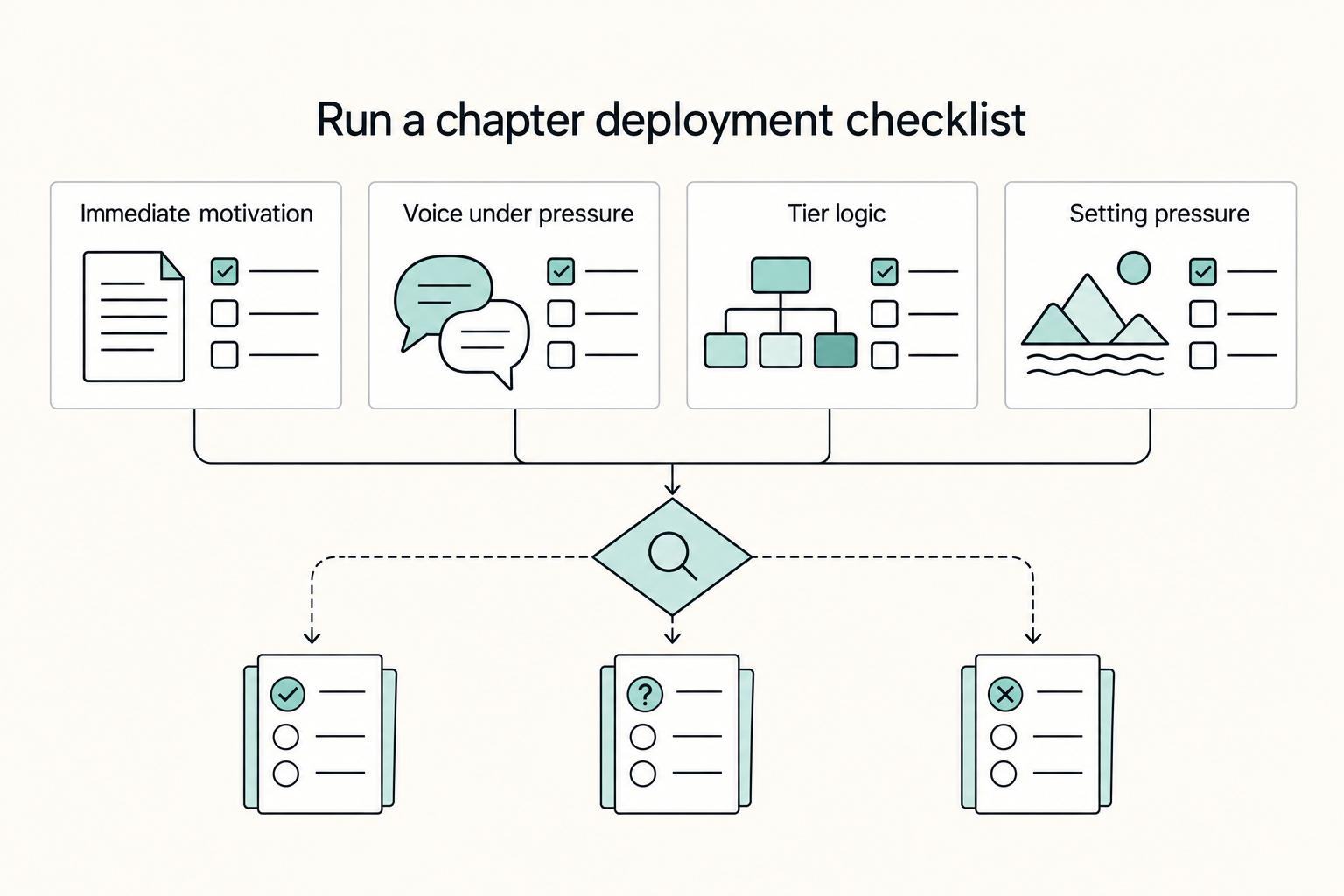
Run a chapter deployment checklist#
On each chapter pass, check:
| Check | Question |
|---|---|
| Immediate motivation | Is the character's immediate motivation clear from what they do? |
| Voice under pressure | Does the voice still sound like the same person under this pressure? |
| Tier logic | Does the choice fit the tier logic (Tier 1 scene job, Tier 2 motive chain, Tier 3 contradiction/worldview)? |
| Setting pressure | Would changing the setting create a more compelling choice? |
Then do one full read for flow. A checklist helps strengthen parts, but you still need to protect whole-story balance.
Update your notes at real turning points#
Treat the blueprint as a living document, but revise it after meaningful turns, not sentence-level tweaks. Update notes after a major character turn, after a secret reveal changes relationship stakes, or when repeated dialogue exposes a truer motive than planned. That keeps continuity strong without over-editing the blueprint. For a step-by-step walkthrough, see A guide to 'world-building' for fiction writers.
| Update trigger | When to revise notes |
|---|---|
| Major character turn | Update notes after a major character turn. |
| Secret reveal | Update notes after a secret reveal changes relationship stakes. |
| Repeated dialogue | Update notes when repeated dialogue exposes a truer motive than planned. |
Keep Character Choices Consistent While You Draft and Revise#
Use your blueprint as an execution tool while you draft, not as extra paperwork. In practice, it helps you keep character choices consistent, catch logic breaks earlier, and make revision decisions with less guesswork.
Treat it as a live reference before each scene. Check the scene objective, the working point of view, and the character's internal conflict. This is where a Story Plan Checklist earns its keep: it helps you keep character, setting, and plot aligned, and it ties goals, motivations, and conflict together instead of collecting trivia. If a scene decision does not map to that chain, tighten the note before you draft further.
| Checkpoint | No blueprint workflow | Blueprint-led workflow |
|---|---|---|
| Decision speed | You pause to rediscover motives during drafting | You test choices against stated goals and internal conflict |
| Rewrite burden | Contradictions are often discovered later | More issues are caught at scene-planning stage |
| Consistency | POV, motive, and behavior drift more easily | POV and behavior are easier to verify against notes |
| Draft momentum | Momentum drops when logic is unclear | Momentum holds because fewer decisions restart from zero |
Carry the same blueprint into revision. A useful blueprint supports planning, drafting, and revising, not just pre-draft prep. If the middle feels weak, check whether pressure is low or the motive chain is unclear. If you use a three-act guide like 25% / 50% / 25%, use it as a diagnostic guideline, not a rigid rule, because overly mechanical structure can make pages feel formulaic.
For your next session, run this handoff checklist before you write:
- Review the blueprint or profile for the next scene only.
- Set one clear scene objective and confirm point of view.
- Validate the character's motivation and internal conflict for that scene.
- After drafting, update the blueprint if the scene exposed a better choice or contradiction.
We covered this in detail in A guide to 'writing residencies' for authors.
Frequently Asked Questions
What is the most important part of a character profile?
The most useful core is the material that changes scene choices: what the character wants, what in their past is still shaping them, and what pressure points show up in conflict. A profile is background information for you as the writer, not a checklist of details readers need to see. If a note does not affect action, dialogue, timing, or choice, trim it.
How much detail does a minor character need?
Usually, a minor character only needs lean notes: their plot function, their relationship to the lead, and one specific trait that affects a scene. Full profiles are most useful for your protagonist, antagonist, and important supporting characters. Expand a minor character only if they start affecting multiple plot turns.
What’s the difference between a profile, a blueprint, and an arc?
Keep the terms distinct so your notes stay clean. A profile is backstory and background for you, a blueprint is your working plan for how that material shows up in scene behavior, and an arc tracks the actual change across the novel. | Term | What it does | Quick use test | |---|---|---| | Profile | Stores life history and backstory | Helps you understand the character | | Blueprint | Turns notes into scene decisions | Helps you write the next scene | | Arc | Tracks change across the story | Helps you judge progression |
How do I adapt this approach for my genre or project?
Do not feel obligated to fill out every prompt. Keep any question that changes plot function or pressure behavior, customize any question that matters to the character’s role in your genre, and discard anything that only produces trivia you will never use. If you draft by discovery, start short and add more only when the manuscript exposes a gap.
Should I use an online template or questionnaire?
Yes, but treat templates as a question bank, not a form you must complete. Some resources are short (for example, 20 questions) and others are extensive (200+), and selective use is still the right approach. Keep prompts that clarify scene-relevant behavior, customize prompts for your protagonist, antagonist, and major supporting characters, and discard prompts whose answers would not change a scene, conflict, or reveal. Do not dump every detail from the profile onto the page just because you spent time answering it.
Try a related tool
Researched and edited by the Gruv editorial team. Gruv builds cross-border billing, payouts, and finance-operations software for global businesses.
Sources
Includes 5 external sources outside the trusted-domain allowlist.
- gillettewy.gov/files/assets/public/v/3/development-services...trusted
- pmc.ncbi.nlm.nih.gov/articles/PMC4566873trusted
- scholarship.law.unc.edu/cgi/viewcontent.cgitrusted
- asthebirdfliesblog.com/posts/character-development-questionsexternal
- barkerbooks.com/book-outline-exampleexternal
- beabrilliantwriter.com/blueprint-for-a-book-jennie-nashexternal
- bookbutchers.com/how-to-create-believable-characters-a-step-b...external
- helpingwritersbecomeauthors.com/impact-of-ai-on-fiction-writingexternal
Educational content only. Not legal, tax, or financial advice.
Related Posts
Value-Based Pricing for Freelancers Under Real Payment Risk
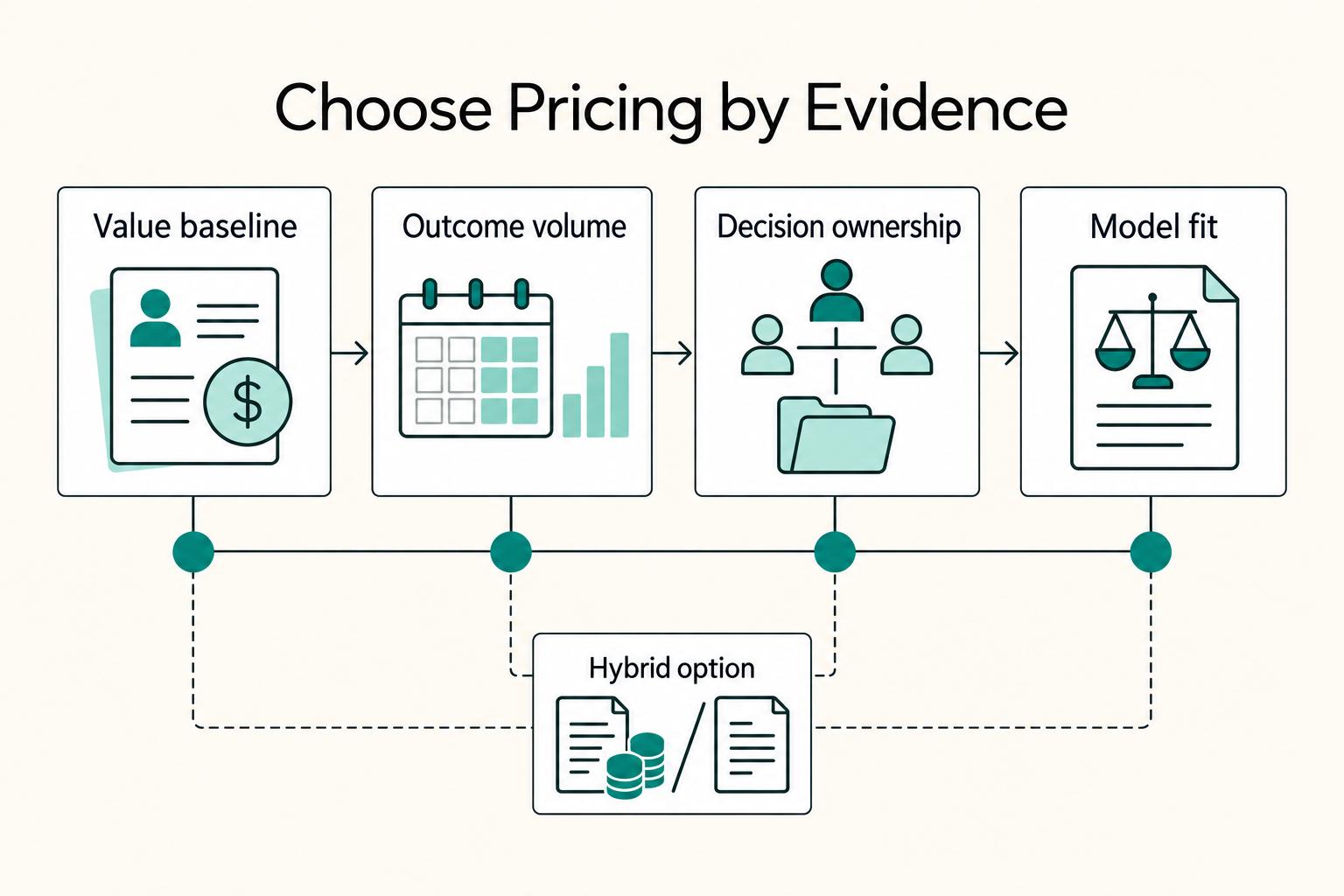
Value-based pricing works when you and the client can name the business result before kickoff and agree on how progress will be judged. If that link is weak, use a tighter model first. This is not about defending one pricing philosophy over another. It is about avoiding surprises by keeping pricing, scope, delivery, and payment aligned from day one.

How to Write a Book as a Freelancer Without Scope Drift
The book needs a defined job and a defined boundary before you draft. In this cycle, give it one job: either support your client book services, or strengthen your own authority book so your niche, offer, and sales conversations become clearer.
Scrivener vs Ulysses for Authors Who Need a Resilient Stack
You are not just choosing a writing app. You are deciding how your solo business will handle draft control, file recovery, and the risk of getting stuck mid-project. That is why reviews of author tools should start with operational risk checks, not feature excitement.