
Quick Answer
Usually no: a solo freelancer with overseas clients is generally outside country-by-country reporting. Check whether you belong to a consolidated multinational group, including any relevant foreign permanent establishment, and whether its preceding-period revenue reaches the local threshold. OECD-aligned regimes generally use at least EUR 750 million; qualifying U.S. groups use $850 million or more. Personal income, residence and foreign-account filings remain separate.
Does Country-by-Country Reporting Apply to You? The 30-Second Answer#
For many freelancers, consultants, and business-of-one operators, the answer is usually no. You are generally outside scope unless you are part of a multinational enterprise group, not just working with clients in multiple countries. Use this quick scope check:
| Scope factor | Article detail | Effect on scope |
|---|---|---|
| Group structure | Consolidated multinational group with foreign entities or a relevant foreign permanent establishment | Foreign clients alone do not form a group; one legal company with a foreign permanent establishment may still need a group check. |
| Revenue threshold | Preceding-period consolidated group revenue | Many OECD-aligned regimes use a EUR 750 million preceding-year consolidated revenue threshold, while U.S. rules for qualifying parent entities filing Form 8975 use $850 million; thresholds are jurisdiction-specific. |
| Cross-border activity alone | Foreign clients, travel, and international invoices | Alone do not make you an in-scope multinational group. |
- Group test: Does your consolidated group include foreign entities or a relevant foreign permanent establishment? Do not count only separate legal companies.
- Threshold test: If yes, does your group meet the country-by-country reporting revenue threshold in the filing jurisdiction for the preceding fiscal year?
Example: a solo consultant with EUR 150,000 of revenue and clients in four countries does not become a CbCR filer merely because invoices cross borders. A company that belongs to a large consolidated group must check the group’s revenue and structure, rather than looking only at its own sales.
This regime sits under OECD/G20 BEPS Action 13. It is designed for large multinational groups and used by tax administrations for transfer-pricing and BEPS risk assessment. It is not a personal filing for independent professionals.
Many OECD-aligned regimes use at least EUR 750 million of preceding-year consolidated revenue. The U.S. rule requires qualifying ultimate parent entities to file at $850 million or more for the preceding reporting period. Confirm the local rule, relevant period and consolidated group; related entities and separately reported foreign permanent establishments can affect the group definition.
If that is not your fact pattern, your real compliance risks are elsewhere. The next section focuses on the filings and records that usually matter more. If you want a deeper dive, read Digital Nomad Taxes in 2026 With a Defensible Filing Plan.
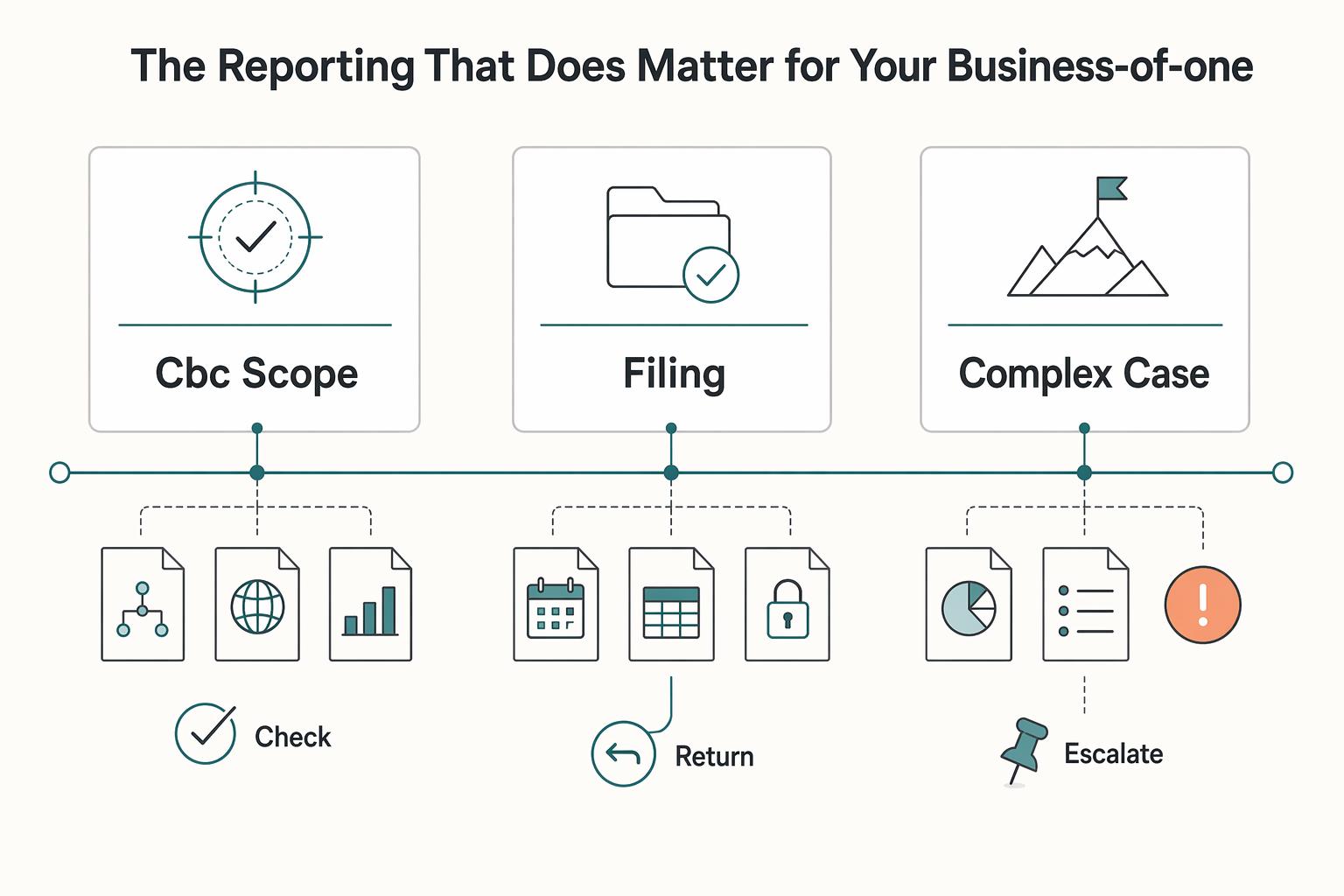
Check CbC Scope First, Then Focus on Filings That Apply#
For a solo operator, first check whether CbC is in scope at all. It is designed for large multinational groups, with filing and exchange mechanics such as Form 8975 and competent authority arrangements. If your setup does not resemble a large-group reporting package, make CbC a scope check first and focus on the filings that apply to your situation.
| Focus | Why it matters | What to do now |
|---|---|---|
| CbC scope confirmation | OECD CbC guidance is aimed at large MNE groups, so scope is the first decision point. | Confirm whether your structure is in scope in your filing jurisdiction and tax year before investing effort in CbC workflows. |
| Filing mechanics (if in scope) | IRS guidance includes practical checkpoints for Form 8975 timing, filing method, and XML schema requirements. | Verify timing, submission method, and required technical format before preparing a filing. |
| Exchange and preparation complexity | CbC operations can involve automatic exchange arrangements and multiple sharing paths, and OECD guidance notes common preparation errors by MNE groups. | Map your reporting path early and run a pre-submission error check so data handoffs stay consistent. |
If the group is in scope, confirm the responsible filer, any local notifications and the relevant reporting period before collecting data. A notification by a subsidiary is not necessarily the same obligation as preparing the group report.
- CbC scope confirmation: Confirm whether your structure is in scope in your filing jurisdiction and tax year before you invest time in CbC workflows.
- Filing mechanics (if in scope): Verify timing, submission method, and required technical format before you prepare a filing.
- Exchange and preparation complexity: Map your reporting path early and run a pre-submission error check so data handoffs stay consistent.
That is the practical shift. CbC is a large-group regime. For a business-of-one, compliance work is usually about clean execution and record discipline in the filings that actually apply to you. The next section turns that into a workable way to track, review, and escalate issues.
Related: A Guide to Transfer Pricing for Small International Businesses.
Triage risk by where you are, what you own, how you earn#
Organize the records by where you live and work, the accounts you own or control, and the way client income is documented. A filing-rule change can also matter even when those facts stay the same.
Tier 1. Residency risk and the day log that supports it#
Residence tests differ by country. The U.S. substantial-presence test counts the current calendar year and weighted days from the prior two years; the UK uses its Statutory Residence Test for a tax year. Where domestic rules make you resident in two countries, check the applicable treaty’s residence provisions and required evidence. A day count alone does not resolve every residence position.
Keep. Keep one defensible day log with entry and exit dates, overnight location, purpose of stay, and matching support such as travel records, accommodation evidence, calendar entries, invoices, and work-location notes. Consistency across records matters more than perfect formatting.
Do this week. Clean one residency file for the current and prior year. If you spend material time in more than one country, add a "dual-residence evidence" tab for home base, family location, banking center, and where work is managed.
Tier 2. Foreign account reporting and the register that tracks it#
For a U.S. person, FBAR generally applies when a financial interest or signature/other authority over foreign financial accounts exists and their aggregate value exceeds $10,000 at any point in the calendar year, subject to exceptions. The annual due date is April 15 with an automatic extension to October 15; specific relief can change deadlines. Form 8938 is separate: for an unmarried specified individual living in the U.S., thresholds are more than $50,000 at year-end or more than $75,000 at any time. Filing status and qualifying residence abroad change those thresholds.
| Item | Trigger or role | Timing or note |
|---|---|---|
| FBAR (FinCEN Form 114) | U.S. person with relevant interest or authority; aggregate foreign accounts exceed $10,000 at any time | April 15 with automatic extension to October 15; check applicable exceptions and relief. |
| Form 8938 | For an unmarried specified individual living in the U.S.: over $50,000 at year-end or over $75,000 at any time | Different thresholds for other filing/residence categories; broader asset scope and separate filing rules. |
| CRS | Financial institutions report covered account data for international exchange | Bank reporting does not replace the account holder’s own filing obligations. |
Keep an account register with institution, country, owner, financial interest or authority, open/close dates, maximum and year-end values, reporting currency and statement location. Use the prescribed valuation and exchange-rate method for the form you file; an approximate value is a screening aid, not the completed return.
Do this week. Reconcile every non-domestic account into that register, then set a quarterly value review and pre-filing check. Do not assume bank reporting or CRS replaces your own filing duties.
Tier 3. Cross-border income risk in invoicing and client files#
For client income, distinguish invoice requirements from the tax consequences of where work is performed. A fixed business base abroad can raise permanent-establishment questions under the applicable treaty or domestic rules; other facts can also matter. A well-formatted invoice does not decide that issue.
For each client, keep the signed contract, SOW, invoiced entity, payment proof and work-location notes. If a parent, agent or another entity pays on the client’s behalf, document the relationship and authority. The names need an explained connection; they do not always have to be identical.
| Area | Risk trigger | Likely consequence | Preventive control | Escalate when |
|---|---|---|---|---|
| Invoicing compliance | An unexplained difference between contract party, invoice addressee and payer | Payment delays or inconsistent records | Verify entity details and document any authorized third-party payer | The requested change lacks a clear relationship or authorization. |
| Tax treatment execution | Unclear place of taxation or missing invoice support | Incorrect treatment and amendment risk | Keep service scope, location notes, and client tax profile with invoice records | You cannot explain why the chosen treatment is correct |
| Permanent establishment | Work starts looking like a fixed business base in one country | Local business tax and registration questions | Track where work is performed and review setup changes early | You are operating from a stable base abroad |
Do this week. Audit your last three international invoices against contract files and travel or work-location records. If you cannot show who hired you, who paid you, and where the work was done, fix that before the next invoice.
Before the FAQ and closing section, run this handoff checklist:
- Which country or countries could plausibly treat you as resident this year?
- Is your foreign-account register complete, with FBAR and Form 8938 reviewed separately where relevant?
- For each active client, can you produce one file with the contract, invoice trail, payment proof, and work-location notes?
- Which one issue needs tax-professional input before your next filing or billing date?
Use the answers to choose the next record to correct or question to resolve. Keep the supporting facts available when you seek a filing decision.
You might also find this useful: How to Use a 'Cost-Plus' Model for Transfer Pricing.
Turn this framework into a repeatable weekly workflow by logging your travel days and residency evidence in the Tax Residency Tracker.
Your Real Compliance System: Movement, Accounts, and Client Records#
If you are not operating inside a multinational group near CbC thresholds (for example, EUR 750 million or U.S. $850 million parent-entity rules), country-by-country reporting is usually not your day-to-day focus. Your real compliance system is simpler: track where you are, what accounts you hold, and how your income is documented.
Maintain three working files#
Keep movement, accounts and client documents linked to the filing year and update them when the facts change.
Your movement file supports residence decisions. Keep dates, locations and travel evidence. For the U.S. substantial-presence test, the basic tests are at least 31 current-year days and 183 weighted days: all current-year days plus one-third of the prior year and one-sixth of the year before that. Excluded-day rules and exceptions can apply. For example, 120 days in each year gives 120 + 40 + 20 = 180, below the weighted test. Other residence rules can still matter.
Your account file supports foreign-account and asset reporting. Keep institution, country, interest/authority, maximum and year-end balances, exchange-rate basis and statements. For U.S. persons, review FBAR’s aggregate value test separately from Form 8938’s asset and filing-status tests. An account closure does not erase an obligation for a year in which the account was held.
Your client file supports income and invoice positions. Store contracts, invoices, receipts, deposit records and work-location evidence together. Document authorized third-party payments and resolve unexplained differences. Check applicable invoice content and tax treatment for the service and jurisdiction rather than deriving them from the client’s country alone.
| Worry Pattern | Control Action | Proof You Keep |
|---|---|---|
| "I may have created residency risk without noticing." | Maintain a day log and review it monthly against the rules that apply to you. | Day log |
| "I have foreign accounts but no trigger view." | Keep an account ledger and compare it against your verified filing threshold. | Account ledger |
| "My client income trail is messy." | Reconcile contract, invoice, payment, and tax records for each engagement. | Invoice and tax docs |
Escalate before complexity compounds#
Talk to a pro when any of these show up:
- your residency facts plausibly support tax claims in more than one country
- your foreign account or foreign income profile now requires threshold analysis, not assumptions
- you add an entity, operate through multiple entities, or your client, payer, and invoice structure stops matching cleanly
Review the three files when you move, open or close an account, add an entity or change a client’s billing arrangement. Keep unresolved items beside their supporting records and next filing or billing date.
For related-party transactions, see A Guide to Transfer Pricing for Small International Businesses. Transfer-pricing obligations can exist below CbCR revenue thresholds.
If CbCR is outside your scope, record the group and revenue facts supporting that conclusion, then return to the personal and business filings that apply.
Frequently Asked Questions
Does country-by-country reporting apply to a solo business?
Usually no. Foreign clients alone do not put a solo business in a multinational group. OECD-aligned CbCR generally uses at least EUR 750 million of consolidated revenue; qualifying U.S. ultimate-parent groups use $850 million or more in the preceding reporting period. A group check includes relevant foreign permanent establishments, not just separate companies.
How is CbCR different from the filings that matter to you personally?
CbCR concerns a qualifying multinational group’s aggregated tax and business information. Personal income, residence and foreign-account filings have separate tests. Being outside CbCR does not exempt you from those filings.
What should you track while moving between countries?
Track your movement facts and keep supporting records that match your filings. A practical minimum is dates, locations, and the documents that back your timeline. If your records do not tell one consistent story, fix that before filing season.
If banks or tax authorities already exchange data, can you relax your own filing process?
No. CbC reports are exchanged between governments under competent authority arrangements, and that process is for authority use. Treat data exchange as visibility for regulators, not a substitute for your own filing and recordkeeping controls.
What actually gets filed when a group is in scope for CbCR?
CbCR reports aggregate revenue, profit, income tax and activity information by tax jurisdiction, plus constituent-entity details. Qualifying U.S. parents file Form 8975 and Schedules A with their income tax return. Use the form instructions to determine jurisdictions, entity treatment and filing method; a foreign client list is not a substitute for group data.
Is CbCR public?
OECD Action 13 CbC reports submitted to tax authorities are confidential and are exchanged under safeguards. That does not mean every CbCR regime is private: the EU has a separate public country-by-country reporting requirement for qualifying large businesses. Distinguish the regime and local scope before answering whether a particular report is public.
What if you suspect exchanged CbC information was disclosed or used improperly?
Preserve the relevant notice and correspondence. The IRS provides a reporting route for suspected unauthorized disclosure or misuse of exchanged information and instructs users not to include taxpayer-identifying information in that report. Follow the route’s instructions rather than sending a tax return or identification documents to a general mailbox.
When does cross-border client work create extra tax risk for you?
Review a new work base, a changed residence position, a new related entity or a different service/payment arrangement. Those facts can affect income source, invoicing or business-tax obligations under local rules even when CbCR remains out of scope. Bring the contract, work-location record and payment trail to the review.
When should you stop DIY-ing and talk to a pro?
Seek a group-reporting scope review when you are part of a multinational group near the local revenue threshold or need to determine the responsible filer. Seek a separate personal-tax review when residence, foreign-account scope or invoice tax treatment is unclear. A foreign client alone is not a reason to prepare Form 8975.
Try a related tool
Researched and edited by the Gruv editorial team. Gruv builds cross-border billing, payouts, and finance-operations software for global businesses.
Sources
Includes 1 external source outside the trusted-domain allowlist.
Educational content only. Not legal, tax, or financial advice.
Related Posts

Digital Nomad Taxes in 2026 With a Defensible Filing Plan
With digital nomad taxes, the first move is not optimization. It is figuring out where you may be taxable, where filings may be required, and what proof supports that position.

Transfer Pricing for Small International Businesses with Related Entities
For a business of one operating across related entities, transfer pricing is mostly about execution. Document each related-party charge when it happens, choose the most reliable method you can actually support, and have the file ready before you file your return. If you wait until year-end, the evidence can be harder to rebuild and your method support can be easier to challenge.
How to Use a 'Cost-Plus' Model for Transfer Pricing
Before you use this playbook, note the evidence limit for this section: the grounding available here does not establish technical rules for cost-base construction, arm’s-length legal tests, comparables screening, defensible markup ranges, or jurisdiction-specific thresholds. Treat the steps below as an internal execution checklist, and escalate technical transfer-pricing positions to a qualified advisor.