
Quick Answer
Run the numbers first: a cost segregation study real estate approach is worth pursuing only when earlier depreciation is likely to outweigh study fees and added documentation work. Baseline treatment often keeps real property on long recovery periods, while reclassified components may move into shorter lives when support exists. Choose a provider that can show clear technical evidence, then align filing steps with your CPA for Form 4562 and, when relevant, Form 3115.
How Cost Segregation Moves Deductions Earlier, and What It Requires#
If you run real estate inside a business, cost segregation is a timing decision. You either keep the default long-life depreciation or reallocate eligible costs into shorter recovery periods so more deductions land earlier.
In practice, a cost segregation study reallocates property costs into the appropriate asset classes and recovery periods for depreciation. Under section 168, residential rental real property is commonly recovered over 27.5 years and nonresidential real property over 39 years. A study may identify components that fit shorter lives, which can accelerate deductions. Depreciation is generally claimed on Form 4562. If you are correcting prior treatment, Form 3115 may apply under accounting-method change procedures, but it is not automatically required in every case.
Compared with standard depreciation, a study can improve near-term timing, but it usually requires more work to document and defend.
First, decide whether the timing benefit is likely to outweigh the study cost and added documentation for your property and tax profile. Second, decide how you will control compliance risk through report quality, support files, and filing posture. Third, execute from engagement through filing so your CPA can report it cleanly. IRS Audit Technique Guides can help frame exam expectations, but they are not binding legal authority.
A conservative default is often the safer starting point. Stay cautious until your numbers and records support a more aggressive position. Involve a qualified tax professional before filing if you are handling prior-year corrections, mixed-use facts, or special depreciation eligibility questions tied to property placed in service after January 19, 2025. If you want a deeper dive, read our guide to a defensible 2026 filing plan.
Part 1: Opportunity Analysis - Is This a Green-Light Project for Your Portfolio?#
Green-light this only when the timing upside is likely to beat the study cost and added documentation for your property. The sequence is simple: confirm eligibility, build a conservative savings estimate, check complexity, then get advisor review before you commit to a filing position.
Start with eligibility#
Do not rely on generic cutoffs. First confirm that you have enough depreciable basis and enough short-life components to justify an engineering-based review. If you use internal screening numbers, verify eligibility thresholds and cost ranges against current official source records, the final study scope, and CPA or tax adviser workpapers before they guide a go/no-go decision.
Your baseline matters. Traditional depreciation treats the building as one long-life asset, commonly 27.5 years for residential rental property and 39 years for nonresidential property. A study helps only if meaningful components can reasonably shift into 5-year, 7-year, or 15-year lives.
Pause early if basis support is weak, placed-in-service records are unclear, or major costs are bundled without clear component detail. The opportunity may still exist, but confidence in both the estimate and the filing position drops when records are thin.
Estimate savings without overconfidence#
Use a first-pass screen that combines property cost basis, an estimated reclassification share, and your marginal tax rate to estimate potential tax timing benefit. Treat that output as a rough filter, not a go decision, until you pressure-test the assumptions.
| Input | Question | Focus |
|---|---|---|
| Depreciable basis quality | Can you cleanly separate land, building, and major improvements? | Land, building, major improvements |
| Expected reclassification mix | Do you have plausible short-life components? | Carpeting; special-purpose electrical systems; custom cabinetry; decorative lighting |
| Tax-position fit | Will earlier deductions actually help your current tax position? | Current tax position |
| Holding horizon | Will your expected hold period make the acceleration worth the cost and effort? | Expected hold period |
If one of those assumptions is weak, the estimate is still useful, but only as a screening tool.
Know what is likely to move#
The practical question is not whether something can be moved. It is whether the split between short-life and long-life buckets looks credible once the provider shows the work.
After a study, the property is treated as multiple assets with different lives instead of one single asset. Use that allocation as a reality check.
| Component bucket | Baseline treatment (no study) | Possible treatment after reclassification | Documentation effort | Typical decision impact |
|---|---|---|---|---|
| Personal property inside the building | In a single-asset approach, treated within one building asset at 27.5 or 39 years | Certain components may shift to 5-year or 7-year life | Varies by scope | Can increase near-term timing acceleration when short-life components are meaningful |
| Land improvements | In a single-asset approach, generally not separated into shorter-life buckets | Certain site features may shift to 15-year life | Varies by scope | Can improve near-term timing when qualifying site features are identified |
| Core real property | Long-life building treatment | Stays at 27.5 or 39-year life | Varies by scope | Usually remains the long-life anchor in a conservative estimate |
If an early estimate suggests almost everything moves to short-life treatment, slow down and challenge the assumptions before you treat the model as credible.
When bonus depreciation helps, and when to pause#
Near-term timing impact can be larger if current law allows faster first-year expensing for qualifying short-life property. The more qualifying costs that move into 5-year, 7-year, or 15-year buckets, the larger the timing effect can be.
That said, do not let the model rest on an unverified bonus percentage, phaseout detail, or tax-year rule. Confirm current treatment with a qualified tax professional before making filing decisions.
The same caution applies to older properties. Do not assume look-back options, filing method, or current-year impact until your advisor reviews the facts.
Hand the right file to your advisor#
Before handoff, prepare the basics in one package: property type, placed-in-service timing, basis support, current depreciation treatment, and your conservative estimate with assumptions documented.
That gives your advisor enough to test whether the opportunity is real, whether the complexity is manageable, and whether the filing position fits your facts. If records are clean and short-life allocations look meaningful, move to Part 2. If not, standard depreciation is often the more defensible choice.
For a step-by-step walkthrough, see When a Series LLC Works for Real Estate Investing.
Part 2: Risk Mitigation - Vet the Provider and Documentation Before You Sign#
Treat risk control as a documentation problem, not a deduction-maximization exercise. A filing position is much easier to defend when the provider can show, step by step, how each class-life decision was made and what evidence supports it.
Use IRS guidance as a checklist, not a shield#
Start with the IRS Cost Segregation Audit Technique Guide (ATG). The IRS says ATGs are built for examiners but also useful for taxpayers and tax professionals. Use the ATG to structure your diligence, not as legal authority.
The limits matter. The Cost Segregation ATG is listed with a 02/2025 publication date, Publication 5653 (2-2025). It is not an official legal pronouncement, and it may become technically outdated after revision. So do not accept "we follow the ATG" as enough. Ask the provider to show where their process covers practical quality signals: qualified personnel, clear methodology, appropriate documentation, and reconciliation of allocated costs to actual project costs where available.
IRS guidance also says there is no standard report format. That makes a redacted sample report a practical diligence item, not a nice-to-have.
Your pre-signing due diligence checklist#
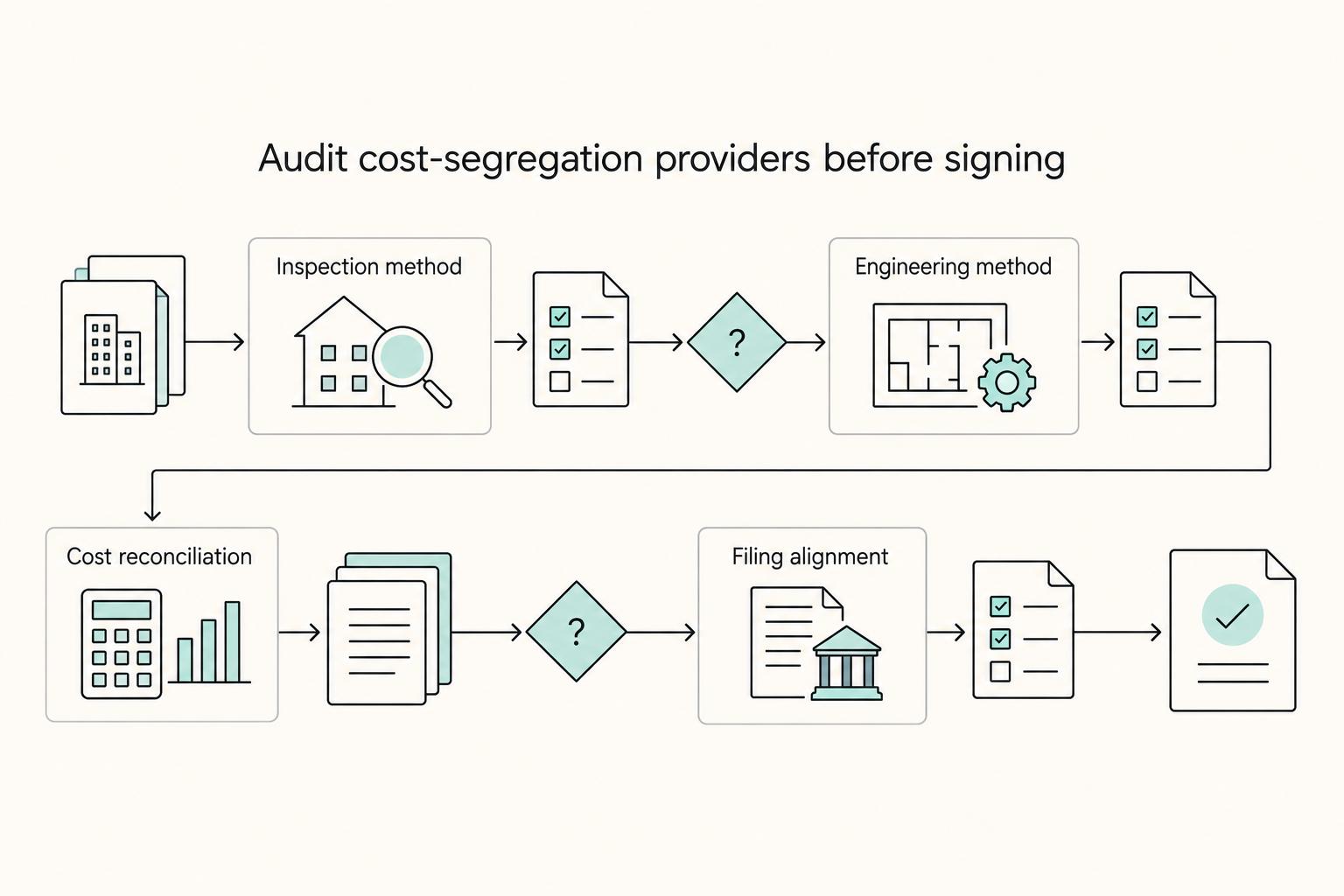
Before you sign, make the provider answer four basic questions clearly and in writing.
| Area | What to ask | What to confirm |
|---|---|---|
| Property inspection approach | Whether the team will visit the property, who performs the inspection, and what substitute procedures apply if no visit occurs | The firm's written inspection policy |
| Engineering or technical method | Whether allocations are based on actual records, a detailed engineering cost estimate approach, or a mix | The method can be explained in plain language |
| Cost support and reconciliation | How component values tie back to source records and how total allocated costs reconcile to actual project cost | Invoices, draws, appraisals, or equivalent records |
| Guidance alignment and filing support | How the provider tracks current IRS updates and handles method-change procedure support | Form 3115 is the filing mechanism when an accounting method change is being requested; eligible taxpayers must use automatic change procedures |
- Property inspection approach
Ask whether the team will visit the property, who performs the inspection, and what substitute procedures apply if no visit occurs. Some practitioner summaries describe a site visit as a quality element, so use this as a verification checkpoint and request the firm's written inspection policy.
- Engineering or technical method
Ask whether allocations are based on actual records, a detailed engineering cost estimate approach, or a mix. That estimate approach is named in IRS guidance. What matters is transparency. If they cannot explain the method in plain language, your advisor will struggle to defend it later.
- Cost support and reconciliation
Ask how component values tie back to source records, for example invoices, draws, appraisals, or equivalent records, and how total allocated costs reconcile to actual project cost. Avoid reports that show aggressive percentages without a clear bridge to what you paid.
- Guidance alignment and filing support
Ask how the provider tracks current IRS updates and handles method-change procedure support. For look-back situations, confirm process discipline: when an accounting method change is being requested, Form 3115 is the filing mechanism, and eligible taxpayers must use automatic change procedures.
How to read provider quality quickly#
A quick scan usually tells you whether you are dealing with a technical team or a sales process wrapped around a tax product.
| Decision area | Defensible provider signals | High-risk provider signals |
|---|---|---|
| Fee model | Fixed fee or clearly scoped written fee; inclusions/exclusions are explicit | Outcome-linked pricing or vague success-fee language with no clear scope |
| Team composition | Named technical staff, clear reviewer/sign-off responsibility, construction + tax competence | Sales-led process, unclear analyst identity, no clear accountability |
| Methodology transparency | Explains classification logic, cost-source hierarchy, and reconciliation approach | "Proprietary" claims without sample detail; target reclass percentages promised upfront |
| Audit-support scope | Written support terms, process, and duration stated in engagement | Verbal-only promises or open-ended post-filing hourly support |
On fees, use extra caution. Circular 230 restricts contingent fees in IRS matters, with exceptions. Do not assume every performance-based structure is automatically prohibited, but do have your tax advisor review the engagement terms before you proceed.
Pass or fail questions before you hire#
Use these as decision gates, not conversation starters.
- Can they provide a redacted sample report for a similar property?
Pass only if you see component-level reasoning, cost sourcing, and reconciliation. Fail if you only get a marketing deck or a one-page summary.
- Can they identify who does the technical analysis and who signs off?
Pass only if names, roles, and accountability are clear, with credentials you or your advisor can verify. Fail if the answer relies on brand reputation alone.
- Can they explain classification decisions without hand-waving?
Pass only if they can clearly explain how they classify assets and how estimates are handled when records are incomplete. Fail if the method depends on default percentages across properties.
- Are support terms in writing?
Pass only if examination-support scope and pricing are written into the engagement. Fail if support is only verbal.
When to talk to a pro#
Escalate early to a qualified tax advisor if ownership is layered, cross-border, or split across entities in a way that makes basis, filing responsibility, or depreciation treatment unclear.
Do the same for look-back work on already depreciated property. Method-change timing can vary under Section 481(a), including different treatment for net negative versus net positive adjustments.
Escalate immediately if records are incomplete, land and building separation is unclear, or prior depreciation schedules do not reconcile. That does not automatically kill the opportunity, but it does mean you should not let the provider improvise your evidence trail.
You might also find this useful: How to Calculate Depreciation on a Foreign Rental Property.
Before you hire a study firm, map your residency footprint and filing obligations so your depreciation strategy stays compliant across jurisdictions: Use the Tax Residency Tracker.
Part 3: Project Execution - Turn Basis Records Into a Filing-Ready Package#
Execution should be straightforward. Turn basis records into a defensible classification package your CPA can evaluate for filing. If the inputs, classification logic, and handoff materials are not clear, you are not ready to file.
| Phase | You | Cost seg provider | CPA/tax preparer |
|---|---|---|---|
| Scoping | Provide basis records and supporting cost records; confirm entity, property, and tax year | Define scope, request documents, set timeline, issue engagement, list deliverables | Flag return-year constraints and filing-treatment considerations |
| Site work / evidence | Provide access or property contacts; answer factual questions on improvements and removals | Document the evidence approach used (including any site work in scope), capture observations, and record limits | Advise if evidence gaps affect filing treatment |
| Analysis | Review assumptions and respond to follow-ups | Perform engineering-based analysis; classify components; reconcile totals to analyzed cost basis; draft report | Review output for return treatment consistency |
| Filing prep | Approve final package and retain records | Deliver final report package, schedules, reconciliation summary, assumptions memo, and support terms | Verify filing treatment and any required filing forms against current official source records, the final study, and approved tax workpapers before return prep |
Scoping#
Start by sending the records that establish cost basis and major additions. In return, your provider should give you a clear request list, timeline, and written deliverables.
You are done with this phase when the scope is fixed in writing: signed engagement, confirmed property and entity details, and a confirmed cost pool to analyze. Before analysis starts, verify that their starting basis matches your records.
Site work and evidence collection#
Your job here is to remove ambiguity. Provide access, confirm facts, and clarify what changed at the property. If site work is in scope, make it easy to complete. If not, ask for a clear explanation of the evidence used instead.
The provider's output should be an evidence trail, not just narrative text: observations (or other documented support), property identifiers, and documented assumptions where records are incomplete. If an assumption cannot be tied to records or observations, flag it before analysis is finalized.
Analysis and final report#
This is where the study either becomes useful or becomes hard to defend. Instead of leaving all costs on the longer lives, commonly 27.5 years for residential rental property or 39 years for commercial property, the provider classifies qualifying components into shorter categories, commonly 5, 7, or 15 years. That can include personal property and land improvements where support exists.
Review for two things: component-level reasoning and full reconciliation back to basis records. You are done with this phase when you have a final report, depreciation schedules or equivalent, and a reconciliation summary that ties classified totals to the analyzed cost basis.
Pre-filing checklist#
Before filing, confirm all four items.
| Checkpoint | Required confirmation |
|---|---|
| Complete file | Final report, schedules, reconciliation summary, assumptions memo, and basis support |
| Readable rationale | Major 5-, 7-, and 15-year classifications are explained clearly |
| Reconciliation integrity | Total classified cost ties to your basis records |
| Advisor sign-off | Your CPA or tax preparer confirms filing treatment before submission |
If any item fails, pause and fix the gap before filing.
Filing handoff#
Give your CPA the full package once, not piecemeal: final report, reconciliation, schedules, and assumption notes. Your CPA then verifies tax return treatment and any required filing forms against current official source records, the final study, and approved tax workpapers before use.
You are done when the filing output is advisor-approved, permanent records are retained, and the provider package supports technical follow-up without rebuilding the study.
We covered this in detail in A Real Estate Agent's Guide to the Home Office Deduction.
Conclusion: Transform Your Real Estate from a Passive Investment into a High-Performance Asset#
Treat a cost segregation decision as a cash-flow timing and tax-planning decision, not an automatic tax win. Reclassifying qualifying components from the default 27.5-year life for residential rental property or 39-year life for commercial property into 5-, 7-, or 15-year categories can improve near-term cash flow. The result still depends on documentation quality, filing coordination, and your hold-and-exit plan.
Use Analyze, Mitigate, Execute as your final filter. Analyze means validating baseline depreciation treatment and confirming which bonus depreciation rules apply to your filing year. Mitigate means selecting a provider that can clearly document component-level categorization and standalone cost allocation. Execute means running a coordinated process between tax advisors and engineers so classifications tie back to property facts and costs.
The tradeoff is straightforward. Accelerated depreciation can improve time-value-of-money outcomes now, but some front-loaded benefit can reverse on sale. A short or uncertain hold period can reduce the net benefit.
Before you proceed#
- Confirm the property facts and filing-year assumptions your tax team will use.
- Reconfirm provider methodology and documentation for major reclassifications and cost allocations.
- Lock your tax-team handoff plan before kickoff, including who reviews the final study and which filing-year rule checks still need confirmation.
- Pressure-test your expected holding period and exit path before maximizing acceleration.
If your facts are incomplete, your support is thin, or your hold and exit plan is still unclear, pause and get a qualified tax review before filing.
Related: How to Invest in Real Estate as a Digital Nomad.
When you are ready to operationalize the paperwork side of your tax plan, keep your records and compliance prep in one place: Explore Gruv tools.
Frequently Asked Questions
What are the primary risks of a cost segregation study?
Start by checking whether the report is fully supported by facts from the property and your records. The main risk is weak substantiation. If classifications are not tied to site observations, drawings, and other supporting records, the position is harder to defend and can raise penalty exposure. If the provider cannot show the support behind major classifications, pause and get professional review.
How much does a study cost?
Start with a feasibility estimate that compares projected tax benefit to the study fee. Do not rely on universal fee bands or property cutoffs. The decision should depend on expected savings, your tax position, and whether you can use the deductions. If you need a market check, verify current fee ranges before deciding.
How do I choose a reputable provider?
Start by screening methodology and documentation quality before price. A lower-risk provider should explain the engineering steps, records reviewed, whether an on-site tour was completed, and how costs were classified. | Criteria | Qualified provider | High-risk provider | |---|---|---| | Site inspection | Completes an on-site tour of the property | Skips an on-site tour without strong supporting documentation | | Technical records | Examines drawings and other relevant documents | Reviews limited documentation | | Cost classification | Classifies cost information and estimates with clear support | Reclassifies costs without clear factual support | | Tax-position context | Coordinates with your accountant on the owner’s tax position | Treats the study as engineering-only and ignores tax-position context |
Is it worth doing for a smaller rental property?
Run the same benefit-versus-fee test you would use for any property size. It can still be worth it if projected near-term benefit clearly exceeds the fee and you can use the deductions, but the case gets weaker when projected tax benefit is limited. A practical default is to get a feasibility estimate before you commit.
Can I do a study on a property I have owned for several years?
Talk to your CPA before filing decisions are made. Form 3115 is used to request an accounting method change, and filing depends on current IRS guidance, including whether automatic procedures apply. The safe move is not to self-direct a filing path without CPA review.
What happens if I sell after accelerating depreciation?
Model the hold-period tradeoff before maximizing first-year deductions. You may improve current deductions now, but sale treatment still matters: unrecaptured Section 1250 gain is taxed at a maximum 25%, and recapture analysis considers depreciation allowed or allowable. If a sale could happen soon, have your CPA run the numbers before filing.
Does a study increase my audit risk?
Start by evaluating documentation quality, not by assuming the study itself is the problem. IRS examiners do review these studies with the Cost Segregation Audit Techniques Guide, but that guide is exam-focused guidance rather than a binding law pronouncement. Risk is higher when reports are thin or poorly supported. If classifications do not clearly tie to records and observations, fix that before filing.
Try a related tool
Researched and edited by the Gruv editorial team. Gruv builds cross-border billing, payouts, and finance-operations software for global businesses.
Sources
Educational content only. Not legal, tax, or financial advice.
Related Posts

Digital Nomad Taxes in 2026 With a Defensible Filing Plan
With digital nomad taxes, the first move is not optimization. It is figuring out where you may be taxable, where filings may be required, and what proof supports that position.
How to Invest in Real Estate as a Digital Nomad
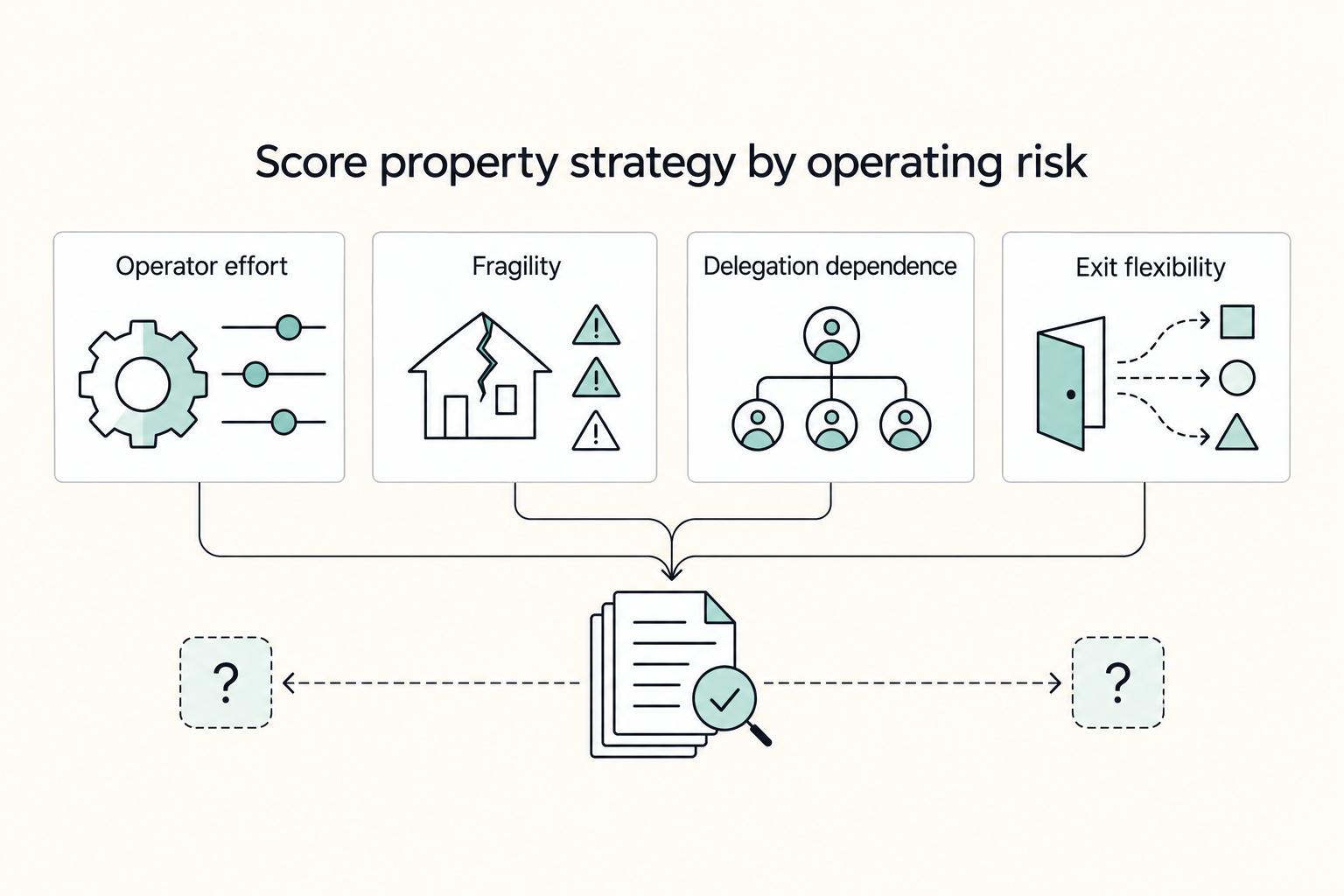
**Run anything with money and moving parts like an operations system (cash, docs, delegation, and controls), not a "passive income" vibe.** Real life stress-tests weak spots. You change time zones, a client pays late, and something breaks at the worst moment. As the CEO of a business-of-one, your job is to build a setup that keeps working when you are not available on demand.
How to Calculate Depreciation on a Foreign Rental Property
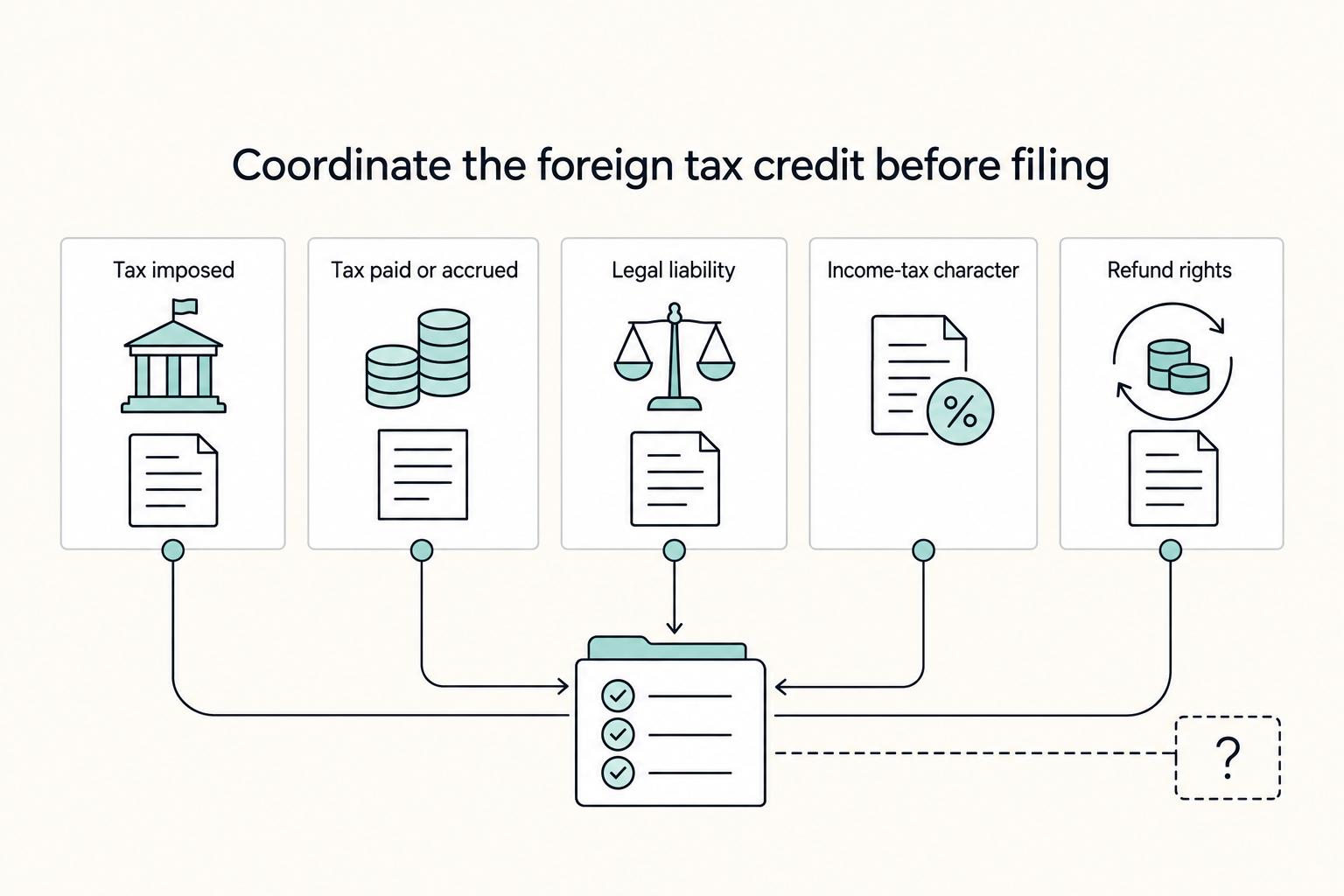
Control of a foreign real estate investment starts at acquisition, not when you file a tax return. Your choices on basis, land versus building allocation, and placed-in-service support shape annual reporting and sale math. Handle the full lifecycle from purchase to operation to sale, and tax management becomes part of running the asset well instead of a filing-season scramble.