

Quick Answer
Start with a hard publish gate: post only when you can confirm who owns the asset, what permission covers the exact Instagram use, and where the supporting record is stored. This instagram copyright guide emphasizes written licenses, a maintained ledger, and a prepared claim-response path. It also treats fair use as a defense raised later, not routine pre-clearance for marketing content. If documentation is thin, pause and replace the asset.
A three-part framework for protecting your work, using content ethically, and responding with confidence.#
Part 1: The Asset Protection Protocol (Your Offensive Strategy)#
Protect your rights first. Many Instagram copyright problems start earlier than people think. Ownership terms are vague, signatures are missing, and no one can quickly prove who had permission to use what.
If you created the work, you usually own the copyright by default. In U.S. law, copyright vests initially in the author, and the author stays the owner unless rights are transferred in writing.
Know the rights structure you are actually selling#
Use exact terms because each one changes control and risk:
Copyright ownership: you hold the rights unless you transfer them. Assignment: you transfer some or all rights to someone else. Exclusive license: one party gets exclusive rights, and U.S. law treats this as a transfer of copyright ownership. Non-exclusive license: the client can use the work, but you keep ownership. Work made for hire: if the work legally qualifies, the employer or commissioning party is treated as the author.
Do not assume payment equals ownership transfer. A client can buy a file or deliverable without receiving copyright rights. In the U.S., a copyright transfer is not valid unless it is in a signed writing.
Choose the contract structure that matches the job#
Default to a non-exclusive license unless the client's need, scope, and price justify broader rights.
| Freelance scenario | Safer rights structure | Clause elements you need | Key risk if omitted |
|---|---|---|---|
| Ongoing Instagram content creation for a client account | Non-exclusive license | Platform use, term, territory, paid ads included or not, edits/derivatives allowed or not, portfolio rights retained or not | Client assumes unlimited reuse across channels, ads, markets, and time |
| Custom campaign asset the client wants to own outright | Assignment, ideally after full payment | Exact deliverables assigned, carveout for pre-existing templates/processes, transfer timing, portfolio display rights if agreed | You unintentionally transfer underlying methods, drafts, or unpaid work |
| Client wants category exclusivity but not full ownership | Exclusive license | Field/category, territory, term, media, approval rights, what remains yours | "Exclusive" is vague, and you get blocked from adjacent work |
| Engagement framed as work made for hire | Use only if it actually qualifies in the relevant jurisdiction; add backup assignment if advised | Signed agreement, exact ownership language, draft/revision treatment, retained rights | Clause fails and ownership is unclear during a dispute |
Before signing, list final deliverables, drafts, unused concepts, source files, and pre-existing materials separately. Otherwise, "deliverables" can get read as "everything."
Register where it changes enforcement#
Registration and ownership are not the same. Berne principles support automatic protection and national treatment across member states, which matters when you work cross-border.
| Action | Timing | Effect |
|---|---|---|
| Register a U.S. work | Before filing an infringement lawsuit | Required before filing suit |
| Register after first publication | Within three months after first publication | Can affect eligibility for statutory damages and attorney's fees |
| Register after publication | Within five years of publication | Treated as prima facie evidence in court |
| Record signed transfer documents | Voluntary in the U.S. | Can add legal advantages such as priority and constructive notice |
Registration can still strengthen enforcement. In the U.S., it is generally voluntary, but you must register before filing an infringement lawsuit for a U.S. work. Timing matters. Registration within three months after first publication can affect eligibility for statutory damages and attorney's fees. Registration within five years of publication is treated as prima facie evidence in court.
If your work is likely to be reused, copied, or monetized in the U.S., registration there can be a practical enforcement step even if you are based elsewhere. Outside the U.S., registration and recordation systems vary, so verify local effects before relying on U.S. assumptions.
If you assign rights or grant an exclusive license, keep signed transfer documents in an organized evidence folder. In the U.S., recordation is voluntary but can add legal advantages such as priority and constructive notice.
Make your authorship easy to prove and easy to license#
Brand style can help support your position, but it is not your main protection. A dated proof trail paired with clear permission terms matters more. Use this pre-publish and proposal checklist:
- Save proof for important assets: original files, dated exports, drafts, invoice, signed SOW/contract, and first-publication link or timestamp.
- State the rights structure in plain English in every proposal and contract: assignment, exclusive license, or non-exclusive license.
- Add a portfolio-rights sentence if you want to show the work later.
- Publish a simple Usage Rights page explaining permission-required uses, request details, and the licensing contact path.
This can reduce confusion for legitimate buyers and give you a consistent record when someone claims reposting, boosting, or remixing was allowed. It can also reduce platform risk. Meta says it removes Facebook and Instagram accounts that repeatedly violate others' IP rights.
If you want a deeper dive, read Work for Hire vs. Assignment of Rights: A Freelancer's Guide to Owning Your IP.
Part 2: Clear Every Third-Party Asset Before It Goes Live#
If you cannot verify origin, license scope, and proof, do not publish. For client work, treat uncertainty as a stop sign. Part 1 protected what you own. This part protects you when you use someone else's work, whether that is music, stock assets, screenshots, reposted customer content, or clips a client found online.
Before anything goes live, every third-party asset needs a source record, a permission decision, and proof you can retrieve quickly.
Apply a publish block rule before anything is scheduled#
Make the gate simple enough to use every time and strict enough to hold up later. Use exact terms so your team makes consistent calls:
| Condition | Action | Record to check |
|---|---|---|
| Origin is unverifiable | Block the asset | Source record |
| Current rights owner for the exact material is unclear | Block until identified and permission is obtained | Rights owner and permission |
| Documentation is missing, incomplete, or trapped in inboxes or DMs | Block until the record is complete | Proof you can retrieve quickly |
| Asset is marked editorial-only for client deliverables | Block unless you separately clear the needed rights | Commercial use clearance |
- Source record: an asset-level record of the exact material you plan to use from a third-party work.
- License scope: the permitted-use boundary in the license terms, plus any additional licensor restrictions.
- Commercial use: promotion or advertising for a product or service that generates revenue.
- Editorial use: content not cleared for commercial campaigns, generally for news or other non-commercial contexts.
- User-generated content permission: permission from the copyright owner for uses that would otherwise infringe.
- Fair use: a legal defense raised in disputes, not pre-clearance before publishing.
Run this go-or-no-go flow every time:
- If origin is unverifiable, block the asset.
- If the current rights owner for the exact material is unclear, block the asset until identified and permission is obtained.
- If documentation is missing, incomplete, or trapped in inboxes or DMs, block the asset until the record is complete.
Treat missing notice, "found online," or public visibility as non-evidence of permission. If an asset is marked editorial-only, block it for client deliverables unless you separately clear the needed rights. That matters because Meta reports early IP enforcement on Facebook and Instagram, including removal of potential infringing content before a rights holder report.
Keep a license ledger that can survive a real dispute#
A license ledger should function as an audit trail, not a memory aid. If a claim lands six months later, you should be able to pull one record and see exactly what was used, why it was allowed, and where the proof lives. For each asset, record:
| Ledger field | What to record |
|---|---|
| Asset title | Asset title and identifying details |
| Creator | Creator or rights owner |
| Source URL | Source URL or vendor page |
| Asset ID | Asset ID or filename |
| Date obtained | Date obtained |
| License type | License type |
| Intended use | Intended use and audience |
| Promotional status | Whether use is promotional or revenue-generating |
| Platforms | Allowed platforms/channels |
| Edit limits | Edit limits |
| Paid ads rights | Paid ads rights |
| Expiration | Expiration/term, if any |
| Proof location | Proof location |
Store proof in a central folder structure, for example by client or campaign, and tie files to ledger entry IDs so you can retrieve records quickly. Assign a verifier. The sourcer can create the entry, but a named reviewer should confirm before publish that:
- The proof matches the exact asset used
- License scope covers the real use
- No editorial-only or extra licensor restrictions were missed
Do not invent a retention period. Keep records as long as the post is live, reusable by the client, or still claim-relevant.
Choose licenses based on who carries the risk#
For client publishing, optimize for defensibility, not convenience. Meta documents Sound Collection for Facebook and Instagram video workflows and Rights Manager for parties controlling exclusive rights. Use those tools only after confirming current platform terms for your exact use and whether rights extend beyond Meta surfaces.
For most client marketing, a direct commercial license from a stock or music provider is easier to defend. The permitted use is contract-defined and easier to hand off across teams and channels.
Treat fair use as escalation, not clearance#
Do not use fair use as your first permission theory for marketing content. Fair use is evaluated later, in context, under four statutory factors. There is no fixed word count or percentage that guarantees fair use. If your use depends on fair use and the risk is material or uncertain, escalate to legal review.
If the post is primarily promotional and you are relying on fair use because licensing is inconvenient, do not publish that asset. Choose a licensed alternative.
You might also find this useful: A Guide to Creative Commons Licenses for Freelancers.
Before you publish, convert your ownership, licensing, and permission checklist into usable client terms with this freelance contract generator.
Part 3: The Enforcement & Response Plan (Your Contingency Protocol)#
When a copyright issue hits, run two separate protocols. Use Track 1 if your work is copied and Track 2 if you receive a claim. Mixing them creates avoidable risk.
Use the right tool for the right problem#
| Term | What it means | Use it when |
|---|---|---|
| Infringement evidence package | A documentation set centered on records of the allegedly infringing material and related communications | You need a defensible record of what happened before outreach, platform reporting, or counsel escalation |
| Platform report (notice-and-takedown notice) | A rightsholder notice to an online service provider about infringing material on its system | Your work appears on that platform and you want removal or disabled access through the platform process |
| Counter-notification | A request to reinstate material removed due to mistake or misidentification | Your content was removed and your records support that the takedown was wrong |
| Cease-and-desist letter | A pre-litigation warning demanding conduct stop and signaling legal action if it continues | Infringement continues, the other party is identifiable, and platform steps or outreach are not enough |
Use these tools carefully. Notices and counter-notices require specific statements, including perjury-backed statements. Counter-notices also include jurisdiction consent language. If your facts are incomplete or cross-border exposure is material, escalate to counsel before filing.
Track 1 if your work is stolen#
Start with evidence, not emotion. The first few moves affect what you can prove and how cleanly you can respond.
- Lock evidence first. Save dated screenshots, URLs, publication trail, and communications related to the allegedly infringing material before the content changes.
- Run a match check. Confirm the allegedly copied item matches the exact asset you own.
- Choose the first move:
- Consider professional outreach first if the account is identifiable, the use appears accidental, and client impact is low. - Consider the platform report first if the account is anonymous, copying is repeated, revenue harm is active, or client impact is immediate.
- File cleanly. If you use the platform route, submit a complete notice with required information and accurate statements only.
- Monitor outcomes. Keep a timeline of submissions, replies, and removals.
- Escalate when needed. If infringement continues, appears across jurisdictions, or sits outside platform control, move to counsel and a cease-and-desist letter.
Professional outreach template:
You are using my original [asset] in [post/link] without permission.
Please remove it and confirm by reply.
If you believe you have rights, share your license or authorization details.
Meta states it has specialized reporting tools, a global IP notice-and-takedown team, and a repeat infringer policy. It also states that repeated IP violations can lead to profile or account removals.
Track 2 if you receive a claim#
Do not answer a claim from memory. Pull the file first, then decide whether to pause, fix, or contest.
- Investigate before responding. Pull the exact ledger entry, license proof, permission record, and publication trail.
- Run a scope check. Confirm coverage for the exact file, edit, channel, and commercial context actually published.
- Decide on pause:
- If records are weak or missing, pause reuse of that asset and closely related posts while you verify. - If records are strong, prepare a documented response path.
- Resolve based on facts:
- If the claim is valid, remove or disable the content, document the fix, and acknowledge quickly. - If the claim appears mistaken, consider counter-notification only if you can truthfully make the required statements.
- Escalate legal review early for fair use uncertainty, cross-border exposure, or meaningful client impact.
- Track timing. Under 17 U.S.C. § 512, if a valid counter-notice is received and no lawsuit notice is reported, restoration is tied to a 10 to 14 business day window.
Claim-acknowledgment template:
We reviewed the asset record for [post/link].
We have [removed/paused] the content while we complete verification and will confirm next steps in writing.
Counter-notification preflight template:
I can support the mistake/misidentification position with records for the exact material removed.
I understand this submission includes perjury-backed statements and jurisdiction consent language.
Evidence checklist for both tracks#
Whether you are enforcing your rights or defending your use, these four record groups are often central:
- Asset ownership proof or license record
- Publication trail, including dates, URLs, and screenshots
- Source or permission documentation
- Correspondence log, including names, timestamps, and outcomes
The cost of non-compliance#
Operational damage can show up before legal damage. When records are weak, you lose time, trust, and flexibility all at once.
| Business outcome | Typical trigger | Operational impact | Immediate response |
|---|---|---|---|
| Account continuity risk | Repeated IP complaints or unresolved misuse | Removals and potential profile/account consequences | Preserve records, fix sourcing controls, and tighten review before publish |
| Client trust risk | You cannot produce proof quickly | Confidence drops; approvals and renewals slow down | Send the evidence package fast or state the gap plainly |
| Delivery disruption risk | Key campaign asset is challenged mid-flight | Delays, swaps, and missed launch timing | Replace with licensed assets and document the change trail |
| Legal exposure risk | Misrepresentation in notice/counter-notice statements or cross-border disputes | Higher legal cost and faster need for counsel | Stop improvised responses and escalate to counsel |
Under pressure, speed comes from records and checkpoints, not assumptions. Related: A Guide to Fair Use and Copyright for Freelance Content Creators.
Conclusion: Confirm Ownership, Document Rights, and Prepare Your Response Path#
The practical advantage is simple: faster publish decisions, a clearer ownership position, and stronger response readiness when a claim appears. If you can confirm ownership, document third-party rights, and pull your proof file quickly, you are making decisions from records, not assumptions.
The thread through this whole process is simple: Protect, Defend, and Respond only works if each step leaves usable evidence. On Protect, confirm ownership first. Your work is protected when fixed, and for U.S. works, registration or preregistration is required before filing a civil infringement action. In U.S. court, registration within 5 years of publication is treated as prima facie evidence.
On Defend, keep license and permission records for each third-party asset tied to the exact post, channel, and client use.
On Respond, do not rush a counter-notice before checking your file. Under U.S. law, a DMCA counter-notification requires a signed good-faith statement under penalty of perjury and consent to federal district court jurisdiction. If your records are thin, pause.
| Pillar | Your immediate action | Proof you keep on file | Risk it reduces |
|---|---|---|---|
| Protect | Confirm who owns the asset before posting, and flag high-value original work for registration review | Source files, drafts, contract language, registration record if filed, publication date | Weaker ownership position, slower enforcement options, poor evidence if challenged |
| Defend | Verify rights for every third-party element in the exact post, edit, channel, and client use | License terms, permission emails, purchase records, asset URLs, approval trail | Infringement claims tied to music, visuals, screenshots, or reused user content |
| Respond | Set your claim path before publishing so you know whether to report, remove, or contest | Saved post URL, dated screenshots, internal notes, rights file, response template | Panic decisions, incomplete reports, bad counter-notice filings, repeat-infringer exposure |
Before your next post goes live, apply one gate: publish only when ownership is clear, third-party rights are documented, and your response path is prepared. If any one is missing, hold the post and fix the file first.
For a step-by-step walkthrough, see our Safe Creative registry guide.
When you are ready to standardize the workflow you just built, use Gruv's practical tools hub.
Frequently Asked Questions
What can actually happen if you infringe copyright on Instagram?
You face two separate lanes of risk: platform action under Instagram's Terms and legal or contract claims outside the platform. Instagram states its Terms govern use of the service and that disputes with Meta are handled through binding, individual arbitration. That addresses disputes with Meta, not every copyright or client-contract issue outside the platform. Risk can increase when you cannot show rights for the exact asset and use case. Do this now: save the post URL, dated screenshots, ownership or license records, and approval emails, and pause posting if that file trail is weak.
Can you use music in a business Reel if it is available inside Instagram?
Treat in-app availability as access, not proof of rights for business or client-service use. A practical go or no-go check is whether you can document permission for the exact track, edit, channel, and commercial context in writing. If you cannot, pause and get permission before publishing. Do this now: keep the track source, license terms, purchase record, and client approval, or replace the music.
Can you post a screenshot of a client testimonial?
Only post it when your rights are clear under both your contract and the underlying content rights. Platform permission to post is separate from what your client agreement allows you to reuse in marketing. If rights or consent are unclear, escalate for legal review before posting. Do this now: store the signed agreement, consent language, approved testimonial version, and written approval.
Is crediting or tagging the creator enough?
No. Tagging does not by itself give you legal permission to use copyrighted work. You still need a license, written consent, or another clear right for that specific use. If you cannot produce that documentation, do not post. Do this now: save the permission message or license record and hold publication if all you have is attribution.
What is the simplest pre-publish check?
Use a three-part check: who owns the asset, what rights cover this exact use, and what proof you can produce quickly. Documentation is strongest when it matches the exact file, edit, channel, and client context you are about to publish. Because platforms have broad discretion in dispute handling, records matter more than assumptions. Do this now: verify source, match license scope to the post, archive URLs and screenshots, and pause if rights are unclear.
Try a related tool
Researched and edited by the Gruv editorial team. Gruv builds cross-border billing, payouts, and finance-operations software for global businesses.
Sources
Educational content only. Not legal, tax, or financial advice.
Related Posts

Work for Hire vs Assignment of Rights for Freelancers
A freelance agreement is not just about price and scope. It decides who controls the rights in the work. If the ownership language is loose, rights can move earlier than you expect, cutting down your control once the work is delivered or used.

Fair Use Decisions for Freelancers in Paid Client Work
If you use third-party material in paid client work, make the call based on sources you can defend, not myths. This guide gives you a practical go-or-no-go path and a permission fallback when support is weak.
Creative Commons for Freelancers Without Client Contract Conflicts
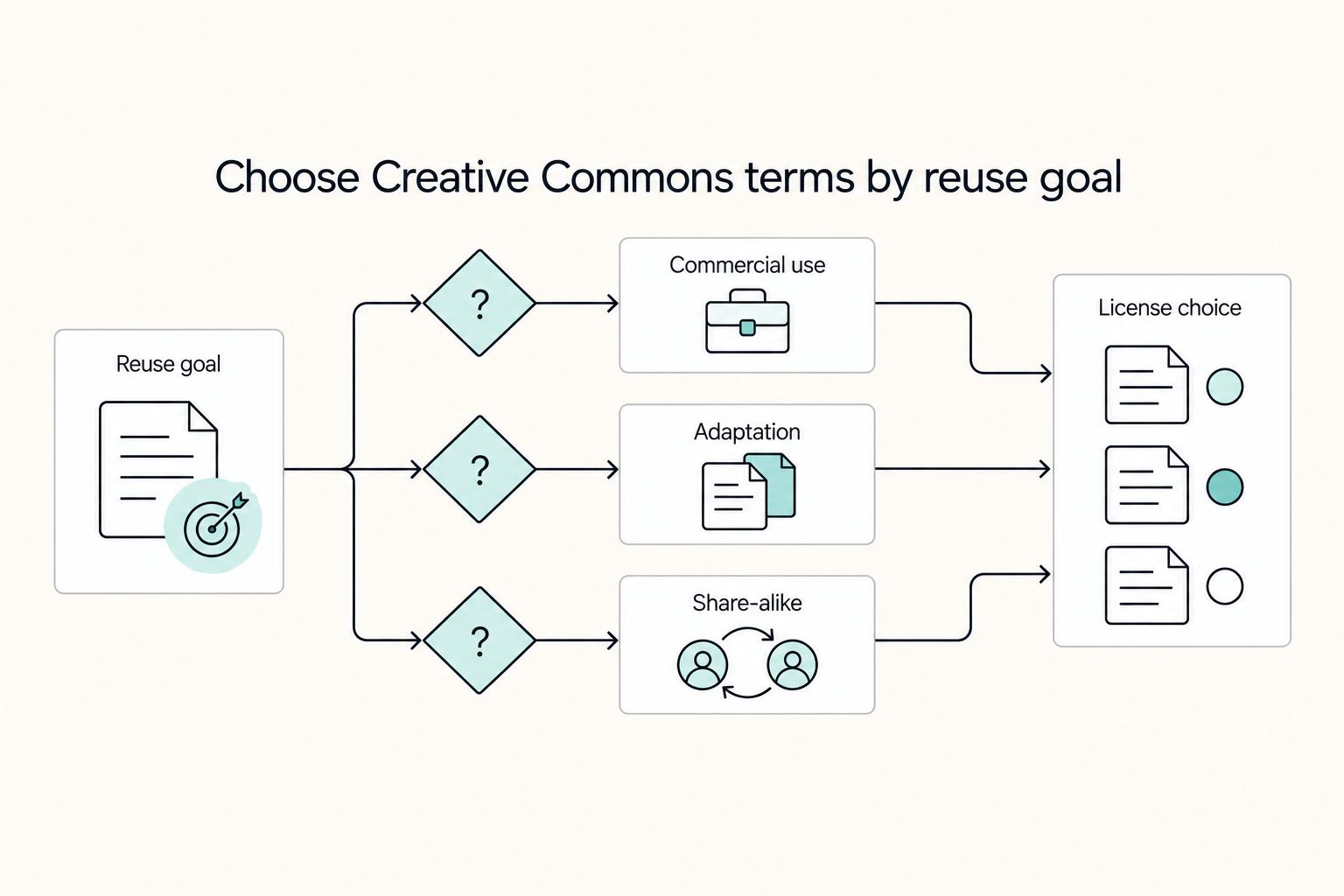
Creative Commons can widen how work is shared, but your signed client contract can determine whether you can grant public permissions for that work. For freelancers using Creative Commons, the first check is ownership: who holds copyright, and who has authority to license this specific asset.