
Quick Answer
Verify your jurisdiction requirements first, then run your CPE process on two tracks: defensible records and practical course selection. Keep a single tracker, store completion evidence immediately, and confirm sponsor acceptance plus course-category fit before enrollment. Treat directory listings and provider filters as screening aids, not final approval. Choose learning that improves current services or near-term offerings, and use recurring reviews to catch gaps before renewal.
From Chore to Competitive Edge: A Strategic Guide to CPA Continuing Education#
Treat CPE as a system, not a year-end scramble. That shift helps you make better course decisions, keep cleaner records, and lower compliance stress at the same time.
At its core, CPE helps you maintain professional competence and service quality and is commonly part of keeping your license in good standing. Your state board of accountancy sets the requirements, and those rules are jurisdiction-specific and subject to change. The practical starting point is simple: check your board's current requirements before you spend time or money on courses.
Provider verification comes second. Before you enroll, confirm what your board accepts and whether the sponsor appears on the National Registry of CPE Sponsors or a State CPE Roster. That status is useful, but it is not a universal guarantee. Final acceptance still follows your board's rules.
This guide focuses on four outcomes: confirming your jurisdiction requirements, building an audit-ready documentation system, choosing courses with a clear return for your practice, and cutting the admin load around tracking and reporting.
Start with the rules. Everything else depends on them.
Confirm Board Requirements and Course Fit Before You Enroll#
Start with your board's published requirements, then confirm sponsor and course fit before you enroll.
Do not treat badges or marketing copy as proof that a course will count. Treat directory listings as screening signals, not final approval. When you use U.S. government sources for rules or forms, confirm you are on an official .gov site and a secure HTTPS connection before sharing sensitive information.
Start with your board, not the catalog#
Your first job is to confirm the current rule set for your jurisdiction, including renewal and documentation instructions. Save the exact page or PDF you relied on and note the access date, so you can show what you used if the rules change later. If a government form involves an information collection, verify that it displays a currently valid OMB control number.
Common areas to confirm in board guidance
- Reporting period structure and renewal timing
- Format eligibility conditions or limits
- Sponsor acceptance expectations
- Field-of-study or mandatory-topic requirements
- Documentation needed to substantiate credits
Board-specific fields to verify
- Total CPE credit requirement
- Annual minimum requirement
- Ethics or mandatory-topic requirement
- Format limits and special conditions
- Record retention and audit response requirements
Validate sponsor and course fit before payment#
Once your board rules are clear, screen the provider against them. If your board references NASBA or another directory, use that as a screening tool, then confirm acceptance in current board guidance. You also need to confirm that the course field of study, delivery method, and completion evidence match your board's expectations.
| Check | What to confirm |
|---|---|
| Board rule check | Open current board rules or renewal instructions and confirm reporting period, format conditions, and required topics. Save proof of the guidance and date. |
| Sponsor verification | Check sponsor status against board guidance, and use NASBA only where relevant. A listing is not the same as an endorsement or final approval. |
| Field-of-study fit | Match the syllabus or agenda to the categories your board recognizes, not just the course title. |
| Recordkeeping artifacts | Confirm you will receive usable proof, such as a completion certificate and supporting course records, before you enroll. |
Run those four checks every time before payment.
Choose formats by defensibility, not convenience alone#
Convenience matters, but defensibility matters more. If two formats are equally useful, favor the one that gives you cleaner proof and a clearer acceptance path.
| Learning format | Credit acceptance reliability | Documentation burden | Scheduling flexibility | Audit defensibility |
|---|---|---|---|---|
| Live webinar | Verify treatment in your jurisdiction before enrolling | Confirm required attendance and completion records | Compare with your schedule | Strong only when records meet board expectations |
| In-person seminar | Verify treatment in your jurisdiction before enrolling | Confirm sponsor and participation records required by board | Compare with your schedule | Strong only when records meet board expectations |
| On-demand self-study | Verify treatment in your jurisdiction before enrolling | Confirm required completion evidence before purchase | Compare with your schedule | Strong only when records meet board expectations |
| Short-form or microlearning | Verify treatment and any aggregation rules in your jurisdiction | Confirm how records must be combined and stored | Compare with your schedule | Depends on whether records satisfy board expectations |
If any requirement, course classification, or documentation detail is unclear, stop and get written clarification before you enroll.
Set Up Four Controls Before You Buy Another Course#
Set up your compliance process before you buy another course. You need four controls working together: one source of truth, one evidence standard, one deadline lane per license, and one pre-enrollment gate to help keep rejected credits out.
Choose one source of truth#
Use one system and keep it current. A common failure point is scattered records across inboxes, downloads, calendars, and provider portals.
| Criteria | Spreadsheet | Dedicated tracker |
|---|---|---|
| Audit readiness | Strong if you update immediately and link each entry to saved evidence | Often stronger for centralized records, especially where electronic audit workflows are available |
| Multi-license handling | Usable, but harder as reporting periods and topic rules diverge | Better for separate jurisdiction and cycle views |
| Error risk | Higher manual risk for dates, hours, and duplicates | Lower when the tool reduces re-entry and keeps files attached |
| Maintenance effort | Lower cost, higher manual discipline | More setup, and sometimes cost, less cleanup later |
| Best fit | One license and low course volume | Multiple licenses, frequent courses, or higher audit-readiness needs |
If you keep a spreadsheet, reconcile it monthly against your saved documents so your log and evidence stay aligned.
Store evidence to a real standard#
Set a minimum evidence standard and use it every time. Washington's documentation fields are a solid baseline for what a usable certificate should include: sponsor name, program title, date(s) attended, CPE hours earned, and participant name. For stronger audit support, consider also saving the course outline or agenda, the provider page showing delivery method, and completion or attendance emails.
| Evidence item | Article note |
|---|---|
| Sponsor name | Washington's documentation fields include sponsor name. |
| Program title | Washington's documentation fields include program title. |
| Date(s) attended | Washington's documentation fields include date(s) attended. |
| CPE hours earned | Washington's documentation fields include CPE hours earned. |
| Participant name | Washington's documentation fields include participant name. |
| Course outline or agenda | For stronger audit support, consider also saving the course outline or agenda. |
| Provider page showing delivery method | For stronger audit support, consider also saving the provider page showing delivery method. |
| Completion or attendance emails | For stronger audit support, consider also saving completion or attendance emails. |
Use one folder structure, for example: CPE > [Jurisdiction] > [Reporting Period] > [Course Name]. Use consistent filenames, for example: 2026-02-14_VA_SponsorName_Tax_4.0h_Certificate_v1.pdf. If a file changes, increment the version instead of overwriting it.
If a record is incomplete, do not log it as earned. Ask the provider for corrected or missing documentation, save that email trail in the same folder, and keep the course in Pending proof until the file is complete.
Run each license in its own lane#
Track each license separately because reporting windows vary by jurisdiction. Give each license its own tab, folder, and reminders.
In each lane, mark unresolved fields clearly until the official board rules are verified:
- Reporting window
- Renewal or completion deadline
- Required topics or annual minimums
- Retention period
This is where multi-state compliance usually gets messy. For example, Virginia active CPAs follow a rolling three-year 120-hour requirement with at least 20 hours annually and a January 31 deadline for prior-year CPE, while some jurisdictions use fixed three-year cycles ending in years such as 2026, 2029, and 2032.
If your board uses NASBA's CPE Audit Service workflow, keep files upload-ready from day one with clean names and complete documentation.
Use a pre-enrollment gate every time#
A short gate before payment prevents a lot of cleanup later. Before you buy, run four checks:
- Board acceptance rules for this license and reporting period.
- Sponsor status check, whether through the National Registry or a required state roster, plus point-in-time confirmation using Sponsor ID, delivery method, and program date.
- Field-of-study fit with categories your board accepts.
- Retention artifacts you will receive after completion.
If any check fails, skip the course. Registry visibility and platform tools can help, but your board still has final acceptance authority.
After you tighten your CPE documentation process, apply the same audit-ready discipline to your money workflows with practical implementation guidance in Gruv Docs.
The ROI Engine: A Framework for High-Value CPE Investment#
High-value CPE is training you can apply to client work soon, not just the option with the lowest price or shortest runtime. Once your compliance process is stable, use a simple rule: if a course will not improve a service you already deliver, support a service you can realistically add, or change how you work with clients in the near term, defer it.
Cheap credits can still be expensive. If a low-cost webinar does not change client conversations, internal work, or measurable outcomes, the return is weak. A course that solves a real problem and gives you something usable next week is usually the better investment.
Build a T-shaped learning mix#
Use a T-shaped model to plan your CPE choices: depth in one core area, with practical breadth in adjacent areas. The important nuance is that this is not one-size-fits-all, so any fixed depth-versus-breadth split should stay provisional until you verify it for your role and market.
Set two buckets in your tracker before each reporting period, then verify the allocation against your role and service mix before using it:
- Core specialization: Allocation pending role and service-mix verification
- Adjacent capabilities: Allocation pending role and service-mix verification
Keep core learning tied to the work clients already trust you for. Use adjacent learning to expand what you can discuss, package, or deliver without drifting away from your main practice.
If your revenue comes from recurring technical work, put core training there first. Adjacent options can include advisory communication, AI-enabled finance workflows, process quality, or marketing execution. For example, CPA.com cites research that 75% of users judge credibility based on website design, which can make marketing-related learning relevant when your goal is better-fit client acquisition.
Compare likely business impact#
Compare courses by business impact before you compare them by price.
| Course type | Service-line potential | Pricing power | Client-fit | Implementation effort | Risk of low transfer to practice |
|---|---|---|---|---|---|
| Deep technical course in your current niche | Medium to high if it strengthens a service you already deliver | Medium to high when it supports more complex work or cleaner judgment | Usually strong because demand already exists in your client base | Moderate | Lower when it maps directly to current client issues |
| Adjacent course with immediate-use deliverables | High if it helps you package advisory work, improve meetings, or add a related offer | Medium, sometimes high when clients value the added capability | Strong when it solves a problem clients already raise | Moderate to high | Lower when the course includes templates, scripts, or tools you can use immediately |
| Broad-interest webinar with weak link to your clients | Low unless it clearly opens a real service path | Low or uncertain | Weak if you cannot name likely buyers | Low to moderate | High, especially for one-off sessions with no reinforcement |
The tradeoff is usually depth versus transfer. Deep technical training often improves quality and defensibility but may not expand your offer. Adjacent training can create new revenue paths, but only when it fits your market and changes real work.
Run a pre-purchase ROI screen#
Before you enroll, run the same five-question screen every time:
| Screen item | Question |
|---|---|
| Problem solved | What specific client or firm problem does this course address? |
| Buyer demand | Can you name clients, prospects, or referral sources who care about that problem? |
| Monetization path | Will this support a new service, stronger retention, faster closes, or cleaner processes? |
| Time to apply | Can you use something from it in the next few weeks? |
| Compliance fit | Does it still pass your acceptance, sponsor, and documentation checks? |
Then make a clear decision:
- Accept when most answers are clear and compliance fit is solid.
- Defer when the topic is interesting but buyer demand, monetization path, or timing is vague.
- Reject when you cannot explain how it will change client meetings or internal work.
Use provider filters such as subject, hours, and price to narrow options before checkout, then confirm the completion artifacts. At least one CPA provider states certificates are available immediately after successful completion, which is a practical checkpoint for faster logging and cleaner records.
Be careful with speed-focused titles. A listing may show 1.00 credit or promote a 30-day AI roadmap, but the title alone is not the transfer. Check the agenda and post-course materials first. If there is no worksheet, template, checklist, or similar asset, you are probably buying information rather than implementation.
Related: The Best Ways to Invest in Your Freelance Business.
Log Each Course Once and Review on a Fixed Cadence#
The goal is simple: log each course once, store each record once, and review on a fixed cadence. That can help reduce missed credits, improve audit traceability, speed reporting, and avoid deadline scrambling.
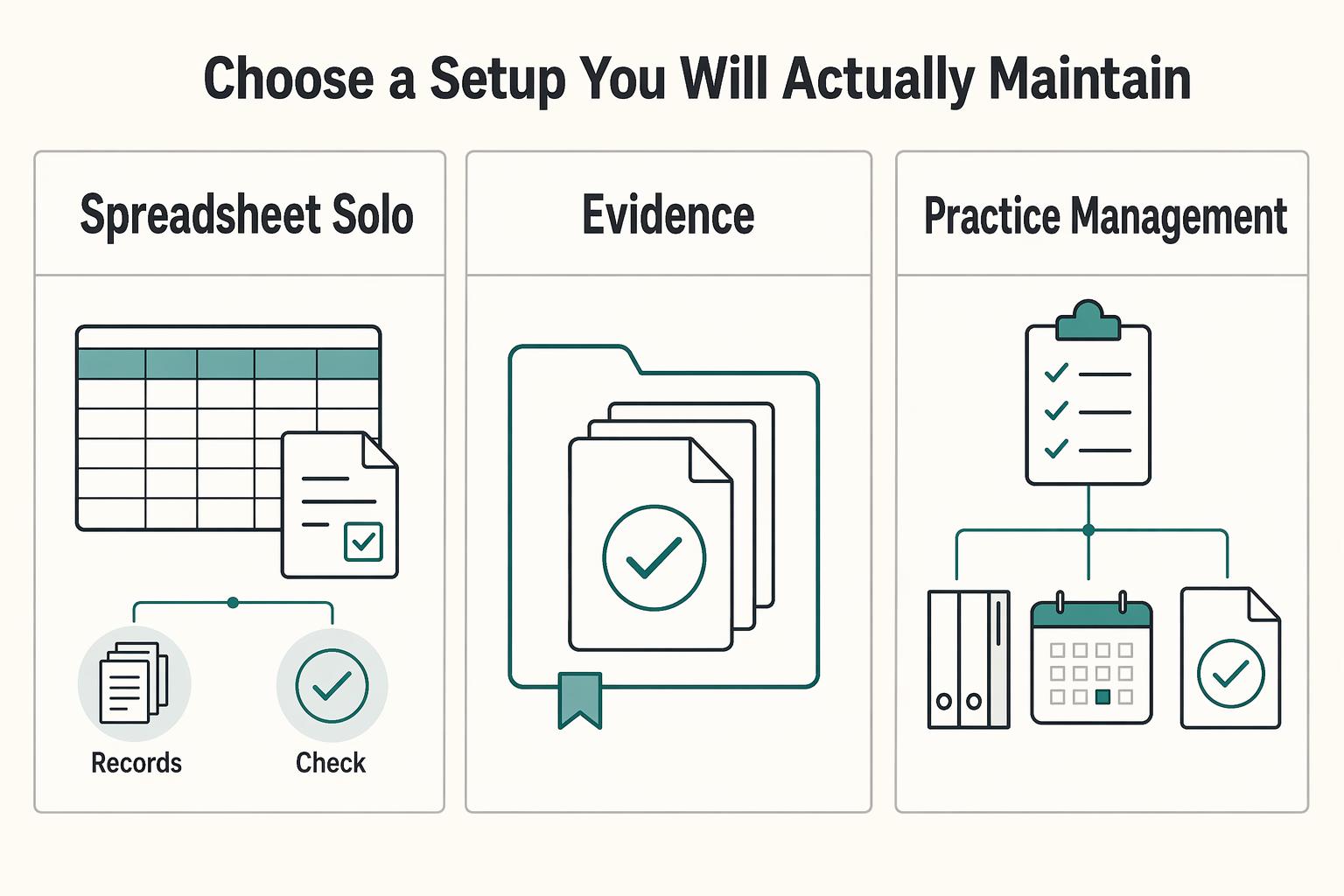
Choose a setup you will actually maintain#
Pick the simplest setup you will keep current. The best system is not the one with the most features. It's the one you update every time you complete a course.
You are still responsible for the compliance decision. NASBA states CPAs must follow applicable board and professional-organization rules. Many boards and associations accept credits from National Registry sponsors, and some boards require them.
| Setup | Best fit | Error risk | Audit traceability | Maintenance effort | Integration fit |
|---|---|---|---|---|---|
| Spreadsheet | Solo practice, lower course volume, disciplined update habits | Can be higher, because hours, dates, and rolling totals are entered manually | Good if each row ties to a certificate and naming is consistent | Moderate | Flexible, but mostly manual |
| Dedicated CPE tracker | You want one place for hours, categories, and records | Can be lower than spreadsheet tracking when duplicate entry is reduced | Can be stronger when certificates and reporting fields live together | Low to moderate | Good if it matches your provider mix and board workflow |
| Practice-management workflow | Your firm already runs deadlines, files, and recurring reviews in one system | Moderate, based on how well CPE fields are configured | Can be strong when tasks, files, and review notes stay linked | Moderate upfront, then lower after setup | Best when CPE is managed alongside existing operations |
If you routinely miss updates for a full quarter, your current setup may be too manual.
Use a documentation SOP#
Build your process so records are ready for board review without a cleanup project. For example, Washington requires completion documentation to include sponsor name, program title, date(s) attended, CPE hours earned, and participant name.
- Intake immediately
Save the completion record as soon as you finish the course. Verify the required fields and confirm the credit amount is reasonable for course time. 1 CPE credit equals one 50-minute period.
- Name files consistently
Use one pattern, such as 2026-04-18_Sponsor_Course-Title_2.0-CPE_Certificate.pdf, so files sort cleanly and stay searchable.
- Store in one location
Keep all CPE records in one cloud location with simple year and status folders, for example, Completed, Pending review, Board correspondence.
- Back up and retain
Keep a second copy and apply your board's retention period. Examples: Virginia requires records for the four calendar-years preceding the current year; Georgia and New York require five years.
- Use a retrieval checklist
For any board request, be able to pull the tracker entry, completion record, and any supporting qualification notes you relied on.
This matters in practice. Virginia runs monthly random CPE audits and requires selected CPAs to submit through CPE Audit Service, and California randomly verifies CE and can require documentation for at least 80 qualifying CE hours.
Review on a calendar#
A fixed review cadence is what keeps the rest of the process honest. Run a quarterly review and a year-end cutoff review. Each quarter, compare completed hours against both compliance pace and your specialization plan.
If your jurisdiction uses a rolling period, check both annual pace and rolling totals. In Virginia, that means tracking 120 hours over a rolling three-year period with at least 20 hours annually.
Then act based on status:
- If you are behind, schedule compliance-safe courses first.
- If you are on pace, prioritize higher-value courses tied to your core niche or a realistic adjacent service.
Before your board cutoff, run one final reconciliation. In Virginia, the prior-year CPE completion deadline is January 31, so a late-year planning check plus a January document sweep is a practical control.
You might also find this useful: How to Choose a Tax Preparer for Your Freelance Business.
Conclusion: Your CPE Is Your Strategic Advantage#
Your advantage comes from doing two things in the right order: keep compliance defensible, then invest learning time where it improves the work you actually deliver. That sequence matters because required CPE can pull time away from client work when it is managed poorly.
The first pillar is an audit-ready record. Verify your current state board rules directly instead of relying on provider filters, old habits, or sample guides. State context matters, and templates can help, but they do not replace your own understanding of the standards that apply to your license. In practice, keep one current tracker, save completion records as you finish, and retain enough notes to explain why you counted each course.
The second pillar is deliberate course selection. When a single marketplace can list "1 - 25 of 777," access is not the problem. Filtering is. Prioritize courses that are concise, immediately usable, and tied to your service mix. If a course does not help you serve current clients better, support a near-term offering, or build a skill clients already request, it is probably a low-value use of limited time.
In practice, the playbook is simple: verify board rules before you enroll, maintain evidence continuously, and choose learning that supports the services you want to grow. Those are controllable moves that can improve planning and help reduce compliance risk as client needs evolve.
Do this next#
- Confirm your tracker aligns with your current state board requirements.
- Verify every completed course has completion records and supporting notes saved.
- Select your next course only if it supports your current service mix or a near-term offering.
This pairs well with our guide on A Guide to Annual Report Filings for LLCs.
When you are ready to simplify how you invoice, collect, and track records as an independent professional, review Gruv for Freelancers.
Frequently Asked Questions
How do I track CPE credits for my CPA license?
Use one tracker for credits and one folder for proof, and update both every time you finish a course. You are responsible for reporting your own credits to your state board, and some providers only let you view or print your certificate after you pass the final exam. Before you rely on any course, confirm your board’s current documentation and sponsor-acceptance rules, then confirm the course is set to your state in the provider portal.
Action: Log the course and store the certificate the same day you complete it.
What happens if a CPA fails a CPE audit?
Outcomes depend on your state board, but missing documentation can create problems when credits are reviewed. If you cannot produce your tracker entry, certificate, and qualification notes, you may need to resolve those gaps with the board. Before you count a course, confirm your board’s current acceptance rules and keep your own records even when a provider keeps records for at least 5 calendar years.
Action: Keep a complete evidence file for every course, not just a running total.
How do I choose the right CPE courses for my career goals?
Choose courses that deepen the service you already deliver, then add adjacent skills that make that service more valuable. That keeps your learning tied to work you can apply instead of collecting unrelated hours. Also check your state board’s current acceptance rules for sponsor, format, and course category.
Action: Build your next quarter around one core service goal and one adjacent skill you can apply soon.
Are free CPE courses for CPAs legitimate?
A course being free does not, by itself, tell you whether the credit will count. Check provider approval details and completion steps first. For example, Ultimate CPE lists NASBA registry number 108036, and providers may require a final exam before your certificate is available to view or print. Confirm current sponsor acceptance with your state board and make sure you can produce the certificate after completion.
Action: Validate sponsor acceptance and completion workflow before you spend time on a free course.
Do CPE requirements vary by state?
State rules can differ, so treat each license as state-specific. Provider tools can help, and some portals ask you to select your state, but that filter is not a substitute for board rules. Read your state board’s current requirements first, then use provider filters as a secondary check.
Action: Save your board’s current CPE rules with your tracker and review them before enrolling.
Can I carry over extra CPE credits to the next reporting period?
Carryover is state-specific, so do not assume extra credits will roll forward. Provider record retention, such as keeping records for at least 5 calendar years, does not determine your state board’s carryover policy. Confirm your board’s current carryover rules before treating excess credits as future-period credits.
Action: Check carryover policy with your board before banking surplus hours.
Try a related tool
Researched and edited by the Gruv editorial team. Gruv builds cross-border billing, payouts, and finance-operations software for global businesses.
Sources
- acb.wa.gov/individual-licensing/continuing-professional...trusted
- boa.virginia.gov/individual-cpas/cpetrusted
- boa.virginia.gov/individual-cpas/cpe/cpe-audit-servicetrusted
- bphc.hrsa.gov/sites/default/files/bphc/compliance/2025-uds...trusted
- dca.ca.gov/cba/licensees/ce-verify.shtmltrusted
- dhs.gov/termstrusted
- fsa.usda.gov/Internet/FSA_File/1-flp_r01_a47.pdftrusted
- gsba.georgia.gov/cpe-requirementstrusted
Educational content only. Not legal, tax, or financial advice.
Related Posts

Digital Nomad Health Insurance Comparison for Long-Stay Moves
Use focused time now to avoid expensive mistakes later. Start with a practical `digital nomad health insurance comparison`, then map your route in [Gruv's visa planner](/tools/visa-for-digital-nomads) so we anchor policy checks to your real plan before pricing pages pull you off course.

Invest in Your Freelance Business by Protecting Cashflow First
Start with payment reliability before you buy another growth tool. Courses, coaching, and software can help delivery, but they do not protect cashflow when payment is delayed, disputed, or never sent. A practical move is to make each engagement payable, traceable, and harder to derail from kickoff to settlement.

How to Choose a Tax Preparer for Your Freelance Business
**Choose a tax preparer for freelancers by ranking compliance controls ahead of speed and price, then shortlist only candidates who can show strong documentation habits.**