
Quick Answer
Yes - cobra health insurance can be the right short bridge after job loss if you can carry the premium without squeezing essentials and you verify each step in writing. Confirm notice dates, check alternative paths before deadlines close, and keep election, payment, and activation proof in one file. Do not end current coverage until the next plan’s start date is documented.
Start Here if You Just Lost Job-Based Coverage#
Your first decision is straightforward: avoid a coverage gap without taking on a premium that breaks your essentials. Do not rule out any path until the key dates, status checkpoints, and written confirmations are in hand.
Verify first#
Before you rule out any option, pull these items into one place:
- Written proof of your job-based coverage end date
- Any notice you received about continuation or replacement options, with date or timestamp
- Your current plan details, including plan name and member information
- Written status for any replacement coverage you are considering, including expected effective date
- Written monthly premium or cost figures for each live option
- The exact source of any rule you rely on, including whether it is official, current, and secure
Before sharing personal data, verify the site. Use official .gov sources where relevant, confirm HTTPS, and do not submit sensitive information on sites that are not official and secure.
Use one decision frame#
Choose continuity first when disrupting care is the bigger risk right now. Choose affordability first when the premium would crowd out essentials or force unstable tradeoffs in your business or household budget.
Fill these in only after written verification: [coverage end date], [any stated enrollment deadline], [any stated payment due date], [application timing], [new plan effective date]. If any key field is still unknown, pause before declining an option.
Pending is not active#
Treat each stage as separate until it is confirmed in writing: notice, enrollment, payment, activation. A submitted form is not processed coverage, and pending status is not active coverage.
Keep your evidence pack simple: confirmation emails, receipts, screenshots, and dated call notes. This is practical guidance, not legal advice. Final terms come from your plan documents and official government sources. Once you have that file together, the next job is to map the timeline so each decision is tied to the right date.
This pairs well with our guide on Digital Nomad Health Insurance Comparison for Long-Stay Moves.
COBRA in Plain English and Who Usually Qualifies#
Start with official documents, not memory. If you are evaluating COBRA, work from official written records rather than summaries or secondhand explanations.
Use this quick document check before you choose:
| Check this in your documents | What to ask for in writing | Why it matters |
|---|---|---|
| Which version of the document is official | Confirmation of the official version if copies conflict | Electronic conversions can include errors or omissions |
| Whether the official text clearly states the terms you are relying on | The exact wording and date from the official record | Small wording differences can change what is verifiable |
| Whether any copy is incomplete or unclear | A complete official copy before you decide | Conflicting versions can lead to wrong assumptions |
The materials summarized here do not support specific claims about who qualifies for COBRA, employer-size thresholds, qualifying events, deadlines, costs, or coverage duration. Treat those points as unconfirmed here.
If an online copy, scan, or extracted text conflicts with another version, stop there and ask for the official document version. Electronic conversions can miss language or introduce errors, so resolve conflicts against official records before you decide.
Before you finalize anything, keep the official documents and written confirmations with your notices, screenshots, and call notes so your choice rests on records, not assumptions.
You might also find this useful: Guide to Xero for Freelancers and Small Businesses.
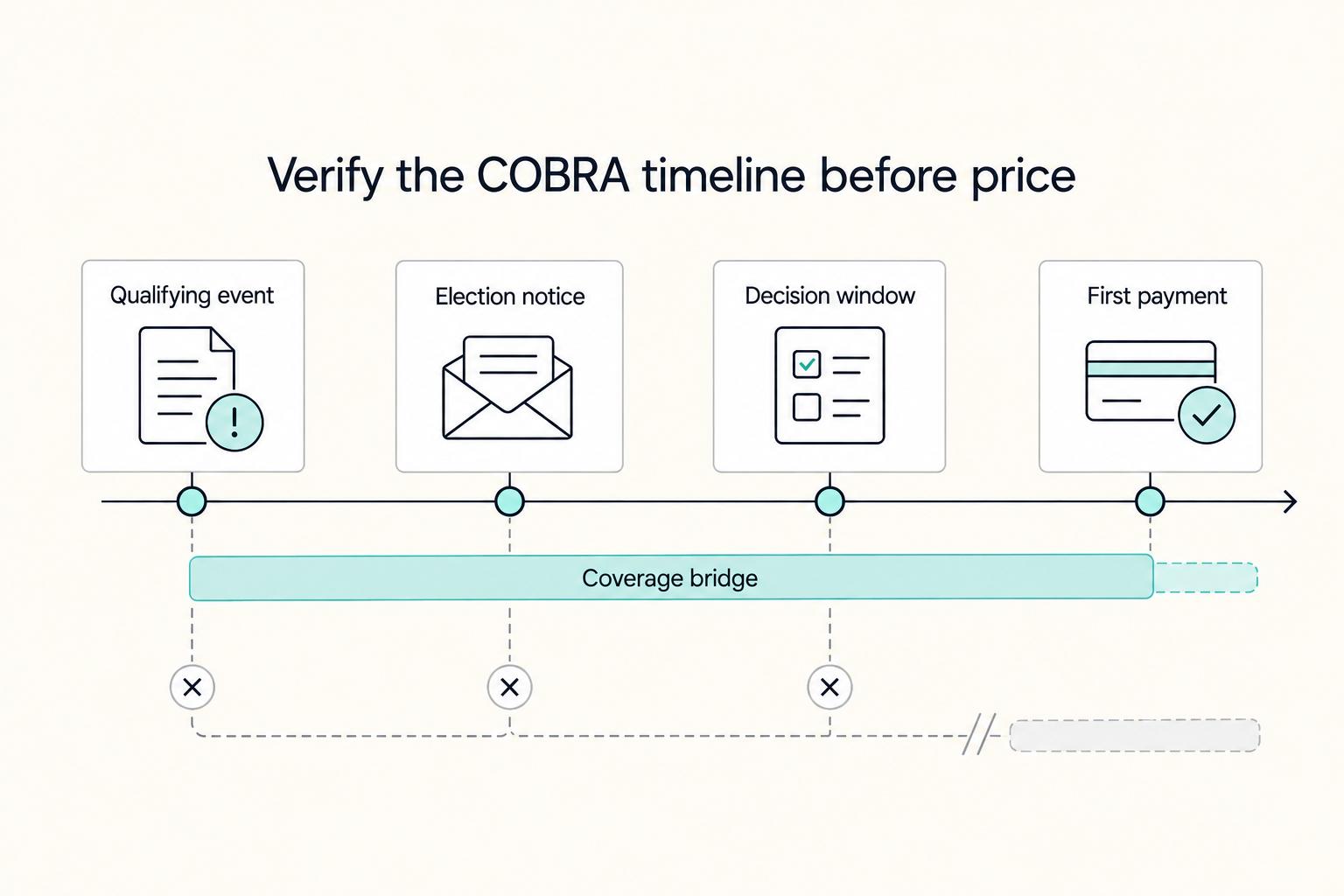
Map the COBRA Timeline Before You Compare Prices#
Once continuation may be on the table, do not compare prices yet. Verify the timeline first, because missed deadlines can create avoidable risk.
Create one dated file with checkpoints for the event notice, election packet, election decision, first payment timing, and activation confirmation. If any date is unclear, pause and resolve it in writing.
Build one working timeline from source documents#
Treat each date as "verify and fill," not memory. Pull each one from the document that controls it.
| Checkpoint | Pull from |
|---|---|
| Event notice date | Employer or plan record showing the coverage-loss event and coverage end date |
| Election packet issue or delivery date | Election notice, postmark, email timestamp, or portal message |
| Election deadline | Election notice or written plan administrator confirmation |
| First payment deadline | Election packet or written payment instructions |
| Activation confirmation date | Written active-status confirmation, portal status, or written administrator acknowledgment |
Use the table as your working tracker: pull the event notice date, election packet date, election deadline, first payment deadline, and activation confirmation date from the document that controls each step, then fill those fields only after verification.
If a packet is missing, late, or incomplete, do not guess. Get written confirmation before you decline continuation coverage.
Audit your file before any price decision#
| Step | Owner | Required proof | Failure risk |
|---|---|---|---|
| Coverage-loss event recorded | Employer and you | Termination notice, HR email, benefits notice, plan record showing coverage end | Wrong starting point for the full timeline |
| Election packet issued or delivered | Plan administrator | Election notice, postmark, email timestamp, portal screenshot | You cannot prove when the election window was communicated |
| Election submitted | You, and each person electing if applicable | Signed form, upload confirmation, fax receipt, certified mail record, or confirmation email | Hard to prove timely election in a dispute |
| First payment sent and received | You and plan administrator | Bank record, card receipt, check image, written receipt | Harder to resolve timing or status disputes later |
| Active coverage confirmed | Plan administrator | Written confirmation, active portal status, ID card issue notice, written status reply | Coverage status can remain unclear while claims or billing are unresolved |
Keep originals in their native format, including PDFs, full emails with timestamps, dated screenshots, and receipts. Notes help, but they do not replace source records.
If verbal guidance conflicts with written records#
Treat that as a stop sign. Send the conflicting dates, attach the records, and ask the plan administrator which date controls. Request written confirmation of the operative deadline or a corrected notice. Use phone guidance for context, but rely on written confirmation for the final date.
Ask these questions in writing before you rely on timing#
Ask these questions in writing before you rely on timing: if you elect within the allowed period, what effective date will apply; while election or first payment is pending, how should providers submit claims; if claims are denied during that period, what should you keep and when should claims be resubmitted; and what written confirmation shows active coverage status?
Do not compare COBRA with alternatives until this timeline evidence is complete.
For a full breakdown, read Digital Nomad Health Insurance Comparison for Visa-Ready Moves.
Run a Cashflow Stress Test Before You Elect COBRA#
After the timeline is verified, treat this ass a cashflow risk question: can you carry it safely? Treat COBRA as a continuity option only if paying for it does not force tradeoffs on essentials or required business obligations. If it does, move to other coverage paths before your verified enrollment window closes.
Do not judge the premium in isolation. Judge whether you can pay it on time while still covering your non-negotiables and the costs that keep revenue moving.
Pull the numbers from records, not memory#
Build one short cash view from your election packet and written plan communications. Keep live-rule items as placeholders until you verify them:
- Monthly premium due: confirm the current premium amount with your plan administrator before paying
- Premium rule or cap detail: confirm the current rule with your plan administrator
- Enrollment window: confirm the current dates from your election notice or plan administrator
- First payment rule: confirm the current rule from your election packet or plan administrator
Then compare those items against cash you can actually use, not expected collections.
Stress-test three freelance cash patterns#
| Scenario | Continuity benefit | Liquidity strain | Reserve impact | What to do |
|---|---|---|---|---|
| Steady collections | Continuity may be easier to maintain with less disruption less disruption | Can be manageable if the premium fits after essentials and business obligations | Buffer draw is more predictable | Consider continuation if you can ring-fence the premium now |
| Delayed receivables | Continuity is still possible, but timing risk increases | Risk can rise when payments slip before premium due dates | Buffer can drop quickly when timing breaks first | Do not rely on "payment is coming"; verify other paths before the window closes |
| Income drop | Continuity may still still have value | Premium can compete directly with essentials and revenue-critical costs | Reserve pressure is often highest | Treat this as fail unless you already funded a separate premium buffer |
Use a hard pass pass or fail rule: if continuation premiums threaten essentials or required business obligations, move to other coverage options before the verified window window closes.
Verify billing mechanics before you rely on them#
Before you commit, confirm the payment mechanics in writing. Ask the administrator to confirm whether and how they handle COBRA Administration and Direct Premium Billing. Verify accepted payment methods, what counts what counts as paid, what confirms receipt confirms receipt, and what confirms active coverage after election and payment.
Keep timestamped proof for every step: confirmations, portal messages, receipts, and delivery records.
Do not assume a general benefits card or portal experience proves premium billing is integrated. Some setups connect tools across CDHC accounts such as FSA, HRA, HSA, and commuter benefits, but that alone does not confirm how continuation premiums are billed, posted, or confirmed. If your setup is setup is more complex than a basic arrangement, verify each checkpoint explicitly.
Ring-fence the premium before you commit#
If you elect, create a dedicated premium buffer immediately. Fund the first expected premium obligation, then add the next month if cash allows.
Run this check each week:
- Review receivables against due dates, not invoice totals totals.
- Compare buffer balance to the minimum buffer threshold you set for essential monthly costs.
- If the buffer falls buffer falls below that threshold, re-shop alternatives immediately while verified options are still open options are still open.
If you pass the cash test, continuity may be worth paying for. If you fail it, do not force it. Use your verified dates and move to a path that protects both coverage and liquidity.
For a step-by-step walkthrough, see Disability Insurance for Freelancers Who Need Stable Cashflow.
If delayed client payments are the weak point in your coverage plan, use this free invoice generator to tighten billing follow-through before your next premium cycle.
Compare COBRA Against Marketplace and Public Program Paths#
Start with one rule: this section covers regulatory context checks, not path-by-path eligibility eligibility, timing, or cost decisions.
For this section, treat these as labels only; legal definitions are not established:
For this section, treat these as labels only: continuation coverage, special enrollment, and effective date are all concepts that still need path-specific verification from current official materials.
If you check federal text while comparing options, confirm recency and status first. The eCFR page for Title 29, Part 2590 (Subchapter L, Group Health Plans) is within Chapter XXV - Employee Benefits Security Administration, Department of Labor, shows content up to date as of 3/26/2026, and says Title 29 was last amended 3/23/2026. It also states the eCFR is authoritative but unofficial, and document-content questions should go to the publishing agency, not OFR staff.
| Path | Continuity question | Start-timing question | Affordability-pressure question | Switch-flexibility question | Choose this when... | Watch out for... |
|---|---|---|---|---|---|---|
| COBRA / prior-plan continuation | Unknown from provided excerpts. | Unknown from provided excerpts. | Unknown from provided excerpts. | Unknown from provided excerpts. | Unknown from provided excerpts. | Do not assume COBRA election, notice, payment deadlines, or premium formulas are confirmed. |
| Marketplace | Unknown from provided excerpts. | Unknown from provided excerpts. | Unknown from provided excerpts. | Unknown from provided excerpts. | Unknown from provided excerpts. | Do not assume this excerpt provides Marketplace special-enrollment windows or triggers. |
| Medicaid or CHIP | Unknown from provided excerpts. | Unknown from provided excerpts. | Unknown from provided excerpts. | Unknown from provided excerpts. | Unknown from provided excerpts. | Do not assume this excerpt provides Medicaid/CHIP eligibility, income thresholds, or enrollment timing. |
| Spouse's employer plan | Unknown from provided excerpts. | Unknown from provided excerpts. | Unknown from provided excerpts. | Unknown from provided excerpts. | Unknown from provided excerpts. | Do not assume this excerpt provides spouse-plan enrollment windows or documentation rules. |
If you document your comparison, keep dated copies of any confirmations you receive; required document sets are still not established.
How to decide today#
- Confirm you are reviewing the correct regulatory context: Title 29, Part 2590 in Subchapter L - Group Health Plans.
- Check the page before relying on it in a comparison: up to date as of 3/26/2026 and last amended 3/23/2026.
- Treat eCFR text as authoritative but unofficial.
- For disputed wording or requirements, verify with the publishing agency.
- Treat path-specific COBRA, Marketplace, Medicaid/CHIP, and spouse-plan decision details as unknown.
Choose COBRA When Continuity Risk Is Higher Than Price Risk#
Choose COBRA when the bigger risk is disrupting care you already rely on, not paying a higher premium for a short period. Here, continuity risk means breaking your current care setup, especially your provider network or deductible progress. Price risk means the full premium strains your budget. Bridge coverage means using continuation temporarily while you line up your next plan.
This choice is strongest when your current setup is hard to replace quickly, especially if switching could disrupt your current providers or reset care progress. COBRA is described as keeping the same plan structure you had before job loss, including benefits, network, and plan rules, which can reduce near-term disruption.
Verify the exact plan before you rely on it#
- Review your COBRA notice and confirm the terms, submission method, and dates in writing.
- Verify provider and facility participation on the exact plan, not just the carrier name.
- Save election proof, payment proof, and confirmation messages in one evidence folder.
Use it as a bridge, not a default#
If you elect COBRA, set an exit-review trigger now so it stays temporary. Use a measurable trigger, such as income stabilization, treatment completion, or a replacement plan with a written effective date. Set that review timeframe yourself based on your situation.
Some guidance describes a 60-day period as a decision window and possible retroactive activation if care is needed unexpectedly. Treat that as plan-specific, and verify it against your actual notice and records before you rely on it.
Skip COBRA When Cost Risk Is Clearly Dominant#
Skip COBRA when paying for it would put your essentials at risk. If premiums and expected care costs would crowd out rent, groceries, tax set-asides, payroll, debt payments, or your cash buffer, consider other paths you can verify as lower-cost for your situation.
Here, cost risk means coverage costs are high enough to threaten core obligations. An affordable coverage path means coverage you can keep paying for without borrowing or giving up essentials. A coverage gap means you believe you are covered, but coverage is not actually active, or you end one plan before the next is confirmed.
Use a simple affordability-first test#
Start with one question: can you carry this monthly cost for the next few billing cycles if income drops or invoices pay late? If the answer is no, treat that as your signal to reassess options now.
Then look past the premium. A lower monthly price can still create cash strain if provider access, prescriptions, or expected out-of-pocket costs do not fit your actual needs.
Compare the alternatives before you decide#
Use this checklist for Marketplace, Medicaid, CHIP, and spouse-plan options. Verify each path directly for your situation before you choose. Start official path checks at HealthCare.gov and Medicaid.gov. Do not assume this checklist gives confirmed COBRA-versus-option cost, eligibility, or deadline comparisons; treat it as a practical verification checklist rather than a confirmed comparison.
| Option | Verify eligibility or access | Verify care fit | Verify total out-of-pocket exposure |
|---|---|---|---|
| Marketplace plan | Confirm whether you can apply now and which documents are required | Check your exact doctors, facilities, and prescriptions on the exact plan | Review premium, deductible, copays, coinsurance, and likely usage costs |
| Medicaid | Confirm whether you currently qualify and what your application requires | Confirm provider participation and prescription coverage | Review expected visit and medication costs |
| CHIP | Confirm child eligibility and application requirements | Confirm pediatric providers, urgent care, and medication coverage | Review program costs and how family coverage would be split |
| Spouse plan | Confirm whether plan rules allow enrollment now | Check network fit for current providers and active treatment | Review contribution impact, deductible status, and likely specialist or drug costs |
Save screenshots, application confirmations, and written eligibility or effective-date messages in one folder.
Tie timing to written confirmation#
Work from records, not memory:
- Pull your current plan end date and enrollment materials.
- Mark your actual application deadline from your enrollment materials or plan administrator.
- Submit early enough to handle document follow-ups.
- Get the new plan's effective date in writing.
- Do not end existing coverage until written activation proof is in hand.
If you check federal text directly, note that the eCFR for Title 29 says it is "authoritative but unofficial" and shows content up to date as of 3/26/2026. It also says OFR staff cannot answer document-content questions. Use it for orientation, but rely on your actual notice, plan documents, carrier confirmation, and official agency material for final decisions.
Switch fast if income drops#
If income falls after you were leaning toward COBRA, switch from hope to triggers. Recalculate real monthly capacity, rerun potentially lower-cost options immediately, and do not cancel current coverage until replacement activation is confirmed in writing.
Avoid the Switching Traps That Lock You Into Bad Timing#
Use one rule for every switch: do not cancel COBRA until your replacement plan is active and the effective date is documented in writing. The CMS material in this section does not provide COBRA Marketplace switching timelines, so treat COBRA timing details as unknown until you verify your path in writing.
A common timing trap is treating an application, a call, or a portal status as active coverage before it actually is. If you are relying on Marketplace enrollment enrollment, verify your current route directly and treat any unconfirmed path as uncertain until you have written confirmation.
| Scenario | What this means for your next move |
|---|---|
| Open enrollment | Confirm the current enrollment window first with HealthCare.gov or your plan administrator. Do not end old coverage before you have a written effective date for the new plan. |
| Special enrollment | Do not assume eligibility. Confirm the triggering event, required documents, and written effective date before you change anything. |
| COBRA exhaustion | This guidance does not state what COBRA exhaustion unlocks next. Verify your current options and keep all end-of-coverage notices. |
| Early COBRA termination | This guidance does not define how early COBRA termination affects Marketplace access. Treat the timing impact as unknown and confirm your options before canceling. |
If you enroll through an Enhanced Direct Enrollment (EDE) pathway or an agent or broker flow, keep proof of the process. CMS guidance states consumer identity proofing must occur before EDE environment access, and assisted consumers must be offered a consumer-facing account option. If manual consumer ID proofing is used, it must be approved by CMS before implementation. Save account confirmation, identity-proofing completion, and any eligibility or effective-date messages.
Follow this exit sequence#
- Verify the new plan's effective date in writing.
- Confirm the current cancellation steps through the contact or process materials.
- Store all proof in one evidence pack: enrollment confirmation, effective-date notice, cancellation record, and dated email or portal messages.
- End old coverage only after steps 1 through 3 are complete are complete.
If any link in this chain is missing, pause and resolve it first.
Build Your Enrollment Evidence Pack Before Any Final Choice#
Before you elect, decline, pay, or cancel anything, build one evidence pack and run every decision from that file. If status flips, payment posting is delayed, delayed, or billing is disputed later, your dated records are what protect you.
Loss-of-coverage circumstances include job loss, reduced hours, transition between jobs, death, or divorce. COBRA outlines how employees and family members may elect continuation coverage, and employers and plans are required to provide notice. Use those notices and related plan materials plan materials as core documents to save and review.
| What to collect | Why it matters in a dispute | Where to store it |
|---|---|---|
| Proof of your loss-of-coverage event and coverage end date | Anchors what happened and when, so later deadlines and switch decisions are traceable | 01 Before election |
| Your COBRA and related plan notices | Shows what option you were you were offered and the instructions you were given | 01 Before election |
| Benefit booklet, premium quote, invoice, or rate sheet | Lets you verify terms and cost exposure, including that COBRA can be priced up to 102% of d of plan cost | 01 Before election and 02 Election and payment |
| Submitted forms, receipts, bank or card proof, portal confirmations, and status screenshots | Proves you completeded each step if the plan says an item says an item was not received or not received | 02 Election and payment saved by date |
| New-plan enrollment confirmation, written effective date, and old-plan cancellation record | Proves handoff timing and helps resolve helps resolve post-switch billing conflicts | 03 After switching |
Use one checklist and file items by stage:
- Before electionlection: loss-of-coverage proof, coverage end notice, COBRA and related plan notices, premium materials, and dated call notes.
- During election election or payment: submitted election proof, timestamp screenshot, payment confirmation, matching bank or card record, and written processing or status messages.
- After switching: new-plan confirmation, written effective date, cancellation record if ended, and final notices or bills tied to the transition.
Keep a deadline deadline log tied to documents, not memory. Start with the notice showing your coverage end date, then log the election deadline exactly as shown in your materials or written response. Log the initial payment rule from the same source set. If documents conflict, pause and resolve the conflict in writing before acting.
After each major step, confirm processing processing in writing, save dated proof, and store it the same day. Do this after election submission, after first payment, payment, and after any replacement-plan enrollment. If status does not update as promised, escalate quickly to the plan administrator or carrier, using the records you already saved, and ask for for a written status status reply.
Related reading: Health Insurance for Freelancers in France During Your First Year.
Fix the Mistakes That Cause Coverage Gaps and Surprise Bills#
Many costly errors start the same way: you move forward without written proof. If you cannot document the deadline,, active status, replacement effective date, and paid-through date, date, pause before the next step.
| What you did | Why it creates risk | What you must verify before moving forward |
|---|---|---|
| You compared options too late | Late comparison can leave you making a rushed choice with avoidable timing risk | Pull dates from your notice and replacement-plan materials, then log the current enrollment window with the document source |
| You treated "submitted" or "pending" like like active coverage | Submission and processing processing status are not the same as confirmed active coverage | Get written status confirming receipt, payment postinging if applicable, and active coverage before you rely on the plan |
| You coverage before replacement coverage was fully confirmed | If cancellation and the new effective date do not line up, you can create a gap and trigger billing disputes | Confirm the new plan's effective date in writing and confirm your current plan's paid-through status before canceling |
| You decided on price alone | A lower premium does not protect you if timing or status failures create uncovered care | Verify live plan rules from your own documents, including the current payment rule and premium cap detail |
Do not let memory fill in missing numbers. Treat any missing date, rule, or status line as unresolved risk until you have written confirmation.
Pending is not active#
"Pending" means something is still being processed being processed. "Active" means coverage is in force. After every election or payment step, run the same confirmation sequence before you assume coverage is usable:
- Save submission proof, such as a portal confirmation, timestamped screenshot, or email receipt.
- Match any payment proof to your your bank or card record.
- Request written status that clearly says whether your step is received, posted, active, or still pending.
- Save the dated reply and a same-day portal screenshot showing the same status.
If records include protected health information, store them securely.
When you check regulatory text, document its its currency before you rely on the wording. The eCFR Title 29 page is authoritative authoritative but unofficial. It shows "up to date as of 3/26/2026" and notes Title 29 was last amended 3/23/2026. Save that dated view, use "view view historical versions" if wording changed, and do not use the eCFR feedback channel for document document questions.
Cancel only after replacement is live#
The order is non-negotiable: confirm the replacement effective date in writing, confirm current-plan paid-through status in writing, then cancel old coverage and save the cancellation record.
If either plan still shows. shows "processing," do not cancel yet. That sequencing error can create coverage gaps and surprise bills.
Tie Your Health Coverage Choice to Your Freelance Money System#
Treat this as a cashflow decision first: choose the coverage path you can fund through your next cycle without creating a gap during the switch.
Use these working definitions for planning, not legal terms, so your review stays consistent:
- Premium buffer: cash you hold on purpose so one late client payment does not force a missed premium.
- Receivables timing: when invoiced money is realistically likely to hit your account, not the invoice due date date.
- Coverage decision date: the next date that can force action, such as the end of job-based coverage, a COBRA election or payment date, a Marketplace enrollment window, or a spouse-plan enrollment deadline window, or a spouse-plan enrollment deadline.
Compare options by cashflow behavior#
| Option | Cashflow fit | Continuity risk | Switching friction |
|---|---|---|---|
| COBRA | Can be the heaviest monthly cost because you may pay the full group premium plus a 2% administrative fee. | Lower continuity risk because coverage is generally the same as your employee plan and may let may let you keep the same doctors. | Medium to high: 60 days to elect after job-based coverage ends, initial payment cannot be required earlier than 45 days after election, and later payments must have at least a 30-day grace period. |
| Marketplace | May fit better when income drops, since savings can depend on income and household size. | Continuity can change, so confirm providers and plan details before switching. | Medium: Special Enrollment is tied to loss of job-based coverage, generally within 60 days after loss; CMS outreach also describes a 60-day before-or-after window tied to loss of pre-COBRA job-based coverage. |
| Spouse-plan option | May be more affordable in some cases, cases, but only if you meet plan rules. | Can work as a bridge, but coverage terms and providers may differ from your current plan. | Medium: special enrollment may be available, typically requested within 30 days of losing job-based coverage, and prior-coverage conditions can apply. |
The main timing trap here is ending COBRA too early. Outside Open Enrollment, one documented Marketplace switch case is when COBRA is running out. If you voluntarily end COBRA early, you may need to wait for Open Enrollment, from November 1 to January 15, unless another another life event applies.
Use one monthly decision checklist#
Run this once a month on the same day, using your reserve balance, collectible invoices, and next coverage decision date.
- Stay the course when your premium buffer covers the next cycle next cycle, collectible invoices are likely to land in time, and continuity needs are still being met.
- Reprice now when reserve pressure rises, a key invoice slips about slips, household income conditions change, or the next premium would crowd out essentials.
- Switch paths only when reserve pressure is persistent, next-cycle next-cycle funding is weak, and you can document a live enrollment route before leaving current coverage.
High-risk month protocol (in order)#
- Pause cancellation. Do not end current coverage while replacement coverage is still pending or unconfirmed.
- Put all dates all dates in one place. Track COBRA election and payment timing timing, Marketplace timing, spouse-plan timing, and the next premium deadline.
- Separate collectible and uncertain invoices. Use realistic cash-in dates, not optimistic due dates.
- Re Reprice the same day. Save current COBRA terms, Marketplace estimate details, and spouse-plan materials if available.
- Document before any missed payment or cancellation. Keep status screenshots, payment confirmations, bank or card proof, and written effective-date confirmation for replacement coverage.
- Cancel only after handoff proof is complete. Confirm the new plan's start date before ending COBRA.
Keep this evidence evidence pack with your invoice log and reserve notes so your coverage decisions stay tied to your operating cashflow. With the core timeline, on paper, the FAQ can focus on the edge cases that usually trip you people up.
We covered this in detail in Can an LLC Pay for a Member's Health Insurance?.
The Bottom Line for Freelancers#
Treat COBRA as a continuity bridge, not an automatic yes or no. Make the decision in order, and move only when each step clears in writing: eligibility and deadlines, affordability under under uneven receivables, viable alternatives, and confirmed effective dates.
Decide in sequence#
- Pass or fail eligibility and timing first.
Use your election notice, coverage-end date, and payment instructions as the controlling record. If anything anything is unclear or conflicts with what you were told, get written confirmation from the plan administrator before you act. If federal COBRA may not apply to your former employer, generally tied to the 20+ employee threshold in the prior year, request ask for the applicable continuation option in writing.
- Pass or fail affordability under stress, not averages.
COBRA can require the full group premium plus an administrative fee. Test it against a bad payment month, including late invoices, tax set-asides already committed, tax set-asides already committed, and fixed obligations due. If coverage cost forces borrowing for core obligations, cost risk is already higher already higher than continuity risk.
- Compare only real options you can actually activate.
Usually this means COBRA, a spouse's plan, Marketplace coverage through the official channel, and possibly Medicaid, CHIP, or Medicare. Use verified values, not assumptions:
- COBRA election deadline: confirm the current deadline with your election notice or plan administrator.
- Initial payment deadline: confirm the current deadline with your notice or administrator.
- Marketplace SEP deadline after job-based coverage loss: confirm the current window with HealthCare.gov.
- Replacement plan effective date: Add actual start date only after written enrollment confirmation.
- Execute only with proof.
Do not rely on verbal assurances or a portal status alone. Keep one evidence pack: election notice, invoices, payment receipts, SEP verification uploads, and written confirmation of the replacement plan's effective date.
The tradeoff to respect#
The core tradeoff is continuity versus cost. COBRA can preserve your current employer-group coverage, and coverage can apply from the day apply from the day prior coverage ended even if election is delayed within the allowed period allowed period. If continuity continuity is critical for active care care, that can outweigh short-term price pressure.
If cost risk is dominant and your provider setup is flexible, a Marketplace or public-program path may be the better move. Keep the switch rule strict: do not end current coverage until the replacement plan's effective date and enrollment confirmation are both in writing in writing. If Medicaid or CHIP is in play, wait for the final eligibility decision before canceling anything.
What to verify before you lock it in#
- Plan administrator: who qualifies, exact deadlines, payment steps, and effective date.
- HealthCare.gov or the official Marketplace channel: current SEP status, document verification requirements, and offered effective date.
- ** U.S. Department of Labor EBSA guidance or advisor support:** unresolved notice or rule issues, especially around beneficiary status, or notice handling.
If any one of those channels cannot confirm a key detail key detail in writing, pause. Choose the option you can document, afford through a bad receivables month, and keep active without a gap.
If you want a deeper deeper, read The Crypto Cautionary Tale: Why Freelancers Should Be Wary of Crypto Payments.
When you are ready to make health coverage choices easier to sustain with steadier client collections and clear payouter clear payout handling, review Merchant of Record for freelancers.
Frequently Asked Questions
What is cobra health insurance in plain English?
It is continuation coverage: a temporary extension of the same group health coverage you would otherwise lose after certain life events. If your biggest risk is a coverage lapse, COBRA is often the safer continuity bridge. If your biggest risk is monthly cost, compare COBRA with Marketplace and public-program options before you elect.
Who qualifies for COBRA after leaving a job?
You are a qualified beneficiary if you were covered by the group plan the day before a qualifying event, and a qualifying event is what causes that coverage loss. Check your election notice to confirm who is listed for continuation coverage. Keep a copy of that notice with the enrollment deadline visible.
How long does COBRA usually last?
COBRA is temporary, and in most cases it runs about 18 to 36 months depending on the qualifying event and who is covered. Use your election notice or plan materials for your exact end date, not a general estimate. If you may need coverage beyond a short bridge, start pricing replacement options now.
Why does COBRA often feel expensive compared with other options?
COBRA can cost more because you may be charged up to 102% of the plan cost. Other options may be more affordable or more generous, so compare cost and coverage side by side before you decide. Keep the premium shown in your notice next to your next 90-day cashflow plan before you commit.
When does COBRA coverage start after you enroll?
If you elect within the deadline, COBRA can still cover you starting the day your prior coverage ended, even when you elect later in the window. Plans must give you at least 45 days after election for the initial premium payment. Keep payment proof and a portal screenshot showing active status.
How long do you have to elect COBRA after a qualifying event?
Your election period cannot end before 60 days after the later of your coverage loss date or the notice date. That is why you should use the exact deadline in your election notice, not memory or a generic timeline. Keep that notice copy until your replacement coverage is active.
Can you switch from COBRA to a Marketplace plan later without a coverage gap?
A Special Enrollment Period is a window outside Open Enrollment when you can enroll in or change Marketplace plans after certain life changes. Losing job-based coverage can trigger one, but you generally need to apply within 60 days of losing that coverage. Ending COBRA early can leave you waiting for Open Enrollment unless another qualifying event occurs. Before you end COBRA, get the new plan’s effective date in writing, and if you are moving to Medicaid or CHIP, wait for the final eligibility decision first.
Try a related tool
Researched and edited by the Gruv editorial team. Gruv builds cross-border billing, payouts, and finance-operations software for global businesses.
Sources
- cms.gov/marketplace/outreach-and-education/losing-jo...trusted
- cms.gov/CCIIO/Programs-and-Initiatives/Other-Insuran...trusted
- dol.gov/agencies/ebsa/about-ebsa/our-activities/reso...trusted
- dol.gov/general/topic/health-plans/cobratrusted
- ecfr.gov/current/title-29/subtitle-B/chapter-XXV/subc...trusted
- govinfo.gov/content/pkg/CHRG-106hhrg71459/html/CHRG-106h...trusted
- healthcare.gov/have-job-based-coverage/if-you-lose-job-base...trusted
- healthcare.gov/unemployed/cobra-coveragetrusted
Educational content only. Not legal, tax, or financial advice.
Related Posts
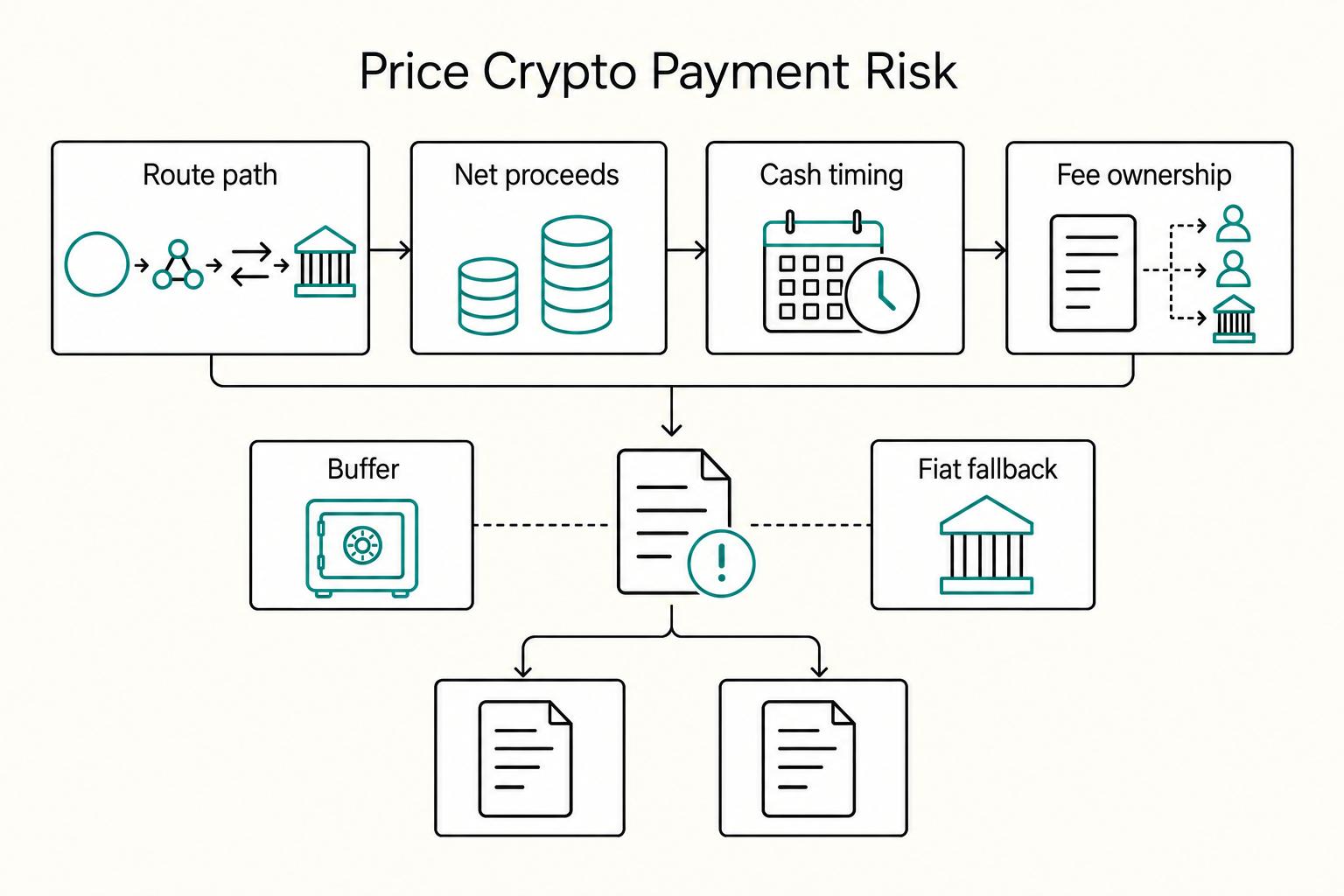
Freelance Crypto Payments That Protect Cashflow and Reduce Disputes
Crypto payments make sense only when they improve how reliably you get paid after you plan conversion, compliance, and recordkeeping up front. They can reduce friction in some international setups where traditional platforms add fees, restrictions, or extra steps. They also move risk onto conversion timing, exchange-fee exposure, and documentation quality, so use a simple acceptance test before you agree:

Beneficial Ownership Reporting in 2026 for FinCEN BOI Decisions
Use this as an execution guide, not a legal memo. Your job is to make a current BOI decision, document why you made it, and avoid cleanup later. The outcome is straightforward: confirm whether your entity is in scope, prepare what you need if it is, and keep dated proof of the basis you used.

A Guide to Xero for Freelancers and Small Businesses
**Treat Xero for freelancers as a get-paid system, not a feature checklist.** Most freelancers do not struggle because their accounting software lacks features. They struggle when payments arrive late or when the process for delays, disputes, or partial payments is unclear. In a business of one, your job is to make cash collection a repeatable system, not a personality trait.