
Quick Answer
Start with a route-first plan for german christmas markets, then clear entry and timing checks before paying for fixed travel. Use Munich and Nuremberg as stable anchors, keep Cologne as a strong middle stop, and choose Berlin only if you are willing to verify each selected market shortly before departure. If you want a lower-admin finish, switch to Dresden. Book hotels before rail, match DB fare flexibility to how settled each leg is, and keep one up-to-date document folder.
The High-Efficiency Guide to Germany's Christmas Markets: A 7-Day Strategic Itinerary for the Global Professional#
Plan a one-week Christmas market trip in Germany in this order: choose the route shape, decide whether the last city should stay flexible, confirm entry rules and Schengen timing, then book hotels before rail. That sequence keeps cheap fares from locking you into a route that looks efficient on paper but becomes awkward once the week starts.
That may sound rigid, but it usually gives you more room to enjoy the trip. A short winter itinerary gets unstable when you solve the wrong problem first. If you start with fares, you can end up with too many hotel changes, too much checking of opening windows, or a final city that demands more decisions than you want to make by day five or six. If you start with route shape, you make one structural decision up front and let the smaller choices follow.
For this kind of trip, the useful distinction is not simply between "big city" and "small city." It is between anchor stops and flexible stops. Anchor stops are the cities you can trust to hold the week together. Flexible stops are the places you keep at the end because they let you adjust based on energy, weather tolerance, or how much market verification work you are willing to do shortly before departure. That is why route shape matters more than the exact order of browsing hotels.
What route shape works best?#
For a one-week, rail-first trip, one workable shape is Munich, Nuremberg, Cologne, then Berlin as the flexible finish. It gives you two straightforward anchor stops up front, then a clear decision at the end. Keep Berlin if you want variety, or swap to Dresden if you want stronger date certainty and less last-minute checking.
| City | Official 2026 status | Planning effort | Crowd or complexity profile | Best traveler fit |
|---|---|---|---|---|
| Munich | Christkindlmarkt at Marienplatz confirmed for 20 Nov to 24 Dec 2026 | Low | Straightforward start, central focus | You want an easy arrival city |
| Nuremberg | Christkindlesmarkt confirmed for 27 Nov to 24 Dec 2026 | Medium | High interest, and daily closing time should be rechecked because official pages currently conflict | You want one flagship market to justify the trip |
| Cologne | Citywide season signal published; current opening window pending official market or city-portal verification for the exact market you want | Medium | Good payoff, but you need market-specific confirmation rather than relying on a city summary | You want a visually strong stop without overloading the week |
| Berlin | Official city portal live; current opening window pending official city-portal or selected-market verification for each selected market | High | Over 100 markets yearly means real choice, but also the highest verification burden | You want flexibility and can narrow your own shortlist |
| Dresden | Striezelmarkt confirmed for 25 Nov to 24 Dec 2026, with published hours | Low to medium | One named market with a clear timetable, easier to trust operationally | You want a predictable final stop |
The practical logic behind this route is simple. Munich works well as an arrival city because it asks less of you on day one. You can land, reach your hotel, and start the trip without turning the first evening into a research task. Nuremberg then gives you the concentrated flagship stop that makes the week feel worth doing as a dedicated market trip rather than just a winter city break with one seasonal stop added on. Cologne adds visual payoff without forcing as much market-selection work as Berlin can create. Then the final city becomes your pressure valve.
That final-city decision matters more than people think because the last two days of a short itinerary are usually where small planning problems start to stack. You are carrying bags again and deciding what still needs to be seen. Your tolerance for "we'll figure it out when we get there" is also usually lower than it was at the start. Berlin can be excellent in that slot if you genuinely want range and do not mind narrowing your shortlist from official pages. Dresden can be the better end to the week if you want fewer moving parts and a clearer timetable once you arrive.
The Berlin versus Dresden choice is mostly a tradeoff, not a matter of taste. Keep Berlin if flexibility matters more than certainty and you do not mind checking individual venue pages shortly before departure. Swap to Dresden if you want one official market window, explicit daily hours, and less local complexity once you arrive. If your final two days are tight, choose predictability over optionality.
Another way to frame it is this: Berlin gives you more decisions later. Dresden asks you to make one decision now. If you like holding options open until close to departure, Berlin supports that. If you would rather decide once and stop thinking about it, Dresden is the cleaner operational fit. Neither choice is better in abstract terms. The right one depends on how much admin you want your final stop to require.
You should also decide early whether you are planning a depth week or a coverage week. A depth week means fewer market changes, longer stretches on foot once you arrive, and less time spent checking whether the next venue is open. A coverage week means more variety and more movement, which can work well if you enjoy the process and are comfortable trimming optional stops in real time. This is not a minor preference. It affects which fare types you should buy, how much hotel flexibility you need, and whether a city like Berlin is energizing or tiring by the end of the trip.
Once the route shape is settled, booking gets simpler because you are solving for execution, not possibilities. You are no longer asking, "What could I do?" You are asking narrower questions. Which night belongs in which city? Which legs need flexibility? Which official pages still need one last check? That shift is where short trips stop feeling scattered.
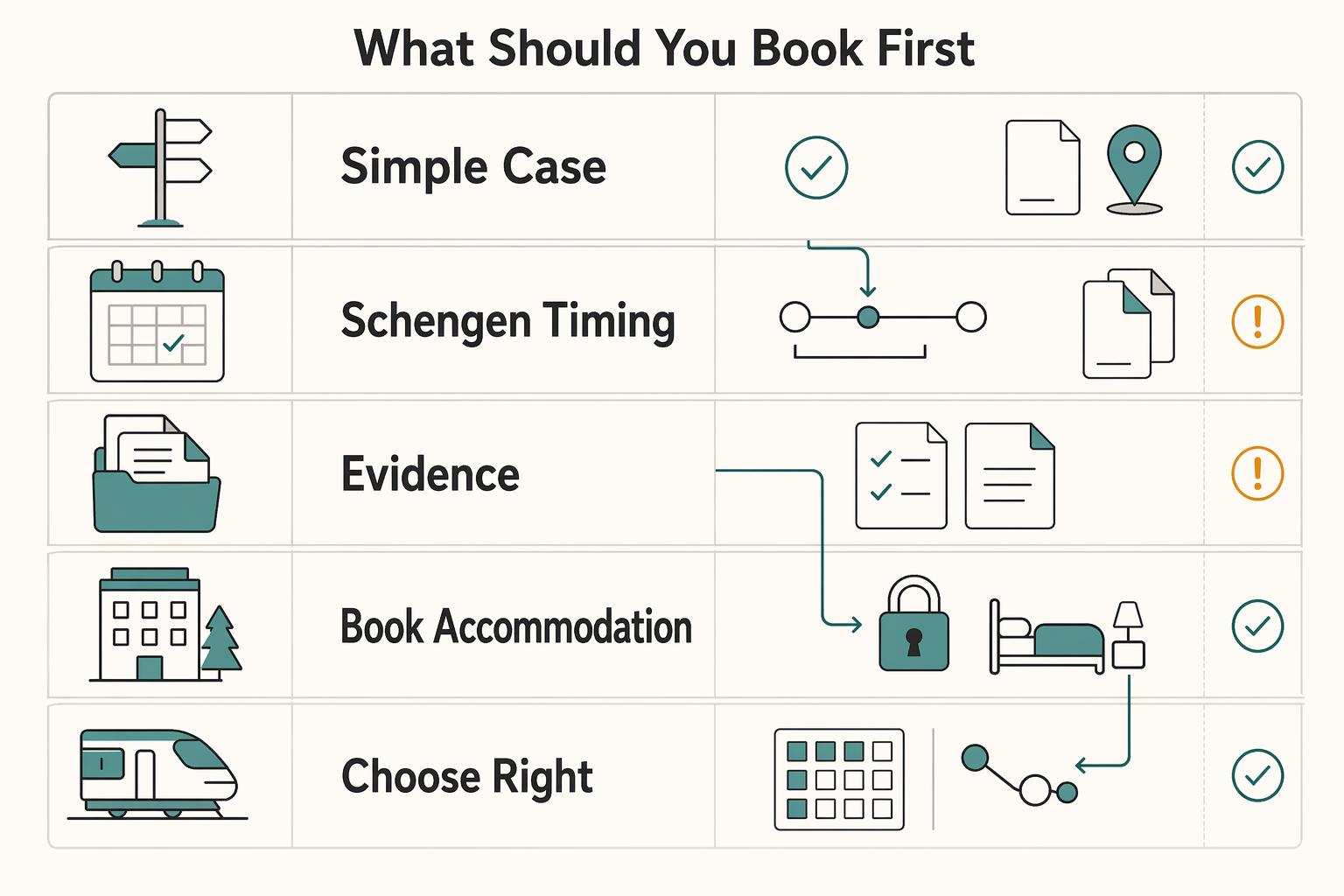
What should you book first?#
The booking order matters because reversing it makes a short trip expensive and messy very quickly.
| Step | Focus | Grounded detail |
|---|---|---|
| 1 | Entry path | Use Germany's Visa Navigator first; a stay of more than 90 days is a different visa category. |
| 2 | Schengen timing | Use the official EU short stay calculator against the 90 days in any 180 day period rule. |
| 3 | Document pack | Keep travel reservations and hotel reservations together; requested documents can vary by case and incomplete applications may lead to refusal. |
| 4 | Accommodation before rail | Hotels define the overnight pattern; once nights are fixed, rail becomes easier to price and harder to misbook. |
| 5 | DB fare type | A super saver fare is train-bound; a flexible fare is not bound to a specific train; seat reservations can be booked up to 12 months in advance. |
- Confirm your entry path. Use Germany's Visa Navigator first. Your checkpoint is simple: you should know whether you are planning a short stay route or something tied to a stay of more than 90 days, which is a different visa category. If a legal detail is missing for your nationality or purpose, stop and verify it before paying for nonrefundable travel.
The useful mindset here is not "I think I'm fine," but "I can point to the official path I am using." Run the navigator before you book and keep the result with your planning notes. If the answer is clear, move on. If the answer depends on a detail you have not checked, that is not a small loose end. It is a stop signal. This is exactly the kind of uncertainty that becomes expensive once hotels and rail are already paid for.
For a short market trip, you do not need to turn this into a legal research project. You do need a clean yes, no, or "further check required" before any nonrefundable purchase. The whole point of doing this first is to avoid building an itinerary around an assumption.
- Check your Schengen timing. Use the official EU short stay calculator against the 90 days in any 180 day period rule. If your count is close, keep a dated copy of your calculation in your travel folder.
This is one of those steps that feels unnecessary until you realize how easy it is to rely on memory and be wrong about recent travel. If your count is nowhere near the limit, save the result and move on. If it is close, treat that as a planning condition, not an afterthought. Keep the dated calculation with the same trip file that holds your hotels and rail. That way, if you revisit dates or shift the trip by a few days, you know which calculation goes with which version of the itinerary.
The important operational point is version control. Do not make several edits to your dates and assume the original calculation still matches the trip you are now taking. If the trip dates move, rerun it and replace the old copy.
- Build one clean document pack. At minimum, keep travel reservations and hotel reservations together, because those appear on a German Missions Schengen checklist. That same checklist also warns that requested documents can vary by case and that incomplete applications may lead to refusal, so do not treat an old checklist from another traveler as enough.
"One clean document pack" sounds obvious, but this is where many otherwise organized trips become messy. The problem is not usually that everything is missing. It is that everything is in the wrong places: one confirmation in email, one in an app, one as a screenshot with the wrong date, and a hotel change saved under an older file name. You want a single folder that answers the practical questions of the trip fast: who you are, where you are staying, how you are moving between cities, and what the current version is.
Keep the latest versions only. If you rebook a hotel, replace the old file rather than storing three similar confirmations and promising yourself you will sort it out later. If you change a train, update the rail file the same day. This matters not because you need a beautiful filing system, but because travel friction often comes from producing the wrong version under time pressure.
A simple rule helps. If a document would create confusion if shown in the wrong order, it belongs in the folder with a clear label. The goal is not to archive every planning step. The goal is to make the final trip easy to prove and easy to follow.
- Book accommodation before rail. Hotels define your overnight pattern. Once your nights are fixed, rail becomes easier to price and harder to misbook.
This is where many short itineraries go off course. People often start with transport because it feels like the network part of the trip, but the real structure of a one-week plan is the overnight sequence. Once you know where you are sleeping each night, the rail legs become obvious. They are not theoretical routes between possible cities, but specific transfers between confirmed overnights.
Booking hotels first also makes it easier to see whether your route is realistic at the pace you want. If one city requires an awkwardly short stay or pushes you into a late arrival that then affects the next morning, you will notice it while the plan is still flexible. Rail booked too early can hide that problem because the ticket makes the leg feel settled even when the overnight pattern is still not right.
If you are using the Berlin versus Dresden decision as your flexibility point, keep that flexibility there rather than spreading it across the whole week. Anchor your first nights, then leave the final stop looser if needed. That gives you one controlled area of uncertainty instead of several half-fixed ones.
- Choose the right DB fare type. A DB super saver fare is train-bound. A flexible fare is not bound to a specific train. If your market checks are still moving, pay for flexibility. If your itinerary is firm, saver pricing can make sense. Seat reservations can be booked up to 12 months in advance, so add them on longer legs when certainty matters more than spontaneity.
The key here is matching fare type to planning confidence rather than trying to make one rule fit the entire week. You do not need to choose "all flexible" or "all saver" as a philosophy. You need to decide which legs are settled and which legs are still exposed to your own uncertainty. If your final city is still open, that is not the segment to lock too early just because the fare looks attractive. If your arrival city and next overnight are fixed, those legs are better candidates for tighter pricing.
Think leg by leg. The first intercity move after your arrival may be easy to commit to. The final transfer may not be. Treat those differently. The right fare structure is usually a mixed one that follows the actual stability of the itinerary.
Seat reservations fit the same logic. They are not just a small add-on. They are a certainty tool. On longer legs, especially when you care about keeping the day smooth, a reservation can be worth adding because it removes one small source of friction. On looser segments, you may decide not to add it yet. Use certainty where it matters, not everywhere by default.
One more checkpoint matters here. Do not assume ETIAS is already live. The EU page says it is not currently in operation, even though it is slated to start in the last quarter of 2026.
That matters because short trip planning often gets cluttered with half-updated travel advice. If an entry system is not currently in operation, treat that as the current operational reality rather than planning against rumor or expectation. The broader rule is useful beyond ETIAS. When a planning step affects whether you can travel at all, use the live official status, not general discussion.
What should you recheck before departure and during the trip?#
Short trips usually go wrong on small operational misses, not big strategy errors. Use this list twice: once seven days before departure, and again each evening for the next city.
| Check | When | Grounded detail |
|---|---|---|
| Official market pages | Seven days before departure and each evening for the next city | Nuremberg's official network currently shows both 9 pm and 10 pm closing times; Berlin requires exact market verification. |
| Mission checklist | Before departure | Requirements can vary by case, and incomplete applications may be refused. |
| Ceramic mug deposit | If you plan on hot drinks in Nuremberg | Plan for deposit-required ceramic mugs. |
| Proof of travel folder | The same day if hotels or trains change | Old PDFs create friction when you need one clean answer about where you are going next. |
| Optional stops | Early if the week starts to feel overloaded | Aachen or extra Berlin venues are easier to cut than core overnights. |
That second use is especially important. Many people treat pre-departure checks as a one-time exercise, but a one-week multi-city trip benefits from a light daily reset. You do not need to rebuild the plan every night. You just need to confirm that tomorrow still matches the latest version of your bookings and the official opening information you are relying on. Five focused minutes in the evening can remove a surprising amount of next-day friction.
- Recheck official market pages if you are relying on Nuremberg or any Berlin stop. Nuremberg's official network currently shows both 9 pm and 10 pm closing times.
The practical lesson is not only that times may differ. It is that you should verify the exact page you will use in the field. If the information conflicts, do not assume you will sort it out on arrival. Recheck before you go out, especially if your timing is tight or you are building the stop around a specific evening window. For Berlin, the issue is less conflicting times and more the need to verify the exact market rather than relying on the city in general.
- Reconfirm your document set against your mission checklist before departure. Requirements can vary by case, and incomplete applications may be refused.
This is less about overpreparing and more about avoiding avoidable risk. If your trip file has changed since your last check, make sure your supporting documents still match the current itinerary before you leave.
- Plan for deposit-required ceramic mugs in Nuremberg if you plan on hot drinks.
This is the kind of detail that sounds minor until it is not. If you already know you are likely to buy hot drinks, planning for the deposit system keeps the transaction quick and uncomplicated.
- Update your proof of travel folder the same day if you change hotels or trains. Old PDFs create friction when you need one clean answer about where you are going next.
The critical part is "the same day." If you delay the update, the folder stops being trustworthy. Once that happens, you will hesitate every time you need to open it because you know it may contain the wrong version. A folder only reduces stress if you believe it reflects the current trip. Keep it current or it becomes just another source of clutter.
- Trim optional stops early if the week starts to feel overloaded. Aachen or extra Berlin venues are easier to cut than core overnights.
This is one of the most useful habits on a short itinerary. Do not wait until you are tired and behind schedule to decide what is optional. If the trip starts to feel heavy, cut the extras while you still have time to benefit from the simplification. Protect the core sequence first. Optional layers should be the pressure release, not the part you stubbornly preserve while the main route becomes stressful.
A simple nightly sequence helps. Open tomorrow's hotel confirmation, then tomorrow's rail or transfer details, then the official page for the market or markets you actually plan to use. Check whether any change means you should tighten or relax the next day. If yes, make one adjustment and close the loop. Do not spend the evening re-optimizing the whole week.
Conclusion: Mission Accomplished#
The trip is ready to book only when it passes the last operational checks. A one-week Christmas market plan in Germany does not need to be rigid, but it does need a clean go or no-go decision before you lock in nonrefundable rail or hotels.
That is the real finish line for planning. Not "I have a rough idea." Not "I found a good fare." Not "I can probably sort the rest later." Ready means the open risks have been reduced to the kind that are acceptable on a short trip. Minor timing choices are fine. Entry confusion, unresolved market dates, or a final city that still depends on research you have not done are not.
Are you actually ready to book?#
If you are still guessing on entry status, market dates, or your last city, you are not ready to book. If those risks are closed, the rest of the trip can stay flexible without becoming sloppy. Use this as your final screen.
| End-state check | Pass when | Fail when | What to verify now |
|---|---|---|---|
| Route locked | Your overnight sequence is fixed, including the Berlin versus Dresden decision. | You are still holding speculative stops or extra transfers "just in case." | Save one final city order and travel date list. |
| Market pages rechecked | You opened the official page for each market you plan to use and checked the page year. | You are relying on old screenshots, roundup articles, or city summaries alone. | Munich Marienplatz: recheck the current page year and opening window. Cologne Cathedral market: the current opening window must be verified from the official market or city-portal record before use. Berlin: match each market to your exact dates. Nuremberg: confirm the current season year before trusting the page. |
| Visa path confirmed | The Federal Foreign Office Visa Navigator gives you a clear entry route and, if relevant, where to apply. | You are assuming visa-free entry without checking your passport and trip purpose. | Run Visa Navigator before any nonrefundable purchase. |
| Schengen position reviewed | Your dates fit the 90/180 day rule. | You are close to the limit or have not checked recent Schengen travel. | Use the EU short stay calculator, but remember it is a helping tool only and not a legal right to stay. |
| Document pack complete | Your passport copy, bookings, and trip records are in one easy-to-show folder. | Your proof is split across email threads, apps, and screenshots. | Keep one current folder and replace old PDFs when plans change. |
| Payment backup ready | You have both cash and card. | One declined card would interrupt the day. | Germany still uses cash heavily, so do not assume every stall works the same way. |
Read this table as a decision tool, not a polite suggestion. A single fail does not mean the trip is impossible, but it does mean something important is still unresolved. The purpose of the check is to surface the exact point of friction before money gets locked in. If the route is not locked, fix the route. If the market pages are not rechecked, do that before touching rail. If the document pack is scattered, consolidate it before anything else. Solve the actual blocker rather than continuing to book around it.
The route check deserves particular discipline. "Basically decided" is not the same as fixed. If Berlin versus Dresden is still open, the route is not locked. If you are still carrying speculative side stops that would require extra transfers, the route is not locked. A short itinerary becomes much easier the moment you save one final city order and one date list and treat that as the working version.
The market-page check is also more than a quick glance. You want to know that the page is current and that it matches the exact market you plan to use. This matters most in the cities that already carry a higher verification burden. Nuremberg matters because official pages can show different season years, so check the page year and details for your travel window. Cologne matters because citywide signals are not enough for a specific market. Berlin matters because a city portal with many options still requires you to match your dates to your chosen venues. The mistake to avoid is thinking that broad awareness of a city's Christmas market season is the same as confirmation for the exact stop you intend to visit.
The document-pack check can be tested in a brutally simple way. If you had to show the shape of your trip quickly, could you do it from one folder without searching across apps and inboxes? If not, the pack is not really ready. This is one of the easiest issues to fix and one of the most worth fixing before departure.
A small but useful rail check belongs here too. If your longer intercity legs are fixed, a DB long distance seat reservation can add certainty without forcing a fully flexible fare, and the published starting price is from 5,50 Euro. If your dates or final city are still moving, keep transport looser until the route is truly settled.
That sentence captures the wider booking principle for the whole week. Add certainty where the structure is already stable, and avoid buying certainty too early where the structure is still unsettled. This keeps the plan efficient without becoming brittle.
Should you choose depth or coverage?#
Once those risks are handled, stop optimizing for more and choose based on your actual travel energy. If you move well, handle transfers comfortably, and do not mind rechecking pages, keep the broader route. If you want calmer days and less admin, cut one stop or make the Berlin to Dresden swap.
This is the point where a good itinerary often gets worse because the planner keeps trying to extract one more market, one more side trip, or one more late evening option from an already workable week. Resist that urge. On a short trip, "more" often means more transitions, more checking, and more opportunities for one delay or one bad call to ripple into the next day.
Depth means giving each core stop enough room that you are not constantly thinking about the next transfer. Coverage means accepting that the pace itself is part of the experience and planning accordingly. Neither is wrong. But mixing them badly is where problems start. If you want coverage, own it and keep your admin clean. If you want depth, stop adding optional layers that force coverage-style planning anyway.
Berlin is the clearest test of this choice. The official city portal says over one hundred markets take place there every year, and its search tool helps you match exact open days. That is excellent if you have verification bandwidth and want variety. It is a poor fit if you are already tired by day five and do not want to spend your evenings checking which market is open when.
That is why Berlin can either feel like the most rewarding finish or the point where the week becomes more work than fun. If you are still energized, the variety is a benefit. If your planning bandwidth is already low, the same variety can become decision fatigue. Dresden is the cleaner alternative because it reduces that burden. Again, the right answer is not abstract. It depends on your actual capacity for one more layer of choice.
A good self-test is to ask what kind of evening routine you want by the end of the week. If you are happy to shortlist, verify, and choose, keep Berlin. If you would rather know the timetable and go, swap to Dresden. This is exactly the kind of choice that should reflect travel energy, not travel ambition.
What belongs on the pre-departure control list?#
The day before you travel, use this as a hard pass or fail screen, not a casual reminder list.
- PASS: Visa Navigator gives you a clear answer for your passport and stay type. FAIL: You still need to ask whether you need a visa.
- PASS: Your 90/180 Schengen position works for the trip. FAIL: You are relying on memory instead of the calculator.
- PASS: Each official market page has been rechecked, including the page year. FAIL: You are trusting stale Nuremberg pages or broad Berlin summaries.
- PASS: Your route is fixed, and your rail choice matches your certainty level. FAIL: Cheap fares pushed you into booking before the city sequence was stable.
- PASS: Your payment backup is packed and your document folder is current. FAIL: One card issue or one missing confirmation would leave you improvising.
Treat each fail literally. If one line fails, correct that line before treating the trip as finalized. Do not compensate for an unresolved issue by becoming more detailed elsewhere. A beautifully organized train file does not solve an unchecked entry path. A fully reserved week does not fix stale market information. The control list works because it is blunt.
It also helps to run the list in order. Entry status and Schengen position come first because they determine whether the trip works at all. Market-page checks and route stability come next because they determine whether your bookings reflect reality. Payment backup and document currency come last because they determine how smooth the trip will feel on the ground. That order keeps you from spending energy polishing details before basic viability is confirmed.
If you pass everything, stop planning. That matters more than it sounds. Once a short trip is operationally sound, continued tweaking often makes it worse, not better. You do not need endless optionality. You need a route you trust, a document pack you can use, and enough flexibility in the right places to absorb normal travel variation without stress.
That is the whole closeout. If you want to extend the itinerary after Berlin, start with The Best Day Trips from Berlin. If you want broader lifestyle context, use city guides to decide where this kind of winter trip fits your longer term plans. If you need country-specific support, get a passport and program check before you book. Related: The Best Digital Nomad Cities for History Buffs.
Frequently Asked Questions
What route shape works best?
For a one-week, rail-first trip, one workable shape is Munich, Nuremberg, Cologne, then Berlin as the flexible finish. It gives you two straightforward anchor stops up front, then a clear decision at the end. Keep Berlin if you want variety, or swap to Dresden if you want stronger date certainty and less last-minute checking. City; Official 2026 status; Planning effort; Crowd or complexity profile; Best traveler fit City: Munich; Official 2026 status: Christkindlmarkt at Marienplatz confirmed for 20 Nov to 24 Dec 2026; Planning effort: Low; Crowd or complexity profile: Straightforward start, central focus; Best traveler fit: You want an easy arrival city City: Nuremberg; Official 2026 status: Christkindlesmarkt confirmed for 27 Nov to 24 Dec 2026; Planning effort: Medium; Crowd or complexity profile: High interest, and daily closing time should be rechecked because official pages currently conflict; Best traveler fit: You want one flagship market to justify the trip City: Cologne; Official 2026 status: Citywide season signal published; current opening window pending official market or city-portal verification for the exact market you want; Planning effort: Medium; Crowd or complexity profile: Good payoff, but you need market-specific confirmation rather than relying on a city summary; Best traveler fit: You want a visually strong stop without overloading the week City: Berlin; Official 2026 status: Official city portal live; current opening window pending official city-portal or selected-market verification for each selected market; Planning effort: High; Crowd or complexity profile: Over 100 markets yearly means real choice, but also the highest verification burden; Best traveler fit: You want flexibility and can narrow your own shortlist City: Dresden; Official 2026 status: Striezelmarkt confirmed for 25 Nov to 24 Dec 2026, with published hours; Planning effort: Low to medium; Crowd or complexity profile: One named market with a clear timetable, easier to trust operationally; Best traveler fit: You want a predictable final stop The practical logic behind this route is simple. Munich works well as an arrival city because it asks less of you on day one. You can land, reach your hotel, and start the trip without turning the first evening into a research task. Nuremberg then gives you the concentrated flagship stop that makes the week feel worth doing as a dedicated market trip rather than just a winter city break with one seasonal stop added on. Cologne adds visual payoff without forcing as much market-selection work as Berlin can create. Then the final city becomes your pressure valve. That final-city decision matters more than people think because the last two days of a short itinerary are usually where small planning problems start to stack. You are carrying bags again and deciding what still needs to be seen. Your tolerance for "we'll figure it out when we get there" is also usually lower than it was at the start. Berlin can be excellent in that slot if you genuinely want range and do not mind narrowing your shortlist from official pages. Dresden can be the better end to the week if you want fewer moving parts and a clearer timetable once you arrive. The Berlin versus Dresden choice is mostly a tradeoff, not a matter of taste. Keep Berlin if flexibility matters more than certainty and you do not mind checking individual venue pages shortly before departure. Swap to Dresden if you want one official market window, explicit daily hours, and less local complexity once you arrive. If your final two days are tight, choose predictability over optionality. Another way to frame it is this: Berlin gives you more decisions later. Dresden asks you to make one decision now. If you like holding options open until close to departure, Berlin supports that. If you would rather decide once and stop thinking about it, Dresden is the cleaner operational fit. Neither choice is better in abstract terms. The right one depends on how much admin you want your final stop to require. You should also decide early whether you are planning a depth week or a coverage week. A depth week means fewer market changes, longer stretches on foot once you arrive, and less time spent checking whether the next venue is open. A coverage week means more variety and more movement, which can work well if you enjoy the process and are comfortable trimming optional stops in real time. This is not a minor preference. It affects which fare types you should buy, how much hotel flexibility you need, and whether a city like Berlin is energizing or tiring by the end of the trip. Once the route shape is settled, booking gets simpler because you are solving for execution, not possibilities. You are no longer asking, "What could I do?" You are asking narrower questions. Which night belongs in which city? Which legs need flexibility? Which official pages still need one last check? That shift is where short trips stop feeling scattered.
What should you book first?
The booking order matters because reversing it makes a short trip expensive and messy very quickly. Step; Focus; Grounded detail Step: 1; Focus: Entry path; Grounded detail: Use Germany's Visa Navigator first; a stay of more than 90 days is a different visa category. Step: 2; Focus: Schengen timing; Grounded detail: Use the official EU short stay calculator against the 90 days in any 180 day period rule. Step: 3; Focus: Document pack; Grounded detail: Keep travel reservations and hotel reservations together; requested documents can vary by case and incomplete applications may lead to refusal. Step: 4; Focus: Accommodation before rail; Grounded detail: Hotels define the overnight pattern; once nights are fixed, rail becomes easier to price and harder to misbook. Step: 5; Focus: DB fare type; Grounded detail: A super saver fare is train-bound; a flexible fare is not bound to a specific train; seat reservations can be booked up to 12 months in advance. Confirm your entry path. Use Germany's Visa Navigator first. Your checkpoint is simple: you should know whether you are planning a short stay route or something tied to a stay of more than 90 days, which is a different visa category. If a legal detail is missing for your nationality or purpose, stop and verify it before paying for nonrefundable travel. The useful mindset here is not "I think I'm fine," but "I can point to the official path I am using." Run the navigator before you book and keep the result with your planning notes. If the answer is clear, move on. If the answer depends on a detail you have not checked, that is not a small loose end. It is a stop signal. This is exactly the kind of uncertainty that becomes expensive once hotels and rail are already paid for. For a short market trip, you do not need to turn this into a legal research project. You do need a clean yes, no, or "further check required" before any nonrefundable purchase. The whole point of doing this first is to avoid building an itinerary around an assumption. Check your Schengen timing. Use the official EU short stay calculator against the 90 days in any 180 day period rule. If your count is close, keep a dated copy of your calculation in your travel folder. This is one of those steps that feels unnecessary until you realize how easy it is to rely on memory and be wrong about recent travel. If your count is nowhere near the limit, save the result and move on. If it is close, treat that as a planning condition, not an afterthought. Keep the dated calculation with the same trip file that holds your hotels and rail. That way, if you revisit dates or shift the trip by a few days, you know which calculation goes with which version of the itinerary. The important operational point is version control. Do not make several edits to your dates and assume the original calculation still matches the trip you are now taking. If the trip dates move, rerun it and replace the old copy. Build one clean document pack. At minimum, keep travel reservations and hotel reservations together, because those appear on a German Missions Schengen checklist. That same checklist also warns that requested documents can vary by case and that incomplete applications may lead to refusal, so do not treat an old checklist from another traveler as enough. "One clean document pack" sounds obvious, but this is where many otherwise organized trips become messy. The problem is not usually that everything is missing. It is that everything is in the wrong places: one confirmation in email, one in an app, one as a screenshot with the wrong date, and a hotel change saved under an older file name. You want a single folder that answers the practical questions of the trip fast: who you are, where you are staying, how you are moving between cities, and what the current version is. Keep the latest versions only. If you rebook a hotel, replace the old file rather than storing three similar confirmations and promising yourself you will sort it out later. If you change a train, update the rail file the same day. This matters not because you need a beautiful filing system, but because travel friction often comes from producing the wrong version under time pressure. A simple rule helps. If a document would create confusion if shown in the wrong order, it belongs in the folder with a clear label. The goal is not to archive every planning step. The goal is to make the final trip easy to prove and easy to follow. Book accommodation before rail. Hotels define your overnight pattern. Once your nights are fixed, rail becomes easier to price and harder to misbook. This is where many short itineraries go off course. People often start with transport because it feels like the network part of the trip, but the real structure of a one-week plan is the overnight sequence. Once you know where you are sleeping each night, the rail legs become obvious. They are not theoretical routes between possible cities, but specific transfers between confirmed overnights. Booking hotels first also makes it easier to see whether your route is realistic at the pace you want. If one city requires an awkwardly short stay or pushes you into a late arrival that then affects the next morning, you will notice it while the plan is still flexible. Rail booked too early can hide that problem because the ticket makes the leg feel settled even when the overnight pattern is still not right. If you are using the Berlin versus Dresden decision as your flexibility point, keep that flexibility there rather than spreading it across the whole week. Anchor your first nights, then leave the final stop looser if needed. That gives you one controlled area of uncertainty instead of several half-fixed ones. Choose the right DB fare type. A DB super saver fare is train-bound. A flexible fare is not bound to a specific train. If your market checks are still moving, pay for flexibility. If your itinerary is firm, saver pricing can make sense. Seat reservations can be booked up to 12 months in advance, so add them on longer legs when certainty matters more than spontaneity. The key here is matching fare type to planning confidence rather than trying to make one rule fit the entire week. You do not need to choose "all flexible" or "all saver" as a philosophy. You need to decide which legs are settled and which legs are still exposed to your own uncertainty. If your final city is still open, that is not the segment to lock too early just because the fare looks attractive. If your arrival city and next overnight are fixed, those legs are better candidates for tighter pricing. Think leg by leg. The first intercity move after your arrival may be easy to commit to. The final transfer may not be. Treat those differently. The right fare structure is usually a mixed one that follows the actual stability of the itinerary. Seat reservations fit the same logic. They are not just a small add-on. They are a certainty tool. On longer legs, especially when you care about keeping the day smooth, a reservation can be worth adding because it removes one small source of friction. On looser segments, you may decide not to add it yet. The point is to use certainty where it matters, not everywhere by default. One more checkpoint matters here. Do not assume ETIAS is already live. The EU page says it is not currently in operation, even though it is slated to start in the last quarter of 2026. That matters because short trip planning often gets cluttered with half-updated travel advice. If an entry system is not currently in operation, treat that as the current operational reality rather than planning against rumor or expectation. The broader rule is useful beyond ETIAS. When a planning step affects whether you can travel at all, use the live official status, not general discussion.
What should you recheck before departure and during the trip?
Short trips usually go wrong on small operational misses, not big strategy errors. Use this list twice: once seven days before departure, and again each evening for the next city. Check; When; Grounded detail Check: Official market pages; When: Seven days before departure and each evening for the next city; Grounded detail: Nuremberg's official network currently shows both 9 pm and 10 pm closing times; Berlin requires exact market verification. Check: Mission checklist; When: Before departure; Grounded detail: Requirements can vary by case, and incomplete applications may be refused. Check: Ceramic mug deposit; When: If you plan on hot drinks in Nuremberg; Grounded detail: Plan for deposit-required ceramic mugs. Check: Proof of travel folder; When: The same day if hotels or trains change; Grounded detail: Old PDFs create friction when you need one clean answer about where you are going next. Check: Optional stops; When: Early if the week starts to feel overloaded; Grounded detail: Aachen or extra Berlin venues are easier to cut than core overnights. That second use is especially important. Many people treat pre-departure checks as a one-time exercise, but a one-week multi-city trip benefits from a light daily reset. You do not need to rebuild the plan every night. You just need to confirm that tomorrow still matches the latest version of your bookings and the official opening information you are relying on. Five focused minutes in the evening can remove a surprising amount of next-day friction. Recheck official market pages if you are relying on Nuremberg or any Berlin stop. Nuremberg's official network currently shows both 9 pm and 10 pm closing times. The practical lesson is not only that times may differ. It is that you should verify the exact page you will use in the field. If the information conflicts, do not assume you will sort it out on arrival. Recheck before you go out, especially if your timing is tight or you are building the stop around a specific evening window. For Berlin, the issue is less conflicting times and more the need to verify the exact market rather than relying on the city in general. Reconfirm your document set against your mission checklist before departure. Requirements can vary by case, and incomplete applications may be refused. This is less about overpreparing and more about avoiding avoidable risk. If your trip file has changed since your last check, make sure your supporting documents still match the current itinerary before you leave. Plan for deposit-required ceramic mugs in Nuremberg if you plan on hot drinks. This is the kind of detail that sounds minor until it is not. If you already know you are likely to buy hot drinks, planning for the deposit system keeps the transaction quick and uncomplicated. Update your proof of travel folder the same day if you change hotels or trains. Old PDFs create friction when you need one clean answer about where you are going next. The critical part is "the same day." If you delay the update, the folder stops being trustworthy. Once that happens, you will hesitate every time you need to open it because you know it may contain the wrong version. A folder only reduces stress if you believe it reflects the current trip. Keep it current or it becomes just another source of clutter. Trim optional stops early if the week starts to feel overloaded. Aachen or extra Berlin venues are easier to cut than core overnights. This is one of the most useful habits on a short itinerary. Do not wait until you are tired and behind schedule to decide what is optional. If the trip starts to feel heavy, cut the extras while you still have time to benefit from the simplification. Protect the core sequence first. Optional layers should be the pressure release, not the part you stubbornly preserve while the main route becomes stressful. A simple nightly sequence helps. Open tomorrow's hotel confirmation, then tomorrow's rail or transfer details, then the official page for the market or markets you actually plan to use. Check whether any change means you should tighten or relax the next day. If yes, make one adjustment and close the loop. Do not spend the evening re-optimizing the whole week.
Are you actually ready to book?
If you are still guessing on entry status, market dates, or your last city, you are not ready to book. If those risks are closed, the rest of the trip can stay flexible without becoming sloppy. Use this as your final screen. End-state check; Pass when; Fail when; What to verify now End-state check: Route locked; Pass when: Your overnight sequence is fixed, including the Berlin versus Dresden decision.; Fail when: You are still holding speculative stops or extra transfers "just in case."; What to verify now: Save one final city order and travel date list. End-state check: Market pages rechecked; Pass when: You opened the official page for each market you plan to use and checked the page year.; Fail when: You are relying on old screenshots, roundup articles, or city summaries alone.; What to verify now: Munich Marienplatz: recheck the current page year and opening window. Cologne Cathedral market: the current opening window must be verified from the official market or city-portal record before use. Berlin: match each market to your exact dates. Nuremberg: confirm the current season year before trusting the page. End-state check: Visa path confirmed; Pass when: The Federal Foreign Office Visa Navigator gives you a clear entry route and, if relevant, where to apply.; Fail when: You are assuming visa-free entry without checking your passport and trip purpose.; What to verify now: Run Visa Navigator before any nonrefundable purchase. End-state check: Schengen position reviewed; Pass when: Your dates fit the 90/180 day rule.; Fail when: You are close to the limit or have not checked recent Schengen travel.; What to verify now: Use the EU short stay calculator, but remember it is a helping tool only and not a legal right to stay. End-state check: Document pack complete; Pass when: Your passport copy, bookings, and trip records are in one easy-to-show folder.; Fail when: Your proof is split across email threads, apps, and screenshots.; What to verify now: Keep one current folder and replace old PDFs when plans change. End-state check: Payment backup ready; Pass when: You have both cash and card.; Fail when: One declined card would interrupt the day.; What to verify now: Germany still uses cash heavily, so do not assume every stall works the same way. Read this table as a decision tool, not a polite suggestion. A single fail does not mean the trip is impossible, but it does mean something important is still unresolved. The purpose of the check is to surface the exact point of friction before money gets locked in. If the route is not locked, fix the route. If the market pages are not rechecked, do that before touching rail. If the document pack is scattered, consolidate it before anything else. Solve the actual blocker rather than continuing to book around it. The route check deserves particular discipline. "Basically decided" is not the same as fixed. If Berlin versus Dresden is still open, the route is not locked. If you are still carrying speculative side stops that would require extra transfers, the route is not locked. A short itinerary becomes much easier the moment you save one final city order and one date list and treat that as the working version. The market-page check is also more than a quick glance. You want to know that the page is current and that it matches the exact market you plan to use. This matters most in the cities that already carry a higher verification burden. Nuremberg matters because official pages can show different season years, so check the page year and details for your travel window. Cologne matters because citywide signals are not enough for a specific market. Berlin matters because a city portal with many options still requires you to match your dates to your chosen venues. The mistake to avoid is thinking that broad awareness of a city's Christmas market season is the same as confirmation for the exact stop you intend to visit. The document-pack check can be tested in a brutally simple way. If you had to show the shape of your trip quickly, could you do it from one folder without searching across apps and inboxes? If not, the pack is not really ready. This is one of the easiest issues to fix and one of the most worth fixing before departure. A small but useful rail check belongs here too. If your longer intercity legs are fixed, a DB long distance seat reservation can add certainty without forcing a fully flexible fare, and the published starting price is from 5,50 Euro. If your dates or final city are still moving, keep transport looser until the route is truly settled. That sentence captures the wider booking principle for the whole week. Add certainty where the structure is already stable, and avoid buying certainty too early where the structure is still unsettled. This keeps the plan efficient without becoming brittle.
Should you choose depth or coverage?
Once those risks are handled, stop optimizing for more and choose based on your actual travel energy. If you move well, handle transfers comfortably, and do not mind rechecking pages, keep the broader route. If you want calmer days and less admin, cut one stop or make the Berlin to Dresden swap. This is the point where a good itinerary often gets worse because the planner keeps trying to extract one more market, one more side trip, or one more late evening option from an already workable week. Resist that urge. On a short trip, "more" often means more transitions, more checking, and more opportunities for one delay or one bad call to ripple into the next day. Depth means giving each core stop enough room that you are not constantly thinking about the next transfer. Coverage means accepting that the pace itself is part of the experience and planning accordingly. Neither is wrong. But mixing them badly is where problems start. If you want coverage, own it and keep your admin clean. If you want depth, stop adding optional layers that force coverage-style planning anyway. Berlin is the clearest test of this choice. The official city portal says over one hundred markets take place there every year, and its search tool helps you match exact open days. That is excellent if you have verification bandwidth and want variety. It is a poor fit if you are already tired by day five and do not want to spend your evenings checking which market is open when. That is why Berlin can either feel like the most rewarding finish or the point where the week becomes more work than fun. If you are still energized, the variety is a benefit. If your planning bandwidth is already low, the same variety can become decision fatigue. Dresden is the cleaner alternative because it reduces that burden. Again, the right answer is not abstract. It depends on your actual capacity for one more layer of choice. A good self-test is to ask what kind of evening routine you want by the end of the week. If you are happy to shortlist, verify, and choose, keep Berlin. If you would rather know the timetable and go, swap to Dresden. This is exactly the kind of choice that should reflect travel energy, not travel ambition.
What belongs on the pre-departure control list?
The day before you travel, use this as a hard pass or fail screen, not a casual reminder list. PASS: Visa Navigator gives you a clear answer for your passport and stay type. FAIL: You still need to ask whether you need a visa. PASS: Your 90/180 Schengen position works for the trip. FAIL: You are relying on memory instead of the calculator. PASS: Each official market page has been rechecked, including the page year. FAIL: You are trusting stale Nuremberg pages or broad Berlin summaries. PASS: Your route is fixed, and your rail choice matches your certainty level. FAIL: Cheap fares pushed you into booking before the city sequence was stable. PASS: Your payment backup is packed and your document folder is current. FAIL: One card issue or one missing confirmation would leave you improvising. Treat each fail literally. If one line fails, correct that line before treating the trip as finalized. Do not compensate for an unresolved issue by becoming more detailed elsewhere. A beautifully organized train file does not solve an unchecked entry path. A fully reserved week does not fix stale market information. The control list works because it is blunt. It also helps to run the list in order. Entry status and Schengen position come first because they determine whether the trip works at all. Market-page checks and route stability come next because they determine whether your bookings reflect reality. Payment backup and document currency come last because they determine how smooth the trip will feel on the ground. That order keeps you from spending energy polishing details before basic viability is confirmed. If you pass everything, stop planning. That matters more than it sounds. Once a short trip is operationally sound, continued tweaking often makes it worse, not better. You do not need endless optionality. You need a route you trust, a document pack you can use, and enough flexibility in the right places to absorb normal travel variation without stress. That is the whole closeout. If you want to extend the itinerary after Berlin, start with The Best Day Trips from Berlin. If you want broader lifestyle context, use city guides to decide where this kind of winter trip fits your longer term plans. If you need country-specific support, get a passport and program check before you book. Related: The Best Digital Nomad Cities for History Buffs.
Try a related tool
Researched and edited by the Gruv editorial team. Gruv builds cross-border billing, payouts, and finance-operations software for global businesses.
Sources
Includes 4 external sources outside the trusted-domain allowlist.
- ec.europa.eu/assets/home/visa-calculator/calculator.htmtrusted
- home-affairs.ec.europa.eu/policies/schengen/smart-borders/european-tra...trusted
- home-affairs.ec.europa.eu/policies/schengen/border-crossing/short-stay...trusted
- berlin.de/en/christmas-marketsexternal
- digital.diplo.de/navigator/en/visaexternal
- germany.info/resource/blob/2305060/edce38aaed09f0d1d7b372...external
- int.bahn.de/en/faq/seat-reservations-booking-periodexternal
Educational content only. Not legal, tax, or financial advice.
Related Posts

Can Digital Nomads Claim the Home Office Deduction?
Claim the deduction only when your facts and records can carry it. With the home office deduction for digital nomads, the real decision is usually a three-way call: claim it, do not claim it, or pause and get help because your file is not ready.
Best Nomad Cities for History Buffs Who Plan Long Stays
Treat this as a base-selection decision, not a travel mood board. Pick one city you can actually move to and work from, then keep a backup ready if your first choice stalls. That is how you avoid losing weeks to inspiring but unusable shortlists.
The Best Day Trips from Berlin
**Start with the outcome you want tomorrow, not the destination you can name today.** If you are choosing among the best day trips from Berlin, the useful filters are simple: your energy level, how much planning effort you can tolerate, how much emotional weight you want to carry, and the kind of work waiting for you the next day. This matrix is built for same-day returns from Berlin only. Longer or overnight escapes are out of scope.